fbpx

February 15, 2022

What’s Wrong with Jews?

Since the European Enlightenment, when Jews were given the rights of other citizens and eventually rose in society in finance, the professions and the arts, assimilation has been rampant. And that situation applies in America today.

When Jews lived in ghettos in eastern Europe, with little chance to mingle with their Christian neighbors, there could obviously be little assimilation. And even without physical barriers, the invisible line of prejudice and discrimination between Jews and their neighbors kept them apart.

Once the world of European culture was open to the Jews, it is clear what attracted them; it was a treasure trove of music, art, literature and history that had been denied to them for generations. Finally, opportunities abounded in the professions and in business, and Jews soon made notable contributions.

In modern times, prominent non-Jews have publicly praised Jews and seen in them what Jews themselves too often ignore. Paul Johnson, the Catholic historian, wrote that “no people has been more fertile in enriching poverty or humanizing wealth, or in turning misfortune to creative account. This capacity springs from a moral philosophy both solid and subtle, which has changed remarkably little over the millenia because it has been seen to serve the purpose of those who share it.”

So why make it a choice between Judaism and the world when one can have both?

The great Russian novelist, Tolstoy, said that “A Jew is that sacred being who has brought down from heaven the eternal fire and has illuminated with it the entire world. He is the religious source, spring and fountain out of which all the rest of the nations have drawn their beliefs and religions.” For Winston Churchill, “no thoughtful man can doubt the fact that they are beyond all question the most formidable and the most remarkable race that has ever appeared in the world.” Mark Twain wrote glowingly of Jewish resilience, noting that all nations from the Babylonians, Romans and on are gone, but the Jew remains: “What is the secret of his immortality?”

While others have recognized the rich heritage and astounding contribution of the Jews to the western world, too many Jews in America seem ignorant or oblivious of their own people’s accomplishments and heritage.

Only one-third of American Jews regard being part of a Jewish community as essential. Among young Jewish adults 18-29, 35% have few or no Jewish friends according to a Pew Research report of 2020. Giving to Jewish causes, attendance at synagogues, and attachment to the State of Israel are all down from previous years. In the words of Professor Jack Wertheimer of the Jewish Theological Seminary: “Taken together, these figures suggest declining commitment to specifically Jewish causes, distancing from the Jewish state and its people, and the fraying of the Jewish social networks so necessary for anchoring Jews to their people.”

There is a great irony at the heart of the current situation. There has never been more opportunity for Jews of all backgrounds, religious or not, to learn about Jewish history, source texts, culture and wisdom literature. In addition, in spite of rising antisemitism, there is no ghetto, there are no restrictions, no obstacles to reaching the highest levels of society, even for the religiously observant, and yet now is the time when the majority of American Jews turn their backs on it all.

There has never been more opportunity for Jews of all backgrounds, religious or not, to learn about Jewish history, source texts, culture and wisdom literature.

Throughout the ages, persecution, discrimination, pogroms,  exiles and forced conversions reduced our numbers dramatically and turned Jews into a reviled people. Yet we persisted, and when the possibility for peace and stability arose, we contributed to the common good of every country that gave repose to a weary and beaten people.

Now we have the opportunity to be both full participants in our society and faithful to our history and heritage. So why make it a choice between Judaism and the world when one can have both?

Whatever the cause of today’s apathy, those who have written themselves out of Jewish history are a massive and tragic loss to the Jewish people. Rabbi Jonathan Sacks wrote that we have lost the script of the Jewish story, the story of a people who “though scarred and traumatized, never lost their humour or their faith, their ability to laugh at present troubles and still believe in ultimate redemption; who saw human history as a journey, and never stopped travelling and searching.”

We can only hope that the script of the Jewish story is recovered, that the search is renewed.


Dr. Paul Socken is Distinguished Professor Emeritus and founder of the Jewish Studies Program at the University of Waterloo.

What’s Wrong with Jews? Read More »

What Can We Learn From the Lipstadt Hearing?

Like many American Jews who are involved in the fight against antisemitism, I greatly admire the tireless work of Deborah Lipstadt in standing up for our community. Whether it be challenging Holocaust deniers in court or standing up to the BDS campaign, Lipstadt has repeatedly shown her dedication to rooting out threats to the Jewish people. This is why I, along with many American Jews, was greatly annoyed at the stalling of her confirmation as the next U.S. Special Envoy to Combat Antisemitism, entirely the doing of the Republican Party, which argued that Lipstadt needed more “vetting” due to an early 2021 tweet in which she accused Senator Ron Johnson (R-WI) of espousing white supremacy and white nationalism. At her much anticipated and much delayed Senate hearing, Lipstadt and Johnson finally sparred face to face, a spectacle that illuminated how the non-Jewish majority of the United States grapples with the subject of Jew-hate, and how much it informs this contemporary crisis. 

After the attack on the Capitol on January 6th, Senator Ron Johnson argued that the “Stop the Steal” participants were citizens “who loved their country, truly respect(ed) law enforcement, and would never do anything to break the law,” but that if the mob had been comprised of Black Lives Matter (BLM) activists, he would not have felt safe being in Washington that day. The statement is absurd on its face, as those involved in the storming of federal buildings proudly brandished confederate flags and Nazi paraphernalia, expressed the desire to hang the Vice President of the United States, and attacked police officers in uniform—in other words, behavior wildly antithetical to patriotism. There are plenty of valid criticisms of the BLM organization and movement to go around, but putting a violent right-wing throng on a pedestal of “legitimate political discourse” while regarding any protest of racism as fundamentally dangerous reeks of bigotry and double standards. In response, Lipstadt wrote: “This is white nationalism/supremacy. Pure and simple.” 

Professor Lipstadt did not mince words in her comment. She apologized to Senator Johnson, a move I felt was unnecessary if she truly believed what she wrote, considering that Johnson’s vote alone or even a handful of Republicans taking his side would not have cost her the confirmation. But more importantly, this apology came after Senator Johnson used the vast majority of his allotted questioning time to complain about how cruel Lipstadt had been to him on Twitter rather than to ask her anything about the rise of antisemitism in the United States. In a tangent with little room for Lipstadt to respond, Johnson moaned: “You don’t know me. You don’t know a lot of the people you have accused online in front of millions of people. You have engaged in malicious poison [and] vile and horrible charges against people including me that you don’t even know.”

Both Democrats and Republicans have proved they view antisemitism only through a prism of their own self-interests—using the Jewish community as a weapon to bludgeon far-right or far-left movements they oppose.

What we can learn from Johnson making Lipstadt’s hearing about nothing but himself is the manner in which the non-Jewish world handles the politics of Jewish security. Specifically, both Democrats and Republicans have proved they view antisemitism only through a prism of their own self-interests—using the Jewish community as a weapon to bludgeon far-right or far-left movements they oppose. Condemnations of antisemitism increasingly come without actual concern for Jewish wellbeing, but rather are used only to frame “the other side” as hateful. 

Senator Johnson proved this by asserting that his feelings and the perception of his character were of far more importance than, let’s say, the 300 percent increase in antisemitic crimes from December of 2021 to January of 2022 in New York City. A man of integrity, certainly a man entrusted with representing a constituency, would have perhaps disagreed with Lipstadt, but would have questioned why his words were deemed to be prejudiced by a woman who has spent decades researching the subject of prejudice. Instead, he grandstanded as someone being against the “malicious poison” of social media, to which he accused Lipstadt of contributing, not taking into consideration that it was his party’s malicious poison that led to the Capitol riot in the first place. To Senator Johnson, and to so many others, our community’s concerns are political opportunities to bash those opposite the ideological spectrum, and Johnson felt paralyzed in the face of an antisemitism envoy who was able to judge his misdeeds as well. Republicans likewise pounced on the opportunity to accuse Lipstadt of being a biased, partisan figure, when any glance at her history of activism strongly proves otherwise. 

Luckily, Johnson’s outburst showed the need for confirming Lipstadt, as she has time and time again proven to be an “equal opportunity foe to antisemitism,” stating during her hearing: “Those people who only see antisemitism … on the other side of the political spectrum are not really interested in fighting antisemitism. They’re weaponizing antisemitism.” It’s not that the Republican Party is lacking an envoy candidate more bullish on anti-Zionism; it’s that they have to reckon with an envoy who is capable of recognizing the bigotry they enable as well. And it’s not that the left is struggling with a candidate who refuses to condemn Q-Anon (although by reading the repugnant outburst from the progressive organization IfNotNow after Lipstadt was nominated by President Biden, one would think so); it’s that that they are forced to reckon with a nominee who is brave enough to challenge their anti-Jewish politics as well.

If the right resents you and the left deplores you, and if you can transcend the psychological need to use the Jews as a way to advance your own politics, you’re certainly qualified for the job. 

When it comes to combatting antisemitism, if the right resents you and the left deplores you, and if you can transcend the psychological need to use the Jews as a way to advance your own politics, you’re certainly qualified for the job.


Blake Flayton is New Media Director and columnist at the Jewish Journal.

What Can We Learn From the Lipstadt Hearing? Read More »

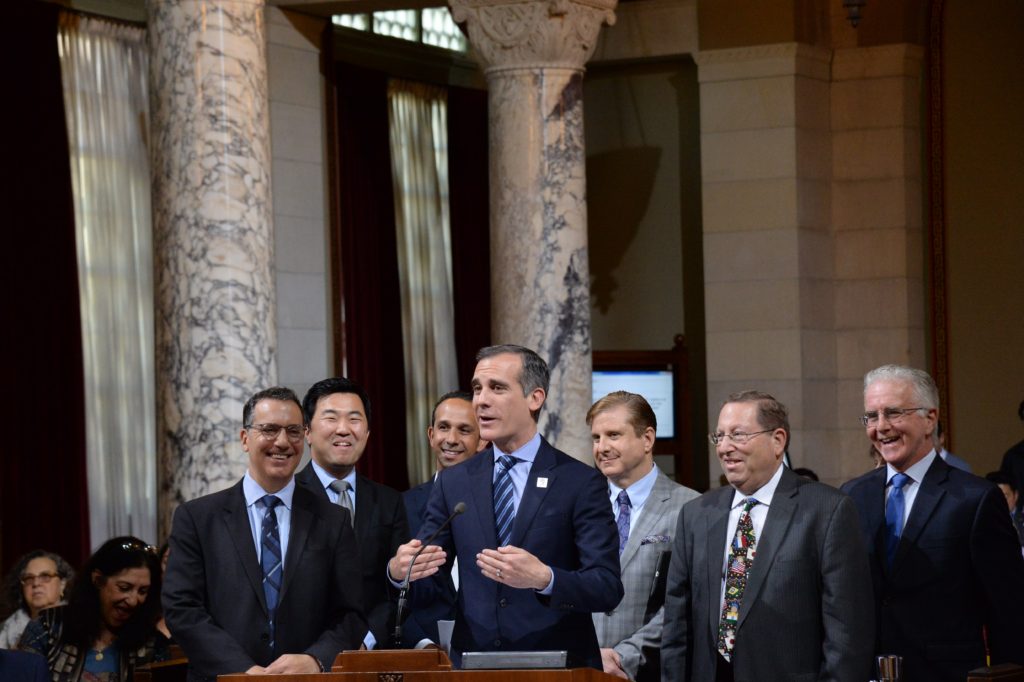
The Race to Replace Garcetti

There are approximately 4.3 billion easily identifiable reasons that Rick Caruso could be the next mayor of Los Angeles. But the most important of those reasons has nothing to do with his wealth. As a successful business leader, Caruso has unsurprisingly billed himself as a “pro-jobs” candidate in the race. But his other point of primary emphasis – his “pro-public safety” self-designation — is much more telling. If Caruso is elected as L.A.’s next chief executive, it will be public dissatisfaction with perceived safety that gets him there. 

The twin issues of homelessness and crime will dominate this election from beginning to end, and both have the potential to be Achilles’ heels for the type of progressive candidates who make up most of the top tier of competitors in this election. Voters who lean left on most other policy challenges have demonstrated a willingness to embrace more aggressive measures to make their communities safe from violent crime and to keep their neighborhoods from being swallowed by a rapidly expanding homeless population. Caruso’s public statements on both topics have indicated his preference for such an approach, reflecting the growing impatience of otherwise liberal Angelenos for their politicians to regain control of the city’s streets. 

Until recently, the only candidate in the race taking a more hard-line stance on these issues has been City Councilmember Joe Buscaino, a former police officer whose proposals on both homelessness and crime have been noticeably more forceful than his colleagues on the Council or his opponents in this campaign. Buscaino is not the front-runner in the campaign: that distinction has belonged to Representative Karen Bass. But he may have been the most important candidate in the field: his tougher approach on these issues has put pressure on Bass and her fellow progressives City Attorney Mike Feuer and Councilmember Kevin De León to adjust their strategies given the change in public attitude. Just days before Caruso’s entry, Bass announced a plan to expand the Los Angeles Police Department. Feuer and De Leon both face difficult decisions on whether to follow Bass’ path toward the political center or whether to try to outflank her to the left by maintaining their support for the type of preventive and service-oriented programs that until recently have dominated local and state politics for much of the 21st century.

Between Bass’ strategic adjustments and Caruso’s entry into the race, the turf that Buscaino has had to himself is suddenly more crowded. Given the changes in the public’s mood, such a shift may have been inevitable. But Buscaino was the first to claim that space, and he will not share it easily: within hours of Caruso’s announcement, Buscaino criticized Caruso for hosting a fundraiser for embattled LA District Attorney George Gascon. A campaign usually leaks that type of information to the media to avoid being linked to it. But in this case, Buscaino may have intended to deliver a message to Caruso that he should not expect deferential treatment from his rivals.

The path to City Hall will not be an easy one for Caruso. Billionaires are rarely popular with the sizable portion of the electorate that has not achieved their level of wealth, and that resentment could be even greater given the economic realities for voters in a city that has not an easy time during the pandemic. In the almost thirty years since businessman Dick Riordan was elected mayor, the city’s blue-tinted politics have gone from azure to indigo and LA’s growing demographic diversity could be a formidable obstacle to any white male candidate.

Michael Bloomberg, Dianne Feinstein, Nancy Pelosi and many others can attest that great wealth is not a fatal political weakness for Democratic candidates. 

But LA’s multi-cultural electorate has been represented by another white man – current mayor and soon-to-be ambassador Eric Garcetti — for the last nine years. And Michael Bloomberg, Dianne Feinstein, Nancy Pelosi and many others can attest that great wealth is not a fatal political weakness for Democratic candidates. 

Caruso is well-positioned for a voting public that has run out of patience – and may also be running low on compassion. But if he is going to be LA’s next mayor, he’s won’t get there without a fight.


Dan Schnur is a Professor at the University of California – Berkeley, USC and Pepperdine. Join Dan for his weekly webinar “Politics in the Time of Coronavirus” (www/lawac.org) on Tuesdays at 5 PM.

The Race to Replace Garcetti Read More »

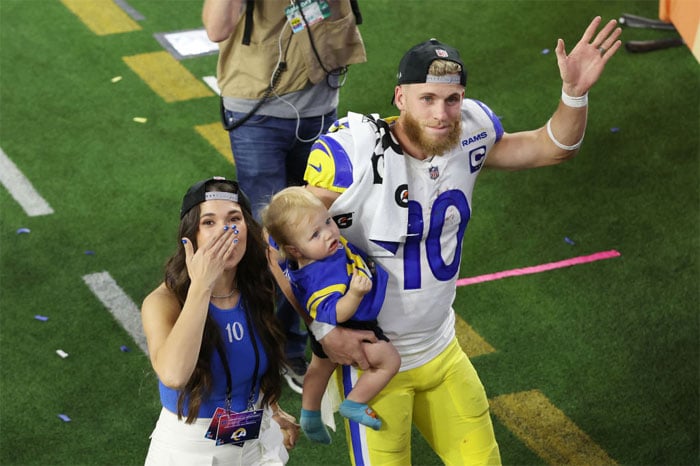
Praying for the Rams

I never thought I would be forced to interrupt a Torah reading the way I did on the 11th of Adar 1, 5782 (February 12, 2022)…otherwise known as “The Shabbat before the biggest Super Bowl in L.A. history.”

At Westwood Village Synagogue, where I am privileged to serve as spiritual leader, and where we have our fair share of sports fans, there was a festive feeling in the air. We welcomed a wonderful young man named Akiva into our community as our new Ba’al Koreh (Torah reader). It had been a few months since we had a regular weekly Torah reader, so Akiva’s arrival marked a joyous new beginning for us.

After introducing Akiva to the community and handing him the silver Yad (Torah pointer), we called up the first aliyah. When Akiva began to read, it seemed like he had always been with us. His reading was melodious, beautiful and well enunciated. So it was for the first aliyah, and the second, and the third. 

Suddenly, I felt compelled to put a stop to everything. I asked Akiva to pause for a moment. What happened that made me stop him? 

While listening to Akiva’s beautiful reading, I glanced ahead at the next aliyah and came upon a verse that shocked me. Its words were too painful to look at, let alone pronounce. I shuddered at the thought that they would soon be chanted directly from the Torah. What to do?

With the same sense of Soren Kierkegaard’s “fear and trembling” that I feel on Rosh Hashanah before blowing the ram’s horn, I stood before God and my community, and, with tongue only slightly in cheek, I shared some words from the heart of an L.A. sports fan.

“Master of the Universe, and honored members of the community,” I said with humility, “I stand before you today in deepest awe and respect for every word of our sacred Torah. I live by these holy words, for they are our life and our length of days, and we will meditate on them day and night.

“However…there is one little verse that I find problematic today. As one who has faithfully sounded the ram’s horn with awe and joy my entire life, how, on this day before the Super Bowl, can I stand in the synagogue and hear the following words read from the Torah: You shall slaughter the ram and sprinkle its blood (Exodus 29:16).”

The congregation immediately figured out where I was going: not a good day to read about slaughtering rams!

The congregation  immediately figured out where I was going: not a good day to read about slaughtering rams!

“Slaughter the ram? Not in our house,” was the collective thought. So, with the deepest sense of spiritual sincerity, we prayed that our rams – the LA Rams – would prevail the following day at SoFi Stadium: “Merciful God, in the merit of the ram’s horn we sound on Rosh Hashanah, have mercy on our LA Rams. Spare them from this one terrifying verse!” 

Akiva did read the verse, of course, but by then, God knew what was in our hearts.

So it was, after a long period in exile, the Rams returned to their historic homeland of Los Angeles. When we prayed for Israel and said “Strengthen the hands of those who defend our holy land and crown them with victory…” – God knew what was on our minds.

On the very next day – Super Bowl Sunday – our prayers were answered. No Rams were slaughtered. 

“Do not raise your hand against the Rams,” cried out a voice from heaven. “And there were some Cincinnati Bengals on the field, caught in the thicket by their helmets, and they were offered up in place of the Rams.”

Many of us take our L.A. sports teams to heart, even when we are in synagogue. Rooting for our teams creates a unique sense of communal bonding and unity. So yes, I really did have Akiva stop reading, and yes, we really did pray that this Torah verse should not come true. 

Of course, my description here was a highly dramatized re-enactment of the actual events. After all, this is Hollywood, the world of drama and happy endings.

Mazal Tov, LA Rams.


Rabbi Daniel Bouskila is the Director of the Sephardic Educational Center and the rabbi of the Westwood Village Synagogue.

Praying for the Rams Read More »

Activist Arrested for Allegedly Attempting to Shoot Jewish Mayoral Candidate

A 21-year-old student activist was arrested on February 15 for allegedly attempting to shoot a Jewish mayoral candidate in Louisville, KY.

The alleged perpetrator has been identified as Quintez Brown, a student at the University of Louisville and a former columnist for the Louisville Courier Journal; he had announced that he was running for the Louisville Metro Council in December. Brown is alleged to have fired a gun multiple times inside the campaign headquarters of Craig Greenberg, a Democrat; no one was hurt, although a bullet scraped Greenberg’s clothing. Brown is believed to have acted alone and police are still determining a motive; Brown’s attorney, Rob Eggert, told reporters that Brown will be evaluated for mental health issues. Brown faces charges of attempted murder and four counts of wanton endangerment since four people were in the office at the time of the shooting.

Greenberg told reporters that the shooter fired right at him and fled once his team barricaded the door. “All of us are blessed, and I’m blessed to be standing here today with you,” he said.

Brown went missing for nearly a couple weeks during the summer of 2021 before being found unharmed in New York. Fox News and the New York Post found a Medium post written by Brown in January stating that “our sick, manipulated brethren” say “that communism and collectivism has never and will never work and refuse to even explore these ‘childish’ (or inferior) ideas.” His post concluded with a call to “to win a new world side by side with a united left front. ‘From all according to ability.’ Radicalize your natural environment, organize the people around you, and watch our numbers grow.”

Additionally, in June 2020, Brown told WDRB that he was partaking in the George Floyd protests every day and was involved with Black Lives Matter Louisville. Nearly a year later, he told Louisville Magazine that “defunding the police is our first step toward dismantling everything that was rooted in slavery. Because they’re the original slave catchers,” per Fox News.

Activist Arrested for Allegedly Attempting to Shoot Jewish Mayoral Candidate Read More »

Rabbi Bentzion Kravitz: Bringing Jews Back to Judaism

When Rabbi Bentzion Kravitz was an undergrad at the University of Texas, two football players stopped by his dorm room. Kravitz asked him why they were there, and they told him they were working for a group called Athletes in Action. It sounded innocent enough, until he kept questioning them. It turned out that Athletes in Action was part of Campus Crusade for Christ, and they were there to try to convert him to Christianity.

Over the next five hours, Kravitz listened to what the football players had to say. “I was perplexed by their arguments and I didn’t know the answers to their questions,” he said. 

Though the experience was jarring, it inspired him to dedicate himself to the Jewish community. In 1977, Kravitz began working with the late Rabbi Shlomo Schwartz, also known as Schwartzie, doing Jewish outreach at schools like UCLA, California State University, Northridge, USC and Los Angeles Valley College. 

“It was through that work that I decided to become a rabbi,” he said. “I went to a yeshiva to study more in-depth. Rabbi Lord Jonathan Sacks said he was very moved by the leadership and the vision of the Lubavitcher Rebbe. I was also very touched by that.” 

Kravitz earned his degree from the Rabbinical College of America, became a rabbi and started Jews for Judaism, which works to prevent Jews from leaving their religion and instead connect or reconnect with it.

“We weren’t Jews against Christianity, we were Jews for Judaism.”  

“The Jews for Jesus program was so well known and disliked by people, the name Jews for Judaism seemed like a great alternative,” he said. “We weren’t Jews against Christianity, we were Jews for Judaism.”  

Kravitz founded his organization at a time when Jews for Jesus was popular on college campuses, and Jews were being persuaded to leave their religion and heritage behind. 

“A lot of students and parents were contacting us because they were being inundated with and confused by the Jews for Jesus movement,” he said. “There were churches following that model of telling people they could be Jewish and Christian simultaneously.”

Through his organization, Kravitz gives community lectures, provides counseling, runs teen workshops and hands out booklets that explain the fundamental Jewish beliefs on atonement, sin and sacrifices. The rabbi also lectures all around the world, including places like Israel, South Africa, Australia and the United Kingdom. 

He’s helped countless Jews return to their faith along the way. One time, a young woman approached Kravitz’s table at a collegea campus and looked at the different items he had. 

“I asked her what her name was and it sounded Jewish,” he said. “She told me she was a Messianic Jew. I said ‘So am I.’ She said, ‘Pre or post?’ I said ‘Pre,’ and she said, ‘I’m post. Jesus is the messiah and he already came.’”

From there, Kravitz and this young woman talked for over three hours. He invited her to his home for Shabbat, and she started asking questions and wanting explanations. 

“I was very patient with her,” he said. “Over a period of three to four months of meeting with her every week and studying with her, she recognized she’d made an uninformed decision. Today, she’s living a committed Jewish lifestyle.” 

Kravitz strives to show the beauty of Judaism to others because of the impact his faith has had on his life. Along with his Jews for Judaism work, he also trains people in martial arts and self-defense. Two years ago, right before COVID hit, he was doing martial arts with a former U.S. Navy SEAL. The SEAL accidentally kicked Kravitz on his right thigh, and Kravitz developed what he thought was a bruise. But when he got it checked out, his doctor told him he had a tumor. He went through seven weeks of radiation and came out on the other side with more trust in God than ever.

“It was a really great opportunity for me to learn more about the concept of ‘bitachon,’ which translates as ‘trust,’” he said. “It gave me a perspective on this disease that allowed me to offer spiritual support and guidance to other people.” 

With his role as a self-defense instructor – as well as a rabbi with hard life experiences– he’s hoping to bring even more Jews back to Judaism.

“I’m trying to strengthen people to make them strong,” he said. “I want to strengthen Jews inside and out.”

Fast Takes With Bentzion Kravitz 

Jewish Journal: How long have you been doing martial arts?

Bentzion Kravitz: Since I was 12. I’m 67.

JJ: I know that you like to scuba dive. Where do you do it?

BK: My best dive I ever did was in Hawaii with 15 manta rays. I also scuba dived in Belize, Costa Rica, Israel and South Africa. 

JJ: What’s your favorite Jewish food? 

BK: A really good quality falafel or pargiot. 

JJ: Where is your favorite place to travel?

BK: Israel, and any place I can be with family and friends.

Rabbi Bentzion Kravitz: Bringing Jews Back to Judaism Read More »

The Person I Never Thought I Would Be

I am that person in the back of the ambulance being rushed after a fall to the hospital,
Though thankfully without the wailing siren.
I am the patient lying helpless and weak in the hospital bed (turns out there were multiple fractures),
The one I pitied but never had real empathy for.
Back at home at last, I am the Bowery bum,
Unwilling to change my shirt for four days lest I jar my injured arm.
I am the frumpily dressed woman—yes, I admit it!
Comfort comes before fashion these days.
I am the shnorer, the one I always looked down on,
Now gladly accepting meals from whoever is offering to give,
(But may I ask, extra-virgin olive oil only please!)
I am the person who had to humbly learn how endlessly caring were my family, friends, and community,
And especially how devoted was my husband, the real hero of this story.
I am the baby, pleased and excited at each new small accomplishment—
Today I loaded the dishwasher all by myself!
I am my limping Zaide, may he rest in peace, leaning on each piece of furniture as I pass by,
Just as he did when he did not have his cane.
I am the one about whom the prophet speaks,
My lips swollen from saying “enough!”
Enough to the many kindnesses—food, prayers, flowers, visits, and healing remedies—showered on me,
But mainly to G-d’s kindness, for He enabled me to learn these lessons,
And for that I praise and exalt Him.

The Person I Never Thought I Would Be Read More »

AOC Claims That Palestinian Children Are in Cages in West Bank

Representative Alexandria Ocasio-Cortez (D-NY) alleged that Palestinian children are being put in cages during a February 13 event.

Jewish Insider (JI) reported that Ocasio-Cortez was speaking at a campaign rally for Greg Casar, who is running for Congress in Texas. She was heckled by pro-Palestinian protesters at the rally; in response, Ocasio-Cortez declared that she supports “the rights of Palestinians and Palestinian children.” She went on to say that “believing in the basic human dignity and the ability for a person to not be jailed or beaten for who they are… does not mean that you are bigoted against any other community” and that “I don’t believe that a child should be in a cage on our border and I don’t believe a child should be in a cage in the West Bank.”

Her remark on cages resulted in criticism on Twitter.

“.@AOC, you know as well as we do that there are no Palestinian children ‘in cages’ in the West Bank,” the American Jewish Committee tweeted. “This kind of gross misinformation hurts chances for reasonable discussion and furthers harmful biases. You must apologize for these baseless allegations.”

“.@RepAOC demonizing Jews at a time of raging #Antisemitism in NYC,” the Simon Wiesenthal Center similarly tweeted. “Throwing children into cages is [inhumane] and cruel. Prove it or apologize. You are legitimizing hatred against Jewish people everywhere.”

“This should go without saying, but Israel does not have children in cages in the West Bank, @AOC,” Israel War Room tweeted. “This vicious libel mirrors the libels that have plagued Jewish civilization for centuries.”

United With Israel similarly tweeted: “Dear @AOC, I also don’t believe that children should be in cages. Please reply with one example of a Palestinian child being held in a cage by the State of Israel. Ever.  Looking forward to hearing from you, Israel.”

The JI report also noted that earlier on February 13, Ocasio-Cortez was also heckled by pro-Palestinian protesters at another event put on by the local Democratic Socialists of America chapter in Austin, TX. Ocasio-Cortez responded to the protesters there by arguing that the word “Palestine” is “banned” and “censored.” “We don’t talk about it,” she said. “No one knows about it,” she said. “Thank you for bringing it up, honestly, because we shouldn’t have to tiptoe around these things.”

AOC Claims That Palestinian Children Are in Cages in West Bank Read More »

AOC Calls Marc Lamont Hill’s CNN Firing Over “From the River to the Sea” Comment an Example of “Cancel Culture”

Representative Alexandria Ocasio-Cortez (D-NY) described Marc Lamont Hill’s firing from CNN in 2018 after he made “from the river to the sea” remarks in front of the United Nations as an example of “cancel culture.”

Jewish Insider reported that in an interview with The New Yorker’s David Remnick published on February 14, Ocasio-Cortez called cancel culture an example of the right-wing creating “a sense of persecution or victimhood” concocted “to justify, animate, and pursue a political program of takeover, or at least a constant further concentration of their own power.” “Notice that those discussions only go one way,” she said. “We don’t talk about all the people who were fired. You just kind of talk about, like, right-leaning podcast bros and more conservative figures. But, for example, Marc Lamont Hill was fired [from CNN] for discussing an issue with respect to Palestinians, pretty summarily. There was no discussion about it, no engagement, no thoughtful discourse over it, just pure accusation.”

Hill said to the UN at the time, “We must promote non-violence at every opportunity, but cannot endorse narrow politics that shames Palestinians for resisting, for refusing to do nothing in ethnic cleansing” before then calling for a “free Palestine from the river to the sea.” Shortly thereafter, Hill was no longer under contract with CNN. Hill later wrote in an op-ed with the Philadelphia Inquirer that his comments were meant to “endorse radical change within Israel, not a desire for its destruction.” “Rather than hearing a political solution, many heard a dog-whistle that conjured a long and deep history of violence against Jewish people,” Hill added. “Although this was the furthest thing from my intent, those particular words clearly caused confusion, anger, fear, and other forms of harm. For that, I am deeply sorry.”

The progressive Zionist group Zioness criticized Ocasio-Cortez in a tweet. “2 weeks ago @AOC said, rightly, that people should take the lead from Jews when considering forgiving people for antisemitic comments,” they wrote. “Jews largely agree that Hill’s repeated genocidal comments about Jews are unforgivable. Why doesn’t AOC take our lead?”

Others weighed in.

“@AOC thinks Jew hatred and calling for #Israel’s destruction, is an acceptable form of speech,” human rights lawyer and International Legal Forum CEO Arsen Ostrovksy tweeted. “With #antisemitism surging in U.S., elected officials like AOC are only pouring more fuel on the fire and enabling such hatred and violence.”

Israeli activist Hen Mazzig tweeted, “Dear AOC, Please stop talking about Jews, hatred against us, and who you think should not be punished for their harm to our community. You’ve made it clear you aren’t on the side of justice. Signed, A Jew.”

Israel War Room tweeted, “Marc Lamont Hill was not fired ‘for discussing an issue with respect to Palestinians,” @AOC. He was fired for repeating Hamas’s slogans.’”

AOC Calls Marc Lamont Hill’s CNN Firing Over “From the River to the Sea” Comment an Example of “Cancel Culture” Read More »

An Intimate Conversation with Benjamin Netanyahu

While in Israel last week to visit the grave of my father, of blessed memory, whom we buried on the Mount of Olives at the start of the pandemic, I went to the Knesset to see our dear friend Amir Ohana, formerly Israel’s Justice and then Public Security Minister. I had gotten to know Amir when he became the first LGBT member of Knesset from Likud and we honored him at our gala in New York for his contributions to Israel’s security and international standing. I recognized then that he was a man of exceptional character and talent. But even I could not have predicted his meteoric rise to one of the highest positions in Israel’s government, especially at such a young age.

While we were catching up with Amir, he mentioned that former Prime Minister Binyamin Netanyahu, whom I have known for more than 30 years, was in the building. Did we wish to see him? I had not seen Bibi since the signing of the historic Abraham Accords on the White House lawn in September, 2020, and I jumped at the chance to sit once again with the one of the greatest figures of modern Jewish history.

My wife Debbie and I walked in Bibi’s office with Amir. The Likud leader greeted us warmly.

I first thanked him for the beautiful letter he had written to me on the occasion of my father Yoav’s passing, which led us to a discussion of Bibi’s father, the world-renowned historian Benzion Netanyahu, whom I had hosted in England for lectures at Oxford, London, and Cambridge in the 1998, and whom I had continued to visit in Israel and whom I loved and admired greatly.

Any mention of his father to the Prime Minister immediately evokes laser-like focus. Netanyahu was famous for his devotion to his father who throughout his life, like the Prime Minister himself, displayed convictions of steel and was larger than life. The Prime Minister asked me if I had the videotapes of his father’s three speeches. I said I believe I could find them.

“What I believe we also have,” I told him, “is the first speech you ever gave at the Oxford Union, in about 1990, which till today remains one of the greatest pieces of oratory I have ever heard.”

Netanyahu at the time was Israel’s deputy foreign minister. He was young, single, and by that time had emerged as Israel’s greatest communicator in the English language since Abba Eban. We had booked him to speak in the world-famous debating chamber but he had insisted that “he be worked to the bone” and deliver as many speeches as possible in a single day so as to reach the widest possible audience. We had obliged and taken him even to the Lion’s Den at St. Anthony’s College, filled with Oxford’s world-famous Palestinian scholars and sympathizers who grilled him to no end. He causally had one leg propped up on a chair the entire time, fielded each question with patience and deep scholarly knowledge, and never lost his cool. His ability to respectfully engage even the most rabid Israel haters was a sight to behold.

A few hours later, after a kosher dinner with Oxford’s Rhodes scholars, Netanyahu arrived to a tumultuous and packed crowd at the Union, complete with a large demonstration against him by Palestinian and some Jewish students. “Net-an-yahu you should know, we sup-port the PLO.” Wow, it even rhymed!

Again, taking everything in stride, Netanyahu walked over to the demonstrators and invited them in to hear his speech.

What followed was a masterful discourse of unsurpassed eloquence. Netanyahu did not speak from a single note and engaged in soaring oratory of the kind revered in Oxford that won over even some of the die-hard Israel cynics in the audience. It’s a curious fact about Oxford and its Parliamentary-style debating chamber that no matter how much people disagree with the content of your speech they will appreciate outstanding and passionate delivery and might even give you a standing ovation. The most moving line came when Bibi said Israelis had paid every price just to live. “Some of us have paid with our families,” he said. “Some of us have paid with our brothers.” Everyone knew he was referring to his brother, Israel’s greatest military commando legend, Yoni Netanyahu, who had led and fell in the Entebbe rescue mission of July 4, 1976.

“Prime Minister,” I continued, “what you have done for Israel is unprecedented. You opened Israel diplomatically to the whole world, including regions that had heretofore been closed, like Asia and South America. You rescued Israel’s economy by decentralizing it from government control. You kept the Jewish people safe through repeated terror attacks and war. You defended your people by sending the English language into battle, to paraphrase what Kennedy said of Churchill. The American Embassy was moved to Jerusalem under your watch and, you never once caved into the pressure that Obama exerted on you to cede land, make peace with terrorists, or not speak out against the abominable Iran deal that was an affront to America’s most deeply cherished values. Greatest of all, you forged the Abraham Accords, which I personally witnessed in Dubai and Abu Dhabi just days ago as transforming the Middle East. You are of one of Jewry’s greatest leaders and it does not much matter whether it is appreciated by all. God is watching and he know what you have done for His people.”

I told him that the biggest change in Israel under his combined 15 years of leadership was this. Prior to his premiership, Israel was still treated as the poor cousin of American Jewry. We raised money for Israel and arrived as tourists with an air of superiority, from the skyscrapers of New York to the smaller buildings of Tel Aviv.

All that has changed now, I told him. Israel is booming like never before. It’s a technological super-power, has forged peace with the most influential countries of the Gulf, is an acknowledged military power whose technology and intelligence everyone seeks to defend their own citizens, and has created a passionate Jewish identity of a Judaism and Israeli nationalism that is flourishing like never before.

In a painful reversal of fortune that was impossible to predict, it is now not Israel but American Jewry who are struggling like never before. Rampant assimilation and ignorance of tradition is hollowing out American Jewish identity and commitment to Israel. Antisemitic attacks in the United States are out of control and Jews cannot know that going to synagogue does not mean that they won’t be gunned down by terrorists while they sit in prayer. Openly antisemitic members of Congress like Ilhan Omar and Rashida Tlaib spew the ugliest venom against Jews and Israel without earning an iota of their party’s condemnation. And forces of BDS have all but taken over American College campuses.

And why did I tell Netanyahu, whom I known and loved for 30 years all this? Because every day in the Israeli press I read criticism of Netanyahu. He may indeed have earned it. Lord knows that politicians are not perfect. But there doesn’t seem to be even a semblance of balance. Gratitude is a Jewish virtue and it’s one that our people seldom practice.

I watched as right-wing American Jews could not thank Barack Obama for increasing Israel’s foreign aid before he left office and I watched as left-wing Democratic Jews called Trump “Hitler” even as he became the greatest friend Israel has ever had in the Oval office.

We have allowed even our values to be politicized.

And I wanted Netanyahu to know that, however many critics he may have—which is natural and welcome in politics—there are still members of our people out there who get it, who will not forget a leader who lifted his people to great heights.


Rabbi Shmuley Boteach, whom the Washington Post describes as “the most famous Rabbi in America,” has just published “Kosher Hate: How to Fight Antisemitism, Racism, and Bigotry.” Follow him on Instagram and Twitter @RabbiShmuley.

An Intimate Conversation with Benjamin Netanyahu Read More »