fbpx

February 10, 2022

Beloved UCLA Hebrew Teacher Passes Away

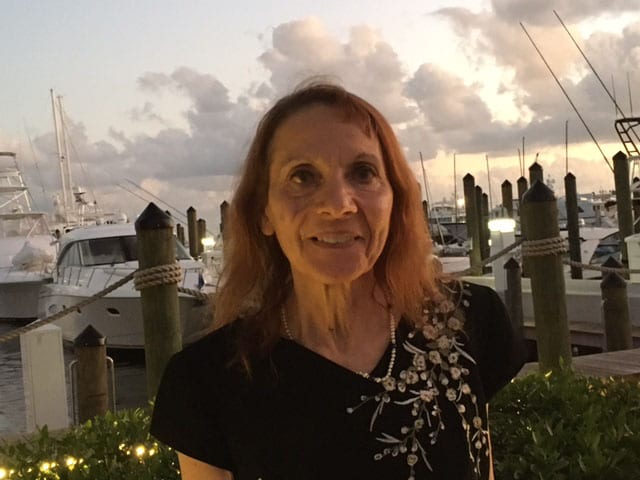
Nancy Ezer, a UCLA Hebrew instructor who taught multiple generations of language learners, died on January 31 at the age of 74. Her funeral was held on February 4 at Hillside Memorial Park and Mortuary.

Ezer is survived by her two daughters, Rona Yaeger and Tamar Ezer, as well as three grandchildren.

In the days after Ezer’s death, her former students and colleagues shared how their teacher, who had a passion for the contemporary Hebrew tongue, had touched their lives.

“Her affect was of a small woman,” Rabbi Jonathan Klein, a former student, said. “But she really was a huge person in my life.”

“She was a morah in the finest sense of the word.” – Rabbi Jonathan Klein

Ezer was a senior lecturer in modern Hebrew in the department of Near Eastern Languages and Cultures (NELC) at UCLA.  Her daily duties involved teaching undergraduate language classes. She also published. In 1987, she joined the UCLA faculty, and she continued teaching until 2021, retiring after successfully transitioning to teaching over Zoom due to the pandemic.

“She was always so future-minded, always looking to computerize when others weren’t, always looking for an edge in her language training, always looking to recreate a home in exile,” Kathlyn Cooney, chair of the UCLA’s NELC department, said in a statement. “She outmaneuvered many of her colleagues in transitioning to online teaching! But most importantly, she provided a place for so many students seeking meaning in the modern Hebrew language.”

An Iraqi Jew, Ezer was born on October 16, 1947 in Baghdad and raised in Israel. In the 1980s, she enrolled at UCLA as a graduate student, working on a doctorate under Arnold Band, a professor emeritus and former director of UCLA’s Jewish Studies Center. Ezer earned a PhD in Hebrew literature, served as a teaching assistant and eventually became a lecturer.

As a member of the UCLA faculty, her colleagues included Yona Sabar, a noted Hebrew scholar and professor emeritus at UCLA’s NELC department, and Lev Hakak, also a professor emeritus as well as a PhD in modern Hebrew literature.

The influential trio worked closely together for more than three decades.

“She was somewhat strict for some students,” Sabar, who retired in 2019, said. “She didn’t make any compromises. She believed in teaching, in very rigorous teaching. Sometimes, teachers try to compromise and do soft teaching, but she did very rigorous teaching. She was very beloved by students.”

In 2007, Ezer was named a recipient of the Distinguished Teaching Award.

Ezer was health-conscious, Sabar said. She climbed the stairs in her Beverly Hills home a dozen times a day. She read and wrote literature, walked in her neighborhood and attended social events in the community.

“She seemed very strong,” Sabar said. “It was a shock to all of us.”

Klein, the spiritual leader of Temple Beth El in Bakersfield, was Ezer’s student around 1990. He described her class as “Hebrew for Hebrew’s sake,” taught from an academic viewpoint rather than a religious one.

She was tough, Klein said, but fair.

“She was not easy,” he said, “but not trying to make life hard for us either. I admired her because she spent so much time with every student, very much willing to give her time, and she cared about students themselves. She was not simply trying to do her research.”

Years after Klein had Ezer for Hebrew at UCLA, his son, a Bruin like his father, would have her, too.

“She was a morah in the finest sense of the word,” Klein said. “A real teacher.”

Beloved UCLA Hebrew Teacher Passes Away Read More »
American Jewish University to Sell Familian Campus in Bel Air and Invest in Expanded Digital and In-Person Offerings

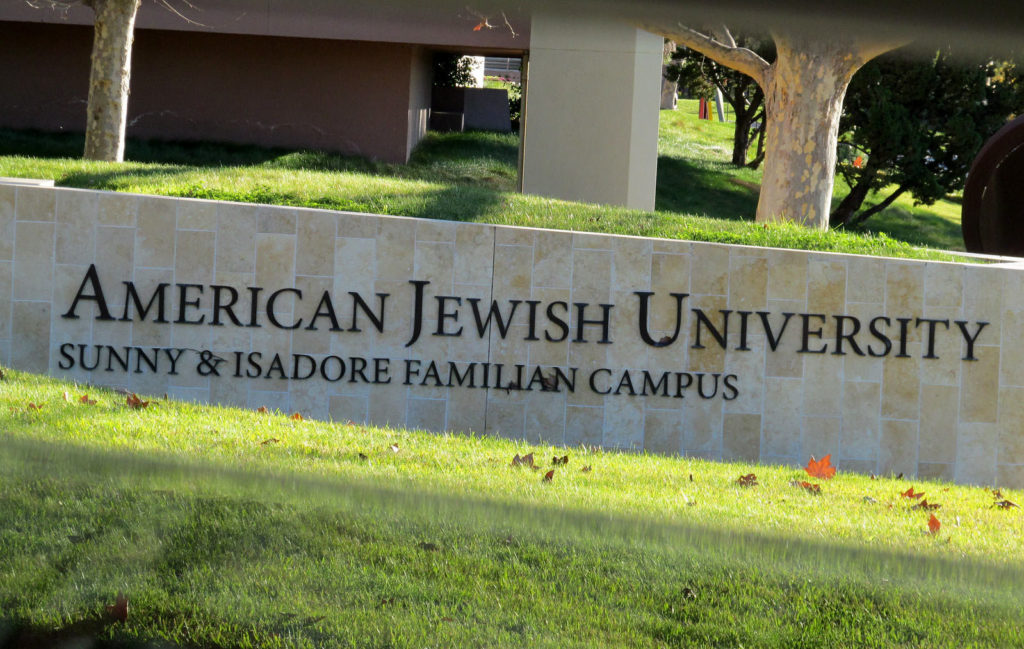
American Jewish University (AJU) announced today that it will be placing its Sunny & Isadore Familian Campus in the Bel Air neighborhood of Los Angeles for sale. The University referred to the plan as a “strategic investment in the future of AJU” that will “generate significant endowment funds for a range of academic offerings and community programs that are tailored to our world—and the Jewish community’s needs—today and tomorrow.”

The Brandeis Bardin Campus in Simi Valley, home of the Brandeis Collegiate Institute and Camp Alonim, will remain under American Jewish University ownership and is not part of the sale.

According to the University, the landmark sale will allow them to invest resources into their evolving mission to “elevate the Jewish journeys of individuals, organizations, and the Jewish community” and will provide them the flexibility to have a presence where they determine is best moving forward.

In a statement, AJU President Dr. Jeffrey Herbst said, “Over the last eight decades, American Jewish University has evolved to meet the needs of the Jewish community. In that tradition, the Board of Directors has made the bold, strategic decision to initiate the sale of our Bel Air campus, allowing us to better direct our resources to fulfilling our mission today and in the future.”

“We look forward to continuing our work to advance the Jewish journeys of individuals and organizations and elevate Jewish life across North America through both robust online and in-person offerings.” – AJU President Dr. Jeffrey Herbst

Founded in 1947 as the University of Judaism (UJ), the school merged with the Brandeis-Bardin Institute in 2007 to become American Jewish University and has played a key role in the Los Angeles Jewish community for decades. The University acquired the 35-acre Bel Air property that overlooks the Santa Monica Mountains in 1977. The Familian Campus boasts a long list of lectures and events, performances and classes that it has hosted over the years.

COVID has changed the landscape of Jewish organizational life and encouraged organizations to reinvent themselves. In the last few years, AJU has  built a robust digital presence to supplement its in-person events, which the University said will continue.

AJU’s online events platform, Maven, has garnered a slate of notable guests from the UAE’s Assistant Minister for Culture and Public Diplomacy Omar Saif Ghobash to Los Angeles County Supervisor Sheila Kuehl; and from New York Times bestselling author Anita Diamant and Academy Award winning producer Melissa Berton to Ozark’s Julia Garner and Chris Mundy.

“We look forward to continuing our work to advance the Jewish journeys of individuals and organizations and elevate Jewish life across North America through both robust online and in-person offerings,” said Herbst.

The Familian Campus is located at 15600 Mulholland Drive Los Angeles, CA 90077. The listing will be represented by Eastdil Secured.

American Jewish University to Sell Familian Campus in Bel Air and Invest in Expanded Digital and In-Person Offerings Read More »

The Daily Kehunah – A poem for Parsha Tetzaveh

…and the kehunah will be a perpetual statute for them.
Exodus 29:9

Today in the Torah two rams and a bull
are going down. I don’t have to worry about it
because the Rabbis who came later said so.

Still, the details haunt me.
There is a lot of blood and descriptions
of what’s to be done with their innards.

I hadn’t read this in 1986 when I became
a vegetarian, but it must have been part of
the internal history passed to me

through the blood of my ancestors
only to become a perpetual part of my non-diet.
The rams had to be perfect, which feels

exclusionary to those of us with imperfections.
As much as I don’t want to slaughter a ram
I want every mammal to have an equal opportunity

to get whatever they feel they should.
Aaron’s sons are being slathered and anointed
and nearby fingers are touching the blood.

This should have the desired effect.
On the other end of it, they will kehunah forever.
I can’t get over the word kehunah

and how it is not Kahunah, which is Hawaiian
or maybe they had a meeting about it
all the King Davids, the Jewish one and

the Hawaiian one, and they decided
let’s share this so even on non-Jewish vacation
I will be reminded of what always is.

I have a long list of things that always are.
I keep adding to it, to the point my wife asks
you’re doing another thing, every day, forever?

It is like our love, my love.
Always room for more. A perpetual state.
My kehunah.


God Wrestler: a poem for every Torah Portion by Rick LupertLos Angeles poet Rick Lupert created the Poetry Super Highway (an online publication and resource for poets), and hosted the Cobalt Cafe weekly poetry reading for almost 21 years. He’s authored 25 collections of poetry, including “God Wrestler: A Poem for Every Torah Portion“, “I’m a Jew, Are You” (Jewish themed poems) and “Feeding Holy Cats” (Poetry written while a staff member on the first Birthright Israel trip), and most recently “The Tokyo-Van Nuys Express” (Poems written in Japan – Ain’t Got No Press, August 2020) and edited the anthologies “Ekphrastia Gone Wild”, “A Poet’s Haggadah”, and “The Night Goes on All Night.” He writes the daily web comic “Cat and Banana” with fellow Los Angeles poet Brendan Constantine. He’s widely published and reads his poetry wherever they let him.

The Daily Kehunah – A poem for Parsha Tetzaveh Read More »

Scrolls, Books, Hooks and Ands

In ancient times the holy Torah was a manuscript that Jews would write upon a parchment scroll.
Once printing was invented they divided all its verses and its chapters in an annotated book,
but always their interpretation of the words made their imagination play a greater role
than the printed or handwritten text on which they hung their own ideas like an imaginary hook,

and fill up to the brim,
like vavei amudim,
ideas that link like hooks
hiddushim in their books,
to “ands” in columns of
the Torah where a vav
starts each page with an “and.”
A maskil will understand,
thanks to his erudition
the process of addition.
Like vavei amudim
it generates hiddushim,
thereby enabling Torah
to glow, and grow its aura
just like the Torah’s vavim,
lead-letters of its qelaphim,
no less important than
its leading words which fan
the texts and make them cool
for those who use this tool.

The practice of starting every Torah column with a vav
was frowned on by great Rabbi Meir, known as Maharam,
“and” on top of Torah columns showing as little love
as what all great rabbis showed to halakhic decisions that are dumb.

There’s more: another function that each vav — not just a hook
that links all Torah columns in the parchment scroll, by signifying addition —
implies that, like the columns of the tabernacle, all the verses of the book
are templates of reversal of the tense into a non-linear edition.


The second verse of this poem was inspired by David Z. Moster’s article in thetorah.com,  “Scribing the Tabernacle: A Visual Midrash Embedded in the Torah Scroll” :

https://www.thetorah.com/article/scribing-the-tabernacle-a-visual-midrash-embedded-in-the-torah-scroll

Moster writes about the custom of beginning each amud, column, of a Torah scroll with a vav, the sixth letter of the alphabet, which means “hook,” and  points out that the practice follows a paradigm that was applied to the building of the tabernacle.  The columns of the Torah scroll are called עמודים (ammudim), the same term as the columns of the Tabernacle, and the sixth letter of the Hebrew alphabet, a ‘ו’ (vav), denotes each hook that was attached to the columns of the Tabernacle to become one of the vavei hamishkan, the hooks of the tabernacle, adding that the scribal practice of the vavei ha‛ammudim is not mentioned by the Talmud or Maimonides and was attacked by  Rabbi Meir ben Yekutiel HaKohen (d. 1298) and his  famous teacher, Rabbi Meir of Rothenburg (d. 1293).


Gershon Hepner is a poet who has written over 25,000 poems on subjects ranging from music to literature, politics to Torah. He grew up in England and moved to Los Angeles in 1976. Using his varied interests and experiences, he has authored dozens of papers in medical and academic journals, and authored “Legal Friction: Law, Narrative, and Identity Politics in Biblical Israel.” He can be reached at gershonhepner@gmail.com.

Scrolls, Books, Hooks and Ands Read More »

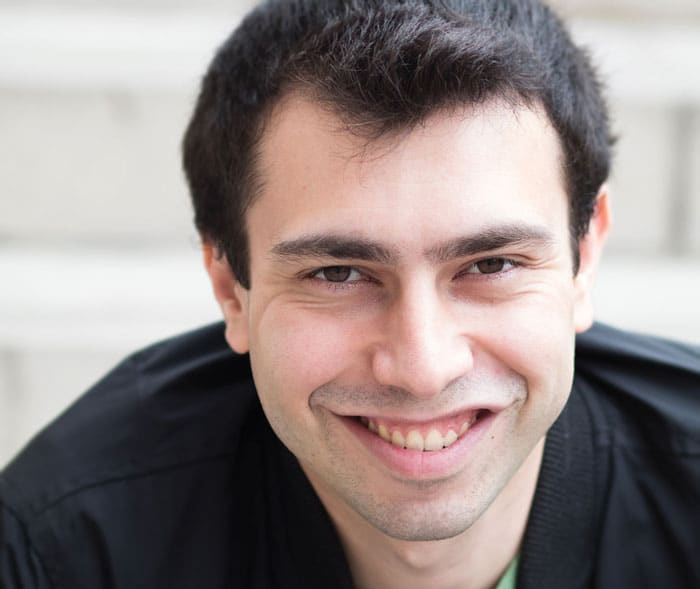
Danny Dalah Combats Antisemitism With Comedy

We can fight back against antisemitism by speaking out on Twitter. We can build interfaith relationships with different communities, as well as educate non-Jews about the Holocaust in school. We can also combat it with comedy.

That’s what comedian Danny Dalah is doing with his new tune, “Song for the Anti-Semite.” From Dalah’s debut album “Mr. Self-Sabotage”  (out February 14), the song takes Jewish stereotypes and turns them on their head. In it, he sings, “You think that we’re white, but your country club said no? You think we run Hollywood, but I’m unemployed! You think we killed Jesus, but Jesus was the biggest Jew! Your discrimination’s got a lot of plot holes. Maybe you should hire Spielberg to fix that. Oh right?”

Dalah said that melodically, “Song for the Anti-Semite” is inspired by Mizrahi music like Eyal Golan and similar artists. Years ago, his Israeli father brought back from Israel a Greek bouzouki, an instrument in of the long-necked lute family, and an Egyptian goblet drum. Dalah started experimenting with both instruments, using them and a melodica in the song.

“[It] almost sounds like a mix of klezmer and Mizrahi music,” he said. “In a time with such hatred on the rise, I don’t believe in hiding our identity or being ashamed of who we are. Embracing these non-mainstream musical instruments in a comedy song is another way to affirm my Jewish identity.”

Photo courtesy of Danny Dalah

The comedian was born and raised in Los Angeles in a Conservative Jewish home, where his family kept kosher, did Shabbat dinner and celebrated the holidays. He embraced comedy early on, making a stop motion movie of his “Star Wars” action figures escaping his room in a “Toy Story”-like fashion when he was in sixth grade. 

“An appreciation of comedy has always been present in my life,” he said. 

Growing up, Dalah would listen to Golan, along with Teapacks (who represented in Israel in 2007’s Eurovision competition) and the Beatles, and learned how to play flamenco guitar.

“It was only a matter of time before I combined music and comedy, so I started occasionally improvising these silly little jingles on the guitar,” he said. 

After graduating from USC’s School of Cinematic Arts with a minor in comedy, Dalah started doing stand-up at The Comedy Store, The Ice House and the Upright Citizens Brigade. 

“Comedy became an outlet to deal with a lot of frustrations in my day-to-day life and to also speak out against nonsense occurring in our society,” he said. 

One of the frustrations Dalah dealt with is antisemitism; he’s experienced it several times. When he was in the Jewish fraternity Sigma Alpha Mu at USC, he was participating in a charity sporting event when one member of the opposing team yelled “filty k*kes” at Dalah and his teammates. 

“[That] was the first time I had ever heard that word, and it was truly shocking to experience antisemitism at home in Los Angeles, which oftentimes can feel like a safe bubble,” he said.

In a second incident at USC, a vendor was selling merchandise with swastikas on it. A group of Dalah’s friends tried to convince the vendor to stop selling it, but he refused. 

And when Dalah was traveling abroad in Barcelona, he said a seemingly nice woman helped him and his friends find a hotel when every hotel in the city was booked up. 

“At the end, she asked where we were coming from, and we responded ‘Tel Aviv.’ Her smile dropped and she said, ‘Why would you go there? There are a lot of Jews there.’ It was truly a bizarre incident, because someone who was so nice and helped us was antisemitic the whole time.”

“I wanted to use comedy to talk about a deeper issue and fight back at some bigots.” – Danny Dalah

Still, Dalah doesn’t let it get him down. Instead, he’s taking a stance in his own way. “I wanted to use comedy to talk about a deeper issue and fight back at some bigots,” he said. 

Ultimately, Dalah hopes he can make an impact. His dream is to write for Saturday Night Live or “Rick and Morty” and continuing to do what he loves. 

“I like to make people laugh because life can be really difficult, and laughing at least makes all of our problems slightly easier to deal with,” he said. “While I can’t perform rocket science, I can make someone laugh, so that’s my attempt to help out.”

Danny Dalah Combats Antisemitism With Comedy Read More »

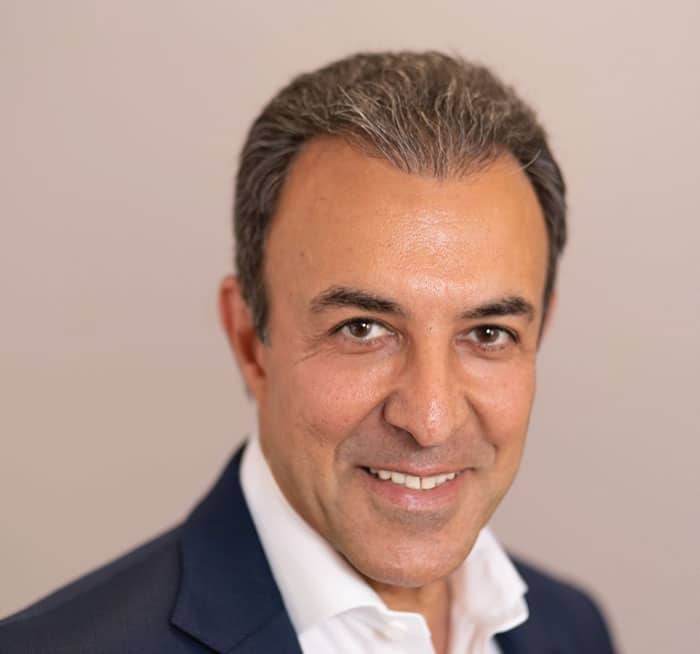
Former LADWP CEO David Nahai Reflects on His Work in the Environmental Sector

When David Nahai was growing up in Iran, people in his community would wash their faces in local bodies of water. They would then experience scarring as the organisms in the polluted water ate away their skin. 

“The condition was so common that there was a name for it: salak,” he said. “Salak is a common skin disease in Iran that results from unsanitary environmental conditions such as polluted water.”

Even as a child, Nahai was concerned about what this meant. “It always struck me that this was a dereliction of duty on the part of the government,” he said. “There had to be a pact between the government and the people that at the minimum, they would be provided with a livable environment, like clean water and clean air.”

As Nahai got older, he became increasingly interested in the environment, reading about it at the British boarding schools where he was educated. “I came to learn more and more about what human beings were doing to the environment,” he said. “It fueled a passion in me to do my small part.”

Nahai took on work in the energy sector, and in 2007 was appointed the chief executive officer and general manager of the Los Angeles Department of Water and Power (LADWP), the largest municipal utility in the country. 

While at LADWP, he made historic reductions in water consumption in L.A. With his team, he led a public education and outreach campaign asking people to cut back on their water consumption, and passed city ordinances like making it illegal for people to excessively water their lawns or for restaurants to automatically serve water to patrons. 

“We’re nowhere near where we want to be, but we’re a little better than we used to be,” Nahai said. “We need to find new ways to reduce water usage. We can do more conservation and recycle our wastewater. Israel recycles 80 to 90% of its wastewater. We are nowhere near there. We can do more.” 

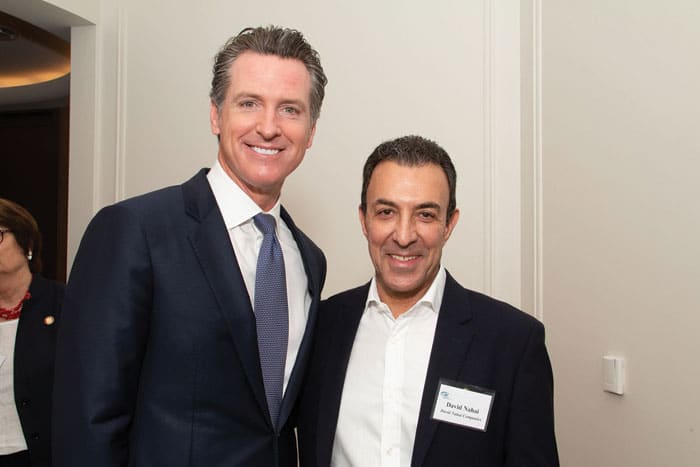
Today, Nahai works as president of his own company, David Nahai Consulting Services, and his law firm, David Nahai Associates. He is also a board member at the Los Angeles Regional Water Quality Control Board, a position he was reappointed to by Governor Gavin Newsom in 2021. Newsom was the fourth California Governor to appoint Nahai to the board, where he was the former chairman.

Photo courtesy of David Nahai

“Being on the board was a natural extension of what I wanted to do,” Nahai said. “It’s been a privilege for me to serve on it.”

Along with his public service on the board, Nahai is dedicated to the Jewish community. He served on the board of The Jewish Federation of Greater Los Angeles, The Jewish Community Foundation and The Iranian American Jewish Federation. 

“It’s important as a Jew to be involved and ensure that we continue to keep our sense of community, our bonds and our Jewish identity,” he said. “Being involved gives me the sense that I’m giving something back. It keeps me connected and it’s very rewarding.”

“We have to go forth and do good in the world to save it.”
– David Nahai

He said that the concept of tikkun olam guides him in his work. “We have to go forth and do good in the world to save it,” he said. “As human beings, we have a responsibility to the world. We can’t pray for a healthier environment. We have to work for it. Our Jewish faith teaches us this. While faith and prayer are encouraged, action and work are what truly get things done.” 

Nahai encourages people to take environmental issues seriously not only for the sake of the planet, but because it can benefit communities, too. He said that bad water quality disproportionately affects communities of color, and that if L.A. invests in sustainability, jobs will be created and it’ll spur economic activity.

“There are huge plusses to taking care of our environment from an environmental and economic point of view,” he said. “But we have a lot of work ahead.”  

Still, even though things could always be better, Nahai doesn’t want others to feel like the small efforts they make every day are futile.

“There is so much we can do in our daily lives that when put together, can have a tremendous global impact.” – David Nahai

“Let’s not think that way because it leads to paralysis and apathy,” he said. “There is so much we can do in our daily lives that when put together, can have a tremendous global impact. I truly believe this.” 

Former LADWP CEO David Nahai Reflects on His Work in the Environmental Sector Read More »

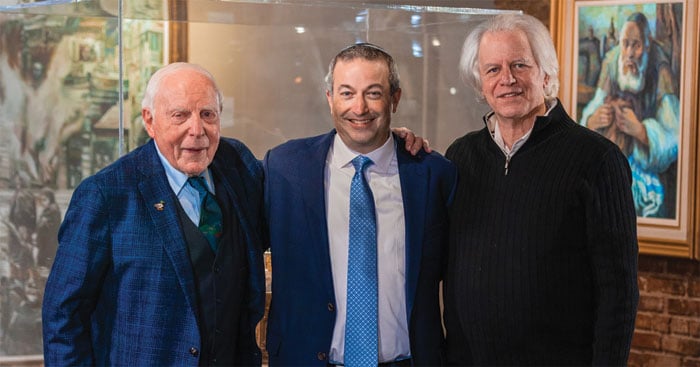
Belz Family Gifts $20 Million to Yeshiva University’s Rise Up Campaign

On January 31, the President of Yeshiva University Rabbi Dr. Ari Berman announced a $20 million gift from the Belz family of Memphis, Tennessee. 

The donation is for the university’s recently launched Rise Up: The Campaign for 613, which was established to fund scholarships and faculty as well as renovate and modernize facilities.

“We have always recognized and admired Yeshiva University and its national and international reputation as the flagship Jewish university.” – Jack Belz

“We have always recognized and admired Yeshiva University and its national and international reputation as the flagship Jewish university,” said Jack Belz in a statement released by YU. 

The Belz family’s gift will be used to spearhead a comprehensive update of YU’s cornerstone academic building (Furst Hall) on the Wilf Campus in Washington Heights, New York. The large multi-storied building, located at the southeast intersection of W. 185th St. and Amsterdam Ave, will be renamed the Belz Building. With the support of the Furst family and the Sol and Hilda Furst Foundation, a permanent memorial to Sol and Hilda Furst will be established in the lobby.

This gift includes much of Jack and Marilyn z”l Belzs’ lifetime collection of Judaica and artwork, valued at $6 million. This breadth of art forms, focusing on elements of Jewish life from religious ceremonial rituals to culture to biblical stories, will be on permanent display as the Belz Collections and Galleries, located at the main entrance to the building and open to the public.  

“[YU] provides a remarkable multi-faceted education for its men and women students in their pursuit of excellence in both Jewish education and general education as they pursue such varied careers as Rabbinical, Law, Medicine, Psychology, Science, Finance and other areas,” Belz said.

Founded in 1886, YU combines the ancient traditions of Jewish law and life and the heritage of Western civilization. More than 7,400 undergraduate and graduate students study at YU’s four New York City campuses: the Wilf Campus, Israel Henry Beren Campus, Brookdale Center and Jack and Pearl Resnick Campus. Ranked among the nation’s leading academic research institutions, YU aims to honor the five core Torah values: Truth (Torat Emet), Life (Torat Chaim), Infinite Human Worth (Torat Adam), Compassion (Torat Chesed) and Redemption (Torat Tzyion).

According to Belz, his family has been involved with YU for decades. His father was an active member of the Board of Trustees beginning in the ‘60s, and he has followed the same path. His parents established and endowed the Belz School of Jewish Music at YU. 

“My wife, Marilyn, of blessed memory, and I have continued annually to provide support for the School of Jewish Music, along with Yeshiva University in general, the Sy Syms School of Business and other affiliates of YU,” he said. 

The Belz family has also been recognized as builders of the city of Memphis, as well as philanthropists committed to the arts and Jewish causes. Jack Belz is chairman and CEO of Belz Enterprises, a privately-owned commercial and industrial real estate development company based in Memphis that his father founded in the 1940s. He has been a trustee of YU since 1986. 

 “Jack and his beloved wife Marilyn of blessed memory have long stood as exemplars of our Torah values and pillars of our Yeshiva University community,” said Berman. “Their lifelong dedication to educating our students, the leaders of tomorrow, reflects the multi-generational partnership between the Belz family and Yeshiva University. I am deeply grateful for our personal friendship and for this extraordinary gift which will profoundly elevate and enhance the YU experience for our students, faculty and entire community.” 

YU’s Rise Up campaign, which launched on December 5, plans to raise $613 million over the next five years to ensure student success in a changing world. 

“The Torah teaches 613 ways to honor God, show respect for others and build an ethical, flourishing society,” Berman said in a December 6 release from the university. “Raising $613 million for scholarships, faculty and facilities reflects our core Torah values and meets our needs for the future.”

Belz Family Gifts $20 Million to Yeshiva University’s Rise Up Campaign Read More »

A Moment in Time: Hitting the “Shift” Key

Dear all,

In my spare time (which is rare) I enjoy Lego projects. My latest is a very cool typewriter with lots of moving parts. As I placed the finished product on a shelf (out of reach of toddler hands), I took notice of the “Shift” key.

Now, on a computer, this key is entirely electronic. But on an old typewriter the movement is mechanical, and when pressed, the shift key lifts/ elevates part of the machine. It’s pretty cool.

I think we all need to activate a shift key every once in a while. We need to see things from another perspective, to emotionally reposition our outlook, and to spiritually transpose our expectations.

In Jewish prayer, there is lots of body movement (bending of knees, getting on our tip toes, bowing….). While there is certainly theological meaning behind this choreography, it’s also a way of ritually engaging our shift key. But we don’t have to do it only in prayer!

What an opportunity we have to take a moment in time each day to hit our shift key, embrace life with a new lens, and write our next chapter. How will hitting your shift key make a difference?

With love and Shalom,

Rabbi Zach Shapiro

A Moment in Time: Hitting the “Shift” Key Read More »

david suissa shanni suissa podcast

Unpacking the Joe Rogan Brouhaha

Where should we draw the line with censorship of public voices? Can the Super Bowl help us achieve our goals? Will Whoopi Goldberg accept the invitation to film The View at the Museum of Tolerance? And do we need a Good News Network? We discuss those burning issues and many others.
Follow David Suissa on Facebook, Twitter and Instagram & Shanni Suissa on Instagram, Twitter and TikTok. 
You can check out Shanni’s new show here!
example one
example two
example two

Unpacking the Joe Rogan Brouhaha Read More »

Ted Lieu Spearheads Bipartisan Letter From Members of Congress Calling on Education Dept. to End Delays of Investigating Antisemitism Complaints

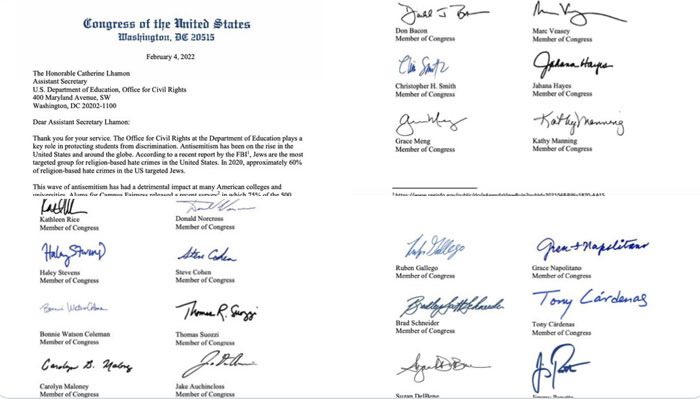
Representative Ted Lieu (D-CA) headlined a bipartisan letter of nearly 40 members of Congress calling on the Department of Education’s Office of Civil Rights (OCR) to end their delays on investigating complaints of antisemitism on college campuses.

The February 4 letter, which was also signed by Representatives Brad Sherman (D-CA), Ted Deutch (D-FL) and Don Bacon (R-NE), noted that according to a recent FBI report, 60% of all 2020 religious hate crimes in the United States targeted Jews. The letter also pointed to an August 2021 report from Alums for Campus Fairness finding that 75% of students and alumni view antisemitism on campus as “a very serious problem,” almost 70% avoided places on campus because of fears of antisemitism and nearly 50% said that antisemitism has gotten worse on campus. “This demonstrates that Jewish students need assistance and protection from the growing threat of Antisemitism on American campuses,” the letter stated.

The letter went on to list three calls of action to OCR, the first being that OCR should “provide technical assistance” to college campuses about antisemitism. The second argued that “there appears to be a significant delay” in OCR completing their investigations on antisemitism complaints falling under the purview of Title VI of the Civil Rights Act, which bars discrimination on campuses. “Therefore, for each Title VI complaint that has been pending in OCR for more than 180 days, we request that you provide the following information: (a) the status of the case; (b) the reason(s) it has not been resolved; and (c) an estimated time frame for its resolution,” the letter stated.

The final call was for OCR to end their delays on codifying the executive order that then-President Donald Trump signed at the end of 2019 stating that Title VI covers antisemitism on college campuses. The Biden administration initially announced that the codification would occur in January 2022, and then pushed it back to December 2022. “These delays in processing Title VI complaints are delaying justice and potentially allowing discrimination to persist on campuses throughout the country,” the letter concluded.

A spokesperson at OCR confirmed to the Journal that they have received the letter and will be responding to members of Congress directly.

Anti-Defamation League CEO Jonathan Greenblatt tweeted, “Bravo @tedlieu for your leadership on this bipartisan effort to turn the 2019 EO on #antisemtism into law and ensure that [the Department of Education] truly commits to combating it on college campuses.”

StandWithUs issued a statement thanking Lieu and the other 38 congressional members for the letter to OCR. “This initiative sends a clear message that our elected officials are concerned about rising antisemitism in the educational context, and are being vigilant to ensure that federal taxpayer dollars are not used to support entities that fail in their responsibilities to adequately remedy antisemitic environments,” the pro-Israel educational group said. “It is our sincere hope that the DOE will respond to this letter expeditiously and that this effort will lead to improved response time to these complaints. This, in turn, will lead to increased protection for Jewish and non-Jewish students who care about Israel, and Israeli faculty, staff and students on campuses nationwide.”

Kenneth L. Marcus, Founder and Chairman of The Louis D. Brandeis Center for Human Rights Under Law and the former Assistant U.S. Secretary of Education for Civil Rights, told the Journal in a phone interview that “we’re delighted that Ted Lieu is taking leadership on this. It was great to see his letter and the fact that so many members of Congress joined him in expressing concern about what Jewish students are facing on campus as well as an insistence that the Biden administration do something about it.”

Marcus went on to explain that he advocated for the Trump administration to codify the executive order before the Biden administration took over in order to give it “greater durability” in the face of “vicissitudes of changing administrations.” “This didn’t get done by the end of the Trump administration, so it landed in the Biden administration’s lap,” he said. “I wasn’t sure whether the Biden team would want to codify the executive order. Generally speaking, new administrations don’t always want to build on the work of their predecessors and of course the Biden administration has expressed considerable disagreement with what was done by President Trump.” Marcus added he was “really pleased” that the Biden administration indicated it would codify the executive order, but said that the “good news was somewhat tarnished when the current administration announced another delay in the much-needed regulation dealing with Jewish students.” He posited that the delays may simply be due to limited resources hindering the process of codifying new regulations. “I’d like to think it doesn’t reflect something worse.”

In order to codify a regulation, it must be formally proposed through the federal register, provide time for public comment, and be approved by the Department of Justice, Office of Management and Budget and the Small Business Administration, Marcus said. 

Marcus argued that it is imperative for the Biden administration to communicate with school administrators about the issues of antisemitism on campus, which he said they haven’t really been doing. “The administrators need to hear that, because otherwise they’re going to think that it’s not a priority for the regulators and investigators,” Marcus said. “College administrators are responsive to the people who regulate them, and so it’s really important—even during this period when the regulation is pending––for the Education Department, the Justice Department and perhaps even the White House, to send clear signals that Jewish students can’t be forgotten in the rush to deal with other issues. 

“That’s what so important about the congressional letter,” he added. “It signals to the Biden administration that OCR needs to address antisemitism and that can have the effect of signaling to college administrators and public schools that they too need to deal with problems that Jewish students are now facing.”

Ted Lieu Spearheads Bipartisan Letter From Members of Congress Calling on Education Dept. to End Delays of Investigating Antisemitism Complaints Read More »