fbpx

December 27, 2021

Thoughts on Omicron—Blessing or Curse?

It’s natural that any virus connected to COVID would scare the daylights out of us. Since the pandemic ambushed us nearly two years ago, escalating fear has been our default position. The first wave was terrible and killed millions around the world. Then the Delta variant hit, which was even more contagious and scary, despite the mitigating effect of vaccines.

If one follows that pattern, we would assume that the latest variant, Omicron, would be even more dangerous, right? But that’s where it gets interesting.

“Dangerous” has two components—how fast the virus spreads and how lethal it is. Much of the panic around Omicron is a reaction to the first component—it’s spreading a lot faster than we’re used to. We’re hearing more often about people who are infected, some of whom we know, some of whom have been vaccinated. That’s scary.

Much of the panic around Omicron is a reaction to the first component—it’s spreading a lot faster than we’re used to.

But much of the evidence so far suggests that this variant is far less deadly than previous strains. As if to confuse us during this moment of weakness and exhaustion, COVID seems to have gone in two directions at once—more contagious, less deadly. And since the “contagious” direction is so visible, many of us are panicking.

The more complete way of looking at Omicron leads to the opposite of panic. The variant’s relatively mild nature means that Omicron could take us more quickly into the promised land of herd immunity. In other words, if we had to pick a variant to go around, it’d be Omicron. The faster it spreads, the quicker it will replace the more dangerous Delta.

Confused, yet?

It’s useful to consider the logic of survival. Pretty much everything in nature tries to survive and replicate. From this vantage point, the Omicron variant may be COVID’s way of trying to survive. It’s figured out that the milder it is, the more easily it can enter our bodies, the more bodies it will enter. Its goal is not necessarily to kill us but to enter us. As NPR reported on Dec. 22, a new analysis by the University of Washington shows that while the Omicron surge will likely peak in a massive wave of infections by the end of January, it is likely to produce far fewer severe illnesses for most people.

The Omicron variant may be COVID’s way of trying to survive. It’s figured out that the milder it is, the more easily it can enter our bodies, the more bodies it will enter.

In this scenario, the vaccines become like seat belts and air bags. Even when they don’t prevent infection, at least they can lessen the severity of a variant that is already less severe. And who doesn’t value the extra protection of seat belts and air bags? It’s all about putting the odds on our side.

This, then, is the case for hope: With the much higher odds of surviving Omicron, the more people catch it, the more we will strengthen our natural immunity and the more likely we’ll tame the tiny beast. Yes, what irony—by being so obsessed with its replication, Omicron may have given us the tools for its demise.

Of course, in this winter of discontent and rampant contagion, it’s hard to see silver linings. If we see mostly the alarming spread of a virus we’ve always assumed is deadly, we’ll see a curse.

But if we see both the rampant contagion and the much lower death rates, maybe we’ll also see that long-awaited light at the end of the tunnel.

Thoughts on Omicron—Blessing or Curse? Read More »

Is There Room in Israel for All the Jews?

The Israel Central Bureau of Statistics reports that the population of Israel has increased to almost 9.5 million, more than seven million of whom are Jews. (These numbers include Jewish settlers in the West Bank, but not the millions of Palestinians in Gaza or the West Bank). Can these numbers keep going up?

Visitors to the Holy Land in the 18th and 19th centuries noted that it was almost empty of people. In “Innocents Abroad,” Mark Twain described it as“a hopeless, dreary, heart-broken land” while the Swedish traveler Frederick Hasselquist (“Voyages and Travels in the Levant in the Years 1749, 50, 51 52, 1766”) referred to it as an “uncultivated and uninhabited country.”

Incredulously, in 1930 Chaim Weizmann was told by Lord Passfield (a British official assigned to investigate the capacity of Palestine to absorb Jewish immigrants) that there was not room in Palestine “to swing a cat”; this when the total population was one million (200,000 Jews and 800,000 Arabs).

For most of the more than 70 years since the existence of the State of Israel, the growth of its Jewish population was dependent on immigration: 3.3 million immigrants since 1948. Immigration (aliyah) is still important. The number for 2021 is 27,000, an impressive number given the difficulties associated with the COVID-19 pandemic.

But the primary reason for Israel’s recent population growth is fertility. The birth rate for Jews in Israel is by far the highest of the OECD countries, with a value of more than three children per family, higher than for Arabs in Israel and the West Bank. Moreover, the high birth rate is true both for orthodox and secular families.

This trend shows no sign of abating. At this point about half of all the Jews in the world live in Israel. With the exception of orthodox families (ten percent of American Jews), birth rates for Jews in the Diaspora are much lower; it is estimated that three quarters of all Jewish babies born annually are born to Israelis. Moreover, aliyah numbers may mushroom in response to increased antisemitism in Europe and North America, as well as economic turmoil in places such as Brazil and Argentina.

This trend shows no sign of abating. At this point about half of all the Jews in the world live in Israel.

Is there room in Israel for all or almost all of the Jews in the world?

Tova Cohen and Steven Scheer think not. In 2015 they noted in Reuters World News that Israel’s high birth rate is leading to a quality of life disaster. Alon Tal, who suggested in a 2017 Jerusalem Post piece that a new kind of thinking is required to prevent Israel’s collapse from too large a population, seems to agree. But Barbara Sofer, on the other hand, is an optimist who sees the high Israeli birthrate as an expression of positive values as indicated in her 2021 article in The Jerusalem Post.

The late Israeli author Amos Oz was an optimist as well. In 2005 he was the subject of a BBC documentary (“Amos Oz: the Conscience of Israel”). In the final segment, Oz shows the producer, Alan Yentob, around his home, the town of Arad, located in the northern Negev Desert. As they sit in the main square Oz proudly points to the diversity of the passersby, noting that Arad, population 27,000, was built on empty land. He goes on to say that there is enough land for all the Jews in the world, from Arad to Eilat on the Red Sea, 200 kilometers of empty land.

Can the Negev, which represents 60 percent of Israel, support a large population? After all, it is one of the most arid and desolate regions in the world. NASA uses the Negev when training for Mars missions.

Yet there are cities and towns such as Beersheva (population more than 200,000), Dimona and Mitzpe Ramon that have shown that it is indeed possible to live and thrive in the desert. Kibbutzim in the barren Arava Valley of the southern Negev have been remarkably successful as well. Kibbutz Yotvata is one of Israel’s largest milk and dairy product operations (700 hundred cows in the desert), while Kibbutz Ketura produces microalgae valuable to the cosmetic and pharmaceutical industries.

In a 1963 address, “The Renewed State of Israel,” the founding Prime Minister of Israel, David Ben Gurion, said that “the Negev is a desolate area which is currently empty of people … What it lacks is water and Jews. It has the potential to be densely populated.”


Jacob Sivak, a Fellow of the Royal Society of Canada, is a retired professor in the School of Optometry, University of Waterloo.

Is There Room in Israel for All the Jews? Read More »

Dr. Oz Is A Great Friend of Israel

I’ve watched with amusement bordering on embarrassment as various Jewish publications have reported on the announcement that Dr. Mehmet Oz, the world’s most famous physician, has announced that he’s running for the Senate in Pennsylvania. I’ve read about how Dr. Oz is of Turkish descent and, given how connected he remains to his parents’ birthplace, he is probably not a friend of Israel.

That’s a vile lie and few would know that better than me.

It’s a little bit stomach-turning to read such drivel about someone you know so well and who has been such an incomparable friend to Israel and the Jewish community.

Dr. Oz and I became colleagues back in 2008 when we both worked for Oprah Winfrey on the Oprah and Friends Radio Network. There were so many special and legendary people on the network, from Oprah herself, to Maya Angelou and to Gayle King. But the one I bonded with the most and the quickest was Dr. Oz. At the time, as is also true now, he was the foremost celebrity doctor on the planet and a cardiac surgeon of world-renown.

It made no difference. He had zero airs about him. I quickly discovered him to be one of the warmest and most genuine people I had ever met.

Because he has four kids and we have nine, we got along like a house on fire. His family started coming to ours for Shabbat dinners and his wife Lisa, a noted Christian theologian, had incredible conversations with me about religion, God and every other subject under the sun. (Lisa moderated my final debate with the world’s most famous atheist, Christopher Hitchens, on the subject of the afterlife, just a year before his tragic passing.)

By the time I invited Dr. Oz and his family to join us on a trip to Israel in the summer of 2013, he was arguably the most famous Muslim on earth who was not a head of State. He immediately jumped at the chance to visit the Jewish state with us and his visit was a media extravaganza. Everywhere we went we were mobbed by media and large crowds of Israelis of every persuasion who wanted a picture with the celebrity doctor. Israel poured its love out on Dr. Oz and he warmly reciprocated.

We visited Israel’s leading hospitals and medical research facilities. The experts were all blown away by Mehmet’s kaleidoscopic knowledge of his art. He was tinkering with new surgical inventions by Israeli startups, giving them ideas as to how to improve them. He was treated not just as a celebrity but also as a world-class physician whom the hospitals were honored to host and consult regarding cutting-edge care. The visit culminated in a lecture we delivered together at the world-famous Rambam Health Care Campus in Haifa that was attended by their leading doctors and researchers.

I asked Dr. Oz if he wanted to go to the Tomb of the Patriarchs in Hebron. I told him he’d get flak from those who hate Israel if he visited Judea and Samaria. He didn’t hesitate. He told me that being at the tomb of Abraham was the privilege of a lifetime. He had no fears about the security situation and the visit to Hebron was unforgettable. Later the same day Dr. Oz joined me in a hora with the Israeli soldiers guarding the tomb in Hebron, a video of which went viral on the internet and sparked much media coverage.

When we came to the tomb of Maimonides in Tiberius the press were there in force. They alighted on the fact that the Rambam, a Jew, had been the personal physician to the world’s greatest Islamic ruler. Now, the world’s most famous physician, who is Muslim, was coming to pay homage to the greatest Jewish doctor of all time.

Mehmet’s love for Israel and the Israeli people and his awe at their accomplishments was evident in every place we visited, from the Golan in the North to Eilat in the South.

Mehmet’s love for Israel and the Israeli people and his awe at their accomplishments was evident in every place we visited, from the Golan in the North to Eilat in the South.

He was invited to meet Prime Minister Netanyahu and the meeting was not one of a celebrity visiting the Jewish state but rather one of deep substance about Israel’s security needs.

In the years that have followed Mehmet has proved to be a friend without compare, to me and the Jewish community as a whole. He has spoken almost every year at our annual Champions of Jewish Values International Awards Gala and became close to Elie Wiesel through the gatherings. Indeed, it was Dr. Oz and Sheldon Adelson, OB’M, who jointly presented Elie Wiesel with our “Light of the Jewish People” Award in 2015 in Times Square. (As he presented the award with Dr. Oz, Sheldon Adelson said of Elie Wiesel, “He is the greatest Jew since Albert Einstein.”)

I have put countless desperate people on the phone with Dr. Oz who needed medical advice in dire situations. He never once said no. Not when he was with his family. Not when he was traveling. And not even when he was taping his TV show.

The other day a man got in touch with me and asked if his wife could speak to Dr. Oz after a particularly worrying diagnosis. I didn’t even have to ask Mehmet if it was OK. I had agreed on his behalf on so many previous occasions. I arranged the call. Mehmet could not have been more caring and patient. On the spot, he offered not only his encyclopedic medical advice but every contact he had in the medical world who might be able to help the woman.

On the bus in Israel, with all of our kids in tow, he made me substitute all the sugary snacks with almonds and other nuts, which he personally and liberally distributed to the entire bus. He has always pushed me to live and think more healthy and positively.

I could fill notebooks with stories of Dr. Oz’s caring for me and my family and he is, quite simply, one of the finest men I know.

But that’s not why I’m writing this column. People have every right not to vote for Dr. Oz and to reject his candidacy. What they have no right to do is demonize a good man—especially Jewish media whose issue seems to be that he is beloved in Turkey—when he has been an unflinching friend to the Jewish community.

I am not a doctor and cannot evaluate Dr. Oz as a physician, even though I once put on scrubs and watched him perform open heart surgery and replace a heart valve on an elderly woman to save her life, which was awe-inspiring. When it was over, the world’s most famous doctor went calmly and warmly to her anxious family, told them the surgery had been a success, and that he was available to them for whatever they needed.

But I am uniquely qualified to evaluate him as a man.

I have worked with and befriended celebrities of various types. Mehmet Oz stands out among them for his sincerity, genius and humanity.

So if you want to oppose Dr. Oz the candidate, that’s what democracy is all about. But if you’re in the Jewish community and you want to question Dr. Oz as a friend of Israel, know your facts first, lest we ever appear ungrateful to those who have stood with us for years.


Rabbi Shmuley Boteach, whom Newsweek calls “the most famous Rabbi in America,” has just published “Holocaust Holiday.” Follow him on Instagram and Twitter @RabbiShmuley.

Dr. Oz Is A Great Friend of Israel Read More »

My Chelm Story!!

By Hazzan Michael Stein
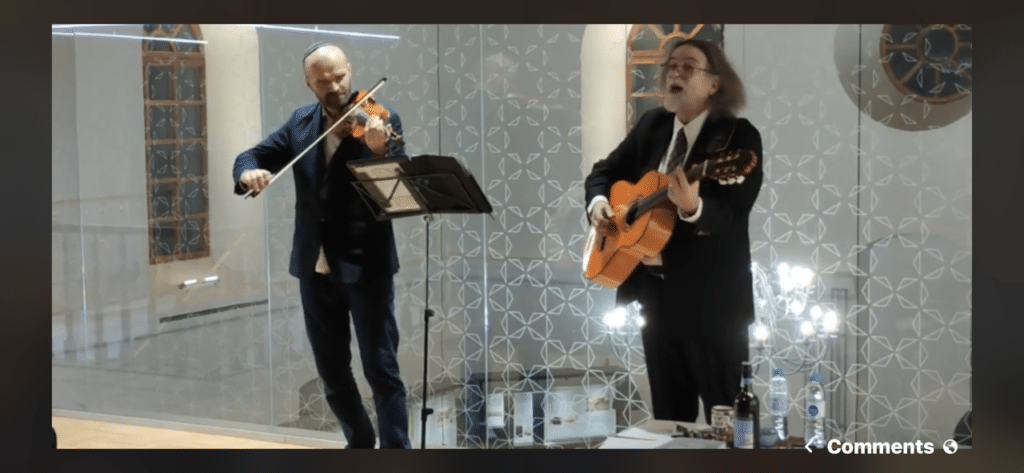
Where to begin? This past Shabbes was a fantastic experience in every way!! Lighting Shabbat candles in the synagogue in Chelm, where there has not been a service for 80 years, was a humbling experience. As I explained the meaning of lighting Shabbat candles, the metaphor of bringing light again into this space was profoundly moving. The service/concert I did with Marcin re-created the Shabbat service. I selected pieces that were both old and newly composed, including a nigun that Marcin wrote. We started with this beautiful nigun, and everyone caught on to the melody, filling the room with song. The Shabbat meal that followed was alive with conversations about Jewish life in Poland, and one of our honored guests was a member of the Polish Parliament! This esteemed government member showed up at all three of the events sponsored by the Jewish community.
Shabbos morning, I slept in, and then we traveled to Wojsławice, where there is a newly restored synagogue. I walked in feeling sad, thinking about shuls that are now museums or restaurants. With no Jews to fill them, they are a memorial. I walked in, and it was a beautiful building. I stood on the bima and sang the Shema, and the sound was fantastic as the synagogues of Europe were acoustically beautiful. I started to walk around the display cases, and then I saw a book with photos of Jews who lived in the area. The museum’s caretaker was a lovely man who, when he knew I was coming, set the photo book to a picture of the family Sztajn. I saw that picture and realized that I am only miles from the Ukraine border, where my father was born in Volyches’k. Could they be relatives?
I don’t know. But when I realized that I needed a siddur for the first section of Havdalah, which I can never seem to memorize, there was a siddur written in Hebrew and Polish sitting on the stand that the Shaliach Tzibbur might have stood. I opened it up, the pages reflected the universal character of the Jewish prayer book, and there, where it was supposed to be, was the Havdalah service. The siddur did not turn my sadness to joy, but a spiritual feeling of familiarity, of being home, and my tears turned to the deep Jewish soul that, baruch Hashem, will always connect with the Holy One. That inspiration made the Havdalah ceremony and concert the best one yet. The President of the town (really the Mayor) made an excellent introduction and emphasized the importance of understanding and working with all faiths. I was surprised to hear his words, but in a sense, he does what I do in my world–work to bring people together. The evening was not a show, but a gathering meant to create understanding. Each year the Mayor presents a program that involves the Catholic Church, the Ukrainian Orthodox Church, and the synagogue. People go from one house of worship to another, and then they have an outdoor music festival. Of course, Marcin and I received an invitation to be part of the festival in July.
I returned to my Chelm hotel and got on a Zoom conference with all of my children, grandchildren, and my darling wife. Although it was not yet my birthday, we spent an hour together laughing and singing. Jared wrote a hilarious song and captured the 70 years, almost unbelievable doings of his father. It was the perfect birthday present. Funny note–one of my sons asked, “So what are you doing on your birthday?” I replied, “I am singing in a cemetery.” That got a good laugh. But it is true. I sang at the anniversary of the clearing of the Chelm Ghetto, where 15,000 Jewish people met their death. The surnames of the families were read, including the name Sztejn. It was a moving moment. I then sang the Eil Malei Rachamim and said in English the words that I was saying in Hebrew. “Men, women, children–strangled, burned, murdered Kiddushat HaShem in the name of God.” It was my birthday–but wasn’t it poignant that 80 years after the horror, Am Yisrael Chai–the people of Israel live and thrive and make the world a better place. No better statement to make on my 70th birthday!!!!
Then we drove to Lublin to do a program at a shtieble shul on the second floor of a building that had survived the war. I had been there before, several years ago, and there did a little program there. The members and President of the Jewish Historical Society were there, and Hania, Professor Spiewak, Iza (Rivka), and people from Slupsk where I am performing a concert on the first night of Hanukkah. They had all come to celebrate my birthday with me, and Marcin brought a cake. It was a great evening, and the cake was delicious. The program was like a parlor concert and very intimate. People felt deeply moved by the music and stories of Jewish life. What a weekend!! I am off to Warsaw tomorrow and then to Krakov for the Shabbat. I am a little tired, but I am getting the opportunity to sleep in and take care of myself. Thanks for listening, Mike  

Niver’s NOTE: I met Hazzan Stein and his son at Nashuva: Watch them sing together:

My Chelm Story!! Read More »