fbpx

October 21, 2021

The Tacos of Memory – A poem for Parsha Vayera

And Abraham circumcised his son Isaac when he was eight days old, as God had commanded him. ~ Genesis 21:4

I like to follow instructions so, like Abraham,
eight days after my son was born, he experienced
the enschnippening of our people.

Many people came to witness it
to sing songs while it was happening
to observe our observance of the covenant.

We served tea.

Thirteen years later, and just two days ago
(as of this writing) my son became a man
in the eyes of everyone who’s ever

been enschnipped (and their wives) in front of
an enthusiastic crowd of familiar people
who sang along and wept along.

We served sandwiches.

Later that evening a similar set of people
gathered under three stars and sang about
how the week was moving from holy to mundane

and how everything from the next moments
was going to be different from all the moments
that came before – A separation.

We served tacos.

Tacos that stained the concrete under which
they were served. A stain which will serve
as a new kind of reminder of that day

for years to come.

We are a people who strive to remember.
With candles and cuts. With wine and scents.
With food, always with food.

Ever since Abraham did what he was told
We do what we were told in this
chain that never ends.


God Wrestler: a poem for every Torah Portion by Rick LupertLos Angeles poet Rick Lupert created the Poetry Super Highway (an online publication and resource for poets), and hosted the Cobalt Cafe weekly poetry reading for almost 21 years. He’s authored 25 collections of poetry, including “God Wrestler: A Poem for Every Torah Portion“, “I’m a Jew, Are You” (Jewish themed poems) and “Feeding Holy Cats” (Poetry written while a staff member on the first Birthright Israel trip), and most recently “The Tokyo-Van Nuys Express” (Poems written in Japan – Ain’t Got No Press, August 2020) and edited the anthologies “Ekphrastia Gone Wild”, “A Poet’s Haggadah”, and “The Night Goes on All Night.” He writes the daily web comic “Cat and Banana” with fellow Los Angeles poet Brendan Constantine. He’s widely published and reads his poetry wherever they let him.

The Tacos of Memory – A poem for Parsha Vayera Read More »

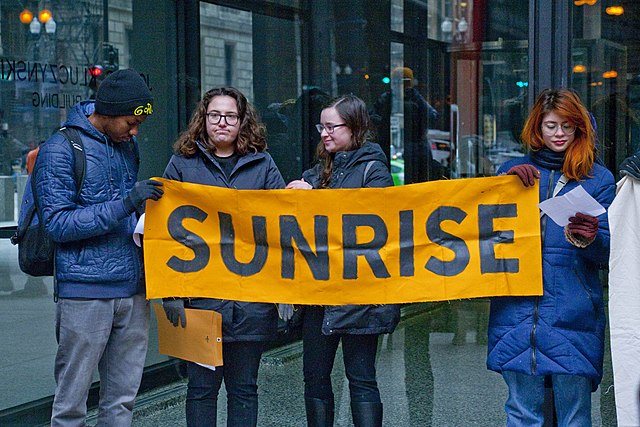
Sunrise Movement Addresses DC Chapter: “We Will Always Welcome Anyone Who Acts on Our Principles”

The climate group Sunrise Movement issued a statement on October 21 addressing their Washington, D.C. chapter’s decision to not participate in a voting rights rally because of “Zionist organizations.”

Sunrise DC cited the participation of the Jewish Council of Public Affairs (JCPA), National Council of Jewish Women (NCJW) and Religious Action Center of Reform Judaism (RAC) in the October 23 Freedom to Vote Relay – Rally at the Finish Line as being “in alignment with and in support of Zionism and the State of Israel.” “Given our commitment to racial justice, self-governance, and indigenous sovereignty, we oppose Zionism and any state that enforces that ideology,” they said in a statement.

Sunrise Movement’s statement addressing their D.C. chapter read: “Our work on behalf of all humanity is rooted in the value of human dignity and we reject all forms of discrimination, including antisemitism and anti-Palestinian racism.” They added that they had not seen Sunrise DC’s statement before it was published.

“As a national movement that supports freedom and dignity for all people, we will always welcome anyone who acts on our principles and chooses to join the fight for collective liberation,” Sunrise Movement’s statement concluded. “We believe that the rights of Palestinians are a part of that struggle and are committed to embracing that struggle together.”

Anti-Defamation League CEO Jonathan Greenblatt tweeted that Sunrise’s statement “doesn’t do it.” “Saying you reject #antisemitism is not the same thing as rejecting anti-Jewish hatred as it happens in real life. Not to mention you failed to clearly and unequivocally condemn the antisemitic call to exclude Jewish groups.”

The Jewish Democratic Council of America tweeted that Sunrise Movement’s statement is “woefully insufficient. The failure to call out blatant antisemitism only leads to further division at a time when we all need to unite to protect our democracy.”

Stop Antisemitism Executive Director Liora Rez said in a statement to the Journal, “Not posting their apology to social media (their main line of communication with followers) [Sunrise Movement’s] condemnation of antisemitism and othering the Jew hatred espoused by their mid-Atlantic hub, DC, is quite troubling; a more firm and transparent stance must be taken for anyone to take this seriously.”

Sunrise’s chapter at George Washington University, Sunrise GW, condemned Sunrise DC in an October 21 Twitter thread.

“Standing in solidarity with the Palestinian people is morally just and not antisemitic,” they wrote. “Singling out explicitly Jewish organizations despite non-Jewish organizations in the coalition holding similar stances on Israel is unquestionably antisemitic and has no place in our movement.” Sunrise GW added that they will never “place a litmus test on Jewish students or any students to be a part of our movement at GW.”

Several Jewish groups have condemned Sunrise DC’s statement as being antisemitic; the progressive Zionist group Zioness called the statement “explicitly antisemitic” because “it calls these leaders ‘Zionists,’ but ascribes ideological positions to them by virtue of one thing: their Jewishness. It targets Jewish leaders in a way that Sunrise would not––and should not!––target leaders from any other group. It focuses exclusively on the demonization of Israel, the world’s only Jewish state. It attempts to pit the entire progressive movement against progressive Jews. It attacks them not for their support of any actual policy or action of the Israeli government, but for their belief that the State of Israel has the right to exist at all.”

Representatives Jerry Nadler (D-NY) and Grace Meng (D-NY) are among the members of Congress who denounced Sunrise DC’s statement as “offensive and wrong.”

Jewish Insider reporter Gabby Deutch tweeted that she had not heard from any members of Congress who had been endorsed by Sunrise on the matter, though one of her colleagues later received a statement from Representative Mondaire Jones (D-NY) saying: “I condemn the call for the exclusion of these Jewish organizations from this event. We must focus on building a broad coalition to support our democracy, not excluding groups for unfair & arbitrary reasons.”

Sunrise DC has protected their tweets, but the Journal did obtain a screenshot of the DC climate group retweeting an October 20 tweet stating that anti-Zionism isn’t antisemitism and “#FreePalestine.”

UPDATE: On October 22, Sunrise Movement tweeted out a photo of their October 21 statement, writing: “To be clear, Sunrise DC’s statement and actions are not in line with our values. Singling out Jewish organizations for removal from a coalition, despite others holding similar views, is antisemitic and unacceptable.”

Sunrise Movement Addresses DC Chapter: “We Will Always Welcome Anyone Who Acts on Our Principles” Read More »

Strengthening Our Camp Community Through Inclusivity

When I think about what inclusivity can do for a community, I think about the Keshet Avodah Corps at Camp Chi. This program allows older teens and young adults with disabilities to work independently at camp during the summer and learn key-life skills that can help them prepare for the next phase of their lives. I have seen firsthand how it has strengthened the Camp Chi community through inclusivity, allowing its participants to feel a sense of belonging and to continuously grow. October marks National Disability Employment Awareness Month and it’s a time when we need to recognize the importance of employing all people who can make strong contributions in unique ways. It’s also a month that calls on us to act because disabled and non-disabled individuals working together adds great value to our community.

Participants in the Avodah program can try many different jobs such as working in the camp office, assisting in the art center, overseeing the camp garden and more! Through this program, participants gain independence, build confidence, and contribute to the greater camp community all while having fun with their friends!

Keshet and Camp Chi started this program to create an inclusive community with an inclusive mindset. We saw campers with disabilities becoming young adults and we wanted to provide them the opportunity to follow the same journey as their non-disabled camp friends and work at Camp Chi. What started as an initiative to provide participants the opportunity to work with their camp friends, soon became so much more. It became a jumping off point to prepare them for the next phase in their young adult lives. As their friends went off to college and began working outside of camp, they realized they too could follow the same path and have a future beyond camp.

The Avodah program in many ways serves as an example of what an inclusive community could and should look like outside of camp. Every year, hundreds of campers come to camp at Chi and see an environment where people with disabilities and people without disabilities work alongside each other. While the program provides life-skills and tools to its disabled participants, it also offers life lessons to non-disabled campers. This creates an example for campers who are the next generation of business owners and employers, who will be advocating for real inclusion in the work force and community life. They will be the ones who will open their doors to having individuals with disabilities working alongside them. They will be the ones who understand the sense of belonging and supporting others.

While we’ve built this inclusive community at Camp Chi, there is still much more work to be done to further inclusivity across the globe. We’ve found the barrier for our participants in getting jobs is not a lack of skills or training, or a desire to have a job, but rather the lack of jobs available. It’s the lack of business owners and employers understanding the value our adults with disabilities bring to their businesses.

While October is National Disability Employment Awareness Month, we need to make sure we’re advocating every day for a more inclusive community. The Avodah program might only run two months every summer, but its impact can be felt year-round. It has shown us the power and value that inclusivity can bring to society.


Jennifer Phillips is an accomplished special education professional with more than 29 years of experience in classroom, recreational and residential settings. She is currently the Chief Executive Officer of Keshet.  She has extensive experience as an administrator, trainer, consultant, and direct service provider. Phillips began her career with Keshet in 1994 as a one-on-one summer camp counselor. This experience motivated her to become a special education teacher and she subsequently spent 18 years teaching before leaving the classroom. She most recently held the position of Chief Program Officer for Keshet, and she oversaw all of Keshet’s service areas – Education, Recreation, Adult Programs, Residential and the Pritzker Pucker Inspire Center. Jennifer’s role in program development and community partnership building has been an unparalleled success for the organization. Phillips was responsible for 340% growth in enrollment in Keshet’s camp and recreation programs in just two years. Her leadership contributed to Keshet’s model of inclusive summer camps to be recognized as an industry best practice. Phillips is regularly called upon by other camps and community centers for consultations and to lead trainings about inclusion. She believes in the power of inclusion and works tirelessly to ensure that people with disabilities have meaningful lives in their home communities. Jennifer is a strong, hands-on, and team-focused leader with a deep passion for inclusion and the well-being of the community.

Strengthening Our Camp Community Through Inclusivity Read More »

Tips For Decorating Your Mantel

One design dilemma that frequently stumps home decorators is how to arrange art and accessories on their fireplace mantels. The mantel is a focal point of a living room, often the first place someone looks when they enter the room. If you’re not sure how to best decorate your mantel, find some inspiration in these tips for creating a beautiful display. Keep in mind these are just tips, not rules. And if you don’t have a mantel, these same tips apply to entry tables and side tables, as well. 

Arrange symmetrically

When you’re not sure how to decorate the mantel, the simplest tip is to go for symmetry. Balance a large object in the middle with identical pieces on either side. For example, you can place a large mirror in the center and then arrange candlesticks of the same height to the left and right. This will result in an isosceles triangle formation that is very pleasing to the eye. 

Skew asymmetrically

In contrast to the symmetrical triangle formation, the asymmetrical – or obtuse – triangle is also visually effective. Here, you would place shorter objects like books and photos on one side, and a taller object like a vase holding branches on the other. The asymmetry guides your eye, allowing it to move from left to right and back again  

Think in threes

Maybe because I was an English major and was taught to outline my essays in threes – three main supporting points, each with three specific examples – I also decorate in threes. To do this, choose three different types of objects and display three of each type. For example, you can display three types of home accents, such as books, clocks and candles. And then, if you really wanted to be true to the principle of threes, you would select three books, three clocks and three candles. 

Keep it monochromatic

Choose a rich hue, like blue or orange, and keep all your display objects in the same color family. The monochromatic look is chic and modern, and more importantly, it takes out a lot of the guesswork in deciding what to display. Shopping is also easier when you know you’re looking for a certain colored accessory. 

Layer with different heights

When displaying objects, try to make them of variable heights so the eye can move up and down. One way to vary the height is to stack objects — for example, by placing a vase or a figurine on top of a book. Also, layer them from back to front, overlapping objects so they are not on the same plane. 

Create a gallery

If you have any framed prints or photographs gathering dust in the closet, take them out and show them off. They’ll look beautiful grouped together as an impromptu gallery on your mantel. And there’s no need to hang them – just lean them up against the wall. Again, make sure they are of differing heights, and overlap them to create layers.

Don’t feel like you have to display only what you see in design magazines. Let your mantel reflect your own interests and personality. 

Get personal

Don’t feel like you have to display only what you see in design magazines – you know, vintage books, candles, vases and other oh-so-tasteful objets d’art. Let your mantel reflect your own interests and personality. I’ve created mantel displays with vintage lunchboxes, typewriters, African masks – whatever was personal and meaningful for my client. After all, one person’s tchotchkes are another’s treasures.


Jonathan Fong is the author of “Flowers That Wow” and “Parties That Wow,” and host of “Style With a Smile” on YouTube. You can see more of his do-it-yourself projects at jonathanfongstyle.com.

Tips For Decorating Your Mantel Read More »

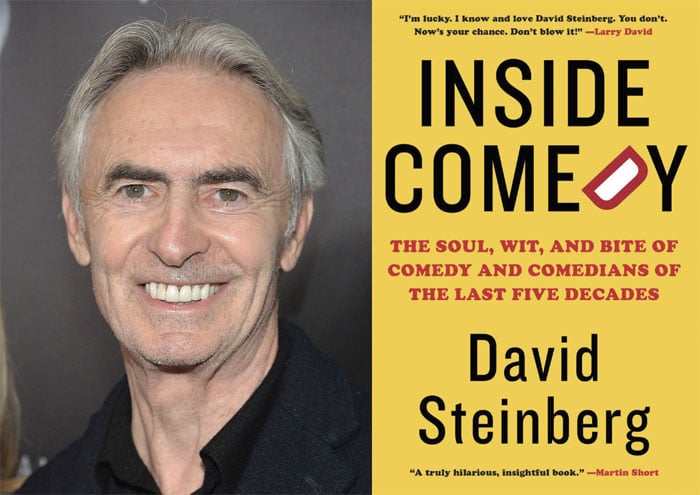
In His New Book, David Steinberg Talks Funny Business

David Steinberg started his career as a stand-up comedian in 1968 and achieved the distinction of 140 appearances on The Tonight Show during its golden age under Johnny Carson. He moved into a parallel career as a director of comedy shows ranging from “Designing Women” to “Curb Your Enthusiasm,” and he has engaged in an on-going public conversation with fellow comedians as the host of the long-running documentary series, “Inside Comedy.” 

Steinberg uses the same title for his new book, “Inside Comedy: The Soul, Wit, and Bite of Comedy and Comedians of the Last Five Decades (Knopf), which is both an frank and intimate memoir and, almost coincidentally, a sweeping history of contemporary American comedy.  More often than not, when Steinberg drops a name, it’s someone he knew before he or she was famous.  Not unlike Steinberg’s on-stage and on-screen persona, the book is funny, savvy and thought-provoking, all at the same time.

We learn, for example, that he was a pre-rabbinical student at Hebrew Theological College before taking the stage as a stand-up comedian for the first time in 1968 at the Bitter End in Greenwich Village in 1968.  His set included comic sermons based on the Bible, his first comedy album was titled “The Incredible Shrinking God,” and he cracks that his familiarity with the Talmud meant he had “the only little black book in Hollywood that was written in Aramaic.”

Steinberg learned a crucial lesson about stand-up he saw Lenny Bruce for the first time at the Bitter End, a jazz and comedy club in Chicago. “He was a revelation because he wasn’t trying to be funny all the time,” Steinberg recalls. “Doing comedy was being smart, which I saw with Lenny.  I suddenly knew that I wanted to be smart as much as I wanted to be funny. And then I realized that being funny is a version of being smart.”

Indeed, Steinberg is credible both as a comic and as an intellectual. For example, he was introduced to the work of Isaac Bashevis Singer by Philip Roth while a student in the class that Roth taught at the University of Chicago.  Years later, it was Steinberg who introduced Barbara Streisand to the Singer’s work, which is why she ended up directing and starring in a motion picture version of “Yentl.”  By then, Steinberg and Singer were lunch buddies.

But Steinberg is not merely name-checking his fellow celebrities.  He recalls the work he did and the conversations he had with an encyclopedic list of actors and comedians  — Woody Allen and Carol Burnett and  Sid Caesar,  Bette Midler and Mike Myers and Steve Martin, Don Rickles and the Smothers Brothers and Lilly Tomlin, Flip Wilson and Jonathan Winters and Robin Williams, among countless others. Each reminiscence carries an insight into the experiences and emotions that help to explain what made them so good at what they did (or still do).

Robin Williams, for example, was working the late-night shift at an ice cream parlor in San Francisco when he saw a flyer for an  improv night at a Lutheran church.  He had spent two years as an acting student at Juilliard under John Houseman but “left when Houseman told him that there was nothing more he could teach him.”  The stand-up stage, rather than Juilliard and John Houseman, was what it took to launch the stellar career of Robin Williams, which Steinberg analyzes in detail and with deep compassion.

“He had an unbelievable sense of what is funny, and his mind went so fast,” explains Steinberg. “But his real genius was his improvisation—brilliant, sometimes scary, because you never knew where he was going.” What the public never saw was his generosity, and Steinberg reveals that when his classmate at Juilliard, Christopher Reeve, suffered the catastrophic injury that ended his acting career, it was Williams helped to pay Reeve’s medical bills. “That was the personal, incredible thing about Robin Williams—he had the biggest heart.”

Steinberg devotes a chapter to the Hillcrest Country Club. “For the price of a small house, you could play eighteen holes of golf there, or a game of tennis,” he writes, “but the real action was at the comedians’ table, set back in a corner of the main dining room.”  Among them were both Danny Kaye (“who was Jewish despite the changed name – he was born David Daniel Kaminsky”) and Danny Thomas (who was “Hillcrest’s first non-Jewish member”).  When Thomas became a member, Jack Benny quipped: “The least they could’ve done was admit someone who looked like a gentile.”  Steinberg reveals that he used to chat in Yiddish with Danny Thomas, who learned the mamaloshen in showbiz circles.

“Inside Comedy” comes at a fraught moment in American comedy, but Steinberg helps us put the latest hot topic – Dave Chappelle’s “The Closer” – into its historical context: “There is no way there would be Dave Chappelle if there hadn’t been Richard Pryor.”  And Steinberg himself was capable of offending his fellow Jews with his comedy. When Pryor and Steinberg were both on the bill at the same New York nightclub, Pryor asked him:  “Son of a bitch, David, how come the Jews don’t get pissed at you?” Steinberg confides to us: “Not quite true. They were pissed at me.”

If there is a through-line in “Inside Comedy,” it is the struggle of stand-up comics to test the boundaries of what can be spoken aloud.  

If there is a through-line in “Inside Comedy,” it is the struggle of stand-up comics to test the boundaries of what can be spoken aloud.  In that sense, the current controversy over Dave Chappelle is only the latest example of the true calling of a comedian.  “And now that the era of Trumpism had suddenly fallen on our heads, and as the independent press is suppressed and discredited, we needed our comedians to remind us that the emperor had no clothes,” Steinberg writes. “I should know—a big part of my early success came from satirizing Nixon and his gang, a necessary service to the nation, even though it put me on the Enemies List.”

The punchline to a famous joke about the secret of comedy – “Timing” – comes to mind in the pages of “Inside Comedy.”  Steinberg makes the point that there is nothing new about the effort to stifle the stand-ups and censor their comedy, and he reminds us that perhaps never before has it been more important to push back.  On that point, he quotes something that George Harrison told the Smothers Brothers when they found themselves in a battle with the network censors in 1968: “’Whether you can say it or not’ Harrison urged them on the air, ‘keep trying to say it.’”


Jonathan Kirsch, author and publishing attorney, is the book editor of the Jewish Journal.

In His New Book, David Steinberg Talks Funny Business Read More »

Student Debt Activists Press for Loan Forgiveness in USC Panel

The Biden Administration’s detailing of its student loan forgiveness plan on October 6 may help more than one-third of those enrolled in the program, but that hasn’t pleased everyone.

At a screening and discussion of “Scared to Debt,” presented by USC School of Cinematic Arts, on October 14, a panel moderated by USC professor of Critical Studies and vice dean for Academic Affairs Michael Renov that included the film’s director, Michael Camoin,  Rabbi Jason Rosner of Temple Beth Israel of Highland Park and Eagle Rock, social justice activist Kiyomi Kowalski and Alan Collinge, author of “The Student Loan Scam.”  Pre-recorded comments from Senate Majority Leader Chuck Shumer (D-N.Y.) and USC President Dr. Carol L. Folt laid out the main points of the plan.

“For generations, higher education has been a ladder up to the middle class, especially for [minorities],” Schumer said. “But today, student debt is an anchor weighing too many down. Listen to this truly frightening number: Over 43 million Americans owe more than $1.7 trillion in student loan debt. Roughly one in five of them is in default, damaging their finances and credit scores for years — maybe decades.”

Folt said that access and affordability are priorities that USC embraces. “In my first year, I announced an affordability initiative for undergraduates. This program makes USC tuition-free for undergraduates whose family annual income is $80,000 or less, and it removes home equity when considering a family’s contribution.”

The new policy is making a difference. According to Folt, more than 20% of the newly enrolled first-year students were part of the program, and one-third of them are first-generation students. 

They received some pushback from the panel. Collinge, who is featured in Camoin’s film, said that even before the pandemic, 80% of borrowers were not going to be able to pay off their debts because of complicated and unfair policies from the government and lenders. 

Camoin agreed, and scolded Albert Lord, the CEO of Sallie Mae, for regarding universities as his customers instead of students.

Instead of being loudly committed to resolving the stickiest portions of student loan debt forgiveness, Collinge added that the GOP largely has camped, uninvolved, on the sidelines. They need to take care of their own, he said, since “55% of student loan borrowers identify as Republican.”

Kowalski explained that she is deliberately not married for what she called strategic reasons. Her original $34,000 student loan has ballooned past a half-million dollars.

During their 45-minute discussion, the panelists concurred that the misunderstood, balky and complicated issue of student loan debt forgiveness should be a priority for Congress and influential Americans. 

Rosner noted that the shmita (or release) year is just underway, capping an every-seventh-year cycle when debt forgiveness is a major requirement, not merely a good idea. He was optimistic about a solution.

“There is a larger public outcry because each year, more people reach the point where they can be forgiven, and they become enraged when they find that this debt can’t be discharged,” he said.

“There is so much convergence between debt forgiveness, equity and Jewish values to explore.”— Lisa Ansell

Lisa Ansell, associate director of the USC Casden Institute for the Study of the Jewish Role in American Life, ended the discussion with a Jewish bent. She said, “There is so much convergence between debt forgiveness, equity and Jewish values to explore.” n

Student Debt Activists Press for Loan Forgiveness in USC Panel Read More »

JFS SOVA Receives $5.7 Million State Grant

Jewish Family Service LA’s SOVA Community Food & Resource Program (JFS SOVA) was awarded a $5.7 million grant from California’s 2021 budget allocation to purchase and expand the property in Van Nuys that it has been renting since 2005. 

California Assemblymember Adrin Nazarian (D-Van Nuys) and State Sen. Bob Hertzberg (D-Van Nuys) announced the grant at a news conference at the Van Nuys JFS SOVA location on Oct. 7.

‘This $5.7 million dollar investment is critical to allow JFS SOVA to continue providing life-saving groceries and support to the ever-growing number of individuals and families struggling to meet their most basic needs.’ – Adrin Nazarian

In a written statement, Nazarian said, “This $5.7 million dollar investment is critical to allow JFS SOVA to continue providing life-saving groceries and support to the ever-growing number of individuals and families struggling to meet their most basic needs.” 

Added Hertzberg: “This funding is essential to feeding countless families here in the Valley. Our Valley neighborhoods have relied on Jewish Family Service LA for decades and the state’s investment recognizes the unique role it plays in the health and stability of our community, especially as we continue to face the ongoing impacts of the pandemic.” 

JFS said its Van Nuys location is the program’s central hub and that it will use this allocation to, “Purchase the property and fully rehab the existing warehouse and pantry site to add additional refrigeration/freezer capacity. With the ability to incorporate the empty storefronts into program delivery and upgrade those spaces, [we] will be able to enhance and expand the services available on-site to individuals and families that need them.” 

“For more than 40 years, the JFS SOVA has been a lifeline for those facing hunger in Los Angeles,” Eli Veitzer, JFS president & CEO, and Nina Tassler, board chair,  said in a joint statement. “This remarkable investment will benefit individuals and families throughout the San Fernando Valley for generations to come.”

The JFS SOVA Van Nuys program houses a five-day per week food pantry distribution center, counseling and case management offices, drop-in space for partner organizations, warehouse space and program administration. JFS said that throughout the pandemic, it expanded its services to provide food to more than 5,700 people and deliver groceries to over 1,300 homebound older adults and people with different abilities each month.

JFS SOVA Receives $5.7 Million State Grant Read More »

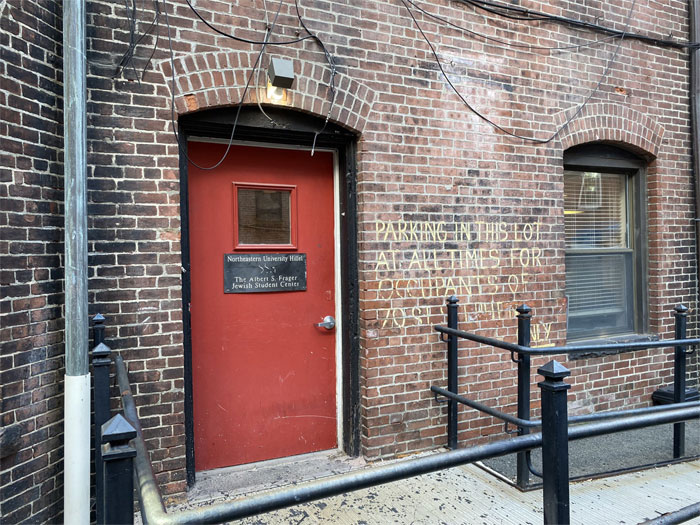
Northeastern University Hillel Mezuzah Torn Down

Northeastern University (NU) Hillel’s mezuzah was ripped from the building over the weekend.

Writer and activist Yoni Michanie tweeted out a photo of the mezuzah, stating: “Saddening to have come into Northeastern University’s Hillel to find the mezuzah ripped from the building’s entrance. Authorities have been contacted and an investigation is being carried out. Hopefully the individual/s responsible for this will be held accountable.”

Erin Fine, a student journalist at the university, also tweeted that the mezuzah had been torn down and quoted the Hillel director, Gilad Skolnick, as saying: “No form of hatred or discrimination should be allowed on campus.”

https://twitter.com/efine2024/status/1450489226408120324?s=20

University President Joseph E. Aoun condemned the tearing down of the mezuzah in a statement. “This despicable act has left members of our Jewish community justifiably upset, and even fearful. They are experiencing firsthand an instance of senseless hate, coming at a time when the ancient scourge of anti-Semitism is on the rise across the U.S. and around the world.

“We must respond first with compassion and empathy. We must offer an endless well of support, standing in unity with our Jewish classmates, colleagues, and friends.”

He also said that the suspect is not believed to be someone affiliated with the university.

Anti-Defamation League New England tweeted that the removal of the mezuzah “sends an alarming message to the community. As NU investigates this hateful act, it should work to foster a safe community where all belong, including those who choose to display religious symbols openly.”

Northeastern University Hillel Mezuzah Torn Down Read More »

Jews Not Welcome in this Museum

Most distressed, I can’t restrain myself from making strenuous strictures
regarding a museum made by the Academy of Motion Pictures.

Though its Director created a Museum Advisory Committee
to spotlight and prevent historical omissions, it’s a pity
installations this committee strangely has omitted
include a lot of Jews, who sadly have not been admitted
officially as Jews, deJudaized with ghostly expurgation
of their ethnicity, members of the challenged chosen nation.

Many of them changed not just their oh-too-Jewish names
and noses, but (j’accuse) a fact that far more seriously shames
the industry that’s known as Hollywood, the story of how Jews
were being persecuted by the Nazis. Moguls would refuse
to mention this till Lanzmann made in France his “Shoah”. Hollywood thus missed
the Holocaust, a huge omission until Steven Spielberg’s “Schindler’s List,”
not showing all the world how Jewish lives were being threatened by
a process leading to the genocide that’s called the Shoah. Why
is space significantly given just to one Jew, mogul Louis Mayer?
The Museum’s funders act like most deplorable deniers
of antisemitism by their failure to have clearly documented
that Hollywood exists because it was by memorable Jews invented.

By demonstrating towards Jews a harmful absent-mindedness,
the Museum exorcises Jewish history that it fails to address.

***

In “Jews built Hollywood. So why is their history erased from the Academy’s new museum?,” Sharon Rosen Leib writes about the $484 million Academy Museum of Motion Pictures in Los Angeles that has finally opened to the public. (Forward, 10/14/21):

Hollywood’s founding moguls included Sol’s tyrannical boss William Fox, Adolph Zukor (Paramount), Harry and Jack Warner (Warner Bros.), Carl Laemmle (Universal), Sam Goldwyn and Louis B. Mayer (MGM) and Harry Cohn (Columbia)— all Jewish. They achieved global reach by creating celluloid dream factories whose moving pictures rapidly became America’s most influential cultural export.

But at the museum, they are ghosts. Their presence hangs over the halls— there would literally be no museum, no industry, without them. But the museum’s current installations devote meaningful space only to mogul Louis B. Mayer as the prime mover in founding the Academy and the villainous executive who tormented Judy Garland.


Gershon Hepner is a poet who has written over 25,000 poems on subjects ranging from music to literature, politics to Torah. He grew up in England and moved to Los Angeles in 1976. Using his varied interests and experiences, he has authored dozens of papers in medical and academic journals, and authored “Legal Friction: Law, Narrative, and Identity Politics in Biblical Israel.” He can be reached at gershonhepner@gmail.com.

Jews Not Welcome in this Museum Read More »