
Print Issue: Judea Pearl Has a Lot on His Mind | Oct. 15, 2021
Print Issue: Judea Pearl Has a Lot on His Mind | Oct. 15, 2021 Read More »


A 23-year-old Jewish man studying in a Yeshiva was reportedly shot by an unknown individual with a BB gun in the Crown Heights area of Brooklyn on October 11.
The New York Post reported that the victim was wearing “traditional Jewish garb” when someone in a black van fired the BB gun at him. The bullet grazed his head and he was taken to the hospital with minor injuries. No antisemitic statements were made by the shooter but the New York Police Department’s (NYPD) Hate Crimes Task Force has been informed about the incident, according to the Post.
“We are extremely alarmed and concerned by this possible antisemitic attack,” Anti-Defamation League (ADL) New York / New Jersey Regional Director Scott Richman said in a statement, adding that the ADL “unequivocally condemn[s] this violent act and hope others will join us to ensure that everyone feels safe in their communities.”
Please see the following statement from Regional Director @scottarichman regarding an incident in #CrownHeights last night.https://t.co/xjbwAR7GG0 pic.twitter.com/rNcRJMR3sj
— ADL New York / New Jersey (@ADL_NYNJ) October 12, 2021
StandWithUs similarly tweeted that they were “horrified” by the shooting. “StandWithUs condemns this attack and hopes the perpetrator(s) will be found. The NYPD Hate Crimes Task Force is investigating this incident as a possible antisemitic hate crime, and we thank them for their efforts.”
We are horrified by the drive-by shooting of a yeshiva student in Crown Heights, Brooklyn, earlier this week. We are glad to see from reports that the student is in stable condition, and we pray for his speedy and complete recovery. https://t.co/uQyUM2dJpJ
— StandWithUs (@StandWithUs) October 13, 2021
StandWithUs condemns this attack and hopes the perpetrator(s) will be found. The NYPD Hate Crimes Task Force is investigating this incident as a possible antisemitic hate crime, and we thank them for their efforts.
— StandWithUs (@StandWithUs) October 13, 2021
The NYPD released a report in July stating that antisemitic incidents had increased by 69% from 2020 to 2021 in New York City.
NY Yeshiva Student Shot With BB Gun Read More »

Former NFL star Herschel Walker, who is currently running for Senate in Georgia, canceled a fundraiser with a donor over her use of a swastika as her Twitter profile image.
The Atlanta Journal-Constitution reported that the donor, conservative filmmaker Bettina Sofia Viviano-Langlais, had as her profile picture an image that appeared to be syringes arranged in the shape of a swastika.
Spokeswoman for Trump-endorsed Senate candidate Herschel Walker: This is not a swastika. "This is clearly an anti-mandatory vaccination graphic."
The graphic: pic.twitter.com/KcseAf99DT
— Brandon Friedman (@BFriedmanDC) October 13, 2021
A spokesperson for Walker’s campaign initially told the Journal-Constitution that the image was “clearly an anti-vaccination graphic”; later in the day, the campaign told the newspaper that the fundraiser with Viviano-Langlais has been canceled.
“Despite the fact that the apparent intent behind the graphic was to condemn government vaccine mandates, the symbol used is very offensive and does not reflect the values of Herschel Walker or his campaign,” the campaign told the Journal-Constitution. They also referred to Walker as “a strong friend of Israel and the Jewish community.”
Viviano-Langlais has since removed the image from her Twitter profile; she posted to social media that the image was conveying “what happens when fascists demand people insert foreign material into their body they don’t want” and was not meant to promote antisemitism.
Anti-Defamation League Southeast tweeted, “Comparing vaccine policies to the genocide committed by the Nazis is deeply offensive — it’s become a common and callous tool for political gain. We’re glad to see the fundraiser was canceled, and the behaviors of the host were denounced as offensive.”
Comparing vaccine policies to the genocide committed by the Nazis is deeply offensive — it’s become a common and callous tool for political gain.
We’re glad to see the fundraiser was canceled, and the behaviors of the host were denounced as offensive. https://t.co/PgIAhnyX9X
— ADL Southeast (@ADLSoutheast) October 13, 2021
The American Jewish Committee similarly tweeted, “A swastika is a symbol of hate. After @HerschelWalker canceled a fundraiser sponsored by an individual who proudly displayed the antisemitic symbol, he must now clearly condemn comparisons between the Holocaust and COVID health policies.”
https://twitter.com/AJCGlobal/status/1448426424818442243?s=20
Dan Gottlieb, spokesperson for the Georgia Democratic Party, issued a statement saying that “canceling a fundraiser does not change the fact that he failed to condemn a hateful, anti-Semitic symbol.”
Walker is running against incumbent Senator Raphael Warnock (D-GA); the polls show a close race between the two.
Herschel Walker Cancels Fundraiser Over Donor’s Swastika Profile Pic Read More »

Not many Jewish actors can claim to have spent their youth in a real haunted house. Asher Grodman was fortunate enough to grow up on a New Jersey farm possessed by spirits from the 1700s. Did it leave Grodman convinced of the supernatural?
“There were ghosts who had died in the Revolutionary War—soldiers through the swampy wilderness of the time,” the actor explained over the phone. “So, out of respect for those stories and for the home I grew up in, I will say yes.”
It seems only fitting that Grodman currently plays an apparition in the highly anticipated CBS sitcom, “Ghosts.” Adapted from the hit BBC One series, “Ghosts” follows a young couple in their attempt to convert a ghost-ridden estate into a charming bed and breakfast. Grodman took a break from filming in Montreal to discuss his new role and working with the late Eli Wallach.
JJ: Congratulations on your new series, “Ghosts.” What can you tell us about your character, Trevor?
AG: I would say he’s a New York, Wall Street nineties guy who loves to have a good time. He is very much of his time, but by today’s standards, has a few lessons he’s got to learn. He is indeed Jewish, which is very exciting for me because, as a Jew, to get to play a Jew, doesn’t happen very often. He’s just looking for a good time. He’s trapped for eternity with this group of people and eternity is a long time. Better enjoy it.
JJ: How did you prepare for the role?
AG: When I auditioned for it, it was just very clear that the script is fantastic … it was a process of kind of letting go and just trusting that. Aside from that, once I had the role, it was creating the relationships with the different characters in the story and the different things that happen. Also, there’s a fun thing of just being someone who grew up in the nineties. Some of these scripts are like walking down memory lane. You remember these moments where, “Oh, that was on television!” He quotes “Seinfeld” in the pilot. So, for me, the little kid in me is like, “Oh, great!”
There’s a little bit of learning some Yiddish, which is fun. Most of which I knew, but just saying it on television is a lot of fun.
JJ: You directed Eli Wallach in your short film, “The Train.” Wallach played a Holocaust survivor. What do you remember most about working with him?
AG: Just watching him work was such a joy because he was mesmerizing … Eli passed away [prior to the release] and I thought, “No, I’m not going to do this. This is going to come out now and he’s had this incredible career. I don’t want to bring the film out now. I’ll just can it.”
I was terrified—Eli was like Marlon Brando’s landlord. I mean, this guy had been around forever. He was incredible. The fact that he gave his time and energy to this little film was amazing. He showed up on set and he was telling stories the whole time. He was so generous. Everyone was just mesmerized by him.
A friend of mine who was there [on set] was like, “You have to show people this film! Because Eli would be like, “You schmuck, what are you doing? I did the movie, let people see it!’” So, when my buddy told me that, I was like, “Okay, okay, you’re right, you’re right.” I dedicated it to [Eli] and put this film out there. It was a little bit of a journey that took way too long, but I’m glad we got it out there. We got to celebrate Eli.
I think one of the biggest takeaways working with him was he was so easy. He was so easy. You could feel every thought he was having. When the camera started rolling, he didn’t change. He was just as alive and spontaneous and magnetic. For Eli, he was so seamless. He was amazing.
JJ: What do you love most about acting?
AG: You can be really down in the dumps and just be having a miserable time and then, read a good story and you’re thrilled. It excites you. The fact that you can tell that story to someone else—that’s like one of the greatest thrills you could have. Then, in the midst of telling that story, you’re bringing it to life, which means you’re actually discovering each element of that story in real time with someone else. That’s make-believe. That’s the stuff that kids do every day. So, part of it is just being a kid again. Even though it’s “pretend,” it feels sometimes more like real life than real life does.
JJ: You come from a drama background. Was it challenging to transition to comedy?
AG: I remember my audition—Joe Port and Joe Wiseman, our creators, who are awesome, and our director, Trent O’Donnell, who directed the pilot and the first four episodes. They were like, “Um, who are you? We don’t know—you’ve never done a comedy. What the hell?” I think I said something like, “I just figure comedy is like drama, but it’s more serious.”
I think there was like a hunch or something I had about who Trevor was. So, I’ve been able to hold onto that and those relationships. But there’s so much work and different techniques and craft to learn around making the joke land, making sure that you’re not stepping on someone else’s joke, and how you set up your scene partner. Because you’re basically balancing two things at once—you’re telling a story but you’re also taking care of this comedic language, which, of course, is a whole other balance between spontaneity and structure. So, there’s a lot to learn and I am outrageously lucky to be able to learn some of these lessons.
This interview has been edited for clarity. “Ghosts” airs Thursdays at 9 p.m. EST/PST on CBS.
Eve Rotman is a writer on the West Coast. Follow her on Twitter @EveRotman
Actor Asher Grodman Believes in “Ghosts” Read More »

When I was a kid, I loved riddles. At summer camp, after lights out, we would play word games, trying to guess, for example, how two men perished in a small cabin in the woods. The forest around the cabin was burned to cinders but the men didn’t die from the fire. (It was an airplane crash.)
This week I read about a word game that’s just plain silly. Novelist Sally Rooney, author of the critically acclaimed “Normal People,” which was made into a Hulu series, has refused to allow her most recent book to be published in Hebrew. She claims that she’d be happy to have it published in Hebrew as long as it can be done so in a way that adheres to the Boycott, Divestment, Sanctions (BDS) guidelines. This would require finding a company that does no business with Israeli-owned firms that would be willing to publish the book in Hebrew, which is quite a tall order and certainly calls into question the sincerity of her claim.
As Deborah Harris, an Israel-based literary agent, put it: “When it’s ice cream or when it’s cement, or whatever else it is, it’s one thing, but when it comes to culture, I just have a very, very hard time seeing how this can be productive in changing anything. What literature is supposed to do is reach into the hearts and minds of people.”
This seems to be precisely the point. Rooney is trying to reach into the hearts and minds of people she influences in a way that demonizes Israel and, more broadly, Jews. Imagine an author painting with as broad a stroke around a translation of her latest book into Mandarin, for example. The Chinese government is guilty of grave human rights abuses including ethnic cleansing and genocide against the mostly Muslim Uyghurs. An author’s refusal to publish a book in Mandarin, preventing its more than one billion speakers from accessing the work, would be seen as a strong statement of rebuke not just against the Chinese government responsible for the reprehensible policies but against the Chinese people as well. In this case, Rooney’s action can be viewed as one aimed not just at Israelis, but, because of our People’s deep and abiding connection to the Hebrew language, also at Jews.
Rooney is trying to reach into the hearts and minds of people she influences in a way that demonizes Israel and, more broadly, Jews.
In this week’s Torah portion, Lech L’cha, Avram is called “Avram the Hebrew.” It cannot be lost on Rooney that Jews collectively have been known as “Hebrews” and that we have used that word to describe communal institutions particularly at times when virulent antisemitism has transformed the very word “Jew” into a slur (i.e., the Union of American Hebrew Congregations, the Hebrew Union College, and the Young Men’s Hebrew Associations). Eventually, of course, the more refined “Hebrew” was also transformed into a slur that was later reclaimed by the Jewish-themed magazine Heeb.
Rooney’s repudiation of Hebrew and the disingenuous cloaking of it in a way that suggests that she’d be delighted to make the novel available in Hebrew were it not for her devotion to the higher value of BDS is antisemitism pure and simple.
What’s particularly insidious and problematic about this incident is the way such things normalize Jew hatred. To be clear, I am not in any way suggesting that criticism of Israeli governmental policies is off limits. But when Israel is held to a double-standard and demonized, it’s no longer legitimate criticism; it’s antisemitism, arguably the only form of racism that seems to be widely tolerated today.
There’s a Hebrew word for this and it’s no game: sinah (hatred).
Rabbi Yoshi Zweiback is the Senior Rabbi of Stephen Wise Temple in Los Angeles, California.
Sally Rooney’s Word Games Read More »

Ernie Grunfeld is the only known NBA player who is the child of Holocaust survivors. Although he doesn’t speak much about his family’s history, his son Dan, 37, also a former professional basketball player, wrote a book about it called, “By the Grace of the Game: The Holocaust, a Basketball Legacy, and an Unprecedented American Dream.”
The younger Grunfeld’s first book, which will be published November 30, dives deep into his grandmother Anyu’s story in Romania before the Nazis invaded. Along the way, she lost multiple family members and witnessed the horrors of Auschwitz. Swedish architect Raoul Wallenberg saved her on two separate occasions, and she received unlikely assistance from a comedian she had never met, Buddy Hackett.
Interspersed between chapters on Anyu are stories about the elder Grunfeld’s experience as an immigrant from Romania who emerged as a standout basketball player in the 1970s. He played nine seasons in the NBA, and symbolically wore number 18 for the New York Knicks. He later worked over 30 combined years as a team executive for the Knicks, Bucks and Wizards.
The author explored his own inspiration from his grandma while also navigating the pressures of growing up with a star athlete father.
“There are moments of extreme pain, and there are moments of extreme joy,” Grunfeld told the Journal. “The story is ultimately inspiring and hopeful because [of] where my family started and what basketball did [for us].”
Anyu and her husband eventually settled in the Bay Area, where she still lives today. In 2002, Grunfeld chose to go to Stanford to be close to Anyu. While there, he was an academic All-American basketball player, and eventually played professionally in leagues around the world.
At one point in the book, Grunfeld discussed the trepidation he felt when he was offered his first pro contract from a team in Oldenburg, Germany. Before signing, he wanted to make sure to get approval from his grandma, since Oldenburg had a perilous history leading up to the Holocaust.
“In 1932, the Nazis received 48.4% of the regional vote in Oldenburg, making it the first state in Germany to put the Nazis in power based on electoral turnout,” Grunfeld wrote.
“Sons are not responsible for the sins of their fathers,” Anyu told Grunfeld upon learning of his offer to play in Germany.
Eventually, he played for teams in Spain before playing for four different basketball teams in Israel: Bnei Hasharon, Hapoel Holon, Hapoel Jerusalem and Bnei Herzliya.
Grunfeld spent a year and a half doing research for the book, interviewing his grandma and talking with his father.
“It’s such a personal process,” he said. “[There are] so many painful details. My dad doesn’t speak about these things. I knew it would be hard.”
A big theme is the weight of holding onto a traumatic family history while being two generations removed. Both he and his father experienced antisemitism while growing up, but nothing like the horrors that Anyu went through.
Improbability is another theme. There is the improbablity of surviving the Holocaust, along with the improbablity of having success with a career in sports that is elusive to so many.
“The true improbability of it all lies in the discovery of a game, the game of basketball, that unknowingly held the power to heal past wounds and tie a complicated history together.” – Dan Grunfeld
“The true improbability of it all lies in the discovery of a game, the game of basketball, that unknowingly held the power to heal past wounds and tie a complicated history together,” Grunfeld wrote.
There is also a powerful forward by Basketball Hall of Famer Ray Allen. In it, he talks about how he didn’t learn about the Holocaust until “Schindler’s List” was released, and every year when his team visited D.C. to play the Wizards, he would take a teammate to the United States Holocaust Memorial Museum.
With “By the Grace of the Game,” Grunfeld said he looks forward to sharing Anyu’s story with readers and meeting people on his book tour.
Although he said Anyu is still sharp as a nail and plays cards with her friends five times a week, she will have a limited role on the book tour. But her story speaks for itself.
“If we don’t tell our stories, people will forget what happened,” Anyu said. “We have to speak about the Holocaust. I’m very, very proud of my grandson.”
Exploring a Family’s Relationship With the NBA and the Holocaust Read More »
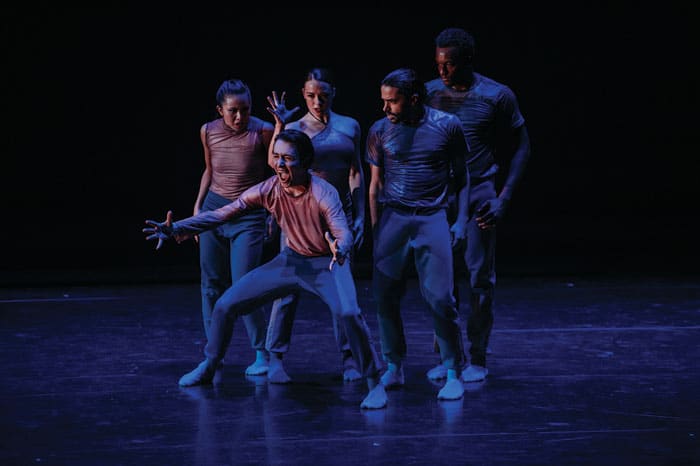
The world-renowned dance company BODYTRAFFIC is about to do their first live hometown show in Los Angeles in 18 months. From October 14 through 16, they’ll be at The Wallis Annenberg Center for the Performing Arts – and they couldn’t be more excited.
“Our industry, of course, has had a really tough time,” BODYTRAFFIC Artistic Director Tina Finkelman Berkett said, referring to the pandemic. “We couldn’t dance for such a long time. But it feels like [there’s] a very fresh [and] energized air in the studio, and we just feel ready to be back in a theater with people and share what we do.”
Berkett co-founded BODYTRAFFIC 15 years ago after relocating to L.A. from New York. With the upcoming show, she said that people can look forward to being part of a performing arts experience that feels more celebratory and current than ever before.
“When [live performance] was ripped from us, we all really understood how much we missed it, and this is our moment to acknowledge that. It raised our commitment.”
Six out of the 10 BODYTRAFFIC dancers are new to the company, so the anticipation for the performance is palpable — but so is the pressure to perform their best. Although it’s the first show in L.A. in a while, BODYTRAFFIC had their first post-pandemic live shows last month in Charlotte and Serbia.
Berkett and BODYTRAFFIC are adept at playing in front of crowds with astronomic expectations, though. In 2015, the U.S. Department of State asked them to be cultural ambassadors in Israel and Jordan. The trip was part of a celebration of the 25th anniversary of the Americans with Disabilities Act of 1990, and BODYTRAFFIC traveled around Israel to connect with children with physical and mental disabilities.
“It was an absolutely life changing experience,” Berkett said. “When you’re a dancer and you spend every day in front of a mirror so focused on yourself or the other dancers in the room, you get to pull yourself out of that experience and go to another country and see how people are struggling and how dance can light up their soul.”
“We couldn’t dance for such a long time. But it feels like [there’s] a very fresh [and] energized air in the studio, and we just feel ready to be back in a theater with people and share what we do.”
— Tina Finkelman Berkett
Growing up Jewish in Queens, New York, Berkett said she’s always felt that she is a Jewish artist.
“I’m a Jewishly concerned human. I believe in community and tzedakah, and these are things that really make me emotional because I have committed my entire life to them. I think there’s something sacred and important about gathering in a synagogue. My Judaism shows up best on stage.”
The show will feature four pieces; two of them are new to the repertoire. One of the works is called “Dust,” and is choreographed by Hofesh Shechter, an Israeli director, and another is titled “Snap.”
“It’s called ‘Snap’ because it’s meant to snap people out of their dazes,” Berkett said. “How do we snap back into being connected to each other? [We] snap people out of just looking at [their] phones. In this case, how do we snap out of the cloud we’ve all been living under? It’s poignant for people to come to the theater and get this work in front of them to see the dance, joy, individuality and inclusion. This is the moment to embrace these themes.”
Renowned Dance Company BODYTRAFFIC Performing at The Wallis Read More »
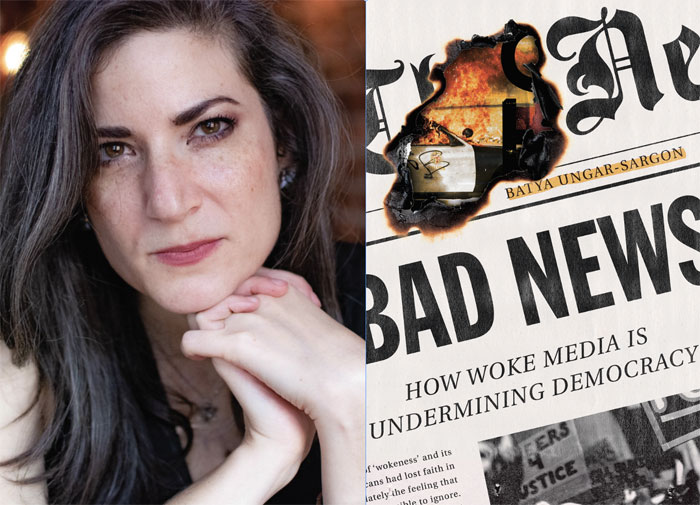
Journalists and commentators have always had their political biases. It’s nothing new. However, in her new book, “Bad News: How Woke Media Is Undermining Democracy,” Batya Ungar-Sargon, deputy opinion editor at Newsweek, argues that wokeness, a far-left, activist political ideology that means a person is awake to institutional or systemic racism, is contributing to many of the societal problems in the United States we’re facing today. This once-fringe philosophy, she writes, has now seeped into liberal media outlets and increasingly divided Americans.
“Bad News” opens with a scene in which CNN’s Don Lemon hosts a panel discussion about white women who voted for Trump. The panelists talk about how voting for Trump makes you a racist and that white women benefit from the white patriarchal system. The conversation then turned into one about how not just all white women, but all white people have a problem with racism.
“There’s a view that’s taken hold of America’s national news media,” Ungar-Sargon writes. “It’s the belief that America is an unrepentant white-supremacist state that confers power and privilege on white people, which it systematically denies to people of color. Those who hold this view believe an interconnected network of racist institutions infects every level of society, culture and politics, imprisoning us all in a power binary based on race regardless of our economic circumstances. And the solution, according to those who hold this view, is not to reform institutions that still struggle with racism but to transform the consciousness of everyday Americans until we prioritize race over everything else.”
In the book, Ungar-Sargon argues that what’s driving wokeness is the class chasm that separates the college educated from the other two thirds of Americans.
“Of course, racism still exists and deserves our attention. But the media wouldn’t be pushing a moral panic if they weren’t benefiting from it.”
— Batya Ungar-Sargon
“The moral panic around race that we call wokeness or wokeism is just the perfect smokescreen for that class chasm,” she told the Journal. “It means people don’t have to address issues of class, using an obsession with race instead to paper over the real inequality in America. Of course, racism still exists and deserves our attention. But the media wouldn’t be pushing a moral panic if they weren’t benefiting from it.”
Ungar-Sargon, who describes herself as a populist and socialist when it comes to economic policy, said that she would have called herself a lefty, but “but today’s left has by and large abandoned the working class to fight a culture war around issues of identity. Instead of building an agenda around the needs of actual working-class Americans of all races, who tend to be more conservative, the left today is pushing highly niche issues brewed at Ivy League universities, like wokeness and cancel culture and anti-Zionism and open borders, things that are really alien to most working-class Americans, no matter who they vote for.”
“Bad News” shows readers how we got here. It’s a story Ungar-Sargon traces back to Benjamin Day, the founder of the New York Sun, who published the first penny press newspaper in the U.S. in 1833. Back then, journalists were catering to the poor and the working class, covering the stories that mattered the most to the common person.
However, over time, as journalists have become part of the elite, they’ve represented the interests of the elite as well. With that, the working class has felt abandoned, which is one of the reasons they voted for President Trump.
According to Ungar-Sargon, wokeness silences conservatives and working-class Americans “because it disempowers the majority and takes their views off the agenda, which is antidemocratic. And it’s immoral because it asks us to put our race and gender identities before our common humanity, which is what the worst people to ever walk planet earth did.”
At the same time, Ungar-Sargon said that the media, politicians and tech companies are actively contributing to and profiting from polarization.
“They are making a lot of money and getting a lot of power off of the rage you feel when you see something on social media that makes your blood boil,” she said. “So that is my no.1 hope for this book: that people will start to recognize that when they feel that rage at someone who is wrong on the internet, someone is making money, and we shouldn’t let our hearts become the battleground where someone else’s fortune is being made because we are all Americans and we’re actually pretty united around the values this great nation was founded on.”
In one chapter of the book, Ungar-Sargon focuses on how Jews, like the working class, have also suffered because of wokeness. An Orthodox Jewish ophthalmologist in Chicago was reading the New York Times when he saw a picture captioned, “An Israeli policeman and a wounded Palestinian on the Temple Mount.” It turned out, however, that this was a lie. The wounded “Palestinian” was actually his son, who had been beaten by Palestinians, and the “Israeli policeman” was an Arab Israeli Druze who saved him.
“[The New York Times] has always been woke,” Ungar-Sargon writes. “For if wokeness is the re-racialization of society into a crude binary where power is a one-way street and one racial group uses it to oppress and dominate another, the Left has long cast Jews in the role of oppressor, proximate to whiteness if not worse.”
Ungar-Sargon hopes her book convinces the American people that they are “too good for this nonsense,” but said the power is so concentrated away from them right now that she doesn’t know if it will happen. And, she suspects that instead of receiving pushback for her book, the media outlets are going to ignore it.
Even though it may seem like there is no easy solution, she advocates for open debate, religious liberties and tolerance for opposing viewpoints, and she encourages people to “find a range of outlets to watch and read to help them embark on the hardest work of all, which is the spiritual practice of being in relationships with people they disagree with,” she said.
Ungar-Sargon said that if she can get more people to think about how class is actually what ails America, then she’d consider her book a success.
“As a religious person, I have always believed that the least among us has the most to teach us. Really all I want is for us to have more humility about the people who have lost on every metric in America, and how we can get back on track towards a more equal society. And yes, that means police reform and education reform but it also means have a pro-working class agenda and not indulging in the contempt the educated have for the non-educated in this country.”
New Book Argues that “Woke Media” is Undermining Democracy Read More »
“I want you to know that the first question I’m going to ask you tomorrow won’t be typical,” I forewarned Dr. Judea Pearl a few weeks ago, on the eve of our interview for this week’s cover story.
Pearl laughed, then responded, “Now, I’m intrigued.”
I had managed to intrigue a legendary scientist — one who has revolutionized artificial intelligence (A.I.) and who has won the Turing Award (known as the “Nobel Prize of Computing”).
As it turned out, the treasure trove of Pearl’s life meant that there would be two separate interviews, totaling nearly four hours. I wondered whether I was driving Pearl out of his mind with questions: What was the feeling on the streets of Bnei Brak when the [1948] War of Independence broke out? Will A.I., be the inevitable ruin of that which sets us apart from all else — our humanity? What are you ordering on Instacart these days?
I may have driven Judea Pearl out of his wits, but he made me fall in love with him all over again.
I may have driven Judea Pearl out of his wits, but he made me fall in love with him all over again.
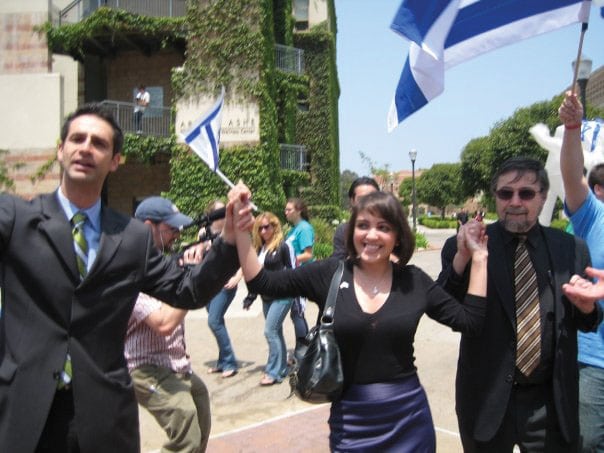
At 85, he is one of the most fast-witted, clarity-driven, and funniest people I know. I first met him in 2006, when I was serving as Director of Academic Affairs for the Consulate General of Israel in Los Angeles. “This is the Dr. Pearl,” a colleague whispered in my ear during a Yom Ha’atzmaut (Israel Independence Day) celebration in the heart of UCLA, hosted by the wonderful student group, Bruins for Israel. Here was the legendary professor and researcher himself; one of the greatest forces behind how we tell computers to behave, and the father of Daniel Pearl, z”l. I was flooded with awe and a sense that he was supra-human, until I saw him dance.
Yes, dance. The students began playing electrifying Israeli music and Pearl joined hands with them and began dancing exuberantly. In that moment, I realized that Pearl, and everything about him, exudes life, sometimes directly in the face of his enemies, who exude death. He was, in fact, extraordinarily human.
In Bruin Plaza, we were surrounded by anti-Israel students. These were the same students who couldn’t bring themselves to publicly call out and condemn the very Islamic fanaticism that had robbed Pearl, his wife, Ruth, and their family of their beloved “Danny” in Pakistan in 2002. Clad in black and holding signs calling Israel “apartheid,” as they watched the celebrations of Israel, the students looked miserable.
I realized that Pearl, and everything about him, exudes life, sometimes directly in the face of his enemies, who exude death. He was, in fact, extraordinarily human.
And there was Judea Pearl, dancing more joyously than anyone else, even the diplomats he called into the ring of dance. There was something that set his dancing apart from the American-born Jewish students, the Israeli-born diplomats who were in their 30s, and me, an Iranian-born Zionist who was in her 20s. And only now, after nearly two decades, countless run-ins, and two intensely meaningful interviews, do I understand what made Pearl’s dancing so different: He didn’t seem to give a damn what anyone thought of Israel.
The students, while espousing pride that inspired us all, nevertheless seemed a little uncomfortable surrounded by such hate; the diplomats, despite their patriotism for the country they served, still took full note of the hostile anti-Israel students (nothing could have prepared them for the unique hate against Israel at some California campuses). As for me, I danced with reservation; the angry dispositions and venomously propagandistic (and untrue) images on the students’ posters reminded me of the trauma of having lived in post-revolutionary Tehran. Bruin Plaza and Tehran?
You can understand why I was reluctant. Back in Iran, Zionism is a crime punishable by death. That’s a big price to pay for some innocent dancing. I hope at least one or two administrators at UCLA are reading this, especially the team at Equity, Diversity & Inclusion.
But Judea Pearl wasn’t born in Iran nor in America;. he was born a sabra (a native to Israel) in 1936, in what was then-called Mandatory Palestine, to a family who had prayed for a “return to Zion” for two millennia. And in 1948, while his Polish-born family was celebrating the re-establishment of the State of Israel in the streets, a young Pearl didn’t even see why it was such a big deal: “For us young sabras, we already had a state in our minds and infrastructure on the ground,” he told me a few weeks ago.
And there you have it. An unabashedly proud Zionist who, just by being himself, makes Zionism as natural as anything else on earth.
For the record, Pearl doesn’t dismiss anti-Israel student voices; in fact, he knows exactly with whom he’s dealing. And he works well into the middle of the night finding ways to make the word “Zionist” noble on campus again.
In 2008, a few years after that celebration, I danced again with Pearl, diplomats, students (and Hillel staff) in Bruin Plaza for Yom Ha’atzmaut. I felt like an invisible thread was holding all of our arms and legs together, and I even felt like the soul of Danny was there, too, no doubt playing an instrument (he was a gifted musician).
Oh, how I would have loved to have seen a few other professors in that dance of unabashed and natural pride.
Tabby Refael is a Los Angeles-based writer, speaker, and civic action activist. Follow her on Twitter @RefaelTabby
Dances with Judea Pearl Read More »
