fbpx

October 14, 2021

Texas School Admin Says Teachers Need to Show “Opposing” Views to Holocaust

A Texas school board administrator told teachers in a recording obtained by NBC News that they need to have books showing an “opposing” view to the Holocaust.

The NBC report, which was published on October 14, quotes Carroll Independent School District Executive Director of Curriculum and Instruction Gina Peddy telling teachers during a training session from the week before that a new state law requires teachers to provide both sides on matters that are “controversial.” “Make sure that if you have a book on the Holocaust, that you have one that has an opposing, that has other perspectives,” she added.

When a teacher asked how one could have an opposing view to the Holocaust, Peddy replied, “Believe me, that’s come up.”

After the training ends, a teacher can be heard on the recording saying: “I am offended as hell by somebody who says I should have an opposing view to the Holocaust in my library.” An elementary school teacher told NBC, “There are no children’s books that show the ‘opposing perspective’ of the Holocaust or the ‘opposing perspective’ of slavery. Are we supposed to get rid of all of the books on those subjects?”

Clay Robison, spokesman for the Texas State Teachers Association, told NBC, “We find it reprehensible for an educator to require a Holocaust denier to get equal treatment with the facts of history. That’s absurd. It’s worse than absurd. And this law does not require it.” The NBC report also quoted Republican State Senator Bryan Hughes, who wrote the law, saying that the law does not mandate teachers to provide opposing views on matters of “good and evil” like the Holocaust.

Karen Fitzgerald, spokeswoman for the district, told NBC, “Our district recognizes that all Texas teachers are in a precarious position with the latest legal requirements. Our purpose is to support our teachers in ensuring they have all of the professional development, resources and materials needed. Our district has not and will not mandate books be removed nor will we mandate that classroom libraries be unavailable.”

The NBC report stated that Peddy did not respond to their request for comment. She also didn’t respond to the Journal’s request for comment by publication time.

Several people voiced outrage on Twitter. The American Jewish Committee tweeted that Peddy’s comments were “absolutely appalling.” “There is no legitimate ‘opposing’ perspective on the Holocaust. Six million Jews were murdered by the Nazis simply for being Jews. We call on the official in question to withdraw her outrageous remarks immediately.”

Stop Antisemitism tweeted to Peddy, “Why in the world are you instructing Carroll Independent School District teachers in to SPREAD lies about the Holocaust ?? This is pure insanity!” They also tweeted if by books with “opposing perspectives” Peddy meant “Protocols of the Elders of Zion” or “Mein Kampf.”


Meghan McCain, former co-host of ABC’s “The View” and columnist for the UK Daily Mail, tweeted that the rise of antisemitism “is very real and growing – and much of [its] root is stemming from psychos in academia. These people are monsters and getting away with it. When will people wake up?”


Texas School Admin Says Teachers Need to Show “Opposing” Views to Holocaust Read More »

Nation Shall Not…But They Still Do – A poem for Parsha Lech Lecha

And the king of Sodom and the king of Gomorrah and the king of Admah
and the king of Zeboiim, and the king of Bela, which is Zoar, came forth,
and they engaged them in battle in the valley of Siddim.
— Genesis 14:8

So many kings fighting
so many other kings
for land or honor.

I’d like to think
these are stories
only in the past.

Legends with swords
and suits of armor
I can see in museums.

Not tales for today.
But it turns out humans
aren’t so sensible.

Swords replaced with
things that hurt more.
Much of war fought

digitally, as is the
custom of our age.
I’d like to think

one good read of
The Butter Battle Book
could fix all this.

But the news streams
tell me otherwise.
Just today Russia

built the best missile ever.
Weren’t we okay with Russia
just a few minutes ago?

I was just about to
have Russia over for dinner.
I had no idea we

were still fighting.
I dream of the people
with the flowers –

Their flowy aquarius
Their reckless desert dance
Their season of love


God Wrestler: a poem for every Torah Portion by Rick LupertLos Angeles poet Rick Lupert created the Poetry Super Highway (an online publication and resource for poets), and hosted the Cobalt Cafe weekly poetry reading for almost 21 years. He’s authored 25 collections of poetry, including “God Wrestler: A Poem for Every Torah Portion“, “I’m a Jew, Are You” (Jewish themed poems) and “Feeding Holy Cats” (Poetry written while a staff member on the first Birthright Israel trip), and most recently “The Tokyo-Van Nuys Express” (Poems written in Japan – Ain’t Got No Press, August 2020) and edited the anthologies “Ekphrastia Gone Wild”, “A Poet’s Haggadah”, and “The Night Goes on All Night.” He writes the daily web comic “Cat and Banana” with fellow Los Angeles poet Brendan Constantine. He’s widely published and reads his poetry wherever they let him.

Nation Shall Not…But They Still Do – A poem for Parsha Lech Lecha Read More »

DC City Councilmember Who Said Rothschilds Are “Controlling the Climate” Running for Mayor

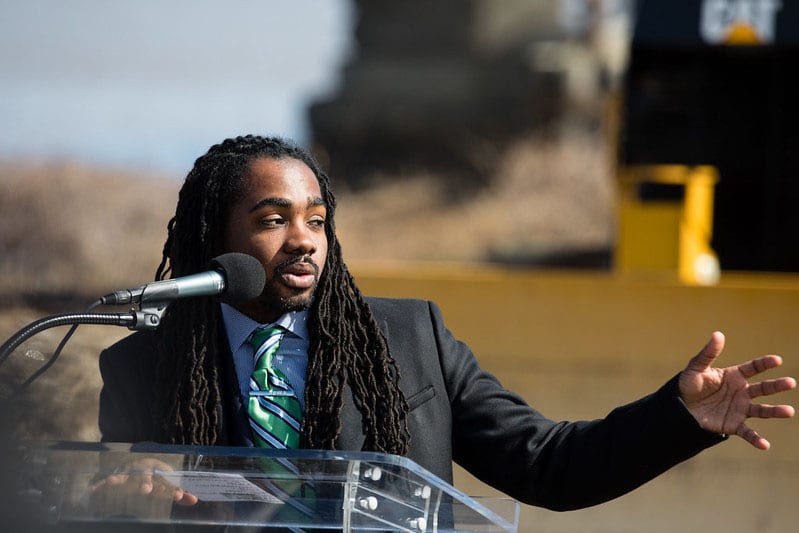
Trayon White, a city councilmember in Washington, D.C., is running in D.C.’s mayoral election.

White responded, “I’m running” to an Instagram comment suggesting he run for mayor. Martin Austermuhle, a reporter for D.C.’s National Public Radio affiliate, confirmed that White is running mayor. Austermuhle tweeted a quote he received from one of White’s advisers stating, “He has a tremendous amount of support coming his way because he is willing to speak out for and advocate for those who need the leadership the most.”

White made headlines in 2018 when he said in a since-deleted video: “D.C. keep talking about, ‘We a resilient city,’ and that’s a model based off the Rothschilds controlling the climate to create natural disasters they can pay for to own the cities, man. Be careful.” According to the Anti-Defamation League, there are “longstanding” antisemitic conspiracy theories about the Rothschild family “exerting influence on regional and national events.” White subsequently apologized for his remarks, stating: “The Jewish Community have been allies with me in my journey to help people. I did not intend to be Anti-Semitic, and I see I should not have said that after learning from my colleagues.”’

White later toured the D.C. Holocaust Museum and suddenly left in the middle of the tour without any explanation. Before he had left, he had reportedly asked if Nazi soldiers surrounding a Jewish girl in a picture were “protecting her.” The Washington Post criticized White’s behavior at the museum in an editorial, stating that it showed that his district needs “adult leadership.”

Additionally, White came under fire for donating $500 from his Constituent Services Fund to Louis Farrakhan’s Nation of Islam in 2018. He defended the donation in a Facebook Live video at the time, saying: “I am not resigning, I’m not backing down, I’m not discouraged, I’m not depressed, so run all the media stories you want because my people support me.” The American Jewish Committee of Washington D.C. called on White to “dramatically change his behavior” and condemn Farrakhan.

The Simon Wiesenthal Center tweeted, “Weather forecast: continued mainstream #Antisemitism rain or shine.”


DC City Councilmember Who Said Rothschilds Are “Controlling the Climate” Running for Mayor Read More »

Sally Rooney Book Published by Company With Ties to Chinese Gov’t, Report Says

One of author Sally Rooney’s books was published by a company that has ties to the Chinese Communist Party (CCP), according to an October 14 report from The Times UK.

The Times report states that they discovered that a Chinese translation for Rooney’s second book, “Normal People,” is available on Amazon. The translation was published by the Shanghai Translation Publishing House, which has at least four senior executives who are CCP members, per the report. The CCP is the ruling party in China. Stephen D. Smith, Finci-Viterbi Executive Director Chair of the USC Shoah Foundation, wrote in a March 2021 Journal op-ed that “the Chinese government is engaged in a slow and deliberate genocide of the Muslim Uyghur minority.”

The Times did acknowledge that “it remains unclear whether the translation is being sold with or without Rooney’s permission” and that they have not heard back from Rooney’s representatives for confirmation. The Journal has also not heard back from her representatives by publication time.

On October 12, Rooney announced in a statement that her new book, “Beautiful World, Where Are You” would only be translated into Hebrew by a publisher that is “compliant” with the Boycott, Divestment and Sanctions (BDS) movement. “In the meantime I would like to express once again my solidarity with the Palestinian people in their struggle for freedom, justice and equality,” she said.

Stop Antisemitism tweeted that the fact that “Normal People” was translated by a publisher with CCP shows “antisemitic hypocrisy at its finest.”

Karen Pollock, who heads the Britain-based Holocaust Education Trust, tweeted out a link to The Times report and wrote, “Nothing to add.”

Sally Rooney Book Published by Company With Ties to Chinese Gov’t, Report Says Read More »

Sarah, the Invisible Hero

What is the value of a wife’s contribution to her husband’s career? This issue stood at the center of Wendt v. Wendt, a divorce that ignited a national debate on the role of “corporate wives,” women who devoted themselves to their husbands’ careers.

Lorna and Gary Wendt met in high school and both attended the University of Wisconsin. They were engaged in college, and married once Lorna graduated. In 1995, after thirty years of marriage, Gary asked for a divorce. In court, the arguments focused on how to value Lorna Wendt’s contribution to her husband’s career.  The Wall Street Journal summarized the arguments as “Mrs. Wendt, 54 years old, testified that she contributed to a 50-50 partnership: giving her husband advice on job applicants, hostessing lavish parties and making small talk with foreign dignitaries … Mr. Wendt, 55, who has had a stellar 21-year career at GE, insisted the family’s fortune came from his hard work, not his wife’s housekeeping.” In the end, the judge accepted many of Lorna Wendt’s arguments; the “invisible work” that she did was a personal investment in her husband’s career that deserved to be recognized.

Invisible work is very much a part of rabbinic households. Shuly Rubin Schwartz, the Chancellor of the Jewish Theological Seminary, wrote “The Rabbi’s Wife,” a history of American rebbetzins. In it, she follows the role of the rebbetzin through the past century and a half. One model, common in the 1920s, is what Rubin Schwartz calls “the power behind the throne.” Rebekah Kohut, the wife of Rabbi Alexander Kohut and a brilliant and accomplished woman in her own right, advised rabbi’s wives to “hide their own ability behind the personality of their husband” and to recognize that the rabbi’s wife, “though unheard and unsung, will have played a tremendous part in this immortality if she will be alive to the mission of her husband.” Another model, which gained popularity in the ’40s and ’50s, is “the two for the price of one” rebbetzin. Very often rabbinic wives specifically married rabbis because they wanted a leadership role in Jewish communal work.  Many of these rebbetzins were also scholars and teachers, such as Tamar de Sola Pool. The daughter of a remarkable Talmid Chacham, Rabbi Chaim Hirschensohn, she wrote and published extensively. It was a different time, and these rebbetzins no longer felt the need to always turn the spotlight back on their husbands. Their invisible work is a bit more visible, and these rabbis and rebbetzins comprise what has been called a “two-person single career.” But in the 1960s, discontent with the rebbetzin’s role began to arise. Many women began to resent  having their own identities submerged under their husband’s choice of career. Rubin Schwartz cites examples of rabbis’ wives insisting that they not be called rebbetzins, and not be given any role in the synagogue. At the end of her book, she notes that the rebbetzin no longer exists in the Conservative and Reform movements; although in Orthodox Judaism, particularly in Chabad, the wives of rabbis often play a significant role in the community.

Invisible work is very much a part of rabbinic households.

The question of how to assess the rebbetzin’s role is already discussed in the Talmud under the topic of “eishet chaver k’chaver”: the wife of a scholar has the same status as a scholar. The Talmud relates that Rav Nachman stood to honor the wife of Rav Huna. The Sdei Chemed, an encyclopedic work written by Haim Hezekiah Medini, cites a debate related to this passage: must one stand for the scholar’s wife if the scholar has died and she is a widow? Can she waive the honor due to her? As usual, opinions vary, and there are rabbis who take either side of these questions. In reading their arguments, a clear delineation appears; it depends on how one perceives the scholar’s wife, and the invisible, intangible work that she does. One possibility is that we stand for the wife as the scholar’s representative, and that is an indirect way of showing honor for the scholar.

If this analysis is true, then one need not stand for the widow of a scholar, for the scholar is no longer living. But there is another point of view: the wife of a scholar has the same status as a scholar because she is his life partner, and her husband’s achievements belong to her as well. I find this second view to be compelling; in the Talmud, Rabbi Akiva tells his students how important his own wife was to his Torah learning, and exclaims that “my Torah knowledge and yours belong to her.” A scholar’s wife is his coach and creative influence, his companion and caregiver. This may be invisible work, but there are many Halakhic opinions that recognize that the scholar’s wife is a full partner in his achievements.

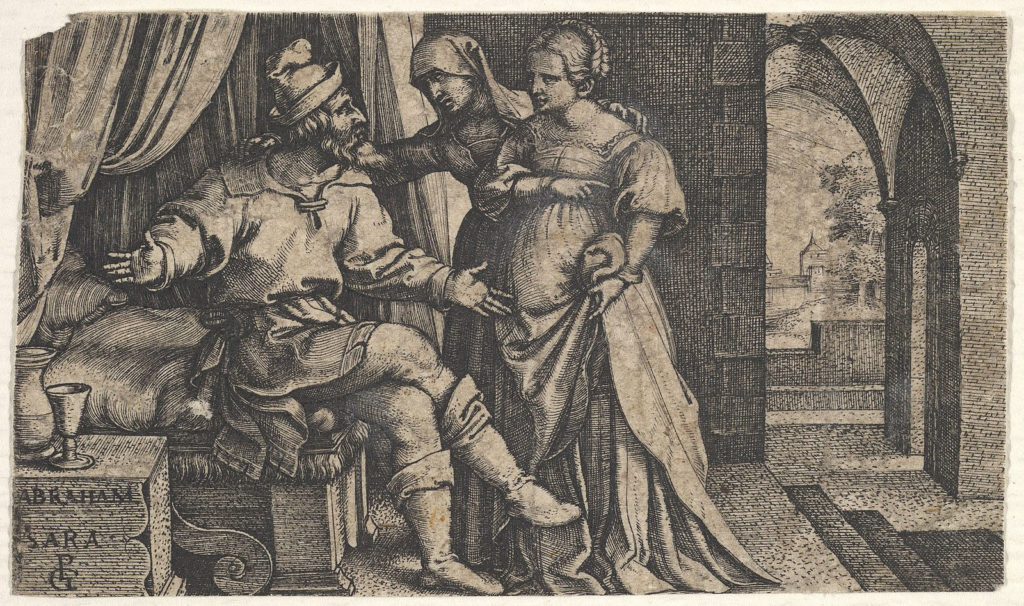
The concept of invisible work is critical to how one reads the Parsha. It is easy to overlook Sarah as she stands in support of Avraham. She certainly is a good helpmate, who deserves credit for her unwavering support. But Sarah is much more than that. Not only does she do invisible work in support of her husband, but also she is an invisible hero who bears the brunt of Avraham’s sacrifices. The Mishna notes that Avraham’s faith is tried by God ten times; but a closer look at the Parsha recognizes that Sarah faced far greater challenges.

But there is another point of view: the wife of a scholar has the same status as a scholar because she is his life partner, and her husband’s achievements belong to her as well.

When they arrive in Egypt, Avraham asks Sarah to say she is Avraham’s sister, so Avraham might live. But what if Pharaoh takes Sarah anyway? Clearly, there was no exit strategy for Sarah, only Avraham; and undoubtedly, Sarah knew this. Without God’s intervention, Sarah would have remained a captive in Pharaoh’s harem while Avraham pursued his mission. (This test is repeated again later in Sarah’s life, when she is taken to the house of Avimelech; and without a clear exit strategy, Sarah is willing to sacrifice herself for Avraham once again.)

When Sarah sees how Avraham continually prays to God for a child, she makes another sacrifice. She offers Hagar as a concubine to Avraham, so he can have children; and this sacrifice is emotionally excruciating, one from which she never fully recovers. Sarah not only assists Avraham, but also she sacrifices herself completely for Avraham’s mission.

God sees Sarah’s sacrifices, and rescues her time and again. And at the end of the Parsha, something far more dramatic occurs. God changes Avraham’s name, from Avram to Avraham, to reflect his mission as “the father of a multitude of nations”; but he changes Sarah’s name as well, from Saray to Sarah, making it clear that she too is a full partner in this mission. The Midrash Rabbah remarks that Sarah was the true leader of the family, and offers the following insight: “Rabbi Yehoshua Ben Korcha said: ‘The letter Yud that the Holy One of Blessing took from Sarai was given half to Sarah, and half to Avraham”; Sarah’s yud, with a numerical of ten, was divided into two letter “heys” with a numerical value of five. One is given to Avraham, and the other to Sarah. This letter “hey” is a metaphor for their relationship; it is Sarah’s contribution that makes Avram into Avraham, and shapes their unique mission.

Because the narrative in the Torah focuses mostly on Avraham, it is easy to overlook that the sacrifices Sarah makes are more exceptional. Invisible work is often undervalued; and so are invisible heroes like Sarah.


Rabbi Chaim Steinmetz is the Senior Rabbi of Congregation Kehilath Jeshurun in New York.

Sarah, the Invisible Hero Read More »

Foreign Minister FOMO

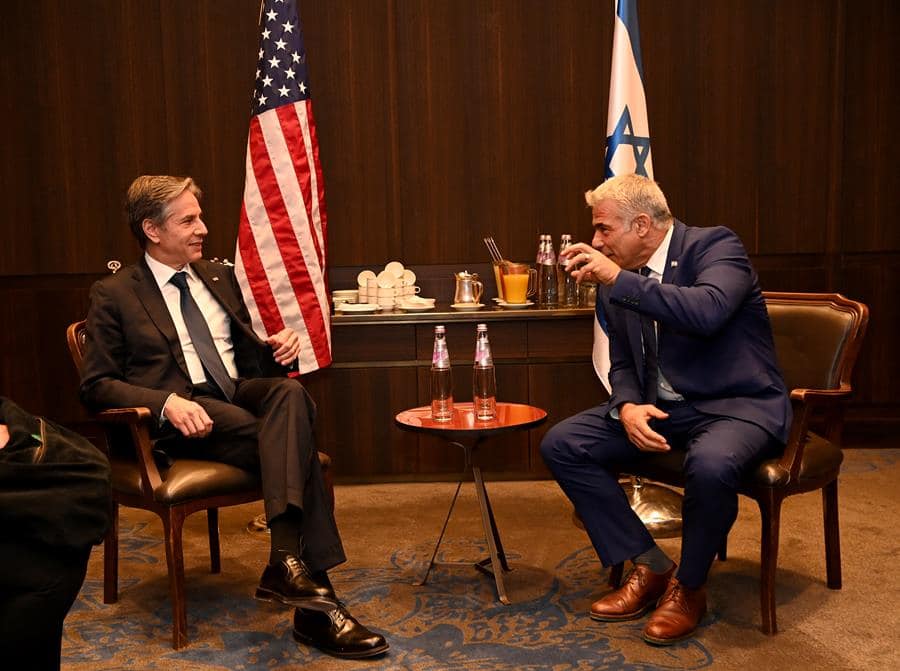
(Israel Policy Forum) — Washington rolled out the red carpet this week for a pair of visiting foreign ministers, Israel’s Yair Lapid and the UAE’s Abdullah bin Zayed, with part of the objective being to highlight the success of the Abraham Accords and the ensuing regional benefits of normalization. New trilateral working groups with the U.S. on religious coexistence and water and energy were announced, and the overall vibe was one of progress and a region attempting to move beyond old barriers. The high-profile series of meetings was precisely the type of public approval that American allies and partners seek in engaging with the U.S., and it highlighted the continuing indispensability of the U.S. in the Middle East irrespective of the signs and concerns that successive administrations have been pulling back.

The praise, attention, and benefits being showered on Abraham Accords countries do not go unnoticed by others. During the Trump administration, the primary underlying logic of normalization was that it afforded states the opportunity to establish better relations with the U.S. in fostering the idea that the road to Washington runs through Jerusalem, though President Trump took things many steps further—as was his wont—by lavishing arms deals, recognition of disputed sovereignty, and terrorism sponsorship delisting on Abraham Accords states as well. The point of making a big deal of three-way meetings between Lapid, bin Zayed, and Secretary of State Tony Blinken is to demonstrate to potential future normalizers what could be in store for them as well.

For all of the focus on who may come next, the more intensive focus should be on who came before. While the UAE is still basking in the glow of having established formal diplomatic ties with Israel one year ago, Egypt and Jordan preceded the Abraham Accords’ signatories by decades. While the UAE and Bahrain, unlike Egypt and Jordan, cannot really lay claim to having signed peace treaties with Israel as they were not in a functional state of war, Egypt and Jordan, unlike the UAE and Bahrain, cannot really claim to having normalized relations with Israel. The cold peace that is effectively one between militaries and not societies has held in both cases without interruption or the specter of serious danger, but the fact that energy, agriculture, and resource deals are often kept quiet or played down is a testament to the way in which peace and normalization can be mutually exclusive.

Since the signing of the Abraham Accords, Egypt and Jordan are displaying understandable signs of FOMO (Fear Of Missing Out). The economic benefits to the UAE from having open and warm relations with Israel are evident, whether it be the flocks of Israeli tourists spending their cash in Dubai or the nearly $700 million in trade between the two countries this past year. Egypt and Jordan had an overwhelming head start in the opportunity to access the larger Israeli economy but have never approached taking full advantage of it, and the economic difficulties both countries are facing make that decision appear ever more short-sighted. Many pointed to the recent announcement of scheduled direct Egypt Air flights between Cairo and Tel Aviv as a commentary on the new Israeli government, but it has more to do with normalization than it does with the transition from Bibi Netanyahu to Naftali Bennett. Egypt also wants to avoid the harsh criticism it is taking from different corners in Washington, and seeing bin Zayed feted by the Biden administration despite U.S. concerns over the Emirati role in the Yemeni civil war and UAE-China relations provides Egypt with a potential pathway forward that involves truly normalizing relations with Israel.

Aside from the benefits that will accrue to the U.S. from more American regional partners cooperating in an open manner, and the benefits that will accrue to Israel if its relations with Egypt and Jordan progress beyond security and come to resemble the relationship with the UAE, there is another important reason to focus on Egyptian and Jordanian normalization as much as, if not more than, chasing the next round of potential Abraham Accords signatories. As Shira Efron, Evan Gottesman, and I note in the report on normalization and the Israeli-Palestinian conflict that we released this week, one of the built-in advantages to greater engagement between Israel and its old Arab treaty partners is that, unlike other normalizing states, Egypt and Jordan have a deep interest in Israeli-Palestinian issues and do not have to be prodded to keep them top of mind. While the UAE, Bahrain, and others want to keep their relations with Israel walled off from anything having to do with the Israeli-Palestinian conflict, Egypt and Jordan do not have that luxury. Due to proximity and historical involvement, Cairo and Amman are acutely sensitive to shifts in Israeli and Palestinian policy and want to be more rather than less involved in figuring out how to get to a sustainable solution. The more engaged with Israel that they are, the more they will remind both Israel and the Palestinians that the Israeli-Palestinian conflict is not going away and that they are available to help bridge some of the differences, come up with solutions, and play a role in making the situation better on the ground and moving toward a viable two-state outcome.

This would be a good thing for all involved. The Biden administration wants to see progress on the Israeli-Palestinian front, and despite the talk of leveraging normalization to make this happen, doing so has so far proved elusive. Israel wants real people-to-people ties with Egypt and Jordan, and Egypt and Jordan want to enjoy the benefits of normalization and to be treated in Washington with the prestige that they see unfolding for the UAE this week. The Palestinians’ hostility to normalization stems from them being deliberately left behind, and greater intercession by Arab states on their behalf in looking out for their interests will be welcomed. This dance can only be orchestrated by the U.S., and there is a good opportunity for the Biden administration to use regional FOMO to begin connecting normalization to Israeli-Palestinian progress, starting with the two states that normalized ties with Israel without ever really normalizing ties with Israel.


Michael Koplow is Israel Policy Forum’s policy director, based in Washington, DC. To contact Michael, please email him at mkoplow@ipforum.org.

Foreign Minister FOMO Read More »

Three Things the US Can Learn from the EU’s New Strategic Plan

Last week the European Commission, the Executive Branch of the  European Union, unveiled a new comprehensive EU Strategy on combating antisemitism and fostering Jewish life to address a significant increase in incidents around the 27-country bloc. While the United States has seen a similar trajectory, our federal government has yet to develop an encompassing governmental response to the problem. Perhaps the EU will inspire the U.S.

On a practical level, the EU proposal contains a number of concrete suggestions—including annual stakeholder forums designed to maximize the effect of joint actions and funding, and additional resources dedicated to better understanding and tracking the spread of online hate—that could aid in the fight against domestic antisemitism. More broadly, it addresses three crucial areas in which U.S. federal and state policy have been lacking: defining, monitoring and preventing antisemitism.

First, the Commission actively encourages all member states to adopt the International Holocaust Remembrance Alliance (IHRA) definition of antisemitism, an essential tool used to determine its contemporary manifestations. The federal government does use the definition, but some politicians have been hesitant to embrace it because among its illustrations of things that could contextually be antisemitic are examples of problematic anti-Zionism, and these officials are ostensibly concerned that embracing IHRA would somehow stifle speech. That argument, however, is a legal red herring and the EU did not take the bait.

Aside from the fact that IHRA itself distinguishes between criticizing Israel and antisemitism, the use of a definition alone simply does not silence any speech—it just allows people to label it correctly. You cannot fight what you can’t define, and what the EU got right is that the IHRA definition is helpful precisely because it includes those useful examples of discriminatory anti-Israel acts that can cross the line into antisemitism—for example, “holding Jews collectively responsible for actions of the state of Israel.” No one who labels sexist speech sexist, or racist speech racist is accused of stifling speech. In fact, officials are often praised for using their own speech to condemn these types of (legal) expression, without crossing the line into censorship. Our government should, consistent with the First Amendment, follow the EU’s lead and actively promote the implementation of IHRA in anti-discrimination policies at all levels. If necessary, they can even issue a handbook (like the EU did) for IHRA’s practical use. Meanwhile, passing the bi-partisan bi-cameral Anti-Semitism Awareness Act, which reaffirms the use of IHRA on campus, would be a great step in this direction.

Next the EU recognized that under current reporting standards it is challenging to obtain reliable and comparable data on antisemitic incidents. The new plan commits resources to help Member States improve and align their methodologies for consistently recording, collecting and assessing information on hate crimes, including antisemitism. But those in the EU are not the only ones experiencing this problem.

In the U.S., under the Hate Crime Statistics Act (modified by The Matthew Shepard and James Byrd, Jr. Hate Crimes Prevention Act), the Attorney General, through the FBI, is tasked with monitoring crimes in which there was “manifest evidence of prejudice” against the victim’s race, religion, disability, sexual orientation or ethnicity. The FBI  relies on local law enforcement agencies to submit data, but thousands opt out of the reporting, and, according to one report, even “among the 15,000 that do, some 88 percent reported they had no hate crimes.”

Standardized and aligning methodologies for federal reporting of bias incidents—including but not limited to the use of IHRA—would be helpful in making sure that the statistics about antisemitism more accurately reflect reality. 

One issue is the lack of definitions: That same report found that “investigators frequently did not mark down incidents as motivated by bias, even if there was evidence suggesting this was so—a spray-painted swastika, for example, might be classified simply as vandalism and not also as a hate crime.” In 2019 (i.e. just before COVID), the number of agencies participating further declined, but the number of reported hate crimes actually rose by 113 percent, including a 14 percent increase in anti-Jewish hate crimes. All across the country 63 percent of the total reported religion-based crimes were directed against Jewish people and institutions, and one can only imagine the real number. Standardized and aligning methodologies for federal reporting of bias incidents—including but not limited to the use of IHRA—would be helpful in making sure that the statistics about antisemitism more accurately reflect reality. 

Finally, the EU plan contains several affirmative steps to attempt to prevent antisemitic sentiments from flourishing. Acknowledging that ignorance and indifference are key culprits, it lays out a number of educational initiatives focused on celebrating Jewish life, culture and societal contributions, while raising awareness about antisemitism and the Holocaust. It also calls for the Commission to ascertain that there is no antisemitism in EU textbooks or classrooms, and to ensure that EU funds are not allocated to antisemitic activities. 

If only the U.S. would do the same.

In stark contrast, the same week the EU established these programs, Governor Gavin Newsom signed California’s Assembly Bill 101 into law, making ethnic studies a high school graduation requirement. While there is nothing inherently wrong about the idea, the first draft of the bill’s model curriculum was so stunningly, openly antisemitic that Newsom himself apologized on behalf of the State, called it “offensive in so many ways, particularly to the Jewish community,” and vowed the draft “would never see the light of day.” Legislators redid the course to make it less objectionable, and appended seven amendments to confirm against anti-Jewish hate being taught. As Tammi Rossman-Benjamin has noted, “the fact that no less than seven “guardrails” were deemed necessary for preventing AB 101 from facilitating the widespread promotion of antisemitism is itself a stunning indictment of the bill and the dangers it poses for Jewish students and the Jewish community.”  But aside from that, as the LA Times warned, these measures will actually do absolutely nothing. The bill still allows schools to use their own curricula, and multiple districts and teachers’ unions have already signed statements promising to use the original, highly antisemitic, version of the course.

But apparently, as the AMCHA Initiative (an organization which fought against the bill) explained, the concerns of hundreds of Holocaust survivors and their descendants, dozens of religious, civil rights and education organizations, thousands of Californians, and hundreds of students and parents begging the government to protect them and their families from state-sponsored antisemitism simply did not matter enough.

It did not have to be this way. For example, the bill could have just required schools to use the new model, or to submit their own curriculums for review. But apparently, as the AMCHA Initiative (an organization which fought against the bill) explained,  the concerns of hundreds of Holocaust survivors and their descendants, dozens of religious, civil rights and education organizations, thousands of Californians, and hundreds of students and parents begging the government to protect them and their families from state-sponsored antisemitism simply did not matter enough. The onus now shifts to Jewish parents and children in each of California’s 13,000 school districts to fend for themselves against the harmful and long-lasting effects of antisemitic material being taught to their children in a state-mandated class. 

Unless, of course, the federal government, like the EU, steps in where they can and should.  

Title VI of the Civil Rights Act of 1964 prohibits discrimination in federally assisted programs, and federal education funding is distributed to states and school districts through a variety of grants. A school district announcing its plans to teach discriminatory material is exposing itself to liability, and the Department of Education should proactively cut off funding from those who flaunt its rules. It should never have come to this, but the federal government must put these schools on notice that under Title VI they have an affirmative legal obligation to protect their Jewish students—even from their own teachers and unions if need be.  

The U.S. must do better, and do our part, in the global fight against antisemitism. That includes adopting and enforcing standards for defining, monitoring and preventing antisemitism. The tools are there, the time is now, and the EU has shown the way. 

If they can do it, so can we. 


Dr. Mark Goldfeder, Esq. is Director of the National Jewish Advocacy Center. He served as the Founding Editor of the Cambridge University Press Series on Law and Judaism.

Three Things the US Can Learn from the EU’s New Strategic Plan Read More »

Katie Couric Wasn’t the First: FDR, Truman and the Jews

Controversy has erupted over the admission by journalist Katie Couric that she doctored her 2016 interview with Supreme Court Justice Ruth Bader Ginsburg, in order to “protect” Ginsburg from criticism of her opposition to athletes kneeling during the national anthem.

Couric joins a growing list of authors who have altered the unflattering words of individuals whom they admire, in order to shield them from embarrassment. Presidents Franklin D. Roosevelt and Harry S. Truman have been among the prime beneficiaries of such unilateral revising of history.

One instance involving Roosevelt concerns remarks he made in a private meeting on January 22, 1938, with Rabbi Stephen S. Wise, the foremost American Jewish leader of that era. The only source for what they discussed is a memorandum that Wise dictated shortly afterwards, for his private records.

According to historians Richard Breitman and Allan J. Lichtman, in their 2013 book, FDR and the Jews, the topic of the conversation was Palestine. Roosevelt believed the country was incapable of absorbing many more Jewish immigrants, so he urged Wise to look for “some large areas [elsewhere in the world] as a second choice for the Jews.” Wise disagreed and “parried” with FDR about Palestine, Breitman and Lichtman wrote, citing Wise’s memorandum.

But Breitman and Lichtman omitted another part of the conversation, in which the president blamed Poland’s Jews for the rising antisemitism in that country.

Breitman and Lichtman omitted another part of the conversation, in which the president blamed Poland’s Jews for the rising antisemitism in that country.

According to the full text of the Wise memo, FDR claimed that “the Jewish grain dealer and the Jewish shoe dealer and the Jewish shopkeeper” had been undercutting Polish Christian merchants, and it was this alleged Jewish financial subterfuge that was provoking Christian shopkeepers to demand that the Jew should go.”

According to the memo, Wise protested, But, Chief, this is pure Fascist talk”—a surprisingly blunt remark, considering that Wise was a passionate supporter of President Roosevelt and his administration. But Wise’s plea had no impact on the president. He wrote that Roosevelt’s remarks were “very painful” and like a blow in the face.” Readers of the Breitman-Lichtman book, like readers of Katie Couric’s interview with Justice Ginsburg, had no way of knowing what had been omitted.

President Roosevelt’s image has also benefitted from another troubling omission, this one courtesy of the State Department. At the Yalta Conference, in February 1945, Roosevelt mentioned to Josef Stalin that he would soon be seeing Saudi Arabia’s king, Ibn Saud. Stalin asked if FDR intended to make any concessions to Saud. According to the transcript, The President replied that there was only one concession he thought he might offer and that was to give him the six million Jews in the United States.”

Stalin asked if FDR intended to make any concessions to Saud. According to the transcript, The President replied that there was only one concession he thought he might offer and that was to give him the six million Jews in the United States.”

But when the State Department published the transcript in 1955, Roosevelt’s unpleasant remark about Jews was omitted. More than fifty years later, a researcher discovered that then-Assistant Secretary of State Walter Bedell Smith had crossed out the comment about Jews prior to publication, and had written in the margin: Delete this–it is not pertinent history.”

Censors have also lent a helping hand to FDR’s successor. In a 1945 memo, President Harry S. Truman wrote: “The Jews claim God Almighty picked ’em out for special privilege. Well I’m sure he had better judgement. Fact is I never thought God picked any favorites. It is my studied opinion that any race, creed or color can be Gods favorites if they act the part–and very few of em do that.”

The most unflattering words in that passage ended up on the cutting-room floor. Journalist William Hillman was hired to assist Truman in preparing his memoirs and other papers for publication. The first volume, Mr. President, appeared in 1953.  It included the 1945 memorandum, but the wording was changed to read: “I never thought God picked any favorites. It is my studied opinion that any race, creed or color can be Gods favorites if they act the part–and very few of em do that.” The reference to Jews was omitted, presumably to protect the former president’s reputation. Hillman never revealed whether it was his idea, or Truman’s, to rewrite the historical record.

Katie Couric, to her credit, has belatedly admitted what she did. Unfortunately, others who have done likewise have not been forthcoming about their own historical malpractice.


Dr. Medoff is founding director of The David S. Wyman Institute for Holocaust Studies and author of more than 20 books about Jewish history and the Holocaust.

Katie Couric Wasn’t the First: FDR, Truman and the Jews Read More »

Cruising Alaska’s Inner Passage with Princess Cruises #WeAreBack 2021

I absolutely loved being back onboard Princess Cruises! I sailed on the Majestic Princess to Alaska August 29, 2021. I sailed from Seattle to Alaska including Juneau, Skagway, Ketchikan and Glacier Bay.

What did I do?

In JUNEAU August 31, 2021: I saw humpback whales on the way in to port. I went to lunch with Mickey Richardson from Icy Strait Port and then to Mendenhall Glacier with Dirk Younk, a naturalist, for some awesome photos! After that I went on the Ship Shore Excursion: “Taku Glacier Helicopter Landing & Airboat Tour – A Discovery Exclusive.” I loved flying over the glacier by helicopter with Pilot Adam. It was my first time in an airboat and I did not realize we would get so close to the glacier. It was very beautiful and Brian was a great captain. He has ear protection for you to wear because the airboat is loud. My tour did not land on the glacier as there was a tour participant who had a slip and fall and we needed to return to base. I loved the parts of the tour that we were able to do. I would go again.
In Skagway, Alaska, I took the ship tour: Chilkat Bald Eagle Preserve Rafting from Majestic Princess Sept 1, 2021. The scenery from the ferry ride from Skagway to Haines was beautiful. I loved floating in the raft. The guides do the rowing–you just enjoy the scenery and take photos of eagles. Chris and Tom were fantastic guides who knew everything about the area, eagles and Alaska. I loved this tour and they have waterproof boots for you to wear so your feet do not get wet. I would definitely go again. THANK YOU to Chris and Tom for a great day with the eagles and on the river. I took a similar tour 20 years ago when I worked onboard for Princess Cruises.
Thank you to the entire team on the Majestic Princess for an amazing Alaska summer cruise in 2021. We sailed into Glacier Bay on Sept 2, 2021. It was quite foggy with liquid sunshine but at some moments it cleared up. The Park Rangers were on board to answer questions and explain about the glaciers we saw. The glaciers are giant and we could hear the pieces calving off! In the evening, I went to the Captain’s Circle Party hosted by Loyalty Ambassador, Tina, and Captain Tony Draper. I loved my cruise on the Majestic Princess!
In Ketchikan, Alaska, I went on the Black Bear, Wildlife & Nature Walk – An Animal Planet Exclusive at the Alaska Rainforest Sanctuary from from my cruise on the Majestic Princess on Sept 3, 2021 which I LOVED!! It was INCREDIBLE to be so close to so many bears! We saw 8 or 9 bears and a mother with cubs. The cubs were climbing up a tree. I loved every minute of watching these black bears catch salmon and walk in the river. I would definitely go again. 20 years ago when I worked onboard for Princess Cruises, I walked with bears with a naturalist. This was awesome to be almost next to them but be on the wooden platform above them.

MORE OF MY MAJESTIC PRINCESS EXPERIENCES–watch all my videos:

I had a balcony on this Medallion class ship with room enough to hula-hoop in my room. I loved the pools, hot tubs, sports court, the many restaurants and all the activities on board like fruit carving and ice carving. I walked around the deck and watched movies under the stars. I have separate videos of Sail Away, the dancing fountains and each of the ports as well as Where to EAT onboard! I spent 2 nights at Fairmont Olympic Hotel in Seattle before joining and have separate videos of those as well. Thank you to Captain Tony Draper and the entire crew onboard for an incredible week in Alaska on the Majestic Princess! See all of my videos from Alaska sailing on Majestic Princess Summer 2021 https://bit.ly/AlaskaCruise21

Cruising Alaska’s Inner Passage with Princess Cruises #WeAreBack 2021 Read More »