fbpx

September 28, 2021

Should Zionists Oppose Foreign Aid?

This week, the Congresswomen of “The Squad” pushed to rescind $1 billion in American foreign aid to Israel’s Iron Dome defense system, predictably whipping the American Jewish community into a frenzy. Influential individuals and organizations alike released statements condemning the move, with Congressman Ted Deutch going so far as to accuse Congresswoman Rashida Tlaib “and all those who see no place for a Jewish state on the map” of antisemitism. I applauded Congressman Deutch and the Democrats for immediately reassuring their constituents of their commitment to the American-Israeli alliance by overwhelmingly voting to fund the Iron Dome later that week. Worth noticing during the unfolding drama, however, was a familiar sentiment arising among younger Zionists in our community, many of whom have recently expressed the opinion that in an era when Israel faces accusations and mischaracterizations of imperialism and colonialism, perhaps making a spectacle over the United States’s funding of the Jewish state’s military is not the wisest move. 

Rudy Rochman is one of these pro-Israel activists, and an impressive one at that. Rochman achieved fame in specifically younger Jewish circles by publishing Youtube videos of him in conversation, and often in confrontation, with Palestinian activists, anti-Zionist Jews on college campuses, and neo-Nazis. His popularity has only increased over time— he now stands at nearly one hundred thousand followers on Instagram, where he promotes educational videos on Zionism and his own appearances on various talk shows. Rochman is known for characterizing the Jewish people as a great indigenous tribe, comparable to the Native Americans, and therefore tethered to Eretz Yisrael with a natural right to resurrect our ancient civilization there. I have my own opinions on this angle of pro-Israel activism, but no one can deny its positive impact on, for example, AIPAC’s student coalition.

“The way the aid is structured causes Israel to be completely dependent on the US. I don’t want Israel to be dependent on any country…Israel can sustain itself and build its own weapons here.”
— Rudy Rochman

A recurring, eyebrow-raising Rochman argument is that Israel should not be given foreign aid. “The way the aid is structured,” he says, “causes Israel to be completely dependent on the U.S.. I don’t want Israel to be dependent on any country…Israel can sustain itself and build its own weapons here.” Rochman asserts that Israeli military manufacturing companies are going out of business by way of American replacement, symbolic of a greater issue at hand: Israel is adamant about its sovereignty, independence, and legitimacy, but actions speak louder than words. 

This begs the question: should Zionists oppose foreign aid? 

My answer is no, not because I don’t greatly admire the activism of Rochman, but rather because I believe that Zionism has consistently been successful thanks to its habit of forging alliances. An example of this would be the shocking mutual recognition of Israel in 1948 between bitter adversaries, the United States and the Soviet Union, … a decision that Rabbi Joseph B. Soloveichik famously cited as proof of God’s approval of Zionism. 

Of course, my heart compels me to romanticize Israel as the grand embodiment of Jewish self determination, unrestrained by the burden of shady weapon deals and political maneuvering. And of course, I understand where young Zionists come from in ascribing to this idealism. This impulse is what led many of us, myself included, to feel uneasy immediately following the signing of Abraham Accords. We felt compelled to celebrate that Israel had made peace with Arab states after decades of intolerance, yet found it impossible to ignore the human rights track record of said Arab states. At the end of the day, we applauded, because knowledge of nations and their histories, especially in the Middle East, informs us that peace is not built upon symbolic acknowledgements of each other’s “right to exist,” but rather on mutual interests. To expect anything else of the American-Israeli relationship would exceptionalize the Jewish state, rather than normalize it.  

I want the two nations I feel the utmost affection for to be aligned with each other in the diplomatic arena, not by way of “dependence,” but by way of cooperation and coercion. Israel should pressure the United States away from signing another Iran Deal, and the United States should pressure Israel away from further settlement construction in the West Bank. None of this is possible without a good relationship, which any voyeur of international politics will tell you means a transactional one.

Zionist Jews in the Diaspora should not oppose foreign aid, and should indeed stand up for our fellow Jews when life-saving Israeli defense infrastructure is under attack, not because Israel is not strong enough to stand on its own two feet, but because the highest indicator of strength for any country is in engagement with the world, not isolation from it. 

Zionist Jews in the Diaspora should not oppose foreign aid, and should indeed stand up for our fellow Jews when life-saving Israeli defense infrastructure is under attack, not because Israel is not strong enough to stand on its own two feet, but because the highest indicator of strength for any country is in engagement with the world, not isolation from it.


Blake Flayton is New Media Director and columnist at the Jewish Journal.

Should Zionists Oppose Foreign Aid? Read More »
Jewish Community School Offers Partnership and Resources for Religious Schools

When COVID-19 hit, Temple Emanuel of Beverly Hills’ Assistant Rabbi and Director of Education Adam Lutz had an idea: He would put Jewish content online so that communities around the world could engage in learning. His program was a success, with 60 different organizations partnering up and providing content to over 13,000 users. 

At the same time, he heard about how synagogues were struggling to stay afloat as well as find the staff they needed to run their programs. In particular, his father, Rabbi Barry Lutz, interim rabbi at The Santa Monica Synagogue, as well as Temple Beth Israel of Pomona’s Rabbi Jonathan Kupetz were having difficulty finding a part-time administrator to run their religious schools. 

Adam came up with a plan. He would start Jewish Community School of Los Angeles (JCS), a community religious school partnership. The Santa Monica Synagogue and Temple Beth Israel would pay a flat fee and have the JCS maintain the overhead as well as manage administrative duties, supply the curriculum and find teachers and staff to run everything at their schools. 

“This whole idea of sharing resources amongst different Jewish institutions is exciting,” said Adam. “It allows us to provide high quality Jewish education in places where maybe they had to settle for someone part-time because they didn’t have the resources.”

Through the JCS, religious school students in kindergarten through 12th grade meet at the individual synagogues on Sundays to learn in person, and then on Wednesdays, all three synagogues meet virtually. Many of the students are preparing for their bar and bat mitzvahs and also participating in the project-based learning curriculum that has been so successful at Temple Emanuel.

‘Students learn how to apply Judaism to their lives no matter what they’re interested in, whether it’s science, art, politics or environmental studies.’ — Rabbi Adam Lutz

“We believe Jewish education and learning needs to be rooted in real world experiences for students,” said Adam. “Students learn how to apply Judaism to their lives no matter what they’re interested in, whether it’s science, art, politics or environmental studies.”

At Temple Emanuel one year, students wanted to solve the problem of homelessness in Beverly Hills. Adam said they studied Jewish texts to see what it had to say about homelessness and helping the needy, like how Avraham would welcome people into his tent. The school brought in the past mayor of Beverly Hills, Barry Brucker, who gave feedback on the students’ projects. 

“It meant the work they were doing in the world was real and relevant because they could share it with someone who had power,” said Adam.

Fourth through seventh graders in the JCS will get to participate in Theatre Dybbuk, which will provide arts-based leadership training, and Adam said that COVID permitting, he plans on taking the JCS teens to Washington, D.C. in March for the annual L’Taken Social Justice Seminar, hosted by the Religious Action Center of Reform Judaism. 

According to Barry, there are a lot of resources that go to waste in the Jewish community because each school thinks they have to do everything on their own. “[The JCS] allows the kids to expand their boundaries and meet other kids, and to participate in a really excellent and thoughtful curriculum that they otherwise might not have had been able to do,” he said. 

Kupetz said that since his synagogue is in an area without many Jews, it’s been tough to find someone to run the school. Now, however, his students are “meeting kids beyond our Temple Beth Israel community. As the program grows, we can leverage even more sharing costs of programming and build a Jewish community for our kids that goes beyond the small Jewish community in Pomona.”

Above all, Adam said his goal is to offer authentic learning for students, no matter where they are based in L.A. 

“It’s about being able to give the Jewish community in L.A. the richest and most exciting Jewish educational experience that we possibly can.”

Jewish Community School Offers Partnership and Resources for Religious Schools Read More »

Jesse Gabriel Provides Update on Ethnic Studies Curriculum in Webinar

Assemblymember Jesse Gabriel (D-San Fernando Valley), who chairs the California Legislative Jewish Caucus, provided an update on the status Ethnic Studies Model Curriculum (ESMC) in the state.

Gabriel was speaking on a September 23 webinar hosted by the Jewish Community Relations Council, Jewish Federation of Greater Los Angeles, Jewish Family and Children’s Services and Jewish Public Affairs Committee of California. Gabriel told the moderator, A Wider Bridge Executive Director Tye Gregory, that a bill was passed prior to Gabriel’s election to the Assembly in 2018 requiring the state to develop an ethnic studies curriculum. In 2019, the first draft of the curriculum was filled with “antisemitism” and “anti-Israel bigotry,” Gabriel said, prompting the Jewish Caucus to pull the “fire alarm on it.” “Our community started to pay more attention to it,” he said.

A year later, California Governor Gavin Newsom, a Democrat, vetoed Assembly Bill (AB) 331, which would have mandated ethnic studies as a high school graduation requirement, arguing that the draft at the time still needed some work. A more recent bill requiring ethnic studies for high school, AB 101, passed both houses of the legislature earlier in the month and is currently awaiting Newsom’s signature.

Gabriel explained that AB 101 is different from AB 331 in that it provides a lesson on Jews from the Middle East and North Africa––also known as Mizrahi Jews––and uses the International Holocaust Remembrance Alliance (IHRA) definition of antisemitism. The demonization and delegitimization of Israel as well as double standards against the Jewish state are included under the IHRA definition.

Additionally, AB 101 adds several new guardrails to existing guardrails to prevent bigotry and bias from entering the classroom, according to Gabriel. Prior to AB 101, there were three such guardrails: the curriculum has to be “appropriate for everyone,” “not reflect or promote directly or indirectly bias, bigotry or discrimination” and “can’t teach or promote religious doctrine,” Gabriel said, pointing out that the “religious doctrine” guardrail is modeled off the current state teaching code for sex education. The new guardrails added under AB 101 include adding the word “nationality” to the discrimination guardrail to prevent discrimination against Israelis. AB 101 also ensures the guardrails not only apply to the curriculum but also toward teachers and “instructional material,” Gabriel said.

Additionally, AB 101 requires school districts to be transparent on the exact curriculum they’re adopting and hold public comment sessions before implementing the curriculum, according to Gabriel, as the guardrails do provide some “flexibility” on what school districts can do with the curriculum. However, districts are barred from adopting the first draft of the ESMC, Gabriel said. The guardrails will go into effect on January 1, 2022, whereas the ESMC will be phased into California schools over several years.

“Those are really, really important changes to the legislation and they’re going to help in making a difference in how ethnic studies is taught in this state,” Gabriel said.

Gabriel also pointed out that the authors of the initial ESMC draft have since asked for their names to be taken off the curriculum, which shows that “we made extraordinary progress on the model curriculum, he argued.

The Jewish Caucus leader added that the caucus was able to forge allies with the Black Caucus, Latino Caucus, and Asian-American Pacific Islander (AAPI) Caucus on the ESMC; Gabriel argued that it’s important for the Jewish community to tell other minority communities that they agree on the need for ethnic studies, but that the Jewish community will not accept anything from those who “want to erase the American Jewish experience.”

The fight now will go to the local level, as Gabriel said that the Jewish community needs to ensure that local school districts adhere to the guardrails laid out in AB 101.

The fight now will go to the local level, as Gabriel said that the Jewish community needs to ensure that local school districts adhere to the guardrails laid out in AB 101.

“I can’t promise that there aren’t going to be rough patches here… but we’re ready to suit up,” Gabriel said. “We’re in the game.”

Jesse Gabriel Provides Update on Ethnic Studies Curriculum in Webinar Read More »

Antisemitic Sukkot Incident Being Investigated by LAPD’s Major Crimes Division

The Los Angeles Police Department’s Major Crimes Division is investigating an incident that occurred on the evening of September 22, when a car attempted to ram into a crowd of people celebrating the holiday of Sukkot. LAPD Detective Maria Ceja confirmed that the Major Crimes Division is now handling the case.

The incident occurred at Congregation Shaarei Tefila in the Fairfax district. According to Magen Am, a security and patrol service that was working security inside the event, a man was spotted walking his dog around the vicinity. People felt he was canvassing the area and made some Sukkot celebrants feel uncomfortable. Magen Am said it immediately called the LAPD to report the suspicious person, who, according to witnesses, threatened: “I’m a real Muslim. I’ll show you what real terrorism looks like!”

“Because LAPD Major Crimes is now involved, there is a better chance of an enhancement as a hate crime, but we will have to see where the investigation leads,” Rabbi Yossi Eilfort, founder and president of Magen Am said. “Also, we and the LAPD have been in touch with the FBI Supervisory Special Agent for Hate Crimes about this incident, so we know there are federal resources being put into this investigation.”

“People had to jump out of the way or they would have been run over.”
– Rabbi Yossi Eilfort, founder and president of Magen Am

According to Eilfort, before LAPD arrived, Magen Am security personnel spoke to the suspect, and he made derogatory remarks about Jews. “This naturally raised our suspicions, but we were able to diffuse the situation and get him to leave,” Eilfort said. “He then returned with his vehicle approximately 20 minutes later and attempted to run over Jews at the event. He slammed the gas to full throttle down an alley full of people. People had to jump out of the way or they would have been run over. Witnesses said it appeared he was targeting a woman and her teenage daughter. The car stopped short in front of the metal gates, as he screamed ‘F the Jews.’ He then turned his car around and left.”  

About 300 to 400 attended the event. No physical injuries were reported. 

LAPD sent back up officers who worked with Magen Am to secure the scene, file police reports and gather statements from witnesses.

Antisemitic Sukkot Incident Being Investigated by LAPD’s Major Crimes Division Read More »

Jews Could Use More Friends

Winston Churchill famously said that “nothing in life is so exhilarating as to be shot at without result.” In the last several days, those of us who are part of the Jewish and pro-Israel communities have been repeatedly reminded of Churchill’s maxim. While the bullets flying in our direction are metaphorical rather than ballistic, we’ve spent a lot of time recently dodging incoming political missives with the potential to do great damage to the Jewish people and homeland.

Most visible in the latest fusillade was last week’s congressional fight over whether the United States should provide financial assistance to help the Israeli military rebuild its Iron Dome defense system after their war with Hamas earlier this year. A small group of progressive Democratic House members forced their leadership to eliminate a $1 billion earmark from a must-pass government funding bill, and although the spending was later approved in a separate measure, it provided an opportunity for a vocal and growing faction of Israel’s congressional foes to air their grievances with the Jewish state’s efforts to defend its people against thousands of missiles fired at civilian targets.

In California’s state capitol, meanwhile, legislation creating a mandatory ethnic studies course for the state’s public schools was awaiting Governor Gavin Newson’s signature. The bill is a vast improvement over the original version, which included a curriculum that neglected to mention anti-Semitism as a type of racial or ethnic hatred and uncritically held up the anti-Zionist Boycott, Divest and Sanctions (BDS) crusade as a worthwhile social movement. But it still allows for that objectionable earlier draft to be taught in local schools, and there is a well-organized advocacy effort to persuade school districts to use it.

And here in Los Angeles, a faction of United Teachers of Los Angeles (UTLA) union members had introduced a motion to be considered by the organization that would have put them on record in support of the BDS movement, following similar successful efforts by the Seattle and San Francisco teacher unions. The Jewish Federation LA effectively marshalled a broad-based opposition campaign and was able to convince union leadership to indefinitely table the proposal, but the fact that such a fight was necessary provided an uncomfortable reminder of the pervasiveness of anti-Zionist and and-Semitic sentiment in political circles.

Along with the excitement that often accompanies such near-misses, narrowly averted disaster can also provide a false sense of security and safety. But these missives show no sign of abating in the future. A recent poll from the Louis Brandeis Center found that a majority of the Jewish college students surveyed had experienced anti-Semitism on their campuses and more than sixty percent had felt unsafe as Jews during their college experience.  Half of respondents have felt the need to hide their Jewish identity on campus or in virtual campus settings. More than half said they “are somewhat or very reluctant to share their views on Israel”.

The Brandeis poll also showed that  about a third of Jewish students said they’re worried about online harassment or being “marginalized or penalized” by a professor. Which means that many of this country’s future leaders are actually being taught that demonizing Israel and denigrating Jews is acceptable behavior.

It is clear that there aren’t many others willing to stand with us.

While most of these attacks are not hitting their targets, it is increasingly clear that our community is perpetually playing defense. It is also clear that there aren’t many others willing to stand with us, even those who face similar challenges to our own.

Some of this is our own doing. Compared to previous generations of Jewish-Americans, our outreach to other minority and underrepresented communities is insignificant. We have never found a cohesive way to establish ties with evangelicals and other religious groups that share our commitment to Israel. And as Muslims face abhorrent persecution in Northwest China and elsewhere, Jewish efforts to stand with them against such oppression is sporadic at best.

Jews represent approximately two percent of this country’s population. If we want to escape our ongoing exposure to Churchill’s definition of exhilaration, then perhaps American Jews should renew our commitment to building alliances with others who are subject to such threats. There are times when even the chosen people need a few more friends.


Dan Schnur is a Professor at the University of California – Berkeley, USC and Pepperdine. Join Dan for his weekly webinar “Politics in the Time of Coronavirus” (www/lawac.org) on Tuesdays at 5 PM.

Jews Could Use More Friends Read More »

Photographer Elinor Carucci on Feminism, Family, and the Jewish Identity

Jerusalem-born Elinor Carucci did not come from a family of artists, yet she always knew she was one at heart. As a teenager, she stumbled upon her father’s camera and began to photograph her mother waking up from an afternoon nap. Then, something magical happened. “There was just so much more I could see and understand and feel,” explained Carucci during a visit to Israel. “I felt so much more connected. I felt kind of like this is the person I want to be—the person who sees and goes deeper and understands and connects—and I could do it when I’m with a camera.”

Carucci’s art has been featured around the world, including the Museum of Modern Art and Gagosian Gallery. A recipient of the Guggenheim Fellowship, Carucci finds her work therapeutic, with one major exception: “Midlife,” Carucci’s fourth monograph. “Midlife” was recognized as one of TIME’s Best Photobooks of 2019. The highly original project featured the harsh realities of aging. “Some of the photos were painful for me to take, painful for me to look at,” noted Carucci. “It took pain and blood—blood, literally—to make this body of work.”

For Carucci, being a feminist photographer means highlighting subject matter about the life of women, including the body and complexities of motherhood. 

Carucci even snapped her own uterus following a challenging hysterectomy. “I had to photograph the uterus as soon as I woke up [after] three hours … it was difficult physically and I really pushed myself to deliver it.” For Carucci, being a feminist photographer means highlighting subject matter about the life of women, including the body and complexities of motherhood. 

Part of her research was talking to women reaching the same milestones and embodying their experiences in her work.

“Three Generations”

The Mizrahi Jewish artist continues to be inspired by her family—its structure, significance and “endless” components. Her cultural heritage also influences her work. “Being an Israeli Jew is very different from being an American Jew,” described Carucci. “The sensitivity and the understanding of things in a different way when you are an immigrant … being an immigrant is part of the Jewish identity.” For the artist, being an immigrant intensifies her vulnerability. “I always think about Robert Frank creating one of the most revealing bodies of work on the identity of the immigrant. … He was Jewish, as well. I think being Jewish relates to the family and also to the migrating element of the Jewish identity.”

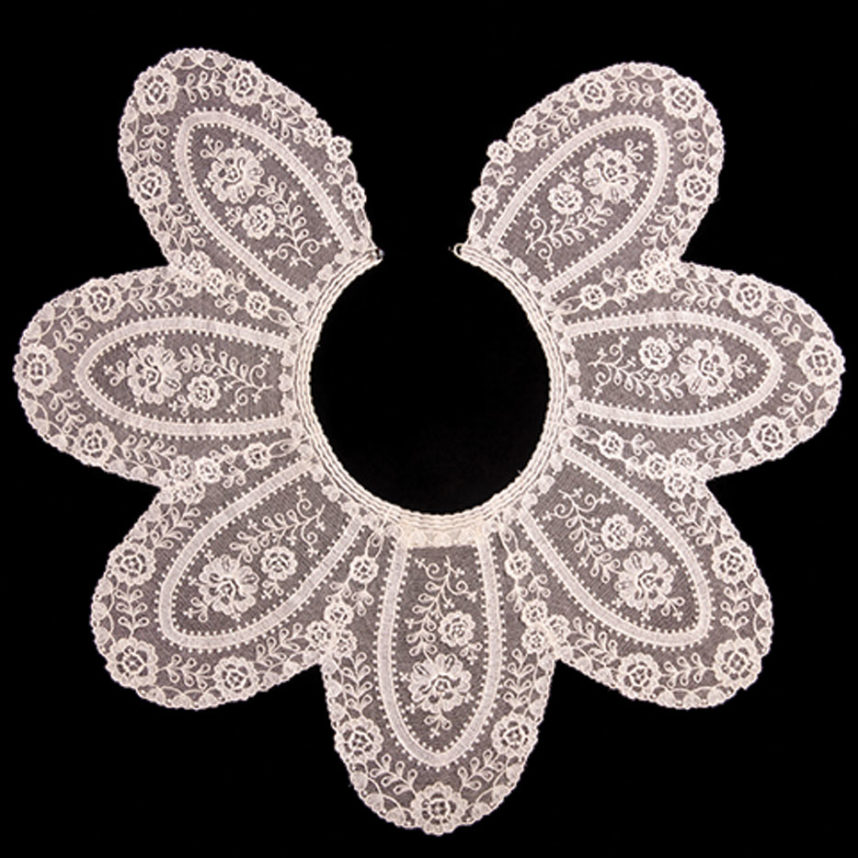
“Court Collar”

In 2020, the Jewish Museum featured Carucci’s photographs of the late U.S. Supreme Court Justice Ruth Bader Ginsburg’s collars. Ginsburg wore each of the decorative necklaces during her twenty-seven year service as an associate justice. It was a deeply emotional experience for Carucci, who describes it as “an incredible opportunity of a lifetime.” 

“I felt so honored to go to the Supreme Court and have access to the collars. We admired Ruth Bader Ginsburg in our home, especially me and my daughter. [We were] inspired by her and her wisdom and life story as a daughter of an immigrant … and her very inspiring feminist identity, [feelings] about equality, [and] women’s rights. It was so interesting because it was like photographing still-lifes but there were so many stories behind the collars. It felt so intimate.” 

Carucci feels that both her intuition and work evolve as she develops more faith in herself as a photographer. “I really learned to trust myself and kind of swim in the water of my heart. I know it sounds pretentious, but there is something about today, I am completely giving myself into the process of photography. This is what I do. This is a part of me. I know I do it well. I’ll just take the camera and fly without hesitation. This is the one place I know I am in my element … I will take more pictures and will go deeper and just fly on.”


Eve Rotman is a writer on the West Coast.

Photographer Elinor Carucci on Feminism, Family, and the Jewish Identity Read More »

Unilever Fired Jewish Employee for Taking High Holidays Off, Lawsuit Alleges

Unilever, the parent company for Ben & Jerry’s, allegedly fired a Jewish employee in 2019 because he wanted to take the High Holy Days off, according to a lawsuit filed against the company.

The New York Post reported on September 23 that the lawsuit alleges that David Rosenbaum, general manager of Unilever’s United States headquarters in Englewood Cliffs, NJ, told his boss, Frank Alfano, that he was going to take Rosh Hashanah and Yom Kippur off. But Alfano would not let him do so, despite Rosenbaum’s insistence that working during the High Holy Days would violate his religious beliefs. Rosenbaum took Rosh Hashanah off anyway and sent an email to the executives at Unilever explaining the situation; the only response came from a Unilever lawyer saying she would talk to Human Resources about it.

The next day, Alfano fired Rosenbaum for taking Rosh Hashanah off; Rosenbaum has remained jobless ever since, as the COVID-19 pandemic made it difficult for him to find a new job. He told the Post that he is “shocked, surprised and deeply saddened that this could happen in this day and age.”

Cindy Salvo, Rosenbaum’s attorney, told the Post: “It’s not like they have no other people to handle things. They didn’t give an explanation and if they had — it wouldn’t have been adequate anyway.”

The lawsuit connected Rosenbaum’s firing to Ben & Jerry’s July 19 decision to cease business operations in the “Occupied Palestinian Territory,” saying that both are “evidence of Unilever’s anti-Semitism” and noted that Ben & Jerry’s “continues to sell ice cream in some of the most repressive countries in the world.”

Additionally, the lawsuit alleges that Alfano had previously “retaliated against Rosenbaum for an August 2019 complaint Rosenbaum made after Alfano allegedly touched him, propositioned him and asked Rosenbaum to lend him money.”

Stop Antisemitism tweeted out a screenshot of the Post story and noted that the watchdog group had given Unilever an “F” grade in its August 10 report on how U.S. corporations have handled antisemitism. “These bigots have no shame,” Stop Antisemitism wrote.


“I guess not just @benandjerrys has a problem with Jews, their parent company @unilever does also!” human rights activist Emily Schrader tweeted.


Rabbi Elchanan Poupko, President of the EITAN-The American Israeli Jewish Network, also tweeted that Unilever CEO Alan Jope has claimed that the company stands against antisemitism, and “the next thing you know a #Jewish man is fired for taking off on #roshhashanah It is time for @Unilever to end of the hate, antisemitism, and religious persecution.”

UPDATE: Unilever said in a statement to the Journal, “Unilever strongly refutes these allegations and has a zero tolerance policy on antisemitism or any form of discrimination in the workplace.”

Unilever Fired Jewish Employee for Taking High Holidays Off, Lawsuit Alleges Read More »

The NFL Is Full of Jewish Players This Season

The 102nd National Football League season just began, and it’s a special one for Los Angelenos and the Jewish people. 

Not only will the Rams and Chargers be allowing fans inside their brand new $5 billion SoFi Stadium for the first time (fans were prohibited last season due to the pandemic), but at the end of the season, the Super Bowl will return to the L.A. area for the first time since 1993. 

While the game was a blow out win for the Dallas Cowboys over the Buffalo Bills, Super Bowl XXVII at the Rose Bowl in Pasadena featured the famous Michael Jackson halftime show. Culminating with a performance of “Heal the World,” it has been lauded by many as the greatest Super Bowl halftime show of all time. 

The entertainment for Super Bowl LVI’s halftime show has yet to be announced. But for now, here’s a list of Jewish players on NFL rosters this season.  

Josh Rosen—Atlanta Falcons

The former UCLA quarterback, nicknamed “The Chosen Rosen,” was born in Torrance and went to high school in Bellflower. He is currently on his fifth NFL team after being drafted 10th overall in the 2018 NFL draft.  

Michael Dunn—Cleveland Browns

Now in his second year in the NFL, Michael Dunn played offensive line for the University of Maryland Terrapins. According to Hillel.org, Maryland has the fourth largest number of Jewish students enrolled out of all public universities in the United States (behind University of Florida, Rutgers University and University of Central Florida).

Nate Ebner (Photo by Maddie Meyer/Getty)

Nate Ebner—New York Giants

Nate Ebner is a three-time Super Bowl winner at the safety and special teams positions. He told the now-defunct Jewish Tribune in Canada in 2014 that his father taught him “the importance of being Jewish with holidays like Chanukah and Passover,” and that he “spent some time at Sunday Hebrew school.”

Anthony Firsker (Photo by Harry Aaron/Getty)

Anthony Firkser—Tennessee Titans

He currently plays tight end for the Titans in Nashville, and also played three seasons at Harvard University. While in high school, Firkser competed for Team USA as a basketball player at the 2013 Maccabiah Games in Israel. 

Ali Marpet (Photo by Mike Ehrmann/Getty)

Ali Marpet—Tampa Bay Buccaneers

Alexander “Ali” Marpert is another Jewish offensive lineman currently in the NFL. He won a Super Bowl ring earlier this year with the Tampa Bay Buccaneers. He also went on a Birthright Israel trip in 2014. 

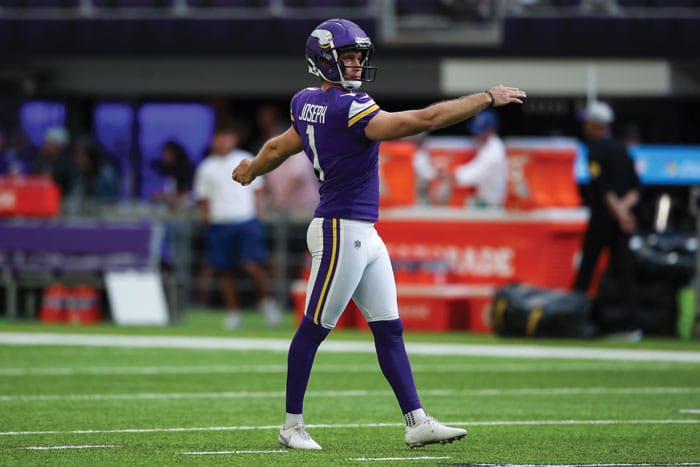
Greg Joseph—Minnesota Vikings

Born in South Africa, placekicker Greg Joseph spent most of his childhood in South Florida, where he attended Jewish day school. 

And a bonus:

Jews in the Pro Football Hall of Fame

Marv Levy

Coached the Buffalo Bills to a record four straight Super Bowl appearances. Inducted in 2001. 

Ron Mix

Before going pro, the offensive tackle was raised in Boyle Heights and played for the USC Trojans. Inducted in 1979.

Andre Tippett

The five-time pro-bowler played his entire career with the New England Patriots. Although he was raised Baptist, after he married his wife in 1993, he converted to Judaism in 1997. Inducted in 2008.

Al Davis

The longtime Raiders executive (in both L.A. and Oakland) presided over three Super Bowl-winning teams. He was also the first NFL owner to hire an African-American head coach, Art Shell. Inducted in 1992.

Benny Friedman

He was a highly-decorated quarterback from the first half of the twentieth century, and spent 29 years coaching college and pro teams. He also served in the United States Navy during World War II. Posthumously inducted in 2005. 

Sid Gillman

Although he is mostly known for his coaching career, Gillman played in the first ever season for the Cleveland Rams in 1936, a decade before they relocated to L.A. Inducted in 1983.  

Sid Luckman

After growing up in Brooklyn, the quarterback played his entire career with the Chicago Bears and was one of the most decorated NFL players in the first half of the 20th century. Inducted in 1965. n

The NFL Is Full of Jewish Players This Season Read More »

Dr. Bruce Powell Teaches About Excelling in Academics – And Kindness

Dr. Bruce Powell has spent over 50 years in education. Along with helping to found three Los Angeles Jewish high schools, he served as the first head of school at de Toledo High School for nearly two decades. 

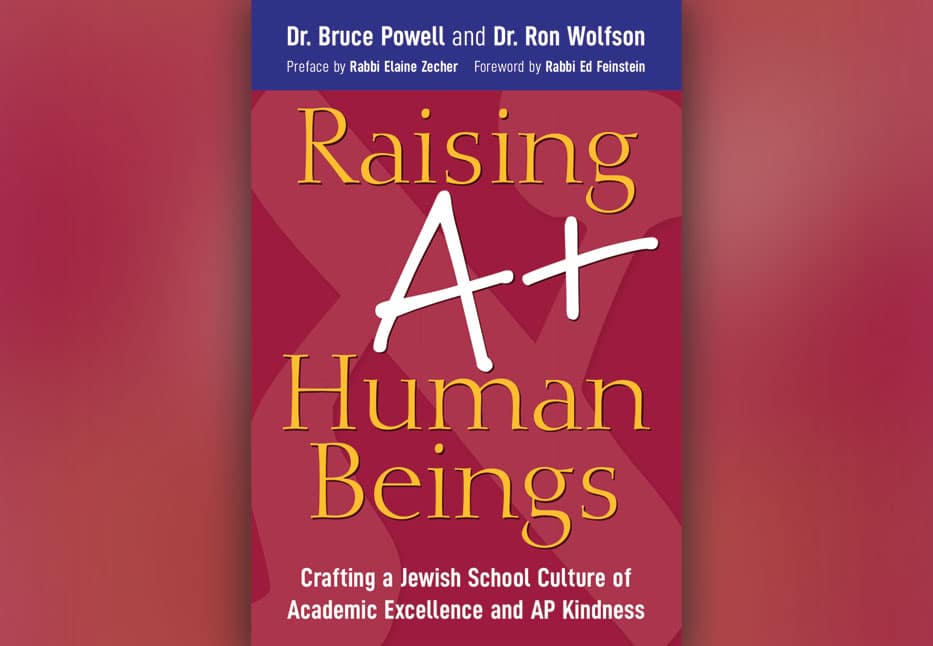
Now in retirement, he’s put out his first book, “Raising A+ Human Beings: Crafting a Jewish School Culture of Academic Excellence and AP Kindness,” which he co-authored with Fingerhut Professor of Education at American Jewish University Dr. Ron Wolfson.

The book provides guidance for educators on how to create a school culture that is based on Jewish values. “We’re helping people figure out how to use the book to inculcate a culture of kindness into their schools,” said Powell. “You’d think that was a normal thing that most schools do. It mostly is, but sometimes it’s not and they need a little boost.”

In the opening chapter, Powell reflects on his experience talking to a room of girls who were stressed out about finals. To calm them down, he talked about how when he was in high school, he received a D in chemistry, which meant he would be disqualified from attending his dream school.

He wrote that he then said, “I realized that not everyone can be an A student in chemistry but that through good deeds, loyal friendship and treating others with dignity, I could indeed be an A+ human being.”

Powell continued with his speech, “It seems to me that every girl in this room is an A+ human being even if you are not an A+ student in every subject. So, has anyone done a good deed today? Has anyone brought joy to a friend? If so, you are an A+ person, so stop worrying about grades. Study hard, but always know that life and friends will judge you on the grades that do not appear on your transcript. Please be A+ human beings every day.”

This anecdote sets the tone and style for the book, which is full of Powell’s experiences. Since there is such pressure to do well in academics, he tries to relieve the burden for students by telling them to go beyond only what they are capable of doing.

“Kids discover that they are created in the image of God, and it’s our job as educators to find out what their gift is and help them excel with it.” – Dr. Bruce Powell 

“It’s a tremendous relief for kids,” he said. “Kids discover that they are created in the image of God, and it’s our job as educators to find out what their gift is and help them excel with it.”

Another important concept that the book discusses is the idea of having a circle of friends rather than a clique. “A circle of friends is a secure group of people who will let anyone in,” Powell said he tells ninth grade students. “A clique is an insecure group that won’t let anyone in.”

According to Wolfson, the lessons from the book could be applicable not only to Jewish organizations in general, but the culture at large. “When you think of how common it is for people to retreat to their own cliques and not leave a space for new people to come in, it really is a metaphor for what’s happening in society right now,” he said.

So far, Wolfson said the book has been a tremendous success. Typically, the benchmark for a bestselling book in the Jewish world is selling 3,000 copies within two years. “Raising A+ Human Beings” has been out since March, and it’s already sold 4,000 copies. 

“It’s an indication that not only has the book been well received, but schools and congregations and other groups have adopted it so everyone can read it together and see how to apply these principles.”

With the overall theme of the book, Powell hopes that students learn how they can excel in kindness – and make the world a better place. 

“They need to understand that SAT scores or being the best is not going to define their life,” he said. “What’ll define their life are the beautiful, kind things they do for people. That’s how they can make an impact and contribution to the world.”

Dr. Bruce Powell Teaches About Excelling in Academics – And Kindness Read More »

The Kabbalah of Healing

We are in a month of holy-days, aware of the brokenness in us and our world. The sound of the shofar shakes us to the core. We bear many losses and recognize better values. We went to the ocean and allowed the wind to sweep away what no longer serves us: worries, blame, coldness of the heart.  

We are getting better at facing the unknown. We feel the fatigue of mundane disputes that are not for the sake of heaven. We want to honor ourselves in a new way. We are ready to go deeper to heal ourselves, to connect with an inner guide who will show us signs that we can trust, understand and follow.  

I go about this process with the twenty-two Hebrew letters, understood as signs and wonders by some of the sages. Since early times, these letters have fascinated many with their transformative power and universal vision. And they are here again.

Yud

How do they work? It’s simple. First, contemplate a wish or question, and then randomly draw a letter from the cards I have included with my book, “Meditations on the Hebrew Letters – A Guide for the Modern Seeker.” Read what is written under the letter. For instance: “What letter will help me start a new relationship with my sister?” When we draw a letter—whether we know it or not—there is an immediate synchronicity between our question and the power of the letter. The result is magical: we receive a meaningful answer. These letters are blessing, healing, repairing and inspiring. Their insights bring change.

When you draw an alef, or your name has an alef, it’s a call to realize who you are: one who is gifted with the ability to reconcile.

For Rosh Hashana, letter “alef” is very clear, simple and deep with her message: take responsibility to create balance in your life. How? By not identifying with one side or the other—allowing opposing forces to dance and complete each other. Just as day needs night, opposite forces cannot exist without each other. Look at alef’s sacred geometry. Can you see four triangles going in four different directions? They are the contradictory forces of life, pulling us in different directions—the way life is designed to be. When you draw an alef, or your name has an alef, it’s a call to realize who you are: one who is gifted with the ability to reconcile.

Shin

In the Sukkah, when we place our cards on the table, face down, let’s say we ask a question and draw the letter “samech.” We gaze at her colorful circular portrait. She is sod—secret. She whispers “go forward” without looking back. Once we make one small change, all 360 degrees of the circle are affected.  

In the Kabbalistic Tree of Life, the map of consciousness showing how the Divine Abundance descends to our world, the letters connect the emanations/sefirot to each other. They are sound vibrations that keep the world in existence. The Jewish people were called to witness the Divine on earth by the power of speech: We bless everything in our life and in Creation. Kabbalists say that the twenty-two letters were created before the creation of heaven and earth. We understand this from the first verse of Genesis: B’resheet bara Elohim et (In the beginning, God created et). The word “et,” spelled “alef tav,” indicates all the twenty-two letters. Etto appear everywhere in Torah; it’s a word with no particular meaning or grammatical usage. This word is spread here and there in the text like seeds of light. It’s a sign of blessings present throughout the text.

Samech

These twenty-two tools of creation are what the Creator uses to create and maintain the world—hour by hour, year by year. The letters invite us to emulate this divine mode. The work with them is deep and transformative, yet light and playful. Drawing a letter, you enter the realm of sacred play.


Gilla Nissan is a teacher and author. To purchase her new box set, “Meditations with the Hebrew Letters—A Guide for the Modern Seeker,” visit TheHebrewLetter.com or write to: Gilla@TheHebrewLetter.com

The Kabbalah of Healing Read More »