fbpx

September 23, 2021

It’s Always Been Unicorns — A poem for Torah Portion Vezot Hab’rachah

and with the sweetness of the produce of the sun,
and with the sweetness of the moon’s yield
-Deuteronomy 33:14

The day and night are different
and both bring their own blessings.
Do not curse the evening, for without it
cucumbers would never arrive in your salad.
Do not curse the day, for without it
your skin would be as pale us a unicorn.
If you’re going to get mad at any time of day
I suggest the dusk. It has a thick skin
and by the time you’re done talking
it will have turned out your lights.

and through the contentment of the
One Who dwells in the thornbush

-Deuteronomy 33:16

God is in a thornbush.
God is in a thornless bush.
God is the thorns.
God is the salve that soothes the thorn’s prick.
God is the one who makes you giggle when
you hear words that have many meanings.
God is the complete lack of words
that leaves you guessing.
God is the one who won’t tell you
if the unicorn exists.
God is the one who exists, though
people argue about that
all the time.

His horns are the horns of a re’em.
With them, he will gore peoples together
-Deuteronomy 33:17

We’re reminded every year
that unicorns exist, but this is
the first year I’ve noticed
they’re out for blood.


God Wrestler: a poem for every Torah Portion by Rick LupertLos Angeles poet Rick Lupert created the Poetry Super Highway (an online publication and resource for poets), and hosted the Cobalt Cafe weekly poetry reading for almost 21 years. He’s authored 25 collections of poetry, including “God Wrestler: A Poem for Every Torah Portion“, “I’m a Jew, Are You” (Jewish themed poems) and “Feeding Holy Cats” (Poetry written while a staff member on the first Birthright Israel trip), and most recently “The Tokyo-Van Nuys Express” (Poems written in Japan – Ain’t Got No Press, August 2020) and edited the anthologies “Ekphrastia Gone Wild”, “A Poet’s Haggadah”, and “The Night Goes on All Night.” He writes the daily web comic “Cat and Banana” with fellow Los Angeles poet Brendan Constantine. He’s widely published and reads his poetry wherever they let him.

It’s Always Been Unicorns — A poem for Torah Portion Vezot Hab’rachah Read More »

Tlaib, Omar Accuse Israel of “Human Rights Abuses” in Opposition to Iron Dome Funding

Representatives Rashida Tlaib (D-MI) and Ilhan Omar (D-MN) announced their opposition to a stand-alone bill providing $1 billion to the Israeli missile defense system Iron Dome, accusing Israel of “human rights abuses.”

Before the bill passed the House of Representatives with an overwhelming majority, Tlaib tweeted on September 23: “I will not support a standalone supplemental bill of $1 billion to replenish the bombs Israel used to commit war crimes in Gaza.” A day earlier, she also tweeted that she was going to vote against it to “stop enabling Israel’s human rights abuses and apartheid government.” Tlaib reiterated her allegations of Israeli war crimes and apartheid on the floor of the House of Representatives prior to the vote.

Omar similarly tweeted, “Given the human rights violations in Gaza, Sheikh Jarrah, and ever-growing settlement expansion, we should not be ramming through a last-minute $1 billion increase in military funding for Israel without any accountability.” In subsequent tweets, she alleged that the $1 billion in funding “was added without the knowledge or consent of relevant committee chairs or proper budgeting” and that the $1 billion would be in addition to the $73 million that Congress already allocated toward the Iron Dome.”

Representative Ted Deutch (D-FL) condemned Tlaib on the floor of the House.

“I cannot allow one of my colleagues to stand on the floor of the House of Representatives and label the Jewish state of Israel an apartheid state,” Deutch said. “I reject it.” He went onto say that those who make false characterizations about Israel “is consistent with those who advocate for the dismantling of the one Jewish state in the world and when there is no place on the map for one Jewish state, that’s antisemitism. And I reject that.”

Both members of “The Squad” came under fire on Twitter.

“You know the truth but choose to ignore it,” Israeli Ambassador to the United States and United Nations Gilad Erdan tweeted to Tlaib. “The Iron Dome protects Israel against Hamas’ war crimes including its indiscriminate firing of rockets at civilians. The U.S. has declared Hamas a terror organization – your actions help to protect terrorists against a democracy!”

“Here’s what @RashidaTlaib is really saying: Let Hamas & Hezbollah fire deadly rockets at will against 9 million Israelis—Jewish, Muslim, Christian… Let these terror groups pursue their aim of genocide. Deny Israel the right to defend itself,” American Jewish Committee CEO David Harris tweeted. “SAY NO TO HER UNBRIDLED HATRED.”

Judea Pearl, Chancellor Professor of Computer Science at UCLA, National Academy of Sciences member and Daniel Pearl Foundation President, tweeted to Tlaib: “Anyone who’s obsessed with ‘Israel Apartheid’ has a problem with Israel’s birth, not with ‘rights.’”


Journalist David Collier tweeted: “It is clear that @RashidaTlaib wants war and bloodshed. It’s as easy as ABC. A. The Iron Dome saves Israeli lives. B. Which means Israel is not compelled to invade Gaza to stop Hamas rockets. C. Which means Iron Dome prevents war and saves both Israeli and Palestinian lives.”

AIPAC tweeted to both Tlaib and Omar, “By voting against Iron Dome, you’re voting against protecting civilians from terrorism. You’re voting for more war, more destruction, and more Israeli and Palestinian lives lost.”

Human rights lawyer Arsen Ostrovsky, CEO of the International Legal Forum, tweeted to Omar, “Stop lying. Are you really filled with so much hatred and indifference to Jewish lives (and for that matter, Palestinian too), that you would rather see Hamas fire rockets at Israel and murder innocent people, only prolonging the violence? Are you really that heartless?”


Former United States Ambassador to the United Nations tweeted, “The same people who call for Israel’s restraint against terrorist groups that fire rockets at Israeli civilians are now opposed to funding the Iron Dome. The Iron Dome saves both Israeli and Palestinian lives. Without it, there will only be more terror and violence.”

IfNotNow and Jewish Voice for Peace (JVP) defended Tlaib and Omar. IfNotNow accused Deutch of “anti-Palestinian racism,” arguing that he shouldn’t “tell a Palestinian woman what she is and isn’t allowed to call the oppression and dispossession that Palestinians have endured through Israeli policies. It’s apartheid.”

JVP, which supports the Boycott, Divestment and Sanctions (BDS) movement, thanked Omar for being “one of a small number of members of Congress who are willing to truly stand up for human rights and safety for ALL people – no exceptions.”


Tlaib, Omar Accuse Israel of “Human Rights Abuses” in Opposition to Iron Dome Funding Read More »

House Passes $1 Billion in Iron Dome Funding

The House of Representatives passed a standalone bill allocating $1 billion in Iron Dome funding on September 23.

The final vote was 420 in favor and 9 against, with two members voting present. Those who voted no included Representatives Ilhan Omar (D-MN), Rashida Tlaib (D-MI), Andre Carson (D-IN) and Thomas Massie (R-KY). Representatives Alexandria Ocasio-Cortez (D-NY) and Hank Johnson (D-GA) voted present. Jewish Insider Capitol Hill Reporter Marc Rod tweeted that after her vote, Ocasio-Cortez appeared “to be crying on the House floor, in a hug with Rep. Primila Jayapal.”

Israeli Ambassador to the United States and United Nations Gilad Erdan thanked House Majority Leader Steny Hoyer (D-NY), Representative Rose DeLauro (D-CT) and others for voting “in favor of supporting Israel’s security & our strong alliance. The overwhelming bipartisan support of the Iron Dome legislation sends a clear message that America stands w/ Israel on fighting terror.”

Christians United for Israel Founder and Chairman Pastor John Hagee said in a statement, “The House of Representatives has spoken, and the message is clear: the American people stand with Israel. Those who would seek to deny Israel the means to protect her citizens from terror were resoundingly defeated today. The overwhelming and bipartisan vote backing US support for the Iron Dome system further proves that only the furthest radical fringe in this country is anti-Israel.”

AIPAC similarly said in a statement, “This vote reinforces the solid bipartisan consensus in support of Israel’s security & repudiates efforts by those in Congress who are pursuing a dangerous agenda to undermine the US-Israel relationship, weaken Israel’s security & place Israeli & Palestinian lives at greater risk.”

The American Jewish Committee tweeted, “We thank all 420 members of the House who voted to replenish the Iron Dome system, which protects innocent Israeli and Palestinian lives every day, and reaffirm the vital U.S.-Israel alliance.”

Democratic Majority for Israel President and CEO Mark Mellman said in statement, “While a small handful of anti-Israel lawmakers sought to strip these vital funds from an earlier bill, Democratic leadership and the vast majority of House Democrats quickly voiced their support for Israel’s right to defend itself and vowed to replenish Iron Dome by passing a standalone funding bill.

“Iron Dome, co-developed by the United States and Israel, is used to protect all Israelis — Jewish and Arab alike — from incoming missile attacks. By ensuring this purely defensive and life-saving system remains capable of neutralizing rocket threats, the U.S. helps disincentivize terrorists in Gaza and throughout the region.”

The vote came after progressive members of the House refused to vote for a government funding stopgap bill if it included the Iron Dome funding, prompting the September 23 vote on the standalone bill.

House Passes $1 Billion in Iron Dome Funding Read More »

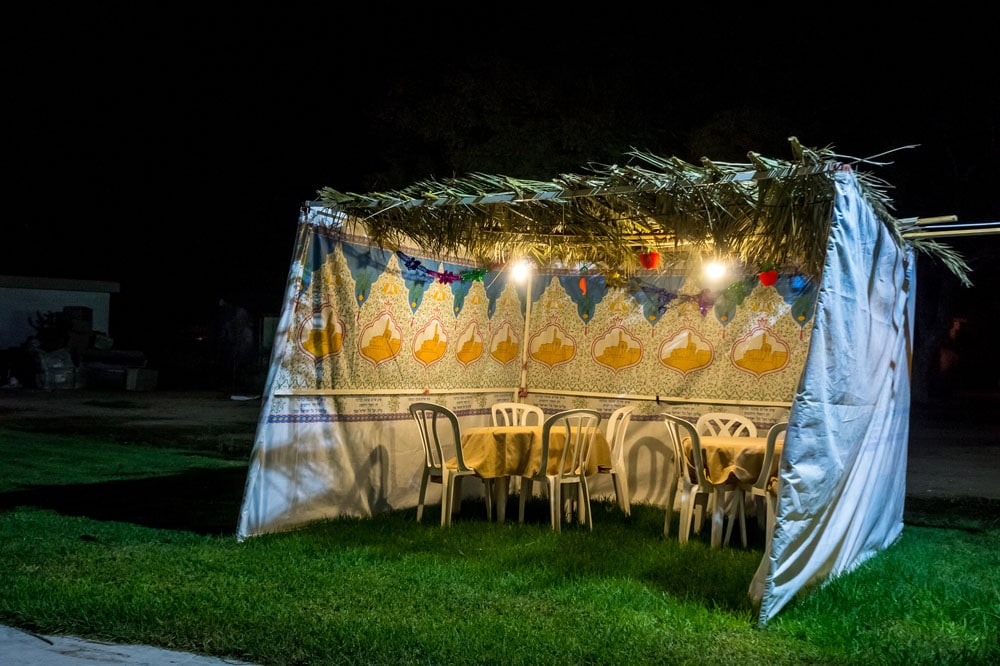
Tabernacle Rock

Tabernacles: all Jews rock Him,
lulavim and etrogim,
palms and citrons, willows, myrtles,
homes revealed like unshelled turtles,
roofed to let the stars shine through,
putting heaven in our view.

Seven autumn days of Sukkos
sukkah seats beneath our tukhes—
labeling the feast Sukkot,
if you are Sephardiglot—
plus Shemini, called Atseres,
airhead Jews upon their terrace
outscore friends who in their dwelling
aren’t the sukkah roses smelling.

Tennis court, and sauna, pool,
aren’t what frum Jews think quite cool.

In that fixing-up debacle,
Jews stargaze the Tabernacle!

It’s the best way to enhance
homes, because we find romance
under palms where we discuss
Moses and the exodus,
and the “Clouds of Glory” cover
God gave Israel, called His lover,
for the festival of seven
days when wilderness was heaven.


Gershon Hepner is a poet who has written over 25,000 poems on subjects ranging from music to literature, politics to Torah. He grew up in England and moved to Los Angeles in 1976. Using his varied interests and experiences, he has authored dozens of papers in medical and academic journals, and authored “Legal Friction: Law, Narrative, and Identity Politics in Biblical Israel.” He can be reached at gershonhepner@gmail.com.

Tabernacle Rock Read More »

Sweets for Simchat Torah — The Sephardic Spice Girls Way

The first time Rachel cooked a meal for her future husband Neil, she made poisson en croute and olive chicken. For dessert, she served mixed berries in a chocolate cup. He didn’t believe her when she said she made them herself. 

Early in our dating life, Alan took me to the Hollywood Bowl. I made my killer roast chicken and potatoes and mini asparagus quiches. For dessert, I dipped strawberries in chocolate. He didn’t believe that I made any of it!

As Sephardic Spice Girls, Rachel and I approach the dessert conundrum with serious consideration. It’s an essential part of the meal and no one, no matter how full, ever refuses dessert. We are enamored by the Mediterranean and Middle Eastern approach to dessert—lots of fresh fruit, dried fruit and nuts. Sephardic delicacies, including baklava, mazapan, ma’amul, baba tamar, that are made with dried fruit and/or nuts have a healthy slant too. 

Don’t get us wrong! Our dessert list also includes decadent European and American desserts like strawberry shortcake, tiramisu, chocolate torte, flan, rice krispy treats, brownies and blondies and other decadent treats. We just try to keep it as balanced and healthy as we can. 

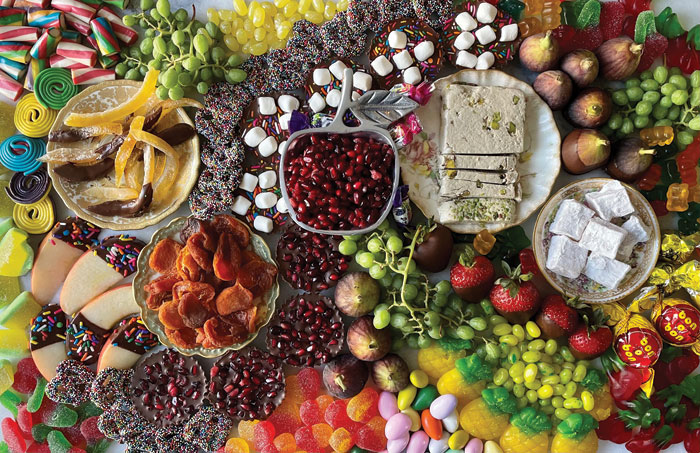
In honor of the holiday of Simchat Torah, Rejoicing in the Torah, we made a Sephardic inspired candy board, a reminder of the candy the children receive in the synagogue on this last, most joyous holiday in the the month of Tishrei. 

There’s lots of gummy fruits and Jordan almonds, bon bons and jelly beans. There’s fresh figs and dried apricots, Turkish Delight and pistachio halva from our favorite purveyor House of Halva. And the chocolate! (An ode to my grandparents who took me to Sephardi Synagogue on Fletcher Street in Sydney, where they handed every child a huge slab of Cadbury’s chocolate!) We had so much fun with the chocolate! We dipped strawberries and apples and dried orange. We filled foil cups with chocolate and topped some with pomegranate and others with marshmallows. 

We are going to let you in on a secret: chocolate covered strawberries are the least difficult, quite impressive and rather delicious dessert you’ll ever make!

It’s so easy to melt that chocolate in a double boiler—just be careful not to splash water in the chocolate—then dip strawberries, apples, dried fruit, nuts, marshmallows, Oreo cookies or whatever you fancy. You’re guaranteed a dessert your friends and family will melt for. 

That’s why several decades later, we are still melting chocolate and adding fruit for our desserts.

Rachel’s Chocolate Berry Cups

1 punnet strawberries, washed and drained
2 cups mixed berries, blueberries,
blackberries or raspberries, washed and
drained
1/4 cup orange liqueur, or 2 tablespoons
orange blossom water
24 ounces dark chocolate chips
1 package silver foil cupcake holders
1 container whipped cream

  1. Place berries in a bowl with liqueur and marinate.
  2. Over low to medium heat, melt chocolate in a double boiler.
  3. Using a spoon, carefully drizzle chocolate into the cupcake holders to create a thin shell, making sure to fill in all the folds.
  4. Place each cup on a baking sheet and place tray in the refrigerator.
  5. When chocolate has completely hardened, peel the foil off the chocolate, and return to refrigerator.
  6. Just before serving, spoon some whipped cream into cup and then spoon marinated berries on top.

Rachel Sheff and Sharon Gomperts have been friends since high school. They love cooking and sharing recipes. They have collaborated on Sephardic Educational Center projects and community cooking classes. Follow them on Instagram @sephardicspicegirls and on Facebook at Sephardic Spice SEC Food.

Sweets for Simchat Torah — The Sephardic Spice Girls Way Read More »

Grasping the Joy of Simchat Torah

There is a moment in shul on Shabbat morning when I will, unfailingly, be overcome with emotion. That moment is after the Torah has been read and been carefully, lovingly carried back into its physical home in the Ark. We stand reverently, dressed in our Shabbat finery, as we look toward our Torah scrolls cloaked in fine, rich mantels; gleaming silver breastplates; and silver crowns. A royal ensemble. 

And then, we sing: Eitz Chayim hi, l’machazikim ba, v’tomheha meushar. . . “It is a tree of life for those who grasp it, and its supporters are praiseworthy.” I love these lines, but the tears begin to flow two lines later, when our voices rise as we sing, Hasheveinu, Ado-shem, eylecha, v’nashuva, chadesh yameinu k’kedem. . . “Bring us back to you, Hashem and we shall return, renew our days as of old.” I know: the English sounds stilted, but the Hebrew is so beautiful and the sound of our communal song is so electric that I can never get those last words out except in a whisper. My tears are flowing. I cannot speak. 

We treat the Torah reverently all year long. If the Torah is being moved in shul, we stand until it has been set in place. If someone accidentally drops a Torah scroll, fasting is required as a symbol of atonement. We clothe it in regal garments and accoutrements. We study it, day in, day out. Its life-giving spiritual nourishment is considered a gift, one we are denied only when we are in mourning, such as on Tisha B’Av.

Any newcomer walking into a rowdy, tipsy Simchat Torah celebration might well wonder: is this boisterous partying with God kosher? 

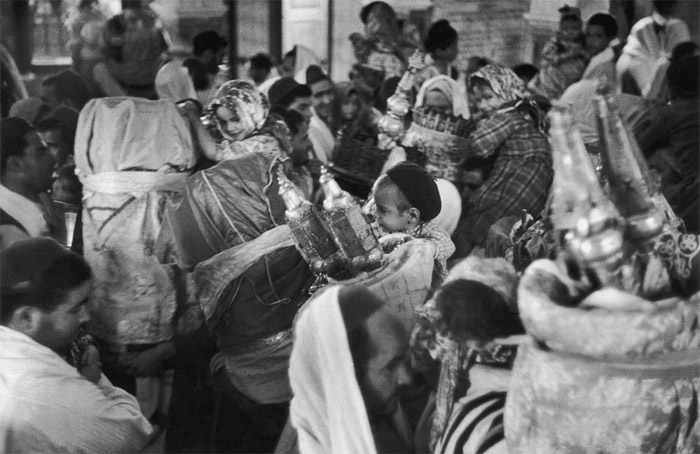
Yet on Simchat Torah we sing and dance with these holy scrolls with abandon, excitedly, sometimes chaotically. We may be knocking back a few as we sing of our love for the Torah and for God in merry melodies that seem better suited for the lightest of verses. Any newcomer walking into a rowdy, tipsy Simchat Torah celebration might well wonder: is this boisterous partying with God kosher? 

The reason I cry when we sing Eitz Chayim hi and the reason I laugh and sing with joy on Simchat Torah are one and the same. It wasn’t until I also “grasped” the Torah as my chosen life path that I began to see that is really is a tree of life. We live with insecurity and instability. Today all may be well; tomorrow we may face a plague, terrorist attack, social and political upheaval, personal tragedy. We require armed guards at our schools, shuls, and community centers. We are whipsawed by increasingly radical ideologies that threaten our Jewish values and freedom to practice our faith. The Torah and God’s eternal promise to us provide ballast in the storm. And even during calm times, the Torah’s wisdom and guidance help us navigate our most important relationships in life: with spouses, children, parents, and even ourselves. 

People often turn to religion when life feels like it’s spinning out of control. During Covid, this happened in the Jewish world, too. Several Jewish outreach organizations with study partner programs faced a surge in demand, including Partners in Torah and Oorah’s TorahMates initiative.   

Rabbi Yisroel Mayer Hoberman, co-director of TorahMates, told the Journal that they have seen a nearly 40 percent increase in the number of students and study partners from February 2020 through September 1. “The turbulence of the past couple of years has upended so much that we take for granted in life,” Rabbi Hoberman said. “It has added significant urgency to the search among many people for a meaningful connection to the Jewish community and to the Torah’s wisdom and guidance.”

Our unadulterated joy on Simchat Torah isn’t disrespectful of Torah—it underscores our respect and love. In a fragile world, where today’s “wisdom” will become tomorrow’s refuted and discarded theory, we sing and dance with the Torah and study it because no matter what faces us tomorrow, it will always remain our Tree of Life.


Judy Gruen is a writer and editor. Her books include “The Skeptic and the Rabbi: Falling in Love with Faith.”

Grasping the Joy of Simchat Torah Read More »

The Disturbing Realization that “People Love Dead Jews”

The bitter ironies that abound in Dara Horn’s new book begin with the title itself: “People Love Dead Jews: Reports from a Haunted Present” (Norton). The author is plainspoken about her use of the off-putting and even heart-breaking phrase: “This book explores the many strange and sickening ways in which the world’s affection for dead Jews shapes the present moment,” she announces. “I hope you will find it as disturbing as I do.”

Horn is best known for her five novels, including “In the Image” and the “The World to Come,” both of which were presented with the National Jewish Award for fiction. She earned a doctorate in Hebrew and Yiddish literature at Harvard University, and she has taught these subjects at Harvard, Yeshiva University and Sarah Lawrence College. But she is also a frequent contributor to Tablet, The New York Times, the Jewish Review of Books and the Atlantic, where some of the essays in her latest book first appeared.

Apparently mindful that the sharp edges of her book will be off-putting to some Jewish readers, she opens with reminiscences of her own Jewish cred. “I read works of Jewish philosophy for fun, tracking medieval and modern arguments about the nature of God,” she writes of her adolescence. She served as the Torah reader at the children’s services at her synagogue. “I often privately began and ended my days with traditional Hebrew prayers.”

“As thousands of Holocaust books and movies and TV shows and lectures and courses and mandatory school curricula made abundantly clear, dead Jews were the most popular of all.”

Eventually, and fatefully, she experienced a revelation. Not only is Judaism deeply rooted in history and tradition, but Jewishness itself is seen by non-Jews as what she calls “a state of non-being: not being Christian or Muslim or whatever else other people apparently were … being alienated, being marginalized, or best of all, being dead.” Exactly here is the idea behind the title of the book: “As thousands of Holocaust books and movies and TV shows and lectures and courses and mandatory school curricula made abundantly clear, dead Jews were the most popular of all.”

Anne Frank, whom Horn calls “Everyone’s (Second) Favorite Dead Jew,” is perhaps the iconic example of her argument. Horn points out that Frank’s diary has been translated into 70 languages and has sold more 30 million copies. The Anne Frank House in Amsterdam draws more than a million visitors each year.  

“But when a young employee at the Anne Frank House tried to wear his yarmulke to work, his employers told him to hide it under a baseball cap,” Horn explains. “The museum finally relented after deliberating for four months, which seems like a rather long time for the Anne Frank House to ponder whether it was a good idea to force a Jew into hiding.”

Not every example is quite so harrowing. The chapter titled “Frozen Jews” reminds us of the 20,000 Jews who once lived in the Chinese city of Harbin, whose Jewish identity was so widely known and valued that international Zionist conferences were held there. “You already know this story has to end badly,” she warns. “[T]he usual centuries-long rise-and-fall was condensed into thirty years. The persecution started when Harbin came under Japanese occupation in 1931 and continued into the Communist era, when Israel secretly arranged for Jewish families to escape. “The last Jewish family left town in 1962,” writes Horn, leaving a single elderly woman who died there in 1985, “the official Last Jew of Harbin.” But Horn, always a myth-buster, points out that there is actually one more Jew left in Harbin, an Israeli journalist and teacher named Dan Ben-Canaan.

“I’m the president of the community here, which consists of me and me alone,” Ben-Canaan told Horn in a rare moment of humor. “It’s great because I don’t have anyone to argue with.”

Synagogue shootings in Poway and Pittsburgh, however, are “shocking and disorienting not merely because of their sheer violent horror, but because they contradict the story that American Jews have told themselves for generations.”

Surely the most heart-breaking chapters of all focus on recent acts of murderous antisemitism here in the United States. “Nearly every diaspora Jewish community in world history has at least one founding legend,” Horn points out. The one that American Jews have always embraced is the notion that the United States “was the first place in centuries where their families could enjoy full and free lives.” Synagogue shootings in Poway and Pittsburgh, however, are “shocking and disorienting not merely because of their sheer violent horror, but because they contradict the story that American Jews have told themselves for generations.”

Even when attention and respect is paid to Jewish history, Horn argues, the exercise can be futile or even harmful. The proliferation of Holocaust museums and exhibitions in America and elsewhere around the world is “imbued with a kind of optimism, a bedrock assumption that they were, for lack of a better word, effective.” Once again, Horn is blunt and candid: “The idea was that people would come to these museums and learn what the world had done to the Jews,” she explains. “They would then stop hating Jews.” But she is haunted by a terrifying thought: “Perhaps we are giving people ideas.” Horn fears that the lesson of Holocaust remembrance—“Never again”—“has come to mean that anything short of the Holocaust is, well, not the Holocaust.”

Horn refers to the phenomenon that she describes and debunks so powerfully in “People Love Dead Jews” as “gas-lighting about the Jewish historical past and present,” and she insists on telling the truth. “I had mistaken the enormous public interest in past suffering for a sign of respect for living Jews,” she writes. “I was very wrong. n


Jonathan Kirsch, author and publishing attorney, is the book editor of the Jewish Journal.

The Disturbing Realization that “People Love Dead Jews” Read More »

Back to the Beginning

Simchat Torah literally means the celebration of Torah. It’s not what we usually associate with Torah, something we study and examine from multiple perspectives. A simchah is a Bar/Bat Mitzvah, a wedding, or even a circumcision. These are celebratory life cycle moments in people’s lives. But a celebration of our precious scroll and all that it contains, that is truly experienced only by a small percent of the Jewish community. If you belong to a synagogue you will know about Simchat Torah, for it will be a scheduled event, a time to gather, and experience the rituals associated with this moment in our calendar. It has become the icing on the cake in the High Holy Day cycle, after deep introspection, baring our souls, touching our fragility, and then sitting in a simple structure, a Sukkah, finding peace in nature and G-d’s mysterious universe.

Simchat Torah is truly a beginning, for it marks the cycling back to the start of the Torah, reading it all over again, either in one year or divided into thirds over three years. And like all beginnings in our tradition, the beginning of Jewish adulthood at Bar/Bat Mitzvah, the couple entering into their marriage contract, or even the moment an infant is brought into the covenant, it deserves attention and joy, with singing and dancing, as we all do at these magical moments in our family’s lives. Torah, like one of our children, is precious to us, beloved, and we want to shower it with the same kind of honor and unconditional love.

At such an event we read the final passage in Torah, about Moses, whose life ends but is remembered for how he served G-d and the people, and then we go back to the beginning and read the first few paragraphs describing the Creation of the World and our first connection to time – night and day and the seven day week. An ancient tradition was to read the story of Isaac’s marriage, a reflection of what this holiday symbolically represents – the marriage of our Creator to the Jewish people, a commitment like no other.

The Torah is like a heart, pumping life into each person who engages with it. Her stories inspire us opening pathways of new understanding and expanding the levels and depth of wisdom. 

The last letter of Torah is a ‘lamed’ and the first letter of Torah is a ‘bet’. Like a never-ending circle, the last letter joins with the first forming the word ‘lev’ which is a heart. The Torah is like a heart, pumping life into each person who engages with it. Her stories inspire us opening pathways of new understanding and expanding the levels and depth of wisdom. Both the right and left side of our brain are jolted into awareness – critical, intellectual learning and creative, innovative expression. She is like a shot of vitamins, a booster elevating our immunity to withstand some of life’s harsh realities, giving us the tonic that creates more balance and greater well-being.

For the mystics she is Shechinah, the bride, the foundation of the world. She is wisdom herself, who teaches how to live, what to value, and the importance of both religious and civil comportment. She offers stories of people, who are both exceptional and scarred, to enlighten us about behaviors and choices as both a warning and a guide for our own discernment on how we should lead our lives. Our most treasured possession is the Torah for it is how G-d speaks to us, cares for us, and teaches us. It is viewed as an expression of G-d’s love and so we return that love by celebrating in joy just as we celebrate a wedding anniversary. The reader of the Torah is called Hatan, the bridegroom, and in the middle ages he was walked to the synagogue with torches like a groom to this wedding canopy.  

Rejoicing with the Torah, which is filled with mitzvot, the many rules we follow, is a testament to the Jewish value and respect for the law. At a time where we see such disrespect and complete anarchy how exceptional is it that we celebrate the foundation of order and communal responsibility. ‘She is our strength and our guiding light.’ And when such insecurity is rampant, how gratifying it is to share in a Simchah, holding and dancing with our most precious possession.


Eva Robbins is a rabbi, cantor, artist and the author of “Spiritual Surgery: A Journey of Healing Mind, Body and Spirit.”

Back to the Beginning Read More »

Headed by Jewish Execs, Israel Philharmonic Partner Aspiration to go Public via SPAC

Aspiration, the financial services company that recently partnered with the Israel Philharmonic to fight back against rising temperatures globally, is choosing the hottest new method to go public. And it’s all backed by Jewish values.

In a recent release, Aspiration announced its plans to go public through a merger with Interprivate III Financial Partners Inc., aspecial purpose acquisition company (SPAC). SPACs have come into recent prominence, with companies such as SoFi Technologies and Lucid Motors opting to take their business public via the increasingly popular method.

According to the terms of the transaction, the company is set to become publicly traded on the NASDAQ by the end of this year—a crucial next step for a company that needs buy-in on a world stage to see its vision of a better, greener Earth realized.

Aspiration’s cofounders, Andrei Cherny and Joe Sanberg, are not only environmentally conscientious entrepreneurs, they’re also Jewish-American leaders who are outspoken in how their Jewish values inform their socially conscious pursuits.

“Aspiration is a company inspired by the Jewish values that Andrei and I hold dear. It allows individuals to reconfigure your financial life so that you can automate Tzedekah into your daily routine,” said Sanberg.

Like its Jewish cofounders, the green-thinking financial institution observes a more literal interpretation of tikkun olam, seeking to democratize world-repairing by equipping consumers with the tools needed to deploy their money for good. That means no money deposited into an Aspiration account is ever invested in harmful fossil fuel projects, and spending can be rounded up to support tree-planting initiatives that increase carbon levels and combat deforestation.

The Jewish lens with which Cherny and Sanberg view the world couldn’t be more apparent than in Aspiration’s choice to partner with Israeli institutions like the Israel Philharmonic. In April, the financial services company announced in April that it would be partnering with the Israel Philharmonic to bring the world-renowned Orchestra to full carbon neutrality by 2022—a seemingly perfect fit for two organizations who have shifted their focus to ensuring a better future for the coming generations.

Through Aspiration’s partnership with the Israel Philharmonic, the environment-first company has promised to donate instruments to the Orchestra’s youth music education programs for every person who creates an account through their partner link. Additionally, Aspiration will plant a tree for every click-through to their site from the AFIPO/Aspiration partner page.

In a statement from American Friends of the Israel Philharmonic (AFIPO), Executive Vice President & CEO Danielle Ames Spivak noted, “Our world isn’t the same place it was 10, 20, or even 1 year ago. Art and culture institutions must now shift their focus globally to prioritize the future they are creating and the Earth we leave behind. That’s why we are excited and proud of our partner, Aspiration, for taking this next step to revolutionize the financial industry and change our world for the better.”

Cherny, who is also Aspiration’s CEO, spoke to Ames Spivak about how his heritage and upbringing influenced his career—and life—path on an episode of AFIPO’s Schmoozic!, a web series that examines humanitarianism through the lens of classical music.

“We are so thrilled to have [AFIPO] as our partners… I say that personally as a person whose family came from communist Czechoslovakia and came and lived in freedom in a Kibbutz before they moved to the United States,” said Cherny.

“This is our heritage. Our religious heritage, our cultural heritage, our environmental heritage. It’s up to each of us to pass that on and be stewards of change.”

The soon-to-be public company also recently made headlines from initiatives with Israeli actress Noa Tishby, which will offset the carbon footprint of her recent book “Israel: A Simple Guide to the Most Misunderstood Country on Earth,” and megastar Drake, who announced that the financial services company would soon make his entire life—both at home and as a touring musician—carbon neutral

Headed by Jewish Execs, Israel Philharmonic Partner Aspiration to go Public via SPAC Read More »