fbpx

September 23, 2021

Soroka Friends Present Women-Led Webinar on Resilience, Reinvention and Self-Growth

Soroka Medical Center is not only known for being the only major medical center in the Be’er Sheva region of Israel. It is also home to the busiest women’s health facilities in the country, overseeing more than 18,000 births and examining over 20,000 women for breast cancer annually at its Marjorie Price in Breast Health Center. 

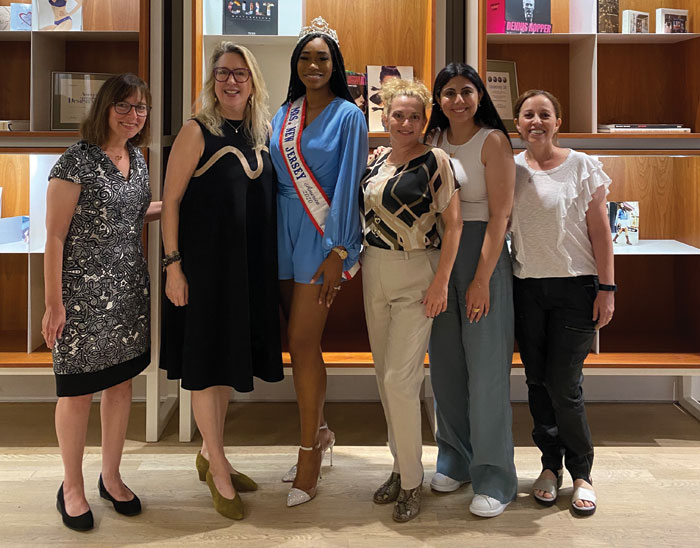
When the pandemic hit, it became the first institution in Israel to open a COVID-19 Care Unit, and American Friends of Soroka Medical Centers (AFSMC) got to work abroad hosting Zoom sessions to support the medical center’s mission. The most recent of those events, “Resilience, Reinvention & Self-Growth,” featured the stories of three women, Reyna Marder Gentin, an attorney and author of “Both Are True,” Chimere Nicole Haskins, Mrs. New Jersey America and founder of Girl Yes and Lori Banov Kaufmann, an entrepreneur and author of “Rebel Daughter.”

“In the age of COVID-19, we quickly pivoted to the new reality and worked hard to create meaningful interactions among Friends of Soroka, leveraging on new ways to stay connected through virtual and hybrid events,” said AFSMC Executive Director Rachel Heisler. “Our dynamic panelists spoke about their own uplifting stories of resilience, growth and gratitude, inspiring our audience in their own journeys [and] building a sense of community and togetherness.”

Each of the speakers explained their roles, along with their professional accomplishments, and how they manage to do so much on a day-to-day basis. 

Haskins talked about her organization Girl Yes, a mentorship program that teaches girls about everything from branding to beauty and business, and how she stays motivated for her hundreds of thousands of followers. 

“When you have people who are holding you accountable [who say], ‘Chimere, you said you were going to post today’ or ‘Chimere, you said you were going to talk about this today,’ it puts a little more pep in your step. Then you know that people are waiting on you [and] relying on you.” 

When discussing what they are proud of, Kaufmann brought up her personal life. “I’m trying to think of something that really makes me proud and I’m thinking of professional highlights or getting [my] book published, but I still think it’s my kids and my family life,” she said. “I just keep going back to that. It’s what I care the most about.” 

Heisler said she related to the speakers’ stories of reinvention and self-growth because before she was executive director, she was a banker and entrepreneur. 

“I welcomed the opportunity to develop and lead this wonderful organization, while embracing the unknown and knowing that I had so much to learn and significant goals,” she said. “It is empowering to realize that we can develop new skill sets at any age and recognize that having a strong sense of purpose in our personal and professional lives is so vital.”

“Resilience, Reinvention & Self-Growth” was just one of the webinars that Soroka Friends have presented. The first webinar series, “Ask the Experts,” featured medical experts talking about topics like COVID-19, vaccines, mental health and coping and resilience in an uncertain time. 

Along with holding webinars, this past summer, Soroka Medical Center put up artist Marc Bennett’s The History of the Star of David, a colorful public art installation that greets visitors and reflects on the meaning of the Magen David throughout history. 

To view the webinar and learn more about Soroka Friends, people can visit the organization’s YouTube channel. In the meantime, Heisler is confident that viewers will watch “Resilience, Reinvention & Self-Growth” and feel inspired.

“We hope participants viewed this webinar as an opportunity to share their stories, learn from others and get inspired to fulfill their goals.”
– AFSMC Executive Director Rachel Heisler

She said, “In an ever-changing world where self-growth and resilience are necessary tools in one’s toolbox, we hope participants viewed this webinar as an opportunity to share their stories, learn from others and get inspired to fulfill their goals.”

Soroka Friends Present Women-Led Webinar on Resilience, Reinvention and Self-Growth Read More »

Jewish World Watch Teens Empowered to Educate Through TAP Program

Amy Cecil, the Director of Education at Jewish World Watch, has always had a passion for education, which is why she created the Teen Ambassador Program (TAP). TAP is a leadership development program to inspire and mobilize teens to take action and change the world. 
Cecil introduced TAP when she noticed that the high school interns involved in JWW, a 501(c)(3) nonprofit that aids survivors of mass atrocities around the globe and   inspires people to join the fight against genocide, were yearning to learn more about the issues discussed within the organization. 

“The goal was to create teens that would really be ambassadors in the best sense of the word – that they would learn what we do [at JWW], how we do it [and] why we do it,” Cecil told the Journal. “They would go back to their schools, their synagogues and their soccer teams, and they would talk the talk … about what genocides and mass atrocities are, about what it means to be a survivor.”

Since its inception six years ago, TAP has flourished from a single-module program to a four-module program,   reaching nearly 150 high school students.

TAP Basic, the first of the four modules of the curriculum, explores the idea of the “personal lens” – that we each view the world differently based on our unique experiences, upbringings and education. The issue isn’t that we have diverse experiences, but that the world is divided into “us” and “them.” 

The purpose of TAP Basic is to equip students with effective communication, leadership and problem-solving skills in order to “blur that distinction between the us and the them, so that we realize and internalize the fact that [we’re all citizens] of one world,” Cecil said.

After TAP Basic, students have the option to pursue TAP PLus (PL = Purposeful Leadership), where they tackle the concept of genocide, understand the importance of advocacy and learn how their actions can impact the world. 

The third TAP module, Philanthropy, allows students to bring their actions into fruition to make positive change through philanthropic efforts. This year, the 12 students enrolled are invested in Seeds of Survival, raising money to plant new sustainable gardens for Darfuri survivors in Chad. 

The newest TAP module, Cinema, is scheduled to launch in-person in January, depending on COVID-19. It will focus on a conversation surrounding genocide through films and filmmaking.

Cecil also recently launched a series called TAP Talks, which provide a space for interns to share their thoughts on issues discussed in TAP and reflect on their time at JWW.

‘I want their voices, which are so brilliant, to be heard by more than just their cohort.’ — Amy Cecil

“[My kids] have incredible perspectives, they’re deep thinkers, and part of being an ambassador is getting the word out,” said Cecil. “I want their voices, which are so brilliant, to be heard by more than just their cohort.” 

Jonah Goldberg, a TAP graduate, JWW communications summer intern and senior student at Washington University in St. Louis was invited to write the first TAP Talk. “I believe in the power of small interventions, matchsticks that can keep a fire burning and sometimes ignite a new one. But I also know that it takes bigger, sustained actions to change the world,” he wrote. 

Goldberg’s TAP Talk discussed the importance of letting go of any guilt or fear associated with not having enough time to volunteer. “I might have sacrificed the chance to continue making an impact if I had listened to that misplaced fear,” he wrote.

But when Goldberg found the time to return to JWW this past summer, he was embraced with open arms. 

“There’s something nice about a smaller, more tight-knit group of people who are all dedicated to the same cause,” Goldberg told the Journal. 

Jonah Goldberg speaks during Jewish World Watch’s 2018 Walk to End Genocide in Pan Pacific Park. Photo by Bill Sparkes

He continued, “That’s a side of Judaism that I’ve always really valued: that connection to social justice … There’s something very validating, comforting and encouraging about coming to a Jewish organization knowing that one of the values we all share is trying to repair the world.”

Jewish World Watch Teens Empowered to Educate Through TAP Program Read More »

Meet the Jewish Brothers Who Started an Annual Punk Rock Convention

Long before it became an annual festival, Punk Rock Bowling began as just a gathering of friends in Los Angeles’ punk music community for a bowling tournament in Santa Monica. 

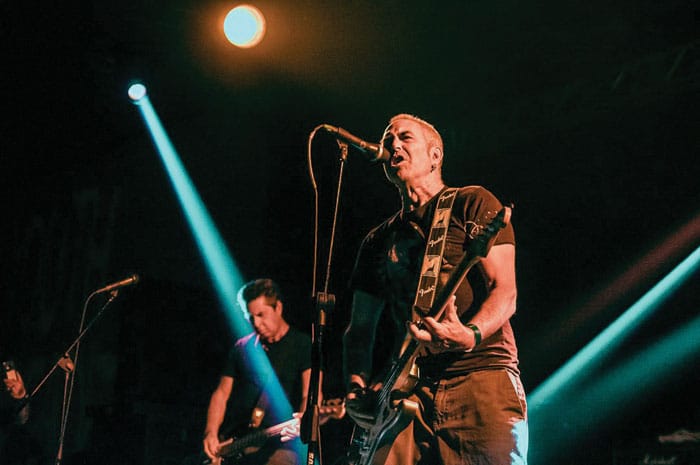
Now, the Stern brothers, Mark and Shawn, are about to host their 21st iteration of Punk Rock Bowling, a punk community convention in Las Vegas.

It started with about 200 punk musicians and fans in a bowling tournament and evolved into the enormity that it is today. By 2011, the festival had migrated to downtown Las Vegas, where approximately 15,000 fans come annually from all over the world to attend.


“We had no idea that the little party we threw for all our friends back in ’99 would evolve into a full-blown festival and be what we spend most of our time on each year.”
– Shawn Stern

“We had no idea that the little party we threw for all our friends back in ’99 would evolve into a full-blown festival and be what we spend most of our time on each year,” Shawn told SLUG Magazine before the most recent festival in 2019. The 2020 festival was canceled due to the pandemic. 

The Stern brothers are never content to focus on just one thing, and they have an unfriendly relationship with the corporate business side of music.

In the early 1980s, when their band Youth Brigade started to tour nationally, it was a rough time for punk music fans; the police would often hassle fans for their outfits and style. 

Never to stand by idly as the punk scene was denigrated, Shawn and his younger brother Mark took possession of an old warehouse in the San Fernando Valley to host their own shows. They named it the Godzilla’s, and for a time, it was the epicenter of the Valley’s punk community. The LA Times called it “the perfect punk playground.” Fittingly enough, the warehouse had also been a former bowling alley. 

Around the same time, in 1982, they started their own record label called BYO Records (an acronym for Better Youth Organization) with the intent of changing how the punk scene was viewed and to help their fellow punk bands make a living in music. 

In 2015, BYO Records pulled their entire catalogue from Spotify because of unfair royalty distribution. Their music has since returned but Shawn and Mark still remain averse to working with major labels. Though it certainly costs them a degree of exposure, the Stern brothers remain firm that it brings an authenticity to the music.

“There was a huge dilemma between Shawn and Mark constantly about whether or not they were musicians or businessmen, whether they were label owners or a band,” their brother Jamie said in the 2009 documentary “Let Them Know: The Story of Youth Brigade and BYO Records.” But with Punk Rock Bowling, the Stern brothers’ do-it-yourself approach to life is the perfect solution to their struggle to straddle the line between being businessmen and musicians.

Part of the allure of Punk Rock Bowling is that it’s much smaller than other prominent music festivals, and that is by design. 

“As a musician, I’d like to play in front of people who actually give a [expletive],” Shawn said in the documentary.

Although there are strict COVID vaccination and testing policies in place for all attendees this year, there will still be one of Punk Rock Bowling’s signature features since moving to Las Vegas: their “infamous” pool party concerts that allow festival goers to sing, dance and headbang from the water at the Downtown Grand Hotel. 

While there is certainly a competition for tickets to Punk Rock Bowling and the after parties, there is hardly any competition amongst the bands that Shawn and Mark book to headline the festival.

“I don’t feel like we’re in competition,” Shawn said. “I think bands can help each other out, just out of respect for the fact that we’ve all been doing this for a long time and we’re all lucky enough to be able to play music and be able to make a living.

Meet the Jewish Brothers Who Started an Annual Punk Rock Convention Read More »