
fbpx

September 17, 2021

My Moroccan Sukkot

My father, of blessed memory, was born and raised in the Mellah of Marrakesh. All of the Moroccan traditions I practice on Sukkot are customs I learned and inherited from him.

Those special Moroccan traditions – which I grew up with and practice to this day – adorn Sukkot with an aesthetic beauty and mystical spirituality all its own.

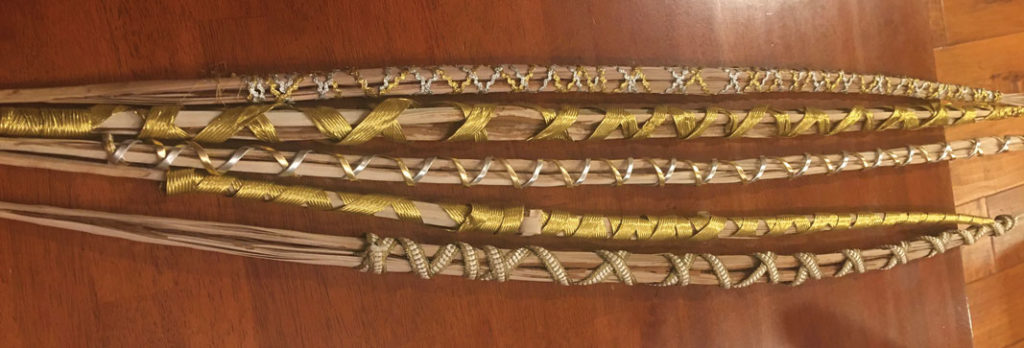
As a child, I loved watching my father decorate my Lulav, but that Moroccan custom now belongs to my Ashkenazi wife Peni, who does it with love and her unique creative flair. 

In my Moroccan tradition, the Lulav is far more than the plain spine of a palm branch. Upon bringing it home from the store, the first thing we do is decorate the Lulav with golden threads or ribbons. This is based on a unique tradition dating back to the Mishnah, where it says “The People of Jerusalem bound their Lulavs with strands of gold” (Mishnah Sukkah 3:8). How did this Jerusalem tradition arrive in Morocco? The simple answer would be that someone from Jerusalem brought it there. I think otherwise. If you’ve ever been to a Moroccan Shabbat dinner and seen how we adorn our tables with a colorful array of foods, it makes sense that we’d be attracted to a tradition that decorates our Lulav! As a child, I loved watching my father decorate my Lulav, but that Moroccan custom now belongs to my Ashkenazi wife Peni, who does it with love and her unique creative flair. 

Fresh from decorating the Lulav, we enter the Sukkah, often with the spool of golden ribbons still in our hands. Bamboo sticks – not palm fronds – sit above our heads. My father taught me that in his family, the Sukkah was treated as more than a temporary dwelling place or dining room. It was a sacred space modeled after the Mishkan (Tabernacle), Judaism’s original portable sanctuary. In that spirit, the décor of our Moroccan Sukkah – a colorful assortment of fabrics and materials – was inspired by the Torah’s commandment to hang in the Mishkan “a curtain made of blue, purple and crimson cloths” (Exodus 26:31). It probably helped that my grandfather sold fabrics for a living! The colorful fabrics are fastened to the Sukkah’s walls with decorative hooks, and the golden ribbons left over from decorating the Lulav help line the fabric adorned walls. Moroccan lanterns made of bronze or copper hang as the Sukkah’s light fixtures. Upon entering my Moroccan Sukkah, I always feel the striking blend of colors and lights exuding a warmth that is at once physical and spiritual.

A special custom practiced by my father’s family was hanging a small “Elijah’s Chair” in the Sukkah. My father’s grandfather was Rabbi Yosef Pinto, a Kabbalist descended from a long line of mystics originally from Spain. Rabbi Pinto taught my father that the reason we hang Elijah’s Chair in the Sukkah is because Elijah the Prophet is the primary teacher of Kabbalah for saintly Moroccan Kabbalists, and on Sukkot, we hope that the spirit of Elijah’s sacred teachings permeates our Sukkah. Perhaps my great-grandfather learned this from Elijah himself?

Elijah’s Chair was decorated with colorful Moroccan pillows, and it was customary to place various special Sukkot-related books on those pillows.

One of those special customs is the “Tikkun Leil Hoshana Rabah,” the all-night Torah study and celebration on the last night of Sukkot

One of these special books is “Hamad Elohim” (God’s Desire), a Sephardic liturgical book devoted entirely to Sukkot.  “Hamad Elohim” was the “official Sukkot book” for my father’s family, and it remains that for my family today. The book is divided into seven sets of Kabbalistic texts read each night, corresponding to the “Seven Ushpizin” – the seven “special guests” (Abraham, Isaac, Jacob, Moses, Aaron, Joseph and David) we invite to our Sukkah. My family welcomes each “special guest” by reading and chanting “Hamad Elohim’s” mystical texts in honor of that night’s guest.

I have fond memories of sitting with my father and reading from his “Hamad Elohim” every night of Sukkot. The pages radiated a unique aura of spirituality, and my father’s sweet chanting animated every sentence on the page. Reading “Hamad Elohim” with my father transported me back to the Sukkot of his upbringing in Marrakech, but it also helped bring the beautiful Moroccan customs from this book into my own Jewish life here in America.

Rabbi Bouskila’s personal copy of “Hamad Elohim” with his father’s inscription.

One of those special customs is the “Tikkun Leil Hoshana Rabah,” the all-night Torah study and celebration on the last night of Sukkot. Inspired by the Talmudic description of Hoshana Rabah as an all-night celebration in the Temple in Jerusalem, the Kabbalists turned this last night of Sukkot into a beautiful all night event in the Sukkah. My father’s family hosted the “Tikkun Leil Hoshana Rabah” in their Sukkah for his community in Marrakesh. His description of the evening included a dazzling array of sweet pastries, fresh and dried fruits, and lots of Moroccan Mint Tea with Nana. Of course, there was the presence and Torah teachings of his grandfather, Rabbi Yosef Pinto.

While my upbringing in America and the Sukkah in my own family life lacked the presence of my saintly great-grandfather, we continue to study Torah and eat delicious Moroccan pastries in the Sukkah on Hoshana Rabah. 

My father’s favorite Sukkot song was “Sukkah Ve-Lulav,” a Kabbalistic poem composed in Meknes, Morocco by Rabbi Moshe Adahan in the 18th century. With its rhythmic stanzas and joyous tunes, “Sukkah Ve-Lulav” expresses our ultimate state of happiness in observing this beautiful holiday. “Let Israel rejoice in the shade of God’s Sukkah,” we sing, and “Happy are the pure of heart who set their intentions on the secret essence of the Lulav and its accompanying species.” 

In January 1993, one week after Peni and I got married, my father gave us a special gift – his “Hamad Elohim” Sukkot book from Morocco. In the personal inscription, written in a beautiful Hebrew, my father wrote to us: “This copy of Hamad Elohim belonged to my beloved father Shalom Bouskila of blessed memory. I’ve held onto this book for forty years, and I now hope that you will hold onto it for many more years, using it every year on Sukkot. May the Seven Ushpizin always protect you.” 

Our kids grew up with my father’s “Hamad Elohim” in our Sukkah, along with all of his family’s beautiful Moroccan Sukkot traditions. 

I’m proud that we’ve kept these beautiful traditions alive, and look forward to the day when we will inscribe something in our “Hamad Elohim” and pass it on to our kids.

In the spirit of Sukkot, that brings me tremendous joy.


Rabbi Daniel Bouskila is the International Director of the Sephardic Educational Center and the Rabbi of the Westwood Village Synagogue. He is currently working on translating the legal and philosophical writings of Sephardic Chief Rabbi Benzion Meir Hai Uziel.

My Moroccan Sukkot Read More »

Date Harvest: A Poem for Sukkot

The season of the dates begins when the sun hovers
on this exact position in the morning
fills my balcony and living room
luminous shadows
most high
the brightness of my arrival one year ago
when everything seemed possible
when I was surely filled with the beauty
of this place
the sun a scarlet ball behind the trees
a grayish sky heralding heat
late in August
You began to leave my life
while the days grew longer
while the dates ripened
invisible, then green, now orange
dripping on the parking lot
squashed
all this waste for just one night
I will never think of dates the same again
of you, in the dry heat of the I-10
at the plantation store
How elusive everything seems
in brimming light
a bitter sound, dates falling to the ground


A student at the Ziegler School for Rabbinic Studies, Julia Knobloch published her debut poetry collection, “Do Not Return,” with Broadstone Books and has a new chapbook forthcoming with Ben Yehuda Press. 

Date Harvest: A Poem for Sukkot Read More »

SukkahCo. Brothers Keep the Sukkah Business in the Family

Eight years ago, while fellow yeshiva students relaxed during the High Holidays, 16-year-old Menashe Zarrini and his younger brothers Elisha and Yeshaya spent their holidays building sukkahs.

“It was common for yeshiva boys to assemble sukkahs to earn a few extra dollars during the High Holiday season,” said the elder Zarrini, now 24. “We just didn’t realize our hobby would blossom into a successful business.”

Today, the three operate SukkahCo., which is located on Pico Blvd. one block west of Robertson, every High Holiday season. It has seen steady growth over the years, with repeat customers and new referrals coming in. 

This year, they took a major leap forward when they decided to sell sukkahs as well. To their surprise, they almost sold out before Rosh Hashanah. Additionally, the brothers service more than 100 clients who hire them and their crew to assemble and then take down sukkahs after the holiday. 

But getting into the sukkah sales end of the business gave the brothers pause. “We wondered, where does the repeat business come from?” Zarrini, who is the manager and spokesperson for SukkahCo., said. “A sukkah can last several years.” 

It soon became clear that the huge LA Jewish community presents many scenarios that keep demand strong, Zarrini, who also learns at a local kollel, said. “There always are people who need to replace a sukkah that is old and worn, especially the mat that serves as the roof. Also, Orthodox newlyweds starting a new home need a sukkah.”

When the brothers decided to add sukkah sales, they had to find a supplier, and soon discovered China’s dominance of the business. According to Zarrini, China supplies sukkahs throughout the world including Israel. “China is in the business big time,“ he said. “If sellers don’t get their orders in by February they could be out of luck.”  

While the metal supports and wall coverings do not need religious certification, the bamboo mats on the roof do, so rabbis travel to China to oversee the manufacturing process. But not everybody favors bamboo mats. “Some people still prefer palm fronds, which I admit offer an extra touch of beauty and warmth to a sukkah,” Zarrini said. “But bamboo mats seem to be the norm simply because they can be used for a number of years, [and they’re] easy to install and easy to store.”

Part of the Zarrini brothers’ business plan was to offer sukkah rentals as well. “Some people come to LA knowing they will only spend a year here,” Zarrini said. “Or perhaps a family simply doesn’t have space to store a sukkah. We also have customers who don’t have time to set up and take down a sukkah. They are happy to have us bring a sukkah, set it up and remove it.”

There is no question the sukkah business is competitive. Between Rosh Hashanah and Sukkot, the sidewalks of Pico-Robertson and Hancock Park fill with merchants selling sukkahs and other holiday-related items such as etrogs and lulavs. “The business is competitive, but we still cooperate and help one another when we can,” Zarrini said. 

The three brothers say they try to never forget that SukkahCo. is more than a business; it is also a mitzvah.

‘We are helping people fulfill a Torah commandment, and (sometimes), that is payment enough.’ —Menashe Zarrini

Zarrini recalled a customer who had gotten divorced and needed help putting up her sukkah. “She also told us she was financially strapped and didn’t have money to pay us,” he said. “Even though we were swamped with customers, we gladly put up her sukkah. She tried to pay us a few dollars but we refused. She then insisted that we accept a bottle of wine as payment. It reminded us that this is more than a business. We are helping people fulfill a Torah commandment, and in these types of circumstances, that is payment enough.”

SukkahCo. Brothers Keep the Sukkah Business in the Family Read More »

In Search of the Perfect Etrog

The phrase “beauty is in the eye of the beholder” has special meaning for Simcha Kagan. The 46-year old owns Atara’s Esrogim and LAesrog.com, through which he sells about 1,800 esrogs every Sukkot. Esrogs (also spelled etrogs) are the crown jewel of the four species, when combined with the lulav (palm frond), hadass (branches of the myrtle tree) and aravah (branches of the willow tree). Together, they form the major religious ritual of the Sukkot holiday.

“There is a Torah commandment which states, ‘And you shall take for yourselves on the first day [of Sukkot], the fruit of the beautiful [citron] tree,’” Kagan said. “People take that commandment very seriously and often go to great lengths to find the perfect etrog [that’s] perfect for them, of course.”

Chabad–Atara’s Judaica Book and Gift Store on Fairfax, where Kagan’s etrog operation is based, displays hundreds of etrogs, each being examined under a high-powered magnifying glass. Kagan, along with etrog expert Shmulie Hauptman, exhibit the concentration of a diamond cutter as they closely scrutinize each of the precious fruit. 

“There are a number of factors that determine the desirability of an etrog,” Kagan said. “Shape, color, texture, blemishes and cleanliness are the primary factors that people look for. However, beauty is relative. Some prefer a round-shaped etrog. Others seek an etrog that is more elongated. Often, people want the type of etrog their father used to maintain a family tradition.”

Kagan’s etrog prices, which appear to be the norm, can range from $45 to several hundreds of dollars, which always includes the lulav, hadass and aravah. “I just sold an etrog for $350,” he said. “And we will probably sell more like it.”  

Kagan grew up selling lulavs and etrogs while working for his mother, who owned Atara’s Bookstore on Fairfax. Upon her passing, it was sold to Chabad Mid City Bookstore just down the street. “My siblings and I knew that each year we were expected to work in the store during Sukkot selling lulavs and etrogs,” Kagan said. “Our mother needed the help and it was a great way to learn the business.”

While Israel still appears to dominate the etrog growing business, they are also cultivated in Calabria, Italy, Morocco and central California. “There is a Kabbalah (mystical interpretation) that Moses got his etrog from Calabria,” Kagan said. “It is very popular to purchase an etrog grown in Calabria. We sell hundreds that are grown there.”

Kagan noted that next year will be challenging because it will be the “shmita” year. According to Jewish tradition, every seventh year, Jewish-owned land in Israel cannot be worked, and any harvest grown on that land must be given away. “We expect next year most etrogs will come primarily from Calabria, Morocco, California or elsewhere,” he said.

While etrog selling is competitive, according to Kagan it is a very loyal business. “There is an unspoken rule that people buy their etrogs from the same person every year,” Kagan said. “As sellers, we try to sell out each year so we don’t have excess etrogs. Our customers patronize our business each year to assure we will have an etrog to their liking when Sukkot comes the following year.”

A curious aspect of purchasing such a costly fruit is: what do people do with it after the holiday?

A curious aspect of purchasing such a costly fruit is: what do people do with it after the holiday? While Kagan said etrogs don’t rot, many put cloves in them and use it for the weekly Havdalah service. Others make liqueur or jam out of it.

“If you think you are spending a lot of money to just buy a fruit, you’re missing the point,” Kagan said. “Purchasing an etrog along with the lulav, hadass and aravah is the fulfillment of a Torah commandment. “You can’t put a price on that.”

In Search of the Perfect Etrog Read More »

How Do You Connect with a “Season of Joy” When You’re Not Happy?

“I punched my husband,” a friend confided recently. “I asked him to watch the kids for 10 minutes so I could take a shower before Rosh Hashanah started. Instead, he played a game on his phone while the kids pulled everything off the beautiful table I had set, and broke my favorite vase. I told the kids to go watch something and punched my husband in the back.”

Ouch.

Her favorite vase and a beautifully-set table.

Oh, and a sore husband. Though, in case you can’t tell, it’s hard for me to feel sympathy for that slouch.

For a year-and-a-half, I’ve been privy to the pains of some friends as they’ve struggled with being married and raising children in a pandemic that, let’s face it, has the potential to bring out the worst in others. Some controlling people became more controlling; some angry people became angrier. And yes, some slouches became slouchier.

At a critical time in the Jewish calendar that’s described as “Z’man Simchateinu” (“the season of our joy”), how do we access happiness, or at least, a semblance of peace, when we feel unhappy?

I’m not a naturally happy person; I’m a grouch. In fact, I can often be the human version of Sesame Street’s lovable character, Oscar the Grouch, if Oscar decorated his trash can with Persian rugs and crystal chandeliers.

I’m not a naturally happy person; I’m a grouch. In fact, I can often be the human version of Sesame Street’s lovable character, Oscar the Grouch, if Oscar decorated his trash can with Persian rugs and crystal chandeliers.

Personally (and despite the fact that I’m modern Orthodox and take the commandment to be happy during this season seriously), I’ve always found “Z’man Simchateinu” to espouse some pressure and overly high expectations—expectations I can never seem to meet as I sit in a sukkah and grumble about being too hot (or too cold), and pull a child’s adorable drawing off the fragile sukkah wall to slap a mosquito dead. Like I said, I’m a grouch.

But I don’t want to be grouchy. In my heart, I build an altar to the singularly most-desired, yet most unattainable treasure for which human beings have yearned for millennia: inner peace. And yes, some happiness.

I also believe that shalom bayit (“peace in the home”) is the inarguable foundation of the whole world. Entire lives are saved (or ruined) by it, including those of children; even wars can start (or end) because of it (one day, I’ll be able to prove this).

Think about it this way: how does a person function as a partner, friend, worker, or any other member of society if he or she lives in a state of miserable tension at home? Yes, most people try to remain professional and leave their home life at home, but we’re all human, and the reverberations of a distinct lack of shalom bayit are everywhere and touch nearly everything. If a teacher is fighting with her husband at home, her students might see the pain on her face. If a male world leader feels like an inadequate, disrespected husband and father, you better believe that his citizens will feel the reverberations of that, too, in his tyrannical rule. Like a perpetual seesaw, when shalom bayit is missing, the balance of the world itself shifts into a state where the forces of darkness overtake light. In fact, without shalom bayit, there can be no shalom olam (“peace in the world”).

Judaism seems obsessed with shalom bayit, sparing no effort to secure it.

Judaism seems obsessed with shalom bayit, sparing no effort to secure it. The Talmud argues, “Great is peace between husband and wife.” When Sarah tells God that her husband, Abraham, is “too old” to have children, God actually omits these words when he retells the conversation to Abraham, as a way to preserve peace between husband and wife (Genesis: 18:12-13). Isn’t that remarkable? Meanwhile, I can’t even ask my husband for a clean kitchen towel without reminding him that he didn’t wash the load of delicates properly.

“Anyone struggling to feel joy in their life, especially around relationship struggles, needs to face the truth about what’s causing them pain,” Rabbi Dov Heller, who’s also a licensed therapist, told me. “They need to stop trying to rationalize or blame others for their pain, but to face it head-on and take complete responsibility for the situation, rather than continuing to suffer.” Heller added, “The irony is that people often choose to suffer with the pain they have, rather than take on the pain of change, which is often very scary because it’s unknown territory.”

He’s right. Changing your perception of things or the way you respond to conflict is painfully hard. But it is achievable. Changing someone else, however, is impossible.

“I’m not a therapist, but I can imagine many disagreements are rooted in our egos,” my friend, Eman Esmailzadeh, who co-founded Bayit.LA, said. Bayit.LA is devoted to improving the family lives of local Jewish couples through workshops, classes and one-on-one learning based on compassion and Jewish values. To date, it has engaged over 100 couples pre-marriage, offering tools and answering many questions. Its workshops have reached over 1,000 people.

“Sukkot is a time of year that reminds us how humble we should be,” Esmailzadeh continued. “Once a year, we are called to leave our safe, air-conditioned, concrete structures and to humbly take shelter in a temporary hut with a roof that allows the visibility of the stars. And though every strife is unique, many fights and disagreements will be better served with a healthy dose of reminding ourselves that our existence itself is not eternal.”

What a profound thought: Our existence, and therefore, our conflicts, resentments and bitter disappointment over others’ behavior is temporary as well, no matter how raw or painful it currently feels.

It seems, then, that pain and happiness exist as part of a seesaw, too. And they have one thing in common: neither lasts forever. But when we do experience happiness, we should welcome it as a true season of joy.

For more information on Bayit.LA, visit www.bayit.la


Tabby Refael is a Los Angeles-based writer, speaker, and civic action activist. Follow her on Twitter @RefaelTabby

How Do You Connect with a “Season of Joy” When You’re Not Happy? Read More »
