fbpx

August 26, 2021

Oooh you make me live — A poem for Parsha Ki Tavo

And the Lord has selected you this day
to be His treasured people
-Deuteronomy 22:10

Whenever we go on a tour
whether it’s Hawaii, or Paris
or New Orleans, or Masada
I make a point of sitting in
the very front of the bus.

When we’re following the guide
on the ground which we’ve paid
our hard earned money to see
we try to wangle ourselves as close
as possible to them for a number of
good reasons: We’re not tall and
don’t want to get lost in the crowd.
Eye contact is like gold to us, and
we want the tour guide to know
we consider ourselves to be
their favorite participants ever.

In some cases it’s worked out –
like with Dublin’s Finbarr who
took us to all the famous writers’
drinking spots, and who will
give me a love on Facebook when
I post something that resonates with him.

Or more recently with Jack in Hawaii
who despite the fact that we just saw
sea turtles barely popping their heads
out of the water, versus actually snorkeling
with them as we interpreted we would based
on our quick read of the website,
became the heart of our weeklong
island experience.

I think it goes back even more.
I’ve always wanted to be the best friend
of the smartest, funniest person in the room.
Like, the Lord, I’m needy and want to put a label on it.
I come pre-ready to commit.
I’m already in love with you.
I’ve got a closet full of holiday gifts
ready to find a time to exchange.

Just say you’re ready to do this and
we can set up shop on the other side of the river.
I’ll follow all the rules You’ve laid out for us.
I don’t want to disappoint You.
I just want to be the treasure You’ve
already told me I am.
Let’s take a forever selfie.
Let’s satisfy our need.
Let’s cross the river together.


God Wrestler: a poem for every Torah Portion by Rick LupertLos Angeles poet Rick Lupert created the Poetry Super Highway (an online publication and resource for poets), and hosted the Cobalt Cafe weekly poetry reading for almost 21 years. He’s authored 25 collections of poetry, including “God Wrestler: A Poem for Every Torah Portion“, “I’m a Jew, Are You” (Jewish themed poems) and “Feeding Holy Cats” (Poetry written while a staff member on the first Birthright Israel trip), and most recently “The Tokyo-Van Nuys Express” (Poems written in Japan – Ain’t Got No Press, August 2020) and edited the anthologies “Ekphrastia Gone Wild”, “A Poet’s Haggadah”, and “The Night Goes on All Night.” He writes the daily web comic “Cat and Banana” with fellow Los Angeles poet Brendan Constantine. He’s widely published and reads his poetry wherever they let him.

Oooh you make me live — A poem for Parsha Ki Tavo Read More »

Israel Has Abandoned Latin America’s Crypto-Jews

Israel has created a discriminatory administrative policy, blocking the immigration of a large group of historically persecuted Jews. These are the Bnei Anousim, also known as Crypto-Jews, descendants of Spanish and Portuguese Jews who were forcibly converted to Catholicism. During the ensuing three hundred years of Inquisitions, they were persecuted. However, a sizable percentage of Bnei Anousim retained Jewish practices in secret. Many preserved Jewish traditions through the entire Inquisition period, which lasted into the 19th century and beyond. In many respects, their historical plight parallels that of the Jews of the former Soviet Union, who were forcibly assimilated and persecuted for their Jewishness during the Soviet period. In recent decades, tens of thousands of Bnei Anousim in Europe, the Americas and elsewhere have converted or returned to openly practicing Judaism.

Bnei Anousim in many countries are barred from immigration despite Israel’s Law of Return, a law allowing the world’s Jews Israeli residency and a rapid path to Israeli citizenship. This barrier comes from a confluence of two decisions. First, in order to be approved for immigration, a convert needs to be accepted by the local Jewish community in which they reside. This restriction comes from an administrative decision made several years ago by Israel’s Ministry of the Interior. Second, in Latin America, Jewish communities decided that they would not accept converts or even Bnei Anousim returnees as members. With the fear of Christian persecution still lingering, the community ruling, originally made in Argentina in 1927, gradually became the general practice in the majority of Latin American countries.

The Ministry of the Interior’s policy prevents Latin American converts from emigrating to Israel—even if they are recognized as Jews by the most reputable rabbis from the U.S., Israel, or elsewhere.

Together with the Jewish community’s ruling, the Ministry of the Interior’s policy prevents Latin American converts from emigrating to Israel—even if they are recognized as Jews by the most reputable rabbis from the U.S., Israel or elsewhere. Returnees can be approved to enter Israel because of non-Latin American rabbis. Converts are typically Orthodox and practice a range of professions, often skilled and white-collar. They tend to be in their own “emerging communities,” a Ministry of Diaspora Affairs classification dating from 2017. These emerging communities are not recognized by the Ministry of the Interior. Because this is the only region where the nearby Jewish communities would not accept converts as members, the Ministry of the Interior’s policy de facto discriminates against Latin American converts. It also prevents the full implementation of the Law of Return.

Ending this discrimination is not only important to the Bnei Anousim, but also to Israel and to the Jewish people as a whole. Historically, much of Israel’s growth has come from its absorption of Jewish Diaspora immigrants, especially when these immigrants faced crises in their home countries. For the past twenty years, however, the pools of immigrants from which Israel historically drew have dried up. Rates of immigration to Israel under the Law of Return have fallen precipitously. Between 1990 and 2000, over 50,000 people made aliyah each year. However, immigration fell below 25,000 people for each consecutive year from 2003 to 2014 and has been less than 50,000 people per year since 2001. By 2006, fewer than half of the new Law of Return immigrants were Jewish by rabbinical standards.

For new sources of immigrants, Israel has begun to consider Latin America. A study from the Technion Institute identified Brazil as the number one country for aliyah potential, because Brazil’s nearly 100,000 Jews are a young and highly educated demographic concerned about their future in the country. A high percentage of these are Bnei Anousim. The same study estimated 30,000 of Brazil’s Bnei Anousim have so far converted or returned to openly practicing Judaism, of a total estimated population of 4 million Bnei Anousim in that country alone.

The Bnei Anousim are a large, barely tapped pool of productive Jewish immigrants who may come even without a crisis in their countries. Today, through local and Internet initiatives of a growing number of organizations, their awareness of Judaism is increasing. In Latin America, these organizations are becoming the next wave of Jewish international aid, now that the Jews from the former Soviet Union, the Arab countries and other parts of the world have mostly been helped. Encouraged by these initiatives, descendants of Crypto-Jews may become a demographically significant group of potential immigrants to Israel.

With a stroke of the pen, Israel’s Ministry of the Interior can end the discrimination and allow the Bnei Anousim to emigrate to Israel under the Law of Return. It has the authority to overturn the current administrative policy and to allow Jewish rabbis and Jewish communities from elsewhere to verify Latin American converts’ Jewishness under Jewish law. “What happened to Zionism?” asks Yaffah DaCosta, CEO of Ezra L’Anousim, a Bnei Anousim aid organization based in Israel. “So this present policy, of the Israeli Ministry of the Interior, is anti-Zionist. Israel is not the Jewish homeland, open to all Jews, if this policy is permitted to remain in its present form.”

Yet change may be on the horizon. Israel has narrowly voted in a new government, replacing Prime Minister Benjamin Netanyahu with Naftali Bennett and Minister of the Interior Aryeh Deri with Ayelet Shaked. To cement its hold on power, Israel’s new government, which calls itself the “government of change,” may want to recruit this group of potential immigrants.

If the Ministry of the Interior knows people are aware of this issue, and feels public pressure to modify its immigration policy, change is much more likely. Zionists from all over the world can use their influence to maintain Israel as a Jewish homeland that is welcoming to all Jews. They can request that the current Minister of the Interior devise an immigration policy that will embrace halakhic Jews from “emerging communities” who have faced so much oppression.


Rabbanit Yaffah Batya daCosta (formally returned from Bnei Anousim in 2000) is Founder and CEO of Ezra L’Anousim—an all-volunteer global non-profit established in Israel in 2005. She has over 50 years of business experience and a concurrent 30 years of involvement with Bnei Anousim, as well as helping pro-Israel Christians explore a root cause of Christian antisemitism in 2nd century C.E. “replacement theology.” yaffbatya@yahoo.com

Rebecca Sealfon is a Reconstructionist Jewish writer and social media consultant living in New York City. She started and maintains a popular Israel-Palestine peace forum called Unity is Strength, which receives more than 1,000,000 views per year and attracts writers from Israel, Palestine, and all over the world. Rebecca has published in the New York Daily News, Smithsonian magazine and the Daily Beastrebecca.sealfon@gmail.com

Israel Has Abandoned Latin America’s Crypto-Jews Read More »

Jewish Groups React to Kabul Bombings

Jewish groups are offering their condolences and reactions after two explosions on August 26 near Hamd Kharzai International Airport in Kabul, Afghanistan, that killed at least 12 United States service members and at least 60 others.

One explosion took place just outside the airport and another took place at a nearby hotel. There are also reports of a third explosion that have yet to be confirmed. The dead U.S. service members include 11 Marines and one Navy medic; another 15 are wounded. At least 60 Afghans have also been killed in the explosions. The perpetrators are believed to be the Islamic State of Khorasan, also known as ISIS-K.

“Deeply upsetting to learn of the deaths of several US service members and Afghan civilians killed in today’s attack at Kabul airport,” the Anti-Defamation League tweeted. “We pray not only for the families of those lost to today’s violence, but for the safe passage of all those seeking their way out of Afghanistan.”

The American Jewish Committee also tweeted, “We are horrified by reports of a dual suicide bombing in Kabul that has claimed the lives of both Afghan civilians and U.S. service members. Our thoughts and prayers are with the victims and their families at this time.”

B’nai Brith International tweeted, “We are monitoring the aftermath of today’s horrific attack outside #Kabul_Airport, and the still developing situation in the Afghan capital. Our thoughts and prayers go out to the loved ones of all those U.S. service members and Afghans killed and injured.”

Stop Antisemitism tweeted, “Our thoughts and prayers are with the family members of the [United States Marine Corps] that lost loved ones today in Afghanistan.”

The Jewish Democratic Council of America tweeted, “We mourn the lives tragically lost today in Kabul, including American service members, and remain deeply concerned with the safety of Americans, Afghans and our partners. Our prayers are with all those affected by the explosions.”

The Republican Jewish Coalition tweeted in response to the State Department’s announcement that there wouldn’t be a press briefing today: “The Biden administration, from @JoeBiden on down, has no interest in take [sic] accountability.”


President Joe Biden will be addressing the attacks today at 2 pm PST.


Jewish Groups React to Kabul Bombings Read More »

Unscrolled: Ki Tavo, A Pretty Thought

On my YouTube homepage this week, I saw a video titled “How Thoughts Create Floods (Or Prevent Them).” The video was posted by an account called “Kabbalah Info.”

The idea that our thoughts shape reality is an extremely popular one. This idea can be traced from the 19th-century New Thought movement all the way to today, where authors like Rhonda Byrne have made fortunes promoting positive thinking and visualization as a way to game the universe by way of the pseudo-scientific “Law of Attraction.”

While this might seem harmless, it’s not, and the YouTube video about floods shows why. Taken to its logical extreme, this philosophy places the blame for catastrophe on the victims of catastrophe. A recent article by Caitlin Flanagan in The Atlantic, for instance, reveals the extent to which cancer patients are blamed for their own sickness by adherents of the positive thinking movement.

“When I began to understand that attitude doesn’t have anything to do with survival, I felt myself coming up out of deep water,” Flanagan wrote. “I didn’t cause my cancer by having a bad attitude, and I wasn’t going to cure it by having a good one.”

In Parashat Ki Tavo, Moses offers the Israelites two options. Either they follow the command of God and live happily ever after, or they disobey and face a litany of gruesome curses.

One could very well read this as some sort of iron-age affirmation of Byrne’s philosophy. Perhaps what Moses is really talking about is the Law of Attraction. Stick with the covenant, and you will attract more positive things into your life. Ditch it, and face the fire. What both ideas share is the idea that we are all in total control of our own fates.

To believe this, however, one must ignore the world as we see it around us.

By the time of the Talmud, it was clear to our sages that divine justice is not always so clear cut, and that good lives are not always rewarded with good fates. Take Rabbi Akiva, for instance. The Talmud relates a remarkable story in which Moses himself asks God to see the reward Rabbi Akiva will receive for his life of Torah study. In response, God reveals to Moses Rabbi Akiva as he is tortured to death by the Romans. Moses, incredulous, protests. “That’s his reward?!” God replies sharply: “Shut up. So it came to my mind” (Menahot 29B).

It seems that in God’s mind, the divisions between blessing and curse are less clear. As God says in Isaiah, “I form the light, and create darkness: I make peace, and create evil: I the LORD do all these things” (45:7).

We humans, however, see the divisions. How can we not, having eaten from the Tree of Knowledge of Good and Evil in the garden of Eden? And so, Moses sets before us blessing and curse. Did he realize that this was an impossible choice? That we can’t have one without the other?

And so, Moses sets before us blessing and curse. Did he realize that this was an impossible choice? That we can’t have one without the other?

According to Zen philosopher Alan Watts, the trouble starts for us mortals when we get the notion in our heads that there can be winning without losing. “In every thought of human enterprise, we are trying to have white without black.”

This notion, of course, is an illusion. Jewish history (and human history) have made this clear. There is blessing and there is curse. There is faithfulness and there is turning away. For every “seven years of abundance” there are “seven years of famine.” These cycles repeat endlessly, but not in any neat and tidy way. In this world, the black is mixed up with the white. There are countless shades of gray and tears are often shed over answered prayers.

This is the only way it can be. “If you don’t have the unknown space–death, darkness, negative,” Watts continues, “you don’t have the light.”

The sooner we realize this, the better off we will be. The sages of the Talmud experienced firsthand that history could be unpredictable and cruel. They knew that positive thinking can’t prevent a flood any more than Rabbi Akiva’s ecstatic mysticism prevented him from running afoul of the Romans.

Judging by the quantity of self-help books published on the power of positive thinking, it would seem that we have forgotten this truth. Or perhaps we are just in denial. That would be forgivable. We are only human, and life can be very frightening. It is comforting to believe that we have a bit of control.

We can forgive Moses, too, for hoping, before he left this world, that the Israelites would manage to choose blessing. Like a loving parent, this is what he wanted for the children of Israel. And so he promised that if we only obeyed, we would “always be at the top and never at the bottom” (Deuteronomy 28:13).

As Hemingway once wrote: “Isn’t it pretty to think so?”


Matthew Schultz is the author of the essay collection “What Came Before” (2020). He is a rabbinical student at Hebrew College in Newton, Massachusetts.

Unscrolled: Ki Tavo, A Pretty Thought Read More »

A Moment in Time: A Culture of Giving

Dear all,

Earlier this week, Maya and Eli expressed curiosity in the tzeddakah jar we keep in our den. (Tzeddakah is the Hebrew word for righteous, and a tzeddakah jar is a place to put aside money that goes to those who need it more than we do).

So Ron and I took the jar down and showed them how it works. They both became really excited to put a few coins in. We repeated the word “Tzeddakah” over and over, and they tried to pronounce it (as best as their not yet two year old lips could!)

I didn’t think much of it until the following day, when they pointed to the jar and said, “Tadaka.” In that moment in time, I realized that – though they have no idea what money is and where it goes – putting coins in the jar must become part of our weekly routine when we welcome Shabbat. They may not get it now, but it’s so very important to create a culture of giving at the youngest of ages.

Our prayer (and our action) will be that they know we have a responsibility to give, a sacred calling to be proactive about giving, and a holy purpose to make the world better through our giving.

With love and shalom,

Rabbi Zach Shapiro

A Moment in Time: A Culture of Giving Read More »

Jewish Social Services Groups Kick Into High Gear as Afghan Refugees Begin to Arrive in Us

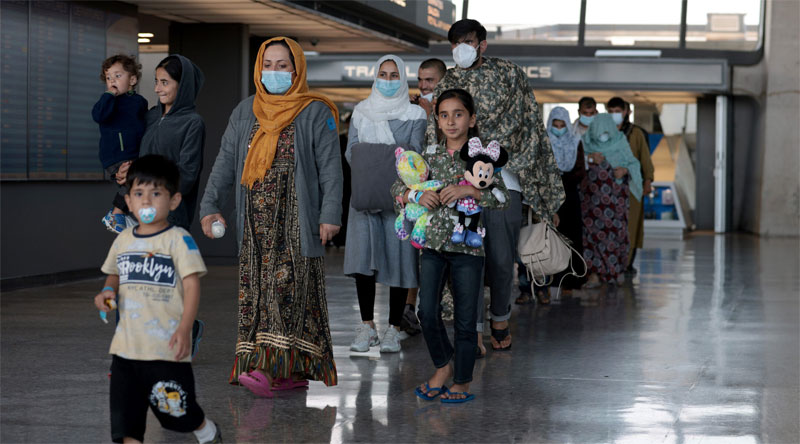
(JTA) — Jewish communities around the world are reactivating their refugee-support networks as they prepare to help resettle Afghans who have fled the Taliban takeover of their country.

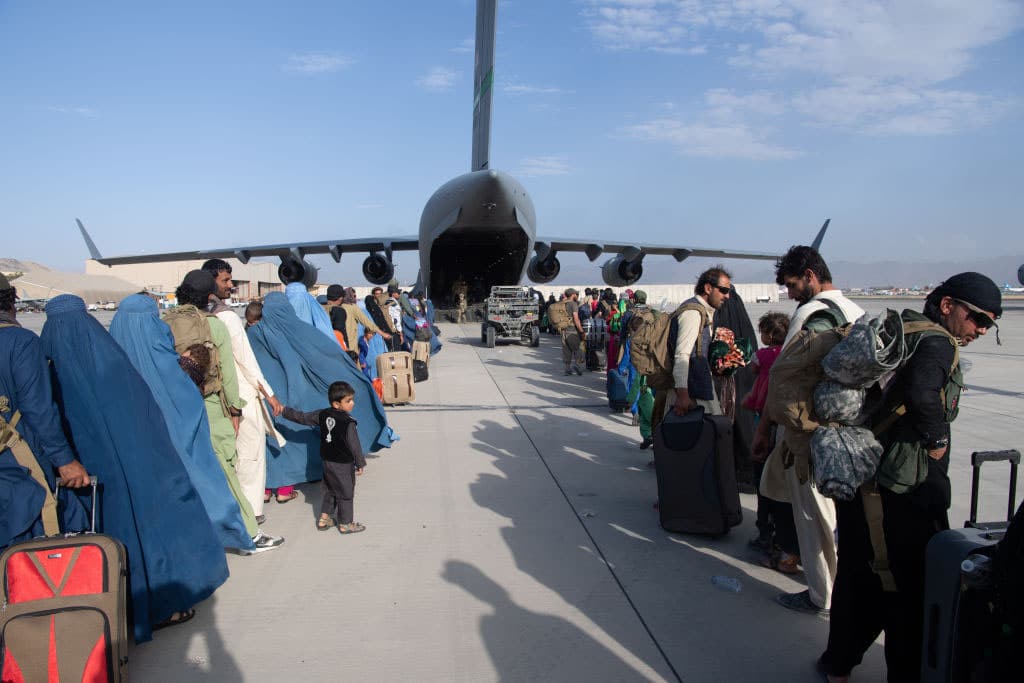
In recent weeks, tens of thousands of Afghans have been airlifted from Kabul after the Taliban retook control of Afghanistan with the U.S.  exit from the country after 20 years. Many will spend time in another country while they wait to be admitted to the United States, but some are already arriving – and needing support as they adapt to a sudden relocation and a new country.

The importance of welcoming strangers is so deeply rooted in Jewish tradition and experience that immigration issues have long enjoyed a bipartisan consensus in Jewish communities even amid deep polarization on other topics. Many cities have social services agencies that began to support Jewish immigrants and now work with new arrivals of all backgrounds, often coordinating with HIAS, formerly the Hebrew Immigrant Aid Society, to identify refugees and meet their needs.

Those agencies — and the Jewish communities that support them — are now scrambling to prepare for a wave of new arrivals as the United States wages an around-the-clock effort to remove as many people as possible who supported the U.S. military mission in advance of an Aug. 31 withdrawal deadline.

In California, Jewish Family Services of Silicon Valley and Jewish Family & Community Services East Bay are preparing to support 130 families, according to J., the Jewish News of Northern California. The East Bay organization has been helping Afghans resettle for years, but has never tried to support so many families so quickly, the newspaper reported.

“This whole thing has been just super expedited,” the group’s senior director of development, Holly Taines White, told J. “Doing this work is deeply rooted in our history and our values.”

White noted that the new arrivals hold what’s known as special immigrant visas, or SIVs, because they collaborated with the United States, meaning that many have experienced trauma throughout the upheaval in their country.

“Every single SIV we’ve resettled has had threats against them or their family members, or had a family member killed, or had a family member kidnapped, or had a friend who also worked with the United States who was pulled out of their house and killed on the street,” White told the newspaper.

In Southern California, Jewish Family Service of San Diego told the Times of San Diego it has resettled 74 Afghans since Aug. 6 and is preparing for an untold number of additional arrivals.

“Most cases are assigned to JFS with little more than 24 hours’ notice before arrival, though all have prior connections — whether family or friends — to the San Diego region,” Etleva Bejko, the director of refugee and immigration services for the nonprofit organization, told the paper.

As of last week, Jewish Community and Family Services of Pittsburgh had already learned that it would resettle two Afghan families, including one that arrived on a tourist visa and now will be able to stay in the country. But it anticipated that the number would rise.

“We’re planning as if we’re going to receive more than a handful of families,” the local group’s director of refugee and immigration services told the Pittsburgh Jewish Chronicle. “We won’t see hundreds of people arriving at the same time, but this is going to be a slow process of refugees arriving for a long time.”

In Tampa, Florida, Gulf Coast Jewish Family and Community Services has resettled six Afghan families and expects four more next week, according to the Tampa Bay Times. The group pays for housing until refugees can begin working, but a representative told the newspaper that the tight housing market has made it challenging to find apartments for the new arrivals.

Jewish Social Services, the only refugee resettlement agency in Madison, Wisconsin, has resettled 61 refugees from Afghanistan since 2017, including 14 in the past three months. It’s expecting an influx now, the group told WMTV, a local TV station.

“We’re reaching out to potential landlords, we’re reaching out to hotel managers to say this is what we expect to happen, we don’t know when it’s going to happen, we don’t know for how long it’s going to be happening for, but as our partner, we would like you to know about it,” the group’s executive director told the TV station.

Jewish social services groups in Kansas City, Delaware and Seattle have all told local news organizations that they are standing by to support refugees who arrive in their areas.

Efforts to support Afghan refugees span the globe. In England, British Jews are drawing on their collective memory of the Kindertransport, which brought children from Germany to England during the Holocaust, as they gather money and goods for refugees who arrive there. The Bushey United Synagogue in Hertfordshire told the local Jewish News it had experienced an “overwhelming” response after asking for donations to support 30 Afghan families in the area.

We “recognize that our grandparents came into this country as refugees and all we’re trying to do is pay it back forward,” the synagogue’s rabbi told the BBC.

Jewish Social Services Groups Kick Into High Gear as Afghan Refugees Begin to Arrive in Us Read More »

UNC-Chapel Hill’s New Antisemitic Anti-Israel Class Violates Both Federal and State Law

Last week students at the University of North Carolina at Chapel Hill (UNC) showed up for their first class in a course called “The Conflict Over Israel Palestine.” But instead of learning about competing narratives and claims over the course of the semester, they will be treated to a one-sided antisemitic hate-fest from a graduate student professor who has been outspoken about her illegal plans.

It is clear that the course will be one-sided and antisemitic because the teacher in question, Kylie Broderick, has said so. In a tweet about how hard it is to pretend there are two sides to the Israeli-Palestinian conflict, she wrote “there is only 1 legitimate side – the oppressed – versus imperialist propaganda. I don’t ever want to encourage them to believe there is reason to take on good faith the oppressive ideologies of American and Western imperialism, Zionists, & autocrats.” In other posts she described all of Israel as occupied territory, and just a few months ago she spread a vicious blood libel, tweeting that “Palestinians are being murdered for just being alive & bc [because] they’re inconvenient to Israel & its patron, the US imperialist death cult.” 

That particular outburst was written while Israel was daring to defend itself from indiscriminate rocket attacks launched at its civilian population by a designated terrorist group. Five days later she wrote an op-ed in support of the antisemitic Boycott, Divestment, and Sanctions (BDS) movement, in which she managed to squeeze in dozens of lies about the Jewish state while avoiding any mention of Hamas, the terrorist organization that started this round of violence.

After early reports about the course by Peter Reitzes, a board member of Voice4Israel of North Carolina, prompted some public pushback, UNC defended its decision to allow the class to be taught by a hostile professor who intends to demonize, delegitimize, and apply a double-standard to Israel by pretending that such an offering was somehow part of an “abiding respect for the First Amendment, academic freedom, and the open exchange of ideas.” 

UNC is just wrong as a matter of law. But the worst part is that they know it, and they do not seem to care.

As it relates to academic freedom, there is a difference between education and indoctrination. Per the American Association of University Professors 1915 Declaration of Principles on Academic Freedom and Academic Tenure, an instructor who address “controversial matters” should present “the divergent opinions of other investigators” and “above all” should “remember that his business is not to provide his students with ready-made conclusions, but to train them to think for themselves, and to provide them access to those materials which they need if they are to think intelligently.” 

As former Assistant Secretary of Education for Civil Rights Kenneth Marcus has explained, there is a difference between a professor sharing their opinion versus disingenuously presenting that opinion as if it were truth. In the first Supreme Court case to expound upon the concept of academic freedom, Sweezy v. New Hampshire (1957), the Court wrote that “The essentiality of freedom in the community of American universities is almost self-evident. …Teachers and students must always remain free to inquire, to study and to evaluate, to gain new maturity and understanding; otherwise our civilization will stagnate and die.” In Keyishian v. Board of Regents (1967) the Court again noted that “The Nation’s future depends upon leaders trained through wide exposure to that robust exchange of ideas which discovers truth ‘out of a multitude of tongues, [rather] than through any kind of authoritative selection.’”

Allowing professors to share biased lies cast as truth in the guise of academic freedom while shutting down an exploration of alternative viewpoints is to violate entirely all that academic freedom is meant to protect.

Allowing professors to share biased lies cast as truth in the guise of academic freedom while shutting down an exploration of alternative viewpoints is to violate entirely all that academic freedom is meant to protect. What student in their right mind would feel comfortable challenging a professor’s anti-Zionist perspective, when that professor has recently referred to  Zionists  as “dirtbags,” and moderated an event that tried to legitimize violence against Israelis? 

When it comes to the First Amendment, the freedom of speech—even offensive speech—must be cherished and protected. But as the United States Department of Education’s Office for Civil Rights has made clear, there are times when even speech can cross over into harassment and invidious discrimination. Title VI of the Civil Rights Act of 1964 prohibits discrimination in federally assisted programs and activities, on the basis of race, color, or national origin. While Title VI does not include religion, discrimination against Jews may give rise to a violation if it is based on race or national origin. Under Executive Order 13899 (Combating Anti-Semitism), when evaluating potential Title VI claims, the government uses the International Holocaust Remembrance Alliance (IHRA) definition of antisemitism. Per the IHRA definition, it is antisemitic to, among other things, deny the Jewish people their right to self-determination, engage in blood libels, or apply a double standard by requiring of the Jewish state a behavior not expected or demanded of any other democratic nation.

Speech crosses over from protected territory into harassing verbal conduct when it is “sufficiently severe, pervasive or persistent so as to interfere with or limit the ability of an individual to participate in or benefit from the services, activities or privileges provided by a recipient.” In their messages to the University, members of the Jewish community on campus confirmed what should already be obvious; they are fearful that students who support and have a connection with Israel will be unwelcome or unsafe in this classroom environment, which is not only an impingement on their academic freedom but also a violation of Title VI, as well as other state and university policies against discrimination. 

A violation of Title VI may be found if discrimination is encouraged, tolerated, not adequately addressed, or ignored by administrators, and complaints alleging such violations may be filed with the U.S. Department of Education’s Office for Civil Rights or in the federal district courts. But of course, UNC already knows all of this because this is not their first, nor even their first recent, Title VI antisemitism rodeo: In 2019 the University hosted an antisemitic conference, and was forced to settle the ensuing Title VI complaint with the Department of Education. In their   resolution agreement, the school agreed to “take all steps reasonably designed to ensure that students enrolled in the University are not subjected to a hostile environment.”  

The University’s commitment to that requirement is laughable, and in fact the Zionist Organization of America has already filed a letter with the Department of Education notifying them of the breach. But the potential result is no laughing matter. Study after study has shown that the kind of inflammatory discriminatory anti-Zionist rhetoric that Broderick intends to continue spreading under the banner of UNC eventually leads to antisemitic action, and to people getting hurt. Over the last few months, and particularly in the immediate aftermath of the most recent outbreak of violence in the Middle East last May, antisemitic attacks around the world shot up over 400%. On college campuses, in between dodging protests, ignoring death threats, and removing Nazi symbols, Jewish students have been subjected to campaigns that call Israel a colonialist settler state, negate the history of their people, and dismiss the lives of their co-religionists, if they are even worth mentioning at all.

North Carolina has also not been immune from this alarming trend, nor has the Chapel Hill campus itself, and it is in this environment that UNC is knowingly shirking responsibility.

This is not a new problem, but the intensification of an existing phenomenon. On university campuses around the country, antisemitism has become entrenched and systemic, with recent studies showing that the number of Jewish students experiencing antisemitism has spiked to nearly 75 percent. North Carolina has also not been immune from this alarming trend, nor has the Chapel Hill campus itself, and it is in this environment that UNC is knowingly shirking responsibility.

That is too bad for them. Universities have duty to protect students from hatred and bigotry motivated by discriminatory animus, including antisemitism, and students need to know that if the University won’t protect them, there are people who will have their back. If UNC will not do this the easy way, by standing up for its Jewish constituents and against unapologetic hate, then they will be forced to do it the harder way, and risk their federal funding—again. And this time, they will have to do more than make empty promises they don’t intend to keep.


Dr. Mark Goldfeder, Esq. is Director of the National Jewish Advocacy Center.

UNC-Chapel Hill’s New Antisemitic Anti-Israel Class Violates Both Federal and State Law Read More »

Hamas Official Says US Withdrawal from Afghanistan Will Result in World Accepting Expulsion of Israel

A senior Hamas official said in an August 19 interview on the Hamas-run Al-Aqsa TV that the United States withdrawal from Afghanistan will result in the world accepting the expulsion of Israel from the region.

The Middle East Media Research Institute reported that the official, Mahmoud Al-Zahhar, argued that the Taliban’s expulsion of the U.S. legitimized “the expulsion of the occupation. This means that what Hamas is doing here to expel the [Israeli] occupation is legitimate. If the world accepted it [in Afghanistan], why shouldn’t it be accepted with regard to Gaza? A liberation endeavor is different from a ‘terrorist’ endeavor, as they call it.”

He added that the Arab countries that have normalized relations with Israel “will flee too, because the removal of the Israeli entity is a Quranic truth that we must work on implementing now.”

UN Watch Executive Director Hillel Neuer tweeted, “Hamas leader voices misconception that is root cause of the conflict. He’s boosted by the removal of US troops from Afghanistan and of historic Roman, Persian, British and French occupiers. But a Jew in Judea is not a foreign occupier. She’s in her ancient, indigenous homeland.”

Muslims Against Antisemitism also tweeted that Al-Zahhar’s remarks were “genocidal talk from the Islamist Hamas group who take inspiration from Taliban extremists. Extremist groups becoming emboldened as the US exits Afghanistan.”

Hamas Official Says US Withdrawal from Afghanistan Will Result in World Accepting Expulsion of Israel Read More »