fbpx

May 25, 2021

UNRWA Gaza Director Apologizes for Acknowledging Precision of IDF Strikes

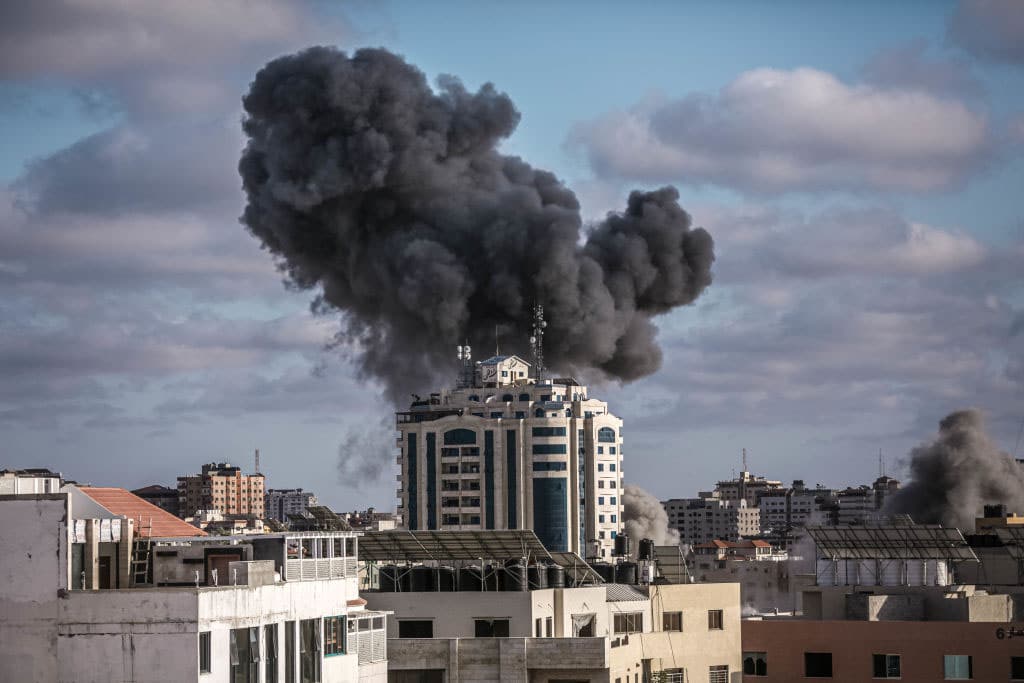
The head of the United Nations Relief and Works Agency (UNRWA) apologized for acknowledging the precision of the Israel Defense Force (IDF) strikes in the Gaza Strip during the most recent escalation between Israel and Hamas.

The Jerusalem Post reported that UNRWA Gaza Director Matthias Schmale told Channel 12 News he “would not dispute” the IDF’s assertion that their strikes in Gaza were precise. “I also have the impression that there is a huge sophistication in the way the Israeli military struck over the last 11 days.” However, Schmale said that his colleagues told him that the IDF strikes “felt much more vicious” compared to the 2014 Gaza War.

“So yes, they didn’t hit – with some exceptions – civilian targets, but the viciousness, the ferocity of the strikes was heavily felt,” Schmale said, adding that “there was unacceptable and unbearable loss of life on the civilian side” in Gaza. Schmale also stated that “there was no shortage of food and medicine” in the Gaza Strip during the escalation between Israel and Hamas.

The clip has been circulating among pro-Israel Twitter users; for instance, UN Watch Executive Director Hillel Neuer suggested in a tweet that Schmale “tweets against Israel every day” and “knowingly employs school teachers and principals who incite antisemitism and glorify terrorism” and yet even he acknowledged the precise nature of the IDF strikes.

However, the Post noted that Schmale’s remarks resulted in “outrage” from “Gaza social media users” and Al Jazeera quoted a joint statement from Palestinian NGOs criticizing Schmale for “statements indirectly praising the precision and sophistication of the Israeli army, when Israel is in fact constantly committing war crimes and crimes against humanity against the Palestinian people.”

Schmale issued a series of tweets on May 25 apologizing for his comments to Channel 12.

“Recent remarks I made on Israeli TV have offended & hurt those who had family members & friends killed & injured during the war that has just ended,” he wrote. “I truly regret to have caused them pain.” In subsequent tweets, Schmale wrote that “military precision and sophistication are never a justification for war” and that “many people were killed or have been severely injured by direct strikes or collateral damage from strikes. In a place as densely populated as Gaza, any strike will have huge damaging effects on people and buildings.”


He also took issue with i24News English quoting him as saying that “there is a huge sophistication in the way the #Israeli military struck over the last 11 days, so that’s not my issue.” “My issue is that the precise strikes of the sophisticated army killed more than 200 civilians including 20 children that went to UNRWA schools,” Schmale wrote. “This is unacceptable and cannot be white washed!”

International human rights lawyer Arsen Ostrovsky tweeted, “In his initial interview, @matzschmale confirmed there was no shortage of basic supplies in #Gaza & that #Israel targeted only military targets. He is now cowardly walking that back.”

UNRWA Gaza Director Apologizes for Acknowledging Precision of IDF Strikes Read More »

After Cease-Fire With Hamas, Israel Finds Peace at Home More Elusive

While a tenuous cease-fire between Israel and Hamas has held since the early hours of May 20, the Jewish state is finding peace more elusive internally between Jewish and Arab Israelis.

In so-called mixed towns, such as Ramla and Haifa, violence between Arabs and Jews peaked over the past two weeks as 1,548 people were arrested. Most of those taken into custody, 85%, have been Arab Israelis.

Y., a self-described right-wing Jewish activist who spoke to The Media Line on condition of anonymity, participated in the unrest in Israel’s center after his car was damaged as a result of the violence.

“I’m not going to sit back and let them hurt us and destroy everything,” he told The Media Line. “Arabs do not want peace with Jews. They don’t want Israel to exist at all.”

While the sectarian violence was prompted by the Gaza-Israel flare-up starting May 10, some say that the violence is less nationalistic and more a result of unchecked inter-Arab violence.

“The violence is triggered by religious and ultranationalist sentiment from groups on the Arab side fueled by Hamas, which is spreading anti-Jewish hatred. They’ve been putting out the call for Arabs to go and attack random Jews,” Arab Israeli activist Muhammad Zoabi told The Media Line. “What’s fueling it even more is extremist Jewish groups that are escalating the situation into a confrontation between two different populations, making it into a nationalist thing when it’s mostly a criminal thing.”

He contends that the vast majority of the rioters in custody are people with troubled backgrounds and are not religious or nationalistic idealogues.

Zoabi says that the violence is part of a long-festering problem of illegal guns and violence within the Arab-Israeli sector that has until now been ignored by the police. They are taking an interest now, he says, because it impacts the Jewish population.

“The government didn’t give a s— as long as this was inside Arab communities, as long this wasn’t targeting Jewish people and not turning into a national situation,” he said. “The indifference that the police have expressed toward this phenomenon in the Arab community is now turning against everybody: Arab-on-Arab violence has turned into Arab-on-Jew violence.”

Zoabi says that parts of Arabs towns have become “no-go zones” for the police, rendering them effectively lawless.

“What we saw on the streets of Lod, of Ramla, of Jaffa, is just a reflection of what different people see in different Arab communities around the country where the police are literally scared to go inside those different spaces,” he said. “If the government doesn’t collect the tens of thousands of illegal weapons in the Arab community and they don’t enforce the law, it’s going to get worse.”

In response, Superintendent Waseem Bader, a police spokesman for the Arab sector and media, told The Media Line in a written statement:

“Unfortunately, incidents of violence and shootings occur too often in Arab society in Israel, most of them against the background of internal conflicts that escalate into violence. … In the past year, under complicated circumstances, until COVID-19 spread, the Israel Police stepped up its activities against illegal weapons offenses in Arab communities and arrested more than 5,000 suspects in the commission of shooting offenses and those related to illegal weapons.”

In the meantime, mixed cities and towns are trying to restore the peace. In Haifa, Israel’s most integrated large city, the local government has started a solidarity campaign called “I don’t have another Haifa,” which features photos of Jewish and Arab professionals, such as teachers and chefs, working together.

“Our mayor, Einat Kalisch-Rotem … made the decision immediately, together with the police, to call for restraint, and met with leaders of the three religions here in Haifa and they spoke to their own communities,” Gil Meller, deputy spokesperson for the Haifa municipality, told the Media Line.

“On every occasion, the mayor emphasized the message that Haifa is a symbol of coexistence and it will always be and forever remain a lighthouse of sanity. It represents a direction for a better future,” he added. “In these times, we, Jews and Arabs, have to be strong and act with responsibility and care.”

A joint Jewish-Arab soccer game was held in Lod on May 25 to promote coexistence.

Mayor Yair Revivo, a Hebrew-language press release says, “has asked all residents of the city to avoid violence, choose dialogue, friendship and fraternity and promote good coexistence and neighborliness.” The city’s Arab residents are “an integral part of society in Lod” and “full partners … in creating the public space in which they live.”

Devorah L., a Jewish resident of Lod, hopes that calm will quickly be restored.

“This is not who we are,” she told The Media Line. “I love that this isn’t ‘just’ a Jewish city; that’s part of what makes Lod unique.”

“I think that the majority of Arabs and Jews want peace,” she added. “It’s the extremists on both sides who are the true obstacle.”

After Cease-Fire With Hamas, Israel Finds Peace at Home More Elusive Read More »

NYT Ad Slams Dua Lipa, Hadid Sisters for Anti-Israel Rhetoric

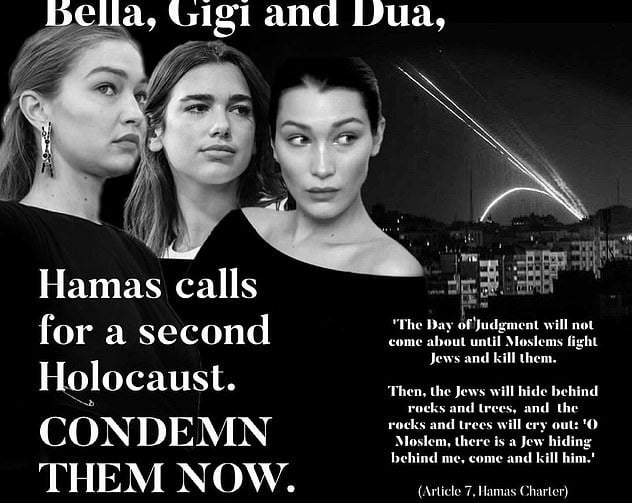
A May 22 ad in The New York Times accuses singer Dua Lipa and Palestinian-Dutch models Gigi and Bella Hadid for having “vilified the Jewish state.”

The ad, which was written by Rabbi Shmuley Boteach, calls on Lipa and the Hadid sisters to condemn Hamas because the terror group “calls for a second Holocaust,” citing a passage in the Hamas charter advocating for killing Jews. Boteach wrote in the ad that Lipa and the Hadid sisters have “vilified the Jewish state in a manner that is deeply troubling,” pointing to Lipa and Bella Hadid accusing Israel of “ethnic cleansing, even as millions of Jews in Israel descend from Holocaust survivors, refugees savagely forced out of every Arab land and Jews living in pre-state Israel who were subjected to multiple Arab massacres and pogroms.”

Additionally, Boteach noted that Bella Hadid has accused Israel of being an apartheid state, even though “millions of Christians, Muslims and Jews of all races” live in harmony in Israel. “If Bella, Gigi and Dua cared about Palestinians, they should consider condemning, not Israel, a free society, but Hamas, a bloodthirsty death cult, whose brutality toward women and tolerance for honor killings of young Palestinian girls is an abomination. They should demand Hamas stop its use of children as human shields for military stockpiles and rocket launch-pads, cease its regular murders of LGBTQ Palestinians, and restore the Palestinians’ right to fair elections, after fourteen autocratic years.”

Boteach concluded the ad by arguing that allegations of Israel “being an apartheid state engaging in ethnic cleansing” are “a boldface libel that is putting Jews at risk around the world. Bella, Gigi and Dua, help us turn the tide against rising anti-Semitism today and bring peace to the Middle East.”


Lipa, who is dating Anwar Hadid, the younger brother of Gigi and Bella, posted a lengthy statement to Twitter responding to the ad, accusing the ad of being filled with “false and appalling allegations” and claiming that “this is the price you pay for defending Palestinian human rights against an Israeli government whose actions in Palestine both Human Rights Watch and Israeli human rights group B’Tselem accuse of persecution and discrimination.” She concluded her post by stating, “I stand in solidarity with all oppressed people and reject all forms of racism.”

Boteach responded to Lipa by tweeting, “Time to follow the example of @MarkRuffalo
and apologize for your extreme defamation of the #Jewish people and #Israel. It’s not too late Dua.”

He also wrote in an earlier tweet that the Hadid sisters “have hung out @dualipa
to dry on her own. They have publicly abandoned her. They will not respond to our @NYT
ad because they cannot factually defend their nauseating lies about #Israel as an apartheid state.”

Stop Antisemitism tweeted in response to Lipa, “Remember that [Instagram] story you shared calling Israelis ‘fake Jews’ and Hamas being an Israeli invention?  We didn’t. Not only are [you] a rabid antisemite but you’re a pathetic liar.”


Previously, Israel’s official Twitter account criticized Bella Hadid for chanting “from the river to the sea, Palestine will be free” during a May 14 Instagram live stream; the Israel Twitter account argued that by chanting that refrain Hadid was “advocating for the elimination of the Jewish State.” Gigi Hadid has also claimed in a previous Instagram post that she just wants “equal rights for Palestinians.”

NYT Ad Slams Dua Lipa, Hadid Sisters for Anti-Israel Rhetoric Read More »

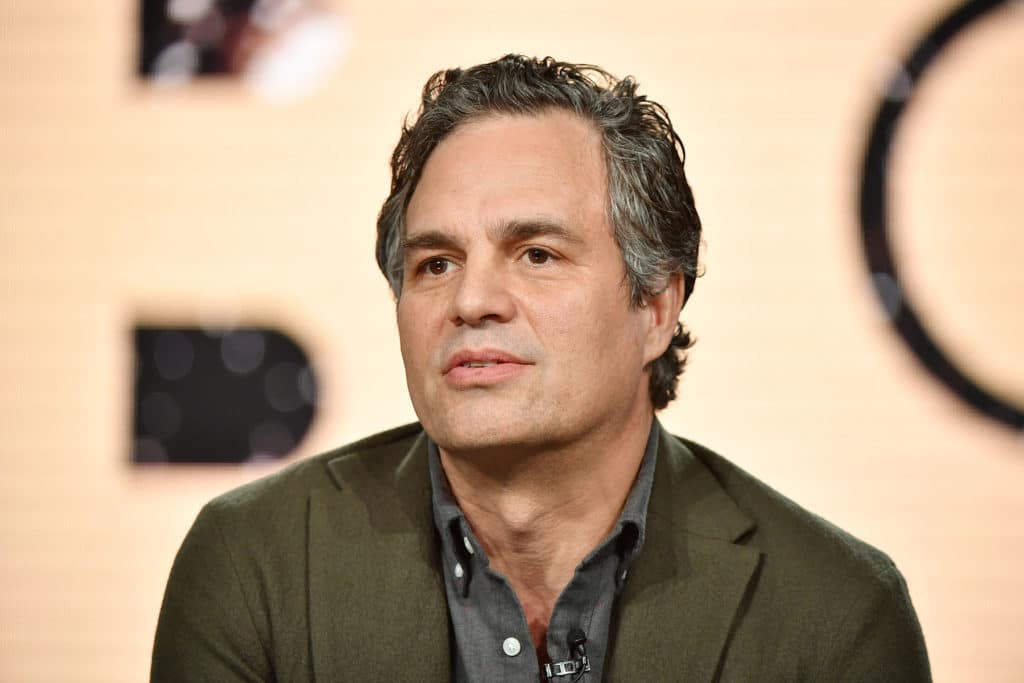
Mark Ruffalo Apologizes for Saying Israel Committed “Genocide”

Actor Mark Ruffalo issued an apology in a May 24 tweet for his past tweets accusing Israel of genocide against the Palestinians in the recent escalation between Israel and Hamas.

The full tweet read: “I have reflected & wanted to apologize for posts during the recent Israel/Hamas fighting that suggested Israel is committing ‘genocide’. It’s not accurate, it’s inflammatory, disrespectful & is being used to justify antisemitism here & abroad. Now is the time to avoid hyperbole.”


Some pro-Israel users appreciated Ruffalo’s apology.

“There is conflict, sure. And people of goodwill work for peace. But there is no genocide,” StandWithUs Israel Executive Director Michael Dickson tweeted. “The ‘genocide’ lie is used to incite violent – sometimes deadly – antisemitism. It matters that you set the record straight and used your voice to reconcile and not divide.”


Former New York Democratic Assemblyman Dov Hikind, who currently heads the Americans Against Antisemitism watchdog, tweeted that while Ruffalo’s apology is “a positive first step,” “the real test is in what comes next, to see if he’s truly sincere and really understood what was so wrong about such a misnomer.”


Others weren’t quite as receptive to the apology. Stop Antisemitism suggested in a tweet that Ruffalo’s tweet was at the behest of his employers at Disney, as Ruffalo currently plays The Hulk in the Disney’s Marvel Cinematic Universe.

Israellycool blogger David Lange asked Ruffalo if he would “also apologize for these falsehoods,” posting screenshots of Ruffalo tweeting in 2014 stating that Hamas didn’t kidnap the three Israeli soldiers that precipitated Operation Protective Edge that year; he also replied in a response to a tweet stating that Hamas uses its people as human shields, “Do you honestly think these people, these fellow human beings, would use their own children as shields? Use your heart.”


Canadian Conservative Party Senator Linda Frum tweeted, “Ruffalo has 7.5M [million] followers. While his retraction is welcome and brave the original lie — of Jews committing genocide— caused great harm that’s difficult to undo. Better to be judicious in the first place. It’s not hard to know the facts if you want to.”


Mark Ruffalo Apologizes for Saying Israel Committed “Genocide” Read More »

D.C. Rabbi Apologizes for Accusing Israel of “Ethnic Cleansing”

For a related post from Stephen Smith entitled “Words Have Meaning” click here

The Sixth & I Historic Synagogue in Washington, DC has come under criticism for statements made by their Senior Rabbi Shira Stutman during its Shabbat service on May 14. Speaking from the bima, Stutman accused Israel of being a country in which the government, representing “the will of the people…categorically dismisses, discriminates, ethnically cleanses, and at its most base cares little for the basic human rights of millions of people that live under its administration.”

The sermon, which was streamed live on the synagogue’s Facebook page, immediately drew the ire of some in its virtual audience, who accused the rabbi of disseminating “the most despicable untruth” that would “provoke anti-Semites” and “gives them ammunition against Jews, not just in Washington DC, but everywhere.”

Simone Friedman, Head of Philanthropy and Impact Investment at EJF Philanthropies, resigned her position on the synagogue’s Board of Directors after the organization refused to condemn Stutman’s allegations. “I value bringing people together. I don’t support speech that inflames and exacerbates tensions within and outside of the Jewish community. My decision to leave Sixth & I’s Board is congruent with my values given their refusal to condemn inflammatory speech from their pulpit which could incite hatred and violence against Jews,” Friedman told the Jewish Journal.

The synagogue, which has a national platform and an audience that includes federal policy makers, responded directly on Facebook in the comments on the sermon video: “As a nonpartisan center for arts, entertainment, and ideas and a synagogue that reimagines how religion and community can enhance people’s everyday lives, Sixth & I is dedicated to offering a forum for a wide range of views on a diversity of topics across our programs. We are also committed to promoting freedom of speech, intellectual discourse, and rigorous debate through our programming.

“In response to Rabbi Stutman’s sermon on May 14, Sixth & I recognizes and values the important principle of Freedom of the Pulpit which means that clergy on our staff may express their own opinions and teachings—and when they do, they are strictly speaking for themselves and may be expressing views that, at times, are at odds with others on Sixth & I’s staff and Board of Directors. As clergy speak their truth, we invite those in the Sixth & I community and beyond to speak their truth as well, with civility, as we have difficult dialogue at a heartbreaking time when lives are being lost in Israel and Palestine.”

In addition to her role at the synagogue, Stutman is a member of the Board of Directors of Jews United for Justice and J Street’s Rabbinic and Cantorial Cabinet. In her sermon, Stutman bookended her accusations against the government and people of Israel with other statements calling on observers to refrain from judging Israel in its self-defensive actions against Hamas. “And then there’s the loss of my own safety as a Jew… I was brought up to think that we’d be safe in Israel… That would be the one place that when the Nazis, not if, when the Nazis came again…you’ll be able to go to Israel,” said Stutman. “Israel is a place which is getting showered indiscriminately, terrorized day after day after day. Even when the rockets are not falling, there is the fear of them falling. And please, I am not interested in hearing from any of you who have never lived under that terror or under that fear.”

In a statement to the Journal, Stutman apologized for using the term “ethnic cleansing,” saying that the phrase “shuts down conversations rather than encouraging them.”

In a statement to the Journal, Stutman apologized for using the term “ethnic cleansing,” saying that the phrase “shuts down conversations rather than encouraging them.” Here is her full statement:

“I am a Zionist who believes that the Jews have a right to live in their ancestral homeland, the Land of Israel. I also believe that the Israeli occupation is not only intolerable for Palestinians but also, ultimately, unsustainable for Israelis as well. As former prime minister Ehud Barak said, “If we keep controlling the whole area from the Mediterranean to the river Jordan where some 13 million people are living – eight million Israelis, five million Palestinians… it would become inevitably – that’s the key word, inevitably – either non-Jewish or non-democratic.” With every passing day, Israel is inching toward a point of no return.

“I have devoted my professional life to bringing young, disaffected American Jews and their non-Jewish partners into a closer relationship with, among other things, the State of Israel, the Land of Israel, and the Zionist dream itself. In a sermon to my community last week, I used the term ‘ethnic cleansing,’ by which I meant the forced removal of one ethnic or religious group from their homes in exchange for members of another ethnic or religious group. I am sorry I used that term, rather than just saying exactly what I think: in East Jerusalem, Palestinians are being forced from their homes so as to settle Israeli Jews in the area.  Because ‘ethnic cleansing’ is a phrase that can be understood in many ways, using the term shuts down conversations rather than encouraging them. Polarizing rhetoric, inflamed by social media, only worsens the situation. Progress in this conflict requires more, not fewer, thoughtful conversations.

“Some people argue that when Israel is under attack, Jews should unite as one and not say anything critical about Israel, because there are too many people who, driven by bigotry and intolerance, hate Jews, and therefore Israel, and that we shouldn’t add fuel to the fire. I agree with those who are concerned about the rise in vitriolic anti-Semitism, and I believe that anti-Zionism is all too often a mask for anti-Semitism. I also believe it is possible, if not required, to express both support for the people of Israel, and criticism of the government of Israel, at the same time. Change happens when people lift up their voices to demand it. I still believe in an Israel that can live up to its promise, in safety and peace.

“Ultimately, if you listen to the sermon in its entirety, you will hear that it was not about my views on specific policies of the current Israeli government. It was about loneliness, and sadness, and also potential and possibility.  About how to embrace complexity, and not give up hope, even when it may feel easier to walk away entirely. A tragedy for me would be to see the young people I serve in my community abandon Israel. I am working day and night to prevent that from happening.”


Oleg Ivanov is a freelance reporter for the Jewish Journal.

D.C. Rabbi Apologizes for Accusing Israel of “Ethnic Cleansing” Read More »

New Book About Israel is the Much-Needed Schooling/Scolding for all Sides of the Conflict

It’s the morning of Jerusalem Day in Los Angeles, and Noa Tishby is doing what was expected to be another routine interview to promote her debut book,Israel: A Simple Guide to the Most Misunderstood Country on Earth.”

Immediately after this 10:00 AM interview begins, the most violent clashes in seven years between Israelis and Palestinians wreak increasing havoc throughout Israel and the Palestinian territories.

Every minute of the interview, Tishby’s phone is inundated with texts, news alerts, and voicemails from friends, family, and media seeking her input. She answers some briefly, speaking in quick bursts of Hebrew.

A hashtag war of perspectives and pejoratives on every possible Middle East policy position would flourish on social media over the next week, a back-and-forth assault that continues even still. The sharp 46-year-old first-time author makes several Instagram videos speaking directly to her almost 220,000 followers, correcting the same “misunderstandings” that she addresses in her book. By the following Monday, Tishby would even film an Instagram video rebuttal to HBO’s John Oliver’s take on the situation on “Last Week Tonight.” Her book seems like an afterthought. Tishby’s concern is setting the record straight.

Seeing a solution in every problem is how Tishby approaches life. After almost twenty-five years in Los Angeles, Tishby is merging her ability to communicate as an actress with her desire to set the record straight on her troubled homeland.

The result is an entertaining yet informative 334-page primer on Israel, published in April by Free Press/Simon & Schuster. The book’s Amazon charts rank the book sales at #1 in categories of “Middle Eastern Politics,” “Historical Middle East Biographies,” and “Israel & Palestine History.”

This is not a book written by academics from their ivory towers of elite universities. It is written by a professional communicator who knows how to cut through the small talk and get to the important points. To speak with Tishby is to quickly understand that she has no interest in wasting anyone’s time with drivel.

Yet the book is written with in-depth geo-political history dating back centuries before the establishment of Israel. Along the way, Tishby shares moments of terror from growing up in Israel, vulnerable moments of trauma, as well as many well-timed exclamation points.

The most impactful line of the book comes from the perspective Tishby takes when reflecting on her own personal growth and struggles and relating them to the relationship between Israel and the Palestinian territories:

“A human’s psyche is not dissimilar to that of their nation. I just wanted to be wanted, accepted, loved. Everyone wants the same—to be wanted, accepted and loved. And every nation wants the same as well. Israel wants to be accepted. She wants legitimization and normalization of international relations, and she will not take anything short of that.”

“Israel wants to be accepted. She wants legitimization and normalization of international relations, and she will not take anything short of that.”

While not presuming to have the solution to the conflict, the pages are loaded with empathy for the Palestinian people and dissections of Israel’s most hard-lined figures. Tishby often distinguishes between the plights of the people on both sides and the actions of their respective governments. She is not afraid to address Israel’s mistakes, and not shy about sharing her hope for a better future for the Palestinian people.

“I am a Zionist and I am also pro-Palestinian,” she writes while condemning the BDS movement in various universities.

Following an optimistic discussion of the recent normalization agreements between Israel and select Arab League countries, Tishby explains her “hope the Palestinian people will not resist these changes…and will join the moderate voices in the Arab world so we can finally create that ‘New Middle East’ for the future and a new reality for our children.”

*           *           *

The genesis of Israel: A Simple Guide” came about as Tishby began to experience more and more success as an actress and producer. She is credited with being the first producer to bring an original Israeli television show to the United States: the multiple Emmy-nominated HBO show “In Treatment.

The more she worked, the more Tishby noticed that she was having similar conversations with coworkers across the entertainment industry. Both on set and off, Tishby became the point-person for inquiring minds about the Israel-Palestinian conflict. But too often, she found herself correcting rampant misunderstandings among her peers and countering falsehoods being spread in the media. She started keeping a written record of the explanations she found herself repeating.

“I had a document on my computer, and it was for a book that was supposed to be called ‘WTF Is Israel’?” Tishby laughs, recalling the title. “I wanted to explain Israel as best as I can.”

She describes that original document as an “idea for a modern take on a new case for Israel…the pop culture version of the story of Israel.” In part, the impetus for writing the book is connected to the plethora of academic books that often fail to communicate the story of Israel to a curious lay audience.

“I know that I couldn’t send those books to my friends, they’d say ‘thank you’ and then never read them,” Tishby laments.

A friend lit a fire underneath Tishby to turn her short document of talking points into a 60-page book proposal—and she did so in less than a month. The list of chapters and the order in which they appear in “Israel: A Simple Guide” is the exact order that appeared in the proposal.

While the book’s points speak for themselves, the subtext of the book is Tishby’s focus on her own struggles growing up in Israel, and how her emotional breakthroughs as an adult may be applied to Israel and its complicated conflicts.

By her own admission, she is not a religious person, but rather a spiritual person. The book, in turn, demonstrates the depth of Tishby’s reflective nature. At one point, she reveals and reflects on the moment that she learned a painful secret about her parents.

Throughout the book, Tishby is adept at revealing these milestone moments, many of which have been traumatic and will remain with her forever.

In our interview, she recounts her most frightening childhood memory of something that happened when she was in junior high school in Tel Aviv during the Gulf War.

Tishby was at a sleepover at a friend’s house when the air raid sirens sounded at about 1:00 AM. Her father rushed to pick her up as soon as he heard them, leaving behind his wife and infant daughter. When he arrived, adolescent Tishby was already in her friends’ shelter, duct taping the doors as the sirens were interrupted by scud missile explosions. Soon, she would realize that these frightening scenarios would be a part of a daily occurrence during the Gulf War.

Several of Tishby’s personal moments of fear are interspersed with watershed moments in Israel’s recent history.

“The peace with Jordan [in 1994] was the first time in my lifetime that as a young adult, I saw [peace] happening…it was so moving, the King of Jordan was sailing in the Bay of Eilat in Aqaba,” Tishby recalls, pausing to notice her goosebumps. “There were a lot of Israeli boats and yachts, people waving flags, it was so celebratory. When you see things like that, you cannot not believe in peace.”

She is optimistic but emphasizes, shaking her fist, that “optimism isn’t easy, being optimistic is harder than to be pessimistic, because of the news and how their cycles operate. We see it on the left, right, and center…on social media, making money by activating and pressing our amygdala.”

She is optimistic but emphasizes, shaking her fist, that “optimism isn’t easy, being optimistic is harder than to be pessimistic, because of the news and how their cycles operate.”

Stopping herself from getting worked up, Tishby remembers her mantra, a quote by the late Israeli President and Prime Minister Shimon Peres: “Optimists and pessimists die the same way. They just live differently. I prefer to live as an optimist.”

Tishby’s optimism was tested consistently during her final years living in Israel.

When Tishby was 19 years old, she experienced another one of her most terrifying memories: a #5 public transit bus exploded a mere 200 meters from her family home near Tel Aviv’s Habima Square. In what would be known as the Dizengoff Street Bus Bombing, 22 civilians were killed in an attack by a Hamas suicide bomber.

“From then on, I would recoil when I’d see bus. I’d see a bus, wince and think, ‘This can be bad,’” Tishby recalls. Although she did not see the bloody aftermath, her fears festered. Thirteen months later she would be enjoying herself at a concert that was interrupted with the news of the assassination of Prime Minister Yitzhak Rabin. This would leave an imprint on Tishby that would haunt her long into her adulthood, even as she forged a successful career in Hollywood.

At this point in her life, Tishby has lived as many years in the United States as she did in Israel. She says she has put much work into healing the psychological wounds from her most perilous experiences of her first 23 years.

Pausing to think as she opens up about her breakthroughs, a ray of mid-day sunshine radiates onto her face from her home skylight. Tishby raises her hands to the light and remarks that perhaps she was meant to share on paper her own journey of healing, that it may be a sign of cosmic reassurance not just for her, but also for Israel.

While it may seem that “Israel: A Simple Guide” was written for this very moment of hostility, Tishby says that the book was really written for her five-year-old son Ari. For now, his interest in his mother’s book is miniscule; as most children his age would be, he is disappointed that it does not include pictures other than a few colorless maps. She hopes that in the future Ari will know his mother’s story and her efforts to make a difference in the peace process.

Tishby’s book is written not only with the hope for a better future for both Israelis and Palestinians, but also with an eye toward our responsibility to care for the environment. Upon completing the book, Tishby partnered with Aspiration, a financial services firm that has committed to plant four trees for each paper copy of the book sold. The goal is to offset the number of trees cut down to print a single copy of the book (it takes approximately four). The act of planting trees for the future is emblematic of the book itself—a seed of hope that will one day enrich the future.

The irony of “Israel: A Simple Guide” is that it’s quite detailed when it comes to complicated topics. It’s equal parts history, contemporary geo-political analysis, and introspective healing. Tishby wants us to take a hard look at the many facets of Israel’s struggles. It is refined, germane, informative and so many other things that can’t be explained in a meme.


Brian Fishbach is a music journalist in Los Angeles. 

New Book About Israel is the Much-Needed Schooling/Scolding for all Sides of the Conflict Read More »

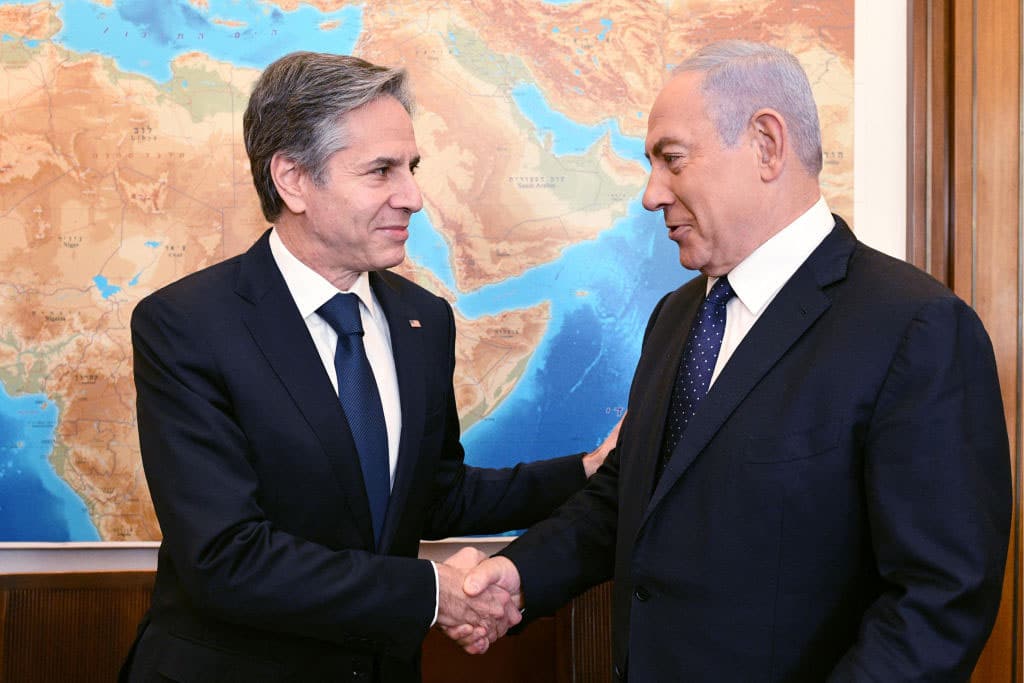
Is Blinken the Carrier of “Genuine Hope”?

What Secretary of State Anthony Blinken attempts to achieve in the Middle East is as admirable as it is impossible. Blinken is visiting the region, a first for him as secretary – a sure sign that Middle East affairs weren’t a priority and still aren’t. Since he knows, and did not make it a secret, that peace negotiations between Israel and the Palestinians cannot be fruitful at the current juncture, he wishes to implement concrete measures that could ease tensions and offer “genuine hope”. The problem might be as follows: he can either ease tensions or offer hope. Doing both seems impossible.

The best way to demonstrate why that’s the case is to look at the most concrete measure on the table at this time. Gaza was ruined in the last cycle of Hamas fighting with Israel, and the world – once more – would like to help it recover and rebuild. This is, no doubt, a worthy cause. There are people in Gaza, many of which – most of which – are innocent. They are hostages of a repressive regime. Easing their level of suffering is the human thing to do.

There’s a problem with that. Countries have realized that whatever they give go to waste in one of two ways. Either Hamas takes it for its own purposes – and uses it to build its military capabilities rather than ease the suffering of its people. Or it is used to build infrastructure than will be destroyed in the next round of violence, at the time of Hamas leaders’ choosing.

What could be the remedy for these two problems? The second one is easy: make sure Hamas doesn’t attack Israel – because if it doesn’t, Israel will not have to counterattack Hamas. The first one is a bit more complicated: hand the funds marked for helping the people of Gaza to someone other than Hamas. Blinken has such someone in mind: the Palestinian Authority.

The PA is also not known for its efficient management and lack of corruption, but at least it is politically more moderate. Giving funds to the PA is supposed to strengthen the moderates against the radicals and thus offer “genuine hope” for the people (be moderate – get money!). Sadly, the PA doesn’t control Gaza. So giving money to the PA means that unless Hamas accepts the terms of the deal, the money will not go to Gaza, will not ease the pain of people and will not offer any hope to anyone. In fact, handing the money to the PA is not much more than playing one of two fantasy games: Let’s pretend that Hamas is not involved when we know it really is – or let’s pretend that we assist Gaza when we know we really don’t.

if one hands Hamas the funds, one eases tensions, but does not offer much hope, because this strengthens the radicals who want no hope for peace.

As we already said, Blinken (and the other “international community” actors) can either ease tensions or offer hope, not both. And now you see why: if one hands Hamas the funds, one eases tensions, but does not offer much hope, because this strengthens the radicals who want no hope for peace. But if one hands the PA the funds, one offers hope, but also creates new tension, because Hamas isn’t going to sit idly by while the world is trying to circumvent its control over Gaza.

I suspect Blinken knows all this. He is an experienced and smart diplomat. So why does he still pursue the impossible? I think – and this is speculation, not information – that the whole idea is mostly for show. We must pretend that the goal is to return to the two-state solution mechanism. We must convince the supporters back home that the Biden team isn’t going to be like the Trump team. We must be seen as if we have new ideas that we bring to the table. Now, whether any of these ideas are practical, most people will never know.


Shmuel Rosner is an Israeli columnist, editor, and researcher. He is the editor of the research and data-journalism website themadad.com and is the political editor of the Jewish Journal.

Is Blinken the Carrier of “Genuine Hope”? Read More »

AP Fires Reporter Over Past Anti-Israel Advocacy

The Associated Press (AP) announced on May 20 that they are letting go of a reporter due to her anti-Israel advocacy social media posts while she was in college.

The firing came after the Stanford College Republicans posted a Twitter thread on May 17 calling Wilder an “anti-Israel agitator” who was a leader in Students for Justice in Palestine and Jewish Voice for Peace organizations while at Stanford. The thread highlighted past social media posts from Wilder, including calling the late philanthropist Sheldon Adelson a “naked mole rat-looking billionaire” and defending then-Stanford Residential Advisor Hamzeh Daoud, who was under fire over a  Facebook post threatening to “physically fight” Zionists, as having his post “misrepresented” even after it was “immediately edited.” Senators Ted Cruz (R-TX) and Tom Cotton (R-AR) retweeted the thread.

“Emily Wilder has a concerning history of bringing anti-Semites to campus, spouting blood libels, and defending threats of violence against Jewish Zionists,” the Stanford College Republicans said in a statement to the Journal. “This information was in the public domain, and the Associated Press still decided to bring her on. This is not surprising in light of recent revelations that the Associated Press shared office space with Hamas. Emily Wilder is not a journalist, she is an unhinged, Marxist, anti-Israel agitator, and the corporate media is full of hardened Marxist activists like Emily Wilder who hate Israel and spew vitriol.  We are proud that our efforts directly led to this individual and the Associated Press being held accountable for their actions.”

Wilder defended herself in a lengthy statement posted to Twitter on May 22, arguing that the College Republicans “launched a smear campaign against me.” She claimed that she was “transparent” with the AP about her pro-Palestinian advocacy in college and that she was under the impression that her editors would defend her. Wilder alleges that when the AP fired her, they claimed that one of her tweets from sometime after she was hired on May 3 violated their policies, but didn’t specify which one.

“This is heartbreaking as a young journalist so hungry to learn from the fearless investigative reporting of AP journalists – and do that reporting myself,” Wilder said. “It’s terrifying as a young woman who was hung out to dry when I needed support from my institution the most. And it’s enraging as a Jewish person – who grew up in a Jewish community, attended Orthodox schooling and devoted my college years to studying Palestine and Israel – that I could be defamed as antisemitic and thrown under the bus in the process.”

More than 100 AP staffers published an open letter on May 24 stating that they “strongly disapprove” of Wilder’s firing and the AP’s handling of it and demanded that the AP reveal more information on the decision-making behind Wilder’s firing.

“Wilder was a young journalist, unnecessarily harmed by the AP’s handling and announcement of its firing of her,” they wrote. “We need to know that the AP would stand behind and provide resources to journalists who are the subject of smear campaigns and online harassment.”

Lauren Easton, a spokesperson for the AP, told Buzzfeed that the AP “looks forward to continuing the conversation with staff about AP’s social media policy” and that “our News Values and Principles, including our social media guidelines, exist to ensure that the comments of one person cannot jeopardize our journalism or the journalists who are covering the story.”

Liora Rez, director of Stop Antisemitism, said in a statement to the Journal, “We wish we could say we’re surprised that the AP hired a reporter that endorsed obscene violence against Zionists, but considering the AP Gaza office operated in the same building as Hamas for years without blinking an eye, we’re shocked more than anything by this firing.”

The leftist Jewish group IfNotNow, on the other hand, tweeted in support of Wilder. “We need more journalists who believe in freedom for Palestinians, not fewer. Solidarity with Emily Wilder.”

Tablet senior writer Yair Rosenberg tweeted concern that “firing journalists over things they wrote as students, without any evidence of bias that’s affected their professional work, won’t make journalism better, it’ll simply make student journalists more afraid to develop their voices and say anything interesting lest they anger a mob.”

Former Miss Iraq Sarah Idan, the CEO of Humanity Forward, a nonprofit that aims to connect Muslims and Jews, tweeted in response to Wilder, “This has nothing to do with Palestine but with the fact you’re biased. With my shallow knowledge of press I KNOW Professional Journalists job is to report not write about their passions, if you like to be an activist for Palestinians then BE AN ACTIVIST not a journalist.”


AP Fires Reporter Over Past Anti-Israel Advocacy Read More »