fbpx

May 13, 2021

A Moment in Time: A Meditation for Israel

A Meditation for Israel

This is our moment.

This is our moment to pray for the safety of Israel.

This is our moment to reach out to our siblings, our aunts and uncles, our cousins and half-cousins twice removed who dwell in the land.

This is our moment to understand our history.

This is our moment to support our future.

This is our moment.

This is our moment to read trusted sources.

This is our moment to engage in meaningful conversations.

This is our moment to stand as Israel.

This is our moment to stand with Israel.

This is our moment to stand for Israelis and Palestinians who care to create a peaceful tomorrow.

This is our moment.

This is our moment to rise above hate.

This is our moment to ground our identity.

This is our moment to not judge others unless we have been in their place.

This is our moment, our moment in time.

A Moment in Time: A Meditation for Israel Read More »

Kristallnacht in Lod?

“It’s Kristallnacht in Lod!” declared the mayor of one of the Israeli cities hit hardest in this week’s Arab mob violence, referring to the infamous nationwide pogrom in Nazi Germany in 1938.

Partisans and pundits have not been shy about invoking Hitler or the Holocaust in their rhetorical salvos in recent years. So far, however, Mayor Yair Revivo of Lod seems to be alone in his particular characterization of the latest violence. Why has everyone else gone silent?

At first glance, reports from Lod could appear to lend some credence to the mayor’s assertion. A Lod resident named Shiloh Fried put it this way in an interview with Israel Television’s Channel 12:

“Gangs of Arab youths [residents of Lod] are going street to street, burning stores, smashing windows… Jewish families are huddled at home, terrified of going out… Their cars are being set alight outside… Police are nowhere to be seen.”

Three synagogues and dozens (according to some accounts, hundreds) of Jewish-owned automobiles in Lod were set on fire. Some residents reported that “power was cut in their homes and petrol bombs [Molotov cocktails] were thrown through their windows,” according to the Times of Israel. “Police acknowledged having to escort some residents from a community center to their homes as Arab mobs marauded in the streets.” The national police commissioner, Kobi Shabtai, said the violence was carried out on a scale “that we have never seen before” in the history of Israel.

Kristallnacht was unique for several reasons. One was the fact that the violence was organized by the government. Obviously that’s not relevant to any discussion of what happened in Lod.

Another reason Kristallnacht was unique was the scope of the violence —hundreds of synagogues burned down throughout Germany, thousands of windows smashed in Jewish homes and stores, nearly one hundred Jews murdered and tens of thousands more hauled off to concentration camps. Mayor Revivo obviously is not suggesting that the residents of Lod suffered on a similar scale.

It is when one considers the savagery of the attackers that the mayor’s analogy strikes a chord. Setting fire to a house of worship or trying to stone one’s neighbor to death are acts of such barbarism that they inevitably call to mind similar attacks on Jews in the past. Likewise it was the viciousness of the anti-Jewish mobs in Crown Heights, Brooklyn, in 1991 — not that number of fatalities — which led most Jews to call it a “pogrom,” even though that violence was neither government-sponsored nor on a scale comparable to the attacks in Czarist Russia from which that term derives.

The problem with using Holocaust references to characterize non-Holocaust events is not that there is something inherently wrong with comparing one historical episode to another. The problem is that too often, partisans misuse history to score political points. In the process, they exaggerate what their contemporary targets have done and implicitly minimize what the Nazis did.

When U.S. Congresswoman Alexandra Ocasio-Cortez compared U.S. border detention facilities to “concentration camps” two years ago, she was saying, in effect, that conditions there were as bad as in, say, Dachau. But since we know that there is no murder, torture, starvation or slave labor in the U.S. facilities, the congresswoman’s (unintended) implication was that Dachau was not so awful — or at least not any worse than the detention sites in Texas.

The dust-up over the Ocasio-Cortez remark prompted the United States Holocaust Memorial Museum to go to the other extreme. Embarrassed that one of its own staff historians had publicly cheered the Ocasio-Cortez statement, the Museum not only announced that it “deeply regretted” thehistorian’s outburst, but it also declared that it “unequivocally rejects efforts to create analogies between the Holocaust and other events, whether historical or contemporary.”

The problem with such a sweeping declaration is that it leaves no room for the possibility that some event, somewhere, at some time in the future, might truly resemble some aspect of the Holocaust and therefore would warrant such an analogy.

Some event might truly resemble some aspect of the Holocaust and therefore would warrant such an analogy.

Consider the fact that it is commonplace today for scholars to refer to the Holocaust as well as the mass killings in Armenia, Cambodia, Rwanda and Darfur as genocides. Grouping them together constitutes a kind of analogy. It is an acknowledgment that they have certain things in common, such as the central role of a sponsoring government, the scale of the atrocities, the depraved sentiment of the individual killers and the indifference of the international community.

In other words, even if Darfur was not identical to the Holocaust, it was still a genocide, just as the Holocaust was. Even if Crown Heights was not identical to Czarist Russia, there are enough similarities to warrant calling it a pogrom.

And when the dust settles, many may come to the conclusion that even if the events in Lod differed in some important respects from the pogroms in Nazi Germany, the behavior of the mobs in Lod —from burning down synagogues to targeting longtime neighbors — should at least warrant a serious communal discussion about these issues.

Hopefully that discussion will focus less on the minutiae of Holocaust analogies and more on urgent questions such as: What would motivate someone to single out a synagogue for destruction? How could people who lived in peaceful coexistence for so many years suddenly turn on their Jewish neighbors? And when will the international community acknowledge the uniqueness and severity of the violence Israel is suffering?


Dr. Medoff is founding director of The David S. Wyman Institute for Holocaust Studies and author of more than 20 books about Jewish history and the Holocaust.

Kristallnacht in Lod? Read More »

Slouching Toward Sinai

A nineteenth-century rabbi, who was a student of the Mussar movement’s founder, had a radical take on receiving the Torah. He wrote a whole book (Hochmah U-Mussar) about what you have to do in order to be ready to receive Torah.

This might seem counterintuitive. How could the Israelites, newly freed slaves, two months out from making bricks, be “ready” to receive Torah? Who would ever be “ready” for God’s revelation on a mountain in the middle of a desert?

That rabbi, the Alter of Kelm, Reb Simchah Zissel Ziv, borrowed a trope from Mishnah Avot, a rabbinic wisdom book, and said that Torah is acquired through being a person who is nosey be‘ol in haveru — one who carries his fellow’s burden with him. As Reb Simchah explains, nosey be‘ol in haveru means that a person prepares themselves to receive or acquire Torah by developing radical empathy.

Rashi, the thirteenth-century French scholar, quoted a midrash saying that as the Israelites journeyed to Sinai, they did tshuvah. The preparation to receiving Torah for this midrash is repentance. This, too, is somewhat surprising. Is not Torah itself the guide to the right path? The Ba’al Shem Tov (the eighteenth-century founder of Hassidism) explained that Torah is like rainwater—it falls on a field and causes whatever is planted there to grow, whether grain or weeds. Receiving the Torah is similar; it strengthens whatever is in a person, whether good or bad.

So, how are we preparing ourselves for acquiring Torah this year — not only on Shavuot, but in general? How will we hear “You shall have no other gods beside me”? How will we understand the relationship between that verse and the previous verse: “I am God your God Who brought you out of the land of Egypt, out of the house of bondage.”

Rabbi Aharon Shmuel Tameres explains that in this verse, God introduced Godself as one who abhors all manner of oppression. Those who claim the right to oppress or enslave others do it “beside” God; they are idolators.

Those who claim the right to oppress or enslave others do it “beside” God; they are idolators.

We believe that everyone was created in the image of God. The deep sin of Pharaoh was believing that some people might be created in the image of God, but others are not. Some people are beasts of burden or machines. One need not worry about destroying or overworking a machine or treating it cruelly. One merely attempts to make a machine as efficient as possible.

In order to take a person and treat them as a machine, one needs to first overcome the idea that every person was created in the image of God and that God cares about every person. One overcomes that idea only by limiting our idea of God. (“I do not know God,” Pharaoh said.) One cannot really look into the face of another person, see the image of God and destroy that image. Denying and destroying the image of God is exactly what Pharaoh did, it is what American enslavement of African people did, it is what Jim Crow did, it is what all racism does. The first step in overcoming racism and white supremacy and the possibility of oppression is recognizing that no people has a right to enslave another people. That is the Exodus that allows for hearing the word of God.

Last year George Floyd was killed several days before Shavuot. On Shavuot there were mass demonstrations around the country and here in Los Angeles. They were mostly nonviolent until the police turned on the demonstrators. When some property was damaged, many in our community complained more about the damage and less about the brutal police killing of a Black man.

We were not ready to hear “you shall have no other gods before me.”

Over the past year, there has been something of a reckoning about police violence and how it is embedded in racism and white supremacy. We are only at the very beginning of the path. We are leaving Refidim, wandering in the desert, and have not yet reached Sinai.

Now, however, is the time to ask the question: What am I doing to prepare myself to acquire Torah? Do I feel the pain that systemic racism has wreaked on our country? Do I understand how the history and culture of police practices have brought us to this point in our history, where Black Americans are killed by police at more than twice the rate of white Americans?

How do I, and the Jewish community, carry the burden together with our Black siblings and neighbors? How will we be antiracists? How will we practice that which we know: that all people are created in the image of God, and all are worthy of life and its blessings?

This process of unlearning white supremacy and anti-Black racism is the true exodus from Egypt. There is a teaching that every day a voice comes from Sinai saying “I am God your God.” The question is, can we hear it? We are only able to hear it once we leave Egypt. Will we leave Egypt this year?


Aryeh Cohen is professor of rabbinic literature at American Jewish University, the rabbi-in-residence at Bend the Arc: Jewish Action, Kogod Research Fellow of the Shalom Hartman Institute and immediate past co-chair of the Board of Clergy & Laity United for Economic Justice. His latest book is “Justice in the City: An Argument From the Sources of Rabbinic Judaism.”

Slouching Toward Sinai Read More »

Comparing the Holocaust to Current Events: Generational Changes

“We learn from history that we learn nothing from history.” — Georg Hegel

After watching Pat Buchanan’s speech at the 1992 Republican National Convention in Houston, my father told me that the speech reminded him of speeches of Nazi Propaganda Minister Joseph Goebbels, which he had heard growing up in Vienna in the 1930s.

Buchanan had excoriated “environmental extremists,” labeled a gay and AIDS activist who had spoken at the Democratic National Convention as “militant,” called Hilary Clinton’s positions “radical feminism” and denounced support of lesbian and gay rights, the right to choose and women in the military as “not the kind of change we can abide in a nation we still call ‘God’s country.’” Goebbels had railed against “the slavering force of International Jewry,” the American “Jewish press” and the “Jewish danger” to the country,” pitting Jews against the “volk,” the German people.

I was surprised by my father’s remark. It broke a largely unspoken taboo — talking about the circumstances leading to the Holocaust or comparing any contemporary circumstances to those events. My parents, aunt and grandmothers rarely mentioned their experiences living in or fleeing from Vienna. What I learned was that speaking about those events or likening them to any current events could only diminish their unique horror — in effect, denigrate the fate of six million — rather than highlight the utter danger of a current event. My father’s remark illustrated the power of the taboo — he was drawing parallels between a politician who, although still influential, had lost his party’s nomination and a man who used the machinery of government to orchestrate genocide.

Silence about the Holocaust was also born of pain and a fear of inflicting that pain on the next generation. But, at the same time, the lesson was also, “Never forget, lest we suffer the same fate again.” So, we needed to be vigilant but not exaggerate the peril of current circumstances or political or social actors. These lessons left me with an underlying question: How do we calibrate the application of a devastating historical event to our present so that it maintains its awful power but not delay its application so long that its impact comes too late?

My father’s comment remains a stark memory because it was so different from any prior discussions we had had about politics. In our prior conversations, I had not sensed the elements of fear, danger and incredulity.

He and my mother were mainstream liberal Democrats. Although not politically active, they supported Democratic policies, the Civil Rights and Voting Rights Acts, Medicare and other measures. They opposed the Vietnam War but did not engage in protests or demonstrations, and they were baffled by some of the strategies of the civil rights movement.

My father was not kind when I first disclosed I was gay. He asked me something along the lines of, “Why are you doing this?” When I replied, “I just want to be happy,” he responded, “So, be unhappy.” The first several years thereafter, he did exhibit moments of genuine warmth and openness. At my 40th birthday party, attended by a largely lesbian and gay, racially mixed crowd, his affability with the guests astounded me. But at other times, he acted deliberately obtuse about my relationship with my partner and was unfriendly to him. His love, acceptance and support grew slowly as time passed and as my partner and I had a son.

His initial attitude undoubtedly arose out of disapproval of what he must have viewed as a choice I had made. And I think it also largely stemmed from fear of threats to my wellbeing and safety arising from my lack of conformity to social conventions. That fear perhaps arose out of his own experiences growing up as an outcast, a Jew in 1920s and 1930s Vienna. I believe he sensed the danger I could face if the likes of Buchanan gained power because it reminded him of the danger he faced when Hitler amassed his.

I think we both saw Buchanan and his comments as an aberration in the American political discourse — or we hoped he was. But I certainly thought “what if . . . ” — and I have to think my father did as well. Because in his youth, “what if” became “what do we do now?”

In his youth, “what if” became “what do we do now?”

This could not have been the first homophobic comment or law my father had heard or read about. Bowers v. Hardwick, the U.S. Supreme Court decision that upheld the constitutionality of the anti-sodomy law in Georgia, was decided in 1986. But Buchanan’s speech and delivery hit close to home. He threw lesbian and gay rights in the same pot of anti-Christian evil as environmental protection, women’s rights and abortion rights.

In the early morning of September 11, 2001, I was doing my morning stretches and listening to NPR when I heard about a jet headed for the World Trade Center Towers in New York. I turned on the TV to see the first plane colliding with one of the towers, and then the second one, and then the towers collapsing in an explosion of dust and debris. I stared horrified at the screen. After the second tower fell, I heard my one-and-a-half-year-old son crying from his room. I went into his room, picked him up out of his crib and placed him on the changing table. As I changed his diaper and looked at his beaming face, I thought, “What kind of world have I brought you into?” I wanted to protect him and feared the limits of a parent’s power to do so.

During his life, my father worked to make sure my mother and his sons and grandchildren were protected, comfortable and well provided for. One or two days before he died in 2007, while I was visiting him in his hospital room, he asked me about my then seven-year-old son, a grandson I am sure he never expected to have and that he welcomed with love and joy. He asked me, “Kevin, how is he, is he happy?” He wanted assurance that, if he were no longer here, Kevin would be okay. And maybe, in the question, he was seeking assurance about his son’s well-being as well. I assured him that his grandson was happy and thriving.

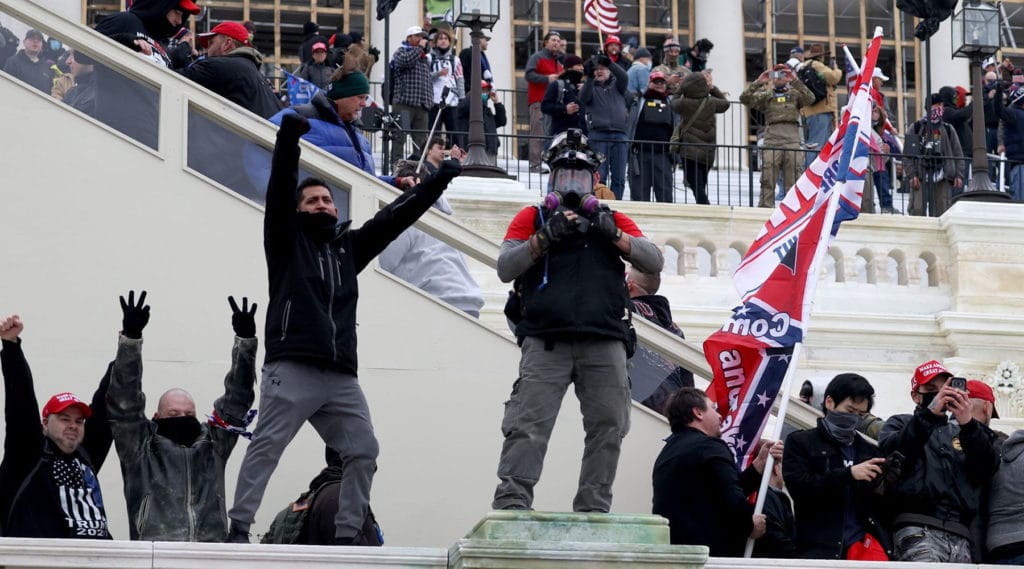
I have thought often recently about my father’s alarm at Buchanan’s rhetoric as former President Trump, welcoming the support of QAnon and right-wing groups invoking Nazi and Confederate ideology, led them in questioning, against all the evidence, the legitimacy of the November election. I remembered his alarm as I read that candidates who were either followers of, or strongly supported by, the same groups were elected to Congress on the Republican ticket. My father’s alarm was prescient.

There may be a rational basis for the taboo in my parents’ generation about making historical comparisons between current political circumstances and the Nazi regime. Because how can we really know what is the same and what is just different, when we see the full historical results of the Nazi regimes but can only guess at the results of the history we are living and making?

Ultimately, we forget history or avoid historical comparisons at our peril. Is the United States of 2021 the Germany and Austria of the 1930s? I would not venture to say, and I think it is the wrong question. Many people, including Jews in the 1930s, believed that the horror to which the events were leading could not happen. Then it did. Dismissiveness is not a viable political or social strategy. Political engagement is.

We forget history or avoid historical comparisons at our peril.

Political engagement must include calling out the rhetoric and actions of those who place political power over the democratic process and demonize the opposition as contrary to the principles of the country that God supposedly wants. Many of the issues we must address are fraught with strong differences that are difficult to bridge. But while tamping down divisiveness could be beneficial to progress on those issues, we cannot afford to lower our voices about those who seek to dehumanize their opponents and delegitimize our democratic process, whether or not the result would be the same now as it was in the 1930s.

We cannot afford to find out how close the comparison hews.

Now that I am a father, I understand my father’s fears. His fears for my wellbeing, heightened by his own experiences in Vienna and hearing the increasingly harsh rhetoric of some U.S. leaders, may also have moved him from disapproval to acceptance and support. And they may have moved him to break through the taboo of comparing situations to the Nazis.

Although my father never directly taught me about the imperative to speak out against injustice, his private comments instilled that lesson in me. I only hope that the lessons I leave with my son bear the same strength as those my father taught me.


William Weinberger is an attorney with a business and employment litigation practice in Los Angeles and serves on the Board of Trustees of Congregation Kol Ami, West Hollywood’s Reform Synagogue.

Comparing the Holocaust to Current Events: Generational Changes Read More »

On Giving and Receiving Torah: An Invitation to Conversation

I am reading a striking book called “Send in the Idiots: Stories from the Other Side of Autism.” It is written by a remarkable man, Kamram Nazeer, who was born to Pakistani parents, raised in New York City and now lives in London. Diagnosed with autism, Nazeer went to one of the very earliest programs that attempted to provide an appropriate education for special needs children. Many years later, as an adult, he decided to visit some of his former classmates to see what had become of them and how they had adapted to life.

The first former classmate adapted to the challenge of conversing by speaking through the use of puppets. The man created a variety of puppets, and when he has specific things to say he utilizes a different puppet. His rules are that the puppet is speaking, not him, and you have to address the puppet, not him.

For autistic individuals, conversation is not something one can just assume but is a skill requiring deep and persistent work. Because of this, Nazeer spends several pages thinking about what it means to be in conversation. And his insights are relevant because the work that we Jews do is participating in and maintaining an ancient and vibrant conversation — with the Holy One, with the generations, with Torah.

Nazeer observes, first of all, that conversation is a form of performance. Conversations cannot flourish when one party sets out to win or destroy the other participant. To enter into conversation means to invite the other person to join with you and can only continue when both parties are participating, when they both are engaged.

Nazeer noticed that conversations are not about conclusions. Most conversations that he overheard between neurotypical people never had a real conclusion; they just moved from subject to subject, dancing around. As I read that description, I thought, How similar to the Talmud!

The Talmud contains approximately 5,000 conversations/makhlokot. Only about 50 are concluded because the action is not in the answer; the action is in the exchange, in the questioning, in the probing, in the exploration. In understanding why someone might see a matter differently than the way we see it, we explore the origins of our perspective while continuing to  perceive it the way we do. The great Jewish philosopher Shlomo ibn Gabirol, in his beautiful work “Mivhar Ha-Penimim,” writes, “Wisdom about which there is no discussion is like a hidden treasure from which nothing is extracted.” Wisdom is made visible by sharing it with others, by bringing it to the light of day and then by batting it around. It is through conversing with others that we bring wisdom into the world, and it becomes something we can own and with which we can live.

It is through conversing with others that we bring wisdom into the world.

Nazeer reflects that conversations are not linear. He writes, “Though conversation may well bring out matters of this sort, it shouldn’t be directed at a conclusion, and it shouldn’t, too formally, be about ‘something’. It should circle, it should break up, it should recommence at an entirely different point.” This is certainly an accurate description of Jewish sacred literature. Our sacred writings routinely circle around, suddenly break up and begin yet again when we least expect it.

Because we never know when a topic will reappear, we never know when a subject will begin, so we need to pay attention at each stage of the conversation. At any moment someone could reveal something you need; someone may introduce a subject of vital importance in the middle of an apparently unrelated topic.

The Talmud notes, “Even the secular conversations of the Sages require study.” Precisely because there is deep insight clothed even in trivial conversation, and because we don’t have access to an objective place to stand, we can only know through our own knowing; we can only converse from where we are. “A judge has nothing to see with save their own eyes.”

Perhaps most important of all, conversation should be fun. You have to relish the opportunity to bring something into the world or to bring something out of your fellow human being. In that exchange, there is deep joy: the invitation to connect to each other, the invitation to connect to our heritage, the invitation to connect to God. As the Pirkei Avot tells us, “When two persons meet and exchange words of Torah, the Shekhinah hovers over them.”

But the process can only be fun if you treat your conversing partner with full respect and with unfeigned affection. There must be civility in our conversations with each other; otherwise, they will shut down. There is a tradition that in the Messianic future, we will paskin, we will adjudicate, not according to the Bavli, the Babylonian Talmud, but according to the Yerushalmi. Why is that? In Massekhet Sanhedrin we are taught, “The word gracious is applied to the Sages of the Land of Israel because they are always gracious to one another in their discussions of Halakhah, their discussions of Jewish Law.” It’s not that the sages of Israel are smarter than those of Bavel; it is not necessarily that they have arrived at a greater truth. But their graciousness to each other makes them fitting role models for us in the Messianic times yet to come.

And that insight leads me then to my last point. Conversations are almost never about the truth. Truth pertains to very finite and concrete matters: How much money do you or do you not have in your checking account? Did you or did you not eat your healthy food prior to dessert? But most of the areas in which we work — building community, healing hearts, saving souls, loving our brothers and sisters — are neither true nor false. They are enriching, they are meaningful, they are empowering, and they are healing.

The “Sefer ha-Hinnukh,”speaking about the Hakhel, the Biblically-ordained periodic gathering of the entire Jewish people, says, “It will soon come to pass that among the men, women, and children, some will raise the question, ‘why are we gathered here, all together in this huge assembly?’ And the reply will be ‘To listen to the words of the Torah which are the essence of our existence, our glory and our pride.’ The ensuing discussion will lead to an appreciation of our Torah, its greatness and supreme value, which in turn will arouse great longing for it. With this attitude they will study and attain a more intimate knowledge of God. Thus, they will merit the good life, and God will rejoice in their works.”

Conversation is not used to verify information. Conversation is used to build community. It establishes the capacity to understand a viewpoint not our own and see the humanity of those who walk in the world differently than we do.

I love the fact that in a room full of mourners, what is required is not accurate information but shared discussion. The Talmud tells us that a group of ancient Jews responded to the destruction with extreme mourning and rigid restrictions of any pleasurable food or drink. Rabbi Joshua taught them a crucial lesson: “‘Children come and listen to me. Not to mourn at all is impossible because the blow has fallen. To mourn overmuch is also impossible, because we do not impose upon the community a hardship which the majority cannot endure.’ … Therefore, the Sages have ruled: ‘You may stucco your house, but you should leave a corner bare.’”

Rabbi Joshua does not prove his point with logic; he enters into a relationship. He invites the others to step with him into another way of understanding the world and how to live in it.

The contemporary philosopher Jürgen Habermas affirms what I believe is an ancient and Jewish insight when he notes, “In his capacity as a participant in argumentation, everyone is on his own and yet embedded in a communication context.” To Habermas, an “idea community of communication” entails “The individual’s inalienable right to say yes or no and his overcoming of his egocentric viewpoint.”

The right to say yes or no and the ability to transcend one’s own limited viewpoint is the basis upon which we build relationships, establish community and live in Covenant. This is what it means to expand our vision, to see the views of another, to see through the eyes of the Holy One.

After all, God created the world through conversation, calling the world into being. God reached out yet again to our ancestors Abraham and Sarah, inviting them to a conversation. Again, at the height of Mount Sinai, God called the entire Jewish people to a conversation that yet abides, a conversation that involves the give and the take of Mattan Torah and Kabbalat Torah. And our predecessors — the Sages of Israel and its prophets, its mystics and its monarchs — have harvested an ever new Torah through ongoing conversation, a respectful yet vigorous exchange of ideas.

We too, are given the holy privilege of joining that conversation, of adding our voices to those words and inviting our people — some now waiting on the margins, some now excluded, some now binding their wounds — to reclaim their birthright, to rejoin the ancient, sacred conversation that is Torah.

My blessing to all of us is that we should always be worthy participants in this conversation, so that we hold in conversation the Sages and the prophets who have come before us and we hold in our hearts and our minds those with whom we speak and teach and those yet to come. I bless us that our conversations should be vessels for God’s love and light to enter the world, that in our speech and in our deeds, we should invite others to walk on that path of righteousness that has guided us across the millennia.


Rabbi Dr Bradley Shavit Artson (www.bradartson.com) holds the Abner and Roslyn Goldstine Dean’s Chair of the Ziegler School of Rabbinic Studies and is Vice President of American Jewish University in Los Angeles. He is also dean of the Zacharias Frankel College in Potsdam, Germany, ordaining Conservative rabbis for Europe. He is a contributing writer to the Journal.

On Giving and Receiving Torah: An Invitation to Conversation Read More »

Satirical Semite: Ministry of Hugs

Something in me recoils when I saw the hugging reaction emoji that was recently added to Facebook posts. Rather than liking a post, you now get to send an “I care” message by clicking the icon that looks like a yellow beachball hugging a heart. I am highly selective with whom I hug and not a fan of the recent development that a handshake is no longer considered a sufficient form of greeting.

Horror befell me yesterday when I heard a BBC newscaster announce that Prime Minister Boris Johnson has now made it legal for UK islanders to hug one another. Legislating on interpersonal touch is the definition of government overreach, or in this case, government overreach-around. It seems that cabinet ministers were concerned about restoring intimacy, and it is a great relief that elected officials now prescribe and oversee our intimate relations.

There are rules to hugging. Phew. If we have learned anything from the last 14 months of lockdown, it is how to obey rules. The laws of social distancing and reduced social contact undoubtedly saved lives, but they also de-socialized us since we got used to keeping friends and families at arm’s length (if our arms were two meters long). Now we can go back to business as usual and only remain distanced from unwanted relatives.

As the governmental leadership states — and it does sound fairly govern-mental — there are recommended guidelines around whom we can hug, how we can hug and where we can hug. Professor Catherine Noakes from the University of Leeds in Northern England explained how we not should hug all of our friends every time we meet them, which is perfectly reasonable, especially since many of them have all but abandoned personal hygiene routines after spending a year isolated and working from home in their pajamas. Thus far Prime Minister Johnson has not yet advised how long we should spend in the shower or which shower gel to use.

There are recommended guidelines around whom we can hug, how we can hug and where we can hug.

Professor Noakes is a chartered mechanical engineer with a background in fluid dynamics, which is helpful since some people’s hugs do seem rather mechanical and could do with a little emotional lubricant to get them moving with more fluidity. In all seriousness, her expertise includes indoor air quality, ventilation and airborne infection, which does make her perfectly placed to offer advice. The professor’s other recommendations include not hugging too frequently and to only hug for a brief period. We are also advised not to hug face to face, and apparently this can be achieved by turning your face away slightly. As of yet there are no government-issued diagrams on how to achieve that last maneuver.

Woe betide the person who goes around hugging all of their friends face to face, although it does sound like a creepy behavior anyway, so full kudos to them for having any friends at all.

The most helpful piece of information offered was that “the reality is that when you hug somebody you are very close to them.” The BBC is full of profound wisdom.

As with many others, I found lockdown a challenge. The last few months felt like a personal hell, living alone, working and going to sleep in the same apartment, unable to socialize indoors with anybody at all. There was no end in sight when the British Government kept extending its lockdown rules, and it is great news that as of May 17, we can socialize indoors, albeit in restricted numbers.

At times the winter felt torturous. The biggest challenge of all was staying positive, avoiding becoming a victim and not having a “pity party” for myself. Few things are less attractive than someone with a victim complex, and what do I have to complain about? I have been vaccinated and did not catch COVID-19. Life is to be celebrated, and next week it’s back to the pub.

Cabinet Minister Michael Gove told a current affairs program that “intimate contact between friends and family is something we want to see restored.” This sounds thoughtful and caring for the mental health of the nation, although for safety’s sake I’ll carry a “hug exemption” card for use when approached by someone I don’t want to touch or be touched by.

May everyone have happy government-approved intimate relations — just make sure it’s consensual. For now I’ll stick to the “like” button.


Marcus is an actor, filmmaker and business consultant

www.marcusjfreed.com

@marcusjfreed

Satirical Semite: Ministry of Hugs Read More »