fbpx

May 13, 2021

Rosner’s Torah Talk: Bamidbar with Eliana Rubin

Eliana Rubin is a queer and trans artist and educator. She aims to help people better understand themselves and the world around them through Jewish, LGBTQ+ and theatre education. Eliana is currently a candidate for a Masters of Educational Leadership at HUC-JIR, with an expected graduation date of May 2022. She received her BFA from NYU / Tisch (ETW). Eliana is a musician, with her first album expected to be released this fall. She will never say no to a bag of movie theater popcorn.

This Week’s Torah Portion – Parashat Bamidbar (Numbers 1:1-4:20) – is the first portion read from the book of Numbers. The Parasha tells us about an elaborate census of the tribes of Israel conducted by Moses in the desert and continues to discuss the priests’ ceremonial duties. Our discussion focuses on the need to find meaning in one of the most boring texts of the Torah.

Previous Talks on Bamidbar

Rabbi Eric Yoffie

Rabbi Andrea London

Rabbi David Ackerman

Rabbi Amy Bernstein

Rabbi Yehuda Ferris

Rabbi Mike Moskowitz


Rosner’s Torah Talk: Bamidbar with Eliana Rubin Read More »

Made in Gaza: Hamas Rockets the Product of Foreign Aid and Smuggled Material

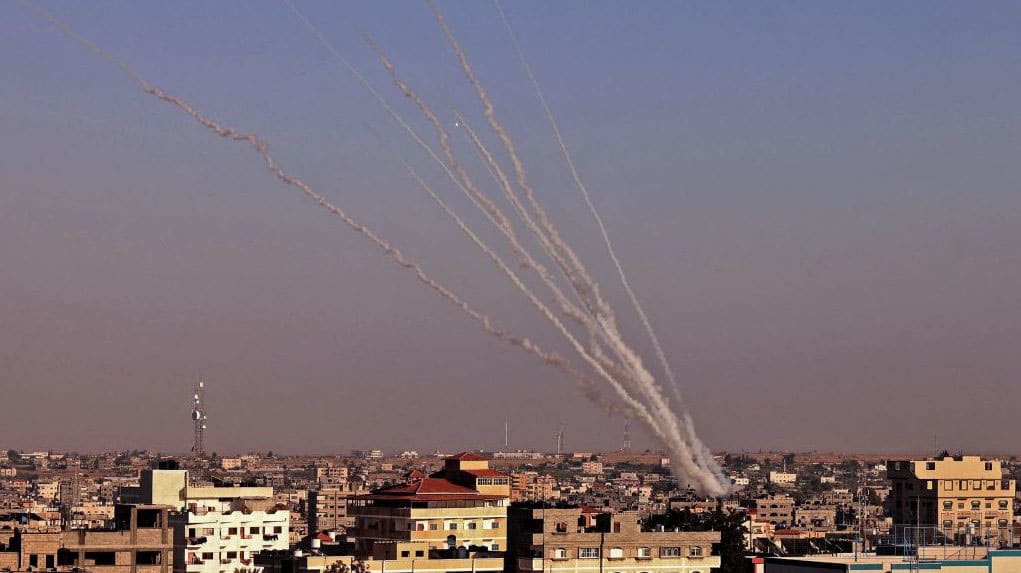
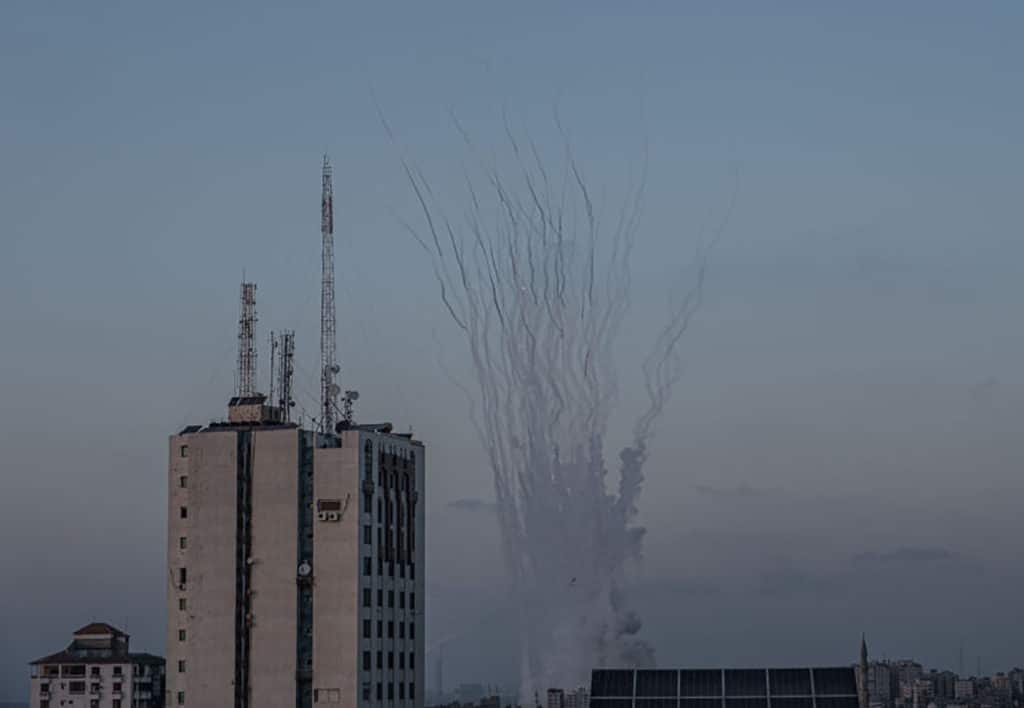
(The Media Line) Palestinian organizations in the Gaza Strip have fired at least 1,300 missiles at Israeli communities since the current round of violence began on Monday evening, with the numbers continuing to mount. The Iron Dome air defense system intercepted 85%-90% of those headed for populated areas, the Israel Defense Forces said.

At least six civilians in Israel have been slain by the rockets, including an Indian caregiver in Ashkelon, and approximately 100 people wounded. In addition, an anti-tank missile killed a Nahal Brigade sergeant on the Gaza border Wednesday.

Gaza has been under an Israeli-Egyptian blockade since Hamas seized power there in 2007, put into effect to prevent the stockpiling of weapons and ammunition by the terror organizations in the Strip. As part of the blockade, Israel limits and supervises the goods and materials that enter the area.

Egypt also tightly controls the movement of goods and people through the Sinai-Gaza border.

Despite the efforts of both countries, Hamas has come prepared to the current round of violence, armed not only with many more rockets than during the last Gaza war in 2014, but also more accurate weaponry.

Dr. Kobi Michael, a senior research fellow at Tel Aviv University’s Institute for National Security Studies, told The Media Line that experts on the matter “aren’t surprised by the amount of weaponry that they [Hamas] have, nor by the quality of the armaments there [in Gaza], some of which was smuggled in, but the majority of the arsenal is manufactured independently by Hamas based on Iranian knowledge and more than 15 years of experience.”

Col. (res.) Dr. Michael Milshtein, head of the Palestinian Studies Forum at the Moshe Dayan Center for Middle Eastern and African Studies at Tel Aviv University, also says the amount of weaponry held in Gaza is not unexpected. “The quantity isn’t surprising,” he told The Media Line.

Milshtein points instead to the ability to fire large numbers of rockets in rapid succession as the main improvement in Hamas’ capabilities. He attributes this to advancement in the organization’s combat doctrine as a result of studying Israel’s Iron Dome air defense system and its weaknesses.

The Islamist group’s rockets and other military equipment are the product of “a cynical use of material which enters the Strip to aid its recovery and for agricultural uses, in combination with money from Qatar,” Michael said.

The UN and Israel have a joint apparatus to supervise the use of the materials, but as Hamas is in control of the Strip, it has managed to overcome this obstacle. Fertilizer is used to produce explosives, for example, Michael says. In addition, medical equipment is disassembled for parts, and oxygen tanks intended for medical care are repurposed to serve the organization’s military needs.

“There’s a lot of dual use,” Milshtein said. “A lot of things enter Gaza as, for example, utility poles, and they know how to later repurpose them as rockets for a variety of ranges” by using their metal.

The majority of the arsenal is manufactured independently by Hamas based on Iranian knowledge and more than 15 years of experience

Some materials are smuggled into the Strip, be it by land or by sea. “Explosives that they need, machines that have to do with the rockets’ accuracy, and sometimes metal parts that are more difficult to get in Gaza,” he says.

The funding of the organization’s enterprise is not dependent solely on Qatari money, but comes also from Tehran, Gazan taxpayers and international aid intended for humanitarian projects, part of which finds its way to Hamas’ pockets, according to Michael.

Israel has responded to Palestinian attacks with air strikes, targeting “terror targets in the Gaza Strip,” which include Hamas and Islamic Jihad assets and operatives. The attacks have so far resulted in 53 Palestinian deaths, 14 of them children, and 320 wounded, according to the Hamas Health Ministry in Gaza. The IDF reported on Tuesday that it had killed 15 Hamas military leaders, and has not released an updated count since.

Michael believes the Palestinian organizations have thousands of rockets left, enough for “a fair few more days of such fighting.”

Milshtein, in turn, differentiates between long-range projectiles and short-range projectiles. Of the latter, he says, “they can shoot all day long.”

However, Milshtein thinks that Hamas may be nearing the end of its stockpile of long-range missiles, those that can reach Tel Aviv. Wednesday night, he said, would be a telling moment. If Hamas was able to repeat its barrages of hundreds of rockets toward Tel Aviv, it would mean they may have a large number of long-range rockets still stashed away in the Strip. Otherwise, they may be pretty close to the bottom of the pile.


Made in Gaza: Hamas Rockets the Product of Foreign Aid and Smuggled Material Read More »

Marching Orders — A poem for Torah Portion Bamidbar

Just as they camp, so shall they travel,
each man in his place, by their divisions.
-Numbers 2:17

I don’t like to use cliché in poems.
I figure, if it’s already been said, then
why should I be saying it?

(That first stanza counts as a
poetry workshop, and I’d be happy
to sign anything to get you the

credit you deserve.)
So, when I tell you we’ve been
given our marching orders

it’s because that literally
is what’s happening. By the way
I don’t like to use the word

literally in a poem, or ever, really
as it’s almost never used the way
it should be used.

If there’s a committee I can join
to decide what words survive
the great linguistic culling

count me out as I don’t have the time
but, please, for me, and all
seekers of truth, spend a lot of time

considering literally. Anyhoo
back to the marching orders. Everyone
who’s anyone (except for the women

and the Levites of course) gets told
where to go. We’re going to sleep and
march in these exact positions.

I mean relative locations to each other
as the actual physical positions
of our bodies will adjust depending

on whether we’re sleeping or marching.
That’s just science, or biology, or physics –
I’m not sure because it doesn’t

cover that clarification in the text, and
Rashi, who lived a long time ago
doesn’t mention it, and he had

something to say about everything!
So, determine who you are –
(Zebulon, Naphtali, Gad, etc…)

And assume your positions – Standing
or lying down. Your choice (for now).
There’s going to be forty years of this…

literally.


God Wrestler: a poem for every Torah Portion by Rick LupertLos Angeles poet Rick Lupert created the Poetry Super Highway (an online publication and resource for poets), and hosted the Cobalt Cafe weekly poetry reading for almost 21 years. He’s authored 25 collections of poetry, including “God Wrestler: A Poem for Every Torah Portion“, “I’m a Jew, Are You” (Jewish themed poems) and “Feeding Holy Cats” (Poetry written while a staff member on the first Birthright Israel trip), and most recently “The Tokyo-Van Nuys Express” (Poems written in Japan – Ain’t Got No Press, August 2020) and edited the anthologies “Ekphrastia Gone Wild”, “A Poet’s Haggadah”, and “The Night Goes on All Night.” He writes the daily web comic “Cat and Banana” with fellow Los Angeles poet Brendan Constantine. He’s widely published and reads his poetry wherever they let him.

Marching Orders — A poem for Torah Portion Bamidbar Read More »

Mourning My Way: Creating a Custom Path to Healing

Shortly after my father died, a little over a month ago, I spoke with an Orthodox rabbi who gave me some advice that surprised me. “Most of the rituals surrounding mourning are customs, not law. It’s impossible to mourn the way people did a thousand years ago when our lives are so different. Mourn in the way that feels right to you,” he advised.

It was ironic how comforting these words were to me — he was giving me permission to do Judaism my way. After all, I am a rabbi at an organization called Judaism Your Way. I spend so much of my time encouraging the families and individuals I work with to do Judaism in a way that is meaningful to them. When I share this advice, I often see a sense of calm come over their faces. For the first time, I was experiencing that calm myself.

In Judaism, the period leading up to and including the funeral is focused on kavod ha-met, honoring the deceased. Once the beloved who has died is buried, the focus shifts to nichum aveilim, comforting the person in mourning. As I moved into this phase, I noticed that some Jewish mourning traditions brought me great comfort — they worked with doing “mourning my way” — and some simply did not.

The first tradition that worked for me was the act of Kriah, which begins prior to burying the deceased. The word Kriah means “torn,” and the custom is that the mourner tears a garment to physically demonstrate how they feel no longer whole because they have lost a loved one. The custom is to wear this torn garment during the week following the funeral, except on Shabbat. Many mourners decide to tear a piece of ribbon, which they can attach to their clothing.

In rabbinical school, one of my teachers spoke passionately about the power of using a garment for Kriah over a ribbon. His teaching made me feel committed to trying out this custom; I just didn’t know I would have the opportunity quite so soon. I selected a shirt, one that I bought for my mother-in-law’s funeral nine years ago and had become one of the staples in my wardrobe. I couldn’t imagine wearing the same shirt essentially every day for a week, but it turned out to be quite comforting knowing what my mourning “uniform” was. By the time the week ended, I was almost not ready to change into something else, but the act of taking it off was actually quite powerful.

Another tradition that has been helpful to me has been attending a daily minyan, a prayer group, and reciting the Mourner’s Kaddish, a prayer associated with death but actually speaks of glorifying the name of the Divine. Being able to attend minyan virtually has been one of the silver linings of the pandemic. During the week following my Dad’s funeral, friends and family members offered support. After this period, I began joining daily minyanim around the country, depending on the time that worked for my schedule. As a working mom with two little kids in Denver, it would have been nearly impossible for me to attend a minyan daily if I needed to attend in person.

Not only have virtual prayer opportunities made it accessible for me to say Kaddish every day, but for the first time, I really resonated with the phrase “traditionally” used to comfort mourners: “May the Holy One comfort you among the mourners of Zion and Jerusalem.” As I stood for Kaddish with people all over the country who are remembering their loved ones, I felt that I am in good company among these mourners, and that brought me comfort.

For the first time, I really resonated with the phrase “traditionally” used to comfort mourners.

One area where I needed to do Judaism my own way was thinking through exactly how I would do shiva. The word shiva comes from the root word meaning “seven” marking the week following the burial of a loved one, but it also comes from the root “to sit.” The idea is that those in shiva do not leave their home for a week. While they observe shiva, ideally, they sit either on the ground or on low stools as a sign of their state of mourning.

Typically, shiva is a time when friends and family gather in the home of the deceased or a mourner to offer comfort and support. Due to the pandemic, the practice of having others come to my home was not an option. I knew that I didn’t want to feel isolated during shiva, and I also wanted to be as safe as possible. What felt best to me was having one friend a day come over and go for a masked walk with me. Although I was not physically sitting, the conversations I had on the walk, I imagine, would have been the same if I was. These walks reminded me how much I was cared for at a time when it felt like the world had fallen open beneath me.

The Shulchan Aruch, a 16th century code of Jewish law, forbids mourners from joyous entertainment. As such, there is a tradition that mourners refrain from listening to music, especially live music. One of my dad’s hobbies was playing folk music on guitar and banjo. When it came time for shiva, I felt a deep need to listen to music that my dad loved. Here was an area where I needed to do Judaism my way. Over the week of shiva, I learned to play mandolin songs that I remembered my dad playing when I was a child, and I listened to some of his favorite music on repeat. These moments were often when I felt most connected to my dad in the month following his funeral.

There is a tradition that when the week of shiva ends, the mourner gets up and goes for a short walk outside, demonstrating that they are slowly re-entering the world. Since I’d already been going for walks during the week, this beautiful tradition felt less appropriate for my reality. So after participating in a morning minyan on my final day of shiva, I went for a long walk with my dog and came home to cook a fancy breakfast for my husband, children, mom and step-dad. I don’t often cook elaborate meals, but I felt drawn to the kitchen that day, and I suspect it may have been because my dad loved to cook. Some of the times I saw him happiest were when he was in the kitchen cooking for others. That morning, while preparing a family recipe, I truly felt my dad’s presence in the kitchen with me.

According to Jewish tradition, the period of mourning varies depending on one’s relationship to the deceased. When one loses a parent, the mourning period lasts a year. I’m just at the beginning of navigating the year of mourning my dad, a loss that came suddenly and unexpectedly. During this disorienting time, I’ve felt so grateful to be part of a tradition that offers so many opportunities to feel held and grounded. I will forever appreciate the rabbi who told me that sometimes these traditions might not work for me and that I should mourn my way.


Rabbi Amanda Schwartz is on the rabbinic team at Judaism Your Way. She received rabbinic ordination and a master’s in educational leadership from the Jewish Theological Seminary in 2016.

Mourning My Way: Creating a Custom Path to Healing Read More »

Andrew Yang Walks Back Tweet Standing With Israel

New York City Mayoral candidate and former Democratic presidential candidate Andrew Yang walked back a tweet that he had stood with Israel.

Yang had initially tweeted on May 10, “I’m standing with the people of Israel who are coming under bombardment attacks, and condemn the Hamas terrorists. The people of NYC will always stand with our brothers and sisters in Israel who face down terrorism and persevere.”

A couple days later, Yang posted a statement to Twitter stating a group of campaign volunteers told him that they were “upset” with his tweet because it “was overly simplistic in my treatment of a conflict that has a long and complex history full of tragedies. And they felt it failed to acknowledge the pain and suffering on both sides.”

Yang then said his volunteers were “correct. I mourn for every Palestinian life taken before its time as I do every Israeli. Suffering and pain and violence and death suffered by anyone hurts us all. All people want to be able to live in peace. We all want that for ourselves and for our children.”

Some Jewish groups and pro-Israel Twitter users criticized Yang for appearing to walk back his May 10 tweet. “Americans looking for leaders with backbone. New York City desperately needs that kind of leader,” the Simon Wiesenthal Center tweeted. “@andrewYang #DefendIsrael.”

Daniel Laufer, who works in communications, replied to Yang, “Nuance is important, but the volunteers may not be well informed. Hamas rockets already killed Jewish & Arab children in Israel. 1/3 of the 1500+ rockets fell short in the Gaza Strip & as in past conflicts likely killed innocent Gazans. Ignore pressure; keep the moral clarity.”


Yossi Gestetner, co-founder of the Orthodox Jewish Public Affairs Council (OJPAC), similarly replied to Yang, “Rockets are launched from civilian areas into civilian areas; motorists are pelted with stones; synagogues are destroyed and Torah Scrolls desecrated while the other side tries to do targeted strikes. The former acts need full condemnation regardless of complex policy debates.”

On the other hand, some local Jewish leaders didn’t think Yang’s statement would harm his standing with the pro-Israel community.

“He expressed his support [for Israel] and I think people appreciate that,” Ezra Friedlander, a government relations consultant, told the New York Post.

David Greenfield, executive director of Met Council, the largest Jewish charity in the United States, also told the Post that Yang’s May 12 statement is “the viewpoint of most people of good conscience,” as it essentially clarified that Yang supports Israel as well as the Palestinians. Greenfield also said that the criticism over Yang’s May 10 tweet was “unfair,” according to the Post.

Andrew Yang Walks Back Tweet Standing With Israel Read More »

NY State Assemblymember Deletes Tweet Showing All of Israel as “Palestine”

New York State Assemblymember Phara Souffrant Forrest deleted a May 13 tweet of a map showing all of Israel as “Palestine.” The deleted tweet also included the caption “#FreePalestine.”

Forrest had also written in a since-deleted tweet that the map showed “historic Palestine.” “The reality on the ground is apartheid,” she added. “We need to make sure that our tax dollars don’t support the oppression of any peoples.”

Among those who criticized the tweets were the Anti-Defamation League New York / New Jersey chapter. “It is incendiary and outrageous, especially at such a sensitive time, for any public official to make references to erasing Israel’s existence from the map or denying its Jewish history as well as leveling claims of apartheid,” they tweeted.


Forrest later tweeted that she had deleted her previous tweet of the “Palestine” map because it “led to misunderstandings about my position. My position has always been about peace and justice. I stand against apartheid because I believe that all people deserve to live under equal rights regardless of ethnicity or religion.”


But not everyone bought her explanation. “As your constituent, I’d like to know where is your apology for tweeting a call for genocide,” Tali Goldsheft, Director of Communications at Americans for Ben-Gurion University, tweeted in response. “I stand against apartheid as well. Israel is not an apartheid [state].”


Rabbi Andrew Jacobs of Ramat Shalom Synagogue in Florida replied to Forrest, “Your dangerous, hateful tweet can’t simply be deleted. The damage is done. We now know your views. They are not peaceful.”


Forrest also tweeted on May 12 that it’s a “moral stain” that the United States “government and elected officials continue to prop up an Israeli state dedicated to apartheid. We can and must change that. #BDS #FreePalestine.”

The Simon Wiesenthal Center tweeted in response, “Please don’t legitimize lie demonizing Israel and your Jewish neighbors. Israel has 9+ million citizens nearly 20% Arab. Want to help Palestinians? Denounce #HamasTerrorists for using Gazans as human shields for 1000s of rockets launched against Israeli civilians.”

NY State Assemblymember Deletes Tweet Showing All of Israel as “Palestine” Read More »

Something Tells me Hamas has More Rockets than Vaccines

What could I possibly add that hasn’t already been written about the current crisis Israel is facing? We know Israel is facing Hamas in Gaza and Palestinians in East Jerusalem (some of whom were photographed next to their stockpile of rocks, stone slabs and even fireworks inside the Al Aqsa compound). There’s also the deeply biased and unfair “coverage” that Israel receives in the media (forget the cesspool of anti-Semitism that has become social media); that’s only amplified at a time like this.

But I’m thinking of Mount Meron. Yes, Mount Meron. Isn’t it unbelievable that nearly ten days after 45 Israelis perished in a stampede during what was supposed to be a holy and joyous experience at Mount Meron that Israelis have endured over 1,000 rockets from Hamas in Gaza, including strikes against Jerusalem and Tel Aviv? So far, five Israelis have been killed by rocket attacks, including a father, Halil Awad, 52, and his 16-year-old daughter, Nadine. In response, Lod Mayor Yair Revivo said, “Hamas missiles do not differentiate between Jews and Arabs.” Sadly, he’s right.

We’ve already seemed to forget that just a few weeks ago, the biggest story in the Jewish world concerned what happened on that mountain on Lag B’Omer. And now, many of the families who just finished sitting shiva for the sons, brothers and husbands they lost during that devastating incident are running for their lives and hunkering down in bomb shelters. I imagine these heartbroken people holding one another in bomb shelters all over Israel, crying out for “Abba” while soothing their young children. I also imagine that they’re praying to G-d to bring them protection and peace — all while still in mourning. If that’s not resilience, I don’t know what is.

And then there’s the question of Hamas. In 2006, I was serving at the Israeli Consulate in Los Angeles when Hamas won Palestinian legislative elections. It was all anyone talked about for weeks. And in 2007, after Hamas seized power from Fatah, no one could believe that a terrorist organization whose charter called for murdering Jews (and which had so much blood on its deadly hands for decades) now was right next door to Israel in Gaza, in an official “government” capacity (if you believe that staging a military victory and throwing men from Fatah off of rooftops counts as earning a seat in Palestinian governance).

As director of academic affairs at the Consulate, I tried to explain Israel’s unimaginable predicament to a multitude of students, professors and administrators. When most of them still didn’t understand about Hamas, I gave up and asked them to imagine if al Qaeda had taken control of Tijuana, which is roughly 20 miles from downtown San Diego. Even that was overly generous, since the distance between Gaza and the southern Israeli city of Sderot is only eight miles.

As soon as Hamas came to administrative power in winter 2006, I became obsessed with one question: How could Israel ever get rid of a terrorist organization that controlled nearly everything in Gaza and hid itself among such densely populated civilian centers, including hospitals? Whoever heard of launching rockets from hospital rooftops? My fellow Angelenos didn’t seem to understand; the only things that ever flew off of the roofs of Cedars-Sinai Medical Center were runaway helium balloons (Hamas has balloons, too, but they contain bombs).

I credit my pessimism about the inevitably of long-term tyranny to having lived my early years in post-revolutionary Iran. In the early days of the revolution, no one believed that fanatic theocrats who had zero experience running a country could possibly last longer than a few years, especially in a nation mostly composed of secular, educated people previously on the path to Westernization. Forty-two years after the Islamic Revolution in Iran, the theocrats are still there and more emboldened than ever.

That summer of 2006, just months after Hamas came to power, Israel fought a two-front war when Hezbollah attacked from the north (in southern Lebanon) and Hamas attacked from the south. The rockets were flying like locusts in a plague.

Ever since then, every few years, the Jewish world stops and watches in horror as videos show rockets flying over Tel Aviv skyscrapers. In the Diaspora, pro-Israel Jews fight their own wars. I’m not comparing Diaspora Jews to the valiant Israel Defense Forces (nor to any Israelis on the ground), especially not when I get to enjoy an iced coffee and relax on a park bench in Los Angeles while my Israeli brethren are running for their lives. But anyone who’s ever tried to defend Israel on the ulcer-inducing platforms of various social media knows that it’s an unjust, outnumbered and 24-hour job. And that says nothing about what thousands of Jewish and pro-Israel students endure in classrooms and quads at universities all over the world.

And when the rockets fall over Israeli cities and headlines against the Jewish state are at the top of every national and international paper, we can’t help but feel under siege as well.

But watching videos in horror, taking to social media, and in some cases, praying Tehillim is what pro-Israel Diaspora Jews must do every few years (or months) when Hamas attacks again. And when the rockets fall over Israeli cities and headlines against the Jewish state are at the top of every national and international paper, we can’t help but feel under siege as well. The media is a curious thing; in case anyone wondered, 85 schoolgirls were killed in a bombing against a school in Kabul last Saturday, while the current conflict in Israel — which began when Hamas wanted to assert power after Mahmoud Abbas indefinitely delayed the first Palestinian election in 15 years — was fanned by tensions at the Al Aqsa Mosque, along with news that six Palestinian families faced possible expulsion from their homes in the Jerusalem neighborhood of Sheik Jarrah. I’m not making light of this situation. But I’m still waiting for protests outside the Afghan Embassy in defense of those poor schoolgirls.

“It’ll be over soon.” That’s what every friend, cousin and uncle in Israel has told me this week. I believe them. But I always wonder when Hamas will start up again. There’s something about a group of Palestinian “leaders” who might have more rockets against Jews than vaccines for Palestinians that makes me wonder how all of this will one day finally come to an end.

Of course, as an Iranian, I can’t help but feel I already know that answer: The day when real balloons (without bombs) fly over the Gazan horizon will only come once the despots in Syria and Iran, who fund, arm and train Hamas, are toppled, and 17 million Syrians, 83 million Iranians and two million Gazans taste the redemption of freedom for themselves. But the optimism of that long-term hope is best left for another column.


Tabby Refael is a Los Angeles-based writer, speaker and activist. Follow her on Twitter @RefaelTabby

Something Tells me Hamas has More Rockets than Vaccines Read More »

Florida Van With Palestinian Flag and “Hitler Was Right” Sign Circles Around Pro-Israel Rally

A van that had several Nazi slogans written on it as well as a Palestinian flag circled around a pro-Israel rally in Boca Raton, FL on May 12.

Rabbi Efrem Goldberg of Boca Raton Synagogue tweeted out a video of the van; the video showed the van had various antisemitic slurs written on it, including “Hitler Was Right,” “Rabbi[s] Rape Kids,” and “We Hate K—s.” The van also had a Palestinian flag hanging out a window. The men inside the van appeared to be wearing shirts saying “SS.” The driver appeared to be saying something into a megaphone but couldn’t be heard in the video.

“We rally for peace and this van filled with hate, call for genocide and threats kept circling,” Goldberg tweeted. “Thank you to our local law enforcement for keeping us safe. Hard to believe in the heart of Boca Raton if didn’t see it myself.”

Various Jewish and pro-Israel Twitter users argued that the video is proof that anti-Zionism is antisemitism. “Just some anti-Zionists, no anti-Semitism here,” Ben Shapiro sarcastically tweeted.


American Jewish Committee Transatlantic Institute Director Daniel Schwammenthal tweeted, “If you don’t believe Jews that anti-Zionism is antisemitic, maybe you’ll believe Nazis?”


Jerusalem Post senior editor Lahav Harkov also tweeted, “Freeing Palestine by driving a van that says ‘Hitler was right’ on it in Florida. Sounds legit.”


Dan Poraz, policy advisor to Israeli Minister of Foreign Affairs Gabi Ashkenazi, tweeted in response to Harkov, “Reminds me of another guy that wanted to free Palestine and thought Hitler was right.” The tweet contained an image of Haj Amin Al-Husseini, the Grand Mufti of Jerusalem, meeting with Adolf Hitler.

Florida Van With Palestinian Flag and “Hitler Was Right” Sign Circles Around Pro-Israel Rally Read More »

Unscrolled, Bamidbar: A Branding Problem

Back in college, when I decided to read the Torah cover to cover for the first time, I found the Book of Numbers so intensely boring that I just had to skip it. More specifically, it was this week’s Torah portion, Parashat Bamidbar (the first reading of Numbers), which put me off.  It would be a full ten years until I tried again.

This isn’t really Numbers’ fault. The book has a branding problem. “Numbers” is a dud of a title. Genesis, Exodus, Leviticus and Deuteronomy are multisyllabic Greek words that convey a stately sense of import. Numbers, on the other hand, is just that: numbers. It also didn’t help that Parashat Bamidbar largely consists of a very numbery census of the Israelites.

As the parashah opens, we see the camp of the Israelites as if from bird’s eye view. In the center is the holy Tabernacle. Camped around it to the east, west, north and south are the tribes of Israel, each one flying a different flag.

When God instructs Moses to make his census of the Israelites, a verb is used with the root “Peh – Kuf – Daled,” or P-K-D for short, which is often translated as “to take note.” Here, Moses is being asked to “take note” of the Israelites in a rather formal way by conducting a census.

This isn’t the first time we’ve seen this verb. When God finally grants Sarah’s prayer for a child, it is written that “God took note of Sarah (pakad)…and did for Sarah as He had spoken” (Genesis 21:1).  When Joseph tells his brothers that God will someday return them from Egypt to their homeland, he states, “God will surely take notice of you (pakod yifkod) and bring you up from this land to the land that He promised” (Genesis 50:24). When God told Moses of His plan to redeem the Israelites from slavery, he said, “I have taken note of you (pakod pakadati) and of what is being done to you in Egypt” (Exodus 3:16).

In all of these instances, it is God who takes note of His people. In Parashat Bamidbar, however, the verb has changed hands. Now Moses is being asked to take note.

This is what the Book of Numbers is really about. The Israelites are no longer in their infancy. The slaves who fled Egypt in a panicked hurry have become a people, unified in purpose and sanctified by covenant. God trusts them enough to take a small step back.

The Israelites are no longer in their infancy.

The seemingly clerical details that fill our parashah — the enumeration of the tribes, the arrangement of the camp, the assignment of various tasks — are the vehicles through which Moses learns to be the one in charge of “taking note” of the people.

And so, yes, there are numbers and plenty of them. But we shouldn’t let that distract us from what we are really seeing, which is the Israelites’ first steps towards spiritual maturity. As we shall see, this process is anything but smooth. Like any coming of age story, it is full of perils and pitfalls, folly and frailty, sudden breakthroughs and terrible regressions.

For those who are willing to take note, there is nothing boring about it.


Matthew Schultz is the author of the essay collection “What Came Before” (2020). He is a rabbinical student at Hebrew College in Newton, Massachusetts.

Unscrolled, Bamidbar: A Branding Problem Read More »

JScreen Is Making Cancer Genetic Testing Accessible

JScreen, a national public health initiative based at Emory University, Atlanta, has announced what could be a major breakthrough: a program that offers at-home testing for more than 60 cancer susceptibility genes linked to certain hereditary risks.

“This type of testing is important because it alerts people to their risks before they get cancer,” explained Jane Lowe Meisel, MD, an associate professor at Emory’s School of Medicine. “They can then take action to help prevent cancer altogether or to detect it at an early, treatable stage.”

Previously, JScreen, a non-profit committed to preventing Jewish genetic diseases, had been focused on screening for reproductive carrier diseases such as Tay-Sachs, which occur more commonly in the Jewish population. JScreen has tested thousands of participants, providing high-risk couples essential information about having healthy children.

JScreen’s emphasis expanded, however, after hearing from Jewish communities across the country that sought genetic testing to evaluate personal cancer risks. The reason: Ashkenazi men and women face a 1-in-40 risk of carrying mutations in the BRCA1 and BRCA2 genes (genes linked to breast, ovarian, prostate, pancreatic and melanoma cancers) — more than 10 times the risk in the general population. Ashkenazi Jews are at increased risk for carrying these mutations even if they do not have a personal or close family history of BRCA-related cancers.

Ashkenazi Jews are at increased risk for carrying these mutations even if they do not have a personal or close family history of BRCA-related cancers.

Karen Arnovitz Grinzaid, MS, CGC, JScreen’s executive director said, ““Through simple saliva tests that can be done at home, we can now provide information about genetic risks across an entire lifespan that will save and change lives.”

JScreen is the first national non-profit to offer at-home screening focused on hereditary risks in the Jewish community.

Karen Shmerling, 62, said JScreen saved her life. Screened during a pilot study, Shmerling said she “never even thought to get screened until I learned about the study. After I underwent screening, I found out I was BRCA2 positive. I chose to have a bilateral mastectomy before cancer could possibly come my way.”

To learn more, visit JScreen.org.

JScreen Is Making Cancer Genetic Testing Accessible Read More »