fbpx

April 14, 2021

Table for Five: Tazria-Metzora

One verse, five voices. Edited by Salvador Litvak, the Accidental Talmudist

The person being cleansed shall then wash his garments, shave off all his hair, and be immersed in water, and become clean. After this, he may enter the camp, but he shall remain outside his tent for seven days.  -Lev. 14:8

Rabbi Pinchas Winston
Thirtysix.org

We get dirt. We know when we’re dirty, and we know how to clean up. True, a lot of that might be “nurture” as well as nature, but given the amount of time people put into their personal presentation, and money they spend on it, cleanliness does seem to be quite accepted. Spiritual “filth” is a more difficult matter.

A person can be physically clean from head to toe, and yet be spiritually “dirty,” physically immaculate, and yet find themself in a situation where they have been set aside from the rest of the community. There is no question that personal hygiene, or the lack thereof, can lose a person friends. But there is also no question that a person although perfectly groomed on the outside can be spiritually unrefined on the inside. In fact, sometimes the two can be mutually exclusive, especially when a person lords themself over others because of the way they physically look.

On the other hand, some people dress in shabby clothes and clearly do not look in the mirror when they get up in the morning, or at any other time for that matter. Yet, just by talking to them and watching the way they behave, it becomes clear that they are spiritually refined people, even godlike, exemplary. They may not look that way on the outside so much, but they certainly do on the inside. These Torah readings help to remind us that spiritual refinement is the main priority.


Rivkah Slonim
Educational Director, Rohr Chabad Center of Binghamton University

Irrespective of how you feel about cancel culture, everyone can agree that it highlights the importance of words. The metzorah, the Biblical leper, is a person who misused the gift of speech God granted the medaber, “the speaker,” an appellation that highlights the distinctive characteristic of humankind. Unlike those afflicted with other types of ritual impurity – the tamei nefesh, who had to leave the innermost camp of the shechina, or the zav, who had to leave beyond the second camp of the Levites – the metzorah had to leave even the third camp, that of Israelites.

While there are ten sins for which one could be afflicted with Tzaraat, speaking lashon harah, evil tongue, is the sin most associated with this condition. The metzorah is one who destroys. This is a person who replaces community with isolation, and supplants support and warm embrace with loneliness. The metzorah justly belongs outside of the system – the encampments – he pulverized from within. Words are meant to be building blocks, not missiles of mass destruction.

Even after the requisite time in isolation, the elaborate purification rites, and mikvah immersion, the metzorah spends an additional seven days in self-reflection before entering his tent. There is forgiveness, to be sure, but prior to coming home and enjoying intimacy, he must first be cleansed of the corrosive spirit of estrangement he had sown.

As a society we must do the same: purge the hurtful discourse while forgiving those who have shown remorse. We can find our way home. #It’sTime!


Rabbi Patricia Fenton
American Jewish University

Think about a time when you felt excluded. Perhaps you excluded yourself, or perhaps others excluded you. Perhaps, like me, you had a COVID contact scare and isolated yourself for 14 days. Remember your thoughts and your feelings. Did you ask for help? Did you want someone to reach out to you, to bring you back in?

Tazria-Metzora brings us the dramatic story of the metzora. It is a beautiful story, full of decision points and drama, a story of exile and reconciliation that is rich with meaning for us today.

After two checks by a priest, a confirmed metzora must leave the camp. Leviticus 14:8 describes the priest helping the soon-to-be-former metzora through re-entry rituals. They include “…and he shall dwell outside his tent for seven days.”

Our verse challenges us look at who is outside the tent – the big tent of community or the smaller tent of a home. Who has been outside all along? Who lost their physical home due to the pandemic? Who has a physical home, but has lost their spiritual and emotional home due to the death of a beloved? Who have we exiled? Who has exiled themself?

As we prepare to receive the Torah on Shavuot, may the Holy One of Blessing help us to remember our Passover invitation to the needy. As a kingdom of priests and a holy nation, may we imitate the priests of Tazria-Metzora, who hesitate to exclude and not only invite, but work actively to include others.


Kylie Ora Lobell
Contributing Writer, Jewish Journal

Back in Biblical times, we had a much closer connection to G-d, as evidenced by the supernatural affliction this verse is referring to. Tzaraat was a plague that occurred when you committed certain sins, and you’d see different colored patches on your skin and your home.

A sinner would need to go through a series of rituals to rid themselves of this affliction. I believe it was much harder to sin in those days. If you did something wrong, you would face very public embarrassment. You would not be able to hide. You’d have to leave your community and shave your head. Everybody would know you did something wrong.

Today, nobody necessarily knows you’re sinning except for you and G-d. In a time when G-d seems so hidden, it’s a lot easier to go off the rails. The Jews who lived in those times were very holy – don’t get me wrong. But we are holy too. There is no obvious cause and effect when we sin, or harsh consequence like tzaraat. This makes it much more meaningful when you do the right thing just because the Torah says it’s right. It’s even more special when you’re fulfilling a hok, a law that does not have a logical explanation. But you do it anyway because you have faith.

Maybe when Moshiach comes, tzaraat will return. For now, we have to trust that by following the Torah, we are doing the correct thing and contributing to a brighter future ahead for ourselves and the Jewish people as a whole.


Rabbi Chanan (Antony) Gordon
Motivational Speaker

Our Sages suggest that the primary cause of tzaraas in the ancient world was loshon hora – “evil tongue.” This sin is considered equivalent to all three cardinal sins, so one would think that we would have the wisdom and discipline to ensure that we do not speak evil of others.

If one understands the underlying motive for pursuing an action, one can learn to remove the drive to act inappropriately. The commentators on the Torah point out that one of the causes of loshon hora is arrogance. We can now appreciate some of the rituals that a person who spoke loshon hora was called on to perform “…wash his garments, shave off all his hair, and be immersed in water and become clean …. [and] remain outside his tent for seven days. (Leviticus, Chapter 14:8).

Directing a person to wash his garments (a task he may have thought is beneath him), to shave off his hair (the symbol of a person’s beauty) and remain outside his tent all have one thing in common – a person is cut down to size and arrogance is replaced by perspective and humility. A humble person does not think less of himself; he simply thinks of himself less. By being less self-absorbed, one can appreciate the beauty of others which in turn neutralizes the ability to make pejorative comments about other people.

To appreciate this life lesson in today’s world, if we become less self-absorbed and humbler because of the horrible pandemic over the past year, we have taken one of the important lessons of Torah portion Tazria-Metzora to heart.

Table for Five: Tazria-Metzora Read More »

Ripple Effect: Recipes

As I desperately try to shepherd my three daughters through their teenage
years and learn how to let them separate from me and be independent, I
look for recipes.

A recipe to figure out how not to suffocate them.

A recipe to step back and learn to control the Jewish worrying mom in me.

Recipes for success.

Recipes that will have guaranteed outcomes.

You know, a recipe to take care of them and be there for them every
waking moment, but still have a life and identity of my own that is not
connected to them.

I want a recipe, like that amazing one your grandmother gave you, that
never fails.

I want THE recipe.

A recipe to help my students stay clean.

A recipe to combat recidivism.

A recipe to make this world a better place.

Recipes for change.

I want a recipe that can guarantee those outcomes I so urgently want in my
work and in my life.

Lately, I have been trying to come to terms with the realization that there
actually might NOT be an easy recipe. As cliché as it sounds, the only
recipe that might be the one that works is love. Love, love, and then some
more love.

Sadly, there are no recipes to keep your kids from being hurt. We must
watch them make mistakes, fall, and sometimes fail, and just stand there
and be present. Ironically, sometimes they will get over their mistakes
faster than we will. I think that is a part of love that no one really talks about
– how badly it hurts when someone you love is hurting.

There is another important ingredient, I have learned from my work – that is
to listen. Listen, listen and then listen harder. Don’t respond. Don’t try to fix
things. Just listen.

A student in a class about communication once said, “Ms., when you don’t
listen, it’s like missing something in a recipe. If you do that, what you’re
cooking comes out like shit.”

I have been teaching communication and relationships for two decades. No
one ever thought of that analogy. My team and I thought it was brilliant.
In a different class one of the women was upset. She told me, “Ms.,
everything was down (which ironically means up). I had it all set. I was on
the right, and still I was fucked. I didn’t get my kids and the judge doesn’t
want to see me for another 6 months.”

Sometimes you can have all the ingredients and the recipe just doesn’t
come out right.

“What is that about?” she asks me with tears in her eyes. “I am clean. I am
sober. I did the program. I am ready for my kids. I don’t understand?”
The past ingredients of her life are sticking to her even though she no
longer needs or wants them. I am quiet. What can I say to this? What
answer would or could possibly make her feel better? I think of my own
kids, and although I joke sometimes about wanting to not be in their
presence, if they were taken away from me, I don’t think I could survive.

“What did the judge say?” I ask, as if hiding in the answer I might find some
secret ingredient to tell her. She looks at me and says, “He said no. He said
that it isn’t time yet and that he wants to see me continue this lifestyle and
not go back to my old lifestyle. F-u-c-k-e-r.” There was something in the
way she said “fucker” that was really funny. I didn’t mean to, but I laughed
out loud. It just slipped out. I immediately apologized, “I’m sorry. That’s not
funny,” and as I said that I laughed even harder. I seriously don’t know
what happened to me.

She looked at me and said, “That’s cool, Ms. He really is a fucker, mother
fucker, fuck fucker,” and to that every single person on my Zoom screen
started laughing that crazy, uncontrollable laugh. I felt horrible and
wonderful at the same time. We all did.

After a good five minutes of laughing, I asked, “Are you okay?”

“You know we were not laughing at you. Right? It was the situation and the
way you talked about the judge.”

“That’s cool,” she said. “You’re cool.” It was quiet again.

“He told you to come back in six months,” I say. “That’s good.” I continue
and add, “Keep doing what you are doing. Stay clean and sober and
working, and we will pray. We will pray that we get the result you are
hoping for.”

“Always good to put praying into the recipe, Ms. That can never hurt.”

“Yup,” I say. “Praying and laughter will always save the day.”

“You got that right, Ms.,” she answers. “You got that right!”


I asked her to stay after everyone else signed off from the Zoom class.
I told her, “I know this is really hard, but you must not give up. I know we
laughed a lot today. I also know this is hard for you and a setback like this
might, well, set you back.”

She was quiet. I don’t know what was with me that day that I was so
emotional. I teared up and said, “I have watched you these past months try
so hard. I am so proud of you. I am so sorry about the judge’s decision. I
know how badly you wanted this and -”

She cut me off and said again, “Ms., I told you he was a F-u-c-k-e-r.” I burst
out laughing.

“Ms., I’m gonna laugh. I’m gonna cry and I’m gonna pray. I’m gonna work
my ass off and listen to the fucker judge. It’s gonna be okay. Then I’ll get to
love my kids real close.” She lost her signal, and my Zoom screen was
empty.

I looked at my reflection on my empty computer screen. I took a breath.
And just like that my brave student gave me the recipe: Laugh. Cry. Pray.
Work your ass off. Listen and Love. All the ingredients needed for it to be
OKAY.

Laugh. Cry. Pray. Work your ass off. Listen and Love. Repeat.

It is both as simple and as complex as that.

Ripple Effect: Recipes Read More »

A Moment in Time: Israel – Feeling it in Your Bones

Dear all,
There’s a really cool (and yes, bizarre) story about the Prophet, Ezekiel. He has this vision where dry bones come together and grow muscle and skin. Breath enters them, and they come to life.
As I said …. bizarre.
And yet….. The story speaks volumes as a metaphor for modern Israel, a Jewish homeland that rose from the dead after 2000 years of Jewish exile.
Israel Independence Day is know in Hebrew as “Yom Ha-Atzma-ut.” Now, while “Yom” means “Day”, the word “Atzma-ut” does not exactly mean “Independence.” It is connected to the Hebrew word “Etzem”, meaning “Bones.” It is a day so central to our identity that we feel it in our bones.
Conversations regarding Israel can be complicated. We don’t need to agree on every policy or with all decisions. Is your connection to Israel strained or broken? Is it complicated?
Perhaps.
But fractures can heal, tears can mend, and brittle feelings can rise with new life. We now have a moment in time to look at the big picture and to recognize the incredible promise and hope that our Homeland offers. We can face the critical issues while still engaging in a sacred vision. And we can capture the pride of Israel, in our heart, and in our bones.
With love and Shalom,
Rabbi Zach Shapiro

A Moment in Time: Israel – Feeling it in Your Bones Read More »

The Chase

Dedication and Background

From the thousands of Israeli songs written since her birth, I find Yaron London’s MIRDAF (The Chase) to be the most poetic expression of Israel’s struggle for survival and peace. In the wake of the hostilities of this past year, I thought it would be appropriate to translate this song and share it with readers of the Jewish Journal.This free, non-literal translation attempts to capture the rhythm of the Hebrew lyrics and the spirit of the unending Chase.

The song was written for Micha Shagrir’s documentary film, “Mirdaf,” during the War of Attrition (1968-1970). It describes the military situation along the Jordan border,
where PLO raids against Israel, followed by the IDF pursuing the perpetrators, became a daily routine.

The song was first performed by Chava Alberstein to music by Nahum Haiman (recipient of 2009 Israel’s Prize) and can be heard on Youtube (search for Mirdaf). Some years later, Haiman tried to make it in Europe and gave “Mirdaf” to a beautiful singer named Marie Lafore, who used the music and ignored the lyrics. In French the song became a romantic ballad called “Un bouquet du fleurs.”

Yaron London is a top Israeli TV anchor, journalist, and song writer. He co-hosted the popular “London and Kirshenbaum” talk show, 2002-2019.

The Chase, translated by Judea Pearl
To Israel, on her 73rd birthday

Generous land, her veins full of honey
Yet blood in her rivers like water, still flows.
Land whose tall mountains are carved out of copper,
Her nerves out of iron, she knows.

A land whose long history reads chase after chase,
Two thousand pages plus one,
The air in her lungs half consumed, she is tired,
But will chase back her foes in the run.

She, who can see her thin life from the sideline
Shaken like a leaf, clinging to one place,
Yes, she is fearful, but as if not concerned,
Will wait for the end of the chase,

The end of the chase is in hiding, she knows,
But will come, like the sun that ascends eastern slopes.
And till then, our feet shall not stop, shall not tire
From chasing the heels of those hopes.

The Chase Read More »

A Tribute to the Bereaved Parents of Unsung Fallen Israelis

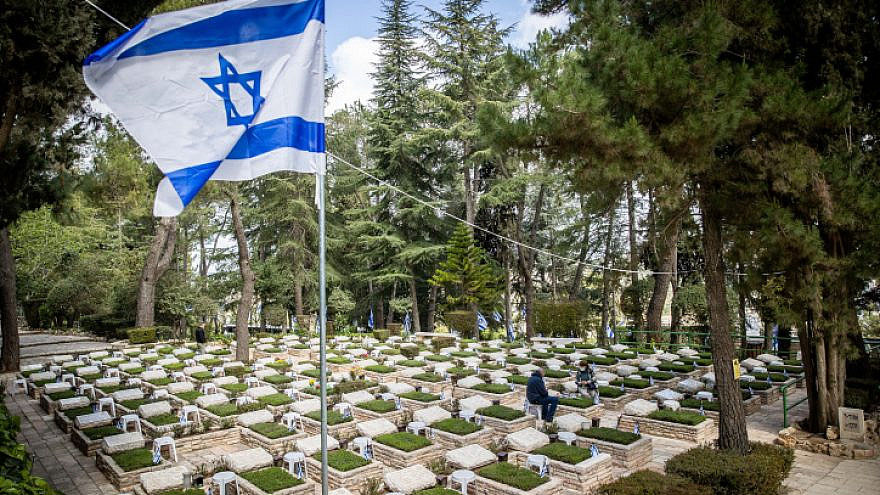
As Israel enters the 24-hour period that marks Yom Hazikaron—Memorial Day for Fallen Soldiers and Victims of Terrorism—the country turns its attention to individual stories of heroism and bereavement. The annual tradition, enacted into law in 1963, is notable for its purposeful proximity to Yom Ha’atzmaut, Israeli Independence Day. Indeed, as soon as the sun literally and figuratively sets on the somber nationwide ceremonies honoring those killed on behalf of the Jewish state, the public celebrates its birth with a burst of fireworks.

Due to the outbreak of the COVID-19 pandemic, social-distancing regulations prevented mourners last year from descending en masse on Israel’s 53 military cemeteries. Instead, the families and friends of the thousands of fallen soldiers buried in various locations were asked to stagger their gravesite visits.

The grieving mothers, fathers, sisters, brothers, aunts, uncles, spouses and offspring told reporters that they don’t need a particular date to remind them of the person whom they lost, as they live with their heartache every day. Yet all agreed that the difficulty posed by the government’s coronavirus restrictions was the inability to gather at one another’s homes on Yom Hazikaron to shed communal tears and share fond memories.

The Hebrew media, therefore, has been making much of the relief that the bereaved feel at the prospect of a “post-corona” Memorial Day, when they can now congregate to recount tales of their late sons’ and daughters’ bravery, hopes and dreams.

Photos of these happy youngsters on pre-army treks in India or South America are on display in newspapers and magazines. Videos of such kids composing songs for instruments that they played so beautifully before their lives were cut short are broadcast on TV for all to see and identify with.

Teachers are seen reminiscing about their late students’ academic prowess and generosity of spirit towards fellow classmates. Widows are heard talking wistfully about their heroic dead husbands who won’t get the chance to see their babies grow up.

It’s virtually impossible to remain dry-eyed at these mini-biographies of so many incredible Israelis who died in the line of admirable duty.

But there’s another group of bereaved parents far from the limelight, unable to engage in the kind of collective mourning that characterizes Memorial Day. These are the mothers and fathers of kids who committed suicide during their service in the Israel Defense Forces—after suffering from periods of depression, unrequited love, unfulfilled perfectionism and probably a less-than-stellar adolescence.

Though suicide, like illness and accidents, is counted in the annual tally of casualties among soldiers, police and civilians, it is not championed as “heroic” or highlighted on Yom Hazikaron. Nor are the parents of suicide victims as likely as their more “normative” counterparts to revel in or dwell on the circumstances surrounding their children’s demise.

Sadly, however, these mothers and fathers—who warrant just as much empathy as those given constant accolades for their kids’ accomplishments—are largely ignored. It’s actually odd, considering that suicide remains what the IDF admitted in January is the leading cause of death among its troops.

According to IDF Manpower Directorate commander Maj. Gen. Moti Almoz, of the 28 soldiers who died last year, nine took their own lives. Eight of these were men, and five served in combat units.

Almoz claimed that because of prevention programs, the IDF has a lower suicide rate than the country as a whole and less than many other of the world’s militaries. He boasted that four soldiers were saved in 2020 thanks to cell-phone data used to locate them before they managed to self-harm. In addition, he said, IDF commanders are better-equipped these days to recognize suicide warning signs.

If so, they and the rest of the public, which stands in silence at the sound of the siren denoting the start of Yom Hazikaron, should give thought and pay tribute to the families of the unsung fallen Israelis gunned down at their own hands.

May their memories be a blessing.


Ruthie Blum is an Israel-based journalist and author of “To Hell in a Handbasket: Carter, Obama, and the ‘Arab Spring.’ ”

A Tribute to the Bereaved Parents of Unsung Fallen Israelis Read More »

Gadi Taub

Gadi Taub: Global Elites and National Citizens

Shmuel Rosner and Gadi Taub discuss Gadi’s latest book: “Global Elites and National Citizens: The Attack of the Upper Classes on Israel’s Democracy”, now out in Hebrew.
Gadi Taub  is an Israeli historian, author, screenwriter and political commentator. He is a Senior Lecturer in the School of Public Policy and the Department of Communications at The Hebrew University of Jerusalem. Taub is also an internationally noticed voice in the discourse on Zionism.

Follow Shmuel Rosner on Twitter.

Gadi Taub: Global Elites and National Citizens Read More »

The 7 Best Tools For The Post COVID-19 Workplace

COVID-19 has compelled businesses to embrace flexible work arrangements and promote a remote work culture among employees. However, the lack of proper tools and strategies has made the transition overwhelming for all stakeholders.

To be productive, remote working requires a range of resources for team management, communication, collaboration, video conferencing, and more. Your team must have access to tools and platforms that facilitate these functions.

However, finding these resources is easier said than done. There is a wealth of apps and software that claim to help with the smooth functioning of your post-COVID-19 workplace.

We make the choice easier. Here is a round-up of some of the best tools you can leverage to get your business back on track and enable your remote employees to maintain productivity.

Profit.co is a full-fledged Objective and Key Results (OKR) solution that help you evaluate and manage employee performance, responsibilities, tasks, and productivity.

Furthermore, the tool lets you streamline the end-to-end Performance Appraisal management process. The platform also enables periodic performance management, feedback, and reviews with your preferred approach.

The biggest selling point of Profit.co is this tool’s capability to facilitate appraisals that are affinity-based for all your employees, regardless of their location. It also allows your teams to get peer review and self-assess their performance to increase their productivity.

The ultimate OKR software solution aims to track your employees’ and team’s progress to assess their overall performance.

With Profit.co, you can measure your implementation and employee engagement while making sure all team members are aligned to achieve collective goals and work on projects irrespective of where your employees operate from.

All in all, this comprehensive OKR platform lets you manage your workforce and scales as your business grows.

Messaging and chat apps have successfully substituted emails at most organizations. For remote workforce, having a powerful communication tool is a fundamental part of a business’s toolset.

Twist is a convenient tool that allows for seamless collaboration and communication that helps remote teams create a distraction-free workspace where they can manage projects with collaborative conversations.

Furthermore, this unified platform enables you to keep all your data and information organized while maintaining transparency. It helps you structure communication, prioritize focused tasks, and ensure company-wide transparency.

With Twist, you can implement a more thoughtful approach to team interactions by allowing distant teams to connect asynchronously and minimizing distractions.

Keeping your projects on track and monitoring their progress and completion are the most challenging aspects of remote teams—fortunately, the ever-evolving trends of digital tools for remote working to address the company’s task-related issues.

Asana is a project management solution that is a great option that helps you manage your team member’s work. The tool’s strength is its automation features and advanced visualization.

With Asana, you can conveniently adapt to your remote team’s unique workflow. This makes it an ideal task and project management tool for the remote workforce, irrespective of its size.

All in all, it’s a comprehensive tool that effectively helps you manage tasks and projects, lets you monitor their progress, and provides you with useful analytics.

Pipedrive is pipeline management and sales CRM software designed to help your remote teams stay on track. It is a powerful sales CRM platform that directly facilitates businesses and leads into sales pipelines from web forms or chatbots.

Furthermore, you can also track the conversations with your customers across emails, calls, and more. You have access to contact histories that help you deliver a more tailored experience to your end-users.

With Pipedrive, you can automate redundant tasks that help you save time and money and builds a simplified process that suits your established workflows. Moreover, you can customize your company’s reports with relevant metrics to your sales objectives and expectations.

Adapting to remote work post-COVID-19 may require some time. However, the various digital tools like Pipedrive facilitates your workforce to stay organized.

Collaborating and working with remote teams across various time zones can be challenging for businesses trying to adjust and embrace distant work structures in a post-COVID-19 workplace.

World Time Buddy is a robust time management platform that helps you effectively schedule meetings and agree on deadlines for your remote teams scattered across the globe.

Furthermore, the platform also enables you to integrate it with Google Calendar to save time when setting up deadlines and conference calls. You can create and share event-related details while minimizing the chances of errors.

World Time Buddy is incredibly simple, easy to use, and implement into your business processes.

Skitch by Evernote is a brilliant application when it comes to reminders and notes. It’s an awesome notepad app that helps you with attachments, audio messages, reminders, etc. which is pretty convenient for users

Furthermore, Skitch app also allows you to take pictures of business cards, office whiteboards, documents, etc. It’s a game-changer application for businesses who want to thrive in a remote work environment.

You can also avoid confusions by including circles and arrows when you share your screen

Collaboration and task management can become a hurdle when working with and managing remote teams. ProofHub is an online collaboration and project management tool that helps you overcome this challenge.

ProofHub is an all-inclusive tool that can help remote teams by providing a dedicated workspace for file sharing and discussions in real-time.

You can manage tasks with due dates and set custom roles and assignees that help everyone involved in a project know about their responsibilities and deadlines. Also, you can get customized reports that let you manage, plan, and organize your resources, tasks, and projects.

ProofHub can easily integrate with other applications like QuickBooks, FreshBooks, Google Calendar, Outlook, iCal, Dropbox, OneDrive, Google Drive that brings everything under a centralized platform.

Wrapping Up

It is imperative for businesses to deploy the right combination of tools which entirely depends on your workflows and your teams.

If you are just starting out, adjusting and transitioning to a post-COVID-19 workplace, it can get quite overwhelming for you. This makes it all the more important to invest in the right resources so you can achieve your business goals despite the distancing.

Hopefully, the above tools can help you transition smoothly and help your business survive and thrive with minimal disruption, making the recovery process easier for your workforce.


Jay T. Ripton is a freelance business, technology, and lifestyle writer out of Scottsdale. He loves to write to inform, educate and provoke minds. Follow him on Twitter @JTRipton.

The 7 Best Tools For The Post COVID-19 Workplace Read More »

Bernie Madoff Dies in Prison

Bernard (Bernie) Madoff, whose $17.5 billion Ponzi scheme victimized major Jewish organizations and thousands of individuals, died Wednesday, April 14 at the federal prison in Butner, North Carolina, while serving a 150-year sentence. He was 82 years old.

When the scandal broke in 2008, the Jewish Journal headlined the story with a piece by Rob Eshman titled, “Is Bernie Madoff Jewish? Very. Oy.” The Jewish Community Foundation, which had invested $18 million with Madoff, was hard hit by the scheme, as were Hollywood luminaries such as Steven Spielberg, Jeffrey Katzenberg, actress Zsa Zsa Gabor and broadcaster Larry King.

Other American victims included Holocaust survivor Elie Wiesel, pitcher Sandy Koufax, Orthodox Jewish day schools on the East Coast and Hadassah, the Women’s Zionist Organization of America. Thousands of smaller investors also took it on the chin, including this Journal reporter.

Madoff was born April 29, 1938, in Queens, New York, where his father worked as a plumber and stockbroker. With extensive ties in the Jewish communities of New York and Florida — serving, for instance, as trustee of Yeshiva University — Madoff worked his classic Ponzi swindle by offering unusually high returns, with early investors paid off with money from later investors.

One predictable result of Madoff’s arrest and confession was an outpouring of anti-Semitic content on the Internet. The Forward took such attacks seriously and presented its readers with a lengthy questionnaire, asking, for instance, whether the scandal had affected their faith in Judaism and Jewish organizations.

The tragedy of the Madoff clan extended to his two sons. Madoff’s older son, Mark, committed suicide, and Andrew, the younger, died of Lymphoma at age 48.

Bernard Madoff is survived by Ruth Madoff, his wife of 62 years.

Bernie Madoff Dies in Prison Read More »

Israel to Celebrate Nearly Coronavirus-Free Independence Day

(The Media Line) As Israel concludes its Memorial Day for Fallen Soldiers and Terror Victims, a day of sadness and introspection, the country’s citizens prepare for a shift in mood, with the start of Independence Day celebrations at sunset on Wednesday, in a nearly coronavirus-free environment. After a year of lockdowns and limitations, families will gather to celebrate 73 years of independence and what they hope will be the soon-approaching end to the pandemic.

Israel to Celebrate Nearly Coronavirus-Free Independence Day Read More »

France Supreme Court Upholds That Suspected Jewish Woman’s Killer Unfit to Stand Trial

UPDATE: There will be a rally to Demand Justice for Sarah Halimi in Los Angeles on Sunday, April 25 at 10am in front of the French Consulate at 10390 Santa Monica Blvd. Protests will be held in Paris, L.A., Miami, Tel-Aviv and other cities the same day. In coordination with the BNVCA (National Bureau of Watchfulness against Antisemitism) and Francky Perez, its official representative in the U.S.

France’s Supreme Court of Appeals upheld a 2019 lower court ruling concluding that the suspected killer of a Jewish woman is unfit to stand trial.

In 2017, Sarah Halimi was killed after being thrown out of her apartment; the suspected killer, Halimi’s neighbor, Kobili Traore, allegedly shouted “Allahu Akbar” before killing her. He then apparently shouted, “I have killed the sheitan! [demon]”

On April 14, the French Supreme Court agreed with the lower court’s conclusion that because Traore was a frequent marijuana smoker, he was in a psychotic state at the time of killing and is therefore not responsible for Halimi’s death. Traore is currently being held in a psychiatric facility.

Jewish groups condemned the French court’s ruling. Anti-Defamation League CEO Jonathan Greenblatt tweeted that the ruling “is an outrageous & unacceptable miscarriage of justice.”


Dr. Shimon Samuels, director of international relations for the Simon Wiesenthal Center, said in a statement that the ruling is “a devastating blow” to Halimi’s family and noted that her family’s lawyers have argued that because Traore voluntarily smoked weed, he must have known of the risks involved in taking it.

The ruling, Samuels argued, “confirms that it is possible to deny justice for a murder aggravated by its antisemitic character. Furthermore, this decision denies closure for the family and potentially creates a precedent for all hate criminals to simply claim insanity or decide to smoke, snort or inject drugs or even get drunk before committing their crimes. The memory of Sarah Halimi, Mireille Knoll and other victims of antisemitic hatred, lives on.”

StandWithUs co-founder and CEO Roz Rothstein tweeted, “This NO WORDS. Unbelievable. How can this judge even be a judge? Sarah Halimi: we will not forget your name…and your story. May your memory be a blessing.”


Former Democratic New York State Assemblyman Dov Hikind, who heads the Americans Against Anti-Semitism watchdog, also tweeted, “A country that protects murderers from prosecution because….they were high on marijuana(!) is one clearly in a dystopian state of decay. TO THE FRENCH GOVERNMENT: YOU WILL REAP WHAT YOU SOW!”


Traore’s attorney, Patrice Spinosi, has argued that the ruling is consistent with how French law is currently written. The Halimi family lawyers plan to try the case at the European Court of Human Rights.

France Supreme Court Upholds That Suspected Jewish Woman’s Killer Unfit to Stand Trial Read More »