fbpx

April 14, 2021

Birds, Bushes, Balance

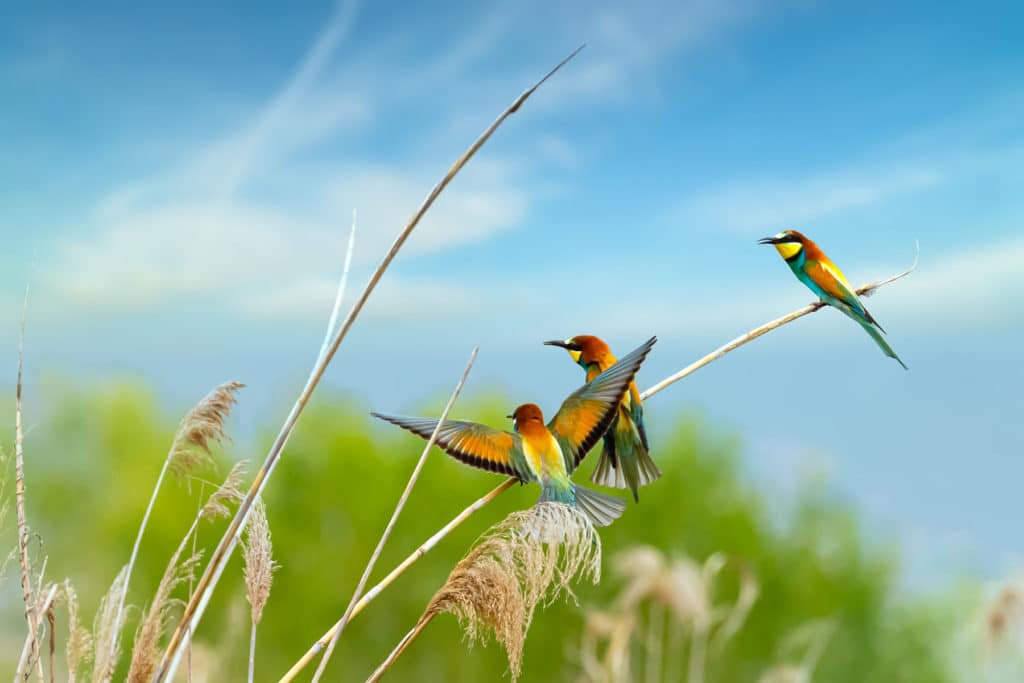
A new Israeli study has found a link between the proliferation of shrubs in forests and the variety and quantity of birds in the surrounding area. How will this affect existing shrub thinning policies aimed at preventing severe instances of forest fires? 

Sapir Pollack, ZAVIT* Science and Environment News Agency 

With spring upon us, the easing of COVID-19 restrictions could not have come at a better time.  Israelis can now freely enjoy the season and visit national parks and forests around the country once more. Coincidentally, March 21st was International Forest Day, a day proclaimed by the UN with the aim of raising awareness of the importance of forests around the world and promoting their conservation.

While trees are perceived as the most prominent elements of forests, other types of vegetation are just as important, like shrubs, for example. In fact, according to a new Israeli study, the conservation of shrubs in forests is vital, as it plays a unique role in protecting the diversity of bird populations in surrounding areas.

Woodlands, vegetation, and shrubs currently cover about a third of the world’s surface, and they make up the natural habitat of about 80% of terrestrial animals including many winged species. The new study, conducted by Dr. Uzi Dagan of the Department of Evolutionary and Environmental Biology at the University of Haifa, found a connection between more complicated sub-forest vegetation and increases in bird habitation.

Sub-forest vegetation includes all vegetation that was not planted in the forest intentionally, but that grew naturally over time, such as shrubs, trees, climbing plants, herbaceous plants, and various annual plants. This vegetation is often perceived as problematic because of the perception that its high-density acts as a “fuel” for large forest fires, thereby complicating firefighters’ task to extinguish them.

Density Invites Variety 

The findings of the study are based on more than 1,400 birdwatching observations in the pine forests of the Carmel and Ramat Menashe areas. During the study, Dagan examined the extent to which birds were present across a set of designated forest plots, which varied according to the density of sub-forest vegetation in those plots and the birds’ behavior in those different environments.

According to the findings of the study, not only is the number of birds in dense vegetation areas greater, but the variety of bird species in those places is also greater. The phenomenon is particularly noticeable within the vicinity of shrubs and trees of certain species, such as European buckthorn (Rhamnus lycioides), a thorny shrub commonly known to occur in Mediterranean forests, which are then referred to as Palestine buckthorn. According to the study, a possible reason for this is that the birds are attracted to fruits that the buckthorn bears, and feeding on them enables the birds to better thrive in an otherwise dry environment.

In terms of their behavior, the birds were found to behave slightly differently in forest plots where the sub-forest vegetation was denser, especially when exposed to external threats. “I checked how the birds behaved when they felt they were in danger due to their proximity to a predator,” Dagan explains.

“Usually, the birds activate a kind of alarm system to alert other birds that there is a predator nearby, and then they congregate with each other around the predator.” According to Dagan, it can be assumed that the birds are trying to signal to the predator that it is visible and that its chances of catching prey are diminishing.

“During the experiment, I played recordings of predator noises, and I saw that in denser forests the flocking of the birds was more significant,” he says. According to him, this is evidence of strong social behavior among the birds.

A New Perception of the Forest

The study was conducted with the support of the Jewish National Fund, which is also known for actively planting additional forest vegetation. “In the 1950s, the incentive to plant forests was driven by Zionism and economic aspirations. It created jobs for new immigrants and allowed the use of trees for different needs, which was made possible by the lumber industry as was done in Europe,” Dagan explains.

“In the 2000s, the JNF’s perception underwent a revolution, and its people came to the understanding that the forest is a public resource to be used as a leisure and tourism site. In this respect, birds and birdwatching activities interest many people and thus have tourist value, which encourages its investment.”

There is no doubt that the presence of animals and the possibility of observing a particularly rich population of birds can attract many tourists to nature reserves and forests. But is this an ecologically desirable phenomenon? According to studies from recent years, massive tourism can cause damage to nature reserves and wilderness areas.

Israel, for example, has a history of forests being damaged as a result of campfires that were not properly extinguished by visitors and hikers. Greater sub-forest vegetation, which includes shrubs and low-hanging branches, can help fire climb up the trees with greater ease, thus creating a more severe fire that is much more difficult to extinguish. This is the main reason the JNF has maintained a complex relationship with sub-forest vegetation over the years, and has proactively acted to thin it, or cut it back.

As a result, shrubs and herbaceous vegetation are thinned because they increase the flammability of forests, especially coniferous forests (cone and needle-bearing pine forests). Attempts have been made to apply creative and ecological solutions to this issue, such as goat grazing, in which herds of goats feed on the shrubs and branches to thin the vegetation in the areas prone to fires, but it has become less common due to economic-related difficulties.

“The ecosystem can recover from the fires,” Dagan explains. “Fear of fires cannot motivate decision-making in the field, and there is no need to use seat belts where none are required. Beyond that, it is important to note that, in Israel, forest fires are usually the result of human activities,” he says referring to negligent behaviour and arson. “So, the solution should be more explanatory and include various means of enforcement and supervision.”

However, Dagan believes more tourism in the area will not disturb the wooded areas or the population of birds that live there. To him, it is still important to encourage people to visit the great outdoors.

“Ultimately, we want people to enjoy the woods, and to have overgrown forests and corners where you can sit and watch the birds,” he says. Dagan explains that even if a disturbance to the birds occurs, it would be very minor. “This is not what will harm the ecosystem. In the end, the presence of the hikers does not interfere with the birds living in the forests or their nests.”

Aiming for Balance

“In light of the rising risk to the forested areas of Israel due to increasing population density and the impacts of climate change, the vegetation in forests must be managed in a balanced manner, which on the one hand will reduce the risk of fires, but on the other hand, must preserve as much biodiversity as possible,” says Dr. Adi Levi, Scientific Director of the Israeli Association for Ecology and Environmental Sciences and Head of the Environment and Sustainability Division at Achva Academic College.

“Preserving a certain percentage of the vegetated areas in the forest according to the new research recommendations, alongside treating areas that are sensitive to fires or those adjacent to buffer zones, roads and trails in the forest, could create a situation that benefits biodiversity without disrupting forests’ resistance to fires.”

ZAVIT – Science and Environment News Agency 

Birds, Bushes, Balance Read More »
The Memory Generation

In many ways, Sidney Bernstein is the reason we know what the Nazi concentration camps looked like.

The scenes we’ve all seen — the dead bodies strewn about or stacked like logs; the bulldozer pushing corpses toward an open pit; the mothers, fathers, sons and daughters tossed in like rag dolls — were filmed by the British Army’s Film and Photographic Unit, under Bernstein’s direction, as British forces liberated Bergen-Belsen on April 15, 1945. Bernstein’s footage has been used over and over in documentaries, as there is little other visual record of the atrocities that murdered six million European Jews.

But even in 2021, Bernstein’s work lives on. This year, I started co-hosting a new podcast with producer Rachael Cerrotti called “The Memory Generation.” And Jane Wells, Sidney Bernstein’s daughter, is our first guest. Jane grew up with no knowledge that her father had documented the Holocaust firsthand. But during the pandemic, she opened his personal archive to dig deeper into the man who saw what was coming before the Holocaust began and knew as soon as it ended that its memory would be threatened.

Although Bernstein’s footage is widely known, his story isn’t. Bernstein was a major figure in the British film industry who went on to play a leading role in the development of television in the United Kingdom. A contemporary and close friend of Alfred Hitchcock, Bernstein visited Los Angeles often to learn from the burgeoning Hollywood film industry. In 1936, troubled by the rise of fascism in Europe, he drove a Buick across America to garner support for opposing Hitler. He was greeted with deafening silence.

The British and American armies had camera units with them as they traversed the European continent. They knew very well the importance of capturing evidence of their heroic efforts to liberate Europe from the scourge of Nazism. It was, in essence, an information war, long before the digital age. Allied forces needed to control the story as well as the landscape. But sound was not yet integrated into cameras.

During the war, Bernstein put his filmmaking skills to use for this information war. When Prime Minister Winston Churchill announced the liberation of Bergen-Belsen in Parliament, Bernstein made his way to the concentration camp the very next day. Bernstein instantly knew that the scene unfolding before his eyes was so unimaginable that it could also be easily denied if it was not documented. He knew he needed to speak to the people he saw there: liberators, perpetrators, survivors. And so he made a proclamation: “Get me a microphone!”

I was recently scanning Bernstein’s footage, looking for a particular survivor I suspected he filmed. I found her. A young woman was screaming something at an SS officer in Polish as Bernstein’s camera watched, and his microphone listened. “Just you wait,” she shouts. “You will pay for wasting our youth!”

Who would have guessed that a recently liberated woman would be brave enough, and strong enough, to berate her Nazi captors? Even more remarkably, she stepped up to Bernstein’s microphone and, in a calm tone, introduced herself. There are thousands of corpses behind her, and a line of SS officers standing in front of her. “Meine Name ist Hela Goldstein,” she says.

In that moment, Holocaust testimony was born.  

In that moment, Holocaust testimony was born.

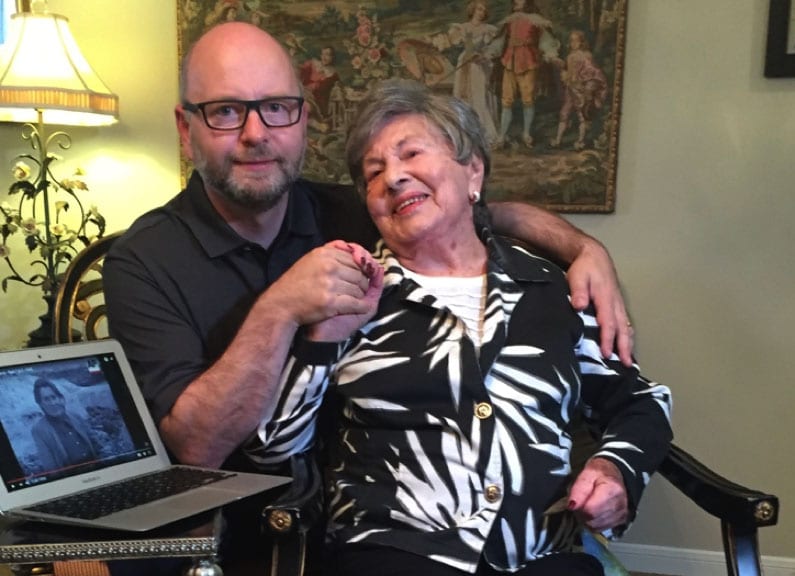
Hela Goldstein later moved to Houston, Texas. She married and became Helen Colin, and she lived a long life. She gave her testimony several more times and was active in telling her story at the Holocaust Museum Houston. I met with her in 2016, just weeks before her death. I asked if she remembered the day in Bergen-Belsen when she first told her story. She did. She recalled her fear of speaking. She remembered yelling at the Nazis, who the British had put to work. She had demanded respect for the dead. “Treat those corpses with care,” she said. “That could be my mother!”

With Hitchcock’s help, Bernstein aimed to make the first documentary about the Holocaust, a film dryly called “German Concentration Camps Factual Survey.” But the British government shut down their project. The Cold War was beginning, and British leaders wanted Germany as an ally. They didn’t want a “horror movie” that could cause a negative reaction among Germans. The film was shelved, and the footage languished in the vaults of the Imperial War Museum. It was finally completed in 2017, 72 years after Bernstein began it.

In a world in which anti-Semitism and denial continue to erode the truth of the past, Bernstein’s life and work serve as a warning: to forget is to give to give victory to those who committed the Holocaust.


Stephen D. Smith is Finci-Viterbi executive director of the USC Shoah Foundation. The first episode of “The Memory Generation” was released on April 15, 2021, and can be found here: https://www.memorygenerationpodcast.com/episodes

The Memory Generation Read More »

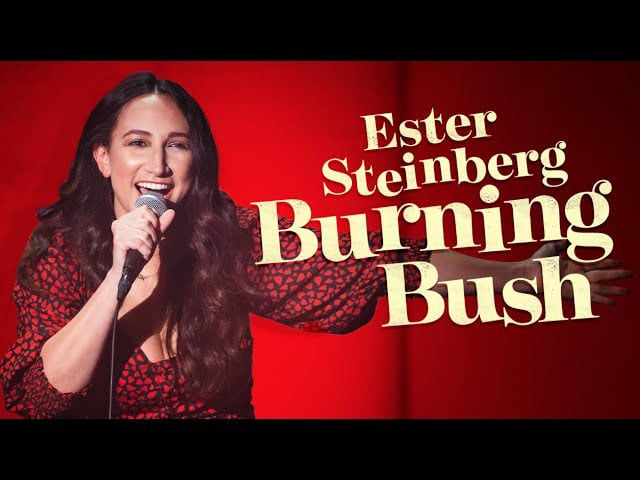
Ester Steinberg on her new “Burning Bush” special, her “Stand Up Mom” podcast, future plans & more

There is no denying that Ester Steinberg made a big impact with her first full-length stand-up album, 2018’s “Hebrew School Dropout.” Yet Steinberg had a lot of buzz around her prior to that as she was one Montreal’s Just For Laughs Festival’s “New Faces in 2015,” starred in Oxygen’s hit show “Funny Girls” and had a project in development at ABC.

“Burning Bush” is Ester Steinberg’s latest special, as released on March 30th via Comedy Dynamics. Billed as a “postpartum pandemic special,” Steinberg’s special includes stories from her first year of marriage and about giving birth in the epicenter of a global pandemic. But also interesting about “Burning Bash” is that it was filmed as part of the Tribeca Drive-In series at the Rose Bowl in Pasadena, California, one of the nation’s first live and safely social-distanced gatherings following the onset of the COVID-19 crisis. Other participating comics from this series included Dave Helem, Daniel Webb and Erica Rhodes.

Beyond promoting “Burning Bush” and preparing for an eventual post-COVID-19 return to the road, Ester Steinberg is also keeping busy these days as the host of the “Stand Up Mom” podcast. Featuring conversations between Steinberg and guests who are trying to find a balance between their careers and motherhood, “Stand Up Mom” often shows a side of Steinberg from her on-stage comedy.

On April 12, 2021, I had the pleasure of speaking with Ester Steinberg via Zoom, as embedded below. Within that conversation we not only spoke about her recent projects, but also life during COVID-19, being married to another comedian (Noah Gardenswartz), her Tampa upbringing, her parents being surprisingly-approving of her career path, musical preferences and her creative process.

More on Ester Steinberg and “Burning Bush” can be found here, here and here.

Ester Steinberg on her new “Burning Bush” special, her “Stand Up Mom” podcast, future plans & more Read More »

Jewish Center at Temple University Shows Bias Against Israel

Why is a major academic center for the study of American Jewish history, which was founded by a stalwart friend of Israel, falsely accusing Israel of “state violence against Palestinians”?

The Feinstein Center for American Jewish History at Temple University was founded — and for many years directed — by the late Dr. Murray Friedman, a distinguished historian and longtime leader of the American Jewish Committee in Philadelphia. I had the privilege of attending presentations by Murray Friedman, and I know he was a strong supporter of Israel. He is surely turning over in his grave at the news that his center is now being used to spread anti-Israel lies.

On April 20, the Feinstein Center will host a public program called “The Weaponization of Discourse: Israel/Palestine, Antisemitism, and Free Speech on Campus,” featuring Professor Kenneth Stern of Bard College and Joyce Ajlouny, general secretary of the American Friends Service Committee (AFSC). The Feinstein Center’s advertisements for the event declare that it will explore, among other things, “increased state violence against Palestinians.”   The phrase “state violence against Palestinians” suggests that Israel is, as a matter of national policy, systematically carrying out violence against Palestinian Arabs. That’s false.

I expect Arab propagandists to spread such lies. I don’t expect the falsehoods to come from an academic center that was founded by a pro-Israel scholar and is funded in part by donations from pro-Israel members of the Philadelphia-area Jewish community.

The April 20 program is responding to, in part, the ongoing debate over the definition of anti-Semitism that has been crafted by the International Holocaust Remembrance Alliance (IHRA) and accepted by numerous governments and Jewish organizations around the world. Some left-wing academics, including Stern, object to the IHRA definition because it includes demonization of Israel as an example of anti-Semitism.

Obviously Stern and his colleagues have every right to their viewpoint. But when an academic center such as the Feinstein Center for American Jewish History sponsors a program about “the potentials and limitations of a state-sponsored definition of antisemitism,” both sides of the argument should be represented. Instead, the April 20 discussion is going to feature only two speakers, both representing the same point of view. The (AFSC), for instance, is the foreign policy arm of the Quakers, and articles on the AFSC’s website openly compare Israel to the Nazi Germany; Ajlouny herself has publicly accused Israel of “ethnic cleansing.”

The April 20 discussion is going to feature only two speakers, both representing the same point of view.

Obviously, leaders who engage in “ethnic cleansing” are war criminals and should be in prison. That’s what Ajlouny thinks of Israel’s leaders, from David Ben-Gurion to Yitzhak Rabin. And Aljouny’s activism spreads beyond speech: Before coming to Philadelphia four years ago, Ajlouny was the head of a school in Ramallah that ran a summer program called “Go Palestine” for teenagers from around the world.

According to the itinerary for the school’s summer program, featured speakers included representatives of “the BDS movement,” Nasser Ibrahim of the Popular Front for the Liberation of Palestine (a terrorist group) and “ex-prisoners [who were in] Israeli occupation jails,” which almost certainly means terrorists. Interviewed by the Philadelphia Inquirer on November 3, 2017, Ajlouny came close to rationalizing Palestinian violence when she claimed that many young Palestinians harbor “feelings of revenge and retaliation” and that “it’s very difficult to manage these emotions.”

U.S. Senator Chuck Schumer (D-NY) said the “intolerance” and “extremism” of the “Go Palestine” program was “disturbing.” Senator Ben Cardin (D-MD) said the reports of the program’s activities were “quite concerning.” Malcolm Hoenlein, executive vice chairman and CEO of the Conference of Presidents of Major American Jewish Organizations, said, “I endorse the calls by Senators Schumer and Cardin for an investigation to make sure that no U.S. government funds are being used, directly or indirectly, to support a camp that promotes BDS or other anti-Israel extremism.”

Ajlouny is entitled to her point of view. In fact, she has the same right to free speech as everyone else. But should the Feinstein Center for American Jewish History be the one to give her a platform — and not even feature a dissenting point of view?

The center’s mission statement reads: “The Feinstein Center for American Jewish History supports innovative approaches to understanding American Jewish life. Its mission is simple: Inspiring Inquiry.”

Is this the program the Feinstein Center’s founder and longtime leader would have wanted? What is “innovative” about accusing Israel of “state violence” and “ethnic cleansing”? And where is the spirit of “inquiry” in hosting a program where only one side of a controversy is aired?

Donors and supporters of the Feinstein Center need to ask themselves if this is the kind of programming they want their money used for — and then act accordingly.


Moshe Phillips is national director of Herut North America’s U.S. division. Herut is an international movement for Zionist pride and education and its U.S. website is https://herutna.org/

Jewish Center at Temple University Shows Bias Against Israel Read More »

“I am a Zionist”: Our Herzlian Jew-Jitsu Moments Twenty Years Ago

“I am a Zionist.”

That phrase has inspired me my entire life. Yet, on Israel’s Independence Day in 2001, when I published those words in the Montreal Gazette, it changed my life. This was my Theodor Herzl Moment — the turning point when I came out of the closet with my identity as a proud Zionist.

Twenty years ago, Israel was reeling. It was the first Yom Ha’atzmaut since Yasser Arafat led Palestinian rejectionists away from negotiations and back to terrorism. I watched the mounting violence in horror from my academic perch at McGill University. The violence was agonizingly personal. One day, a 34-year-old reservist, Amir Zohar, was shot in the usually quiet Jordan Valley — it didn’t help his three young children that, as his widow Orly recalled, he “worked very hard to promote coexistence.” Another day a Palestinian sniper shot a ten-month-old baby, Shalhevet Pass, in the heart. Two days later, on March 28, 2001, a Palestinian suicide bomber walked into a clump of kids waiting for the school bus at “Mifgash HaShalom” — peace stop —  killing Eliran Rosenberg-Zayat, 15, and Naftali Lanzkorn, 13. Eventually, Palestinian terrorists would murder more than one thousand Israelis in their war against the peace process.

Every time I heard about another “pigua” — terrorist attack — my heart skipped a beat, my palms turned clammy. I scoured the names hoping, praying I wouldn’t recognize anyone; hoping, praying that the numbers next to them would say 65 or 74 or something older instead of 1, 13, 15, 34.

Yet, most academics around me, most newspapers I read, blamed Israel for the violence. Although Israel had not been perfect, it had taken major risks for peace — withdrawing from every major Palestinian city. Nevertheless, as soon as Arafat returned to terrorism, the world found Israel guilty — as did many Jews.

This irrational finger pointing against Israel shattered the covenant of complacency that was the foundation of my respectable life as an American history professor. My name “Gil Troy” got me warm greetings at Greek restaurants and, because my last name could be a first name, a high-five from a fellow Teaching Assistant back at Harvard who said “there are so few WASPs like us around nowadays.” (I responded with my heaviest New Yawk accent: “Even fewer than ya tink!”)

I built my career around my ability to pass. I was a proud Jew in my home but a regular American on the street. But now, in April 2001, with buses and cafes exploding in my homeland and anti-Zionist fueled Jew-hatred spreading, I made my stand. I submitted an 800-word essay for Israel’s Independence Day to the Gazette called “I am a Zionist.” I emphasized how lucky we were to be living in a world with a Jewish State — putting our problems in perspective. Using the refrain “I am a Zionist” 14 times — because I saw Jews abandoning the term — I explained what Zionism meant to me, to us.

Beyond hoping for peace, I ignored the Palestinians as I ended the essay. I did not want to knock them down; I just wanted to build our people up. I explained: “A century ago, Zionism revived pride in the label ‘Jew’; today, Jews must revive pride in the label ‘Zionist.’”

I expected to be attacked for outing myself as a Zionist. And I was. Someone wrote a clever if evil parody, “I am a Racist.” What I didn’t expect was how many emails (and back then actual letters!) I received from people saying: “thank you, finally, someone is saying something positive about Israel, even about Zionism!”

That’s why it proved so life-changing. From a full-time American historian, I became a Zionist activist too, trying to trigger a broader communal conversation about what Zionism can mean in the twenty-first century. Central to my message — then and now — was that if Political Zionism’s great twentieth-century success was establishing a functional, democratic Jewish State, today’s great opportunity for Identity Zionism is finding meaning from connecting to that State and to our people, wherever Jews live.

“I am a Zionist” became my Identity Zionism manifesto, which I expanded into the best-selling book “Why I am a Zionist: Israel, Jewish Identity and the Challenges of Today.” Before that, I had written books on presidential history, which were well-reviewed. Occasionally, students would thank me for writing something interesting, maybe even illuminating. Suddenly, I wrote something that to this day (some) people say prompted them to change their lives.

Since then, I have written three more books about Zionism: “Moynihan’s Moment: America’s Fight against Zionism as Racism,” “The Zionists Ideas” — an anthology — and “Never Again: Prison, Politics and My People” (with Natan Sharansky). I have also given hundreds of speeches, written thousands of articles and had tens of thousands of interactions with people all over the world about Israel, Zionism, Judaism and life.

Although I felt alone — aside from my wife, who was my partner every step of the way — I later discovered that all over the Jewish world people like me were standing up and going public, not just to defend our people — but to celebrate us.

All over the Jewish world, people like me were standing up and going public, not just to defend our people — but to celebrate us.

Across the continent, a West Los Angeles family therapist, Roz Rothstein, was equally dazed by the noise against Israel and the Jewish establishment’s silence. The murder of Shalhevet Pass proved particularly unnerving. Rothstein recalls: “As a daughter of Holocaust survivors, I could not take it into my brain that Jews were once again being targeted for murder.”

Twelve days after Yom Ha’atzmaut, on May 8, 2001, terrorists stoned to death two teenagers, Koby Mandell and Yosef Ishran. “That murder was the final catalyst,” Rothstein explains, “the terrible clarifying moment — because it made us realize that there was no great big Jewish organization that could pivot to become the resource that would actively explain what was going on in the moment for Israel and for its citizens who were under attack.”

Two weeks later, on May 21, Roz and her husband Jerry hosted 50 local community leaders for an emergency meeting (serving deli food, naturally). Rothstein asked: “Was there a plan? Anything? Local or National? To stand up against lies and misinformation in the media? To stand up against terrorism? To stand up FOR Israel?” Nothing. Rothstein realized this wasn’t in any organization’s mission statement. “We just needed a new organization to fill an unfulfilled niche. And that gap had to be filled fast.”

Jerry and Roz Rothstein co-founded StandWithUs with their neighbor Esther Renzer. They had no funding — just a desire “to help the Jewish people deal with speaking up and standing tall against terrorism, lies and anti-Semitism.” Twenty years later, their $18 million operation has 150 employees who educate over 100,000 college students and 70,000 high schoolers on five continents each year.

That spring, in tony Boca Raton, Florida, Rabbi Yehoshua Fass was mourning his thirteen-year-old cousin from the bus-stop massacre, Naftali Lanzkorn. “The pain was raw,” Fass explains. “Reciting Psalms seemed like a muted, impotent response. I could no longer be a good Jew pushing for Israel from Florida. I had to move there to take Naftali’s place.” By August, Fass was on his way to Israel and co-founded Nefesh B’Nefesh with Tony Gelbart to facilitate other Jews moving to Israel — seeking to replace each nefesh (soul) killed. By now, the organization has replaced the murdered Jews sixtyfold, easing the immigration of over 60,000 olim — including six members of the Troy family.

Each of us sacrificed a lot professionally, derailing the careers for which we had been programmed, for which we had been trained. But the soul-payoffs have been incalculable.

Following the UN’s World Conference against Racism that turned into a Jew-hating festival in Durban in August 2001, the Islamicists’ mass murders of September 11 and the nightmarish March of 2002, when terrorists slaughtered 131 Israelis, the broader Jewish community mobilized.

“For us, 2002 was a turning point,” Lisa Eisen, co-president of Charles and Lynn Schusterman Family Philanthropies, recalls. “With the grave crisis in Israel and resurgence of anti-Israel activity on college campuses, we considered it vital that our community join forces to develop a unified approach to educating and training college students to support and defend Israel. Schusterman established the Israel on Campus Coalition, in partnership with Hillel International, and also funded Hillel’s new Center on Israel Affairs, to lead a proactive strategy for coordinating support for students and deploying resources to campuses.” Fortunately, Taglit-Birthright Israel had just been launched in 1999, and many Birthright returnees, inspired by “Identity Zionism,” joined the fight to defend the country they had just visited, which looked nothing like the country the media described — and often trashed.

Since then, many former students report that those years mobilized them to support Israel — while many once pro-Oslo Israelis reached their breaking points too: they realized that truly being “pro-peace” first requires ensuring Israel’s security and rebuffing Palestinian extremists’ genocidal plans toward Israel.

This Yom Ha’atzmaut, OpenDor Media will mark the twentieth anniversary of “I am a Zionist” by releasing an animated video of the essay. “In sharing that message with our 60,000 YouTube subscribers, our network of 8,000 educators, activists connected to Hillel’s now well-established Center on Israel Affairs and beyond,” says Dr. Noam Weissman, OpenDor’s senior vice president. “We hope to continue this conversation about how to take Zionism personally.”

The murder of Israelis traumatized many of us, but we are not traumatized Jews. We reject Jean Paul Sartre’s notion that anti-Semitism makes the Jew — Anti-Semitism mobilized these already-proud Jews. Our Herzl moments were Jew-Jitsu’s, turning negatives into positives, seizing opportunities to build the Jewish community, reach out and toast Israel. When you attend a StandWithUs Conference, when you greet a planeload of Birthrighters or Nefesh B’Nefeshers, and (I hope) when you read my work, you feel joy, values, a sense of hope — Hatikva!

Here, then, is the Zionist response to trauma. Some run, some hide, some stew; we write, we unite, we build — and in the process end up rebuilding and renewing ourselves.


Recently designated one of Algemeiner’s J-100, one of the top 100 people “positively influencing Jewish life,” Gil Troy is a Distinguished Scholar of North American History at McGill University, and the author of nine books on American History and three books on Zionism. His book, “Never Alone: Prison, Politics and My People,” co-authored with Natan Sharansky, was just published by PublicAffairs of Hachette.

“I am a Zionist”: Our Herzlian Jew-Jitsu Moments Twenty Years Ago Read More »

Celebrating 73 Years of Independence

Over the course of 73 years, Israel has accomplished far more than even its most optimistic founders could have dreamed. In 1948, we had 800,000 citizens; today, there are well over nine million Israelis, comprising about half of the world’s Jewish population. Out of the ashes of the Shoah, Israel has nourished the revival of Jewish culture and, through the restoration of the Hebrew language, has made its vast library accessible to everyone.

From an economic perspective, Israel, which started with nothing and depended on international aid, now has a standard of living higher than respectable by world standards, with hi-tech leading the way. Israel has achieved all of this and more, while also fighting wars designed to wipe us off the map as well as unending terror attacks and cynical boycotts portraying Israeli soldiers as war criminals. Overcoming these challenges gives us good reason to celebrate.

But this is also an appropriate time to look forward and focus on some concrete goals for our 74th year. First and foremost, we need a functioning government. Four elections during a two year period have ended in gridlock, including the latest round a few weeks ago. Our dysfunctional electoral system reinforces and amplifies the differences that mark Israeli society, rather than highlighting all of the issues that unite us.

Like the old process of electing representatives from different communities around the world to the Zionist congresses 120 years ago, Israelis still vote for tribal parties instead of national leaders. In many cases, the substantive differences are very minor, but the system rewards division rather than unity. If, by this time next year, we can figure out a better political structure that will still reflect the different sectors that make up Israeli society but also provide stability, dayenu — it will have been enough.

Then there is a leadership problem to be addressed. Benjamin Netanyahu has held the position of prime minister since 2009 (after an earlier stint between 1996 and 1999) and, to about half of the Israeli public, is still considered the best option. He is credited with piloting Israel through the coronavirus pandemic and ensuring that Israel could vaccinate everybody very quickly; his supporters are convinced that his leadership is necessary in dealing with the Iranian threat.

But for the other half of the electorate, 12 years is enough (or more than enough). They hold Netanyahu responsible for the polarization, blame him and his remaining allies for the failures in governance and point to the corruption trial as reason enough to bring his era to a close. In the past two years, different candidates have presented themselves, gained some support and then faded — perhaps someone new and qualified will emerge before our 74th anniversary.

Looking beyond our borders, the last year has brought important new openings in the Middle East under the flag of the Abraham Accords. Instead of the isolation that characterized the Jewish state during its first three decades, we now have peace and “normalization” agreements with Egypt, Jordan, the United Arab Emirates, Bahrain, Sudan and Morocco. Extensive cooperation has replaced blind hostility (earlier this week, an agreement was signed for extending Israel’s diabetes support program to citizens of the UAE), setting an example for the rest of the Arab world, including the Palestinians.

The last year has brought important new openings in the Middle East under the flag of the Abraham Accords.

The unresolved conflict with the Palestinians and the threat from the Iranian regime remain the two biggest external challenges facing Israel. Both require close cooperation with the United States, but the opening moves from the Biden administration have not been promising. History shows that the unconditional resumption of U.S, funding for the Palestinians and UNRWA (the corruption-riven UN framework created in 1949 that will spend $1.4 billion this year to artificially maintain the refugee status of millions of Palestinians) will reinforce rejectionism.

On Iran, it is difficult to be optimistic that the negotiations on Tehran’s illicit nuclear program in exchange for an end to economic sanctions will end with better terms than were accepted by Obama in 2015. But perhaps some lessons have been learned in Washington and Jerusalem, and with the cooperation of the Gulf states threatened by Iran (including, at least tacitly, Saudi Arabia), Israel’s technological and strategic advantages will force Iran to curb its aggressive strategy.

For these reasons, and despite the challenges, Israelis can be proud of their accomplishments and celebrate 73 years of independence and freedom.


Gerald Steinberg is professor emeritus of political science at Bar-Ilan University and president of the Institute for NGO Research, in Jerusalem

Celebrating 73 Years of Independence Read More »

After Death

The silence of Aaron remained in the air

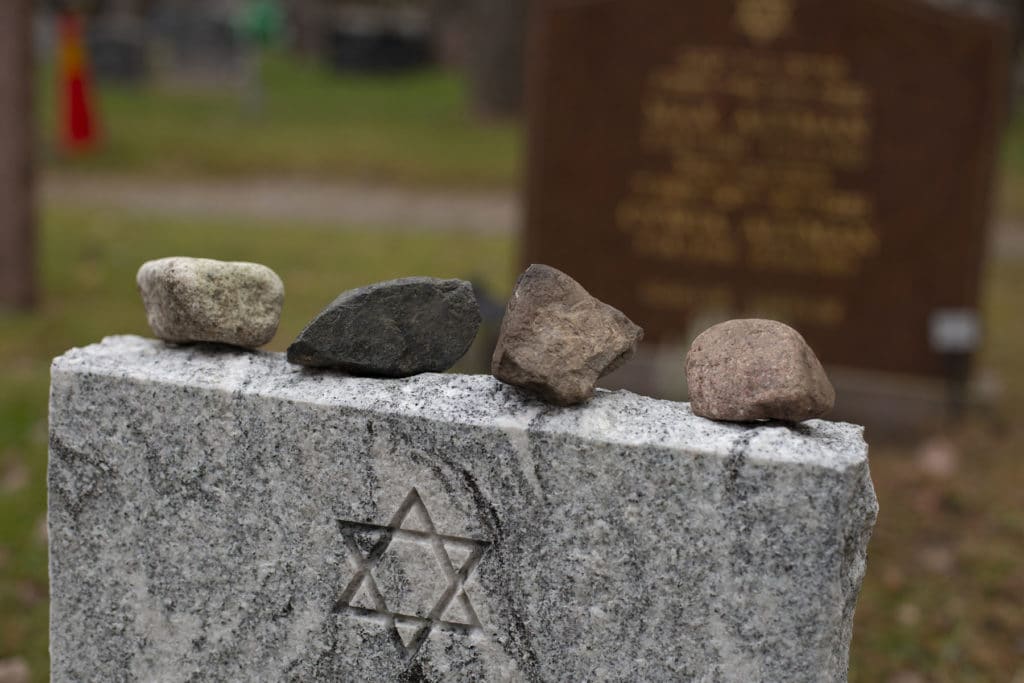
Even after the last stone

Covered the grave, after the strange fire

Consumed the flesh.

This silence lies in wait behind all the poems,

Behind all the talking, behind the music

That draws tears, the music that can,

The music that can what the silence cannot.

In the twilight of the death of the holy ones

Soon I will light candles to light the worlds

And the scent of apple cake will fill the rooms

And azure sheets fly in the wind from the sea

To the bed and beneath the Sabbath tablecloth

And in the red wine will float the letters of silence

Within the holy words that sanctify the time

Will lie the mound of memory and will pull

The inner glance and the bit of challah

That is brought forth from the earth

Will cover over the great darkness hiding

Beneath all the words.


Translated by Toby Klein Greenwald

After Death Read More »