fbpx

April 9, 2021

CUNY Student Senate to Vote on Resolution Rejecting IHRA

The City University of New York’s (CUNY) Student Senate will be voting on a resolution that rejects the International Holocaust Remembrance Alliance (IHRA) definition of anti-Semitism on April 11.

The resolution is being pushed by the CUNY Jewish Law Students Association and CUNY Students for Justice in Palestine in response to a March resolution adopting IHRA. The resolution states that the IHRA definition “has been used to create a false and dangerous polarity of interests between Palestinian/ pro-Palestinian rights students and Jewish students” and “endangers and defames those advocating for Palestinian rights as inherently antisemitic and has already been used to smear Palestinian, Arab, and Muslim groups and individuals at CUNY, and to stifle free speech and political debate on campuses.”

Additionally, the resolution alleges that “the equation of speech and activity opposing Israel and Zionism, and/or supporting Palestinians, as inherently antisemitic is a form of anti-Palestinian racism” and that “antisemitism is not an exceptional form of bigotry. People and systems that hate, discriminate and/or attack Jews, have also upheld structural racism, patriarchy, and white supremacy.”

The resolution instead urges the Student Senate to adopt a definition stating that anti-Semitism is “hostility, prejudice, vilification, discrimination or violence directed against Jews, as individuals, groups, or as a collective — because they are Jews. Its expression includes attributing to Jews, as a group, practices, characteristics or behaviors that are perceived as dangerous, harmful, frightening, or threatening to non-Jews.”

Roz Rothstein, co-founder and CEO of StandWithUs, said in a statement to the Journal, “StandWithUs is appalled by the promotion of an antisemitic resolution to CUNY USS to rescind the IHRA Working Definition of Antisemitism. Such despicable efforts must be called out for their true aims — to shield those who promote antisemitism from being criticized and to silence Jewish students.

“The reality is that the vast majority of Jews believe denying Israel’s right to exist is antisemitic. No amount of misinformation or disingenuous claims about the IHRA definition will change that. We stand with Jewish students as they stand up for their community and we call on CUNY USS to do the right thing and uphold the IHRA definition.”

“The reality is that the vast majority of Jews believe denying Israel’s right to exist is antisemitic.”

A petition against the resolution, which has more than 1,000 signatories, stated, “The Jewish students at CUNY strongly condemn this resolution. These groups do not represent the Jewish community. Jews should have the right to define what is and is not antisemitic just like other communities have the right to define what constitutes bigotry against them.”

CUNY Student Senate to Vote on Resolution Rejecting IHRA Read More »

Biden’s Push for Restoring Aid to Palestinians Faces Legal Hurdles and Brewing Political Crisis

In recent days, the Biden administration has moved rapidly to restore funding to the Palestinians that had been largely severed during the Trump administration.

Concerns are being raised, however, that the funding could both violate existing U.S. law, while also rewarding bad behavior by the Palestinian leadership through their continued support of terrorism, their targeting Israel in international forums such as the International Criminal Court, and perhaps most importantly in terms of optics, their refusal to even sit down with Israelis or Americans and engage in the peace process.

Last week, the Biden administration announced that it would allocate $90 million in aid to the Palestinians, with $75 million going to short-term projects to rebuild U.S.-Palestinian relations and $15 million for coronavirus relief.

Additionally, U.S. Secretary of State Antony Blinken announced on Wednesday plans to restart funding for UNRWA, the U.N. agency that deals with Palestinian refugees. This would include $150 million in direct financial aid to UNRWA, $75 million in U.S. economic support and $10 million in development funding.

Asaf Romirowsky, executive director of Scholars for Peace in the Middle East, told JNS that the decision to restore funding to UNRWA is a “serious mistake.”

“UNRWA remains a mainstay of Palestinian rejectionism, characterized by advocacy for the ‘right of return.’ Accountability and transparency are hard to come by at UNRWA, given its monopoly over Palestinians,” he said.

Romoriowsky added that “if Palestinian statehood is a real goal, then the creation of institutions that foster civil society and democratization should be a priority. UNRWA acts in direct opposition to Palestinian statehood and to the Palestinian Authority.”

Jonathan Schanzer, senior vice president at the Foundation for Defense of Democracies, told JNS that while it appears that the initial aid was designed to help the Palestinians deal with the ongoing pandemic, the additional aid could run into serious legal hurdles.

“There are clear indicators that the Biden administration seeks to widen the aid to include UNRWA or even broader support. It’s the widening support that could create complications, particularly with certain American laws in the books, including laws that Biden himself helped pass,” he said.

Indeed, while the new administration—not even in office for its first 100 days—noted that the U.S. aid would bypass the P.A. and go directly to charities in the West Bank and Gaza Strip, additional monies could run afoul of the Taylor Force Act, which prohibits funding to the P.A. as long as it provides stipends for terrorists or their families. It has been reported that Biden will likely hold off on direct economic aid to the P.A. while it determines how to navigate any legal obstacles.

UNRWA staff members protest against cuts in financial aid outside the agency’s offices in Gaza City on April 14, 2019. Photo by Hassan Jedi/Flash90.

‘Money is fungible’

“The TFA [Taylor Force Act] stops aid that directly benefits the P.A., with limited exemptions for hospitals vaccines and water treatment,” explained Sander Gerber, CEO at Hudson Bay Capital and a fellow at Jewish Institute for National Security Affairs (JINSA). “Given that Abbas has recently taken control of Palestinian NGOs, it hard to see the PA won’t gain a benefit from US aid.”

Gerber, who helped craft the Taylor Force Act, told JNS: “The point is that money is fungible, and if the P.A. saves money, it can spend it on terror. The Taylor Force Act seeks to stop using U.S. taxpayer dollars in money laundering for terror.”

The Biden administration also appears to be moving towards reopening the PLO Mission in Washington, D.C. Former President Donald Trump shuttered the mission in 2018 amid a larger fallout with the Palestinians that also saw the former president cut millions in aid to the West Bank and Gaza.

Yet similar to restoring aid to the Palestinians, the Biden administration will also face legal hurdles to reopen the mission. In 2019, Congress passed an anti-terrorism amendment that the Palestinians would become liable for $655.5 million in financial penalties against them in U.S. courts if they open an office in America proper.

“Under longstanding U.S. law, the PLO mission should be closed, but it remained open due to a presidential waiver. Trump didn’t renew that waiver,” said Gerber.

“Given that the PLO sponsors terror, I think it’s inappropriate for a terror-sponsoring entity to have offices in D.C. I guess others disagree. But if Biden issues a waiver and allows the PLO to reopen their mission, the administration will be effectively sanctioning terror,” he said.

These measures arise amid political uncertainty both in Israel and the Palestinians. For Israel, which has held four inconclusive elections in the past two years, this comes as the Biden administration has shifted its tone on Israeli policies from the Trump era.

Last week, the U.S. State Department made headlines when it returned to using the term “occupied” when referring to the West Bank. Just a few days later, U.S. State Department spokesman Ned Price also lambasted Israel over its settlement policies.

“We believe when it comes to settlement activity that Israel should refrain from unilateral steps that exacerbate tensions and that undercut efforts to advance a negotiated two-state solution. That includes the annexation of territory. That includes settlement activity,” said Price.

And despite supporting Israel against an investigation by the International Criminal Court in The Hague on war-crime allegations, the United States dropped its sanctions against top ICC officials that had been imposed by the Trump administration.

Given this, it would seem that Washington would favor a change in leadership in Jerusalem.

“Using the past as a guide, the Biden administration would almost certainly prefer another prime minister to [Benjamin] Netanyahu,” said Schanzer.

‘Ignore painful lessons of 2006 Palestinian elections’

Still, it appears that the political gridlock in Israel will not affect U.S.-Israel relations in the long term.

“The U.S.-Israel relationship is broad and deep,” said Schanzer. “Work is already underway, including at [the] high[est] levels. This will continue at a rigorous pace until there is a change of the guard. So, in this sense, I don’t think the political uncertainty is a significant factor at the moment.”

However, the brewing Palestinian political crisis could have significant ramifications, especially as the Biden administration is ramping up its efforts to restore ties. The P.A. will hold legislative elections next month as well as a presidential election in the summer for the first time in a generation.

On Friday, U.S. Secretary of State Antony Blinken also spoke with his Israeli counterpart, Foreign Minister Gabi Ashkenazi, emphasizing “the administration’s belief that Israelis and Palestinians should enjoy equal measures of freedom, security, prosperity and democracy.”

“The readout from the Blinken call to Ashkenazi last week appeared to be an indirect call to allow the Palestinians to proceed with their planned May 22 legislative elections without preconditions,” said Schanzer. “I don’t see this as much as a break from Trump policy as a deliberate decision to ignore the painful lessons of the 2006 Palestinian elections, during which Hamas gained control of the PLC [Palestinian Legislative Council] and set off a political crisis that endures to this day.”

Indeed, the Palestinian elections in 2006 eventually led to the ouster of the P.A. from Gaza by Hamas, which the Palestinian terror group has used as a base, along with other operative groups, to launch rockets and terror attacks against Israel resulting in several wars and dozens of flareups over the last decade-and-a-half.

This could prove troubling again if Hamas gains victory in the upcoming Palestinian elections, which could lead to further instability, while also posing a dilemma for America and Israel over whether or not to engage with a P.A. controlled by Hamas.

“The White House decision to not take steps to prevent a Hamas victory strikes me as troubling, particularly since Hamas is a designated terrorist organization here in the United States,” said Schanzer. “This is almost certainly a recipe for another Palestinian crisis.”

Biden’s Push for Restoring Aid to Palestinians Faces Legal Hurdles and Brewing Political Crisis Read More »

Drone Deliveries to Launch in Tel Aviv By Year’s End

(The Media Line) Your next burger could be delivered by drone.

Israeli company Simplex Interactive is planning to launch a pilot project in Tel Aviv that will see goods purchased online delivered via unmanned aerial vehicle (UAV) by the end of the year.

During a recent demonstration in the northern Israeli city of Hadera, Simplex showed how aerial orders would be delivered to pillar-shaped stations that it plans to set up around Tel Aviv.

According to Shay Levy, founder and CEO of Simplex Interactive, the cost to the consumer will be the same as with traditional delivery methods.

“We’re going to deploy 15 of those [stations] in Tel Aviv, providing actual deliveries for e-commerce purposes,” Levy told The Media Line. “Our goal is to provide customers with the ability to receive their deliveries in approximately 60 minutes.”

Shay Levy, founder and CEO of Simplex Interactive. (Raymond Crystal/The Media Line)

Once a drone reaches a station, it drops the package it is carrying into a box that is secured with a code. An SMS then is sent to the customer’s mobile device, notifying him or her that the package is ready for pick up.

There are several key benefits to making deliveries via air, Levy said.

“First, it’s much greener; second, it’s much faster; and third, it’s much safer for the operators,” he said.

Israel currently is conducting large-scale testing to create a national drone network for commercial deliveries to transport everything from food to medical supplies and equipment.

The Israel Innovation Authority (IIA), together with the Ministry of Transport, the Civil Aviation Authority, and several other government bodies, have launched a pilot program aimed at establishing a safe and functioning commercial drone infrastructure.

The project, part of what is known as the NAAMA Initiative, includes an autonomous Unmanned Aircraft System Traffic Management (UTM) placed in the air traffic control centers of the Ayalon Highway Company in the port city of Haifa.

“In order for us to create the leap from the use of one drone to many drones, we need the drones to communicate [with each other] so that we know how to control the space,” Daniella Partem, head of the Israeli Center for the Fourth Industrial Revolution at the IIA, told The Media Line.

In line with this vision, drones from several companies are regularly flying simultaneously over the city of Hadera, performing roughly 300 flights a day in a designated airspace. Each drone is tasked with simulating the execution of a variety of tasks, such as delivering food or transporting medicine.

The ultimate goal is to revolutionize the future of mobility and airspace management.

“Our goal is to have drones that deliver everything,” Partem said. “Whether it’s food, goods, a shirt … . My vision is to get my coffee in the morning via drone.”

Five different companies currently are taking part in the program, including Simplex Interactive.

Before drone deliveries become routine, however, serious obstacles need to be overcome, among them the cost of operation and ensuring that the sky highway is safe and easy to use.

“We’re not sure when this will be commercial because it has to be economically viable for a company to use a drone” instead of a car or a bicycle, Partem said.

First, it’s much greener; second, it’s much faster; and third, it’s much safer for the operators.

Nevertheless, drone manufacturers are optimistic that the time is ripe for drone deliveries.

“If we can successfully demonstrate that [commercial drone] activity is safe – and won’t harm flights or public safety – things will start to happen,” Ronen Diker, VP Operations at CopterPix Pro, told The Media Line, adding that he believes this will happen “in the near future.”

Headquartered in Kibbutz Karmia near Israel’s border with the Gaza Strip, CopterPix Pro develops and produces specialized autonomous drone systems for the private sector as well as for Israel’s Ministry of Defense.

The startup recently released Drone-in-a-Box, that can be used to patrol facilities and secure perimeters.

“The drone itself weighs less than 300 grams, which means that there is no regulation [permit] required,” Diker said. “The system can thus be deployed everywhere.”

In Israel, drone pilots require a special license to operate any unmanned aircraft that weighs over 300 grams (0.66 pounds).

The NAAMA Initiative is expected to continue over the next two years, with many challenging scenarios set to test the limits of aerial deliveries and prepare for a future where the skies could soon be filled with the buzz of UAVs.

Drone Deliveries to Launch in Tel Aviv By Year’s End Read More »

The Girl with the Funny Hair

When I was in high school, my nickname was “Girl with the Funny Hair.”

I kid you not. An older boy I really liked, three grades ahead of me, once literally referred to me as that.

Some busy-body in concert choir had reported my crush to him.

“What, *that* girl? In 9thgrade? The girl with the funny hair?”

I know he said this because it was reported back to me with an air of triumph that only a 9thgrade schadenfreud-ridden-demi-yenta could convey.

But truthfully, even by that early age, my hair had been troubling for awhile.

It troubled my mother, who frowned at it, and was constantly telling me to brush it. ( I forgive her, her own hair was nothing like mine; she simply did not know.)

It amused my older sister Jackie, an annoyingly perfect Brooke Shields look-alike, with the silkiest stick-straight mane you ever saw.

“Sarz.” she’d howl. “ What is up with that clump?” She’d affectionately tweak the clump of not-curly- but-not-straight frizz that I hoped might pass for bangs.

As a teen there were a number of things that I felt marked me as Other, but most of them lurked just beneath my awareness, invisible to others. Hair, disastrously, was something everyone could see.

Only two years prior, in 7thgrade English class, another boy, one of the cool boys, announced, apropos of nothing, that my hair was “nasty”. I blinked at him. “ What.” he said, shrugging. “It is.”

In the liberal reform Jewish community of L.A.’s west side that I grew up in, wild curly hair was not considered a sign of beauty—it was considered the exact opposite of that.

“You know they make heavy duty blow-driers and round brushes right? You know you could save up for Brazilian hair straighters?”

Having beauty-status in those days explicitly meant having straight hair.

Nobody came out and said “ because you seem less Jewish that way.”

Nobody came out and said that. It just lingered, like perfume in the air.

Later, in Germany, I’d meet Israeli’s, who took one look at my hair and learned my name, and laughed “ Oh my G-d” they’d say. “ Could you possibly GET any more Jewish?”

But Germans in Germany, total strangers, came up to me and touched my hair, with an air of awe. In Germany, someone I barely knew once told me, awkwardly “ I have dreams about your hair.”

Now, in 2021, curls are “having a moment.”

For those of you old enough to remember, curls were not having any moments in the 90’s and early 2000’s. Hair, to be considered “good” needed to be parted down the middle in two silky drapes. White girl hair was good hair. That was it. Hair needed to be smooth. Hair needed to be symmetrical. Hair needed to behave. Hair could not have texture. Hair needed to be tamed into submission. Hair needed to feel smooth, not brittle and poofy like a brillo-pad. Gwenyth Paltrow famously said in an interview “I feel like unless my hair is stick-straight I have absolutely zero sex appeal.”

Because it was the backwards 90’s, and teachers said inappropriate thingd to underage students all the time, I had one high school teacher (male) who pulled me aside and whispered  “One day, your hair is going to be legendary. One day, I guarantee you, your hair is going to drive men wild.” This comment left me equal parts creeped out and also deeply hopeful.

The older I got, the more people started swooning over the thing I had been told made me “nasty” and “funny”.

When I cut it chin length in college, my voice teacher hissed at me  “What. Did. You. Do. You. RUINED yourself.” In Berlin, as a baby opera singer, I cut it shorter and a male friend said “Well, you won’t have to worry about people hitting on you now.”

My beloved Brooklyn-born Grandma Rae, who once wanted to be a beautician, used to end almost every phone call with me with the words“ I love you. Remember, don’t cut your hair.” (I assumed she meant, sweetheart, that hair is literally the only thing you have going for you. Don’t mess that up.)

It’s so odd. When you have long hair, hair that strangers adoringly tell you “ deserve it’s own Instagram page” hair that literally makes it impossible to go incognito anywhere, hair that—inprobably, after a lifetime of being teased for– people suddenly appear to passionately love, sometimes in a way that’s honestly weird, they feel entitled to your hair. They get angry at you—angry! In an era when there is so much to be angry about!– when you cut it, as if you have somehow desecrated a public landmark. As if you cut down a statue that was there for all to enjoy. How COULD you?

And still, three days ago I cut my hair, accidentally went shorter then I intended, and sobbed—sobbed—all the way home from the hair salon. Poor Max, who gently said all the right things, I love you both ways, you are always beautiful to me, etc.

Somehow, I was immediately back in grade 7, and grade 9, and all those other times that hair marked me as bad or less then or inadequate or just generally unable to fit in.

And not to get all annoying-Instagram -inspiration-y-sunshine on you: but it’s weird how we identify with things that are utterly transient.

Hair comes and goes. Yet we think it is who we are.

How endearingly quaint, how sweetly, adorably misguided are we humans to identify with something that is so un-solid.

So, vive change. Vive new chapters. Vive not being 13 anymore. Vive learning to love every stage and phase for its own unique beauty, and maybe even our whole self, too.

The Girl with the Funny Hair Read More »

Local Rabbi Introduces Social Media Star David Portnoy to Tefillin

David Portnoy, founder of Barstool Sports digital media, got more than he bargained for after recently taping one of his popular “One Bite” pizza reviews on Fairfax Blvd. Rabbi Zalmy Fogelman of Village Synagogue approached him, and before Portnoy knew it, he was putting on tefillin for the first time.

“While David said he had a bar mitzvah, he never in his life put on tefillin, which is an important part of the bar mitzvah experience.” Rabbi Fogelman said. “It was amazing reciting the Shema with David and making his bar mitzvah ‘official.’”


The tefillin part starts at 6:23 minutes.


Harvey Farr is a Los Angeles-based marketing consultant, writer and photographer.

Local Rabbi Introduces Social Media Star David Portnoy to Tefillin Read More »

The Jewish Journal Post-Pandemic: On Coming Out Ahead

The Jewish world was battered by the pandemic. This was especially true for organizations that had to shut down their physical spaces — like museums and synagogues.

Groups and leaders were forced to pivot and innovate in order to survive and, perhaps, even thrive. In the words of my friend Rabbi Stephen Leder, “If you have to go through hell, make sure you don’t come out empty-handed.”

The Jewish Journal was no different. We also were hit by the pandemic and had to be creative and resilient in order to come out ahead.

First, the pain. When synagogues went into lockdown in 2020, it virtually shut down the readership of our weekly print publication — since synagogues represent the bulk of our free distribution. In turn, this caused a shortfall of advertising revenue, since most of our ad revenue came from print.

On Coming Out Ahead

Instead of bemoaning our fate, we realized we needed to take a hiatus from print and pivot to 100 percent online. This enabled us to focus and significantly upgrade our online operation, from building a new website to expanding our podcasting to growing our social media presence. Among Jewish news sites, for example, we’re now a leader on Instagram, with over 30,000 followers. When we return to print, the combined operation of print and online will be much stronger.

When we return to print, the combined operation of print and online will be much stronger.

When Will Print Return?

As we promised when we announced the hiatus, the print will return when our synagogues in the greater Los Angeles area reopen. Realistically, in speaking to rabbis and community leaders, it looks like the pews will be full again by the High Holidays. That’s our goal, and we’re now in the process of revving up.

But when we return to print, we want to do it better. We’re currently working on a redesign to make the paper even more reader friendly. And we’re investing in the environmental sustainability of our operation by having a tree planted for every paper we print.

Solidifying our Financial Support

The print hiatus triggered two moves. One, we reduced our staff to focus solely on digital. Two, because of the loss in print ad revenue, we had to broaden our donor base to cover the shortfall. Several local philanthropists who believe in the Journal’s mission, led by Peter Lowy and Mitch Julis, stepped up and played a key role in making that happen. The return of print ad revenue later this year will further strengthen our position.

More Diversity on our Board

One of our goals is to add diversity to our board. Four out of our six board members, who have served anywhere from five to 15 years, recently rotated out to give us an opportunity to add some new blood. Our chairman, Peter Lowy, will soon be announcing new members that will include new donors as well as rabbinic voices. For the first time, we will have a female rabbi and a Sephardic rabbi sitting on our board.

New Space

Like many companies, we have been working remotely for the past year. But instead of just returning to our corporate offices in Koreatown, we have decided to look for new space that will have more of a “start-up” feel.

Editorial Content

Our editorial philosophy is to provoke thought, not anger. In addition to breaking news, feature stories and thoughtful commentary from across the spectrum, our approach is to cover as much of the “Jewish buffet” as possible to “connect, inform and inspire” our readership. That has not changed. These are some of the features we’re especially proud of:

“Table for Five,” which offers a diversity of voices on the weekly Torah portion.

“Daily Roundtable,” which offers three different takes on the hottest issues of the day.

“Jewish Streaming Guide”: With the Zoom revolution, this is a convenient guide to some of the top online events in the Jewish world.

We also recently launched a new section called “The Speech Project.” Edited by Monica Osborne, the section examines the controversial subject of speech from multiple angles, curating diverse pieces and providing our own content.

Our editorial philosophy is to provoke thought, not anger.

Finally, a little humility.

While the pandemic threw us (and the world) for a loop, it also awakened our resiliency gene. We’re fortunate and deeply grateful that we can even speak of “coming out ahead.” I’ve never felt more optimistic about the future of the Journal. The pandemic clearly brought out the best in us and forced us to up our game.

I’ve learned a few important things along the way, one of them being that Jewish journalism needs to sell itself more assertively. Jewish journalism, in my view, is an indispensable Jewish institution. It is the gathering place that deepens and enriches the community conversation and keeps us connected. Like I say to donors who consider themselves activists, “the best activism is good, independent journalism.”

As the Jewish community aims to regain its balance, we can only wish that other organizations will also find a way to come out ahead.

In that spirit, a gentle reminder to all donors: Coming out of the pandemic, the Jewish world needs you now more than ever. Please reach deep into your hearts and pockets to make sure no Jewish organization is left empty-handed.

The Jewish Journal Post-Pandemic: On Coming Out Ahead Read More »

In this Transition Moment, A Chance to Appreciate What We Love and What We Miss

We’re in this weird moment. Now that more and more people are getting vaccinated, many of us are gingerly returning to some of our old activities — you know, the kind of things we used to do before the pandemic hijacked our lives: go to movies, restaurants, synagogues, visit friends and so on.

But as exciting as that may sound, it’s also unsettling. Nothing is the way it was. Movie theaters that used to be packed with crowds feel like mini-ghost towns. The physical space is the same, yes, but the human component has shrunk. I find myself walking around empty movie lobbies with a handful of other diehards. I miss the crowds.

I imagine it will be similar with some of the synagogues that have begun to reopen — the same physical space but fewer people and everyone physically distanced and still wearing masks.

In other words, we’re back, but we’re not really back.

It’s sobering to see familiar spaces largely devoid of people — like the sight, perhaps, of a fading movie star. It’s the people, after all, that create the atmosphere, warmth and communal energy we’ve been craving and missing for so long.

It’s sobering to see familiar spaces largely devoid of people — like the sight, perhaps, of a fading movie star. It’s the people, after all, that create the atmosphere, warmth and communal energy we’ve been craving and missing for so long.

But like so many other things in life, if we look hard enough, we can always find a silver lining.

The absence of crowds reminds me both of what I love and what I miss. If I’m among a handful of people at a movie theater, it reminds me how much I’ve loved films my whole life, and nothing has changed that. If I can’t see the crowds I’m used to, it reminds me that I miss the human energy that nourishes us at our common gathering places.

When the old crowds will return, whether in theaters or synagogues or other places, we’ll just be happy and relieved to be back in our familiar worlds.

But right now, we are only tasting that world. We have some of what we love, but we don’t have it all. This gives us a chance to better appreciate both the things we love in life and the things we miss. They’re both equally valuable.

Shabbat shalom.

In this Transition Moment, A Chance to Appreciate What We Love and What We Miss Read More »

Meet the Couple Giving Away their Fortune to Uplift the City of Angels

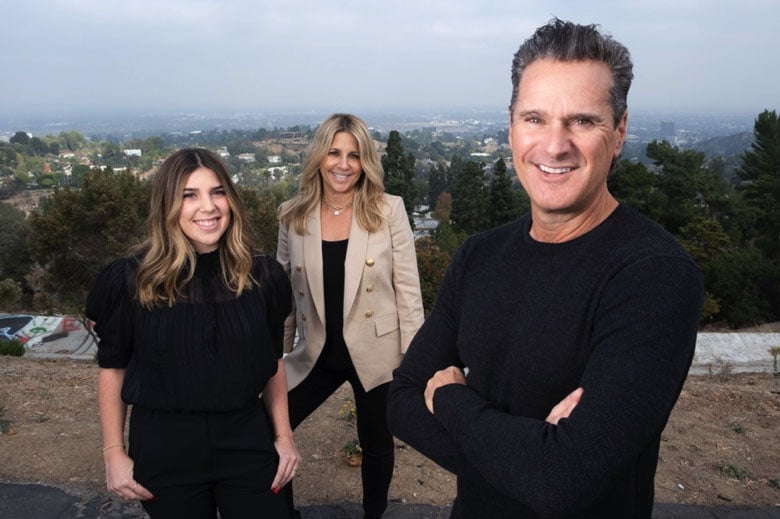
Greg Perlman and his family are ready to give away their fortune — one Angeleno at a time.

Greg and his wife, Jodi, are an Encino-based couple who have amassed a substantial amount of wealth in real estate over the past 30 years as owners of GHC Housing Partners. In 2018, they called a family meeting with their three adult children and agreed that they (Greg and Jodi) would be giving away seventy-five percent of their wealth while they’re still alive. The key was giving away their fortune in the most creative and fulfilling way possible so that the whole family would be involved and make it their life’s work.

After years of doing philanthropy in a standard way (giving charitable gifts to organizations), the Perlmans realized that the most fulfilling type of giving was seeing their funds going to help people directly. In 2019, Greg and Jodi founded The Change Reaction (a play on words of “Chain Reaction”) as the first large-scale, direct giving platform focused exclusively on helping hardworking Angelenos facing financial hardships.

Greg, 55, is a straight-shooter who realized he preferred direct giving — the kind that pays to repair a single mother’s car so she can get to work on time, save a small business during a pandemic or help a veteran pay a security deposit on his new home. “Since the beginning of time, we have always valued being generous to our neighbors,” Greg told the Journal. “But how do you find the right recipients, so you’ll feel okay about giving directly, and how do you do it at scale so you can really start to move your money?”

“We realized that we needed to empower the best people in our community — people whom we call community ‘change agents,’ including social workers, teachers, therapists and even faith leaders,” Jodi said. “And when they bring us stories and connect us with recipients, we basically let them become our way of scaling to heights no one has ever done.”

To make this dream a reality, the Perlmans hired four full-time staff to help them “give away the money,” according to Greg. They created relationships with over 110 Los Angeles-based community organizations (and over 300 community change agents). When a social worker identifies a client (a hardworking Angeleno who is otherwise financially stable but is facing a critical need), the social worker reaches out to The Change Reaction with a financial request to help maintain the client’s stability. Requests are approved and processed in less than twenty-four hours.

The Change Reaction team also hand-selects and researches organizations and sets up in-house angel funds ranging from $10,000 to $250,000. When requests come in, the “team” (as Greg calls the staff) knows they are from a trusted source. When an amount is approved, the organization draws down on the fund to support the request. Grants generally do not go to clients. Instead, checks typically are sent directly to vendors.

Since its inception, The Change Reaction has made over 4,000 grants, averaging approximately $1,200 each and impacting over 10,000 Angelenos. At the start of the pandemic, The Perlman family partnered with Councilmember John Lee in Los Angeles County’s 12th District to start a small business relief fund. That fund made over $1.5 million in interest-free loans and grants available through the Jewish Free Loan Association of Los Angeles to help small businesses. The fund also offered over $250,000 in grocery cards. Those loans, once repaid, will be recirculated to help community members in the future.

“Greg and Jodi Perlman have single-handedly provided immeasurable relief to constituents in Council District 12, and I will be eternally grateful,” Lee told the Journal. “Their strategy for direct giving minimizes bureaucratic delays and gets money and resources into the hands of those who are struggling in short order. They are truly angels in the City of Angels.”

As an owner of Section 8 and other affordable housing properties, Greg directly witnessed the pain of intergenerational poverty. One of the family’s earlier capital gifts was building a new family homeless shelter at the San Fernando Valley Rescue Mission. “We saw homeless families who worked full time and had jobs yet still were homeless,” said Greg. “We started helping the families directly to move out of the shelter and into permanent housing by paying upfront costs, and ultimately, when they had a roof over their heads, we even offered to furnish their homes.”

When thank you letters from families started coming in, Greg and Jodi realized how impactful their gifts were — not just for the recipient, but for the social workers and for them as donors. “We have given seven-figure gifts and never gotten a thank you letter as powerful as the one we got for making a $3,000 gift to help a husband and wife — both working at LAUSD and living at the rescue mission with their two autistic boys — move into a new apartment after being pushed out of a rent control unit by their landlord,” Greg said.

“Nothing feels better than being able to give such underserved people hope that there is good out there in the world,” said Jodi. “We also encourage a lot of people to pay it forward and be kind in their own communities, and we hear from recipients who are helping their own communities. It makes you realize how powerful generosity is and how it can impact anyone, no matter how small or how big the act of kindness is.”

The Perlmans established their first angel fund at UCLA Health to support inpatient families in need of help. “I asked the CEO, ‘When someone’s in the hospital, who pays for things like their rent and food for their family, while the primary supporter is getting treatment for cancer?’ And I realized that’s something we could do,” said Greg. “We don’t pay medical bills, but we pay other financial hardships like rent, transportation and hotels.” The Change Reaction also has angel funds at Children’s Hospital of Los Angeles and City of Hope.

Greg and Jodi recall a particularly moving case in which a father and daughter were both in the Intensive Care Unit at UCLA with COVID-19. Sadly, the father died. “Dr. Thanh Neville came to us to help with the rent for the family who just lost their dad,” said Jodi. “That will always stay with me. Not just because of the impact it had on the family, but the impact it had on the doctor, who was in the middle of a huge wave of ICU patients, and how our gift literally put ‘wind in her sails’ to come to the hospital every day and do the work.”

“The name of the organization embodies a full circle of fulfillment and giving,” said Greg. “I couldn’t be more fulfilled, because I see that the money is going directly into people’s hands. And the social workers have never been more fulfilled because they get to call a family, including the elderly, veterans and foster youth, and let them know that their bills will be paid.” According to Greg, many recipients tell social workers and other agents that they feel that their faith in humanity has been restored.

Many recipients tell social workers and other agents that they feel that their faith in humanity has been restored.

The Perlmans believe that society is at an important crossroads where the wealthy should show more empathy to the hardworking people who drive their children to school, pack their groceries, clean their hospital floors and pour their coffee — all for low wages (especially in Los Angeles). “These people make up the fabric of our community, and we need to lift them up and make sure they stay on track,” said Greg. “They are doing everything they are supposed to do, yet are one missed paycheck away from being homeless. The wealthy need to become their safety net.”

Perlman hopes this new type of giving will inspire the wealthy to give at new levels. “I’ve always been inspired by the Jewish traditions of education and giving,” he said, “yet traditional philanthropy is redundant and not very fulfilling. High-impact direct giving fulfills our innate desire to be generous and has limitless potential to move money from the wealthiest people in our community.”

Greg remembers his mother’s unique form of targeted giving. When he was a child, his mother stood in line with him to order at fast-food restaurants and looked around for those who seemed unable to afford enough food. “We weren’t wealthy,” he recalled, “but one time, my mother gave a man standing with his family a $100 bill when she saw that his wallet was nearly empty. His eyes lit up when he came to order his meal.”

The Perlman children, 28, 26 and 22, have each identified organizations that they have funded with direct grants. They also approve funding requests themselves.

The youngest, Brooke, serves as Marketing and Social Media Coordinator for The Change Reaction. “My parents have taught me and my brothers how to start giving back as soon as we learned to walk,” Brooke said. “The first time I started to get involved in the nonprofit was when I was five years old, and I haven’t looked back.”

Like Greg and Jodi, Brooke has been deeply impacted by giving. “The Change Reaction has taught me that at the end of the day, all of the people that we directly help are our neighbors, having daily financial struggles, but they are no different than any of us,” she said. “We are all human, and we all deserve a fulfilling life that’s worth living, especially when we work hard for it.”

For Daphna Gerendash, program director for The Change Reaction, enabling direct giving has been a once-in-a-lifetime gift. “This is not a job; this is not work. This is a way of life,” she said. “I have found my calling and my purpose in this world, and part of the whole picture is that I get to do this with other people who feel the same way.”

Gerendash is proud that The Change Reaction helps hardworking Angelenos who are doing everything they can to stay financially stable, but who come upon a bump in the road and whose survival is dependent on outside help. As for Greg, he wants to scale up efforts. In 2021, he’s prepared to offer over 10,000 grants. “I’m just trying to lift up one Angeleno at a time,” he said. More than anything, he hopes others will join him.

“There should be a Greg Perlman in every city with more than 100,000 people, moving his or her money and lifting up the hardworking folks in their community,” he said. “If you’re a multi-millionaire or a billionaire, you don’t need to save for a rainy day; there are no rainy days. This is wealth needing to be moved, and if not now, when?”

“I want to trigger the heart of the wealthy,” he continued. “They don’t realize how much their cup is full. Focusing on this type of giving will change the narrative as everyone in society benefits when the wealthy spread their resources. Someone once told me, ‘You need to give enough that it hurts a little bit, and then it’ll be impactful for you.’ It’s absolutely true.”

Greg doesn’t see a limit to what The Change Reaction can offer: “When all the money runs out of all my bank accounts, and I lose the ability to buy food to eat, then we can talk about limits.”

For more information, visit The Change Reaction.


Tabby Refael is a Los Angeles-based writer, speaker and activist. Follow her on Twitter @RefaelTabby

Meet the Couple Giving Away their Fortune to Uplift the City of Angels Read More »

Filmmaker Creates Mini-Series Asking Jews with Disabilities ‘What Do You Pray For?’

Emerging filmmaker Ben Rosloff is taking what he learned at his time as a Jewish Inclusion Fellow in RespectAbility’s National Leadership Program, by creating a 16-part short videos series featuring Jews with disabilities. The series asks the question, “What do you pray for?”

The series, created during the pandemic, centers on the universal nature and themes of prayer, as well as the hopes and dreams of people with disabilities. Rosloff, a filmmaker on the Autism spectrum, explores his intersection of disability and prayer in the Jewish community and asks the guests to do the same. Filming for the series released on April 9 began in late 2020 via Zoom.

“I am grateful for the opportunity to use my talent to share these insights from talented Jews with disabilities,” Rosloff, said. “I look forward to more professional opportunities to continue telling people stories as a video producer, editor and filmmaker.”

Each video includes interviews with poets, clergy, entrepreneurs, entertainment leaders, activists and educators with disabilities. Each person shares insights on their disability experience and presents both their challenges as well as opportunities.

The videos will be released weekly in RespectAbility’s newsletter, “Jewish Disability Perspectives.” RespectAbility will also host a release event with the speakers together in Summer 2021.

Matan Koch, director of Jewish Leadership at RespectAbility says, “I was truly gratified when Ben, as a fellow who was working on our communications team at the time, took the initiative to offer this wonderful idea. I hope that this insight into the thoughts and dreams of individuals with disabilities will highlight that we are talented members of the Jewish community just like anyone else.”


Rosloff, who is engaged with RespectAbility’s Jewish inclusion team, fights stigmas and advances opportunities so that Jews with disabilities can contribute their talents to the Jewish world. Rosloff, a New York native, has made films for a variety of organizations, including his documentary short “Can I Call You?!” His work has been screened around the world, including a film he made for World Autism Awareness Day, where Ben interviewed then-Secretary General Ban-Ki Moon and “#Envision 2030” for Disability Awareness Day.

To receive the weekly newsletter and witness the 16-part series, fill out this web form.

Filmmaker Creates Mini-Series Asking Jews with Disabilities ‘What Do You Pray For?’ Read More »