fbpx

March 16, 2021

Reboot Creates ‘Plastover Challenge’ to Remove Single-Use Plastics on Passover

Passover is Jonathan Bines’s favorite Jewish holiday, but every year, he wishes it directly tied to Tikkun Olam so Jews could repair the earth, “which is so desperately in need of help.”

Bines, who is an Emmy-nominated comedy writer and part-time environmental activist, teamed up with the arts and culture non-profit Reboot to launch a new initiative that asks Jews to give up single-use plastics for the eight days of Passover. Named Plastover, the initiative adds a contemporary and meaningful approach to the Exodus story.

“My 12-year-old son suggested giving up plastic [this Passover.] I thought this was a terrific idea, and …so the exodus from plastic waste was born,” Bines said. “This project leverages Passover’s power of symbology and transformation to use plastic to spark a sustained climate intervention. An Exodus of a thousand miles begins with a single step. We believe this step of Plastover will set us on a path toward having a real impact.”

Plastic has many important uses, but the over-reliance on it has had disastrous consequences for the health and the wellbeing of the planet and humanity. National Geographic reported in July 2019 that half of all plastics ever manufactured have been made in the last 15 years. “Plastic production has increased exponentially, from 2.3 million tons in 1950 to 448 million tons by 2015,” the 2019 report stated. “Production is expected to double by 2050.”

Bines, along with the Reboot network, wanted to challenge everyone this Passover to take the first step in becoming less reliant on plastics. Just like Jews don’t eat hametz during Passover, Jews will sacrifice plastic bags, straws, candy wrappers, cellophane, bubble wrap or take-out containers during Plastover. Reboot believes reducing plastic use is a moral responsibility and Jewish value as well as a practical necessity.

Jews will sacrifice plastic bags, straws, candy wrappers, cellophane, bubble wrap or take-out containers during Plastover.

As part of the reinterpretation of the holiday, Reboot is reimagining the original 10 Plagues of Egypt. “The 10 Plagues of Plastic” share the tolls that plastic has taken on the world. Correlating with the original 10 plagues (waters of the Nile turning to blood is now the oceans filled with garbage), each plague ends with an action item that all people can do to remove the plastic in their lives.

Once again, because of the pandemic, this Passover will look different than others. Reboot CEO David Katznelson said the pandemic offered another  opportunity to modernize Passover rituals and turn them into action-oriented experiences.

“Reboot’s goal is to use our Jewish stories, traditions and rituals to create opportunities for both Jews and their friends to be inspired and connected,” he said. “The idea behind Plastover is a universal idea of understanding an aspect of human environmental damage and thinking about how to change our habits and thus our world. “[Plastover] is a powerful opportunity to take an ancient Jewish tradition and make it relevant for today’s concerns.”

In addition to participating in the plastic-free challenge, Reboot network member and Detroit artist Olivia Guterson is showcasing an art installation at the Museum of Contemporary Art Detroit (MOCAD). The installation, “At Our Table,” will showcase a 20-foot-long seder table dressed to the nines in single-use plastics. The art collaboration is put on through Reboot, the museum and Jewish Funders Network CANVAS.

Guterson, a visual and conceptual artist, is deeply influenced by textures, landscapes, patterns as well as her Jewish and Black heritage. She said she had been “hoarding” plastics for years and during quarantine found herself picking plastic up around her neighborhood. She had hoped the right opportunity would come along where she could use them for a project. She said this project is a wonderful opportunity for her to embrace all aspects of her identity.

“I walk through the world mostly as like ‘other’ or a person of color. I don’t always get to talk about my Jewishness, so I’m really excited to merge those,” Guterson, 30, said.
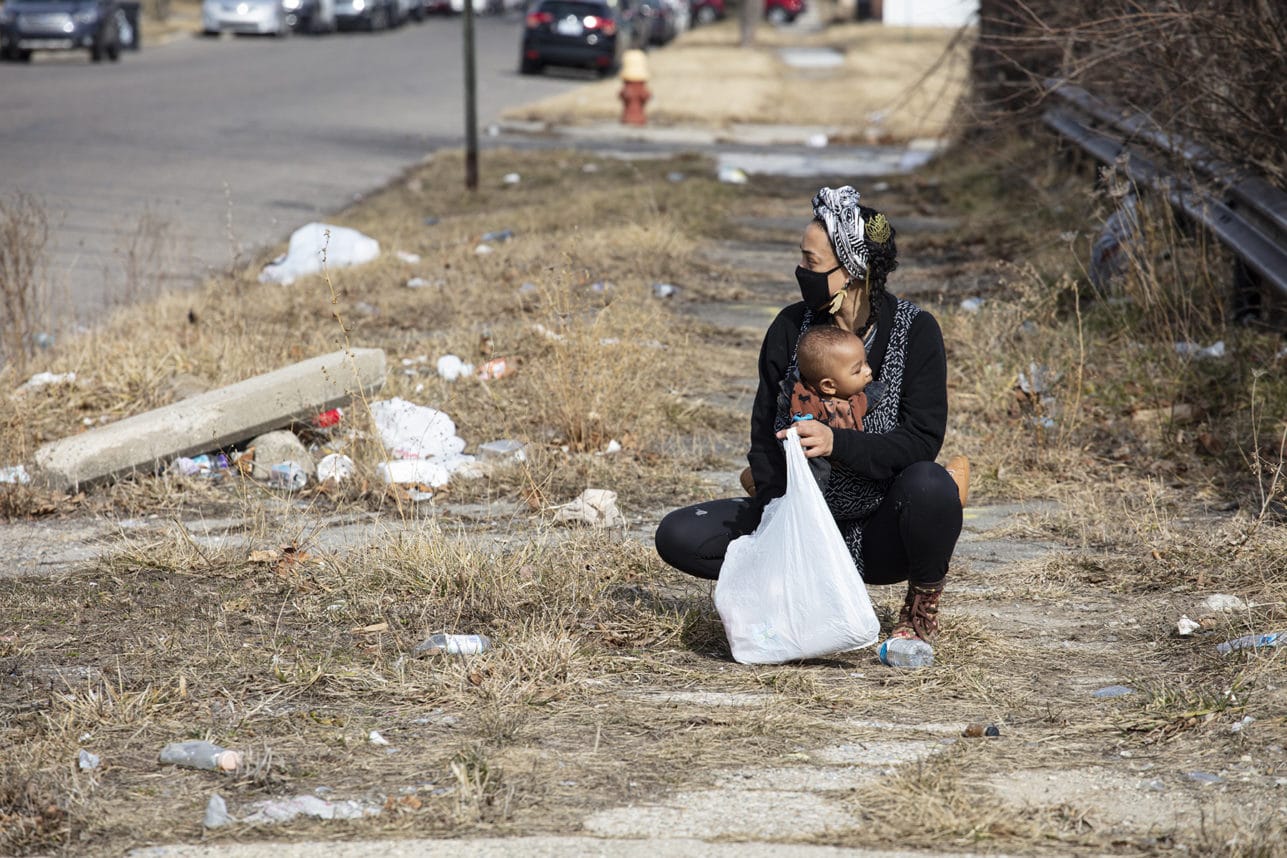
Detroit artist Olivia Guterson collecting garbage with her son around the neighborhood. Photo by Sal Rodriguez/courtesy of Reboot

She also added it isn’t lost on her that communities of color are disproportionally impacted by plastic manufacturing and consumption. From the packaging and marketing of plastics and food items to the actual location of the manufacturing sites, plastic production targets minority and lower income communities at a higher rate. “Even the way plastics [cause] these microplastics that people are breathing in. These are the predisposition conditions that are causing Black and Brown communities to be impacted by COVID-19.”

When the art installation is finished with its run, Guterson is ensuring that it will be recycled properly so that it can be turned into eco-bricks to build garden beds throughout the community. She is partnering with the sustainability non-profit HAZON to set up bins that collect plastic around the community to create more eco-bricks.

“It needs to be full circle… some form of action to get rid of the plastic,” she said. “The Passover table will turn into a garden bed when it’s over…it’s not lost on me that all this stuff was found outside and now it’s going back outside as something elevated to talk about the role of waste and things that are disposable.”

Members of the Detroit Jewish community can view the installation in person safely outside at MOCAD from March 25 through April 5. Others can still experience “At Our Table” and the national CANVAS project “Dwelling in a Time of Plaguesonline. The art project allows for new art to be constructed outside during the pandemic. In addition to Detroit, different Passover-related exhibitions are in Baltimore, Boston, Charlotte, New York City and Toronto. Guterson hopes that the call to action will resonate with people because it is presented through art.

“[The installation] is all made from garbage, and it’s damaging our environment,” she said. “Art is a way of providing a platform to having a conversation, a way of educating each other without shaming one another. It’s not always easy just to tell someone, ‘Hey, you need to stop doing that.’ Let me show you that we can do other things, be creative and thrifty. Art gives us the opportunity to see the impact. It’s the vehicle to imagine what is possible.”

Guterson collected hundreds of single use plastic bags to create a woven tablecloth for her seder table installation titled “At Our Table.” Photo by Sal Rodriguez/courtesy of Reboot

Back in Los Angeles, Tarah Malhotra-Feinberg of Eagle Rock has been a member of Reboot since 2010. This Passover, he and his wife are excited to participate in Plastover with their five-year-old twin daughters. He and his family are committed to reducing their waste and think this is a great way to start taking action as a family.

“We’re looking for ways to teach our children about environmental responsibility… how joining movements we believe in can make a significant change collectively. We want to do this in a fun, interactive way,” he said. “We are a pretty secular, interfaith, interracial [and] international family, so we sometimes struggle to find the balance between incorporating religious and cultural traditions without making one of the parents feel like an ‘other’ to the kids. By finding ways to apply the core principles, teachings and stories of these traditions to modern social causes, it makes them palatable, universal and meaningful in ways that are immediately applicable to our lives, and can be understood by five-year-olds.”

Bines wants as many households to participate in this initiative as possible and encourages them to interact on social media using #Plastover. He’s also eager to hear the responses from those who realize how difficult it is to remove plastic from their everyday lives. But that’s also the point.

“We’re not asking people to gather up and throw out everything made of plastic,” he said. “By encouraging individuals to take responsibility, Plastover can help raise awareness about the impact of plastic, the need for change, and the ways in which we are not in control of our own plastic consumption and plastic waste.”

To learn more about the Plastover challenge and how to get involved, visit the website.

Reboot Creates ‘Plastover Challenge’ to Remove Single-Use Plastics on Passover Read More »
The Time Iran Sheltered Jews During the Holocaust

“To us … it is a heaven.” These were the words of Warsaw-born Rabbi and scholar Hayim Zeev Hirschberg in the early 1940s in reference to an Asian country that, at the time, was saving the lives of thousands of Jewish and non-Jewish refugees during the Holocaust.

Incidentally, Hirschberg wasn’t referring to Mandatory Palestine or China or Japan but to…Iran.

Yes, Iran, whose regime in the past four decades has executed Jews at home, paid terrorists — from Jerusalem to Buenos Aires — to kill Jews abroad, repeatedly denied the Holocaust and hosted Holocaust cartoon contests in Tehran (as well a 2006 event titled “The International Conference to Review the Global Vision of the Holocaust” that featured former Ku Klux Klan Imperial Wizard David Duke).

But Iran after the 1979 Islamic Revolution doesn’t resemble the Iran of the early 1940s, which was led from 1941-1979 by the secular, Westernizing Shah Mohammad Reza Pahlavi, who succeeded his father, Reza Shah Pahlavi. In 1941, the British and Soviets invaded Iran and deposed Reza Shah, who was friendly to Nazi Germany. Anglo-Soviet troops quickly brought his pro-British son to power.

Starting in 1942, the port city of Bandar Pahlavi (now called Bandar-e Anzali) received up to 2,500 Polish refugees per day, totaling 116,000 (5,000-6,000 of them were Jewish, and of that number, nearly 1,000 were children).

One of those children, Hannan (then 14), was the father of Israeli author and CUNY Professor Mikhal Dekel. “Pahlavi was the first city my father encountered since the beginning of the war that had not been ravaged by war and hunger,” Dekel wrote in her magnificent book, “Tehran Children: A Holocaust Refugee Odyssey” (W. W. Norton & Company, 2019). In meticulously-researched detail, the work retraces the 13,000-mile journey of Dekel’s father and several of his family members from Poland, shortly before the Nazi invasion in 1939, to Siberia, where they nearly starved to death, to Uzbekistan and, eventually, to Iran (then under British rule) in August 1942.

On March 17, Dekel will share her thoughts on the journey during a virtual program hosted by Sephardic Temple Tifereth Israel.

“Tehran Children” is as much a personal journey as it is a travel narrative and work of historical nonfiction, as Dekel travels in the footsteps of her father and a quarter of a million Holocaust refugees who escaped to the former Soviet Union and the Middle East. What did they recall about these regions? And how are they being remembered in countries ranging from Uzbekistan to Iran?

Hannan and his younger sister arrived in Iran without their parents, who remained in Uzbekistan. They were greeted in Bandar Pahlavi by many members of Iranian’s 2,700-year-old Jewish community, who arrived with hugs and sweets. But the initial warm welcome by the country’s population turned bitter the following winter, when, amid low supplies, Polish refugees were seen as “parasites,” and graffiti in Tehran read, “all of Persia is hungry as it watches the Poles and the British eat its bread.” Concerned over an uprising, the British decided to ship the Polish Catholic refugees to India, Africa and New Zealand, and some 861 Polish Jewish children, including Dekel’s father, to British Palestine.

“Many ask why the story of these survivors of the East — those who survived in Iran, Uzbekistan, Kazakhstan, etc. — is virtually unknown, especially since it is the story of nearly quarter million survivors,” Dekel told the Journal. That question, coupled with her father’s personal experience (which he never shared in detail with her), prompted Dekel to spend years researching the facts and many primary sources, such as diaries and letters of children and adults who were brought to Iran from Poland.

For Dekel, researching and writing “Tehran Children” was cathartic as a daughter and as a Jew: “My father was a complex parent: devoted, yet tense, aloof and at times inexplicably angry,” she said. “The research and writing of the book gave me a key to who he was. I now know exactly what he went through and who he was before the war. That’s liberating.”

The book also freed Dekel from a seemingly all-or-nothing relationship with the Holocaust: “On a more general level, as a Jew, I was always overwhelmed by the enormity of the Holocaust, so overwhelmed that I oftentimes avoided reading about it,” she said. “Knowing the specifics of this particular Holocaust experience, as painful as it is, feels liberating. It isn’t just this huge, shapeless horrific experience. It is a specific story set in time and place. I can cry, but I am no longer overwhelmed.”

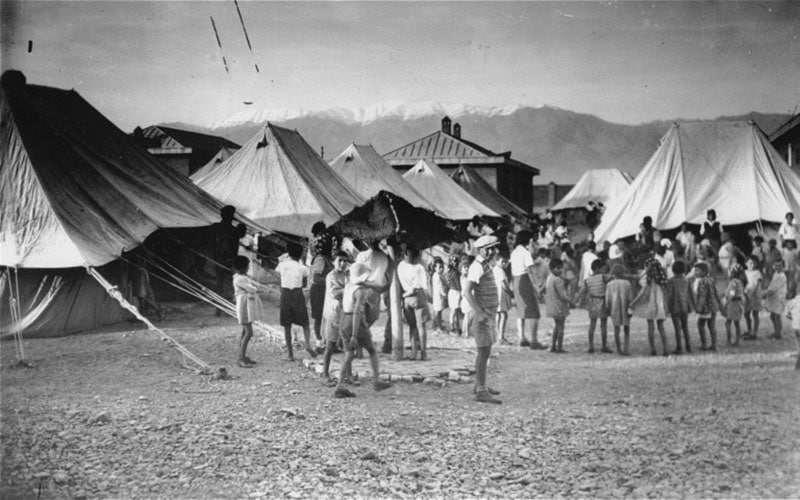
From April to August 1942, 730 Polish Jewish children arrived in Iran and lived in tents on the former military barracks of the Iranian Air Force. Soon thereafter, over a hundred more children arrived, and the camp became known as the “Tehran Home for Jewish Children.” It was supported by the local Jewish community as well as many international Jewish organizations, such as the Hadassah Women’s Zionist Organization and the American Jewish Joint Distribution Committee. These Polish Jewish youth became collectively known as the “Tehran Children.”

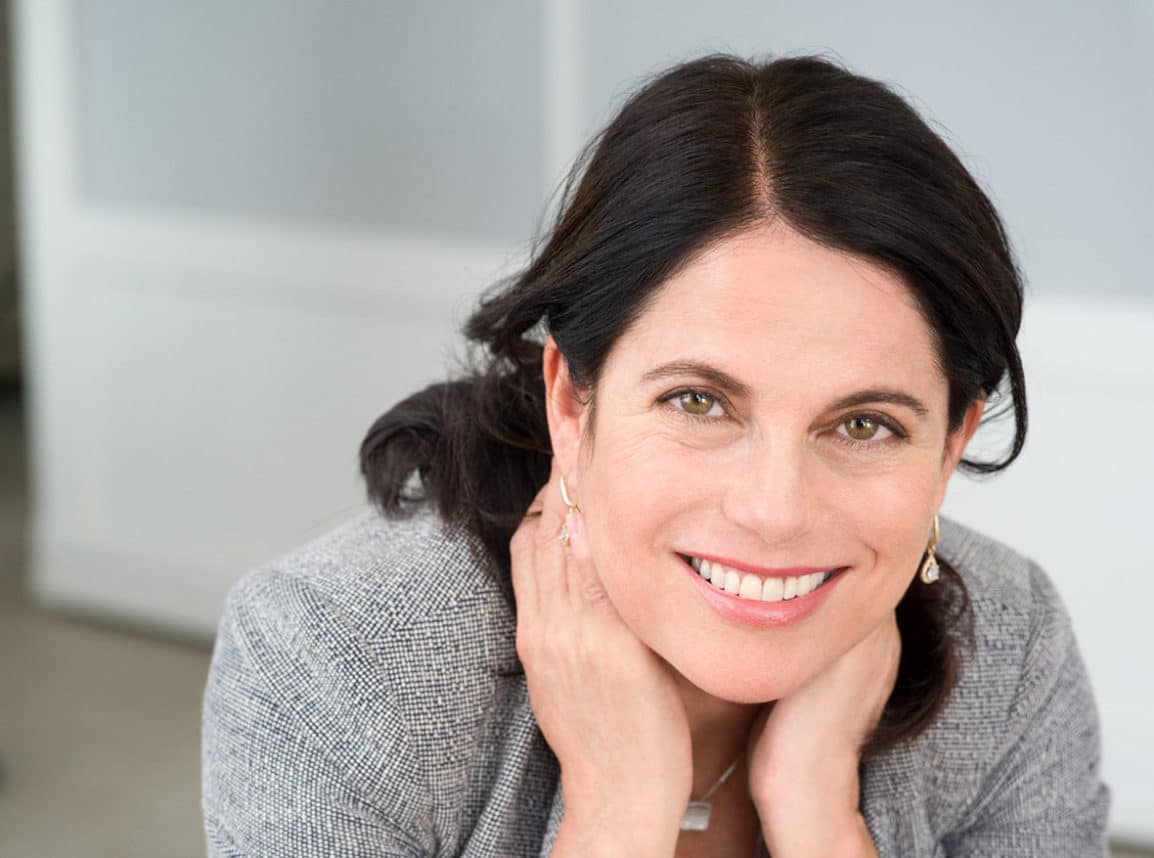
“Tehran Children” author Mikhal Dekel. Photo credit: Nina Subin

Rafael Szaffar, the only representative of the Jewish Agency for Palestine (founded in 1929), joined the 75-member Polish delegation that welcomed Polish refugees in Bandar Pahlavi. Before the war, Szaffar had immigrated from Poland to Palestine and was sent to Tehran to secretly help Polish Jewish refugees and orchestrate their eventual arrival in Palestine. The refugees, Szaffar reported, were “swollen from starvation, dressed in rags,” and looked “much worse than the Poles.” The Jewish Agency helped relocate some 870 “Tehran Children” to moshavim (cooperative farming villages) and kibbutzim (collective farms) in then-British-controlled Palestine, but their journey was unimaginable.

In January 1943, over 700 Jewish children arrived by truck to the Persian Gulf city of Bandar Shahpour; they boarded a freighter to Karachi, Pakistan, then traveled around the Arabian Peninsula through the Red Sea to the Suez in Egypt. They crossed the Sinai Mountains by train and finally came to the Atlit refugee camp in northern Palestine. In August 1943, over 100 children arrived in Palestine via Iraq. All of the children were resettled by the Jewish population in then-Palestine, known as the Yishuv.

Several years later, during Israel’s War of Independence, 35 of those “Tehran Children” died as civilians or soldiers (Israel lost one percent of its population in the war).

There’s a reason why many Israelis know about these children, whereas American Jews have little to no knowledge of them: “The Tehran Children became Israelis,” Dekel said. “They were absorbed into the new nation and shed their Holocaust refugee status very quickly. It’s only in the past decade or so that they began to be commemorated in Israel. And as far as research goes, there is a lot about the last leg of their journey — the travel from Iran to Palestine — but less so on what happened before that. That is where my book comes in.”

Dekel, who moved to the United States in 1993, currently knows about the existence of two “Tehran Children” in New York. She believes that a few hundred remain in Israel, although most have died (one passed away from COVID-19 last year).

Dekel’s important book questions who gets to be recognized as a survivor. “In truth,” Dekel said, “the most important question my book raises is: Why haven’t these quarter million Polish Jews who survived in the USSR and Middle East been recognized as survivors? Until now, these people have not been commemorated. They were also not included in reparations agreements with Germany.”

Dekel’s important book questions who gets to be recognized as a survivor.

Today, most Iranians know that there were Polish refugees in Iran during World War Two, but they do not know there were Jews among them. Dekel believes that they should be educated about this fact, and hopes her book will help achieve this task. She believes that Iranian leaders may know about the book and hopes it will be translated into Persian and read by Iranians inside Iran.

Dekel’s story gets even more complicated given Iran’s once cozy relations with Nazi Germany: During World War Two, Iran, under Reza Shah, pushed back against British and Russian pressure and sold oil to the Nazis. Iranians who were sympathetic to the Nazis drew comparisons between “Aryan Persia” and “Germanic Europe,” hoping to ally Iran further with the Third Reich. In 1933, pro-Nazi Iranian intellectuals in Iran established an overtly racist magazine called Iran-e Bastan (The Ancient Iran). In 1935, the country formally changed names from “Persia” to “Iran” (from the internal nickname, “Aryānām,” or “Land of the Aryans”). Nazis even exempted Iranians (except Iranian Jews) from the infamous Nuremberg Racial Laws, claiming they were actual Aryans.

But the saga of the “Tehran Children” marked the beginning of ties between the Jews of Palestine and those from Iran  — ties that were further deepened after Israel was established in 1948. In the 1960s and 1970s, Iran had good de-facto relations with Israel, and many Israelis, especially architects and builders, lived and worked in Tehran and other major Iranian cities.

“I strongly believe that those ties could and should resume,” Dekel said. “The Israeli and Iranian people, and especially the young people, are natural allies.”

As for Jews worldwide, Dekel hopes “to convey the fact that Jewish groups around the world are interconnected and bear a mutual responsibility. Polish Jews, Iranian Jews, Iraqi Jews, German Jews who were refugees in Iran, the Jews of Palestine, American Jews, Bukharian Jews and other Jewish communities in Montreal, London, Mexico and Argentina are all linked in the book.” Indeed, her 2019 New York Daily News story, which powerfully retraced her father’s Yom Kippur experience as a child refugee in Iran, shows the undeniable interconnectedness of the Jewish experience.

“Many descendants have reached out to me in the wake of the book,” Dekel said. “Many of them knew nothing about this and the book enables them to fill in the missing pieces about their parents’ or grandparents’ past.”

In the decades immediately following the Holocaust, some Polish refugees to decided to stay in the country, marrying Iranian citizens and raising children. But nearly three thousand Polish refugees perished months after arriving in Iran. In their desperate starvation, many overate and suffered from acute dysentery. Others died from malaria, typhus and respiratory illnesses. The largest refugee burial site in Iran is a Polish cemetery in Iran that has 1,937 graves.

A separate area was reserved for Polish Jews and belongs to Tehran’s Jewish community. On each of those 56 graves is a Star of David and a name…in Polish.

Mikhal Dekel will speak virtually as part of Sephardic Temple’s Distinguished Speaker Series on March 17 at 6:30 p.m. More information may be found here


Tabby Refael is a Los Angeles-based writer, speaker and activist. Follow her on Twitter @RefaelTabby

The Time Iran Sheltered Jews During the Holocaust Read More »

5 Notable Jewish Nominees for 2021 Oscars

(JTA) — “Mank,” the black-and-white Netflix film about Jewish screenwriter Herman Mankiewicz, leads the slate of Academy Award nominations in a year when most Americans viewed movies via streaming services.

“Mank” earned 10 Oscar nods, including for best picture, making up nearly half of Netflix’s total nominations. The company also drew six nominations for “The Trial of the Chicago 7.” Meanwhile, Amazon’s nominations were bolstered by Regina King’s film “One Night in Miami” and “Borat Subsequent Moviefilm” — one of two movies that earned creator Sacha Baron Cohen an Oscar nomination.

Here’s what you need to know about the notable Jewish nominees. The awards will be presented in a ceremony April 25.

“Mank” dominates

Mank

Gary Oldman on the set of Mank (Nikolai Loveikis/Netflix)

Starring Gary Oldman as Herman Mankiewicz, “Mank” was tapped for best picture among its nominations. Oldman and co-star Amanda Seyfried, as well as director David Fincher, are in the running. There are also nominations for original score, cinematography, costume design and more.

“Mank” focuses on the story behind Mankiewicz writing the classic film “Citizen Kane,” and trying to get credit for his work following its success.

Sacha Baron Cohen is recognized for two very different films

sacha baron cohen

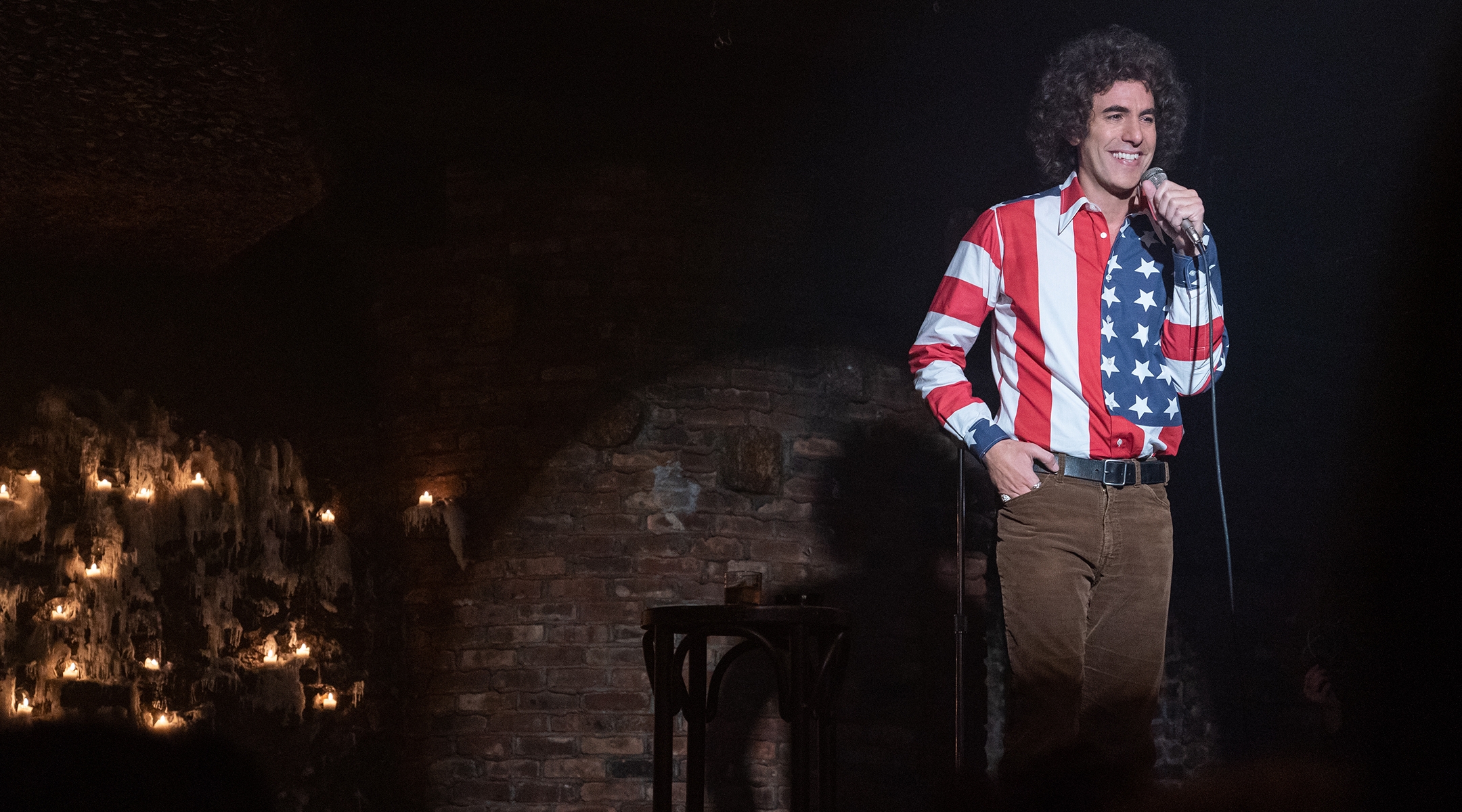
Sacha Baron Cohen as Abbie Hoffman in “The Trial of the Chicago 7.” (Niko Tavernise/Netflix)

Cohen was nominated for his portrayal of the Jewish activist Abbie Hoffman in “The Trial of the Chicago 7” and for best adapted screenplay for the Borat sequel, “Borat Subsequent Moviefilm.” Maria Bakalova, the Bulgarian actress who plays Borat’s daughter in the latter, scored a nod for best supporting actress.

“Trial of the Chicago 7” garnered six nominations, including for best original screenplay by the Jewish writer-director Aaron Sorkin.

“Crip Camp” is recognized

The Netflix documentary, nominated for best documentary feature, is the story of teenagers with disabilities who attend Camp Jened in upstate New York during the summer of 1971. The film, executive produced by President Barack Obama and Michelle Obama, follows a group of campers and counselors who become activists for the disability rights movement, including the Jewish activist Judy Heumann.

Following the nominations Heumann tweeted, “Make this year the first of MANY where the Oscars is accessible to all disabled people.”

Israeli and Palestinian short films score nominations

The Israeli short film “White Eye” is up for best live-action short film. It’s the story of Omer (Daniel Gad), a Mizrahi man whose bicycle is stolen. He spots his bike outside a factory and calls the police on an African migrant worker, Yunes (Dawit Tekelaeb), setting off a chain of events out of Omer’s control.

“The story actually happened to me,” Tomer Shushan, the film’s writer and director, told Jewish Insider. “I found myself fighting to get my bike back, and I almost made a man go to jail, to be deported from Israel. I just sat down like one hour after the situation and I wrote the script in 40 minutes.”

Competing against “White Eye” in the same category is the Palestinian short film “The Present,” which is directed by the Palestinian British filmmaker Farah Nabulsi. It tells the tale of Yusuf (Saleh Bakri) and his daughter, Yasmine (Mariam Kanj), who set out to buy his wife a gift. They navigate Israeli soldiers and military checkpoints in their frustrating attempt.


“You can portray checkpoints with all the facts and figures – a woman can give birth at a checkpoint; people can’t get to work or whatever. But you go stand at a checkpoint, it’s a very different perception to what the facts and figures provide. It was this life-changing trip, it had such an impact on me and I came back and battled with it for two years,” Nabulsi explained of her inspiration to make the film.

The first scene in “The Present” is filmed at a Bethlehem checkpoint.

Diane Warren gets her 12th best original song nomination

The Jewish songwriter Diane Warren was nominated for “Io sì (Seen)” for the Sophia Loren Holocaust film “The Life Ahead.” She shares the nomination with singer Laura Pausini; it was the film’s only nomination.

Warren has been nominated a dozen times over three decades but failed to take home a statuette. This could be the year: She won a Golden Globe in February.

5 Notable Jewish Nominees for 2021 Oscars Read More »

David Hall on the Passover Interfaith Seder, future plans and more

The Passover Seder is a Jewish tradition celebrating freedom from oppression. It is the retelling of the exodus from Egypt, with rituals, food, wine and song.

The Passover Interfaith Seder is a new, global tradition celebrating freedom from oppression for all peoples. In turn, all are welcomed to the virtual table of the Passover Interfaith Seder. The Passover Interfaith Seder will be co-produced by Temple Adath Or and sponsors include Mark Gerson (author of “How Judaism’s Essential Book Reveals The Meaning Of Life) and the Lake Worth Interfaith Network.

To learn more about the Passover Interfaith Seder – which debuts on March 28, 2021 at 4:00 PM PST – I had the pleasure of doing Q&A with David Hall, who serves as President of the aforementioned Lake Worth Interfaith Network.

How would you describe the Passover Interfaith Seder concept to someone not yet familiar?

David Hall: Rich in tradition, the Passover Seder takes families all around the world on a special storytelling journey of the Hebrew slaves on their Exodus from Egypt. Part of the Passover dinner, the Seder, is to invite strangers — friends we’ve not yet met — to join us in this celebration of freedom from oppression. The INTERFAITH concept includes people from all religious beliefs and backgrounds to participate in the universal story of anti-slavery, in our quest for all to live in peace.

Where did the idea for the Passover Interfaith Seder organization come from?

David Hall: As president of the Lake Worth Interfaith Network, I’ve wanted to continue our network’s tradition of hosting an annual Interfaith Seder. Last year, we were shut down due to the pandemic. This year, we decided to go virtual, inviting the entire world to partake in this time-honored tradition of the “telling” of the Exodus.

To most people who observe Passover, it comes and goes, meaning that it is observed for a week and then onto the next holiday. How much planning does it take to run something like the Passover Interfaith Seder organization?

David Hall:  We began plans back in December 2020, for March 28, 2021. Together, with an active committee of like-minded people, we are aiming high and low to be inclusive, educational, and fun in our desire to share the peace and freedom theme around the world.

Who are some of the individuals or organizations that the Passover Interfaith Seder organization works with? 

David Hall:  The co-producers are The Lake Worth Interfaith Network, or LWIN for short , and Temple Adath Or, TAO for short. Together, we decided to reach out to our community friends and partners to bring us all together in celebration. We attracted Mr. Mark Gerson, a New York-based philanthropist, and author of the just released, best-seller, “The Telling: How Judaism’s Essential Book Reveals the Meaning of Life.”

Additionally, thanks to Dr. Donna Goldstein, one of our committee members, we have collaborated with the Emory University Candler School of Theology to present their large 700 plus Haggadah collection from the 17th Century to the current day. These Haggadahs are the books used to present the Passover Seder and include gorgeous imagery and calligraphy based on the parting of the Red Sea miracle, the 10 plagues and so much more.

We are also privileged to partner with Dr. Jerry Glantz, son of the world-renowned cantor of all time, Cantor Leib Glantz, whose beautiful voice is simply one of a kind. We are utilizing his voice to enhance our 60-minute Seder presentation.

You are also the President of the Lake Worth Interfaith Network. What is coming up for the network in the near-future?

David Hall: In January, we celebrated MLK Jr. Day, In February, we celebrated Black History Month with a 28 day anti-racism campaign on social media, featuring famous daily quotes of inspiration. In March we are celebrating Women’s month and the Passover Interfaith Seder. Easter celebrations in April, and the National Day of Prayer in May. Our goal is to support and encourage interfaith activities both in Palm Beach County, the Southeast Florida region, and around the world. We’ve been very busy, as you can see.

When not busy with wonderful faith-oriented causes, where does your free time usually go?

David Hall: For the past several years, I’ve been growing my organizing and decluttering design business called A+ Clutter Clearing Services. As the CCCO, (Chief Clutter Clearing Officer), I oversee and develop systems for people with “TMS” – or “too much stuff.” Even during COVID times, business has been robust and continues to blossom.

When not working on clearing clutter and design, I love to garden, landscape design, and love outdoor photography of natural things. Ocean, woods, anywhere there’s open spaces. Finally, I love preparing gourmet vegetarian meals with my partner, Anne Goldberg, and my son, Jaxson Hall.

Finally, David, any last words for the kids?

David Hall: Kids! Listen up! This Passover Interfaith Seder is for you and your friends. Why? Because it’s a generation to generation tradition that includes the 4 questions – as asked by the youngest household member — the 4 children, fun interactive songs, 4 cups of wine, and the “afikomen” dessert matzo, where kids play hide and go seek with the leader of the Seder, find the matzo dessert and win a prize. So this Passover Interfaith Seder is really designed to enliven, enlighten and entertain people of all ages, faiths and backgrounds.

More on this year’s event can be found here and here.

David Hall on the Passover Interfaith Seder, future plans and more Read More »

University of Texas Student Gov’t Passes IHRA Resolution

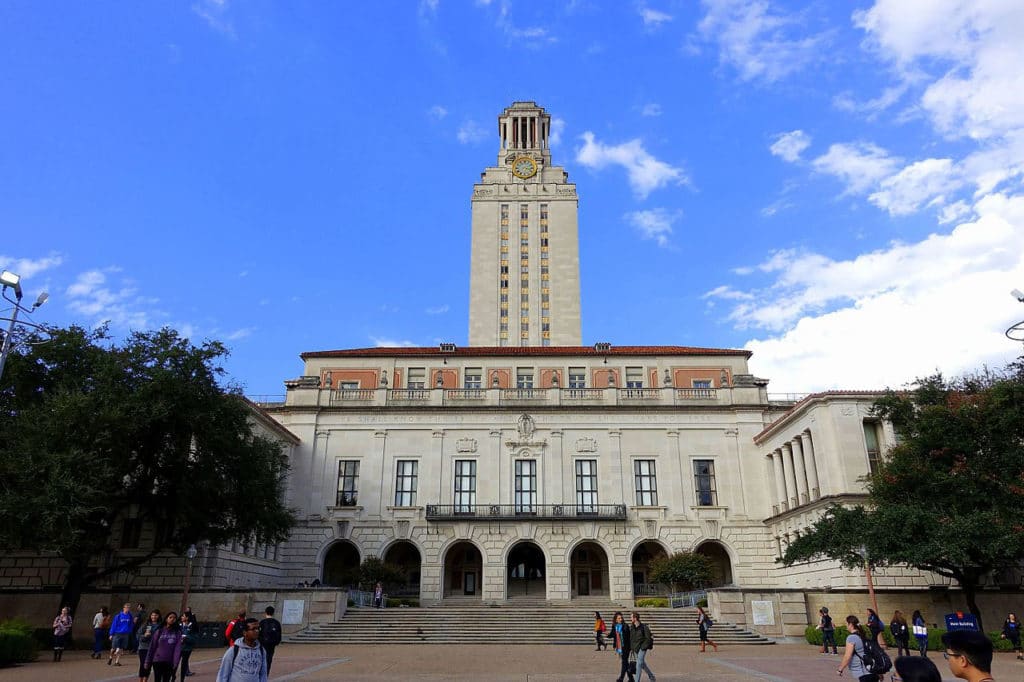
The student government at the University of Texas (UT) at Austin unanimously passed a resolution endorsing the International Holocaust Remembrance Alliance (IHRA) definition of anti-Semitism on March 9.

The resolution, which was obtained by the Journal, states that adopting IHRA became necessary following a spate of recent anti-Semitic incidents on campus, including a Jewish fraternity house being spray-painted with the words “Samys R Jews LOL, Samys’ Js Rape” and a then-professor comparing Jews to bacteria in an April 2020 Twitter thread.

“In light of recent anti-Jewish hatred, vandalism, and endangerment, the University of Texas Student Government wholeheartedly issues its support for its Jewish students; and, be it resolved, that the University of Texas Student Government pledges to combat future anti-Jewish hatred by adopting the International Holocaust Remembrance Alliance’s ‘Working Definition of Antisemitism’ and its included examples, which have worldwide bipartisan support, including that now from the newly elected Biden administration,” the resolution states.

Jordan Cope, a member of the student government, told the Journal, “While the university has been quick to address other forms of hatred, regardless of whether it actually occurred on campus, it has largely neglected the incidents that targeted its Jewish students. It is an unfortunate double standard that we have sought to address previously through student petition and now through this legislation, which we hope will create a more urgent precedent for our student body and university to better address anti-Semitism.”

He added that the passage of the resolution “is a victory for the greater American Jewish community as it is for that of our campus, especially given the size of our university student population, which exceeds 50,000 students. Such [a] passage has emboldened the legitimacy of the IHRA definition, and we hope that it will inspire Jewish students to more proactively define, confront, and raise awareness to antisemitism in their communities.”

Texas Hillel wrote in a March 10 Facebook post that they were grateful to the UT student government for passing the resolution. “Texas Hillel looks forward to partnering with our student leaders to promote an inclusive and welcoming campus environment and to help ensure that antisemitism has no place on the Forty Acres. Thank you to the students who shared their experiences and brought their perspectives to this process.”

Texas Hillel is thankful to the UT Student Government for unanimously passing a bill last night which supports the…

Posted by Texas Hillel on Wednesday, March 10, 2021

Kenneth L. Marcus, who heads the Brandeis Center, said in a statement to the Journal, “Anti-Semitism is too often swept under the rug by university administrators, particularly when it is disguised as anti-Zionism. This is why formal definitions are critical. Unfortunately, U.S. universities have lagged behind their European counterparts when it comes to adopting the IHRA Working Definition of Anti-Semitism, one internationally agreed-upon definition in this field.

“We commend UT students for taking matters into their own hands and serving as leaders in combating rising anti-Semitism on their campus. We urge the UT administration to follow its students’ leadership and adopt IHRA and its contemporary examples both for educational purposes and when investigating and responding to incidents of harassment and discrimination to determine whether such conduct is motivated by anti-Semitic animus or bias.”

Carly Gammill, director of the StandWithUs Center for Combating Antisemitism, similarly said in a statement to the Journal, “StandWithUs celebrates the unanimous passing of a bill recognizing the IHRA definition of antisemitism by UT’s student government. This is a wonderful first step in committing to combat antisemitism and acknowledge the actual experiences of Jewish students at UT. We congratulate Jewish and pro-Israel students for their efforts. We look forward to learning about the additional steps that will be taken by UT’s student government to ensure and uphold an inclusive campus environment for Jewish students.”

University of Texas Student Gov’t Passes IHRA Resolution Read More »

Photographer Zion Ozeri Showcases Jewish Diversity in Virtual Haggadah

Renowned Jewish photographer Zion Ozeri is no stranger to creating meaningful Haggadot. His award-winning photographs, which capture the world around him, have appeared in The New York Times, Newsweek, The Jerusalem Report, Moment and The Economist, to name a few publications. After reviewing his pieces, Ozeri decided to create a virtual interactive Haggadah that highlights the diversity of Jews, just in time for a second pandemic Passover.

Ozeri, along with Sara Wolkenfeld and Josh Feinberg, curated “Pictures Tell: A Passover Haggadah,” a Haggadah that is completely virtual (can be utilized at home or in a classroom) and celebrates the traditions and cultural experiences of the Jewish Diaspora. Ozeri told the Journal that a major goal of “Pictures Tell” is using imagery to tell the story of the Jewish people.

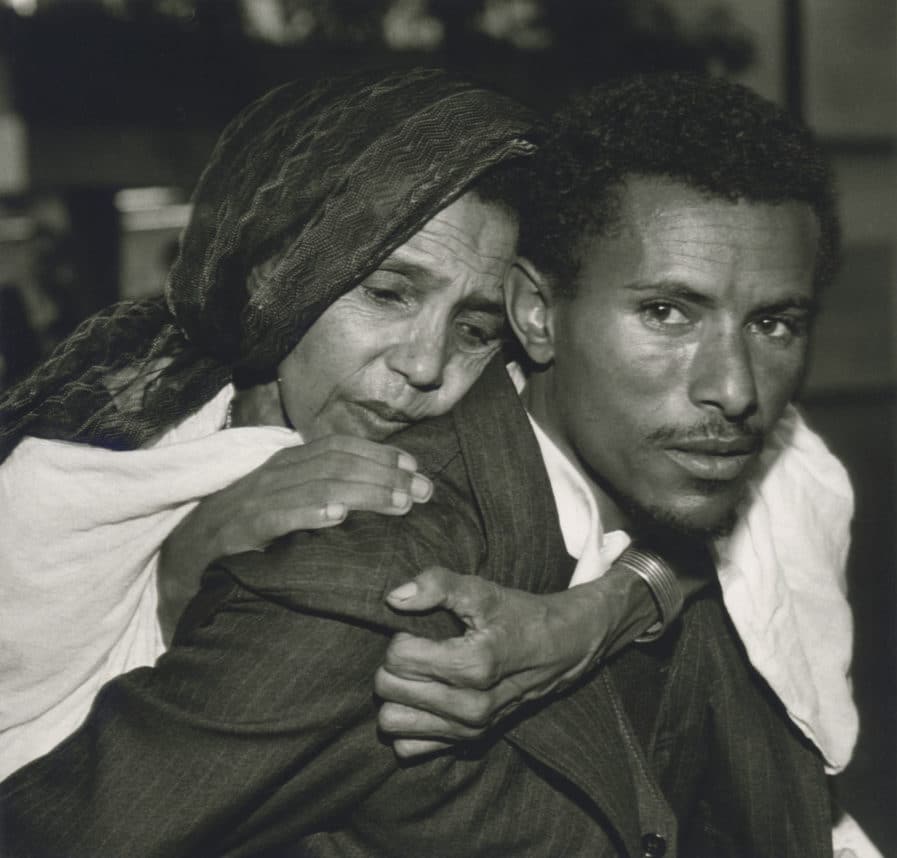
Holocaust survivor, Buenos Aires, Argentina (Courtesy of Zion Ozeri)

Ozeri said that each community he has visited — from Europe to Africa and Asia — has its own history and traditions, but “We have more in common than what separates us, within the Jewish community and beyond.” This theme is integrated into every page of the Haggadah.

“One of the big things I’ve seen this past … two years, [is] this idea of diversity, this idea of ‘who are the Jewish people?’ Most Jews and non-Jews don’t realize that Jews are not just coming from Europe,” Ozeri said. “There are not that many Haggadot showing the diversity of the Jewish people. There is nothing better than just showing people rather than talking about it.”

“There are not that many Haggadot showing the diversity of the Jewish people. There is nothing better than just showing people rather than talking about it.”

Along with the traditional prayers, text and modern photographs, readers will find short entries by contemporary Jewish thinkers — including Rabbi David Wolpe, Rachel Wahba, Rabbi Ammiel Hirsch, Rabba Sara Hurwitz, Dr. Mijal Bitton, Yossi Klein Halevi and Karma Lowe, to name a few. These supplements add another perspective to the rich conversation of Jewish rituals, reflection and diversity. Ozeri also embedded links to multiple melodies of prayers not often popularized at seders to show how tunes vary at seders around the world.

For those looking for separate study sheets to incorporate in classrooms — or the Passover seder itself — study links on Sefaria offer deeper exploration.

Ozeri recently launched the “DiverCity Lens” curriculum and program for public schools, as part of a partnership with the New York City Department of Education. This initiative adds to his existing Jewish Lens project, which helps students around the world conceptualize Judaism and Jewish history through photography.

(Courtesy of Zion Ozeri)

Ozeri is passionate about teaching students about visual storytelling because it’s an easy way for them to relate in history and retain information. He wanted to bring the same elements into his Haggadah so young Jews were engaged throughout the seder. “It’s more engaging when you see modern photographs,” he said. “We read [the text] every year, and it can get a little dry, but with photographs, especially with kids, the imagery triggers a conversation. It’s easier with an image.”

Ozeri found that photos were compelling when used in lecturing college students. A few months ago, Ozeri was asked to speak virtually in front of a group of students studying for their master’s at Columbia University. During Ozeri’s lecture, he displayed pictures of Jews from around the world to show how diverse the Jewish people are. The response from the students not only surprised Ozeri but also inspired him to create this Haggadah for all ages and all religion.

Matzah oven, Bukhara, Uzbekistan (Courtesy of Zion Ozeri)

“The responses from the Zoom [lecture chat] were amazing. Most of the comments were, ‘Oh I didn’t realize there are Black Jews and Brown Jews, Jews in Asia and India.’ I expected Jews to know about this and even they don’t.”

During the pandemic, Ozeri realized how many around the globe used their time in quarantine to learn about their family history and those similar and different to them. He said that pictures and films taken from a phone or computer made it possible to stay connected and educated in a time of isolation.

He hopes his images help others learn about the diversity of Jews and deepen conversations about the Passover story. While Ozeri plans to use this Haggadah at his virtual seder this year, he would eventually like to have a printed version so he can have it for his own children.

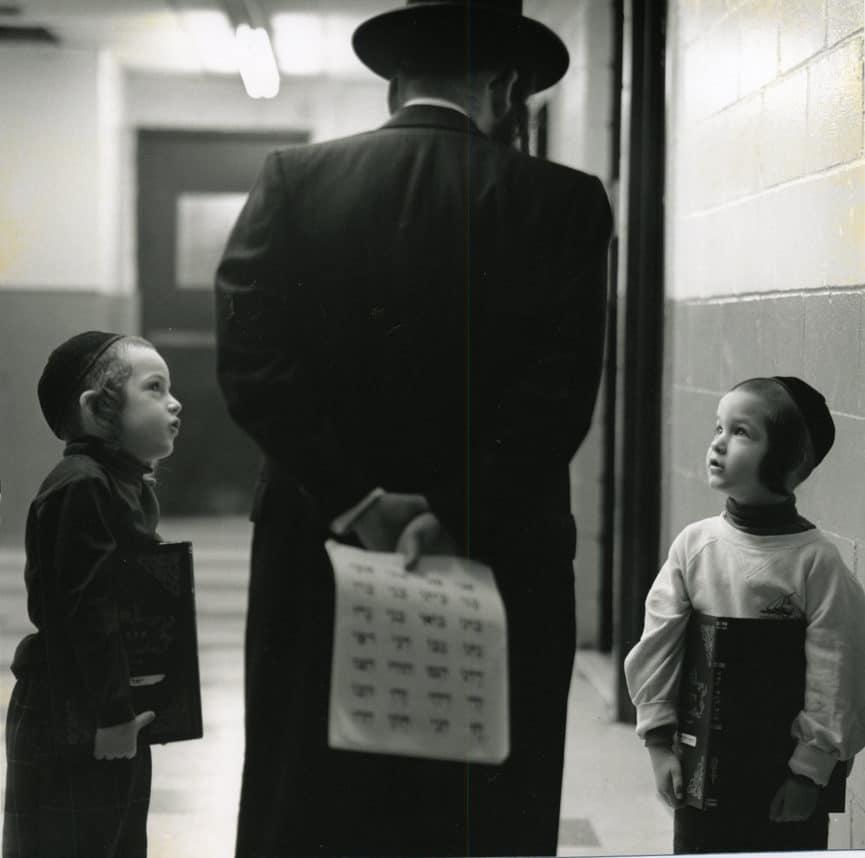
Williamsburg, NY USA (Courtesy of Zion Ozeri)

Whether virtual or in-person, through his curricula or individual photographs, Ozeri’s work, much like Judaism, aims to teach Jews about their history in an insightful way. These are the lessons and pictures children remember and pass down from generation to generation. It isn’t a coincidence that the cover of Ozeri’s Haggadah features a grandfather and grandson sitting together reading Torah.

“Photographs can also tell a story. It’s a language we are using more and more,” he said. “All we [want to] do [is] pass something to the next generation… It’s about education and passing the torch. That is really one of the most important things in Judaism. This is our responsibility.”

“Pictures Tell: A Passover Haggadah” is available for free online.

Photographer Zion Ozeri Showcases Jewish Diversity in Virtual Haggadah Read More »

Meghan Markle Doesn’t Need the Royals — She Has America

Last week, Meghan Markle shook the British Royal Family with a bombshell interview with Oprah Winfrey, in which she described enduring racism within the royal family.

As a confident, self-assured and highly articulate woman, Markle was always going to find it hard to fit into the stodgy, conservative and uber-conformist culture of the royals. It’s no surprise that no love is lost between the two parties.

Although Meghan’s charges of racism against select members of the family are believable, the reason they disliked her is likely not due to her being bi-racial but rather her being American.

I lived for 11 years in Great Britain. Six of my nine children were born there. I ran a successful and renowned student organization in Oxford, and I know how many of the British students viewed me: They liked me as a person, but as an American, they found me loud, brash, moving too quickly and too ready to share my emotions.

Sound familiar?

We forget what an amazing culture clash there is between the United Kingdom and the United States, two countries separated — as George Bernard Shaw said — by a common language.

My own advice to Meghan is this: You don’t need them. You have the love and support of your husband. You live in beautiful California. So what if baby Archie doesn’t have a title? You yourself said the “firm” is stifling. So why burden him with the suffocating straightjacket of illusionary royal titles anyway?

Everything you’ve achieved as a professional and as an actress, Meghan, you’ve achieved on your own. We Americans believe in a meritocracy, where people are judged by their talent, effort and character. We reject the aristocracy of the British, where many people are judged by their birth. That’s why we sent King George III packing a quarter of a millennium ago when he had the insolence to try and tax our tea.

Like Meghan, we Americans have a strange love-hate relationship with British royals that is positively bizarre. When Prince William and the Duchess of Cambridge came to New York in December 2014, they were roundly celebrated.

But because I’m an American, I don’t see them as any more special than the next person. In fact, that’s the very essence of being an American: a detestation of the divine right of kings, a revulsion at the idea that any man or woman is born superior to their fellows. President Biden sits in his chair because he earned it. Prince William, for all his decency, sits there because he was born into it.

Which begs the question: why are Americans — for all our history — so fascinated with this stuff? Why do royal visits dominate New York, which spent much of the war under royalist occupation?

Why are Americans — for all our history — so fascinated with this stuff?

I don’t quite know the answer. Is it a human need to deify humanity? Is it that in an increasingly godless age, we all require objects of worship, or perhaps it has something to do merely with celebrity. The royal family is famous. Or is it that in an age of flimsy and ephemeral novelty, we have nostalgia for something old, unbroken and ancient?

If I had to guess, I would say it’s something entirely different. The underlying attraction to royalty is the human desire for an effortless life, where all things are magical and where all beauty is innate. A meritocracy has its own rewards. It allows ordinary people to become extraordinary, but it always involves hard work: the entrepreneur who must burn the midnight oil to build his business; the rising politician who must travel around the country begging rich people for money to make his candidacy viable.

But then there are people who are all those things — rich, beautiful, wonderful — without any effort at all. They are angels who live among us. They are magical. And Disney, in giving us things like princesses and “enchanted forests” and “Neverland,” where no boys grow old, tapped into our sense of weariness at the constant struggle that life demands and gave us an escape.

Royalty is fantasy in the flesh. An impossible, effortless, wealthy, magical existence that seemingly requires no effort or struggle. I get it. And I’m drawn to that world as well.

But I would take an American hell of blood, sweat and tears over a royal heaven of effortless beauty, prosperity and success. Because the only thing really worthwhile about heaven is that it’s a place we have earned rather than it being handed to us on some magical platter.

So Meghan, let it be enough that Americans admire and appreciate you — an appreciation that is not given but earned. So enjoy your beautiful family and be happy that you’re an American who rejected the divine right of kings centuries ago, even as you married a prince whose real specialness is that he is a loving father and a great dad.

God bless you.


Rabbi Shmuley Boteach, “America’s Rabbi,” is the best-selling author of 30 books and recipient of the American Jewish Press Association’s Highest Award for Excellence in Commentary. He has just published “Lust For Love” with the actress Pamela Anderson. Follow him on Twitter @RabbiShmuley.

Meghan Markle Doesn’t Need the Royals — She Has America Read More »

The Tikvah Fund & the Roots of Jewish Conservatism

The winds of change are blowing hard and fast. Sociologists and economists note both an accelerating pace of change in our modern culture and exponential growth in our technology. Our politics too has veered sharply into an era of increasing instability and national disunity.

The advocates of sober realism and traditional values find themselves recalling the words of respected conservative author and commentator William F. Buckley, Jr. in the mission statement of “National Review.”

It stands athwart history, yelling Stop, at a time when no one is inclined to do so, or to have much patience with those who so urge it.”

If the rise of academic and media orthodoxy and the flaws of central government planning were of concern to American conservatives in 1955, imagine the alarm bells ringing throughout the land from quarters which question intersectional identity politics, a social media cancel culture, and a progressive agenda that promotes a massive expansion of federal debt, invites illegal immigration, rejects Constitutional first principles, and risks accommodating itself to Chinese imperialism and appeasing Iranian nuclear ambition.

For wisdom seekers across the political aisle seeking to understand Jewish responses to the intellectual and practical challenges of our times, as well as to grapple seriously with Jewish morality, history and destiny, a fast-rising organization has been the Tikvah Fund. It offers  university-level scholarship and educational programs for adults, college students and teens through its Tikvah Online Academy, student seminars, video courses, and publications such as “Mosaic” magazine and the “Jewish Review of Books.”

Recently the organization has expanded its role and relationships in Israel as well, with initiatives that educate Israelis through Zionist conferences and the Hebrew language quarterly journal “Hashiloach” (along with major conservative books translated from English); empower law students with liberty principles; and engage and integrate the Haredi Orthodox community into civic affairs.

At its fourth Jewish Leadership Conference this week, some 2,000 paying online attendees re-engaged with the tension between tradition and freedom and sought to re-connect to the best of political conservatism in the service of the American Jewish future, the nation of Israel, and American national security, prosperity, liberty and virtue.

In his opening remarks, executive director Eric Cohen recalled that the first Jewish seder was “a people-forming” event, and that ever since we have annually gathered to re-affirm our attachments to Jewish peoplehood and mission. Each Passover we gather as “a people-renewing” event, in the belief that “the Jews are an exceptional people, that Jewish civilization is a treasure for the world, that the Jewish state is a heroic moral and political achievement, and that American self-government is a precious inheritance.”

Cohen suggested four additional questions for this Passover:

  1. Will we perpetuate or abandon our core Jewish values?
  2. Will we confront or appease our most zealous enemies?
  3. Will we ensure that Israel is our national homeland and will flourish for all time?
  4. Will new Jewish leaders emerge to carry our traditions forward?

The conference focused on subject areas familiar to Jewish conservatives and their friends and allies. Because mainstream American Jewry leans strongly liberal and progressive, Tikvah is deepening the American Jewish conversation by offering an alternative, more conservative take.

Because mainstream American Jewry leans strongly liberal and progressive, Tikvah is deepening the American Jewish conversation by offering an alternative, more conservative take.

To summarize, here is my own brief overview of the conservative take on a few of the areas covered at the conference:

RELIGIOUS TRADITION

Conservatives note our flawed human nature and the role of ethical monotheism as a basis for our legal codes and social mores (food and sexual ethics, avoiding harm to others in our behavior and speech, etc.).

Torah values, and the 10 Commandments (including keeping the Sabbath) are gifts from the Jews inherited by western philosophy. Hebraism is the study of the Bible as foundational to the American Republic.

Our tradition’s stories of right and wrong and of statecraft in the service of a secure and prosperous society informs today’s citizens. From Abraham, Joseph, Moses and Joshua to Washington, Lincoln, Herzl, Jabotinsky, and Churchill, conservatives respect many heroes of political statesmanship.

The American Enlightenment promoted religious liberty, which allows communities to grow and flourish and individuals to enjoy our God-given natural rights to life, liberty and the pursuit of happiness. Private property rights and free markets allow us to be co-creators with God and to commit to charity and community in fulfillment of our religious obligations.

AMERICAN INSTITUTIONS

Political sociologists from Alexander De Tocqueville to Robert Nisbet argued that America’s non-governmental “mediating institutions” (religious, educational, social) were critical to building community, civil society, and good neighborliness. The decline of many of these forums has been noted in such books as “Bowling Alone.”

Advocates for school choice and competition seek a pathway for parents and students to force innovation and to find sources of education that work for their families.

The sensitive discussions of “family values” remains of interest to those who note the declining marriage and fertility rates in the United States. Honest debate exists around the role of government in favoring married couples in the tax code or the nuanced discussion of traditional male / female distinctions in a society that allows for alternative lifestyles.

As transmitters of our heritage and as the first teachers of our children, parents play an essential role in our religious communities and our national life.

The 5th Commandment, “Honor your father and your mother, so that you may live long in the land the LORD your God is giving you” is cherished as a guide to the kind of lifetime loyalty that models compassion and respect as pillars of social order.

STANDING BY ISRAEL

Jerusalem, past and present, is the moral capital of Western civilization. Conservatives have been building a deep brotherhood of shared values and shared interests with Christians who have long promoted restorationism — the successful return of the Jewish people to the holy land.

Political Zionism has been uniquely successful, liberating a small Jewish nation to become a light unto the nations and the pride of world Jewry.

The recent diplomatic breakthroughs brokered by the United States between Israel and the U.A.E. and Bahrain, (the Abraham Accords) as well as improved relations between Jerusalem and Morocco, Saudi Arabia, Sudan, and Kosovo all reveal how wrong was the longstanding consensus that peace for Israel ran through Ramallah, and that dramatically improved Arab-Israeli relations were not possible without solving the Palestinian conflict first.

SECURITY

There are many variables that support our personal safety and national security. A growing economy that incentivizes work, social cohesion based on shared attachments to American exceptionalism, equal justice under the rule of law and civil order, secure borders, close diplomatic alliances, and U.S. leadership on behalf of free trade lanes and global human rights.

The lesson of contemporary European history — the absence of Jewish sovereignty and the destruction in the Holocaust — is that Jewish power is required for our self-respect and self-defense. As Israel is threatened, still, by Iranian terror and its proxies Hamas and Hezbollah, its close strategic alliance with the United States remains a pillar of its security.

So too, the United States must remain robustly committed to peace through strength vis a vis a rising China, which has aggressive ambitions for global economic, trade, political, and military dominance.

While we have universalist passions, we are more effective in healing the world if we come from a rooted place of particularism. Long after redemption from Egypt and receiving the law at Sinai, Jews have survived as a people with hard-earned and well-learned practical sensibility. Enjoying the fulfilment of both Herzl’s dream of a Jewish state and the American dream, Jewish conservatives seek to preserve our spiritual and political tradition.


Larry Greenfield is a Fellow of The Claremont Institute for the Study of Statesmanship & Political Philosophy.

The Tikvah Fund & the Roots of Jewish Conservatism Read More »

Life as a Calling

Ever since my adolescence, I intuited that there must be more to life than the material dimension of human existence. That the human story is about so much more than what Karl Marx called “Homo faber” — the human being as the producing and manufacturing animal.

This deep-seated intuition, that there’s more to life than the race for income, was factually and empirically corroborated for me back in 2006. During that year, the General Social Survey in the United States revealed some astounding findings about what the Dalai Lama called “the art of happiness.”

The survey found that the practitioners of the following professions reported the highest rates of career satisfaction in their work: clergy, educators, nurses, fire fighters, artists and therapists. What do all these professions have in common? They are all about so much more than “making a living.” Rather, they are about elevating and enhancing the lives of others.

Many of us are brainwashed from our very childhood by the market economy ethos that inner contentment is to be achieved by pursuing professions which carry exceptionally high monetary dividends.

But as Albert Einstein wisely discerned, “not everything that counts can be counted.” Existential satiation, implies the general social survey mentioned above, is to be derived by having a sense of a calling in life, by cultivating a constant inner striving to contribute to the well-being of others and the overall advancement of human welfare.

This germane existential insight about the inherent connection between altruism and happiness is exemplified in the very opening word of the book of Leviticus in the Torah.

That word is “Vayikra,” which means “Called upon.” Usually, when God allegorically addresses Moses in the Torah, the text uses the word “Vaydaber” (“And God spoke”) or “Vayomer (“And God said”).

So why is it that the opening word of the Torah book discussing sacrifices depicts God as “calling upon” Moses, rather than God merely “saying” to Moses, or “speaking” to Moses?”

The answer is, as the Chassidic tradition intimates, that the Torah is addressing here the universal Moses lurking within each and every one of us. The Torah is alluding here to the pristine altruistic streak inherent in every human soul. We are all being existentially summoned and challenged here. We are all “called upon” by a cosmic voice, which is also an inner voice, to see life not only as a solipsistic socio-economic endeavor, but also as a sacred altruistic vocation.

The Torah is addressing the universal Moses lurking within each and every one of us.

If you feel a little depressed, a wise relative advised me once, then “go and volunteer.” For few things in life enhance and invigorate the human spirit more than the knowledge that you are useful, relevant and helpful to those around you. That you truly make a difference in people’s lives, and that you lead an impactful existence by enriching and beautifying the lives of others. In the words of Rabbi Hillel in the Talmud “the rest is commentary,” now go and “be a blessing” (Genesis 12:2).

I leave you today with the sagacious words of the great Bengali mystical poet, Rabindranath Tagore: “I had a dream, and dreamt that life was happiness. I awoke and found that life is service. I served, and found that in service happiness is to be found.” Shabbat Shalom.


Rabbi Tal Sessler, Ph.D., is the author of four books in philosophy and contemporary Jewish identity. He is the Senior Rabbi of Sephardic Temple Tifereth Israel, and the incoming Dean of the Rabbinical School at the Academy for Jewish Religion in California, where he also teaches Jewish philosophy.

Life as a Calling Read More »