
fbpx

March 2, 2021

An Open Letter to the Co-Founder of Black Lives Matter

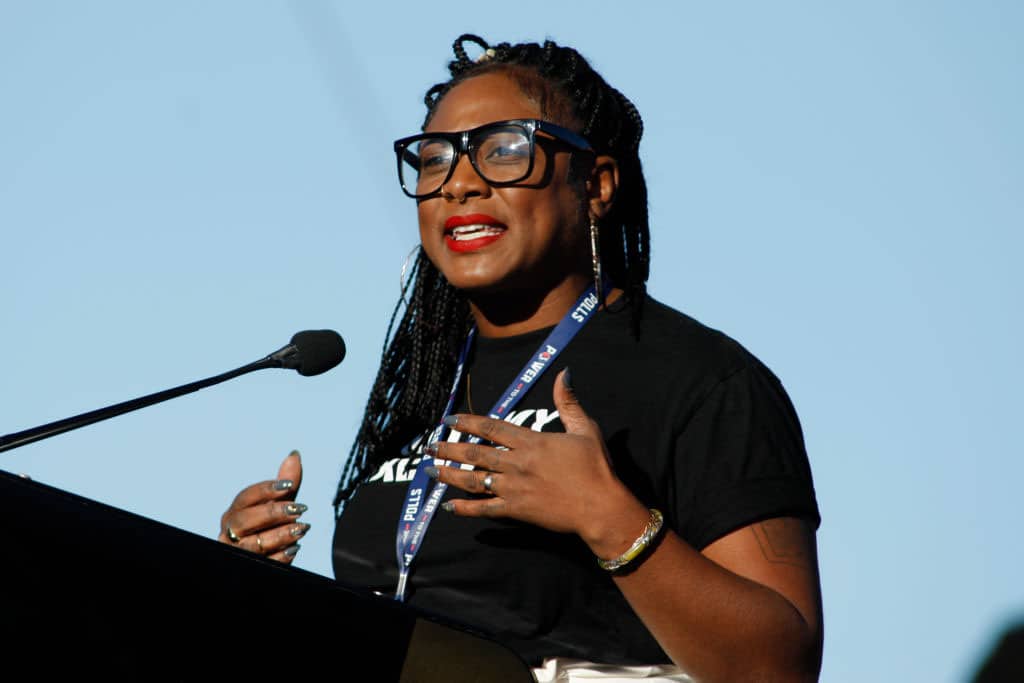
Dear Alicia Garza,

I thank you for initially accepting the award the World Values Network offered you to salute your efforts in fighting racial injustice and prejudice. The event, which took place on February 18 in celebration of Black History Month and African-American and Jewish brotherhood, turned out to be one of the most moving of my life. That truly beautiful celebration responded to President Biden’s call for renewed national unity.

It was an evening that you especially would have enjoyed, Alicia, given your singular accomplishments in having co-founded Black Lives Matter while being the step-daughter of a Jewish father who identifies as Jewish. But you withdrew two weeks before the event with a public tweet to which I now wish to respond.

African American and Jewish brotherhood has been the passion of my life, ever since my mother worked alongside an African American woman at a Los Angeles bank when I was a small child. By the time I arrived as Rabbi at Oxford University in 1988, I had set a goal of establishing an organization that celebrated the unity of the two communities. In 1993, I appointed Cory Booker president of the Oxford University L’Chaim Society; over the course of nearly 25 years, we studied hundreds of hours of Torah together and gave countless public speeches together celebrating African American and Jewish identity.

Right after the tragic attacks of 9/11, I called Rev. Al Sharpton — whom I had debated at a New York church a few months earlier and took to a kosher steak house immediately after — and told him that the mass murder of our fellow citizens called for a moment of unity. “Come with me on a solidarity mission in support of victims of terror to Israel.” He immediately agreed, and his visit to Israel was co-hosted by Israeli Foreign Minister Shimon Peres.

I was criticized by members of my own community for hosting Rev. Sharpton in Israel, just as I was sharply attacked in several publications for giving you an award at this year’s gala. Financial funders withdrew support. In both instances, the complaint was about alleged support for anti-Semitism, with Rev. Sharpton over the events in Crown Heights in 1991 and with you and BLM’s stance on Israel and BDS.

But I didn’t care. I am dedicated to my mission of re-creating the bonds of brotherhood that united Martin Luther King, Jr., the greatest American of the twentieth century, and Rabbi Abraham Joshua Heschel, the twentieth century’s most eloquent voice for Jewish spirituality in the English language. That commitment has led to, among other things, my becoming the first white morning radio host on the legacy African American radio station, 1600 AM WWRL in NYC, as well as using my platform on a giant Utah radio station in September 2005 to passionately advocate for African American families displaced from New Orleans by Hurricane Katrina (which led, unbelievably, to the cancellation of the show).

I am dedicated to re-creating the bonds of brotherhood that united Martin Luther King, Jr. and Rabbi Abraham Joshua Heschel.

Yet on February 9, you tweeted that you were no longer a part of our event after you were “made aware” of the “political positions of this group.” It seems that it may have been Linda Sarsour who played a role, as she publicly thanked you on the same day for withdrawing.

The organizer of our gala was my friend and colleague Gabrielle Bell. Like yourself, Gabe is African-American, Jewish, and openly gay. I remember how happy he was when you accepted and how disappointed he was when you succumbed to pressure and withdrew. He saw me weather condemnation for inviting you. But I held fast. I was thrilled to recognize your efforts at protesting moral abominations like the shooting of Trayvon Martin, when you launched the #BlackLivesMatter hashtag.

At the time, I wrote in the Huffington Post, “a young African-American teenager, wearing a hoodie against the rain, died, seemingly, for carrying a can of iced tea and a bag of skittles. If that isn’t a tragedy, then the word has no meaning.” It’s one of the reasons that after the murder of George Floyd, I wanted the Jewish community to join you to protest that despicable abomination.

You and I could have worked well together, Alicia, even as we would have likely disagreed sharply on Israel, which is no doubt the “political positions” you are referring to. Such disagreement would have been fine with me. One of the things I love about Israel is that it is an open democracy that tolerates dissent. At our 2014 gala, we honored Sean Penn, who gave a memorable address in which he referred to the West Bank as “undeclared territories.” He argued that the ranks of those unjustly imprisoned around the world include Palestinians in Israel and repeated that the label of anti-Semitism is “too often used to discredit dialogue.” He was never censored for expressing his opinion, just as you would not have been. We know that brotherhood does not mean agreement. It means love despite disagreement.

As for Linda Sarsour, here’s the weird thing about her unprovoked attacks against me. In 2016, I met her on the Steve Harvey Show, where I had a warm and extremely civilized dialogue about Jewish and Islamic relations with her on national TV. I praised her for her pride in wearing the hijab. I try to do the same by wearing my yarmulke and tzitzis.

I could, therefore, hardly believe how she had no issue becoming quickly radicalized against the Jewish community. In April 2017, Linda spoke alongside Rasmea Odeh at a dinner and told the audience that she was “honored to be on this stage with Rasmea,” a member of the PFLP convicted in 1969 for her involvement in the bombing of an Israeli supermarket, an event that took the lives of two young students and maimed nine more. You have a big heart, Alicia, and I know you will appreciate that the Jewish community was pained to hear Linda praising a terrorist with the blood of two innocents on her hands. Like the African American community, we Jews know all too well what it’s like to be murdered and have no one care.

That day Linda also extended her gratitude to her “favorite person in this room, Imam Siraj Wahhaj,” a man known for hateful views toward the LGBTQ community, what he calls “a disease of this society.” In 1992, Imam Wahhaj expressed his desire to burn down a gay-friendly mosque in Toronto, if only he could. His admonition of “woe to the Muslims who pick kafirs [non-Muslims] for friends” implies that Wahhaj is no fan of peaceful coexistence either, a fact I find surprising considering that Linda holds “radical love” to be a tenet of her faith, which most certainly is in normative Islam.

It’s no wonder that in August 2020, President Biden condemned Linda Sarsour in the strongest terms. His campaign said, “Joe Biden has been a strong supporter of Israel and a vehement opponent of anti-Semitism his entire life, and he obviously condemns [Sarsour’s] views and opposes BDS, as does the Democratic platform. She has no role in the Biden campaign whatsoever.”

Alicia, my advice would be to take President Biden’s advice on both counts. Let’s engage in a moment of unity, bringing together the Black and Jewish communities. And let’s listen to President Biden and reject the hatred of people like Linda Sarsour who seek to separate us.

I look forward, God willing, to speaking and meeting.

God bless you.


Rabbi Shmuley Boteach, “America’s Rabbi,” whom the Washington Post calls “the most famous Rabbi in America,” will release his new book “Holocaust Holiday: One Family’s Descent into Genocide Memory Hell” in April. Follow him on Instagram and Twitter @RabbiShmuley.


An Open Letter to the Co-Founder of Black Lives Matter Read More »
Have We Lost All Shame?

Although I have about 40,000 followers on my different social media accounts (Twitter, Instagram, Facebook, etc), I try to engage as many of them as possible. Unless it is a two-way street, the wonderful opportunity social media provides to read countless perspectives might be lost. And while it is hard to separate the “trolls” and the “bots” from authentic users, I do my best.

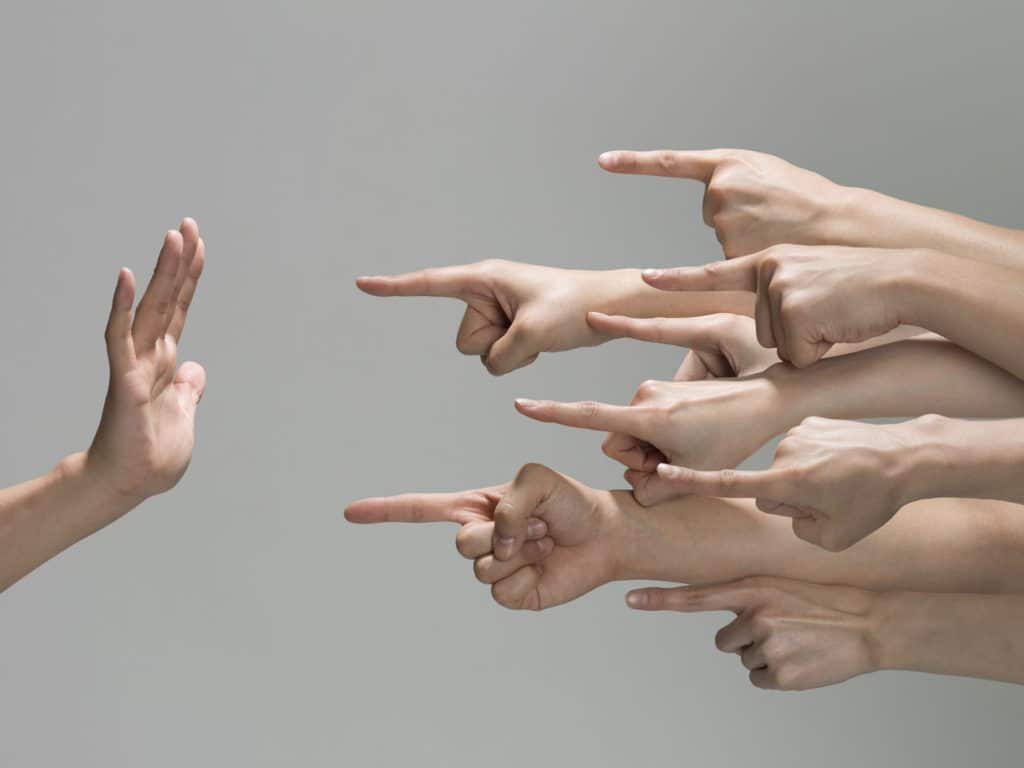
However, over recent months, I have seen more than the usual hateful and vituperative comments. During this pandemic, shaming and bullying reached a boiling point. And it has been Jews online — some of whom I have met personally and known for years — who have been shameless.

The first emotion mentioned in the Torah is shame. Adam and Eve felt shame for disobeying Hashem, which the Torah describes as a positive kind of shame. As Genesis teaches, shame can be a positive emotion; when one is doing something morally flawed, they should feel shame.

Yet those of us who stake a claim to the moral high ground ought to think twice before we shame others. The Talmud teaches us that “a person would rather experience physical pain than shame” (Talmud, Sotah 8b).  Shaming can be as brutal and violent as a physical blow. Later on in the Torah, after Cain killed Abel, Cain’s lack of shame was so problematic that he had to go through a long cleansing process.

The Talmud also teaches us that there are “three signs that signify that a person has a Jewish essence: he is compassionate, ashamed of doing wrong, and seeks to do acts of kindness” (Talmud, Yevamot 79a).

Recently, however, some Jewish social media users have become shameless while remaining intent on shaming others. Numerous Jews have been “doxxed” by other Jews, an assault when your adversaries dig up and mass publish your identifying information, such as your address, phone number and place of work. Sefaria employee Russel Neiss doxxed @ClaireRedacted as revenge for her being “too vocal” in her critiques of left-wing Jews, just months after user Tasha Kaminsky openly offered a monetary prize for Claire’s personal information. As a single mom, Claire felt this violation endangered her young child.

A similar attack happened to Anna Rajagopal from anonymous users in an attempt to silence her left-wing views on racism. Rajagopal, who is 20, then had someone create an account devoted to mocking her. And Kaela Curtis was on the end of a vitriolic bullying campaign in which people publicly accused her of “Jewface” and cosplay because she’s in the process of converting to Judaism.

Now, much of this ugliness online has centered around the California Ethnic Studies Model Curriculum (ESMC). That topic has divided the Jewish community between those who are against the existence of ethnic studies altogether and community leaders who want to have all Jews represented in it. Younger, “online activists” are attacking these seasoned Jewish organizations and leaders, claiming they are “getting duped into thinking antisemitic ideologies” just by supporting ethnic studies in any form.

It hurts my heart to see people threaten and harass individuals, and it also reflects poorly on the Jewish community when we publicly attack — not debate — an ideologically diverse slate of prominent Jewish organizations like the JCRC, ADL, AJC, JCF, Jewish Federation, StandWithUs, JPAC, The Holocaust Museum, JFCS and JIMENA. These institutions and the many volunteers who support them have worked hard to include Jews in the curriculum and remove anti-Semitic content like the Boycott, Divestment and Sanctions (BDS) Movement.

That’s not to say it is unacceptable to speak out, question or debate the way a Jewish organization is run. In fact, last week I asked my Twitter followers what they thought of the little-known fact that the American Sephardi Foundation has an executive director who is not Sephardic. But there is a fine line between debating how an organization is run and claiming that Jewish institutions and leaders are anti-Semites because they do not support one’s own political stance. That assertion is not a valid criticism; it is a personal, if not libelous, attack.

There are legitimate debates and grievances one can have with the Ethnic Studies Curriculum, particularly specifics in the sample lesson plans. However, much of the criticism is of no substance or is just pure misinformation, like false claims that attacks, such as the one on the synagogue in Poway, are “not even on the document” when they are. Even worse, some people are shaming anyone who doesn’t oppose ethnic studies altogether as anti-Semitic.

These instances demonstrate that “the online mob” — as Bari Weiss once called it — knows no boundaries when it comes to shaming the people who disagree with them. When you bully those you disagree with into silence  — be it on racism, Ethnic Studies or left-wing politics —  the only voices you will hear are your own in a narcissistic echo chamber. Sure, it will be a comforting environment to you, but it is a boring and false one — deception of reality.

When you bully those you disagree with into silence, the only voices you will hear are your own in a narcissistic echo chamber.

Judaism teaches us to distinguish between healthy shame and harmful shame. Too much shame is at the core of anxiety and depression and can lead people, particularly youth, to self-harm. Not having shame at all leads people to dangerous extremes, for example, by doxxing a Jewish single mother and endangering her child or by viciously attacking other Jews who have different opinions than one’s own.

A few weeks ago, a friend of mine, who works at a synagogue, received intense harassment by a Jewish Instagrammer who was not a member of her congregation. It was someone who didn’t even live in the same state. The Instagrammer, who has a Jewish account with around 15,000 followers, was upset that the Temple’s account posted a generic infographic about the definitions of Ashkenazi, Sephardic and Mizrahi Jews. The post was apolitical, as is the synagogue’s account in general. But because this Instagrammer was opposed to these academic standard definitions, she sent threatening and abusive messages to the synagogue. She terrorized them until they removed the post, but by that time, I had already reposted it on my Instagram account.

Ultimately, this Instagrammer threatened to sue the synagogue if it did not compel me, a private unaffiliated individual, to remove my repost. This harassment spanned weeks, with countless phone calls in which temple staff were screamed at and abused. The synagogue tried to get this Instagrammer to talk to me directly about the post, but she refused. Instead, she spiraled onward, threatening a local Jewish organization with frivolous lawsuits. Regretfully, I have become accustomed to these kinds of threats. I would never be swayed to post or not post on that basis. Still, no matter how accustomed one is, it is never comfortable being the target of a violent, unpredictable mob.

I wish I could say this behavior was the irrational nonsense of one deranged individual, but this level of shamelessness in pursuit of shaming others has become the norm. This is an unhealthy shame and unbecoming of an online Jewish community that faces so much real danger from anti-Semitism. This online shaming (which, I admit, I’ve even engaged in a heated moment or two) is not only bad for unity but also strengthens the voices of bullies and misanthropes.

An October 2020 report by researchers from the Georgia Institute of Technology and Harvard Medical School found that “the uncertainties surrounding the COVID-19 pandemic have led to multi-faceted mental health concerns, which can be exacerbated with precautionary measures such as social distancing and self-quarantining, as well as societal impacts such as economic downturn and job loss.” These researchers found that all of the symptoms of vexed mental health have significantly increased during the COVID-19 crisis.

The online attacks on me took a personal toll, exacerbated by the fact I have limited access to the support system I rely upon during non-COVID-19 times. It was truly debilitating to see people calling me names, claiming I hate Jews or Jewish subgroups and even misrepresenting a year-old tweet in Hebrew in an attempt to “cancel” me. These attacks by Jews have been as virulent and irrational as those from white supremacists and anti-Israel activists.

My thickened skin is going to be of little service to the young Jews who are seeing this vitriol, the teenagers who are bullied and the Jews who belong to other marginalized groups that are being intimidated against speaking out about the discrimination they face. Just because youth are being bullied by adults doesn’t mean they can go toe to toe with them without serious emotional damage.

Apologies, my own included, are important to move past this cycle of online shaming. But unless we commit to kindness and good faith as a community, the damage to our youngsters and future leaders may be irreparable. I pose this as a challenge to everyone: for the next month, the month of March and Passover, do not attack individual Jews online. Even if you disagree with them, do not go after them directly; post your comment without attacking anyone directly. I commit to doing this too. The only shame that should occur is a healthy one — the one you feel inside when you fail to live up to your kindest self.

This article has been edited for clarification.


Hen Mazzig is an Israeli writer, speaker and a senior fellow at the Tel Aviv Institute. Follow him: @HenMazzig

Have We Lost All Shame? Read More »