fbpx

March 1, 2021

Golden Globes: Sacha Baron Cohen Wins Big, and Other Fun Jewish Moments

(JTA) — Sacha Baron Cohen’s Borat character is going out on a high note.

Cohen won best actor in a comedy or musical, and his “Borat” sequel upset the Disney+ adaptation of “Hamilton” by winning best film in the category at the Golden Globes on Sunday night.

Like its predecessor, “Borat Subsequent Moviefilm” poked fun at the blatant anti-Semitism found in parts of Eastern Europe. It features a scene with Holocaust survivor Judith Dim Evans in a synagogue who helps Borat (almost) come to grips with his backward views about Jews.

But just before the film’s release, Evans’ daughter sued Cohen, claiming that her mother (who passed away after filming) did not want to appear in a comedy. That was just one of the many lawsuits and obstacles that Cohen said he has had to endure as a result of his prank disguise method of making comedic films and shows, which beyond “Borat” include the Showtime series “Who is America?”

And that’s why he said recently that his disguise days — the Borat character included — are over. In his acceptance speech for the best comedy actor award, Cohen thanked his bodyguard, who he said protected him from getting shot twice during the filming of the Borat sequel.

Cohen also couldn’t help but poke fun at Donald Trump, whose presidency motivated Cohen to take formerly uncharacteristic public stands against hate speech and social media disinformation.

“Hold on, Donald Trump is contesting the result,” he said after winning the actor award. “He’s claiming that a lot of dead people voted, which is a very rude thing to say about the HFPA,” the Hollywood Foreign Press Association.

Despite the historic nature of the Globes ceremony — hosts Tina Fey and Amy Poehler were featured in a split screen from opposite coasts, and small in-person audiences were made up only of essential workers who were all tested for COVID-19 — the show had its usual share of fun Jewish moments. Some Jewish stars won marquee awards, while others lost in major categories.

Here’s what you might have missed:

Dan Levy pushes inclusion

The final season of “Schitt’s Creek,” the riches-to-rags comedy featuring the Jewish father-son team of Eugene and Dan Levy, finished its historic award show run with a couple of accolades: Golden Globes for best TV comedy series and best actress in the same category for Catherine O’Hara.

Inclusion was the theme of the evening, as several presenters — including the show’s hosts — called out the Hollywood Foreign Press Association for not having a single Black member, and for snubbing acclaimed shows by Black creators, including HBO’s “I May Destroy You.” Multiple Globe winners also used their acceptance speeches to push the film and TV industry to work harder at bringing diverse voices to the table.

Dan Levy put the theme at the heart of his speech.

“This acknowledgement is a lovely vote of confidence in the messages ‘Schitt’s Creek’ has come to stand for: the idea that inclusion can bring about growth and love to a community,” he said. “In the spirit of inclusion, I hope this time next year this ceremony reflects the true breadth and diversity of film and television being made today because there is so much more to be celebrated.”

Aaron Sorkin quotes Abbie Hoffman and condemns Jan. 6

Sorkin, the heralded Jewish screenwriter, won his third Globe for best screenplay for a drama film, for “The Trial of the Chicago 7,” which chronicled the backstory of the riotous protest at the 1968 Democratic National Convention.

Cohen was nominated as well for best actor in the drama category for his performance as Abbie Hoffman, a very Jewish icon of the anti-war movement of the 1960s and ’70s. (He was beaten out by the late Chadwick Boseman for “Ma Rainey’s Black Bottom.”)

In his acceptance speech, Sorkin said that Cohen emailed him a quote from Hoffman during each day of filming. (Cohen wrote his college thesis at Cambridge University on the American civil rights movement, so he’s pretty familiar with the era.)

“None of them ever made it into the film, but I saved the emails,” Sorkin said. “I don’t always agree with everything that characters I write view or say, but here’s something Abbie said: ‘Democracy is not something you believe in or a place to hang your hat. But it’s something you do. You participate. If you stop doing it, democracy crumbles.’”

He added: “I don’t need anymore evidence beyond what happened on Jan. 6 to agree with this.”

Norman Lear gets a “progressive” tribute

Lear, the Jewish creator of several memorable TV shows, is still winning at 98.

The Globes gave him the honorary Carol Burnett Award, which since 2019 has recognized “outstanding contributions to television on or off the screen.”

In narrating a video tribute to Lear, comedian Wanda Sykes called him the “most progressive” television producer in history for bringing uncomfortable issues around race and class into mainstream American TV screens through series such as “All in the Family” and “The Jeffersons.”

Cynthia Nixon revives the Bernie Sanders meme

Nixon — the actress, former New York gubernatorial candidate and Congregation Beit Simchat Torah member — was nominated for best supporting actress in a dramatic TV series for her role in the “One Flew Over the Cuckoo’s Nest” spinoff “Ratched.” She didn’t win, but she made plenty of headlines for her appearance via video stream, which included a life-size cardboard cutout of Bernie Sanders in his now iconic Inauguration Day pose wearing a pair of homemade mittens.


View this post on Instagram


A post shared by Cynthia Nixon (@cynthiaenixon)

Ben Stiller shows off his baking skills

Stiller presented the best actress in the musical or comedy category, but got everyone’s attention by bringing food to the stage.

After lamenting a full year of the COVID-19 pandemic, the Jewish actor said: “Like many of us, I’ve used that time to really look inward and grow. I’ve come to fully understand the nature of cryptocurrency. I read a book. I finally got around to dying my hair gray. And like so many other resilient Americans, I learned to bake.”

Then he revealed a banana bread in the shape of a Golden Globe trophy.

Other Jewish winners and losers

– Songwriter Diane Warren won her second Globe for best original song. Her tune “Io si” featured in “The Life Ahead,” in which the iconic actress Sophia Loren plays a Holocaust survivor.

– The Pixar flick “Soul,” which one JTA writer argued borrows from an ancient Jewish idea, won best animated film.

– Shira Haas was nominated but didn’t win the best actress in a limited TV series category. She drew acclaim for her performance in “Unorthodox,” about a young Hasidic woman who leaves the community.

– Jane Levy was nominated in the best actress in a comedy or musical category for her role in “Zoey’s Extraordinary Playlist,” but lost to O’Hara.

– Al Pacino is not Jewish, but he played a Jewish Nazi hunter with a Yiddish accent in Amazon’s “Hunters.” He lost in the best TV drama series actor category.

Golden Globes: Sacha Baron Cohen Wins Big, and Other Fun Jewish Moments Read More »

There’s Something About Mary

If you’re petty like me, it’s not easy to meet someone who has a better social life than you. It’s even more of a blow to your ego if that seemingly fabulous person is in their 90s.

Before the pandemic, I’d call my friend, Mary Bauer, and ask if she had time to talk.

“I’m just on my way out to have lunch with a friend, darling,” (she always calls me “darling”).

“How about if I call you tomorrow?” I’d ask.

“Oh, darling! I have to give a lecture in the morning and I have two get-togethers after that!”

It’s easy to see why Mary, a survivor of Auschwitz-Birkenau, was so busy. At 92, she was not only a sought-after speaker but also an awesome breakfast, lunch or dinner date due to her indescribable joie de vivre and everything-out-on-the-table personality. In fact, she has a better personality than most people I know who are in their 20s and 30s.

I first met Mary in 2018, when we both delivered remarks to young professionals at Sinai Temple on the eve of Yom HaZikaron — Israel’s Day of Remembrance for victims of terror and fallen soldiers — and Yom Haatzmaut, Israel’s Independence Day. Mary described her childhood in Hungary and what it was like to have barely survived the infamous Nazi Death March through the merciless winter. She was more charismatic, energetic and engaging than any speaker I’d ever heard, and that list included presidents and prime ministers. With shaky knees, I followed her talk and spoke about growing up in post-revolutionary Iran, but I felt like Salieri performing after Mozart.

We hit it off right after the program ended. For reasons beyond my comprehension, Mary seemed intrigued by me. Perhaps she saw that I was in awe of her. Perhaps, after her own traumatic childhood, she was dismayed to hear that children in Iran were (and still are) forced to scream “Death to Israel” and “Death to America.” I became ever so slightly obsessed with her because, in addition to her courageous life story, she’s such a hoot.

Mary was born in Budapest, Hungary in 1927. An only child, she was a quintessential “Daddy’s girl” and had an idyllic childhood until 1944, when German soldiers marched into Hungary and demanded that Jews pack their suitcases (without being told where they were going). At the railroad station, boxcars were ready to take them to Auschwitz.

Holocaust survivors Betty Cohen and Mary Bauer. (Screenshot from YouTube/Jewish Journal)

At Auschwitz, Mary was forced to weave the shorn hair of Jewish inmates into items the Nazis used during the war effort. As a society, we talk a lot about the inhumanity inflicted against Jews during the Holocaust, about stolen jewelry and other heirlooms, yellow stars and reprehensible tattoos, rape, disease and intolerable suffering. But there’s something about imagining a teenage girl with a shaved head, sitting in a concentration camp, weaving shorn hair from Jewish men, women and children that rips my soul apart.

Mary’s story of Auschwitz doesn’t end with being joyfully liberated by the Russians. Knowing that their time was up, Nazi soldiers marched Mary, her mother and countless other Jews out of the concentration camp for miles in the snow. In the month of January. In Poland.

During that Death March from Auschwitz to Ravensbrück, Mary’s mother suffered severe frostbite and lost several toes. She gave up, fell with her face in the snow and waited for the Nazis to shoot her dead. Mary, who spoke German (as well as several other languages), calmly told them not to waste a bullet on her mother, because she was going to die anyway. When the SS soldiers weren’t looking, she helped her mother back up to her feet.

She and her mother were the only members of their family to survive the Holocaust. After the war, she went back to Hungary and ran into a non-Jewish friend who was wearing her clothes. “You’re back?” the girl said in embarrassed shock.

Like a child awaiting a bedtime story, I often ask Mary to tell me about the decades after the war, when she moved to America, and especially about her visit to Israel in 1967, during which she and her husband found themselves trapped in Jerusalem during the Six-Day War. She stood with other jubilant Jews in the Old City when news arrived that the kotel had been liberated and the city reunited.

Every story that Mary tells would merit its own column and lecture. She’s one of the best people I’ve ever known. That’s why, before the pandemic, I made sure to have her in my home as much as possible.

Every story that Mary tells would merit its own column and lecture.

“Mary, will you come to us for the second night Passover seder?” I asked in 2019.

“Darling, are you sure your family will want me there?” she responded. Not surprisingly, she was the hit of the evening. And we spared no authentic experience (I think it was her first time being whacked with big, pungent scallions as part of the Persian Passover custom during the recitation of “Dayenu”). She whacked us right back and had a blast.

“Mary, please come for dinner the first night of Rosh Hashanah, before anyone else reserves you,” I asked later that fall, trying to beat out her sons, daughters-in-law and grandchildren.

“Darling, is it okay if I come?” she asked. We treated her to my mother’s famous Persian black eyed peas and tongue dish (as part of the “head of the year, rather than the tail” symbolism of the simanim). Again, she was the hit of the evening.

“Mary, what kind of donut do you prefer?” I asked a few days before she was set to join us for Hanukkah.

“Darling, all I want is to be with you and your beautiful family,” she responded. By that point, our sons, then two and four, were so accustomed to having “Ms. Mary” in our home that they jumped for joy when she knocked on the door. It also helped that she always arrived with toys and sweets. We lit the hanukkiah together, sang songs, and Mary settled on the couch to read a book she had brought for my kids.

There was a 90-year difference between her and our youngest son. But you could instantaneously see the connections in their souls as he placed his head on her shoulder.

When Mary hears that I keep fully kosher and observe Shabbat, she asks whether I think she’s a “bad Jew.” But in my eyes, she’s irrefutably holy.

The last time she came to our home was a Shabbat lunch just weeks shy of the pandemic, in winter 2020. She was joined by two world-renowned Iranian authors, but, as usual, she was the hit of the meal.

That’s the thing about Mary. You have to be careful when inviting her to your home, because, quite unknowingly, she always steals the show.

The pandemic robbed our family of Mary’s physical presence in our home. After a year, it’s getting unbearable. I finally conceded and asked her to lunch outdoors a few months ago, just the two of us.

“Darling, can we go to a Persian restaurant?” she asked. Dressed to the nines in summery white and green gingham (she thought she looked shabby), she said it was the first time she had left the house for something other than a short walk around her West Hollywood neighborhood in six months. Her silver hair was lustrous, as usual.

Mary, I know you’re reading this because you’ve told me you read each and every one of my columns. And when you informed me that you recently received your second dose of the COVID-19 vaccine, thanks to the amazing USC Shoah Foundation, I wanted to invite you over for a whole weekend, until I realized no one in our home had yet been vaccinated.

So I find my mind wandering to that night of Hanukkah in 2019, when our then-four-year-old sat next to you and asked if you wanted to hear him sing, “Hinei Ma Tov.”

“Darling,” you said to him, “Let me hear your song.”

And in his broken Hebrew, he began to sing: “How good and how nice is it when brothers sit together,” as you held his hand and the same luminous twinkle emanated from both of your eyes.


Tabby Refael (on Twitter @RefaelTabby) is a Los Angeles based writer, speaker and activist.

There’s Something About Mary Read More »

STAY TUNED: On Layers

Q: Is acting putting on layers or taking off layers?

The actor is responsible for inhabiting a character, not only so the audience can believe it, but so the actor can. In your preparation, you need to empower yourself so that you can fully inhabit the character and live freely in the moment. How do we do that?

Thinking in layers is great. What are the layers? Layers of our humanity include our belief systems, emotions, intellect, life experience, unconscious and conscious minds, personality, and more. Actors consider all of these aspects of character each time they take on a role.

We can begin to prepare by considering the given circumstances: Who you are, What are you doing, Where you are, Why are you doing it, and When is it. Simply answering those questions intentionally begins to connect you. Each question, if answered in depth, can evoke enormous amounts of information for you.

Let’s considerer WHO you are. You can look at the script and write down all of the things the writer says about your character, all of the things other characters say about your character, and all of the things you say about your character, then compare them and see which elements are the same or different. This should be thought provoking.

The character has as many layers as you do. But certain parts or yourself may be turned up and others turned down depending on the character’s circumstances. So if you’re playing a boxer and you don’t box, you learn to box. In learning how to box, certain aspects of your own personality will be turned up or turned down. If you are a very gentle and sensitive person in your daily life, what happens to that part of you when you have to punch someone out? It doesn’t go away, but it expresses differently. All of the layers are there, they are just repositioned inside of you, so that you can truthfully live in the character’s circumstances.

A good script is going to give you what you need to experience, and you are responsible for motivating it. You can mine the script for all the facts about your character’s life that you can, and then write a Character Biography so you understand the characters history, before the story starts. In this exercise you may invent relationships and events that shaped the character’s life, so you can choose what really moves you. This will help you to integrate what’s interesting to you personally with the given facts in the script. Let’s say you’re playing Mark Wahlberg’s character in The Fighter. That great script gives so many facts, but it’s up to you to make those facts sing to you. How would you feel if your brother’s addiction messed up your life? Your goal is to position your inner life so that it’s correct for your character. And you can do this for each of the given circumstances, until you understand why YOU need to play the character. Then, you’ll be free to step into it and live.

Acting isn’t something you do. Instead of doing it, it occurs, I you’re going to start with logic, you may as well give up. You can have a conscious preparation, but you have unconscious results.” – Lee Strasberg

Acting is a form of self-expression. It’s not becoming someone else, and it’s not playing make believe. It’s about using the fiction of being someone else to express something about yourself.” – Maggie Gyllenhaal 


Kymberly Harris is an actor’s director. She specializes in character-driven stories, whether the genre is drama, comedy, thriller, or action. Her extensive experience as a method acting coach to professional actors of all ages has led actors to seek her out to direct them towards their best performances in film, television, and theatre projects. Kymberly is a private coach to select clients and an instructor at The Lee Strasberg Film and Theatre Institute. She is also the founder of @firsthand.films.

STAY TUNED: On Layers Read More »

MA School Committee Member Resigns After Saying “K—” On Air

A member of the Lowell School Committee in Massachusetts announced on February 26 that he is resigning after saying the anti-Semitic slur “k—” during a February 24 interview on a local television program.

The member, Robert Hoey Jr., said in an interview on Channel 8’s “City Life” that “we lost the k—, oh I mean the Jewish guy” when talking about his former colleague Gary Frisch. “I hate to say it, but that’s what people used to say behind his back,” he added, saying that Frisch “was the guy in charge of our budget.”

Following a backlash to his comments, Hoey announced in an emotional Facebook Live video that he will be resigning from his position on the committee and apologized for his remark. “I’m so sorry to that individual that was hurt by this, and I’m sorry to every individual across the country,” he said. Hoey also acknowledged having a “big mouth” and called himself “worse than Archie Bunker” and urged people to denounce the slur across the country.

Anti-Defamation League (ADL) New England tweeted, “We welcome Robert Hoey’s resignation & acceptance of responsibility which allows the community to heal and reaffirm that #antisemitism #racism #bigotry have no place in #LowellMA. Each of us has a continuing responsibility to call out #hate in real time.”


Robert Trestan, director of ADL New England, told the Jewish Journal of Greater Boston that Hoey’s use of the slur was used in context of Frisch being involved in budgetary matters, which “enforces an anti-Semitic stereotype about Jews and money.” He also pointed out that after Hoey’s use of the term, no one on “City Life” called him out on it.

“If you hear someone say this and you remain silent and don’t call it out, you know, in some ways you’re just as culpable,” Trestan said. “One of the primary things we teach kids in school is that you should be calling out racism, anti-Semitism and hate in real time. Imagine if a teacher used that word in a school. What would the school do to the teacher?”

MA School Committee Member Resigns After Saying “K—” On Air Read More »

Israeli Director Vies for Oscar

In the runups to the annual Academy Awards, true blue and white members of the Tribe around the globe root for the Israeli entry to make the shortlist of foreign language films, vying for an Oscar in the recently renamed “international features” category.

In a frequent scenario, akin to always a bridesmaid but never a bride, Israel’s past entries have made the lists of five finalists 10 times, but have never won the coveted Oscar.

This year the faithful were disappointed when 15 semi-finalists were chosen among entries representing 93 countries. Israel’s submission “Asia”, an intimate mother-daughter film about Russian immigrants in Israel, didn’t make the cut.

In contrast to the U.S. and global mass media, which focuses its attention of the best actor/actress/director nominees and winners, this column traditionally concentrates on the achievement of Jewish/Israeli talent.

Thus we reported recently that for the 2021 Academy Awards, a group of Israelis from Tel Aviv University and the startup industry Aminom had won the special Academy Award in the Sciences and Engineering category. The group developed a wireless video technology now used throughout the global film industry

However, recently Hillel Newman, Israel’s consul general in Los Angeles, phoned this reporter to draw attention to an overlooked Israeli candidate. He is Tomer Shushan, a 33-year old director, whose 20-minute film “White Eye” has made the short list of 10 finalists among 174 entries.

(For full-length foreign language movies, each country’s film academy enters one movie. However, in the short film category, producers and directors can submit their own works.)

“White Eye” tackles an Israeli problem quite familiar to Americans — prejudice by much of the population and police against non-white inhabitants, especially if they are immigrants.

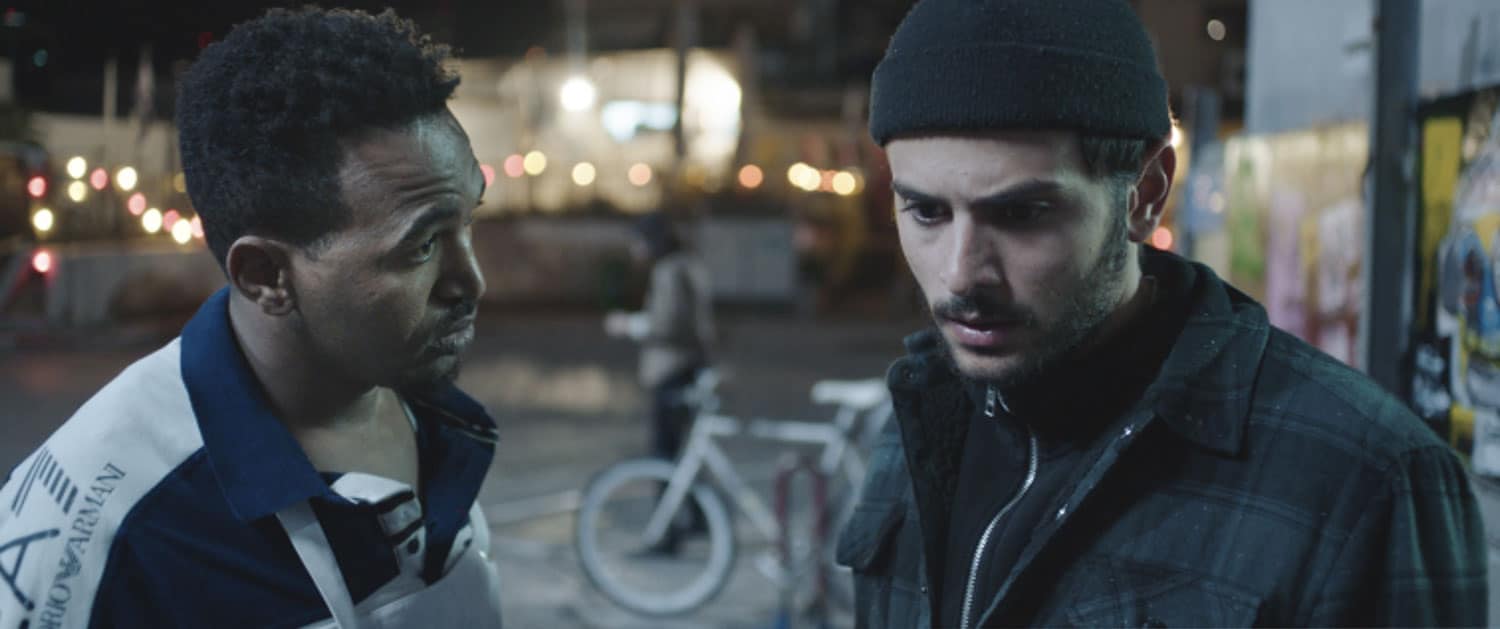
Shot in one take during one night in a squalid quarter of Tel Aviv, the film’s protagonist is Omer, a light-skinned middle class native Israeli. In the opening, he spots a bicycle recently stolen from him during a beach outing. While he tries to break the bicycle’s lock, Yunes, a black Eritrean immigrant, taking a break from his job in a nearby meat packing plant, spots Omer and claims that he owned the bicycle and had bought it for 250 shekels, roughly $75.

Confrontation over a stolen bicycle and racial identities pit Israeli native Omer (Daniel Gad on right) against Eritrean immigrant Yunes (Dawit Tekelaeb) in Israeli Oscar contender “White Eye” (Photo by Tomer Shushan)

Omer, played by actor Daniel Gad, calls the police and two cops — one wearing a kippah — discover that Yunes has overstayed his visa— meaning that he, his wife and child would likely be deported back to their strife-torn African native land.

Now Omer has twinges of conscience, walks over to a nearby ATM and withdraws 250 shekels, which he hands to Yunes.

The final scene is a shocker, which viewers must discover for themselves and which closely resembles Shushan’s own real life experience when his bicycle was stolen

In a phone interview director Shushan said that he chose the film’s title as an allusion to white eye as an affliction of blind people and implies that many of his fellow Israelis were blind to the racial prejudice in their country. “Though less intensive than in the United States,” he observed, there is considerable prejudice in Israel, and among the police, against dark-skinned inhabitants.

Statistically, there are some 80,000 Eritreans and Sudanese in Israel, with half of them living in the Tel Aviv area.

Shushan, himself the descendent of Moroccan Jews, said he had experienced prejudice, though less in “liberal” Tel Aviv than in Jerusalem. Asked for an example of such prejudice he had experienced personally, Shushan recalled that one day in class, his teacher announced that the following day a session would be dedicated to a remembrance of the Holocaust. However, young Tomer decided to skip school that day “because I wanted to do something else,” he said.

Next day, the teacher told Tomer to bring in his parents for a talk, during which the boy told the teacher that he didn’t care about the Holocaust. He was then suspended for three days.

Whether the reader considers that punishment just or not, the incident illustrates the gulf between Israelis of different descents. But that the gulf does exist is shown by “lots of demonstrations, especially in Tel Aviv, against domestic prejudice,” Shushan said.

Harking back to his own experience underlying the film, Shushan said that he felt sorry for the alleged thief, told the police to go away, gave 250 shekels to the immigrant and took the bicycle back. However, the latter continued to cry, saying he was afraid that the police would come back and that everybody was against him.

By that time, Shushan said, he “didn’t like the bicycle anymore” and consigned it to the fate illustrated in the finale of the film.

The total cost of the film came to $34,000, of which 90 percent was covered by the government-backed Makor Foundation. Shushan is now trying to raise finds for a feature film on a similar theme, titled “Between Sand Grains.”

Speaking of off-beat films, Variety magazine reports that Stone Canyon Entertainment has started production on the film “Who Are the Marcuses?” The film focuses on Holocaust refugees Lotti and Howard Marcus, who lived modestly in a San Diego apartment but bequeathed half a billion dollars to Ben-Gurion University of the Negev to study water management — the largest single gift in the history of Israel.

Israeli Director Vies for Oscar Read More »

Israeli Supreme Court Rules State Must Grant Citizenship to Non-Orthodox Jewish Converts

(JTA) — Israel must grant citizenship to Jews who converted to Judaism in Israel under non-Orthodox auspices, its Supreme Court ruled Monday, possibly igniting another round in the long-running government battle over who the state should recognize as Jewish.

The decision, written by Chief Justice Esther Hayut, comes less than a month before national elections.

Israel’s Law of Return offers automatic citizenship to anyone with at least one Jewish grandparent. The state also generally recognizes those who converted to Judaism under Orthodox standards.

Past Supreme Court decisions have mandated that the state also recognize Jews who converted outside of Israel under non-Orthodox authority, provided they live in a recognized Jewish community. Non-Orthodox converts, such as Conservative or Reform Jews, however, still often face hurdles in obtaining Israeli citizenship and are sometimes denied.

Monday’s decision extends the right to citizenship to those who converted to Judaism under non-Orthodox auspices in Israel itself. The petition that spurred the court ruling was filed in 2005 but was postponed for more than a decade because the court wanted to give the government time to resolve the matter through legislation.

“The petitioners came to Israel and went through a conversion process in the framework of a recognized Jewish community and asked to join the Jewish nation,” Hayut wrote in her ruling, according to Haaretz.

Rabbi Gilad Kariv, a leading Reform rabbi in Israel and a Labor Party candidate for the Knesset, or parliament, called the ruling a “foundational decision of the High Court” in a Facebook post.

Aryeh Deri, the head of the Sephardi haredi Shas party, wrote on Facebook that the decision was “misguided, very troubling, and will cause arguing and a difficult rupture among the people.”

Successive government coalitions, based on their political leanings, have attempted to either liberalize or narrow Israel’s conversion standards. But such efforts at reform usually fall flat. Haredi Orthodox politicians object to laws that would broaden the range of recognized conversions, while attempts to make requirements stricter have provoked backlash from organizations representing American Jews, the vast majority of whom are not Orthodox. That has effectively meant that any change in conversion regulations comes from court decisions.

Once they become citizens of Israel, non-Orthodox converts still face restrictions.

Once they become citizens of Israel, non-Orthodox converts still face restrictions. Several issues of personal status in Israel, including marriage and divorce, are controlled by the country’s haredi Chief Rabbinate. Because the Chief Rabbinate does not recognize non-Orthodox converts as Jews, they have no way to marry legally in Israel.

Others who obtain Israeli citizenship under the Law of Return but are not considered Jewish by Orthodox standards — such as immigrants with only one Jewish grandparent — similarly cannot marry legally in Israel. Legislation to address that issue has been stymied as well by haredi opposition in parliament.

“Today Israel’s Supreme Court decided that Israel should be a national home for all types of Jews,” said Mickey Gitzin, the Israel director of the New Israel Fund and a longtime Israeli activist for religious freedom. “It is a day to celebrate, even as the road towards equality for all — especially those who are not Jewish — remains long.”

Israeli Supreme Court Rules State Must Grant Citizenship to Non-Orthodox Jewish Converts Read More »

Newsom Likely to Face Recall — But Removal Is a Much Higher Bar

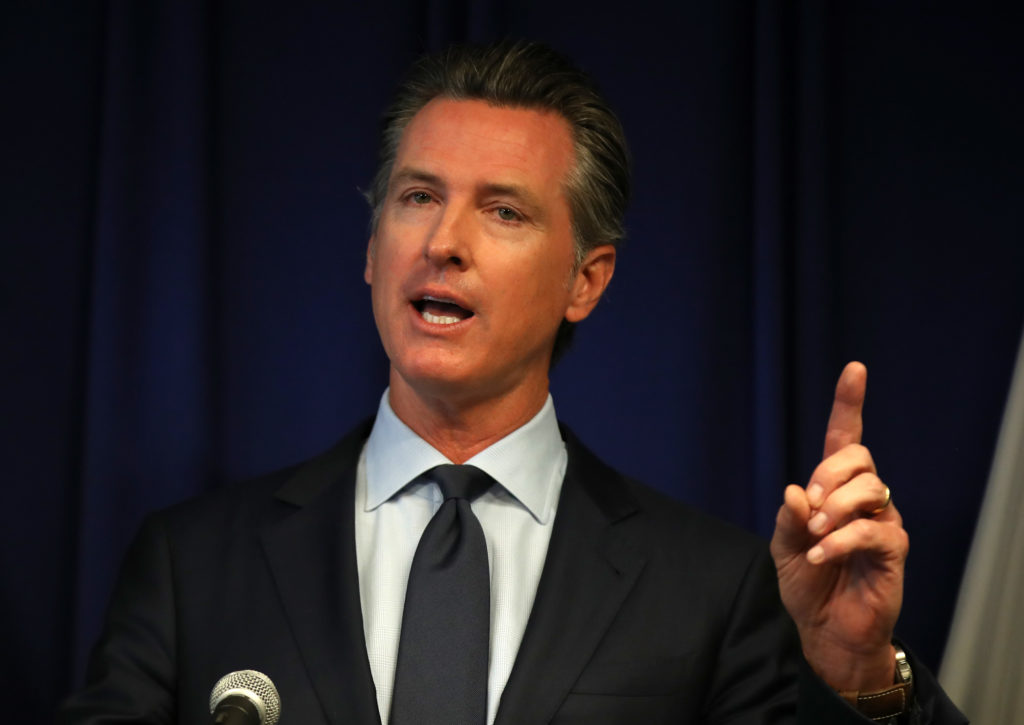
It seems like only eighteen years have passed since California last threw its governor out of office during a recall election. It was back in 2003, when the Arnold Schwarzenegger Govern-ator Express prematurely derailed Gray Davis only a year into his second term. That’s the last time a Republican ascended to the governor’s office in our heavily Democratic state, but a pandemic-fueled recall of Governor Gavin Newsom appears increasingly plausible.

In many ways, Newsom is in a much stronger position than Davis. The biggest difference to date is the lack of a Schwarzenegger-ian (Schwarzenegger-esque? Schwarzenegger-ish?) candidate to captivate public interest the way the actor utilized his celebrity to attract attention to his campaign. In addition, California’s heavily-blue tint has deepened over the years. Democratic voter registration is now roughly double that of the GOP, and Newsom’s landslide victory just over two years ago was far more one-sided than Davis’s close call the year before his recall. Unlike the energy crisis and rolling blackouts that drove public sentiment against Davis, the coronavirus has been a worldwide emergency that is much harder to pin on any single political leader. And Newsom has benefited tremendously from his ability to use the Trump administration as a foil throughout the crisis.

But Newsom’s vulnerabilities are considerable. Voters know he did not cause the pandemic, but they are less understanding about the closed businesses and schools, the state government mishaps and scandals and, most damaging, the governor’s horrendous decision last fall to attend an exclusive dinner at an expensive restaurant while ignoring the social distancing rules that he had been urging on his constituents. The perceived double-standard of the mask-less dinner — coupled with the fact that his own children had been attending in-person private school classes when most California public schools were relying on distance learning — has breathed life into what had been a floundering recall effort.

As a result, the recall’s backers have dramatically increased their signature-gathering efforts and now appear likely to collect enough names to qualify for an election later this year. Although it will be several more weeks before the recall’s status becomes clear, Newsom’s own behavior and heightened schedule of public appearances suggests that the governor and his advisors have shifted from a strategy attempting to prevent the recall to instead preparing a campaign to defeat it.

Newsom’s own behavior suggests that he is preparing a campaign to defeat the recall.

Even though Newsom’s public approval ratings have dropped since his restaurant adventure, it does not appear that California voters have turned dramatically against him. But while his overall poll numbers hover around fifty percent, he receives much lower marks on his handling of the coronavirus. Since a recall will almost certainly be a referendum on the pandemic, Newsom’s team may be tempted to delay the election for as long as possible to increase the chances that our post-COVID lives will have returned to normal by the time we vote.

The recall ballot would include only two questions. The first will be an up-or-down vote on whether Newsom should be removed from office. The second will list all of the candidates running to replace him. At least three prominent Republicans have already committed to running, including businessman John Cox, former San Diego Mayor Kevin Faulconer and activist Mike Cernovich, with former Trump official Ric Grenell likely to follow if the recall does qualify. But in a heavily Democratic state, Newsom’s most serious challenge could come not from the right but from his left.

Most prominent Democratic officeholders have vowed not to challenge Newsom — although former Los Angeles Mayor Antonio Villaraigosa has been noticeably non-definitive about his plans. And there are already earnest conversations among party loyalists about whether to put a just-in-case candidate on the ballot as a safety guard should the first question against Newsom pass.

Even if the recall does happen, Newsom will be a strong favorite to retain his office. But voters are suffering from months of COVID-driven fatigue, and any politician who wanders into their eyesight becomes a convenient target for their anger. In a local campaign, they would remove a mayor. In last November’s national election, they replaced a president. In a statewide recall, the name they’ll see will be Newsom’s.


Dan Schnur teaches political communications at UC Berkeley, USC and Pepperdine. He hosts the weekly webinar “Politics in the Time of Coronavirus” for the Los Angeles World Affairs Council & Town Hall.

Newsom Likely to Face Recall — But Removal Is a Much Higher Bar Read More »

Shocked by the Revelations About Amos Oz? ‘Deal With It,’ Says His Daughter.

Galia Oz, 56, is an established author of children’s books. Her “Shakshuka” book series won prizes and was adapted for TV and for the stage. But a new book she just published for adults made her more famous than all the previous books combined. It is a book she wrote about her fraught relationship with her father, novelist Amos Oz.

The irony here is almost mesmerizing: Oz tells a story about a tyrannical, sometimes violent, oppressive father. But if that tyrant was not a famous author and great orator, her story would not be nearly as interesting as it is. Galia has become famous for metaphorically killing her father (who died three years ago). But in practice, her book is both a repudiation of him and an admission that without him, her tale would probably be cast as mundane.

It is a sad story and a sad affair. On Saturday night, Galia gave a long TV interview in which she repeated the allegations made in the book. It is easy to believe her. She feels that her parents did not truly love her. She was clearly lonely and scared. Once, she witnessed her father slap her mother. She was twenty at the time. Her mother, Nilli, does not categorically deny it. Her statement following the interview was crafted with care: “Amos was never a violent husband… We lived together for sixty years of great love.” But it does not say anything about the incident her daughter describes. Did it happen?

The attentive observer is led to believe that it did happen. But what happened matters less than the way it was perceived by the participants. The observer is led to understand that some family peculiarities and failures were interpreted differently by certain family members. One daughter sees “a routine of sadistic abuse,” while the other daughter, son and mother see something else: an occasional mishap, a family member who tends to inflate the importance of not unusual family feuds, a loving father that isn’t perfect, a troubled daughter that couldn’t get over herself.

The book, thin and purposefully dry, became the talk of the town, and not because of its brutality or dramatic narrative. It seems clear that Amos Oz did not deal with his daughter with great patience. She claims he belittled her. He thought — and said — that the music she loves is inferior to the “real music” that he adores. Once he lost his temper and poured cold coffee on her. Although these examples do not always shock, they succeed in communicating why Galia feels haunted.

Although these examples do not always shock, they succeed in communicating why Galia feels haunted.

Here is a small example: Galia was already an adult, and her book received a raving review in a small online publication, signed by a reviewer whose name she couldn’t recognize. She examined the style and realized it was her father. He wrote it and then published it under a false name. She demanded that the review be removed from the site and confronted her father. She interpreted it as abuse, and considering their troubled relations, it is easy to understand why. Yet the reader wonders if this is not also an awkward, clumsy attempt of a father to win his daughter back. The rest of the family seems to think that a lot of what Oz did in the decades since Galia cut ties with her family was just that — an attempt to win her back, to better understand why she feels the way she does.

No reader can feel what Galia feels. No reader has a right to doubt that she feels the way she does. Still, the reader is free to interpret this story with his own eyes. Some Israelis were quick to announce that Oz no longer deservers the admiration of his readers, that he should be taken off the literary and cultural pedestal. But Galia Oz asks for no such thing. “Deal with it,” she teases readers and those watching her on TV. Deal with the fact that the daughter of the great author describes him as an abusive tyrant. Deal with the fact that on at least one occasion he slapped his wife.

There are those who find it a difficult tale to deal with. When the New York Times reported the story, it referenced events in other countries as relevant to this Israeli affair. “Galia Oz’s book has disrupted Israel’s literary world and cast a shadow over her father’s legacy at a time when a new social consciousness has laid low flawed cultural figures in the United StatesFrance and other places around the world.”

Maybe because I find most of the “new social consciousness” ridiculous and juvenile, I have no trouble dealing with the story of Oz. Or maybe it is because (like Galia) I always thought that Oz was not as great a writer as he was made to seem. Maybe because I never thought that a great novelist is also a beacon of morality and intellectual vigor. So now we know that Oz’s cloak concealed a less than exemplary family man. Now we know that he could be petty and cold and self-centered. So what? The books are the books, the author is the author. He is not the first author to have a less than exemplary family life. He is hardly the first beacon of culture whose personality is less than appealing.

Galia is annoyed when people question her motivation to write the book. They ask: why now, when he is no longer here to respond to the allegations? Why at all — why ruin the name of Oz for a generation of adoring readers? But why is it even necessary for her to explain her decision to publish? Is this not what all authors do? Is this not what her father did when he wrote his masterpiece, “A Tale of Love and Darkness”?

Oz wrote books because he felt a need to write books. His daughter wrote a book because she felt a need to write a book. And yes, the book made me and many other people a little sad. But if writing it would make Galia Oz a little less sad, I’d consider it a price worth paying.

Full disclosure: I work as the chief non-fiction editor for Kinneret-Zmora-Dvir Publishing, by which Oz’s book was published. But I had no involvement with this specific book.

Shocked by the Revelations About Amos Oz? ‘Deal With It,’ Says His Daughter. Read More »

Why Jewish Vaccine Advocates Shouldn’t be Condescending Towards Those Who Are Hesitant

We are living in complicated and difficult times. Our society is divided and in tension. As we prepare for Yom Hashoah, crucial lessons from the Holocaust are especially relevant for this pandemic and, in particular, vaccination efforts.

The success of the vaccine rollout is crucial for our ability to overcome this pandemic and the various societal inequities it has created or exacerbated. Distribution of vaccines has been unequal, unclear and frustrating. Even some with access to vaccines have opted not to take them. The attitude we take toward those who are hesitant may determine the success of distribution efforts and thus how smoothly we move beyond this pandemic.

Many people respond to those who express vaccine hesitancy with harsh judgment and condemnation. But I advocate a different approach: We should treat individuals who hold these views with respect and listen to their concerns. For many, especially in communities of color, there are legitimate fears and mistrust of the medical establishment as a result of past injustices, such as the unethical Tuskegee syphilis study, in which African American men were unknowingly injected with syphilis by government health officials and left untreated for decades despite the availability of effective treatments.

For many, especially in communities of color, there are legitimate fears and mistrust of the medical establishment as a result of past injustices.

Jews are no strangers to injustices in the medical field. We have also been mistreated by doctors and researchers at many points in our recent history, most notoriously in Nazi Germany, where Josef Mengele conducted inhumane — and deadly — experiments on concentration camp prisoners.

Here in the United States, Jews have been subjected to various non-lethal, but still injurious, forms of discrimination and prejudice — so much so that Jewish communities once found it necessary to establish their own hospitals, including Kaspare Cohn Hospital near downtown Los Angeles, the forerunner to today’s Cedars-Sinai.

In the American medical field of the early twentieth century, physicians routinely labeled Jewish patients as “subhuman,” “dirty,” “nervous” or “difficult,” and even created specific phrases and diagnoses for these unwelcome patients, such as “Hebraic Debility” and “Jew-Neurasthenia.” At this time, there was widespread missionizing of sick Jews in American hospitals, often including deathbed conversions and baptisms, while staff at some hospitals forced Jewish patients to listen to readings of Christian scriptures.

This sordid history helps explain why the Jewish community needs to express solidarity, understanding and respect toward those who are hesitant to get vaccinated, particularly toward communities of color, with whom we have historically shared so much in common.

Once we recognize the legitimate concerns stemming from the horrors of the past, the question becomes: Have we learned any lessons, and have we put in place appropriate safeguards to prevent a recurrence?

Thankfully, I’m confident that the answer is “yes.” While there is still more to be done and some skepticism is healthy, it’s clear that all of the currently-approved COVID-19 vaccines were developed with very high standards of oversight and safety, and they have proven to be both safe and effective.

I am thus a strong advocate of vaccination and encourage everyone to get vaccinated as soon as they are able to do so. But as Jews, we should move forward with understanding and empathy. We should embrace the ideals of the Torah that stress remembering what it was like to be mistreated and oppressed, and thus show empathy and inclusion (“welcome the stranger”). Hopefully, if the vaccination campaign gains momentum, we will be able to welcome and embrace each other in communal gatherings again very soon.


Rabbi Dr. Jason Weiner is the Senior Rabbi and Director of Spiritual Care at Cedars-Sinai and Rabbi of Knesset Israel Synagogue of Beverlywood.

Why Jewish Vaccine Advocates Shouldn’t be Condescending Towards Those Who Are Hesitant Read More »