Eight decades after the Holocaust began, The U.S. Holocaust Memorial Museum will host a ceremony on January 27, the anniversary of the liberation of Auschwitz-Birkenau, to convey the urgent responsibility to protect the lessons and legacy of Holocaust history and to defend the truth.
Although the museum has been closed due to the coronavirus, it will stream the ceremony with other Holocaust education programs on its Youtube page starting at 10 A.M. PT. Following the live broadcast, a recording will be available on the museum’s YouTube page.
The ceremony will feature testimonies from Holocaust survivors who volunteer at the museum with remarks from U.S. Holocaust Memorial Museum Director Sara J. Bloomfield and the Auschwitz-Birkenau State Museum in PolandDirector Piotr Cywiński. Also in attendance will be Maryland Senator Ben Cardin and South Carolina Senator Tim Scott, representing the U.S. Holocaust Memorial Council; Thomas Lutz, head of the Memorial Museum’s Department of the Topography of Terror Foundation in Berlin and Jacques Fredj, director of the Mémorial de la Shoah in France.
Bloomfield told the Journal that International Holocaust Remembrance Day holds a strong meaning this year because it comes three weeks after a “man wearing a Camp Auschwitz sweatshirt was part of an attack on the U.S.Capitol.”
“As we remember the victims of the Holocaust — and the potential of their lives and the horror of their deaths — we must also remember how and why they became victims,” Bloomfield said. “Understanding what happened and what failed to happen challenges people from all walks of life to think about the dangers of unchecked anti-Semitism and racism and their own roles and responsibilities. Holocaust remembrance and understanding is about the future as much as the past and more urgent now than ever.”
The ceremony starts on January 21 from 10 a.m. to 10:30 a.m. PT. To learn more about the virtual ceremony or to see the full lineup of International Holocaust Remembrance Day events, click here.
When the chief of staff of the IDF speaks about the Iran nuclear deal, knowing full well that a new American administration is looking to renegotiate it — that’s a big deal. When the chief of staff of the IDF, Aviv Kochavi, said that had the 2015 deal materialized, Iran would have obtained a nuclear bomb — that’s a clear message concerning future expectations.
Yesterday, at the Institute for National Security Studies’ annual conference, General Kochavi did not mince words. And there’s no doubt that he knew what he was doing and why. Any return to the 2015 deal would be a bad idea, he said. Any return to the deal with slight improvements would also be a bad idea, he said. He did not say “no” to any deal. He said “no” to any deal that resembles the previous deal.
Two things stand out here.
One: Kochavi is clearly and unequivocally attacking a parable that has become common among some Israelis and foreigners who write about Israel and the United States and Iran. The false story is about a radical prime minister, Benjamin Netanyahu, whose views are incompatible not just with those of the U.S. administration but also with those of his own generals. You can read such stories in publications such as The New Yorker, Haaretz, The Boston Globe, Bloomberg and many others. Some accounts are more cautious and admit that there is a debate within Israel. Some are less cautious and plainly state that Netanyahu is the lone alarmist who would not listen to his military experts’ sound advice.
Such a parable can no longer fly. Kochavi is Israel’s top general, and his words were clear. Naturally, his position is going to make him a target of criticism. More than one of his critics will mention the fact that Kochavi just started his third and last year as chief of staff — that is, unless the government decides to give him a fourth. So, for Kochavi, there could be a personal interest in keeping no daylight between him and the prime minister. But most criticism will be by the generals who disagree with him, and they will censor him because for thinking what he thinks and for expressing his thoughts in such a public way.
There could be a personal interest in keeping no daylight between him and the prime minister.
The second thing that stands out is the timing. The Biden administration just began its term, and a high-ranking Israeli official is already drawing a line in the sand that the administration must not cross. One of Kochavi’s early critics, General Amos Gilad, who has vast experience as a Defense Ministry official, asked this morning, “What good is it to attack President Biden? In the past, we have attacked Obama and created tensions. Who said it is the chief of staff’s job to say such things?”
Gilad poses two good questions. Kochavi did not “attack” the new administration and certainly did not attack President Biden. But he did step into a political minefield by publicly revealing his position when a sensitive process of negotiations is just beginning. Is it good to have such a position aired at this juncture? Is it good to have it aired by the professional military chief rather than by the political leadership? General Gilad was highly critical of this move. “The question is not what the chief of staff thinks. As soon as the chief of staff uses such strong language, critical of the policies of an incoming U.S. administration, this could be perceived as defiance. It is not the place of the chief of the IDF to say such things. The prime minister is the one who ought to formulate a policy and decide whether to have a public confrontation with the new president who is barely a week in office.”
So, was Kochavi wrong to make the speech? One way to defend his decision is to argue that Kochavi made the speech not in spite of who he is and the position he holds but rather because of who he is and the position he holds. He made the speech because he wanted to clarify that Israeli opposition to a renewed deal is not some caprice of the prime minister but rather the product of a professional process in the IDF. He made the speech not because he wanted to step into a political minefield but rather because he wanted to remove Iran from being politicized as a serious topic of discussion. In essence, Kochavi said, forget about political maneuvering, forget about U.S. mistrust of Netanyahu, forget about Israel having another election, forget about the United States having a Democratic administration that wants to reverse Trump’s policies. Forget about all these, and let me tell you how I see this matter when I examine it with the seriousness of the professional soldier.
Will Biden’s team listen to what he said rather than get annoyed by the fact he said it? If it does, Kochavi made the right choice. If it doesn’t, Kochavi is appropriately concerned.
As the state awaits a final vote on California’s Ethnic Studies Model Curriculum in a few short weeks, the controversy surrounding the educational plan has seized the Jewish community’s imagination — and its fears.
Now is the time to take stock of our achievements and continuing challenges as a community, after 18 months of efficacious advocacy to eliminate anti-Jewish, anti-Israel content and for including Jewish narratives in the curriculum, which will be taught in California’s K-12 public schools.
But first, we must understand the purpose of ethnic studies, the goals of its advocates and how we, as Jewish Americans, relate to it.
At its core, ethnic studies is about marginalized communities telling their own stories. Throughout history, students of Color have not seen themselves accurately or adequately represented in the classroom. Fifty years ago, African American, Hispanic and Latino American, Asian Pacific Islander American and Native American academics and leaders founded the ethnic studies movement to put forth academic disciplines that take back ownership of their stories, cultures and customs.
As Jewish Americans, we can certainly relate. For too long in the classroom, our identity has been flattened primarily to that of a white religious minority, taking little note of our global history, cultures, traditions and oppression — not to mention erasing Jews of Color and Middle Eastern Jews almost entirely. Ironically, those seeking to exclude us from ethnic studies are resting their laurels on this very distortion, despite overwhelming evidence of rising anti-Semitism in this country. Our crucial inclusion in the curriculum presents the chance to impart — on our own terms — the richness of our multicultural, multiracial, multidenominational people.
To be sure, there are key individuals within the ethnic studies movement clearly opposed to our community’s goals. Yet our primary concern with ethnic studies lies not with communities vying to tell their own stories but with special interest groups manipulating the discipline for anti-Jewish political purposes and for advancing anti-Semitic tropes as well as the Boycott, Divestment and Sanctions movement (BDS).
Thanks to a diverse statewide coalition of Jewish organizations — including my own, the San Francisco-based Jewish Community Relations Council (JCRC) — and tens of thousands of community members petitioning their elected leaders and the authors of the curriculum, the plan’s original denigrating content about Jews and Israel, such as anti-Semitic rap lyrics, has been removed. Moreover, two Jewish American lesson plans have been added: one on Jews from the Middle East and North Africa, the other a holistic Jewish American lesson plan.
The holistic lesson plan obliterates the notion that Jews are a monolithic group and clearly defines anti-Semitism. It teaches that Jews hold intricate identities that cannot be defined by religious, racial or ethnic terms alone. It also makes a central argument for Jewish inclusion in ethnic studies: that while white, white-passing and light-skinned people in this country maintain very real and systemic advantages — something that we inside the Jewish community must rectify when it comes to Jews of Color — the color of our skin as Jews has never shielded us from hatred from both extremes in our politics.
The holistic lesson plan obliterates the notion that Jews are a monolithic group and clearly defines anti-Semitism.
So where do we go from here?
While the current draft of the model curriculum is dramatically better than earlier iterations, the groups seeking our exclusion have advocated for a reversal of our gains. We must remain engaged and vocal in this process until the final adoption of the state curriculum in just a few weeks.
And as every city and school district across California considers how to best implement the ethnic studies mandate for its own unique populations, JCRC will continue organizing and educating parents, students and community leaders to ensure that all districts’ curricula are consistent with the law, do right by our community and foster pride.
It is often said that as goes California, so goes the nation. School districts and state education departments across America are taking note of our process and are starting to explore adopting ethnic studies — either as a semester course similar to California’s or by integrating ethnic studies into their social studies framework. In short, our end result here will shape the national landscape for years to come.
In the coming months, we must remain clear-eyed: Again, our fight is not with ethnic studies itself but with those manipulating our state process to drive a wedge between us and other marginalized communities.
The Jewish community has much in common with the founders of the ethnic studies movement. We share the understanding that to protect and advance justice for our community, we must define the narrative about our own history, oppression, culture and traditions, rather than allowing others to define our narrative for us.
All communities engaging with this discipline, including ours, must learn to navigate difficult issues of privilege and race, which also means having the courage to engage with uncomfortable truths. If we expect our neighbors to understand both the richness of our identities and the many dog whistles of our oppression, we must be prepared to do the same for them.
Our continued success in California — and the nation — depends on it.
Tyler Gregory is the executive director of the Jewish Community Relations Council of San Francisco, the Peninsula, Marin, Sonoma, Alameda and Contra Costa Counties. He is originally from San Diego.
“[I] f I were a Jewish child in a school using this curriculum,” reads a public comment from a clinical psychologist at UCLA about the California Ethnic Studies Model Curriculum (ESMC), “would I feel called out, that I deserve to be shamed and isolated and that any bias, prejudice or hatred directed against me or my ethnic group would be deserved and justified?”
It’s a valid question. A recent article by Pamela Paresky (one of this article’s authors) and Joel Finkelstein expressed dismay about the ESMC and what it had to say about American Jews.
Tyler Gregory, director of the Jewish Community Relations Council, was, among others, instrumental in getting Jews included in the curriculum and suggests that we should be celebrating the “efficacious advocacy” that eliminated “anti-Jewish, anti-Israel content” and won “Jewish inclusion and representation.” He argues that “For too long in the classroom, [Jewish] identity has been flattened primarily to that of a white religious minority, taking little note of our global history, cultures, traditions and oppression – not to mention erasing Jews of color and Middle Eastern Jews almost entirely.”
But after completing this curriculum, students will have learned almost nothing about any aspect of Jewish culture, history, or traditions. About oppression, however –– which is mentioned over 60 times in other parts of the curriculum and just once in reference to Jews –– what children will be taught about Jews is that “internalized oppression” leads Jews to change their names in order to hide their jewishness. And they will learn that “this practice of name-changing continues to the present day.”
What children will not be taught is the actual history of the oppression of Jews. They will not learn about the forced conversions of Jews under Islam or The Inquisition. They will not learn about the long history of discrimination, pogroms and expulsions from scores of countries in Europe, the Middle East and North Africa. They will not be taught to recognize anti-Semitic conspiracy theories, many of which are still circulated today. They will not even learn about the atrocities perpetuated against Jews in Nazi-occupied Europe. (Notably, of the five instances of the word “Nazi” in the entire curriculum, only two have anything to do with Jews –– and only tangentially.)
Even the section titled, “Jewish Americans: Identity, Intersectionality, and Complicating Ideas of Race” is not exactly about Jewish Americans. It is more accurately a lesson about identity, intersectionality, and race, and it uses Jews to illustrate those concepts.
Perhaps this was the only way for Jewish Americans to be included in this curriculum. But in 2021 in the United States, Jews should not be pleading to be given a place alongside other ethnic minorities in a curriculum that professes to be about inclusion and cultural understanding. And the separation of Jews into “white-presenting” and “Jews of color,” a distinction that the critical ethnic studies paradigm requires Jews to adopt, does not emanate from Jewish culture or religion. We should not be compelled to conceive of ourselves in racial terms.
By contrast, a section of the curriculum titled “Antisemitism and Jewish Middle Eastern-Americans” correctly teaches that Jews come from the Middle East and that after being expelled by the Babylonians in 586 BCE and the Romans in 70 CE, some Jews remained while most found homes farther afield. This part of the curriculum could do a better job of emphasizing that whether or not Jewish immigrants arrived in the US from the Middle East, we all trace our heritage to Israel.
Defining Jews as either having or lacking “racial privilege” not only divides Jews into “us” and “them,” it erases realities that are inconvenient to the critical ethnic studies narrative. For example, one third of America’s Holocaust survivors — the vast majority of whom this paradigm classifies as having “racial privilege” — live at or below the poverty line, and more than 60% earn an income below the median.
Defining Jews as either having or lacking “racial privilege” erases realities that are inconvenient to the critical ethnic studies narrative.
Despite what the curriculum teaches when it asks, “How did the Holocaust shift Jewish Americans’ position in American society?” (the curriculum’s answer is that Jews “gained conditional whiteness”) the Holocaust was not an initiation into whiteness for Jews. It was evidence of how dangerous race consciousness is as a compact for identity — not just for Jews but for us all.
Jews should never again accede to being defined and divided in racial terms.
According to California state guidelines, the ethnic studies curriculum must “Be inclusive,” “Encourage cultural understanding of how different groups have struggled and worked together” and “Include accurate information based on current and confirmed research.” Whether it succeeds at the first two imperatives is dubious at best. But that “accurate information based on current and confirmed research” is replaced by ideology is undeniable.
The narratives that form the foundation of this critical ethnic studies curriculum are explicitly ideological — about whiteness, oppression, colonization, racial privilege, identity and intersectionality. Educators have every right to subscribe to this ideology. And it is a worthwhile endeavor for students to learn about critical ethnic studies and compare that paradigm to other ways of interpreting the world. But K-12 education is not the place for ideological indoctrination.
Although Mr. Gregory notes that “the plan’s original denigrating content about Jews and Israel has been removed,” there is much denigrating content about Jews that remains. I encourage parents, educators and concerned citizens –– whether Jewish or not –– to think critically about this critical ethnic studies curriculum. And let your voices be heard.
Pamela Paresky, PhD , (@PamelaParesky) serves as Senior Scholar at the Network Contagion Research Institute (NCRI) and is a Visiting Senior Research Associate at the University of Chicago’s Stevanovich Institute on the Formation of Knowledge (SIFK).
Lee Jussim, PhD , (@PsychRabble) serves as Senior Scholar at NCRI and is Distinguished Professor of Psychology and Chair of the Psychology Department at Rutgers University. He has published over 100 articles and six books, and much of his scholarship addresses, issues of stereotypes and prejudice, including antisemitism.
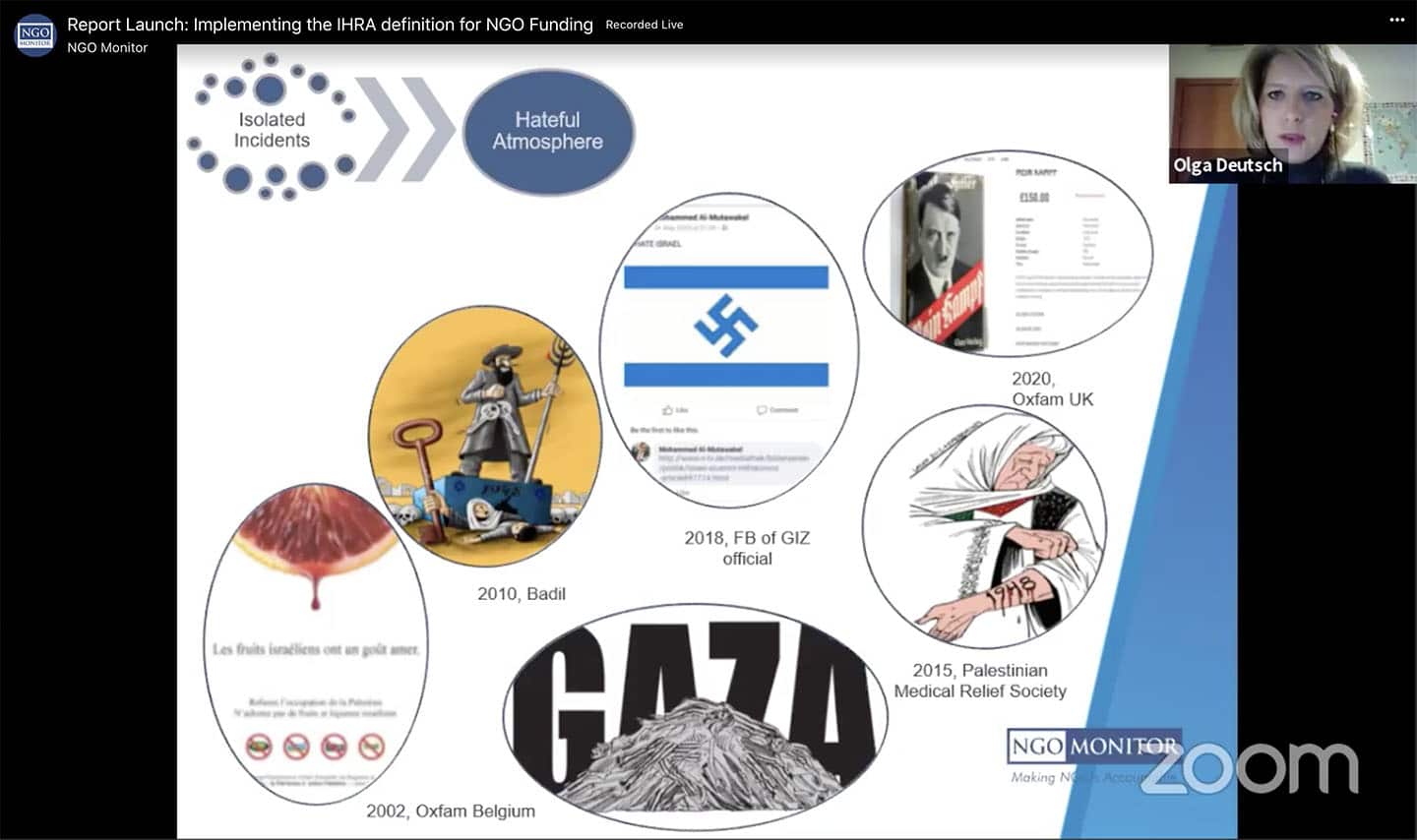
The NGO Monitor watchdog hosted a webinar on January 26 discussing the report they realized that day on how the International Holocaust Remembrance Alliance (IHRA) working definition of anti-Semitism can be used to vet NGO funding.
The former Deputy Special Envoy to Monitor and Combat Anti-Semitism Ellie Cohanim (2019-2021) explained that IHRA was first used by the United States State Department in 2010 and was formally adopted in 2016; in 2019, an executive order codified IHRA throughout executive agencies. “One of our highest priorities was really engaging all foreign governments and all of our counterparts on the working definition of anti-Semitism,” Cohanim said.
She stated that 1948 was “a marker as the end of the Holocaust and the creation of the Jewish State of Israel,” arguing that “at that point, classical anti-Semitism was forced to take a break.” The next inflection point was 1967, Cohanim said, as “despite the very young and still struggling Jewish state of Israel being attacked by Jordan, Syria and Egypt, Israel emerged as the winner of the horror.”
Israel’s victory in the Six Day War is what caused it to viewed as a Goliath instead of a David, and thus started a new anti-Semitism as “the hatred of the Jew among nations,” Cohanim stated. As an example, she pointed to Representative Rashida Tlaib’s (D-Mich.) January 19 remarks falsely accusing Israel of excluding Palestinians from the COVID-19 vaccine and therefore being a “racist” state.
Cohanim argued that IHRA is “the most important tool in the toolbox toward combating antisemitism,” since it provides the most comprehensive definition of anti-Semitism. The definition includes making stereotypical allegations about Jews (such as tropes of Jews controlling the media and the government). IHRA defines anti-Semitism when it comes to Israel as “denying the Jewish people the right to self-determination for example by claiming the existence of the state of Israel is a racist endeavor” and “drawing comparisons of contemporary Israeli policy to the Nazis,” Cohanim said.
Given that governments tend to dedicate part of their budget toward grants for NGOs, Cohanim argued that’s imperative for governments to vet NGOs through the IHRA definition of anti-Semitism. As an example, she pointed to the anti-Semitism controversies that have plagued the Islamic Relief Worldwide charity of late. Cohanim said that her office issued a statement in December 2020 condemning the organization and called on other governments to follow suit. On January 19, the Dutch government announced they would cease funding to Islamic Relief Worldwide over the matter.
Olga Deutsch, vice president of NGO Monitor, then highlighted examples of anti-Semitism from NGOs listed in the report. One such example was from Palestine Monitor, a news website that the Palestinian Medical Relief Society runs. Palestine Monitor published a cartoon in 2015 showing a Palestinian woman with the world “1948” carved into her arm. Another example included a poster Oxfam Belgium released in 2002, which featured an Israeli orange with blood dripping from it to call for a boycott of Israeli fruit.
“If there’s one common denominator here… it’s actually the combination of what we know of classic anti-Semitism and its more contemporary manifestations that usually come in the form of anti-Israel and anti-Jewish state narratives,” Deutsch said.
She recommended that all government branches take up measures and guidelines to properly evaluate NGOs when it comes to anti-Semitism and that funding should be suspended as part of the evaluations.
Toward the end of the webinar, Cohanim said that those who claim that IHRA silences speech are promulgating a “false flag” and an “excuse for people who want to express their anti-Semitism.” She added that “pushback” to IHRA shows its success.
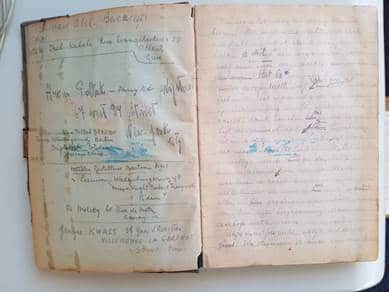
Melcher de Wind, my distant cousin, has mixed feelings about “herdenkings,” or commemorations. To him, Holocaust Remembrance Day 2021 marks the end of a year full of commemorations of the Holocaust and his beloved father, Eddy de Wind, who wrote his memoir in real-time during the 16 months he spent in Nazi captivity during World War II just because he was a Jew.
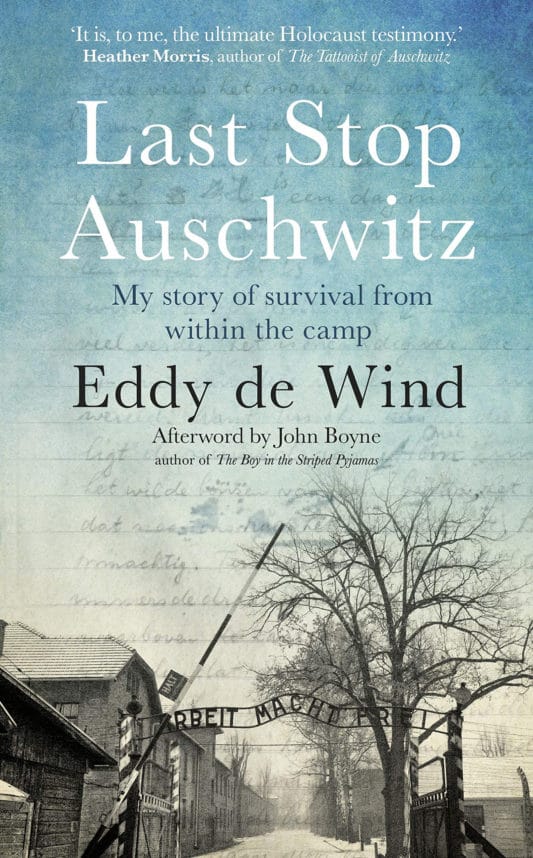
One year ago, Melcher’s family published “Last Stop Auschwitz: My Story of Survival from Within the Camp,” a book of those memoirs translated for the first time into English and now into 30 other languages. For the family, this Holocaust Remembrance Day will be a time to reflect on the emotions, doubts and heart-searching they have experienced in deciding to publish the book and, subsequently, in attending “herdenkings.”
“Last Stop Auschwitz” is probably the only Holocaust account written “in situ,” from the belly of the Nazi beast, while the horrors were still fresh in de Wind’s memory and psyche. The book was published twice in Dutch and only in limited numbers — once immediately after the war and again nearly four decades later. At both times of publication, the book did not receive the publicity and attention the unprecedented work so rightly deserves.
Melcher de Wind recalled to me how, as a little boy, he saw his father’s manuscript “tucked away between other books.” He leafed through it once, never realizing the significance of the family heirloom.
Pages from Eddy de Wind’s manuscript (Courtesy Melcher de Wind)
Although he penned his memoirs in the camp, Eddy de Wind never set his story completely aside. On his deathbed in 1987, de Wind thought he was back in Auschwitz. His son recalled, “We — our mother, my brother, my sister and I — didn’t know what to do with his emotionally-charged legacy.”
That continued to be so for the next 30 years, until, in 2018, the “Eindstation Auschwitz” manuscript became part of prominent exhibits at international Holocaust exhibitions in Madrid and elsewhere, drawing intense attention.
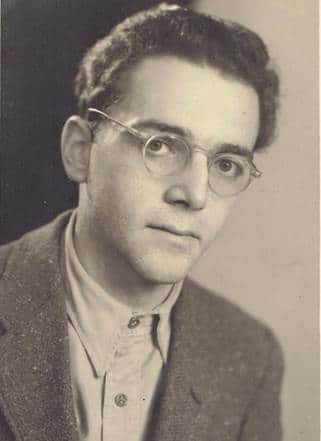
Young Eddy de Wind, circa 1939. (Courtesy de Wind family)
The book has since become one of the defining accounts of the atrocities and inhumanities perpetrated by the Nazis during the Holocaust.
Publication of the book was a family project, led by Melcher de Wind. “No easy task,” de Wind said to me. “At first, it led to a lot of tension between us, but it also gave us a reference point and a new, mutual goal that ended up bringing us closer together.” He added, “The process of publishing the book taught me a lot about the role my father’s past had played in my life, finally helping me to cast off the ‘curse’ of Auschwitz. Essentially, it was a commemoration that would last more than a whole year.”
De Wind is referring to the whirlwind of obligatory interviews, book fairs, book-signings, press conferences and Holocaust commemorative events that followed the success of his father’s book this past year.
He remembers attending a Holocaust-related commemoration with his father several years after his father’s return to the Netherlands from Auschwitz in 1945. “The emotions and unspoken reproach made the commemoration exhausting for my father, and he was very confused,” De Wind explained to me. “Once home, he withdrew into himself, remaining distraught for days…”
De Wind told me that his father’s experiences at Auschwitz, along with the murders of his father’s family and friends, remained an open wound for him — memories too real, too recent, too raw and too painful to be assuaged by commemorations.
De Wind told me that his father’s experiences at Auschwitz remained an open wound for him.
“My father’s incapacity to come to terms with the sorrow often led to intense anxiety and panic attacks in the days leading up to a commemoration,” he said. “At the gatherings themselves, I was preoccupied with trying to keep an eye on him. Was he managing? Could he handle it, or was he about to panic?”
Melcher attributed his own dislike of commemorations to seeing how much his father suffered at such events and to his own perception of a certain amount of shallowness at such gatherings. “People attend and feel remorse, but when they go home afterwards, they can live on as if nothing has happened,” he said.
However, publishing his father’s book forced de Wind to come face-to-face with his doubts and anxieties. For example, last year, de Wind — who lives in Amsterdam — finally visited Auschwitz, a place that for him had always been “an absolute no-go.”
A place, de Wind explained, where his father’s family was transported to by force and then gassed like infected animals. A place where his father barely survived after suffering the deep wounds that burdened him throughout the rest of his life. A place where his father wrote the book in a notepad he had found among Schutzstaffel (SS) supplies, a book that would bring Melcher to Auschwitz more than 60 years later.
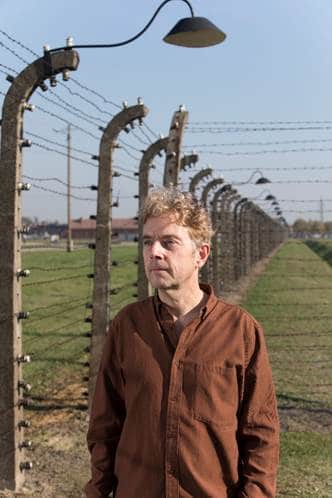
Melcher de Wind at Auschwitz (Courtesy Melcher de Wind)
During that portentous visit to the Nazi death camp, de Wind saw the infamous barracks, cringed at the ruins of obscene gas chambers and found Auschwitz “empty, a dead museum where it’s hard to imagine the terrible things that took place there.”
He also realized that one of the most memorable aspects of his father’s book is “the way it gives you a chance to really visit Auschwitz…It guides you through the pain, the fear, the arbitrariness and sadism of the place but also through the solidarity and hope that kept the prisoners going.”
De Wind now realizes that his visit has “humanized’ Auschwitz for him. Being able to walk around Auschwitz without intense fear was a victory for him. “My father had survived the camp; he had worked there as a doctor for months after it was liberated, and he had written his book there. More than ever, I felt incredibly proud of him,” de Wind said.
The Auschwitz visit has had a “liberating effect” on de Wind, just as several other “herdenkings” would have. But memorials continue to be a delicate balancing act between competing emotions — despair, anger and hope.
For example, de Wind cited an exchange he had with his father when he was only 16. Melcher had asked his father, “Did anyone ever survive the gas chambers?” His father replied, “There was a group of Hungarian children who came out of the gas chamber alive.”
Melcher felt enormous relief. “So, it was true. It wasn’t all darkness; there is always hope,” he thought. But his father continued: “Afterwards, they were burnt alive.”
De Wind also told me about a more recent conversation. After an event in Budapest for “Last Stop Auschwitz,” a very old Hungarian lady came up to him. She told him how, in the late summer of 1944, she and other Hungarian Jews were herded to the gas chambers immediately after their arrival in Auschwitz. But after a few minutes, the doors opened again, and some of the prisoners were taken back to the camp. She was one of them.
Stunned, de Wind asked, “So you survived the gas chamber?” “Yes, something went wrong, and we were spared,” the survivor answered.
“Whenever I think back on that moment,” de Wind said, “I am overcome by emotion. I don’t know who the woman is, but in my mind, I have come to love her. Her story encourages me and makes me realize that commemorating pain is not enough. More than anything else, we must look to the future with hope.” “Herdenkings,” then, can be inspirational and liberating after all.
This particular “herdenking” of 2021 can only reinforce humanity’s call for “Never Again.”
Dorian de Wind is a retired U.S. Air Force officer, born in Ecuador and educated in the Netherlands. He now makes Texas his home.
On May 23, 1960, I was helping my mother, an Auschwitz survivor, in the kitchen when the radio announced, “The Nazi war criminal and the architect of the ‘Final Solution’ is in Israel and will stand trial.”
Our once large family had lost 98% of its members to Adolf Eichmann’s death trains in Auschwitz. My mom’s first tearful then angry reaction to the news on the radio was simply indescribable. That moment will never leave my soul.
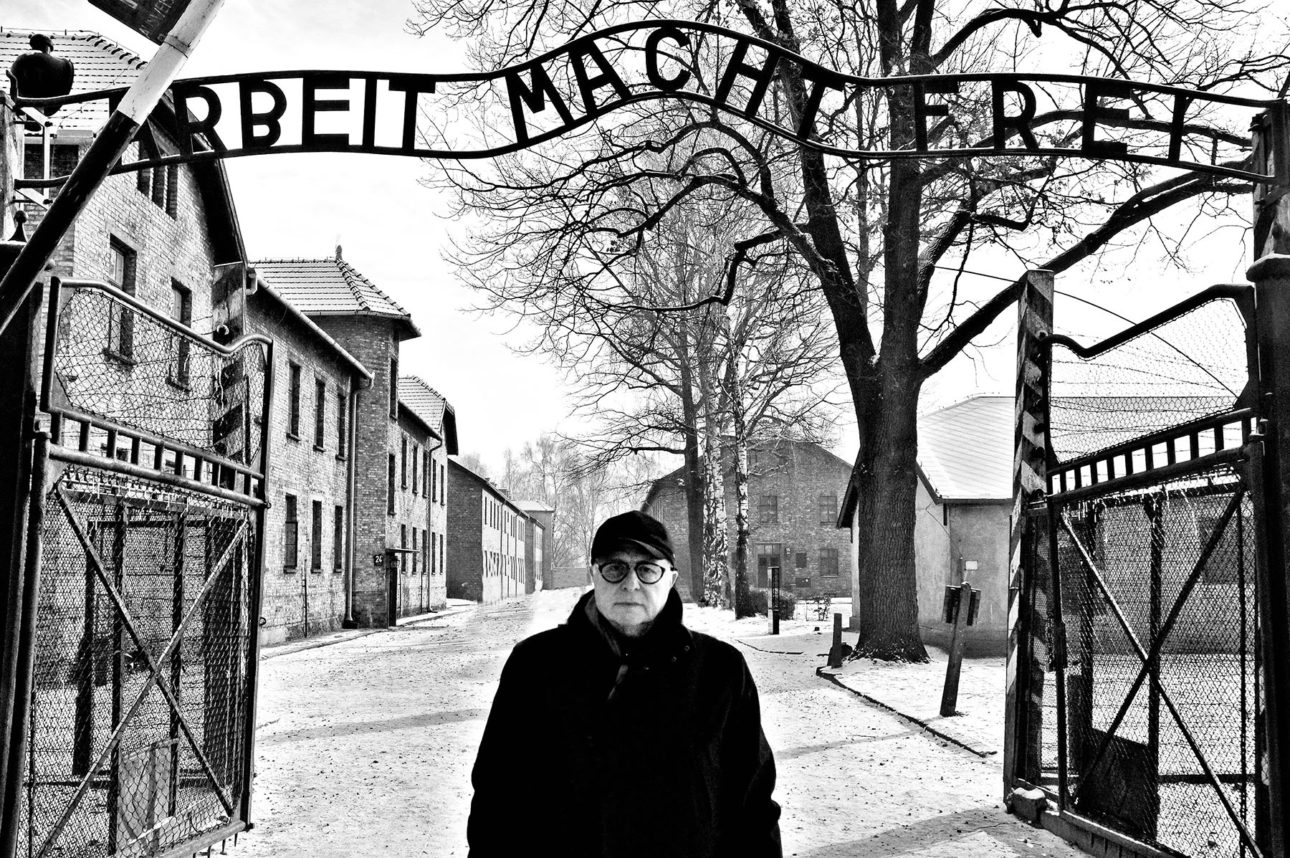
The author at the infamous gate of Auschwitz
In May 1960, Mossad smuggled a team of experienced agents into Argentina, acting upon the information that Fritz Bauer, a Jewish-born German prosecutor, had passed on: Eichmann was hiding in Buenos Aires under the alias Ricardo Clement. Knowing that Argentina might never extradite Eichmann for trial, Israel decided to abduct him and take him illegally.
On May 11, a team of hand-picked Mossad operatives descended on Garibaldi Street in San Fernando. Under the supervision of legendary operative Raffi Eitan, Peter Zvi Malkin physically captured Eichmann as he was walking home from the bus. The capture was directed by the then Head of the Mossad Isser Harel. (Years later, several members of the capture team related details of the operation to me.)
Eichmann’s family called local hospitals — but not the police — and Argentina knew nothing of the operation. So on May 20, Mossad was able to fly a drugged Eichmann out of Argentina, disguised as an Israeli airline worker who had suffered head trauma. And on May 23, 1960, Israeli Prime Minister David Ben-Gurion announced that Nazi war criminal Adolf Eichmann had been captured and would stand trial in Israel.
“I have to inform the Knesset that a short time ago, one of the greatest of the Nazi war criminals, Adolf Eichmann, who was responsible, together with the Nazi leaders, for what they called ‘the final solution’ of the Jewish question, that is, the extermination of 6,000,000 of the Jews of Europe, was found by the Israeli Security Services” Ben-Gurion stated. “Adolf Eichmann is already under arrest … and will shortly be placed on trial in Israel under the terms of the law for the trial of Nazis and their collaborators.”
For nine months, Israel Police Captain Avner Less served as Eichmann’s interrogator, questioning him daily. He was the only investigator allowed to speak to Eichmann. The transcripts of the 275 hours of interrogation were forwarded to prosecutors.
Argentina demanded Eichmann’s return, but Israel argued that his status as an international war criminal gave them the right to proceed with a trial. On April 11, 1961, Eichmann’s trial began in Jerusalem. It was the first televised trial in history.
Attorney General Gideon Hausner said in his opening speech at the trial, “When I stand before you here, Judges of Israel, to lead the Prosecution of Adolf Eichmann, I am not standing alone. With me are six million accusers, but they cannot rise to their feet and point an accusing finger towards him who sits in the dock and cry, ‘I accuse.’ For their ashes are piled up on the hills of Auschwitz and the fields of Treblinka and are strewn in the forests of Poland. Their graves are scattered throughout the length and breadth of Europe. Their blood cries out, but their voice is not heard. Therefore, I will be their spokesman, and, in their name, I will unfold the terrible indictment.”
Eichmann faced 15 charges, including crimes against humanity, crimes against the Jewish people, and war crimes. He claimed he was just following orders, but the judges disagreed, finding him guilty on all counts on December 15 and sentencing him to death.
On June 1, 1962, Eichmann was hanged at a prison in Ramla. The execution was attended by a small group of officials, four journalists — including Holocaust survivor and Hungarian-Jewish “Uj Kelet” journalist Dr. Paul Benedek — and spymaster Raffi Eitan. In 2014, Eitan claimed to have heard Eichmann mumble, “I hope that all of you will follow me” as his final words.
Most of those involved in Israel’s first and only execution are no longer living. But the guard who spent most of Eichmann’s incarceration guarding him, a soft-spoken man named Shalom Nagar, was brought to the limelight some years ago, when an Israeli radio station wanted to produce an anniversary program on Eichmann’s capture and hanging. After sifting through prison records and following tips from former prison employees, the radio station located Nagar, “the short Yemenite guard,” as he was remembered, and asked him to reveal the memories he had stored away for so many years.
Eichmann’s hanging was where my story began. As a child of survivors, I tried to uncover as many small details of the capture, trial and execution of that unrepentant Nazi as possible. I transcribed the interview and followed its threads…
Eichmann’s Guard
At the time of the interview, Nagar, having retired from the Prisons Services, was living in Kiryat Arba and learning in Kollel from dawn to midnight. But he spoke about his time guarding the Nazi war criminal. “I guarded him for six months in Ramle.” He said on the radio program. “I was one of the 22 guards. We were called ‘Eichmann’s guards.’ They put him in a special wing on the second floor. We called it Eichmann’s ‘apartment.’ … He was protected by so many guards because there was reason to believe that he might want to take his own life, and we were to prevent that at all costs.
“They didn’t trust anyone. Whenever his attorney came, I’d lead Eichmann in from one side, while the lawyer would come from the other side. They sat across from each other with a bullet-proof glass between them and used a microphone to communicate. They could speak but not actually touch or pass anything because the lawyer might pass him poison or something.
“During the entire Eichmann trial, Prime Minister David Ben-Gurion personally made sure that any prison guards in the vicinity of Eichmann on the sealed-off second floor of the prison were Sephardic, as he was certain that Ashkenazi Jews whose families were among the millions sent to their deaths by Eichmann would harm him,” Nagar said.
“For years, I was sworn to secrecy. My commanders feared reprisals from neo-Nazis and others who thought Eichmann was a hero. But Isser Harel, the Mossad chief in charge of Eichmann’s capture in Argentina, had already written a book about it, so what did I have to fear? Besides, I was involved in the great mitzvah of wiping out Amalek [the implacable enemy of the Jews].”
Nagar recalled the events that led up to that fateful night. The police summoned a man named Pinchas Zeklikovsky for a special mission. Zeklikovsky, whose family was wiped out by the Nazis, worked for an oven factory in Petach Tikvah and was an expert oven builder. He was asked to build an oven the size of a man’s body, which would reach 1,800°C. He worked on the oven in the factory, telling inquirers that it was a special order for a factory in Eilat that burned fish bones.
The original gloves used in the capture of Adolf Eichmann. Mossad agent Peter Malkin used these gloves during the capture operation as he did not want to touch the mouth of the monster who sent eleven million human beings to their deaths.
On the afternoon of May 31, 1962, after the other workers left, an army truck rolled into the oven factory and loaded the oven. Under heavy guard, the oven made its way to Ramla Prison. All the preparations were done secretly, for fear of sabotage by Eichmann’s supporters. Streets around the prison were cordoned off for several blocks that afternoon.
That same day, Nagar was on a 48-hour furlough. He was walking with his wife, Orah, and infant son in his Holon neighborhood when a police van screeched to a halt in front of him and pulled him inside. It was his colleague Merchavi. Nagar knew immediately what this special invitation was about. “I realized I had won the ‘lottery,’” he reflected.
Nagar responded to Merchavi, “You now have a problem because although you want the hanging kept top-secret, my wife thinks I’ve been kidnapped. She’ll call the police.” Merchavi allowed Nagar to explain to Orah that he’d be working late.
Nagar remembered that when he arrived at Ramle, “I was given a stretcher, some sheets and bandages and was told to go and wait downstairs. Meanwhile, upstairs, Eichmann was with the priest and —according to his last wish — was given a glass of wine. By the time I was summoned, the noose was already around his neck, and he was standing on a specially-made trap door, which would open under him when I would pull the lever.”
According to an official account, there were supposedly two people who would pull the lever simultaneously, so neither would know for sure by whose hand Eichmann died. But Nagar said he knew nothing about that. “I didn’t see anyone else there. It was just me and Eichmann. I was standing a few feet from him and looked him straight in the eye. He refused to have his face covered, and he was still wearing those trademark checkered slippers. Then I pulled the lever, and he fell, dangling by the rope.”
After an hour, Nagar and Merchavi went downstairs to release the body. A scaffold had been built to reach him. “Merchavi told me to climb the scaffold and lift him, and then he would loosen the rope,” Nagar said. “For years, I had nightmares of those moments. His face was white as chalk, his eyes were bulging and his tongue was dangling out. The rope rubbed the skin off his neck, and his tongue and chest were covered with blood. I didn’t know that when a person is strangled, all the air remains in his stomach. So, when I lifted him, all the air that was inside came out, and the most horrifying sound was released from his mouth — ‘baaaaahhhh’ — I felt the Angel of Death had come to take me too.”
“I felt the Angel of Death had come to take me too.”
“Finally, a few other guards arrived, and we managed to get him onto the stretcher we had prepared earlier. We took him to the other side of the courtyard, where the oven was waiting. One of the guards, [whose] name was Luchs and … had been in Auschwitz, was given the job of heating the oven. … They’d built tracks so that the stretcher could slide into it. It was my job to push the stretcher into the oven, but I was shaking so hard that the body kept rolling from side to side. Finally, I was able to push him in, and we closed the doors.”
Nagar was slated to escort the ashes to the port, but he was in such a state of trauma that Merchavi had him sent home with an escort. In the very early hours of the morning, the ashes were removed from the oven and transported by police van to Jaffa Port, where a Coast Guard boat carried them beyond Israel’s territorial waters so that they would not defile the Holy Land.
In addition to this trauma, Nagar had a hard life. He faced the most difficult time when his beloved son Noam succumbed to cancer. But he always remained optimistic, going on to become one of the first to live in Kiriat Arba, “Town of the Four,” an urban Israeli settlement on the outskirts of Hebron.
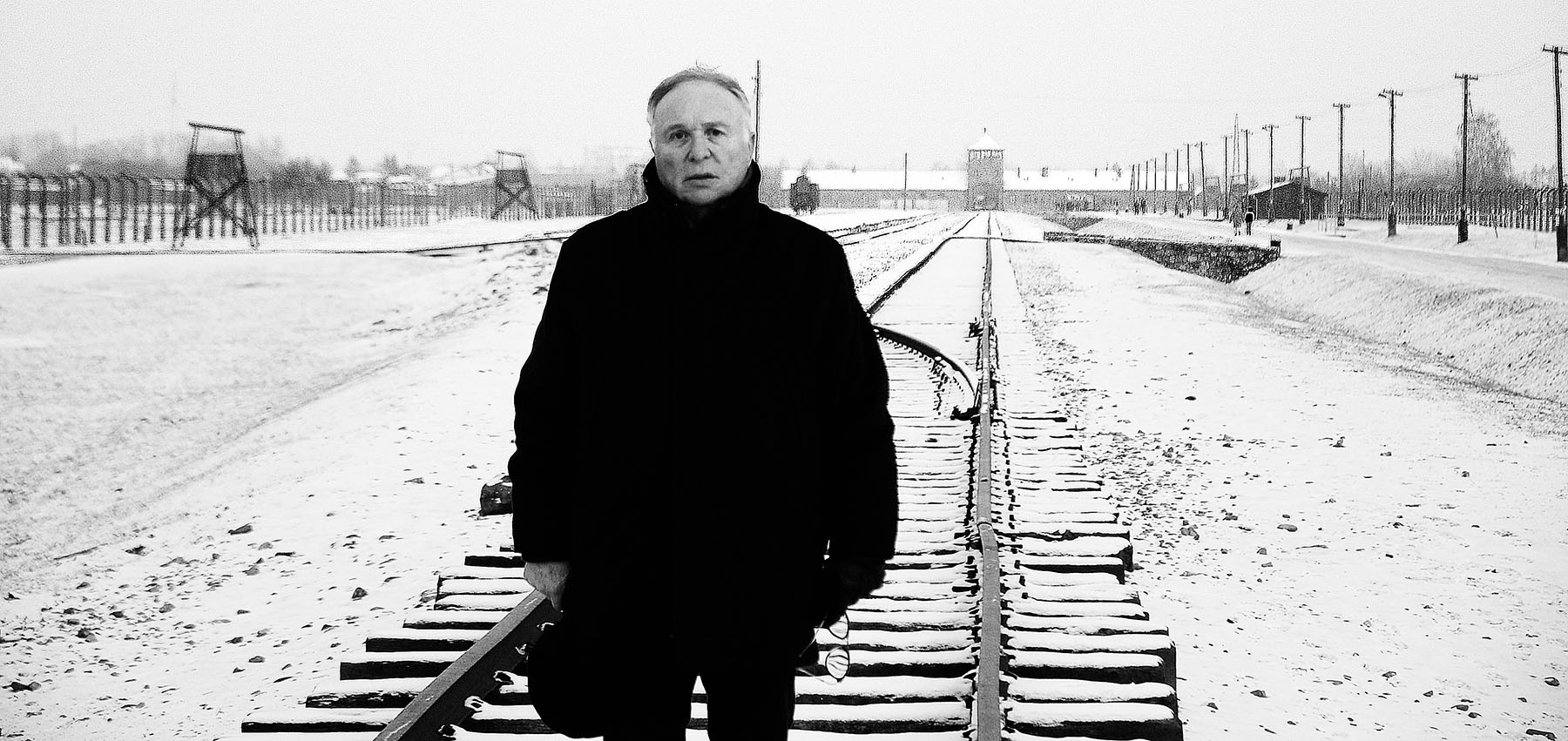
The author on the rail tracks of Birkenau.
Caring for Nagar
I decided to share Nagar’s story now, in all of its details, because my mom, who survived Auschwitz and Belsen, never got to hear it. I feel that Nagar’s story remains acutely relevant to our times — especially for those who come from families of Shoah survivors. And we can still protect and care for heroes like Nagar.
For example, a couple of weeks ago, an early morning phone call woke me. The call came from a former Israeli Intelligence Operative Avner Avraham, who reached out to me to let me know that Nagar was living at his modest home in poor medical condition. Within minutes of receiving a WhatsApp photo of the ailing Nagar, I was on the phone, reaching out to my best connections in Israel to find a suitable, medically supervised old age home for the last living hero of the era.
Everyone acted immediately. Within an hour, I spoke with several descendants of Holocaust families in North America, and they all offered to help finance the proper care for Nagar. Now, Nagar is enjoying the comfort and safety of a first-rate old age home, under the care of top doctors and nurses. He participates in daily prayer services and is very happy. I will take comfort in the fact that I helped Nagar in the name of the millions of martyrs — and my many family members — who perished during the Holocaust. I am sure my parents would be proud of me.
If anyone reading this article — especially if you are a descendant of families decimated by the Holocaust — would like to offer your help by contributing to his ongoing care, you can reach me via this newspaper or by contacting me at contactgabe2013@gmail.com.
Gabriel Erem is a successful serial entrepreneur and active philanthropist with a deep passion for Tikkun Olam.