fbpx

January 27, 2021

Table for Five: Beshalach

One verse, five voices. Edited by Salvador Litvak, the Accidental Talmudist

It came to pass when Pharaoh let the people go, that God did not lead them [by] way of the land of the Philistines for it was near, because God said, Lest the people reconsider when they see war and return to Egypt. -Ex. 13:17


Rabbi Elchanan Shoff
Beis Knesses of Los Angeles

“God didn’t lead them [by] way of the land of the Philistines ki karov hu.” “For it was near” is certainly a fair translation of “ki karov hu.” Daas Zekenim, a medieval commentary on Torah offers another reading. “Ki karov hu,” actually means, “because he (Israel) is [His] close relative.” They cite Psalms (148:14) “the Israelites, His nation, [His] close relative.”

The word karov means close, and means a relative. Because of God’s close relationship with Israel, He made an active and involved choice to direct their destiny in a way that it would not have unfolded otherwise without His involvement. When Pharaoh sent the nation out, teaches the Torah, it was not Pharaoh who was influencing the history of the Jewish people, but God himself, who is closely supervising the destiny of His beloved people.

This lesson is the very cornerstone of the Jewish Bible. There is a God, who is engaged in this world, and he has a people who, beginning with Abraham, were loyal to Him, and to whom he made a pact of loyalty. No matter how lost we may feel in our travels and exiles, we cling to the reality that if we have not taken history’s most direct route to the Promised Land, this is because God, with whom we are so exceptionally close, is directing our destiny. We eagerly await the end of the journey, when “He will raise up the pride of His people, the Israelites His nation, [His] close relative, Hallelujah.”


Dr. Sheila Tuller Keiter 
Judaic Studies Faculty, Shalhevet High School

Normally, we understand this verse to mean that God chose to take Israel the long way home to avoid warfare that would frighten them into returning to Egypt. That is almost certainly correct. However, I would like to suggest another plausible reading of this verse.

The verse uses the verb n.ḥ.m. to mean “reconsider.” While this verb has precisely that meaning, the very same verb can also mean to be at ease, to become comfortable. Thus, we can re-render the concluding phrase, “Lest the people become comfortable when they see war and return to Egypt.”

In this reading, the concern is not that war will frighten the Israelites, but that Israel will become accustomed to war, become comfortable with it, and make it a way of life. If so, their first instinct may be to return to Egypt and take vengeance on their former enslavers in a Quentin Tarantino-style revenge fantasy. Therefore, God avoids war and leads them through the sea to make a clean break with their Egyptian past. This reading follows Judaism’s rejection of vengeance: “You shall not take revenge or bear a grudge” says the Torah in the very same breath it exhorts us to love our fellow as ourselves (Lev. 19:18). Justice is the cornerstone of civil society, but vengeance is seldom tailored to justice. For Israel to fulfill its destiny, it must leave Egypt behind. For us to be whole, we must learn from our past hurts, but move on to bigger and better things.


Rabbi Benjamin Blech
Professor of Talmud, Yeshiva University

It was the most important journey of Jewish history – and yet G-d did something extremely strange from a contemporary perspective.

Our ancestors were finally escaping from the slavery of Egypt. Before them was the blessing of the Promised Land. It would seem that speed was of the essence. Hurry up, we would urge. Get moving. The faster the better. But G-d had other plans. He did not lead them by way of the most direct route. How was that possible?

Because the Torah teaches us a remarkable truth: The Jews weren’t ready to face the challenge. It was simply too soon. Had they been faced with the test of fight or flight they would have preferred servitude over freedom. And there are times in our lives as well when what is right needs to be deferred until the child, the student, the teenager or the not-yet-religious require patient waiting instead of being hurried into a situation for which they are as yet unprepared, for which the task would only spell defeat and total surrender.

As a rabbi I know what a spiritually guided life of Torah can add to personal joy and fulfillment. Yet when I guide others on the journey to a glorious Promised Land, I have learned that the key is not a speedy trip to total commitment and observance. Short cuts are most often short circuits to success. Spiritual growth, like the journey from Egypt to Jerusalem, is most often achieved when we recognize the wisdom of the longer way chosen by G-d instead of the more obvious and appealing shortcut.


Nili Isenberg
Pressman Academy Judaics Faculty

Have you seen our friend Mayim Bialik’s quirky new TV show, “Call me Kat”? Did you notice how her titular character sometimes turns to speak directly to the audience, breaking the fourth wall? This eccentric conceit allows the audience and Kat to feel as if they have shared a joke, like friends.

French Philosopher Denis Diderot (1713-1784) is credited with popularizing the idea of the fourth wall during the Enlightenment, but could God have actually been the first to use this technique? To whom is God speaking in our verse if not to us, the audience? And what is the purpose of this gesture? If you know the next part of the story (as we do), you can’t help but wonder if this sudden insight into the Divine mind is a kind of heavenly sarcasm: “Oy, these Israelites! I don’t have the highest hopes for them. So, I guess I’ll take them by way of the Red Sea. That should be better…”

It’s funny, in a dark way, because we know that the challenges keep coming for the Israelites. And this is true: Life is difficult, as we know well in these endless days of pandemic and social unrest. But maybe we can take a page from God’s playbook and get through this time with a bissel humor, remembering faithfully that God can turn around our troubles in a moment, just as God soon drowns the Egyptians in the raging sea even as it seems that all hope is lost.


Rabbi Michael Barclay
Spiritual Leader of Temple Ner Simcha in Westlake Village

The great magician Ricky Jay z”l taught that “Magic is all structure…from the ordinary to the extraordinary to the astounding.”  The concept, demonstrated in the film “The Prestige,” is that to be impactful there must be setup and eventually an astounding payoff.

Ricky Jay understood this as a performer, and God sets up this process for the ancient Hebrews in this verse.

Although it often seems that God takes us through difficult journeys instead of making it easy on us, we can usually see in retrospect that the challenging journey was to teach us lessons, and/or help us appreciate God’s magnificence.

Rabbi Chananel (990-1053 Tunisia) taught that this is actually the deeper reason for God’s choice of a circuitous route.  The Hebrews had already seen extraordinary demonstrations of God’s power through the ten plagues.  Now as they were leaving Egypt, God took them on the longer route that would ultimately be filled with more dangers than just war with the Philistines.  But each time the people see God’s miracles of splitting the Sea, providing a well, daily manna and more, their relationship with God deepens… as does their gratitude and awe.

Slavery was ordinary; the exodus was extraordinary; and God’s constant miracles in this longer route were the astounding teachings to remind us forever of God’s greatness.

May we all be conscious as we go through challenges that these trials are simply a way to deepen our relationship with the Divine; and may we all accept these challenges with gratitude and grace.

Table for Five: Beshalach Read More »

Holocaust Remembrance and Tu Bishvat: Resilience Meets Renewal

Today (Jan. 27) is International Holocaust Remembrance Day, and tonight we welcome the holiday of Tu Bishvat, also known as the Jewish “birthday” of the trees.

The marriage of these two days is chilling. The six million souls murdered in the Holocaust were like individual human trees. Each had the potential to grow, to flourish and to bear fruit for generations. They were obliterated. But one thing remained that could never be destroyed.

Their roots.

They were obliterated. But one thing remained that could never be destroyed.

Their roots.

The roots of Jews who perished in the Holocaust, like the roots of all Jews, go back 3,300 years to Mount Sinai. What gives Holocaust survivors the sustenance to keep going? What motivates future generations of Jews to double down on life? It’s not just the memory of those who passed away. It’s also the memory of the hundreds of generations who came before them, the generations who struggled and prevailed against all odds. These generations are the Jewish roots.

As we remember today the six million souls who left us, we can also remember the millions of souls who came before them, and those who will come after.

The roots that go back to ancient times represent resilience; the trees of Tu Bishvat represent growth and renewal.

Today we mourn. Tomorrow we plant and renew.

Holocaust Remembrance and Tu Bishvat: Resilience Meets Renewal Read More »

Facebook Debuts New Fact Check Box to Combat Holocaust Denial

(JTA) — People who search for information about the Holocaust on Facebook will now be prompted to visit a website on the genocide curated by the World Jewish Congress and UNESCO, the United Nations Educational, Scientific and Cultural Organization.

Starting Wednesday, which is International Holocaust Remembrance Day, users will see a box labeled “Learning About the Holocaust” when they search Holocaust terms. Similar boxes with resources pop up after searching about things such as the COVID-19 pandemic and U.S. elections.

“The Holocaust was the organized persecution and killing of 6 million Jewish people, alongside other targeted groups, by the Nazis and their collaborators during World War II,” the box reads. “Learning about the Holocaust can help prevent future genocides and other acts of hatred based on religion, ethnicity or other differences.”

There is a link to aboutholocaust.org, a joint WJC and UNESCO site.

WJC President Ronald Lauder said the new tool could help counter Holocaust ignorance among the young. A study last fall on Gen Z views on the genocide found a widespread lack of subject on the subject — 11% of respondents thought that Jews caused the Holocaust.

“It is saddening and disconcerting that 75 years after the end of World War II, roughly 50 percent of the world does not even know that the Holocaust occurred, or that Jews were targeted for genocide in Europe,” Lauder said in a statement.

Another factor spurring the prompt is the proliferation of hate speech on social media. Facebook has come under fire in recent years for not adequately stemming hate speech, incitement and disinformation. Last July, a campaign sponsored by the Conference on Jewish Material Claims Against Germany produced videos of Holocaust survivors urging Facebook CEO Mark Zuckerberg to take forceful steps to erase Holocaust denial content from the site.

Facebook now works to removes hate speech, including Holocaust denial.

“At a time of rising hate and intolerance, taking time to read and reflect on what happened to Jews and others in Europe is more important than ever,” said Facebook COO Sheryl Sandberg, who is Jewish, in a news release.

Monica Bickert, Facebook’s vice president of content policy, spoke Wednesday on a panel jointly organized by The Paley Center for Media and the Claims Conference, entitled “The Media’s Role in Combating Holocaust Denial, Misinformation and Anti-Semitism.”

“We’re thinking not just about removing hateful content; we are now removing anything that denies or distorts the Holocaust,” Bickert said on the panel, whose speakers also included Holocaust survivor Eva Schloss and Sara Bloomfield, the director of the U.S. Holocaust Memorial Museum. “A really important part is using technology. We need to make sure we are harnessing the very positive power of social media to educate.”

Facebook Debuts New Fact Check Box to Combat Holocaust Denial Read More »

My Grandfather Survived Auschwitz — and Spends His Life Spreading Kindness

(JTA) — On Jan. 6, a sea of heads bobbed and flags flew outside the U.S. Capitol. A closer look revealed a dark hoodie, skull, crossbones and large white letters: “Camp Auschwitz,” followed by “Work Brings Freedom.” That’s the phrase my 91-year-old grandfather, David Moskovic, saw every day in German — “Arbeit Macht Frei” — when he was a 14-year-old Nazi prisoner.

For nights following the riots, my grandfather roused to recurring nightmares. The mob at the Capitol brought him back to Auschwitz, 1944.

Upon arrival, soon-to-be prisoners were rushed out of cattle cars and had their belongings taken. Everyone was sorted into two lines: One led to a building with a chimney exhaling bulging smoke — the product of cremating innocent bodies. One led to the camp. His family was split, but by the end of the war he lost everyone — his mother, father, older brother and two younger sisters — but his older sister, Edith. 

“You can’t even comprehend what could have happened,” he said to me over the phone from Ottawa when we spoke about the riots.

But he could. He knew what hate-born violence looked like, felt like, the pain, the starvation, the loss, the imprint.

Today, on Holocaust Remembrance Day, it’s imperative to step into the past as a way to process the present. At 16, my grandfather had suffered more than most people do in their entire lives, but he never let it define him. Instead it fueled a deep, wholehearted sense of kindness that guided the rest of his life.

Following his arrival at Auschwitz, my grandfather, along with his brother and father, was tattooed with his new name — A6024. David Moskovic no longer existed.

For six months he was sent to lay bricks at Buna, a work camp outside of Auschwitz. His daily diet consisted of a slice of hard bread, grass soup with stones mixed in and sometimes a thicker potato soup for dinner. He often saved his slice of bread for his father, terrified for his diminishing body and declining health.

In January 1945, Buna prisoners were rounded up at dusk and instructed to march. Gunshots pierced the air. Prisoners dropped dead. After three days without food or water, they arrived at a brickyard in Glewice, a village in Poland, and were given a slice of bread before being jammed into cattle cars. Each time the train stopped, the soldiers removed dead bodies, but my grandfather needed these corpses. He hid beneath them as a blanket. When it snowed, he kept his mouth open to dampen his lips. Later he learned that his father and brother had died.

By the fourth day without food or water, the cattle car stopped at Buchenwald, a concentration camp in Germany. My grandfather rolled off, unable to stand. He saw his uncle dying but did not react, could not react. Survival was the sole focus. Each day he pleaded to God, “Give me one more day.”

Finally he was fed a bowl of soup. He snuck back in line for seconds — a death sentence if discovered. When he saw prisoners on the verge of dying, he took their food vouchers. This was the only way to survive. He was so skinny he could practically see through his own hand. All that remained was skin and bones.

As the Allies encroached, the Nazis tried to kill as many people as possible. They selected hundreds of prisoners every day, instructed them to dig a large hole and shot them into the mass grave. One day, my grandfather was chosen. He knew once he left those gates he would never return. No one did. As the selected prisoners began to march, he threw himself to the ground and lay flat while the others stepped on him. Once they left, he ran back to his barrack, hiding in the rafters for hours.

On April 11, 1945, planes flew so low it seemed like they would hit the roofs of the barracks. My grandfather could barely walk outside to see what was going on. A big white sheet hung in the air. The guards were gone. American soldiers had arrived.

When I place the picture of American soldiers liberating my grandfather, handing him the most valuable gift imaginable at the time — freedom — next to the U.S. Capitol rioters, I feel nauseous, my muscles tighten and my jaw clenches. The contrast is uncanny.

But it’s a testament to reality. Freedom and hate live in tandem, immersed in a tumultuous relationship: When one pushes, the other pulls.

White supremacy is alive. But my grandfather is alive, too. The Capitol mobs represent a hatred that was growing louder every day. But my grandfather and other survivors represent a love that has the extraordinary power of sowing hope for “one more day.”

Auschwitz is not a historical artifact. The gates did not close on liberation day; they opened a door to generations of hate that may never have an expiration date.

But they also opened the door to freedom for my grandfather, who reminds me that every day is beautiful. He lost his family, his home, his health, his nationality and religious identity.

Yet he started over. The past never tainted his future, but instead showed him a path of resilience. Love became the cornerstone of his life — a sharp contrast to the hate-filled wishes of white supremacists.

Living in Ottawa, while working as a plumber, he dropped off and picked up his three children every day from school, no matter what. He traveled eight hours round trip from Ottawa to Toronto for my school plays, graduations, birthdays, holidays and often just for a visit.

He welcomed a new rabbi by delivering a Shabbat meal. He gifted my cousins’ old toys to children he met in the elevator of his apartment building. He extended an open-ended offer to take a blind woman for groceries. He made peanut butter sandwiches for the security guard in his building — two, toasted, just the way he likes it.

His hugs are more like squeezes. His handholds can last hours. His kisses are on both cheeks.

Before the pandemic, my grandfather regularly spoke at schools about his experiences. He often concluded with this sentiment, the same words he says to me at the end of every phone call:

“I live a beautiful life. I have three beautiful children. I am a happy man. Be nice to each other. Be good to each other. Take care of each other.”

My Grandfather Survived Auschwitz — and Spends His Life Spreading Kindness Read More »

If “Never Again” Means Something, It Must Go Hand-in-Hand With “Never Forget”

Today is International Holocaust Remembrance Day. It also marks 76 years since the Auschwitz-Birkenau concentration camp, where nearly 1,000,000 Jews, including 200,000 Jewish children, were murdered.

As a person who is active on social media and in writing articles about both Israel and anti-Semitism, I often hear from anti-Semites and Israel-haters (I know, I am being redundant) that Jews “talk too much about the Holocaust.”

Sadly, 40% of Germans agreed with the sentiment that Jews “talk too much about the Holocaust” in a 2019 poll, despite their nation’s role in the mass-murder of a third of the Jews in the world in under five years. And in a 2020 poll of adults under age 40 in the United States, 20% agreed with that same sentiment.

Of course, the reason many Jews talk so “much” about the Holocaust is the same reason most of us have annually re-told the story of our liberation from slavery in Egypt every Passover for the past 3000 plus years.

Because we recognize the importance of remembrance, education and liberation. Because we recognize the truth in the expression that those who don’t know history are doomed to repeat it. Because our 3,000-plus years of history have taught most of us the truth contained within the “Vehi Sheamada” passage in our Passover Haggadah, which tells us that “in every generation” an enemy will “rise up against us to destroy us.”

We recognize the truth that those who don’t know history are doomed to repeat it.

So, we educate. We remember. We commemorate. We say “never again.” Because we know, sadly all too well, the cost we pay when we forget.

We also know that despite the perception that we talk too much about the Holocaust and the systemic Jew-hatred that made it possible that way too many people are woefully ignorant about the Holocaust.

In the same study where 20% of American adults under age 40 asserted that we Jews “talk too much about the Holocaust,” we learned that over 10% of these American adults think Jews were the cause of the Holocaust. We also learned that nearly half of the people surveyed in this study could not name a single death camp or concentration camp — not even Auschwitz, the concentration camp whose liberation we are commemorating today.

So plainly, we are not “talking about the Holocaust” enough, let alone “too much.”

Today, make sure you are doing something to make sure we never forget. To educate, to commemorate, to remember.

One relatively easy thing you can do is watch a movie about the Holocaust. If you have teenage kids, watch it with them. Some great movies are “Schindler’s List,” “Life is Beautiful,” “The Boy in the Striped Pajamas,” “Defiance,” “Son of Saul,” “Sophie’s Choice,” “Walking With the Enemy” and “The Pianist.” Younger children can watch “The Devil’s Arithmetic.” If you haven’t seen these movies or it has been a long time since you last saw one of them, please watch one (or two). If not today, then this weekend.

And, if you live in a state where Holocaust education is not mandatory, then contact your local legislatures and departments of education and try to make it mandatory.

If “never again” is to mean something, it has to go hand in hand with “never forget.”

#EndJewHatred

If “Never Again” Means Something, It Must Go Hand-in-Hand With “Never Forget” Read More »

CA Progressive Zionists Decry “Anti-Israel” Test in Questionnaire

The Progressive Zionists of California (PZC) have denounced a questionnaire from the Progressive Delegates Network, a “state-wide network of experienced grassroots organizers” promoting progressive candidates and causes, for promoting an anti-Israel litmus test.

The questionnaire features five statements of affirmation that delegates to the state Democratic Party need to adhere to; one statement says that they will oppose “legislation restricting our Constitutional freedom to advocate for the boycott, divestment, and/or sanction of countries that engage in routine human rights violations.” Another states that delegates will support the “human rights of all refugees, including the right to leave and return.”

Susan George, the executive director of PZC, said in a statement to the Journal, “As progressive Zionists we stand for a more progressive vision for California, especially at a time when so many people are falling through the cracks due to the pandemic, lack of health care, housing insecurity and joblessness. It’s baffling for Progressive Delegates Network to have 2 of their 5 issue affirmations focused–obliquely though clearly enough for those familiar with the issues–on a complex, international conflict. Moreover, the leadership of the Progressive Caucus has spearheaded numerous anti-Israel or BDS [Boycott, Divestment and Sanctions] efforts in the party, including the floor fight at the November 2019 convention over a platform plank that would have the California Democratic Party endorsing a unilateral Palestinian right of return to Israel. So when organizers tell us, ‘this is not really about Israel,’ please excuse us when we call BS.”

She added that two of the organizers of the Progressive Delegates Network had previously “attempted unsuccessfully to have the caucus endorse a stridently anti-Israel, pro-BDS organization, US Campaign for Palestinian Rights” in 2018.

Karen Bernal, one of the Progressive Delegates Network organizers, told the Jewish News of Northern California (the J), “We have a situation with Kashmir and India and even on our own southern border. It includes Israel but isn’t exclusive to Israel. It applies to lots of countries. It’s a nonviolent, time-honored form of protest.”

On the other hand, Jody Pratt, a delegate candidate in the Sacramento area, told the J that Bernal’s rationale “doesn’t pass the smell test,” pointing to the fact that the questionnaire cites “the [United Nations] Universal Declaration of Human Rights, which targets Israel.”

Mike Harris, who heads San Francisco Voice for Israel, similarly tweeted analogized the questionnaire to a bill providing“tax breaks for business, written so that only 1 company qualifies.” He added in a subsequent tweet that the goal is to make sure “that this extremist fringe remains exactly that— a fringe.”

https://twitter.com/DrMikeH49/status/1354523164995280900?s=20

https://twitter.com/DrMikeH49/status/1354523166069059585?s=20

PZC has launched a petition calling on the Progressive Caucus leadership and state party leadership to ensure that “progressives who support a Jewish and democratic state and peace between Israelis and Palestinians but oppose discriminatory boycotts must not be forced out of progressive spaces.”

CA Progressive Zionists Decry “Anti-Israel” Test in Questionnaire Read More »

What Larry King Taught Me About Interviewing

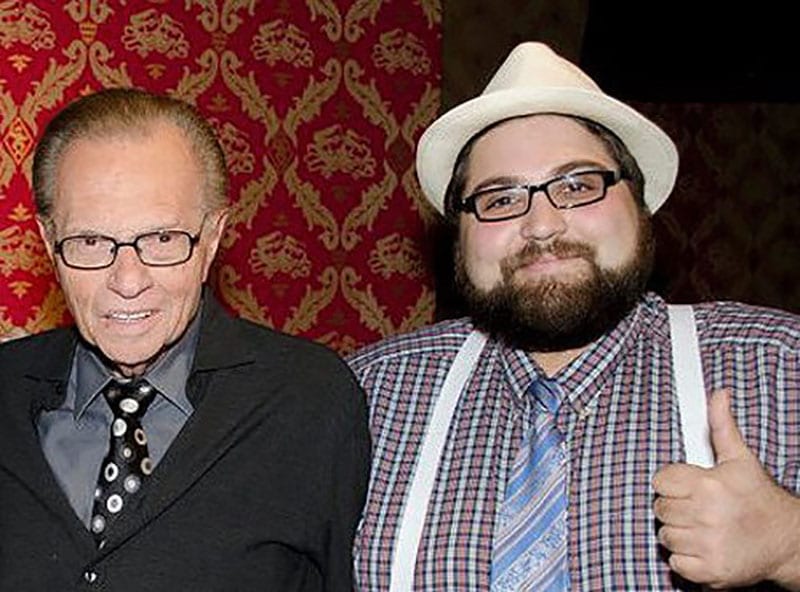
In 2011, I was in the seventh year of doing my comedy podcast, Comical Radio. It was the first podcast to feature interviews with comedians. By this time, I had done well over 1,000 interviews.

I was no stranger to hosting celebrities on the podcast. From George Carlin to Paul Giamatti to Janeane Garofalo and Kid Rock, I had talked to some pretty high-profile guests. But it wasn’t until an old, skinny Jew from Brooklyn walked into my studio that I really became a great interviewer.

To be honest, I wasn’t initially that excited about interviewing Larry King. My wife, Kylie Ora Lobell, booked him for me, and I knew that having him on my show could boost my download numbers. But I wasn’t a big Larry King fan. To me, the greatest interviewer of all time was and still is Howard Stern, who, especially back when I was growing up, would take crazy chances — at the risk of burning major bridges — to ask the questions everyone was afraid to ask.

In my young mind, Larry King was just a corporate shill for CNN who played it safe. Still, I was inclined to try and have some fun with the situation. I invited two comedian friends of mine, Esther Ku and Peyton Clarkson, to join me for the interview. Esther suggested we all wear suspenders in honor of Larry, which I thought was a great idea. She asked if she should write a song for him that might be a bit inappropriate. I loved that idea, too.

When Larry King came in, what took me by surprise was how incredibly comfortable he made me feel. I think he saw something in me that may have reminded him of himself. After all, a Jewish kid from Queens was making a go of being an interviewer and sitting across a Jewish kid from Brooklyn who had done it for years. It turned out we had a lot more in common than I thought. This became apparent as the interview went on.

As the interview progressed, I started to second guess if I should have encouraged Esther to write a song calling attention to Larry’s many divorces (and some things that maybe shouldn’t be written down in the Journal). But I’ve never been one to back down from a bit. So, I figured I would stick with the horse I rode in on.

When Esther did finally sing the song with a chorus — “Hey Larry King, Hey Larry King, when are you gonna buy me an engagement ring?” — instead of being giddy that we make might Larry King uncomfortable, I felt uncomfortable, because I’d really taken a liking to him in a short amount of time.

I don’t know what Larry King really thought of the song, but he was a good sport. I breathed a sigh of relief when he didn’t get up and leave but rather gave it a polite chuckle.

What really made that interview special, however, when that Larry King decided to impart some of his interviewing wisdom on me. He confided in me that he thought I was a very good interviewer, but I could become a great one with a few tweaks. He suggested making sure I keep the amount of “I’s” in the interview to a minimum, as it’s about the guest, not me. He told me I don’t need to say, “Can I ask you a question?” to my guests. He said if someone has agreed to be on your show, then it is already implied that you can ask them any question you want.

In response, I got vulnerable with him. I opened up about my insecurities as an interviewer. I told him that sometimes I’m scared that I’m going to look like an idiot because my guest will say something that goes over my head. I said I was never truly comfortable with my guests because of this fear. That’s when Larry gave me the single best piece of advice I ever received in my career: He told me that it’s OK to admit that you don’t know things. The audience will always forgive you for being ignorant as long as you are honest.

It’s OK to admit that you don’t know things.

That advice totally transformed the way I thought about my listeners. Up until that point, I thought they were all listening with the idea that they were out to get me as soon as I slipped up or showed any vulnerability. In my mind, they weren’t fans; they were judges. From then on, I saw the audience as empathetic comrades who wanted me to do well. With that one change, I was able to build my loyal fan base.

King’s advice gave me such a burst of confidence and a new appreciation for everyone I interviewed from that point on. It also changed the way I thought about the world. I started to see people in a kinder light.

For that, I will always be grateful to the legendary Larry King, whom I had misjudged before that day. In the time since I interviewed him, I have had the chance to go back and watch many interviews he’s done with a new sense of appreciation for his unique talent. To me, that talent was not necessarily the questions that he asked but his innate ability to disarm his guests with his incredible warmth and kindness.

Hey Larry King. I’ll miss ya.


Daniel Lobell is a comedian and the host of the pro-Israel talk show The Lions’ Den With Daniel Lobell from The Israel Group and the Doctorpedia podcast.

What Larry King Taught Me About Interviewing Read More »

An Appreciation of an American “Troublemaker”

In the days between Holocaust Memorial Day and Black History Month, Jewish and Black Americans will be giving specific thought to the alliance of another era. As we reflect upon that historic alliance, we should also (re)introduce a remarkable forgotten “American troublemaker,” Bayard Rustin, who mightily impacted Blacks and Jews during the tumultuous struggle for equal rights in America…

My first personal experiences with Rustin began on Purim in March 1979, when I accompanied my young boss, the founder and dean of the fledgling Simon Wiesenthal Center (SWC), Rabbi Marvin Hier, to the Jewish Memorial at the Dachau concentration camp. There, we were joined by the famous Nazi hunter himself, Simon Wiesenthal. At the memorial, I read from the Megillah the miraculous story of the thwarting of Haman’s diabolical plan to murder all the Jews more than two millennia ago. But for twentieth-century European Jewry, there would be no Mordecai or Queen Esther to stop Hitler. Simon Wiesenthal, a victim of the Holocaust, would become the unofficial ambassador of six million Jewish ghosts and would not let the world forget.

The mission of the SWC’s first foray on the world stage in 1979 was to convince West German lawmakers and Chancellor Schmidt to rescind the statute of limitations on prosecuting murder. Failure to rescind the law would have enabled every escaped Nazi war criminal, including Auschwitz’s infamous Angel of Death, Dr. Josef Mengele, to permanently escape the bar of justice.

Mr. Wiesenthal decided not to lead our delegation. “It is important that this be an American initiative,” he declared, as he left for his office in Vienna. So that evening, our American team convened our group for the first time. It consisted of Congressmen Chris Dodd (D-Conn) and Bob Doran (R-CA), Martin Rosen, Simon Wiesenthal’s lawyer, who fought across Europe as a GI during WWII, a Catholic theologian and Holocaust survivors.

But the person who would emerge as the spiritual (and strategic) leader of the SWC delegation entered the room a few minutes late. I recognized him immediately from Free Soviet Jewry rallies in New York and from his spirited defense of Israel after the June 1967 Six-Day War.

This man exuded a sense of fearlessness without an iota of arrogance. He was not a rabbi or even a Jew. But he knew why he had to be there, to act in solidarity with the victims of the Nazi Holocaust and to open another front in the pursuit of justice.

His name was Bayard Rustin, a Black civil rights organizer, conscientious objector turned anti-Nazi activist, former communist turned Free Soviet Jewry campaigner, a union organizer in the 1940s, a follower of Gandhi’s nonviolence mantras, a key advisor of Martin Luther King, Jr. and the unbridled energy behind organizing the 1963 March on Washington. And he was a gay man at a time when being gay was a crime.

So why did Bayard Rustin join us for a historic week of lobbying and cajoling Germans about Nazi war criminals?

The short answer: It was an act of teshuva, of repentance and reconciliation. Rustin told us that had he understood the full extent of the evil that was Nazi Germany during the war, he would have found a way to fight them, even as a pacifist. Nothing prepared him for Auschwitz.

A look at Rustin’s own history helps explain his affinity for the cause. The grandson of slaves, Rustin was born in 1912 to a Quaker family in Pennsylvania. During the Depression Era, Rustin gravitated to New York City, and after the betrayal of the Hitler-Stalin pact, he left the communist youth movement but remained an independent leftist and antiwar crusader. After World War II, Rustin qualified his pacifism in one case: “If the Germans had begun to break laws when Hitler came to power, they would not have ended up putting Jews into furnaces.”

A precocious champion of civil rights, Rustin served as the deputy to Black labor leader A. Philip Randolph, whose plan for a March on Washington in 1941 forced President Franklin Roosevelt to issue an executive order banning discrimination in defense hiring. In 1942, Rustin helped launch the Congress of Racial Equality (CORE), which organized the first “Freedom Ride” to integrate interstate transportation in 1946.

A continuous thread through Rustin’s career was his commitment to working with Jews for human rights. He attributed this to the grandmother who raised him, who “was thoroughly convinced we had more to learn from the Jewish experience than we had to learn out of Matthew, Mark, Luke, and John.” Most important was Rustin’s secular belief that no “progressive” alliance for social justice could succeed without African American and Jewish cooperation.

A continuous thread through Rustin’s career was his commitment to working with Jews for human rights.

At the time of the 1955 Montgomery Bus Boycott and the founding of the Southern Christian Leadership Conference (SCLC), Rustin encouraged Reverend King “to accept pacifism as a way of life.” He worked closely with MLK’s Jewish associates, Stanley Levison and Rachel Horowitz.

After the Black Power Movement emerged in 1965, Rustin re-affirmed his commitment to coalition politics over some of the movement’s emphasis on African roots, “identity politics” and even violence. MLK denounced the Vietnam War, and Rustin spoke up for the cause of anti-colonialism in Africa, but neither embraced the Black Power or Black Nationalist crusades.

Following Israel’s victory in 1967, Black militants, like Rustin’s protégé, Stokely Carmichael began denouncing the Jewish state. Carmichael said “I’m against Zionism…The only good Zionist is a dead Zionist.” Rustin and MLK condemned this rhetoric. MLK said just days before his assassination: “I see Israel, and never mind saying it, as one of the great outposts of democracy in the world, and a marvelous example of . . . how desert land can be transformed into an oasis of brotherhood and democracy.”

To Rustin, anti-Semitism was history’s “oldest and most shameful witch hunt.” He insisted that “Zionism is not racism, but the legitimate expression of the Jewish people’s self-determination.”

In 1968, when predominately Jewish teachers clashed with Black advocates of “community control” of schools in New York, Rustin sought compromise, but he was almost alone among African American leaders in supporting the Teachers’ Union because of his commitment to trade unionism.

During the 1970s, Rustin paid repeated visits to Israel, where he met Golda Meir, and he founded Black Americans in Support of Israel (BASIC). He visited Le Chambon sur Lignon, the French village that had harbored Jews from the Nazis during World War II. A year after President Carter appointed him to the Holocaust Memorial Council, he helped lead the SWC’s Mission to Germany.

Rustin also worked closely with Senator Henry Jackson, whose Jackson-Vanik bill in Congress tied trade relations with Moscow to the fate of Soviet Jews. He chaired a commission to compile testimonies from Soviet Jews for a report that was delivered to the secretary general of the United Nations. He even visited the Soviet Union to lobby for freedom for Soviet Jews, a cause MLK had endorsed as early as 1966. Bayard Rustin passed away in 1987.

Bayard Rustin hoped that, in 1963, he had helped “plant a seed in the American conscience whose harvest may someday astonish us.” In a deeply divided America, there is still time for new generations to fully reap that harvest.

*Historian Dr. Harold Brackman contributed to this essay.

An Appreciation of an American “Troublemaker” Read More »

Israel Can No Longer Afford to Ignore Palestinian Conflict, Including the Issue of Settlements

When it comes to ignoring the Israeli-Palestinian conflict, it’s fair to say the party’s over.

Actually, I take that back. The Trump administration didn’t exactly ignore the conflict. It’s more that they stopped idolizing it. Above all, they tried to avoid repeating the same tired tropes that have failed decade after decade.

Now, for better or worse, we’re back to those old tropes.

You could Google hundreds of previous statements on the conflict and they would sound similar to what Ambassador Richard Mills, the Acting Representative of the U.S. Mission to the United Nations, said yesterday in a speech to the U.N. Security Council.

He reiterated that the United States supports a two-state solution and rejects “unilateral steps that make a two-state solution more difficult, such as annexation of territory, settlement activity, demolitions, incitement to violence and support of terrorism.”

While cautioning that “Arab-Israeli normalization is not a substitute for Israeli-Palestinian peace,” Mills expressed hope “that normalization can proceed in a way that unlocks new possibilities to advance a two-state solution.” He added that the Biden administration hopes “to start working to slowly build confidence on both sides to create an environment in which we might once again be able to help advance a solution.”

I know, it sounds tediously familiar, but it’s reality. And Israel can no longer afford to ignore that reality. To keep the focus on other crucial issues, such as the Iran nuclear deal, it will have to confront a familiar albatross around its neck: the accusation that any kind of “settlement activity” undermines the revered two-state solution, the holy grail of U.S. and international diplomacy.

The subject of settlement activity sucks up so much oxygen it obscures the obstacles to peace from the Palestinians, such as the rejection of past Israeli peace offers, the division between Hamas in Gaza and the PA in the West Bank, sponsorship of terrorism and incitement to violence, a reluctance to compromise on the right of return and a refusal to recognize a Jewish sovereign presence within any borders.

As long as Israel engages in “settlement activity,” the spotlight will be on them. President Joe Biden, in fact, has personal experience with this. As vice president, he was in Israel in 2010 when Israel announced it would further the process of approving a building permit in Ramat Shlomo, a religious Jewish enclave in Jerusalem.

“I condemn the decision by the government of Israel to advance planning for new housing units,” Biden said at the time. It “undermines the trust we need right now and runs counter to the constructive discussions that I’ve had here in Israel.”

If Israel wants to avoid such damaging friction with the new administration, it will need to figure out its red lines. Rejecting the two-state solution, even if it looks like a delusional fantasy at the moment, is out of the question. Most importantly, Israel will need to avoid any unpleasant surprises, especially if such surprises are seen as undermining the two-state solution.

Israel will need to avoid any unpleasant surprises, especially if such surprises are seen as undermining the two-state solution.

One of Israel’s first priorities should be to sit down with new Secretary of State Antony Blinken, who is friendly to Israel, and agree on settlement red lines—what is acceptable and what isn’t. These red lines are sure to be complicated by Israeli politics, but they are worth the effort to delineate.

Otherwise, we’ll just be back to the old days, when a Jewish building permit in Jerusalem becomes an international cause célèbre, and Palestinian leaders celebrate in Ramallah because no one’s looking at them.

Israel Can No Longer Afford to Ignore Palestinian Conflict, Including the Issue of Settlements Read More »

Jealousy, Obsession and Thrills in Israeli Series “Losing Alice”

These days, TV dramas made in Israel like “Shtisel,” “Srugim,” “Fauda,” “Tehran”, “False Flag” and “No Man’s Land” have become worldwide hits on streaming platforms, captivating audiences with absorbing family drama or thrilling action. “Losing Alice”, a twisty psychological thriller now playing on Apple TV+, fits neither category but is equally riveting, exploring the complex and increasingly obsessive relationship between two women as they forge a dangerous alliance to make a film.

Veteran Israeli star Ayelet Zurer (“Shtisel, “Daredevil”) plays the titular Alice, a 48-year-old director who longs for the career she left to care for her daughters and resents her movie star husband David’s (Gal Toren) success. After a chance meeting on a train with Sophie, a young screenwriter (Lihi Kornowski), Alice soon finds herself back behind the camera, directing David and Sophie in sexually charged scenes in the film.

The eight-episode series, which unfolds in flashbacks and flashforwards, was created, written and directed by Sigal Avin, who drew from her own life for the project. “I always draw from my experience for my characters. It’s not autobiographical, but it’s very personal,” she told the Journal.” Something that’s going on in my life will find its way into the story or a character somehow. People around me are afraid to tell me things because it might find its way into a script.”

Avin had several aims at the outset. “There are not enough stories about women of this age on television. And I wanted to explore the conflict between two worlds, between the family domestic life and career,” she said. “I wanted to show a portrait of a woman in a certain place who misses her creativity and has to raise the stakes in order to create. She wants to shake things up within herself.”

Exposing her characters’ darker proclivities in the process “was important to me because we don’t see women in the way we see men. Male protagonists as selfish and jealous. They betray and do things just for themselves. I wanted to show a woman can have rage and be jealous too.”

“Male protagonists as selfish and jealous. They betray and do things just for themselves. I wanted to show a woman can have rage and be jealous too.”—Sigal Avin

In Zurer and Kornowski, she found the ideal stars to portray those emotions. “Both of them are very strong women and actresses but at the same time they have vulnerability, which is very important for both roles,” Avin said. “When they read together the chemistry was of two worthy rivals as opposed to a mother-daughter relationship that happens with a lot of actresses.”

Avin spent “three very intense years” writing, producing and shooting “Losing Alice,” “and the editing process during Corona wasn’t easy either,” she said, noting that directing the intimate scenes was particularly intense. “I’ve always heard actors talk about their sex scenes about how hard or not hard it was for them. But from the director’s side, I was shocked at how hard it was for me to deal with that. You don’t breathe on the day it’s happening,” she said. “I wanted to protect the actors and make sure they had all the choreography and moves down so they had the freedom to act.”

Born in Miami and raised in Israel, where her family moved when she was 10, Avin had dreamed of being a director from the she was seven but took the acting route first, which proved to be a wise move. “I knew that Ron Howard and Penny Marshall were actors so I thought I’d study acting and go from there. The tools that you learn are amazing–you speak the same language as your actors.”

Avin, who lives in Tel Aviv with her husband and two daughters, doesn’t have her next project lined up yet, “But I’m always writing. It’s my way of dealing, especially now during the pandemic,” she said.

In a separate interview, Zurer explained what drew her to the project and the role: “The beautiful writing, the journey the character takes from beginning until the end, the realistic way that Sigal portrayed women and marriage. There were a lot of pearls of truth in it intertwined with the drama aspect.”

She related to Alice’s passion to create and be self-fulfilled, and express those emotions and desires and dilemmas related to being of a certain age and thinking, “Have I been able to achieve what I wanted?  Is that it? What is my next step? How do I express myself? And at the same time being a working mom and the juggling I have to do,” she said. “I sometimes wish for work but when I get it, it takes me away from the things I love.”

The mother of a teenage son, Zurer “always felt torn” between the pulls of career and family. “It was always a struggle but I always felt really lucky and appreciative that I have this [career] but it always creates a challenge and you have to find a way to make it fit,” she said.

The structure of the series posed challenges for Zurer, as did the intimate scenes. “The sexual content part of it wasn’t so extreme but it was nevertheless personal, and I felt vulnerable at times,” she said. Scenes from the eight episodes were shot out of order, sometimes from different episodes on the same day and the plot’s time shifts compounded the confusion. Her solution: “I learned almost everything by heart. I had almost everything organized in my mind, and that really helped me.”

The Tel Aviv native has lived in Los Angeles for nearly 15 years and usually visits Israel at least once a year, but has not been back since the pandemic hit. Plans to bring “Losing Alice” to Cannes were also derailed by COVID-19. But Zurer found a bright side to the lockdown. Quarantining with her family “was really a special time for me because we had time to be together all the time. We had a lot of fun doing new things, working on the garden, playing the ukulele, painting and being creative, so that aspect was good.”

An illustrator who created the artwork for her book “As of Now,” Zurer is working on an animated adaption one of its pieces, “The Whale.” “It correlates with this particular time because it’s about hope and how it shifts us from depression into light,” she said. Pre-pandemic, she filmed three episodes of the Netflix series “You,” playing a therapist who counsels couples, and she’s awaiting answers on other projects, including some that she developed.

Although she’s recognized most often in America for her roles in “Daredevil,” “Angels & Demons,” and “Man of Steel,” Zurer, who also appeared in “Munich” and the first season of “Shtisel,” is proud of her roles in “BeTipul” (the original Israeli version of “In Treatment”) and the Czech film “Milada,” in which she played the title role. Her mother and grandmother were Slovakian Holocaust survivors and the film is set in the region where they lived.

“Shooting there opened a door to who they were and helped me see them as people rather than my mom and my grandma, which shifted things within me,” Zurer said of the film, which is available on Netflix. “I feel most proud of the way I’ve managed all of it, to have a nice life, and really good friends and a beautiful family while having a career,” she said. ‘“Losing Alice’ is another step up for me as an actor.”

She was elated by the passionate reception the series received in Israel and hopes the international reaction will be just as enthusiastic. “I hope the audience will be challenged. It’s an opportunity to look at archetypes and the perception of women and rebuild them in a new way.”

“I hope that [viewers] understand something about themselves, about creativity or art,” Avin added. “I hope they enjoy the journey.”

“Losing Alice” is streaming on Apple TV+, with new episodes premiering every Friday.

Jealousy, Obsession and Thrills in Israeli Series “Losing Alice” Read More »