It was late June and one of those perfect Israeli Summer days, with clear blue skies. My friend Judy and I were strolling through the old and beautifully restored Sarona Market. The old stone buildings built by the German Templars in the late 19th century and early 20th century were bathed in a gorgeous golden sunlight.
We sat down at Cafe Biga, we ordered a cool limonana and we reminisced. About meeting in second grade at Beverly Vista Elementary School. About how lucky we were to have our special group of friends that stayed close through Middle School and graduation from Beverly Hills High.
About how I met my Sephardic Spice Girl writing partner, Sharon at her Casablanca themed Sweet 16 birthday party. About her brave decision to make Aliyah after graduating from Harvard University. About our husbands and our children.
When I scanned the menu, I noticed that there were listed at least a dozen different types of Shakshuka. Shakshuka with eggplant. With mushrooms. With spinach. With goat cheese.
We ordered “Shakshuka Beiti,” (beiti means home). It’s the classic version with the eggs nestled in a deeply fragrant red sauce made with sautéed onions, fresh tomatoes and red peppers, tomato paste and a generous dollop of spicy Harissa sauce. The Shakshuka came in a battered tin dish, with a side of chopped salad and a hunk of crusty bread. We ate the eggs with their slightly runny yolks and then we swiped our bread into the sauce, wiping those little bowls clean of every trace of delicious sauce.
That Shakshuka brought me back to the many times my mother had made Shakshuka whenever she needed to serve us a quick, easy meal. She would warm generous amounts of her homemade matboucha in a large frying pan, then she would carefully place the eggs in the sauce.
Shakshuka is that perfect dish—nutritious, foolproof and simply delicious!
Sharon’s Shakshuka
4 tablespoons olive oil
1 purple onion, finely sliced
1 red pepper, seeded and sliced
3 plum or Roma tomatoes, diced
4 garlic cloves, finely chopped
2 teaspoons paprika
2 teaspoons turmeric
1/4 teaspoon red chili flakes
6 tablespoons tomato paste
1/2 cup water
6 large eggs
Salt and pepper, to taste
Chopped fresh Italian parsley and cilantro, optional
Heat olive oil over medium heat in a large sauté pan.
Add the chopped onion and sauté for 3 minutes.
Add red peppers and continue sautéing until the onion becomes translucent.
Add chopped tomatoes, garlic and spices and cook for an additional two minutes.
Stir in tomato paste and water until the ingredients are mixed.
When the sauce is a smooth consistency, make small wells in the sauce and crack the the eggs into each well.
Cover the pan and cook for 5-7 minutes, until eggs are done to your taste.
Garnish with fresh herbs, if desired.
Serve with fresh bread or pita.
Rachel Sheff and Sharon Gomperts have been friends since high school. They love cooking and sharing recipes. They have collaborated on Sephardic Educational Center projects and community cooking classes. Follow them on Instagram @sephardicspicegirls and on Facebook at Sephardic Spice SEC Food.
(JNS) Following the U.S. Capitol riot, there has been a renewed emphasis on the threat from white-supremacist hate groups from the Biden administration, much of the media as well as the organized Jewish community. The anti-Semitic imagery seen at the rally organized by former President Donald Trump as well as in the mob storming Congress was frightening. No one should discount the fact that although their numbers are few, such violent right-wing extremists are dangerous. If there was any complacency about such threats, the deadly attacks on synagogues in Pittsburgh and Poway, Calif., in 2018 and 2019 should have dispelled that notion. Jewish institutions should remain on alert, as they have been for years, and law enforcement should also be better prepared to act to prevent criminal behavior from such persons and groups.
But it’s equally true that just as a riot by a despicable mob was rhetorically inflated into an “insurrection” more as a way of expressing revulsion against Trump and partisan fury against his supporters than anything else, building these extremists up as being more than a marginal sub-sector of American society is just as dubious.
While we obsess about what the far-right is up to on college campuses around the country, the ordinary work of fighting the example of anti-Semitism that has the most impact on Jews on a day-to-day level continues.
The BDS movement continues to lose ground internationally as the four normalization agreements with Arab and Muslim countries concluded last year further undermine a movement that was already a terrible flop with respect to its efforts to damage Israel’s economy. But the impact of the hate spread by groups promoting boycotts of Israel and its supporters within the academy continues to be felt even as most students are studying remotely during the pandemic.
In that context, the most important questions about fighting anti-Semitism aren’t solely focused on white supremacists. Instead, the key variable is whether the federal government will continue—as it did under Trump but hadn’t under his predecessor, President Barack Obama—to protect Jewish students on campuses where anti-Semitic incitement is encouraged or tolerated.
As a feature published in The New York Times last week detailed, Jewish kids are still being bombarded with anti-Zionist propaganda and either shunned or marginalized if they aren’t willing to bend to the intellectual fashion of the day. As even Columbia University Professor Todd Gitlin, himself a leftist stalwart, acknowledged, “Hatred of Israel became a bellwether for the orthodox left,” meaning that acceptance of the delegitimization of Israel has become a litmus test for social acceptability. We are not unreasonably focused on right-wing lunatics with guns, but it is on college campuses that the most frequent interactions with anti-Semites occur for most American Jews.
Yet as the Times article made clear, in much of the mainstream media, the narrative about the fight against campus anti-Semitism is often flipped to portray the victims as the victimizers and the hate groups as an oppressed minority. When Jews band together to respond to the anti-Semitic invective of the BDS movement, those preaching hate against Jews and Israel cry foul, saying their right to free speech is being impinged upon by Zionist bullies.
A lot of the debate on this issue now is focused on how the reliance on technology for remote learning forced upon schools by the coronavirus pandemic has altered the playing field. Hosting veteran terrorists like Palestinian Leila Khaled at university symposiums on panels alongside others who promote hatred for Israel and Jews has become more difficult. Platforms like Zoom have found themselves in the cross-hairs of both outraged Jewish activists and the potential for being prosecuted for violating federal laws against facilitating terrorists.
The same people who complain are equally furious about activism from groups that seek to expose anti-Semites in academic settings. As the Times reports, the ability of groups like Canary Mission or cell-phone apps like Act.IL are especially frustrating because they have allowed the general public to better understand the anti-Jewish hate that has flourished at some universities. That’s a shock to elites who have heretofore felt invulnerable to public criticism for their attacks on Jewish targets.
In this same context, the pushback from left-wingers against the International Holocaust Remembrance Association’s definition of anti-Semitism, which has been accepted by the U.S. government and that of many other countries, is especially telling. The definition rightly declares that, among other things, judging Israel by a double standard and demonizing the one Jewish state on the planet and its backers is anti-Semitic. That means the BDS movement can’t continue to disingenuously claim to be merely expressing support for Palestinian or human rights when they engage in such conduct.
The key to this discussion isn’t so much whether some university administrations will wink at violations of the IHRA definition by BDS advocates or condemn them. Rather, it is whether the U.S. Department of Education will continue to enforce the law in such a way as to threaten schools where hate is tolerated with penalties involving cuts in federal funds.
That’s what happened while Trump appointees Secretary of Education Betsy DeVos and department civil-rights chief Kenneth Marcus were in charge. It remains to be seen whether Biden’s appointees will be just as vigilant about policing anti-Semitism on campuses as they might be if it were African-Americans, Hispanics or other protected minority groups whose rights were being violated the way BDS threatens Jews. While liberal Jews routinely denounce Trump as an anti-Semite, they ignore the fact that whatever his other faults, this was an issue that he took a particular interest in, as even the recent Times feature conceded.
There are many within the Democrats’ left-wing base that have embraced intersectionality, critical race theory and its myths about Israel being an “apartheid state,” or the Palestinian war on its existence as akin to the U.S. civil-rights movement. But other mainstream liberals have also accepted the false arguments that ignore the evidence that BDS groups are anti-Semitic by virtue of their ideology and also engage in regular acts of Jew-hatred.
The government must not only understand that anti-Semitism exists on the left as well as the right. It must also realize that the former operates under respectable academic titles instead of being part of easily exposed and marginalized extremist groups as is the case with right-wingers. It is imperative that Biden’s Department of Education continue Trump’s policies of fighting anti-Semitism and enforcing the law in such a manner as to ensure that Jew-hatred is neither legitimized nor tolerated on college campuses. If not, all of the hot air we have been hearing from Biden’s supporters about fighting hate will be exposed as empty partisan rhetoric.
Jonathan S. Tobin is editor in chief of JNS—Jewish News Syndicate. Follow him on Twitter at: @jonathans_tobin.
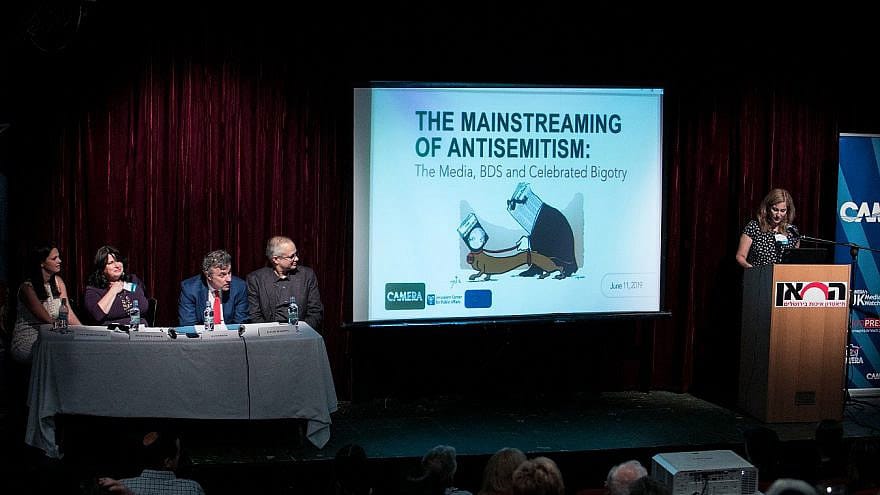
Representative Ilhan Omar (D-Minn.) and the Democratic Majority for Israel (DMFI) group engaged in a Twitter spat over the Boycott, Divestment and Sanctions (BDS) movement on January 25.
The argument started after the DMFI responded to a tweet from former CNN commentator Marc Lamont Hill arguing that BDS “denounces and fights racism and oppression in all forms.” “BDS is antisemitic,” DMFI retorted. “It opposes Israel’s existence in any borders. People are entitled to express antisemitic views in this country, but aren’t entitled to evade the label.”
America's BDS supporters are either ignorant of the movement's positions or purposely misrepresenting them. BDS is antisemitic. It opposes Israel's existence in any borders. People are entitled to express antisemitic views in this country, but aren't entitled to evade the label https://t.co/A9hXuqvvDE
— Democratic Majority for Israel (@DemMaj4Israel) January 24, 2021
This tweet prompted Omar to accuse the pro-Israel Democratic group of being “either ignorant of the movement’s positions or purposely misrepresenting them. BDS opposes Israel’s denial of Palestinian rights & dignity. People are entitled to express their views in this country and should support this nonviolent movement.”
This is a lie. @DemMaj4Israel are either ignorant of the movement's positions or purposely misrepresenting them.
BDS opposes Israel's denial of Palestinian rights & dignity.
DMFI responded with a tweet noting that Omar stated opposition to the BDS in 2018 as an impediment to a two-state solution. In a subsequent tweet, the group highlighted a video from BDS co-founder Omar Barghouti stating, “We oppose a Jewish state in any part of Palestine. No Palestinian — rational Palestinian, not a sell-out Palestinian — will ever accept a Jewish state in Palestine.”
Your stance is curious considering you opposed BDS as a candidate.
“BDS is not helpful in getting a two-state solution.”
— Democratic Majority for Israel (@DemMaj4Israel) January 26, 2021
And here’s BDS Co-Founder Omar Barghouti: "Most definitely, we oppose a Jewish state in any part of Palestine. No Palestinian — rational Palestinian, not a sell-out Palestinian — will ever accept a Jewish state in Palestine."pic.twitter.com/CAiWpNNbuR
— Democratic Majority for Israel (@DemMaj4Israel) January 26, 2021
The Stop Antisemitism.org watchdog also noted that Omar once argued in a tweet that sanctions haven’t worked in Iran, North Korea and Cuba and that “it’s time Congress rethinks the humanitarian, human rights, and geographical impacts of our sanctions.”
The progressive Jewish group IfNotNow, on the other hand, defended Omar and accused DMFI of being “ignorant of BDS’s positions AND purposely misrepresenting them. Thanks for standing up to AIPAC 2.0’s blatant lies, @IlhanMN.” Omar retweeted IfNotNow’s tweet.
In January 2020, Omar was asked by conservative reporter Julio Rosas about why she opposed sanctions against Iran but favors BDS; the congresswoman replied, “The BDS movement is a movement that is driven by the people. The sanctions on Iran are sanctions that are being placed to create maximum pressure by a government. That’s very different.”
Rabbi Noach Weinberg never let failure deter him. Before he founded Aish HaTorah in 1974 as a yeshiva tailored for unaffiliated Jews, he had launched half a dozen others. They all failed.
Most Orthodox rabbis thought that Rabbi Weinberg was tilting at windmills, pursuing an impossible dream. Secularism was winning the day. Assimilation and intermarriage seemed unstoppable. The only other leading figure in the Orthodox world working the kiruv (outreach) circuit was the Lubavitcher Rebbe, who sent young couples to Jewishly-starved communities around the world. Rabbi Weinberg knew that if he wanted to achieve his goal badly enough, the Almighty would help him succeed.
He proved the naysayers wrong, eventually growing Aish HaTorah into an international organization with 35 branches on five continents. And on January 24 (11 Shvat), a live Zoom event, co-sponsored by Aish HaTorah and AJOP (Association for Jewish Outreach Professionals), commemorated the rabbi’s twelfth yartzeit. Aish HaTorah leaders and viewers shared Rabbi Weinberg’s impact on their lives.
Having been privileged to meet the Rav several times, I could only affirm what others recalled: He was a “gentle giant,” charismatic, warm, indefatigable, passionate, visionary and fearlessly blunt.
“What are you really living for?” he famously challenged every student. When they listed goals such as college, career, advanced degree — whatever it was — he’d ask, “Why?” Weinberg wanted students to drill down until they understood that without God and Torah as the foundational purpose behind their actions, nearly every endeavor could lead to disappointment, perhaps even emptiness.
He also told people all the time, “Remember, the Almighty loves you,” with a depth of love in his eyes that will stay with me always. In all my years of energetic synagogue involvement at a Conservative shul and in supplementary Jewish programs, I never heard any teacher or rabbi tell me that God loved me. By contrast, religious Christians fully embrace this idea and repeat it often, though they identity “God” quite differently than we do. Who knows how many Jews have left the religion because they yearned for this emotionally nourishing — and innately Jewish — idea?
Untold thousands of Jews are alive and living a life of Torah today because of Aish HaTorah and Rabbi Weinberg. I am one of those people. Without his influence in my life, I might not have lit Shabbat candles last Friday night. I almost certainly would not have one daughter and three daughters-in-law who all do the same, children whose Torah literacy eclipsed my own by around fifth grade and grandchildren who are all growing up in Torah-observant homes. It is absolutely astonishing.
Untold thousands of Jews are alive and living a life of Torah because of Weinberg.
And, back around 2005, I probably would not have had a guest at our Shabbat table named Gavin Teller, a behavioral therapist who had recently returned from a Young Professionals trip to Israel with Aish HaTorah Los Angeles. At the time, Teller was considering going for a master’s degree in clinical psychology. Intrigued by his experience in Israel, though, he returned to Aish HaTorah in Jerusalem, stayed for six years, and returned to Los Angeles as Rabbi Mordechai Teller. Married and the father of three, Rabbi Teller has been a kiruv rabbi ever since, and in 2017, he became the director of JHubLA, which offers programming, classes and social events for individuals aged 25-40.
Kiruv has changed in some fundamental ways since Rabbi Weinberg began teaching his “48 Ways to Wisdom” series in the mid-1970s. For example, my generation would willingly sign up for a several-day Aish “Discovery” program — or at least one lasting an entire Shabbat. Today, students of Rabbi Teller and his colleagues in kiruv must factor in that people are addicted to social media and counting “likes,” and attention spans have shriveled. While Rabbi Weinberg’s fundamental teachings about Jewish values have not changed, they are repackaged into smaller, bite-sized portions.
“People still yearn for truth, but they also want to be connected to something beyond themselves, to a community, to a purpose,” Rabbi Teller told me in an interview. “People still want to know, why am I here? A lot of self-help gurus have elevated the idea of self-awareness and self-growth, but self-awareness can quickly become self-absorption. I tell students, sure, self-awareness is important, but it needs to be rooted into something bigger. Realize you have a special talent and a special gift that was given to you by God. Tap into that thing that is beyond you and bigger than you.”
Teller also observes that the age when young adults often start focusing on the “big questions” of life has been pushed back from about 25 to now 30 or older. “By that point, they’ve swiped left, swiped right; it’s getting old,” Rabbi Teller observes. He also notes the greater tendency today for people to blame external sources for disappointments and unhappiness. In 2020, he emphasized to his students that despite a global pandemic, they could still take responsibility for their lives “and make something incredible happen.”
Rabbi Weinberg used to say, “Life is for pleasure, not for comfort,” and one of his most innovative creations was the 5 Levels of Pleasure series, which later grew into the book, “What the Angel Taught You: Seven Keys to Life Fulfillment,” which he co-authored with Yaakov Salomon. Rabbi Teller often recommends this book to students, because it changed his life. “That book opened my eyes to realizing that I needed to discover my main truths, to know what I really wanted, and to be willing to work passionately to get there. It helped me understand that God really did create us for our pleasure, but the ball was in my court.”
Rabbi Weinberg was bigger than life, his drive to spread the joy and preciousness of Judaism unquenchable. Rabbi Teller, my husband and I and thousands of others like us who were touched by his greatness can only try to continue to pay it forward.
Watch 4-minute video with highlights of some of Rabbi Weinberg’s most memorable teachings or engage with his phenomenally popular series, the “48 Ways to Wisdom,” based on Pirkei Avos, Ethics of the Fathers. It was also adapted into a book.
Judy Gruen is a writer and editor. Her books include “The Skeptic and the Rabbi: Falling in Love with Faith.”
Editor’s note: On the first anniversary of Kobe Bryant’s death, we republish this piece from last year.
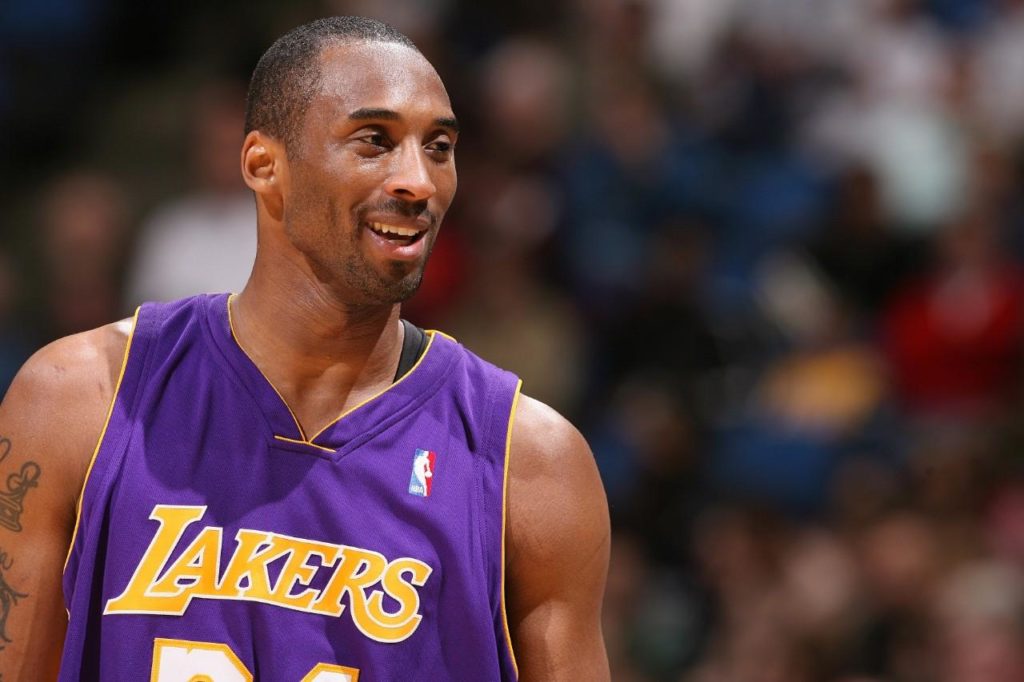
My two worlds collided on Sunday, Jan. 26, a day that will surely live in L.A. infamy. It was right before noon, and I had just finished moderating a panel on anti-Semitism at the Z3 Conference at Stephen Wise Temple.
I knew something was up from the first text I got, which simply said: “KOBE BRYANT!!!”
Since he’s no longer playing, I thought, this cannot be good.
Sure enough, as I was milling around a little sea of Jews who had come to discuss the future of Zionism and some of the challenges facing the Jewish world, the news hit me with the second text, and the third, and the fourth.
Kobe Bryant, a virtual member of my family from the day he joined my beloved Lakers 24 years ago, had perished in a helicopter crash, on a foggy hill not far from where I was standing.
I got dizzy. My mind started racing. Should I go to a quiet corner and cry? Should I call my son in Israel who adores Kobe? Should I seek out more information on the crash?
I was surrounded by people I hadn’t seen in years. I was looking forward to reconnecting with them. As the news of Kobe’s death flooded my brain, I had to click on that other part of my brain that says: “You must look happy and schmooze, no matter what.”
I’ve had plenty of practice doing that — no matter how dark the thoughts in my mind, if I’m at a public event, I’ve learned to smile and fake it so as not to dump my darkness on others.
I got dizzy. My mind started racing. Should I go to a quiet corner and cry? Should I call my son in Israel who adores Kobe?
It was harder to do that on Sunday, but I tried.
The afternoon turned into a blur of love and darkness. I was loving the depth of conversation on so many Jewish issues that mean so much to me, but Kobe’s death kept assaulting me. And I was thinking about my son in Israel, who wasn’t answering his phone.
The Lakers have always represented for me a kind of ultimate “safe space.” When I moved to L.A. in the early 1980s, way before I had kids, the Lakers became my brightest and proudest connection to my new town. They boosted not just my mood but my civic pride. When I went to games, I could experience, like nowhere else, the cultural kaleidoscope of this great city.
As I got more involved with the Jewish world and had to comment on things like wars and terrorism and anti-Semitism and endless communal strife, the refuge provided by the Lakers became even more welcome. The incredible thing about sports, I would say, is that you get all the drama of the real world — conflict, fierce competition, tribalism, winners and losers — without anyone dying.
That sanctuary was also true in my family. No matter all the ups and downs in our lives, we could always count on the Lakers for moments of safe, enjoyable drama.
The death of Kobe pierced that safe space, especially for me and my son.
Kobe would always come up in our conversations. He had a work ethic, a drive to excel and an ability to overcome obstacles that we both admired and tried to emulate. Kobe was far from perfect, but he had the will to improve and get the most out of life.
Suddenly, this man of life who had so influenced our lives was gone. And finally, in the early afternoon, my son answered his phone. He had already heard the news. I had to go outside because I knew I might break down.
The afternoon turned into a blur of love and darkness. I was loving the depth of conversation on so many Jewish issues that mean so much to me, but Kobe’s death kept assaulting me.
Part of me wanted to protect him by looking strong, but it didn’t matter. I lost control. I was unable to click on the “fake it” part of my brain, so I just cried.
It was probably better that way. It was too early to share the coping mechanisms that help us function in times of loss (“He’ll live forever in our hearts” and so on). We both needed a moment of pure sadness to honor a man who had meant so much to us.
As the day wore on, the pain got even deeper as the news came of the other eight people who died in the crash, including Kobe’s daughter Gianna. By then, people at the conference were talking about the tragedy. A horrifically violent accident had interrupted a day of highly civilized thought and dialogue.
Maybe we don’t need to rush to draw lessons from dark episodes in our fragile lives. A human earthquake hit Los Angeles on Sunday, Jan. 26, that many of us will long remember, each for our own reasons.
Sometimes it’s enough to just stare at reality and cry.
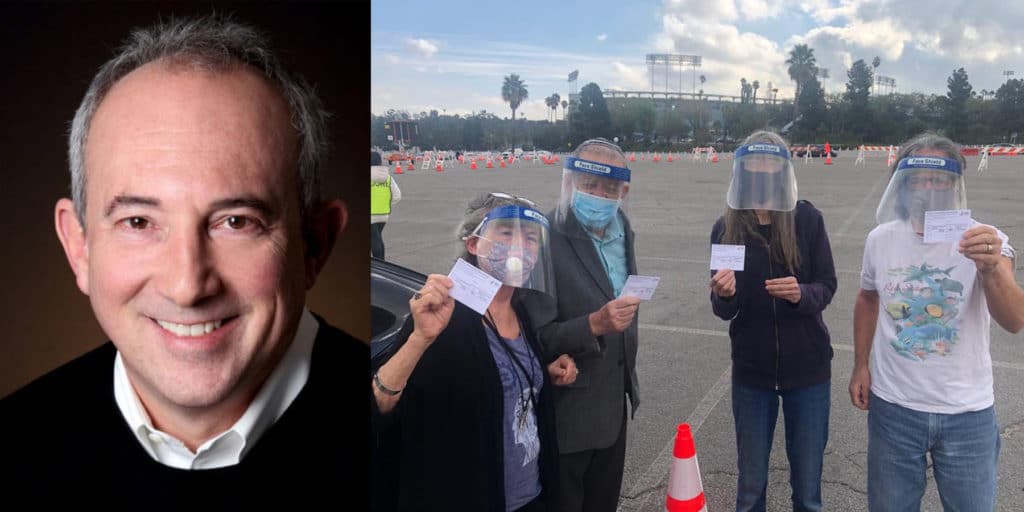
On the morning of January 25, I had the distinct pleasure of interviewing David B. Agus, M.D., Professor of Medicine and Biomedical Engineering at USC’s Keck School of Medicine and USC’s Viterbi School of Engineering.
To better prepare myself for this interview, I decided to reach out on social media and ask people what questions they wanted to ask Dr. Agus about the COVID-19 vaccines. I specifically encouraged people who are on the fence or don’t plan to vaccinate to express those doubts and give Dr. Agus a chance to answer each particular point.
Boaz Hepner: Is it a realistic concern to still spread the virus after being fully vaccinated? If so, doesn’t that make it harder to achieve herd immunity?
David Agus: That’s a fantastic question. If someone gets the vaccine and waits until full immunity — which is about a week or two after the second shot — and then they are exposed to the virus, 60% of those people will have no detectable [viral load] at all. Anywhere from 30-40% may have some detectable amount of the virus, but it would be a dramatically lower [viral load] than if they hadn’t taken the vaccine. This is fantastic because we know that the amount of virus you have dictates how infectious you are.
While it would be better if there were zero virus [after inoculation], [the vaccine] will certainly lead toward herd immunity by eliminating most of the highly contagious individuals and lowering the viral level pretty dramatically… By dramatically reducing the amount of virus, we will still achieve herd immunity and stop the virus in its tracks.
BH: Do you anticipate at least some capability of transmission post-vaccination?
DA: It will certainly be much harder to be infectious after you’ve been vaccinated, but it will remain possible. When you get vaccinated, it’s not a free pass to go hug grandma and go about any behavior or activity. What we’re looking for is that the majority of the country gets vaccinated and then waits two or three months, and we will see the virus [cases and hospitalization] fall precipitously. And that will bring us back to what will be a good new normal.
If you do get exposed to the virus, you’ll have a much lower [viral load], and we already know that these four leading candidates of vaccines result in no hospitalizations or deaths from the virus. You may get a little bit sick, you may get a mild cold, but you won’t be severely ill, and that’s what we really care about — the severely ill. What we worry about is that 5-7% of the U.S. population can’t respond well to a vaccine; it’s these individuals that we have to protect, and that’s why we’re pushing for herd immunity.
BH: To clarify, the four leading vaccines you are referring to are Moderna, Pfizer, AstraZeneca and Johnson & Johnson?
DA: Correct.
BH: Is it likely that we will have a kid-friendly vaccine by the summer? Or before the next school year?
DA: There’s no reason that the vaccines won’t be just as safe and work just as well on children. In the United States, we first do clinical trials in adults. If it proves safe, we do the safety studies on children. Safety studies with children are ongoing at the present time, and those results should be available over the next several months. So probably by the beginning of the summer, we will have safety data on children and [will] start to distribute vaccines to people under the age of 16.
BH: What ages of children do you expect them to be safely released for?
DA: Every vaccine has slightly different age requirements with what they’re doing. It will probably end up averaging age five and above.
BH: How will the vaccine hold up to the different mutations of COVID-19? Do you believe it will work on the new and future strains?
DA: We predicted — science knew — that this virus would zig and zag, and science is going to zig and zag with it. The strains are slightly different shapes of the spike protein that binds these to the receptor. For example, with the U.K. variant, our current vaccines work remarkably well. With the South African and Brazil variants, they work but not as well — they’re not conferring as much immunity to those as they would to the virus before the mutation happened.
Over time there are going to be more variants — no question about it. The sooner we vaccinate everybody, the less virus there [will be], and the less variance there will be. At some point, we are going to have boosters to the vaccine, and they will include these new variants. …This was expected. This is how immunization to viruses work. This doesn’t at all negate what we are doing now. We are still going to need vaccinations for the current strains, and then we’ll augment our immunity with boosters.
BH: What about the fear from people who say, “fine, we’ll come up with boosters, but when there are variants this doesn’t work on, how does that not just put us back to step one?
DA: Because [the vaccines] will still work somewhat against those variants. By saying there’s decreased immunity against a variant, it probably means you’ll [have] some immunity, and [it will] probably prevent you from getting really sick, but you may still get a mild cold. It’s not all or nothing. We have to deal with the viruses we have now. We have to look at it [on] a strain by strain basis. At the same time, we have to plan for the future of developing and augmenting further immunity to these new variants.
BH: How easy is it for them to keep adjusting the vaccine for new strains?
DA: Already, the four leading vaccines have developed variants to the new strains. Vaccine boosters will go through safety studies and at some point be added. It may be that when you get your flu shot in the fall, we add a couple of variants of spiked protein to them. Or we give an additional booster shot separately. Which of these ways they choose to go isn’t yet clear, but they are already under development, and safety testing will soon begin.
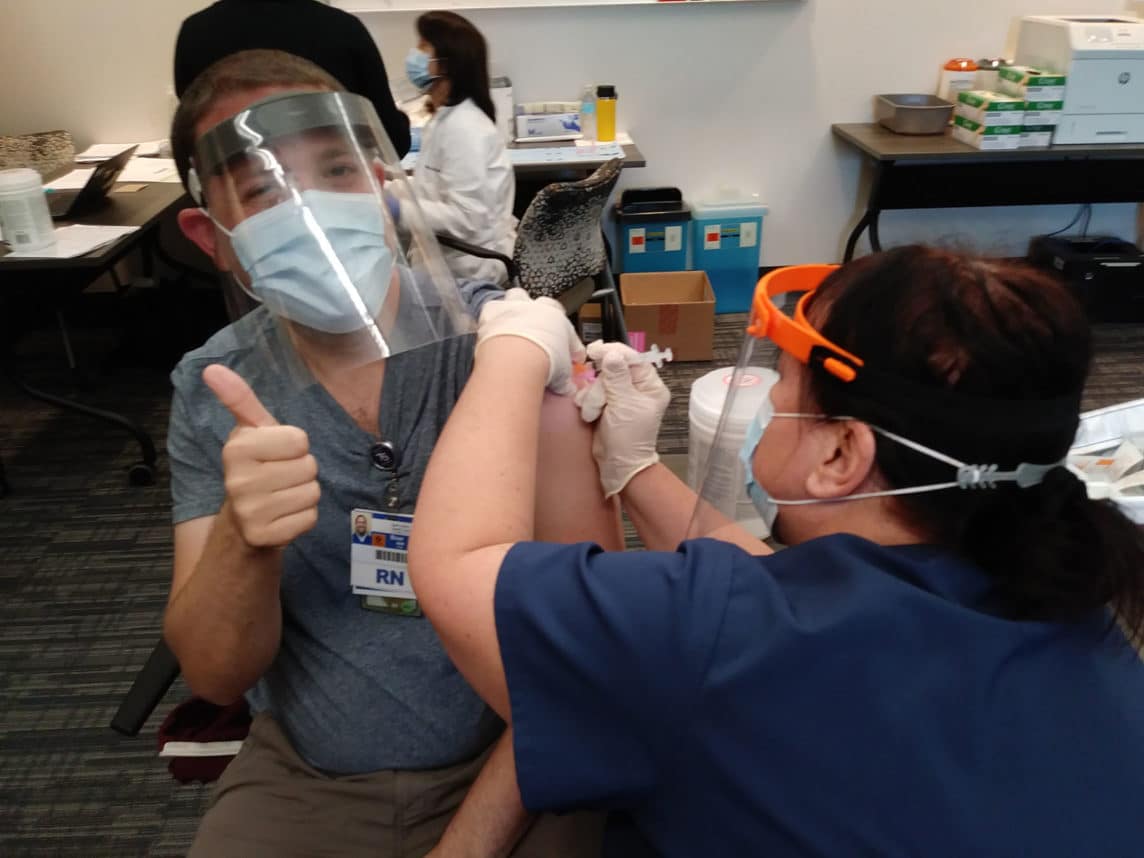
The author, a registered nurse, gets his vaccine.
BH: If someone was presented with an opportunity to get vaccinated before others who are more at risk, should they decline or jump at the opportunity?
DA: It’s a really difficult question. When I was vaccinated, I felt guilt. I felt guilt my parents hadn’t been vaccinated yet. I felt guilt that many of my patients, who are older and have more risk factors, didn’t have it yet. But at the same time, by vaccinating me — a frontline provider — I couldn’t be a conduit to spread the virus as easily anymore. If you look at it in the sense that every single person who is vaccinated is one more person slowing or stopping the spread of the virus, then we all need to be vaccinated.
By setting up this hierarchy, saying [that] this person needs it more than that person, society has imposed its ethical constraints on vaccination. I don’t think anybody should be cutting the line. I think that every state is setting their hierarchy, and we all have to abide by the rules of that, and there will be an order to it all, and we can and will be able to get it in the next few months.
I don’t think anybody should be cutting the line.
If there isn’t an indication where you can be vaccinated now, I would stay back and let the people who need to be vaccinated sooner get it first. Right now, there is an advantage to those who can search on a computer and find the times. Think about who has the resources and time to do that, to keep logging in and seeing when a slot opens. That’s not equal across the board. We need to find a way to distribute this vaccine to the right people at the right time, regardless of personal resources.
BH: Some people are hearing about doses being wasted at the end of the day, and some people are told by friends “be on standby, I might call you if we have extra doses being thrown away so come and get it quickly if that happens.” I assume that’s something you’d be comfortable with?
DA: Yes, that’s playing by the rules. If the rules are that these people get it first, but at the end of the day, we don’t want to waste a dose, and so it’s available to anyone nearby [because] we don’t waste it, that’s all fine as long as you’re playing by the rules.
Unfortunately, there’s been a lot of chaos in the organization of all of this. The federal government and every single state made their own rules, and what you had was some states being really good with it, and other states weren’t. Some states wanted to give all of the doses they had and tried to immediately get more, and other states were holding back doses to have a supply prepared for each person’s second dose. I think we’re going to start to get more of a national policy on this, which makes a lot more sense.
BH: How likely is it that people will get long-term side effects from the vaccine? People are scared of getting MS or cancer or birth defects in future children and countless other scary things.
DA: When you get the vaccine, the important thing is to realize the vaccine is no longer present in your body after a couple of days. Your immune response actually eliminates the vaccine. Regarding side effects, this is what we learn from our trials. If you look historically, we can learn the different things they observe[d] during those trials when things [did] not go as planned. In some cases, the side effects have been that when you make an immune response, it targets something else in your body instead. In other unsuccessful trials, they’ve found the immune response to be so powerful that you get sick from the vaccine itself. And in yet another example during trials, they’ve found that the immune response doesn’t really deal with the virus and instead hides it from the body, so you can get sicker from the virus. But the beauty of it is that all of those examples are consistently seen in the first four to six weeks of inoculation. So every vaccine that I’m aware of in the modern era has involved side effects that have been caught in the first four to six weeks.
With these [Pfizer, Moderna and AstraZeneca] vaccines, which have been given to over 25 million people globally to date, there have yet to be any long-term side effects at all. All of the side effects are short-term and reversible. They are pain in the arm, fatigue for a day or two after the shot [and] fever the day after the shot. The wonderfully predictable thing is that these are really markers of an immune response, not side effects necessarily of targeting this spike protein of COVID-19. This is remarkable — new vaccines where there have yet to be any long-term side effects from the vaccine. And I think that’s making us all very encouraged. At the same time, these vaccines have … prevented death and hospitalizations [just about 100%] (assuming you wait a week or two after the second dose). You can’t do better in terms of a vaccine than what we have now.
BH:People have a fear that vaccines may typically show side effects in the first 4-6 weeks, but they’re also touting mRNA technology as new and revolutionary. How can you be confident that there won’t be any long-term side effects on this vaccine if the technology is so new?
DA: Because it’s not as new as people think. We’ve been using mRNA vaccines for over a decade now. They aren’t yet approved by the FDA, but they’ve been used in clinical trials and studies for many years, and we haven’t seen any long-term issues with them. So the backbone for these vaccines — Pfizer, Moderna, Johnson & Johnson and AstraZeneca — all of these have significant history and data behind them. They weren’t created from scratch. All of these vaccines were built on scientific knowledge that took decades to create. So it’s not like these vaccines were made overnight. They were tweaked overnight to be able to target COVID-19, but the foundations have a long-term science behind them.
BH: Wouldn’t it be safer to wait until millions of people have had the vaccine for years before taking it? What if it has unintended side effects that we can only find out about years later, such as birth defects or cancer?
DA: Even people who are asymptomatic can get heart and lung problems from this virus that can last a lifetime. We know that. The inflammation from this virus can cause havoc on your body throughout your life.
[Compare that to] the vaccine, which now from 25 million people has yet to show any significant issues. I look at the risk/benefits from both, and clearly it favors getting the vaccine. Can I definitively say no, there won’t ever be a side effect from the vaccines? No, obviously not; until we’ve gone long-term, we can’t know 100%. But I can tell you that if you do get the virus, the chances of something significant happening health-wise is very real, whether it be [to your] heart or lungs; it can even happen to the young, asymptomatic individuals.
We all have to be a part of this. We’re in a new era, and the era dictates that you have to look after your community. By you getting the vaccine now, you are significantly helping to prevent spread to others, especially to people who physically can’t respond to a vaccine. We have to think of ourselves as one community, and I think that’s a really powerful notion, being one community together, creating a necessary herd response.
By getting the vaccine now, you significantly help prevent the spread to others.
BH: What’s the point if doctors are saying everyone will still have to wear masks even though they are vaccinated? Has there ever been a virus that you’ve been capable of still transmitting to others after achieving immunity?
DA: Yes, it’s certainly not uncommon [with] the flu and other viruses to find the vaccine giving some immunity and protecting you from getting very ill but still being able to transmit the virus to others. For the first couple of months after herd immunity, if we all continue to wear masks, the virus will go away. That’s what we’re shooting for.
We’re not asking people to wear masks forever. But we are saying [to wear masks for] a month or two after we achieve herd immunity. And then, the new normal will be that you wear a mask when you’re sick, just as they do in most Asian countries. If you have a cough or a cold that day, you [will] wear a mask if you’re going out.
BH: What is different about “FDA Emergency Use Authorization” versus “FDA approval,” and what additional steps (trials, studies, etc.), if any, would the vaccine manufacturers have to take in order to obtain actual FDA approval?
DA: In order to get full FDA approval, they need more follow-up time on the vaccines, which should happen in the relatively near future. This is a vaccine process that’s different from almost everything we’ve ever done because classically, when a drug or vaccine is approved, we stop collecting data. That’s it. But the beauty of this vaccine is that every single person who is vaccinated is given a card with something called V-Safe on it, where they can actually submit their side effects and how they’re feeling. We’ve collected over 20 million data points after the vaccine has been administered, and that is ongoing. The exciting part is collecting real-world data, which is powerful and important as we move forward.
BH: Do mRNA-based vaccines suffer from a greater chance of becoming less functional/adaptable to viral genetic mutations than other vaccine types — such as adenovirus-based vaccines — due to the more precise nature of these mRNA vaccines?
DA: No. They are equivalent in that regard. An mRNA vaccine is basically a code to make the spike protein. And the adenovirus vaccines use the same translation of the code that the mRNA vaccines use or vice versa. There could be a one to one mapping. The conventional vaccines are also basically a code for the spike protein. So we’re describing the same spike protein in all of this. If that spike protein changes like it did… in the U.K. or South Africa or Brazil [variants], then we would have to sufficiently change the code. All of these technologies are amenable to changing the code with the new booster shot.
BH: Many are unsure whether to get vaccinated, as they’ve heard it can cause infertility in both men and women. Is there any truth or possibility of that?
DA: The fertility thing is an internet rumor. There is no effect on fertility at all with any of these vaccines. There is no way scientifically that it could affect fertility. We also know that we have over 20,000 pregnant women in the database now, and they have done fine. Mothers nursing their babies — those moms and babies all have done fine. All of that is very encouraging. We have to be cautious [about] what’s real and what’s basically an internet rumor. And in this case, the fertility accusations are entirely an internet rumor not based on science.
BH: Some vaccines can cause worse reactions than getting the virus without being vaccinated in the first place, what is called Antibody Dependent Enhancement (ADE). Is that a possibility for COVID-19?
DA: It has been disproven for all of the four vaccine candidates that we’ve been talking about.
BH: Why not just inject a bunch of spike proteins instead of injecting a fragment of RNA or DNA?
DA: In order to get good immune responses, we need carriers to basically turn on their immune systems. So with every vaccine we use, it’s a little piece of the virus that has to be given in another context. We have to basically prime the immune system. Each of these vaccines is meant to do that. You saw today, for example, Merck’s vaccine failed because it didn’t turn on the immune system enough. So it’s really critical that we not just have the spike protein, but also other components [to] activate the immune system so that the response is robust enough to provide adequate protection.
BH: After the elderly, at-risk members of a family get both doses of the vaccine and wait a few weeks after the second dose for full immunity to kick in, what does a safe family get-together look like with the younger family members who are lower risk but still not immunized?
DA: Vaccinated people can still get the virus and spread it to others. It’s really critical that we continue to have get-togethers the same way we’ve been — with wearing masks and social distancing — and not having large get-togethers until we achieve herd immunity and go past it by a few months. We’re talking this summer, probably.
Getting the vaccine is not a pass. We have to be cautious about that. We’ve seen this in the world already, where after the first shot, people have started to think it was a free pass to change behavior, and we saw a rise in the number of cases. We have to be very helpful here. If we do this together and do it right, we’ll be back to a fall where we can have children going to school; we can have businesses open; we can have the economy rebound and get back to our new normal.
BH: How will this focused effort on COVID-19 translate into other biomedical advances?
DA: There’s no question that what COVID-19 taught us is that data matters. It taught us that we have to start to be able to use every patient’s experience to benefit others. What I think COVID-19 will do for our future is two things:
This horrible experience will enable us to start to use medical data in a privacy-protected way to help each other and better target disease.
It also shows us what the roadblocks are — how we should do things better and quicker. Being prepared for a future pandemic but also developing drugs faster for cancer, Alzheimer’s and heart disease.
We learned a lot here, and I think there are going to be ramifications for early research and clinical care of every disease in a positive way because of what we’ve gone through.
Dr. Agus invites and welcomes anyone who has questions about this or any medical topic to text him at 310-299-9322, be patient, and he’ll get back to you as soon as he can.
Dr. David B. Agus is a professor of medicine and engineering at the University of Southern California Keck School of Medicine and Viterbi School of Engineering. He is the founding director of USC’s Lawrence J. Ellison Institute for Transformative Medicine. Dr. Agus specializes in treating patients with advanced cancer. His clinical responsibilities include the development of clinical trials for new drugs and treatments for cancer, supported by the National Cancer Institute and other private foundations. He serves in leadership roles at the World Economic Forum, among other prestigious organizations.
Boaz Hepner works as Registered Nurse in Santa Monica and lives in Pico/Robertson with his wife and daughter.
New David Suissa Podcast Every Tuesday and Friday.
In honor of International Holocaust Remembrance Day, a conversation with Stanlee Stahl of the Jewish Foundation for the Righteous.
How do we manage our lives during the coronavirus crisis? How do we keep our sanity? How do we use this quarantine to bring out the best in ourselves? Tune in and share your stories with podcast@jewishjournal.com.
On an ordinary Tuesday in 2017, a Facebook message from a stranger popped up on my phone.
“Dear Sara Hershkowitz, are you related to Philip Herschkowitz, composer, from Iasi Romania, who studied with Alban Berg?”
I texted back that I didn’t know but that I thought it possible.
“Because if you are, Philip Herschkowitz, who studied with Alban Berg in Vienna before the Nazi’s came, died with no heirs. He left his entire musical estate to the Vienna Public Library.
If you think there’s a chance you might be a descendant, or even if you’re not, they’d love for you to come look through the archives. Maybe consider performing some of it?”
I blinked at the screen. Alban Berg was the composer I had been most obsessed with since I was 21 and stumbled across Lulu in the Manhattan School of Music library.
My voice teacher at the conservatory had once said “You were born to sing Alban Berg’s Lulu” and I secretly agreed.
Berg’s music was dark, sensual, cinematic. Occasionally sinister, occasionally angelic.
And now maybe I was related to someone who knew him personally….? My heart leapt into my throat like a starstruck teen.
Was there a family tree that might connect us? Most likely any birth certificate of any other evidence of a common lineage would have been lost or burned in the war. It would be almost impossible to know for sure what connection—if any at all—I might have to Philip Herschkowitz.
It did not matter.
It did not matter because the possibility now existed that I had had an ancestor who had gone through the exquisite highs and lows of a life in music, the way I had.
And this tiny glimmer of possibility made me feel a bit less lonely in the world. I did not exist as an island. I was maybe part of a lineage.
And that is why I booked myself an economy class flight from Los Angeles to Vienna in January of 2018, to immerse myself in the archives and pore through the musical estate of the man who I now believe is my great-grandfathers nephew.
They say that in Vienna the ghosts are friendlier than the living.
I’d been to Vienna before but this time I could not shake the sense that all my past, future and present selves were all lined up inside me like those Russian Matryoshka dolls.
On a cold, rainy January day, I had my first appointment with Herr Aigner, the head librarian in charge of Philip’s estate.
I put on a camel wool coat, high-heeled boots and a man’s fedora hat. When I paused to look in the mirror before leaving the AirBnB, a fancy lady looks back. I thought my own face looked like a face from 1933.
When I arrived at the gothic library of the Vienna Bibliotek, Herr Aigner invited me into his office.
I sat across from him clutching my umbrella.
He started by saying how close Philip had been to Alban Berg. Berg had thought the world of Philip and his talent.
He mentioned that Philip had fled the Nazi’s and moved to Russia and how the Soviets then blacklisted him because he taught serialism, a post-tonal composition style, which the Russians considered to be subversive.
“Philip Herschkowitz was always on the wrong side of politics”, Aigner explains “ Or, maybe more accurately, the right side—for this his music was never given a fair chance.”
I did not have the chills at that moment, my DNA did not respond.
I just nodded.
It wasn’t until later that afternoon, in the library archive, when I was holding Philip’s ancient, yellowing scores in my gloved hands and look at the original faded pencil markings on the fragile paper, that something sparks inside me. It is as if a string of lights is suddenly switched on, illuminating a secret passageway that I am just now realizing has been there all along.
Herr Aigner warned me that I was not allowed to take any music out of the archive but I was allowed to take as many photos of the score as I liked.
So I clicked away, and managed to take about 80 pages worth of photos my little iphone 7. When I was done, Aigner stopped me.
“Wait. Take this” he said, handing me a scary looking, small-printed paperback book entitled “ Philip Herschkowitz.”
I took it but secretly winced, figuring it was a book on music theory.
I winced because there was no way I was going to read a thick book on serialist music theory, not even if I was related to the guy. And definitely not auf Deutsch.
But on the flight home I cracked open the cover. To my astonishment, it was not a book on music theory at all.
It was a book of Philip’s letters. His private letters to Alban Berg.
“Sehr geehrte Herr Berg”, read one. “ I only have 150 per month to live on. This means I would have to beg for free lessons from you…. all I truly need now is one lesson a month. But what I really need most, quite simply, is to be in your presence.”
“But not in your presence, as in, having a cigarette together, but your presence, meaning, in a sitting tempo, sitting at a table decorated with flowers, with you, I want to be useful to you, in whatever way works the best, I want– for example– to make corrections for you, to bring them to you in the bath.”
In my little cramped seat of 23D on the Easyjet flight home, I wept into the pages. Was this a love letter? Or merely a student devoted to his teacher?
I didn’t know but love is love is love and the point was: his letters to Alban Berg were filled with it.
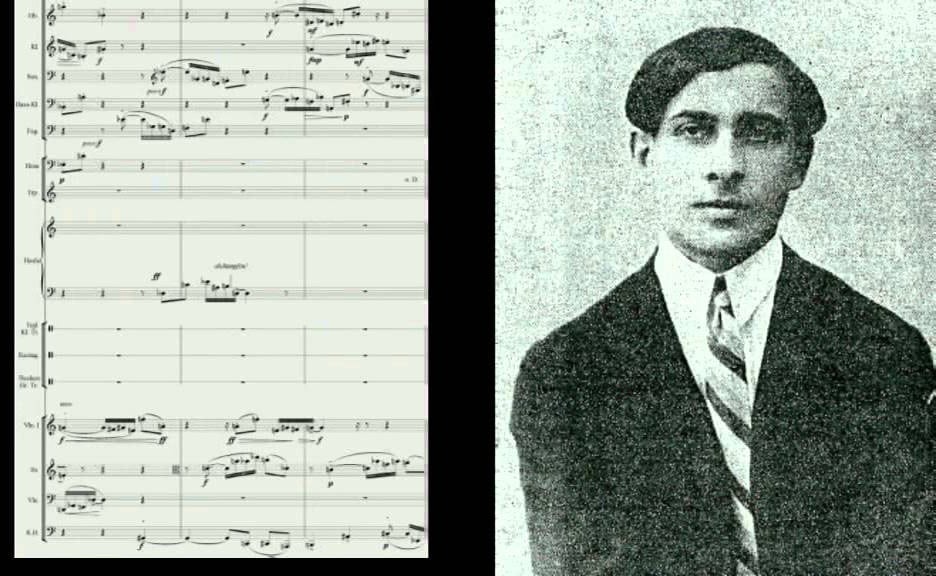
The flight attendant came with coffee and I wiped my eyes with an airplane napkin. Then I kept turning the pages, until I saw a photograph of Philip as a young man. I could not stop staring at it. He looked about 25, with pale, smooth skin, midnight-black hair, parted on the side and eyes so liquid, so deep, so long-lashed it almost looked like he is wearing eye-liner. He has a strong nose and an oval face. He looked like a cartoon cliché of an artist. But there was something else he reminded me of and it took me a second to realize: He was the spitting image of my father and his brothers. He even looked….well, he looked a little bit like me.
I closed the book, opened up my phone to look at all the photographs of Philip’s sheet music. Some were with words in smeared smudgy ink. Some were song texts in Romanian, in curly old-fashioned handwriting.
When I put the phone down I understood that somehow I had been give a task.
*************
“I have to sing them,” I said into the cell phone, my voice brimming with excitement. “ I have to somehow bring them back into the world.”
I had only been home in Berlin for about three hours but had already called up the stranger from Facebook.
The stranger from Facebook, I’d since learned, was no ordinary stranger but a brilliant man called Michael Hass. Michael worked for Exilarte, an organization that takes care of the estates of composers who were persecuted by the Nazis.
“If you could somehow get in touch with the pianist Elisabeth Leonsakaja and collaborate with her, you’d easily get booked for a concert in Vienna. Elisabeth was Philip’s student in Moscow. I know she expressed interest awhile back in doing his music. Ask Herr Aigner.”
Elisabeth Leonskaja, the famous Russian pianist, had studied with Philip? And wanted to perform his music? But why hadn’t she done so already? I was excited to call her.
In retrospect, believing I could simply call up a legend like Elisabeth Leonskaja was as delusional as thinking I could simply “casually reach out” to Martha Argerich.
As if this was just any ordinary human who happened to play piano. Contacting Leonskaja would be quite a long shot with a lot of gatekeepers who would protect the airy, famous-person-perimeter around her.
But connecting with her was also the best shot I had at bringing back Philips music.
When I emailed Herr Aigner about it he was cagey.
Liebe Frau Hershkowitz, I cannot give you Frau Leonskaja’s email…. I am sorry but I have a duty to protect her privacy. If you want to try and reach her another way, fine. I am sorry I cannot help you further.
So I typed the words into a Google search on my laptop:
Elisabeth Leonskaja, Agentur, and a phone number popped up.
I picked up my cell phone. “Ja! Guten Tag. My name is Sara Hershkowitz. I’m calling to get in touch with Frau Leonskaja? I believe that I am that great-grand cousin of the man who was one of her most important teachers, Philip Herschkowitz—“
The agent interrupted me.
“Frau Leonskaja is a very busy woman who has many demands on her time and I would not advise you to get your hopes up. However I will give you her email.”
This is a long shot, I told myself. Don’t get your hopes up. But I was off to the races.
And because the rule in life always seems to be that when you expect nothing, things happen, the following email arrived:
Dear Sara Hershkowitz,
It is a phenomenal news- to know that somewhere in the world are the relatives of our (my, Alexei Lubimov (my great kollege ) and many other musicians in Moscow) teacher Phillip Herschkowitz.
BOSTON (JTA) — A heartwarming and beautifully illustrated Passover tale and two poignant coming-of-age debut novels are this year’s gold medal winners of the Sydney Taylor Book Awards for the best in Jewish children’s literature.
The awards, given by the Association of Jewish Libraries, were announced Monday at the American Library Association’s midwinter meeting as part of the ALA’s Youth Media Awards ceremony. The ALA conference was held remotely due to the pandemic.
In “Welcoming Elijah: A Passover Tale with a Tail,” by Leslea Newman and illustrated by Susan Gal, a young boy celebrating a Passover Seder with his family is united with a lonely kitten shivering at his doorstep on a cold, windy night. The lyrically written story, echoing with the holiday’s theme of welcoming strangers, won in the picture-book category.
Newman is the award-winning author of more than 70 books, including the trailblazing “Heather Has Two Mommies” and “Gittel’s Journey.”
“Turtle Boy,” by M. Evan Wolkenstein, won in the category for middle grades. In this stirring work, seventh-grader Will Levine is a shy loner paired for his bar mitzvah project with a terminally ill hospitalized teen longing for adventure. Kveller, a sister site of the Jewish Telegraphic Agency, described the book as a “marvelous coming-of-age story about bravery and the redemptive power of friendship,” and finding meaning in Jewish ritual.
In the young adult category, the top prize went to “Dancing to the Pity Party,” by Tyler Feder. The critically acclaimed graphic-style memoir explores the loss and grief following the death of Feder’s mother. It’s funny and sad, according to Rebecca Levitan, chair of the Sydney Taylor Award Committee, who in a news release described the book as a “singular achievement.”
Six silver medalists and 11 notable books were recognized. The full list is available here.
The Sydney Taylor Book Awards honor books for children and teens that exemplify “high literary standards while authentically portraying the Jewish experience.” They are named in memory of the author of the mid-20th century series “All-of-a-Kind-Family.”
The winners will receive their awards at the Association of Jewish Libraries’ annual conference, which this year will be held remotely at the end of June.
They breached the walls of the building in throngs. The seemingly smaller ones seemed to derive the sheer strength to scale the high walls through hatred and vengeance — a potent and, as it turned out, unstoppable source that propelled them forward and upward over the seemingly impenetrable.
They had made it to the other side. They were in.
This isn’t a description of the previously unimaginable breach of the United States Capitol Building by a violent mob on January 6. Rather, it describes the moment when fanaticized Iranians breached the gates of the U.S. embassy in Tehran in November 1979 and took over 50 Americans hostage, just ten months after a deadly revolution turned Iran into an oppressive theocracy.
I wasn’t even alive in 1979, but that image is ingrained in me, possibly from what I’m convinced is some genetically-inherited trauma from my mother and father, who lived through Iran’s Islamic Revolution. You know what other image won’t release me from its miserable clutches? The sight of radicalized men climbing over the walls of the Capitol building this month.
Three weeks ago, when it first happened, I wrote down some reactive thoughts but decided not to publish them, thinking my reaction was perhaps too visceral. This is America, I thought, and these bad events and feelings will pass. But three weeks later, I can’t get that image from the Capitol wall out of my mind. Worse, it keeps reminding me of the photos of Iranian fanatics in 1979.
Trump supporters storm the United States Capitol building on January 06, 2021 in Washington, DC. (Photo by Spencer Platt/Getty Images)
The image of those rage-filled men in Tehran, breaching what was more than a wall, but a symbol of freedom and strength for millions (the American embassy), remains entrenched in the minds of the tens of thousands of Iranian immigrants and refugees in Los Angeles who were still in Iran during the revolution. Many of them, whether knowingly or unknowingly, suffer trauma from having lived through the nightmare of politicized fanaticism that resulted in the total upheaval of a land rendered wholly unrecognizable in the hands of tyrants.
There’s a reason why a freeway sign on the 405 North freeway near Westwood Boulevard reads, “Persian Square Next Exit.” Southern California is home to nearly 700,000 Iranians — the largest Iranian diaspora community outside of Iran. And many of us still need access to mental health professionals to help us heal from the trauma of violence and oppression — but that’s an issue for another column.
My family is among those refugees who thought we had left the nightmares of Iran back in, well, Iran.
“Please,” my father pleaded weeks ago when I showed him a photo of zealous men breaching the walls of the Capitol building in support of President Donald Trump, “I don’t want to see that.” Like millions who fled Iran after the revolution, my father never again saw his home, his land nor the members of his family who were unable to leave Iran. In fact, he lost nearly everything to bring his wife and two young daughters out of a place that seethed with despotism. “I already saw that once,” he said. “That’s not supposed to happen here.”
Here.
In America.
There were three remnants of our previous lives we thought we had left behind when we escaped Iran over 30 years ago: First, the mandatory hijab, or Islamic head covering that all females, whether five or fifty, and regardless of faith, were forced to wear after the revolution. Second, the oppressive stench of dictatorship, where the omnipresence of a self-espoused “supreme leader” even managed to breach the hallowed gates of our dreams, which soon became nightmares. And finally, the threat of a coup d’état. For many Iranian-Americans, the Capitol breach conjures trauma from a land we thought we’d left behind.
For many Iranian-Americans, the Capitol breach conjures trauma from a land we thought we’d left behind.
In 2019, I took my father to see Washington, D.C., for the first time. We toured the Capitol, and he was noticeably disappointed that he wasn’t able to see the Senate chambers. “That’s where they argue like civilized people, instead of practically hitting each other over the head like they do in the majlis (Iran’s parliament),” my father joked. A few minutes later, I watched as he held his breath while standing in the rotunda. “Dad,” I whispered, “This is where Abraham Lincoln and John F. Kennedy [had] lain in state.” He breathed deeply and looked at his shoes, as if overcome by the humility of his own redemption.
We then walked toward a statue of Rosa Parks, and the tour guide announced that she had laid in honor in the rotunda — the same space where, a few weeks ago, tear gas was dispersed and where, close by, in another room, a man proudly walked around the portrait of an abolitionist while waving a huge Confederate flag.
The Capitol is like hallowed ground for my family and me. It was there, in 1980, that Congress passed the Refugee Act, which granted us the most important blessing of our lives: protected admission into the United States. If I could, I’d get the words “Admitted as protected refugee” (which are stamped on my Iranian passport) tattooed on my forehead.
In the decades that passed, our community thrived in this country. And like many immigrant communities, it’s hard to peg Iranian Americans into neat political categories. Many from the older generation, who still remember the revolution (and still haven’t forgiven President Jimmy Carter for his role in the overthrow of the former Shah of Iran), lean to the right, especially when it comes to strong foreign policy against Iran and the regime’s unsatiated pursuit of nuclear weapons.
But there’s a younger generation — mostly American-born — who embraces progressivism as the ultimate confirmation that the traditionalism of Iranian society that’s been ingrained in our community needs to be buried, and quickly. As for me, I’m in my thirties and lean somewhere in between. My fears about an emboldened Iran are beyond the realms of individual presidents and partisan politics. I’ve been worried about Iran for 25 years.
But as a former child refugee from post-revolutionary Iran, I can assert with confidence that what is highest on the list of fears that terrify and re-traumatize our community in the United States is the threat of radicalized people. We’re not afraid that a “supreme leader” will simply take the reins of power in a country like America; we’re biting our nails over the prospect of who will support and enable such a person to radically change this country. Who would carry out the leader’s directives? Who would turn against ordinary citizens? And for people like my father, who were in their twenties and thirties when five million joyous Iranians foolishly greeted Iran’s revolutionary leader, the Ayatollah Khomeini, in Tehran when he returned to the country after a fifteen-year exile, there remains just one question: Who will wake up one morning and take their radicalism too far?
I’m not suggesting that America is about to morph into Iran. And I’m not one of those Americans who’s dusting off the old passport and anticipating greener pastures in Canada or anywhere else. I’m staying right here. But as an Iranian American, I’m following the trends of radicalism in this country with a combination of uneasy concern and with a certain unrelenting awe for the good, decent and nuanced people of this country.
It’s not easy. Sometimes, it’s downright infuriating, especially when despots like Ayatollah Ali Khamenei, Iran’s supreme leader, respond to the carnage at the Capitol by ridiculing “American values” and declaring that the incident was “God’s revenge” against the United States for having sewn instability in the Middle East.
Khamenei, too, seems to have been impacted by images from America. As if there isn’t enough fanaticism and unrest in his own backyard about which to tweet. But that’s the thing about images. Some of them — like fanatics breaching the Capitol Building wall in 2020, jubilant Americans hugging during victory parades in 1945, or the upside-down man,with one leg bent like a dying flamingo, falling from the World Trade Center in 2001 — stay with you forever.
A seed seems to have sprouted over the past few years. Perhaps it had been there all along, deep beneath the soil, and simply needed the nourishing rains of militant speech and nods and winks at the highest level to make it sprout. After what we saw on January 6, there’s only one thing that I and thousands of others like me want to see climbing over the venerable walls of our Capitol: some good old ivy, nourished by the moderate rains of our nation’s capital.
Tabby Refael is a Los Angeles-based writer, speaker and activist.