fbpx

December 29, 2020

Making Ma’amul: A Middle Eastern Dessert

I met Rachel when she was a sophomore at Beverly Hills High School and I was a junior at YULA Girls High School. Brigitte, Molly and Shira were all friends in high school. Brigitte married Jonny who was in my graduating class. He was also good friends with Yosi. Esther married Yosi, who’s grandmother was a cousin of my grandmother. Yosi went to law school with Neil. I met Mona on New York’s Upper West Side. She had gone to Israel on the SEC Hamsa trip when Neil led the tour group, way before he ever married Rachel. This trip also resulted in many unfortunate camel jokes, but that’s a different story.

The friendships were cemented in our early twenties through the Sephardic Educational Center Young Professional’s Group, when we had Monday night Classes for the Masses at Kahal Joseph Synagogue and Cultural Nights and at SEC Conventions in Montreal, Miami and Mexico.

The sisterhood grew stronger with every engagement, marriage, childbirth and bar and bat mitzvah that we celebrated together.

The G-d Squad title was coined over twenty years ago when one of the moms in the group had a newborn and two toddlers and had to move houses. We all came over to unpack boxes and that’s when she decided that we were her G-d Squad.

The group has expanded with the years. But the rules have remained the same: make each other laugh, celebrate birthdays and milestones and cheer each other on.

There is so much to learn from each and every member. We all love to eat and we all bring our different culinary traditions—Moroccan, Turkish, Syrian, Egyptian, Persian and Iraqi—to the table.

One fun day, in what seems to be a different lifetime, we gathered to bake for Rosh Hashana, the Jewish New Year. We made lots of beautiful challot and ka’ak, salty, crispy, ring-shaped crackers.

Esther, whose family has a Turkish and Syrian legacy, by way of Cuba, showed us how to make ma’amul, a Middle Eastern dessert delicacy. She brought the beautiful wooden ma’amul mold that her great aunt gifted her upon her marriage (to Yosi, remember?).

Traditionally made with pistachios or a mix of nuts, like pistachios, almonds and walnuts, Esther used walnuts.

The ma’amul can be filled with walnuts or dates, but whichever filling you choose, be sure to include orange blossom water, which lends a sublime and subtle flavor.

If you don’t have a great aunt, or a G-d Squad, to give you a ma’amul mold, they can be purchased on Amazon.

And full disclosure, the stunning ma’amul in the picture is from our culinary angel Jazmin Daian Duek. She delivers.

Awafi!

To your good health!

Ma’amul molds

Esther’s Ma’amul Recipe

Dough
2 cups all purpose flour
1 cup semolina flour
1/2 teaspoon rose water
1 cup unsalted butter or margarine or coconut oil

Nut Filling
1 pound walnuts, ground
2 tablespoons confectioners sugar
1 tablespoon unsalted butter or margarine or coconut oil, melted
1/2 teaspoon cinnamon
1/2 teaspoon orange blossom water

Date Filling
1 pound pitted dates
1/2 cup ground walnuts
1/2 teaspoon cinnamon
1/2 teaspoon orange blossom water

Preheat oven to 350F.

Combine flour and semolina in a large bowl until it has a crumb consistency.

Add rose water, fold in the butter and add 1/2 teaspoon lukewarm water.

Knead the dough well and place in the refrigerator until ready to use.

Prepare the fillings by combining the ingredients.

Divide the dough into four portions.

Work with one portion at a time, while covering the rest as you work.

Pinch walnut size balls of dough, then press down on the center with your finger, to form a ½ inch indentation.

Fill the indentation with ¼ tsp of the filling, then close the pastry.

If using a ma’amoul mold, press the top of the pastry firmly against the mold, then lightly tap the mold on a hard surface to remove the pastry.

Place the pastry on a cookie sheet lined with parchment paper.

Bake 10-12 minutes or until the bottom of the pastries are lightly browned and tops remain pale.

Sprinkle the cookies with confectioners’ sugar before serving.


Rachel Sheff and Sharon Gomperts have been friends since high school. They love cooking and sharing recipes. They have collaborated on Sephardic Educational Center projects and community cooking classes. Follow them on Instagram @sephardicspicegirls and on Facebook at Sephardic Spice SEC Food.

Making Ma’amul: A Middle Eastern Dessert Read More »

New Jersey Jewish Man Stabbed

A Jewish man was stabbed as he was walking out of a shopping plaza in Lakewood, N.J.

Video footage of the incident shows a woman standing behind a wall and then attacking the man from behind as he walks by her. The man then chases the woman and tackles her until police arrive; the suspect is currently in police custody.

The victim, who can be seen wearing a kippah in the footage, told The Lakewood Scoop that he initially thought someone was “poking me” until he saw the woman standing in front of him and felt a knife in his back. He added that he proceeded to scream for someone to call the police and then managed to pin her to the ground until they arrived. The victim went to the hospital for minor injuries and was subsequently released.

Police are still investigating the motive of the attack and said that the suspect is “mentally unstable.”

The Anti-Defamation League New York / New Jersey chapter tweeted, “Aware of this disturbing incident and reaching out to law enforcement to learn more.”

New Jersey Jewish Man Stabbed Read More »

Changing — Like Language — in a Catastrophe

Language evolves through the crucible of catastrophe.

I learned that in real time in 1991, when I was in Israel during the first Gulf War. Although the uncertain terror of Saddam Hussein’s aerial dispatches quickly yielded to inconvenient middle-of-the-night sirens, the era did feel catastrophic. For me, my peers on gap years and the entire country, we were at war. And we spent our nights in sealed rooms, protecting ourselves from chemical weapons with which the Iraqi scuds might be tipped.

Before the Gulf War, in Israeli idiomatic Hebrew, the adjective אטום (atum) was commonly appended to the noun ילד (yeled, or boy) to refer (rather insensitively) to a child with some intellectual disability. A “sealed child.”

But nine months later, that two-word phrase took on new meaning. There was a significant baby boom in Israel in the fall of 1991. Israelis, up in the middle of the night, facing potential death, chose to cherish and produce new life. And so, yeled atum came to refer to a child conceived in that sealed room.

Language transformed. But not just that. The transformation of the language codified something larger than letters, something the society had experienced and achieved — extracted hope and vitality and light from muck and darkness and fear.

The Jewish people have learned and taught that there can always be laughter and life — even and especially in the face of unspeakable horror. But to live and to laugh amidst that horror does not diminish it — rather, it renders the horror markedly less horrible. Life and laughter cannot bring back the victims of war or shuttered businesses. But they can be one of the buoys that keeps our heads above stormy waters.

Life and laughter can be one of the buoys that keeps our heads above stormy waters.

2020 has been catastrophic for many reasons. But COVID-19’s specter looms the most ominously. There is no way to look back upon this year and ameliorate it with magical thinking. The losses of life, well-being, livelihoods and the societal fabric we relied upon are incalculable and mostly irreversible.

But there also has been beauty in 2020. We all have been witness to countless examples of good people mustering strength and fortitude when circumstances conspired against them. I have been uplifted by how people I know (and people I don’t) have transformed this year’s sense of being atum, sealed, into glimpses of being free, liberated and soaring.

My own minor example of this has been how a schedule both more onerous and more flexible, combined with the urge to break out of quarantine, has gotten my rabbinic tuches on the bike more than ever before. As many people know, biking, which I just picked up about nine years ago, is a balm in my life. It brings me to the salty air of the beach. It gets my body moving, heart racing and calories burning. It bonds me with a dear set of friends, relationships burnished somewhere between Playa del Rey and Palos Verdes. It gives me a reason to get up early on a Sunday, squeeze in rides within the smallest of windows and challenge my own physical abilities.

COVID-19, for all its treachery, has been a boon to me and my biking group. We found its appeal at paces we previously never would have considered. And it allowed us to extract life, beauty and health from a miasma of despair, confinement and hovering illness.

I leave 2020 not only gratefully alive — and more grateful than ever before — but perhaps living in the healthiest body that has ever encased this soul.

Somewhere in the late summer or early fall, when I saw the miles pile up on my Strava account, I realized that pushing my previous annual high of 2,700 miles to 3,000 or even 3,600 miles was insufficient. 4,000 was in reach. A couple of extra rides to Terranea, an inaugural century and plenty of early morning rides did the trick. And with three days to go in the year, I have eclipsed 4000 miles.

I have no verbal or etymological schtick to consecrate this achievement. Nothing as profound as heder atum to yeled atum. But it feels as monumental as that did then. I don’t mind saying that I am proud of myself. And I am proud of all who have, in ways minuscule and gargantuan, forced order and goodness and life upon this landscape of loss and devastation.  There have been gems glistening all around us. The woman who lost her job and found a new one; the college or gap-year student who gained unexpected time with family; the Jews (and others!) who have found Zoom prayer across time zones and communal boundaries. The examples abound if we search for them.

So as 2020 dissolves into 2021, ask yourself how you created your own yeled atum. What beauties have you birthed, and witnessed, this year? What did you open within this extended sealed room?

Happy New Year to all those who transformed, like language, in the wake of tragedy.

Changing — Like Language — in a Catastrophe Read More »

Wiesenthal Center Releases Top 10 Worst Anti-Semitic Incidents of 2020

The Simon Wiesenthal Center unveiled its list of top 10 worst anti-Semitic incidents in 2020 on a December 29 Zoom call.

Associate Dean and Director of Global Social Action Agenda at the Wiesenthal Center Rabbi Abraham Cooper said that while it was tough to limit the list to only 10 incidents this year, the COVID-19 pandemic was the number one anti-Semitic incident in 2020. Cooper said that the pandemic has been “weaponized” against minority groups, particularly Jews and Asians. As an example, he pointed to anti-Semites’ calls to infect Jews with COVID-19 in what became known as the “Holocough.”

Because the pandemic has been politicized, there have been countless conspiracy theories surrounding COVID-19 that have paved the way for anti-Semitism, Cooper said. He also noted that there have been “elements” of anti-Semitism in the anti-vaccine protests.

“In places like Germany, where they had demonstrations against a vaccine before it was even available… among the protesters were anti-Semites and those who were misusing Holocaust symbols,” Cooper said. He acknowledged that the anti-vaccine movement is not by-and-large anti-Semitic, but there was anti-Semitism in the “pernicious nature of individuals and groups who want to take advantage of the virus.”

Second on the list was Telegram, an encrypted messenger app. Cooper said that Telegram is “becoming the weapon of choice, the platform of choice, for extremist groups.”

Rick Eaton, the Director of Research at the Wiesenthal Center, pointed out that neo-Nazi groups like the Atomwaffen Division — a group that has been reportedly linked to five killings in the United States — are among the extremist groups on Telegram. Other groups include the anti-government “boogaloo” movement and the Nordic Resistance Movement, a group that has targeted a synagogue and other Jewish institutions on Yom Kippur.

“Telegram is a feed from a particular group so they can continually post articles and outside links as long as you subscribe to the feed that they’re promoting,” Eaton said.

Nation of Islam leader Louis Farrakhan is third on the list; Cooper explained that while Farrakhan’s names invokes memories of his long list of anti-Semitic tropes, some in the Black community view Farrakhan as synonymous with Black empowerment.

“Louis Farrakhan’s tropes were repeated by sports stars and other cultural elites,” Cooper said, adding that “one of the few voices who spoke out in real time against this trend was Kareem Abdul-Jabbar… who challenged the bigotry he was seeing in his own community.” Abdul-Jabbar wrote an op-ed in The Hollywood Reporter about the matter in July.

“There’s a lot of healing that needs to go on, but also an understanding… that Louis Farrakhan is not a source of hope but a source of hate,” Cooper said.

Number four on the list focused on how Jewish houses of worship have been desecrated in 2020. Among the examples highlighted in the list included how a Jewish man was attacked outside of a Kentucky Chabad house during a menorah lighting and how a Los Angeles synagogue was vandalized with “Free Palestine” and “F— Israel” graffiti during riots on May 30.

Iranian Supreme Leader Ayatollah Ali Khamenei made the list at number five, as Khamenei tweeted out a poster in May invoking “the Nazi final solution,” Cooper said. Cooper lamented that there “was no major outcry from the European nation[s]… no real price to pay for that regime’s profound Jew hatred and Holocaust denial, and that silence goes right to the top of most of the countries.”

The European Court of Justice’s December 17 ruling that upheld a Belgium regulation that essentially banned kosher slaughter of meat was sixth on the list. The regulation requires animals to be stunned before being slaughtered, which violates kosher standards. Kosher and Halal slaughter is a “core religious value… going back thousands of years” for both Jews and Muslims, Cooper said.

Cooper added that the allegation that stunning animals eases their suffering is “especially galling,” since it was the Torah that first stated that animals can’t be put through “unnecessary pain.” He said that some scientists say that stunning actually makes the suffering worse for animals. “This is a terrible blow to European Jewry,” Cooper said.

Number seven on the list was how some German elites have been attempting to undo a resolution from the German Bundestag (parliament) denouncing the Boycott, Divestment and Sanctions (BDS) movement as anti-Semitic. Cooper said that this is “particularly outrageous” given the history of Germany. He added that most Germans understand that swastikas and support for Hezbollah are anti-Semitic, but they don’t seem to understand how anti-Semitism from the left consists of “an effort to delegitimize the very notion of a Jewish nation.”

Number eight discussed anti-Semitism on college campuses. Among the examples discussed included recent tweets from UC Merced Professor Abbas Ghassemi depicting “The Zionist Brain” and alleging that “the Zionists and IsraHell interest have embedded themselves in every component of the American system.” The list also highlighted how USC student Rose Ritch resigned from her position as student vice president over the summer after being harassed on social media for being a Zionist.

Cooper criticized USC’s response to the Ritch incident as “tepid.” “USC going back to the years of the 1930s has a very… checkered past when it comes to standing up for Jews and speaking out against Nazis,” he said. Cooper added that any other minority group “would have full backing of the university as they should,” but there is a “deeply disturbing double standard when it comes to Jewish and Zionist students.”

At number nine, the Wiesenthal Center noted that the New York City Democratic Socialists of America (DSA) chapter had a questionnaire for candidates running for city council asking if they would “pledge not to travel to Israel if elected to City Council out of solidarity with Palestinians living under occupation.” The chapter later clarified that they were referring to how city council members are taken on an annual trip to Israel, and they affirmed that they are not opposed to candidates taking a personal trip to the Jewish state.

Cooper called the question “a declaration against the Jewish community in New York” and that voters “need to reject this kind of bigotry.”

The final incident on the list is the rise of a Chilean politician named Oscar Daniel Jadue. Jadue, the current mayor of Recoleta, is a member of the Communist Party and is supportive of the BDS movement. According to Cooper, Jadue has called Jews a “subversive force” that will stab the country in the back. There is a chance that Jadue could lead Chile, which Cooper said is “shocking.”

“We hope today’s release of the list will spurn international concern and content [about Jadue],” Cooper said.

Wiesenthal Center Releases Top 10 Worst Anti-Semitic Incidents of 2020 Read More »

Have New Year’s Resolutions? Managing Middot Can Help

When New Year’s rolls around, I, like most people, review the things I promised I would change from the previous year. Sadly, the platitudes of my resolutions could be better described as my “New Year’s Delusions.” My grandiose ideas about integrating growth and discipline into my life remain just that: ideas.

But resolutions for 2021 need not be as bleak. In fact, Judaism gives us incredible tools to transform lofty concepts into day-to-day practice. I discovered these opportunities on a mind-blowing study trip to Israel in my twenties, where I met a cadre of individuals who were actually growing spiritually and ethically. This journey toward personal mastery is called Tikkun Middot, the healing of our character traits.

Middot comes from the word “measure.” We are measured by our middot, or, alternatively, we must balance each of our character traits within limits. For example, if we are too charitable, we may neglect our own needs. If we are too compassionate in justice, murderers may go free. Parents who are overly strict with children might stifle their natural curiosity. Any given middah isn’t good or bad until it becomes extreme. When we notice one side getting off-kilter, we have to emphasize the other side of the continuum to restore equilibrium.

Judaism rejects “I am who I am” thinking, maintaining that we are all works in progress. According to Rashi, the Torah should have begun with the first laws given to the Jews in the book of Exodus, at the cusp of our liberation from Egypt. But God included the adventures of the patriarchs and matriarchs so that we can learn about their middot. Learning how to be a mensch comes before appreciating our liberation from Egypt and the gift of the Torah. The Talmud echoes this priority, stating “derech eretz kadma Torah” (common decency comes before Torah wisdom). Our brilliant laws are irrelevant if they don’t result in creating a just, compassionate society.

Don’t know where to start with middot? Try a mussar vaad, a group that systematically analyzes and applying specific character traits. Some vaadim spend a few weeks or a year on a given middah, and many are “locked in,” meaning that once the group is established, it cannot be joined by others, which allows the unit to bond without outside distraction. Text study is selected to reinforce a specific middah, and passages are exhaustively reviewed to inculcate the message. The goal is to settle for nothing less than heroic character, to emulate the patriarchs and matriarchs in the quest for ultimate human nobility.

The goal is to settle for nothing less than heroic character.

But if you don’t have time to dedicate to a vaad, what’s the next best option? Work independently on one middah at a time. The best way to figure out where to start is to contemplate which middah is the hardest to keep in balance. Once you deduce whether it’s impatience, laziness, selfishness, callousness or anger, learn to focus on the appropriate counterpart — patience, industry, generosity, compassion or composure.

I know firsthand how the repeated exhibition of negative traits can be destructive to all in our midst. For example, I used to be baited into arguments and would lose my temper, saying things I regretted. I hated feeling out of control, and I knew I had to change.

So, I worked on that middah. When I said the Modeh Ani prayer each morning, I contemplated how joy, patience, selflessness and compassion would fill my day. I trained myself to do the diametric opposite of getting irate. Rather than retorting with a snappy comeback, I would offer the gift of silence, removing myself from the altercation. I would only respond when I cooled down and regained my composure. Rather than a reaction, I took positive action.

Here are some further techniques for transformation of anger, which can also apply to other middot:

    1. Keep written track on a calendar of the times you lose your temper. You will have a running list where you need to focus, and you can visualize the patterns of your emotional output.
    2. Rabbi Zelig Pliskin recommends “reframing.” Imagine someone you respect entering your room; certainly, you would not act rashly in their presence.
    3. If you are prone to blowups when you are hungry, eat a granola bar before you face others.
    4. If you cuss out everyone on the highway, it works wonders to leave an extra fifteen minutes for the trip.
    5. Always have your favorite music available to soothe you in a traffic jam.

Preparing yourself for the moments that you are unbalanced is crucial to mastering a middah. If you struggle with miserliness, for example, make sure to leave the house with twenty dollars in singles in your pocket for the sole purpose of sharing. Force yourself to overtip, sponsor a Kickstarter campaign and put an extra ten bucks in the pot when splitting a check.

Can’t decide where to begin? There are multiple middot lists available. Perhaps the most famous is the “Forty-Eight Ways to Wisdom” enumerated in Pirkei Avot (Ethics of the Fathers 6:5). This is the fount from which Aish HaTorah’s Rabbi Noah Weinberg (z”l) drew so much inspiration. The ethical program influencing Founding Father Benjamin Franklin is Rabbi Mendel of Satanov’s Cheshbon Hanefesh (Moral Accounting).

Tikkun Middot is hard work. Yet, it is the very task we were placed on this planet to accomplish. We all want to be experts at life, but no expert gets credentials overnight. Hillel the Sage asserts that the primary mitzvah of the Torah is to “Love your neighbor as yourself.” One way to understand this precept is that love of self is the prerequisite to loving others. When we master our shortcomings, we gain self-respect. When we gain self-respect, we are more likely to gain the respect of others. We become less self-absorbed and are able to truly radiate love.

Realizing one’s New Year’s resolutions is a multi-year effort. The key is persistence and patience. As Rabbi Yisrael Salanter once said, “I wanted to change the world, but it was too hard, so I tried to change my city. I couldn’t do that, so I tried to change my family. I finally realized I could only change myself.”


Sam Glaser is a performer, composer, producer and author in Los Angeles. He has released 25 albums of his music, and his book, “The Joy of Judaism,” is an Amazon bestseller. Visit him online at www.samglaser.com. Join Sam for a weekly uplifting hour of study every Wednesday night (7:30 pm PST, Zoom Meeting ID: 71646005392) for learners of all ages and levels of knowledge.

Have New Year’s Resolutions? Managing Middot Can Help Read More »

The Good Things That Happened in an Otherwise Terrible Year


Many have summed up 2020 as an “annus horribilis.” You know a year is really, really bad when you have to reach all the way back to Latin to find a phrase that describes its awfulness.

But Latin aside, many good things happened in 2020, too. People discovered resiliency, reassessed their goals and recharted their paths. While some relationships, especially marriages, ended, others built deeper and more satisfying foundations. Deprived of going to shul, people reexamined and renewed their relationships with prayer and with God. There were engagements, marriages, babies born. In a time when so much was suddenly impossible, people discovered the possible.

One ray of sunshine was my family’s newest member, Yaakov Moshe, born on March 17, when everything was breaking loose. My husband and I immediately bought airline tickets to fly to Norfolk, Virginia, for the bris of our sixth grandchild, but the state lockdown was announced a day or two later. Our first Zoom simcha was Yaakov Moshe’s bris. Dozens of family members and friends joined in remotely.

Like so many other families, we also saw job loss. Our daughter, Yael, 26, lost her job as a teacher at one of the local day schools. But through connections, Yael found a better job in special education at a day school in Dallas; her husband, Yonah, was offered a job as a customer success manager at a medical devices start-up in Dallas, too. While we would miss them terribly, we encouraged the move. Although Yael was devastated to lose her job, she found her “dream job in special education” and was able to buy a house, which she “didn’t expect to be able to do in the immediate future.”

Throughout this long crisis, the sense of mission Jeff and I shared only deepened as our life experiences allowed us to offer reassurance and steadiness to our children and grandchildren facing uncertain situations — and that included providing extra care for the children who were suddenly out of school.

My relationship with Jeff changed, too. He had always been a stalwart member of the early morning minyans in town. Pre-pandemic, Jeff often began the day somewhat tense with anticipation over his workday ahead — on the rare weekday morning when we’d see each other, it was hard for him to greet me with a relaxed smile. With the shelter-in-place order, it was an adjustment for both of us to see one another in the morning.

COVID-19 demanded a change. “The restrictions of the pandemic forced me to reassess certain priorities,” Jeff said. “Too many aspects of my life had been on autopilot. With COVID, I finally needed to listen to my inner voice and pay more attention to [the] things that I knew really matter. The best example was slowing down and sharing breakfast with my wife and allowing myself to enjoy her company. Business has slowed, but that has also taken some of the pressure off and given me space to think about other plans for the future.”

Lisa Soltes, a married mother of 23-year-old twin sons, had worked as a graphic designer all her professional life. But her beloved job at Princess Cruises, designing menus for a fleet of 17 ships, was eliminated in June 2020. She found a new passion — making her own challah. “My family and friends were my tasters and critics, and soon I had the perfect recipe,” she said. “Within a very short time and thanks to social media, my challah was the topic of discussion all over town… Now, I deliver challah through braidchallahscv.com to families in time for Friday night.” She noted, “I certainly never considered opening a home-based bakery at my age! But if there is one thing I have learned, it is that change is often out of our hands. I now find myself more open to new possibilities, and I’ve met so many lovely people in my community that I never would have met before.”

“If there is one thing I have learned, it is that change is often out of our hands.” — lisa soltes

Elizabeth Shatzkin, a marriage and family therapist in Los Angeles, observed unexpected resilience among her patients during the pandemic. She explained, “Without all the normal distractions that our daily lives used to bring us, relationships have grown and become more intimate. Individuals have learned about themselves in a way they never had the time to do. Many became aware of a deep creative self that had never been tapped.” Shatzkin said that many patients began to cook, knit, paint, draw or build things.

Those who lacked both personal interactions and some human touch “learned what it means to be by ‘myself’ and being with ‘myself,’” Shatzkin observed. “For those who took the time to look at this, it has been life-changing for the better. The strength of knowing that one can rely on the self to get you through is incredibly powerful.”

While singles have had it particularly hard, many have also found benefits. One woman in her early thirties, a baalat teshuva who preferred to remain anonymous, said that COVID-19 has had a mixed impact on her spirituality and observance. “I’ve been disappointed to see many frum people continue to have large simchas and refuse to wear masks in public,” she said. “As a people, we place so much emphasis on pikuach nefesh (saving lives) and sakanas nefesh (not endangering lives needlessly) … so it is hard to see people who are strict with so many laws be so cavalier about others’ lives.”

But she also found that making a Pesach seder by herself for the first time was “an amazing experience. It really gave me insight into all the work that goes into it. As a baalat teshuva, I’ve always gone to others for meals… and it has been nice to be home rather than out and about. I’ve rediscovered my love of reading, which I never had time for during the week or on Shabbos with other people.”

A rabbi of a medium-sized shul who preferred to remain anonymous observed a more mixed result among his congregation. “People who had been helpful before the pandemic were even more helpful during the pandemic, and conversely, people who were not particularly helpful before the pandemic were even less helpful during the pandemic. In other words, character is what counts more than the life circumstances. I do not believe the pandemic really changed the essence of the person; it just gave everyone an opportunity to express who they really are.”

Rabbi Elchanan Shoff, rabbi of BKLA (Beis Knesses Los Angeles — Not Just a Shul), said that it has been “heartbreaking” to see his shul now at only a quarter capacity or less, “but at the same time, I see that some relationships have blossomed among people who didn’t know one another so well before.” He added, “The atmosphere, though sparse, is also warm and special.”

The tumultuous events of 2020 have driven up rates of Aliyah. By the end of October, the Jewish Agency and the Immigration Absorption Ministry reported that 35,586 aliyah files were opened in 2020 so far (a 133% spike in requests from English-speaking countries), despite Israel’s own COVID-19 outbreaks and lockdowns.

Many college students decided to take a gap year in Israel instead of Zooming into freshman courses. Chicago native Evan McMahon, for example, was scheduled to begin at Dartmouth College in the class of 2024, but he is now part of Aardvark Israel, a program that offers meaningful internships and coursework.

“COVID changed my life in monumental ways,” said McMahon, who plans a career in public health. “I am extremely lucky because I have been able to create very exciting and interesting opportunities for myself during this pandemic. Never would I have thought I would be at my kitchen table in Tel Aviv, looking over my Hebrew and Arabic notes before I head out to my internship at an NGO that aims to alleviate the issues that asylum-seekers deal with in Israel. After much growth and flexibility, I know that taking this year off before university has allowed me to do absolutely amazing things in the context of this global pandemic.”


Judy Gruen’s latest book isThe Skeptic and the Rabbi: Falling in Love with Faith.”

The Good Things That Happened in an Otherwise Terrible Year Read More »

How Pixar’s ‘Soul’ Borrows From an Ancient Jewish Idea

(JTA) — Pixar’s “Soul,” released on Friday on Disney+, is a tender balm of a movie about an aspiring jazz musician who dies on the day he gets his big break. Watching “Soul,” which is set in a richly imagined New York City, as well as in a blissed-out, blue-ish, and minimalist realm of unborn souls, in the final days of 2020 is once elegiac (the riotously crowded New York it depicts sure isn’t there at the moment) and soothing, like applying a poultice to a wound. The New York of our dreams may be in limbo, but there’s still Pixar offering its pastel take on, well, limbo.

“Soul” may not feature the nuanced emotional intelligence of the previous Pixar hit “Inside Out,” which takes place mostly inside the head of an 11-year-old girl, nor the devastating power of the opening minutes of “Up,” but it is the first to make its central subject a question of metaphysics. The question of metaphysics. Namely, what is the body and what is the soul?

For those of us who take Pixar’s metaphysical questions seriously — and as a Jew, a rabbi, the father of young children, and an adult who remembers being wowed by the first “Toy Story” in the theater, I take these questions very seriously indeed — ”Soul” offers a great deal to think about. Watching it over the weekend with our two boys gave us a most welcome opportunity to talk about some big-ticket Jewish questions as well as an occasion to sit back and inhabit a lush world beyond the little realm of our apartment.

For a movie about the nature and destiny of the soul, “Soul” is wisely spare when it comes to explicit religious content. Quite simply, there isn’t any. The abstract beings (all named Jerry or, in one case, Terry) that guide souls in the hereafter and in the Great Before are somewhat godlike, but they certainly don’t seem to be gods. And the subject at hand isn’t why things work as they do, or, really, what the capital-M Meaning of it all is. Instead, the story of Jamie Foxx’s poor Joe Gardner is focused squarely on questions surrounding the nature of his soul’s “spark” (and the spark of one other lost soul, voiced by Tina Fey) and what that has to do with his body and his path through life.

“Soul” offers a variety of sweetly packaged, life-affirming answers to these big questions, answers that have resonances in a variety of world religious traditions. Certainly, in the Jewish mystical tradition, there is much ado about soul sparks. There are also cognate visions of the Great Before, my personal favorite being the Kabbalistic image of the tree of souls, hung richly with the fruit of future lives, which, when ripe, are blown down to earth by a light wind. This particular image doesn’t appear in Pixar’s version of things, but it is certainly of a piece with the gentle realm where new souls are nurtured before birth.

It doesn’t give too much away to tell you that one of the movie’s central messages is that true personhood is rooted in the union of body and soul, that they are both indispensable ingredients of life’s confection. If Joe Gardner’s adventure with an unborn soul named “22” yields any concrete moral, it is that corporeality and spirituality are intimately bound up with one another. Each is incomplete, perhaps woefully so, without the other. And of the many ideas that Pixar gracefully bandies about in “Soul,” it is this one that strikes me as the most profoundly Jewish.

On this very subject, there is a famous midrash, or ancient rabbinic homily, about a body and soul separated by death and standing before God in judgment. The soul, pleading her case, argues that all of her sinful behaviour was caused by the body’s base desires. The body, not to be outdone, makes the point that without the soul he would have been entirely lifeless and therefore unable to transgress. Accepting their arguments, God puts them back together and punishes them in unison.

I have always found this story irresistibly charming (very much like a Pixar movie) not because I am in love with the idea of divine retribution, but rather because, as an embodied soul myself — or, if you like, as a body who happens to be ensouled for the moment — it simply rings true. One of the enduring contributions of the ancient rabbis is their forceful insistence that we are Jews not only because we have Jewish souls (though they did believe that) but also because we have Jewish bodies, the product of Jewish families and pumping with Jewish blood. The human being, in this view, is not a metaphysical construct — as Tina Fey’s character somewhat derisively describes the realm of souls. Nor is the human being only a soft, perishable body. Rather, a human being is a luminous, fragile and ultimately temporary marriage of the two. In “Soul,” it is only when our heroes discover and inhabit this truth that they both get to where they need to go.

In a year in which so many bodies have been ravaged — and in which so many souls have been frayed — you can do a lot worse than sitting back and, for just under two hours, allowing Pixar to offer up some humane and very Jewish answers to some very deep questions. The movie itself is perhaps somewhat slight, given it’s rather weighty subject matter, and the answers it gives may not knock your socks off. But they just might soothe your soul, and, as we close the book on 2020, I say that’s plenty. I give it three out of four sparks.

How Pixar’s ‘Soul’ Borrows From an Ancient Jewish Idea Read More »

New Statistics on Haredi COVID-19 Deaths in Israel

(JTA) — In Israel, as in the United States, haredi Orthodox communities have been hard hit by the coronavirus.

Now new data from the Israeli Ministry of Health shows that one in 132 haredi, or ultra-Orthodox, adults in Israel over age 65 has died from the coronavirus, compared with one in 475 adults over 65 among the general population, according to Israel Hayom. That puts the death toll among haredi adults over 65 at 3.6 times that of the general Israeli population.

Haredi families in Israel often live in cramped quarters, with large families in small apartments, allowing the virus to spread easily among family members. The communal nature of the haredi lifestyle has made their communities particularly susceptible to the virus, as has continued resistance to social distancing measures and lockdowns. Even as Israel has gone through several lockdowns, haredim have continued to come together for large weddings, funerals and other gatherings.

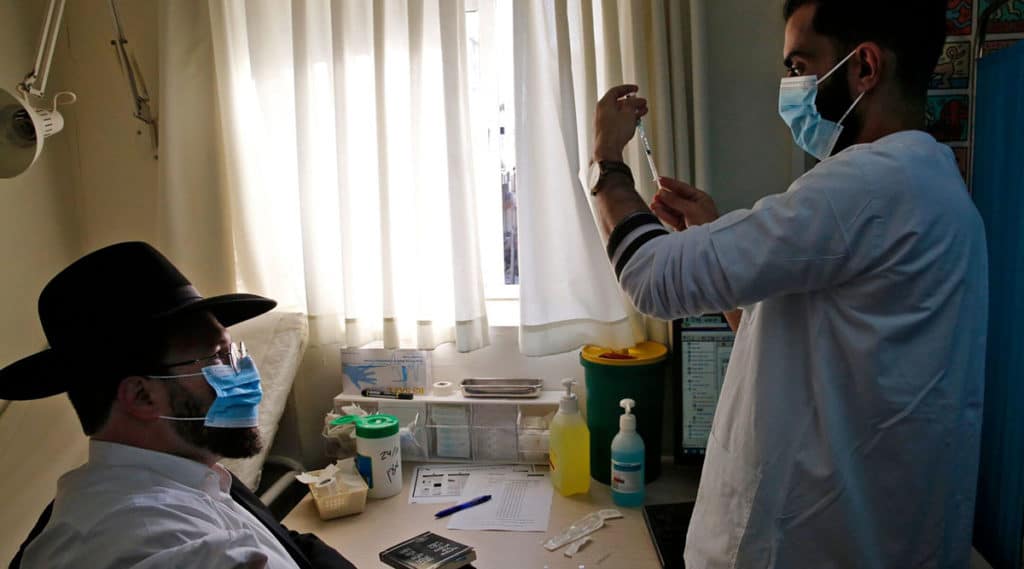
As the Israeli government has struggled to have the haredim comply with social distancing measures, haredi Israelis have flocked to get the vaccine.

“The response has been overwhelming,” a medical official familiar with the haredi sector told Israel Hayom, saying the lines to get the vaccine have been especially long in haredi cities.

In the U.S.,  too, there has been strong interest in the coronavirus vaccine in Orthodox communities, even where compliance with pandemic guidelines has been spotty. ParCare, an Orthodox-owned health clinic with locations in Brooklyn, Manhattan and Orange County, is currently under investigation by New York state’s attorney general for administering vaccines to the general public while the state’s guidance has specified only specific groups are eligible.

New Statistics on Haredi COVID-19 Deaths in Israel Read More »

Will Vaccinating Israel Bring Netanyahu Victory?

The Media Line — With just over 80 days before Israelis go to the polls for the fourth time in two years, the coronavirus and the ongoing vaccination operation will play a part in electioneering. The debate among experts is focused on how large an impact this will have on the process and thus, on the final results.

The coronavirus pandemic injects itself into two major categories: technical and political.

On a technical level, Israel’s Central Elections Committee is currently drawing up plans to add around 3,000 new polling stations to the existing network of 11,000 stations. Some 350 of the new stations will be placed in nursing homes and other facilities catering to the elderly, while the others will be spread through current stations to diminish crowding.

This not only means adding workers but also enhancing precautionary measures such as bringing bottles of hand sanitizer, alcohol wipes, and partitions to protect workers and voters.

Another aspect of the plan is to facilitate drive-in voting and the creation of special quarantine ballots, including extra plastic coverings, for voters who are ill with the virus.

Unlike the US, Israel has no arrangements for mail-in ballots, early voting, or digital voting booths. Likewise, with few exceptions such as Foreign Ministry employees and sailors, Israelis abroad on Election Day cannot vote.

“Around one-fourth of all Israelis don’t vote and it is even more complicated this year [due to the pandemic and uncertainty regarding flights to Israel and quarantine for travelers], for Israelis abroad to come back to Israel to vote,” Camil Fuchs, professor emeritus of statistics at Tel Aviv University, told The Media Line.

During recent elections, airlines had been filled with expat Israelis arriving only to vote and leaving immediately afterward.

“This year, due to the pandemic,” he said, “Israelis will be cautious about voting if they believe it could make them ill. The Central Elections Committee should add hours. Instead of finishing at 10 pm, they should add a few hours so that people can feel safer.”

The committee should also consider opening polling stations for more than one day, though this will be an issue, as currently, Election Day is a day off for workers – and the economy.

“The country should spread out the vote into more than one day to diminish the pressures on voters who do not want to expose themselves to the virus,” said Prof. Dani Filc of the Department of Politics and Government at Ben-Gurion University of the Negev in Beersheba.

Filc, a pediatrician whose research focuses on health policy, is optimistic about the efficacy of the rollout of vaccinations that could reach a majority of Israelis prior to Election Day, March 23.

“We have about 80 days left and if we inoculate 100,000 daily, we can reach 90% of the populace. I think this is too optimistic but we could reach ‘herd immunity’ levels [between 60 and 70% of the population] before the elections. We have the technical capabilities to do this,” he told The Media Line.

Filc moderated his optimism, observing that the government’s policy depends on when the country will obtain more vaccines from the producers and the extent to which certain populations, such as the Arab and ultra-Orthodox Jewish communities, will comply with vaccinations.

Will Vaccinating Israel Bring Netanyahu Victory? Read More »

Israel’s Vaccination Craze

Just a few weeks ago (or maybe days or hours — it’s not easy to remember these days), Israeli health officials were still worried about vaccination. In more than one public opinion poll, Israelis said they did want the vaccine, but maybe not now, maybe later, maybe when the better vaccine arrives, maybe after they see other people taking it successfully. Shipments of vaccines landed at the airport, the authorities began to prepare for the great operation, and the citizens seemed hesitant, unsure. Do we really want to be the first to try this? Do we play the role of lab mice? Is this safe?

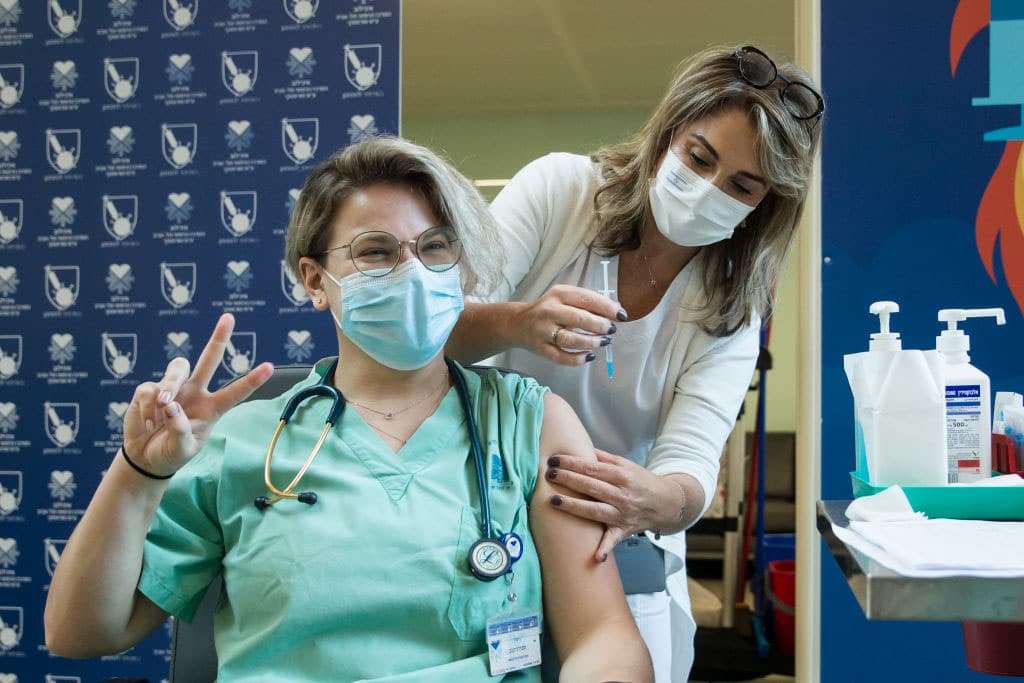
Now, health officials are worried about the opposite problem. Do we have enough vaccines? Can shipments land earlier than expected? Is it time to slow down? Israelis, except for a few skeptics, are standing in lines to get the vaccine. They call, write, complain, try to reschedule to an earlier date and protest against irrational priorities (the right priority being: me first, everyone else later). They are proud to be living in the country with the fastest vaccination rate in the world — the whole world!

Consider this: Israel is a country of fewer than 10 million souls, of which about a third cannot receive a vaccine because of their young age (Israel, after all, is a young country). Realistically speaking, about five million vaccinated citizens (out of six million old enough) would be the current goal of the authorities. The pace of vaccinations is now about 100,000 a day. Do the math: A million every ten days. Four million by mid-February. All Israelis before their next Election Day.

All Israelis could get vaccinated before their next Election Day.

Election Day? Yes, this is very much on the minds of the politicians who must compete on Election Day, March 23. Because as puzzling as it might seem, Election Day might take place in an atmosphere of a post-coronavirus Israel. Of course, this is quite strange to imagine when the country is still at the beginning of a third lockdown and still has to contend with a vast number of daily infections. And yet, this lockdown feels different. It is the lockdown to end all lockdowns (or so we hope).

You can already feel this in the way our politicians recalibrated their messages. For Prime Minister Benjamin Netanyahu, it is all about making sure that Israel gets the vaccine early. Forget about his trial, his divisive language, his dysfunctional government, his tricks and his untruthfulness. Forget about all of his deficiencies and consider just this one quality: he gets important things done.

And what is true for him must be true for other contenders. Naftali Bennett was running the coronavirus crisis remedy. If there’s no coronavirus, there’s no such message for him to use. So, in recent days, Bennett has switched to economics. He switched to talking about what needs to be done in a post-pandemic world.

Is COVID-19 really going to be over by Election Day? It is too early to tell, and thus, strange things may happen. On the one hand, the politicians are speaking as if the end is near. On the other hand, they are considering necessary means to make the vote safe. Maybe the polls will be open until midnight to avoid lines. Maybe more polling places will be opened for the same reasons. And politicians are looking for ways for people in quarantine to vote. And for people who will still have COVID-19. And for people who refuse to get vaccinated and thus should not be allowed to get mixed with those who were inoculated.

The start of the pandemic was slow. It took time for us to take it all in and understand the new world of social distancing, masks and the occasional lockdown. The end of it feels fast, almost dizzying. Next week, the elders of my family all get vaccines. I come next, when the fifty-year-old and up category gets its turn. I have children in the military — they will get their vaccines as fast as the IDF decides, based on their current position and role. But all of it is going to happen — fingers crossed — in five, six, seven weeks. So, this could end before Passover. This could mean that we can have a family Seder.

Could we?

Israel’s Vaccination Craze Read More »