From Sholem Aleichem’s shtetl tales to Broadway to the movies, the iconic characters and stories in “Fiddler on the Roof” have captivated audiences—Jewish and not—all over the world. The subject of the 2019 making-of film “Fiddler: A Miracle of Miracles,” it gets a new documentary treatment in “Fiddler’s Journey to the Big Screen: The Untold Story of Norman Jewison’s Fiddler on the Roof,” chronicling the producer-director’s quest to bring Tevye’s world to the big screen nearly 50 years ago.
Including revealing interviews with Jewison (not Jewish, by the way), his collaborators, lead actor Topol, critics and historians and chock full of surprising anecdotes about the production, the film is a must-see for “Fiddler” fans.
On Dec. 25 at 1 p.m. PST, the Los Angeles Jewish Film Festival will host a free virtual Q&A with its director Daniel Raim, writer Michael Sragow, and producer Sasha Berman, who will give attendees a 16-minute preview excerpt of their work-in-progress film. (Projected release: fall 2021.) Attendees are encouraged to watch “Fiddler on the Roof” on Netflix beforehand and download the lyrics here to sing along: https://www.allthelyrics.com/lyrics/fiddler_on_the_roof_soundtrack
From Jan. 1-3, LAJFF keeps the musical theme going by hosting the Los Angeles virtual premiere of “Stand!” a Romeo and Juliet love story between a Jewish suffragette and a Ukrainian immigrant set against the backdrop of a citywide workers’ strike in Winnipeg, Canada in 1919. It’s adapted from the stage hit “Strike!” by writer/composer Danny Schur, who based it on his own family history.
Tickets are $12 and include a free Zoom Q&A on Jan. 3 at 11 a.m. PST with Schur, director Robert Adetuyi, and cast members Gregg Henry, Laura Slade Wiggin, and Lisa Bell, among others. Registration info will be posted at LAJFilmFest.org, and further information about the film can be found at https://stand-movie.com.
(Israel Policy Forum) — As this strange and dreadful year comes to a close, there is a heavy dose of uncertainty in the air that goes beyond the intersection of mutating COVID-19 strains and vaccine skepticism. The Knesset dissolved at midnight on Wednesday after seven months of gridlock for yet another Israeli election, the UN this week appointed a new envoy for the Middle East peace process, and next month a new U.S. administration will take office. Without listing the obvious items on everyone’s mind, such as whether President-elect Joe Biden will rejoin the JCPOA or what has to happen for Saudi Arabia to pull the trigger on establishing diplomatic relations with Israel, here are some issues on which to keep a close eye in 2021.
Israel’s political alignment
During the three Israeli elections in April and September 2019 and January 2020, the alternative for voters looking to unseat Prime Minister Netanyahu was Benny Gantz’s Kachol Lavan. Gantz’s decision after the third election to join in a coalition government with Netanyahu in return for a pledge that he would take over as prime minister after a year and a half – a pledge that was obviously empty to everyone paying attention save Gantz – sealed his party’s fate as one that would become irrelevant as soon as the next election took place. The question now becomes who and what will take up the anti-Netanyahu mantle now that Gantz’s political relevance is effectively over, since the fundamental split in Israeli politics is no longer a right-left divide over the Israeli-Palestinian conflict or security, but a divide between Netanyahu partisans and Netanyahu opponents that transcends ideological commitments.
The two people who stand at the head of the anti-Netanyahu column are Yair Lapid, who is a familiar foe from outside Netanyahu’s camp, and Gideon Sa’ar, who is a familiar foe from inside Netanyahu’s camp despite having spent much of the past half decade in effective banishment from Netanyahu’s presence. Neither is going to garner enough Knesset seats to win the election in any real sense, or even surpass Netanyahu and Likud’s vote total. Each also enters the campaign to form an alternative coalition with one hand tied behind their backs, since neither is comfortable forming a government that includes the Joint List or its constituent parties and each has another critical political handicap that creates built-in disadvantages. Both Lapid and his most obvious political ally, Avigdor Liberman, are at odds with the Haredi parties – in Liberman’s case probably as much as he is with Netanyahu himself – which takes another chunk of seats out of their potential coalition, and Sa’ar has taken a clear anti-Netanyahu position that will leave him trying to build a right-wing government that leaves out Israel’s flagship ruling and largest right-wing party.
The clearest path forward for the anti-Netanyahu camp is a coalition of Lapid, Sa’ar, Liberman, Naftali Bennett, and whatever remains of Kachol Lavan. Not only will this require a rapprochement between the constituent parts of Kachol Lavan’s original iteration, it will require some serious massaging of egos among four men who all see themselves as future Israeli prime ministers and will all want to get first crack at the job. It also means that the alternative to Netanyahu is a coalition that is arguably more right-wing than Netanyahu and Likud on Israeli-Palestinian and territorial issues, as Sa’ar and Bennett are unapologetic proponents of full Area C annexation and the consignment of the 2.3 million Palestinians in Areas A and B to permanent autonomous statelessness while Liberman does not much care what happens to Palestinians so long as Israelis do not have to see or deal with them. While Israeli politics has had a rightward tilt for decades, this would be an unprecedented realignment between right and farther right.
Much can and inevitably will happen between now and March 23 to shake up this calculus. Former IDF chief of staff Gadi Eizenkot might enter politics; there may be mergers or breakups among the current parties; the hundreds of thousands of Israeli voters who deserted Labor and cast ballots for Kachol Lavan in an effort to dislodge Netanyahu might look at the options now in front of them and go back to the mostly dead husk of Labor; or Netanyahu might announce that he is running not only on behalf of Likud and his Haredi natural partners but on behalf of his new friend Mansour Abbas’s Ra’am (United Arab List) party. Parties that do not exist today will form in the next few months, and all sorts of new permutations will present themselves. Whatever the end result, the potential for a shakeup of Israel’s political landscape is greater now than it was when Gantz threw his hat into the ring two years ago and consigned Labor to virtual non-existence.
Parties that do not exist today will form in the next few months, and all sorts of new permutations will present themselves.
Israel’s response to Palestinian concessions
The evidence points to the Palestinian Authority leadership understanding that if they want to take full advantage of the opportunity presented by the Biden administration to reset relations with the U.S., they will have to implement genuine reforms. The biggest item on that front is heeding overwhelming American calls from both sides of the aisle to end the martyr and prisoner payments system that provides higher payments to martyr families and prisoners convicted of crimes against Israelis based on severity of the attack committed and length of prison sentence. Given the importance of prisoners within Palestinian politics and society, the obvious answer is to create a social welfare system that allocates payments to all Palestinians below a certain income level based on need, which removes the adverse incentives for Palestinians to carry out attacks against Israelis while ensuring that families of those who do are not punished for actions they themselves did not commit.
If the system is reformed in this way, some will argue that it is not enough, and that families of prisoners or martyrs should be cut off from any welfare or payment system entirely. How Israel responds should the Palestinians actually move toward a reform akin to the one outlined above will determine what happens next. Domestic Palestinian political constraints will not allow the PA to leave prisoners’ families high and dry, which is why the choice is likely to be between having the system continue unchanged or having a reform that eliminates most of the problem while allowing Palestinian leadership to claim that it is still prioritizing and watching out for martyrs and prisoners. If events unfold in this direction, the Israeli government may have to choose between taking a policy win that leaves it open to hawkish criticism or rejecting a compromise solution that allows maintaining a hard line on a potent political issue.
The fate of the Abraham Accords
The normalization agreements between Israel and Arab states constitute the Trump administration’s most obvious foreign policy accomplishment, and it is a significant one. But they are more tenuous than they appear, and not because Biden will try to roll them back. Biden and Secretary of State designate Antony Blinken have been unambiguously explicit that they view these agreements as a positive and will try to build on them. The minefield ahead lies in the fact that, contrary to how they have been presented, the Abraham Accords do not actually represent prioritizing the interests of normalizing relations with Israel over the ideology of paying fealty to the Palestinian cause. They represent prioritizing other foreign policy interests over the ideology of paying fealty to the Palestinian cause, and agreeing to normalize relations with Israel if those other foreign policy interests are advanced. That leaves the normalization agreements brittle, with their survival dependent on events that have nothing to do with Israel itself or its actions.
Despite the fanfare over the recent addition of Morocco to the group of Arab countries welcoming open ties with Israel, King Mohamed VI pointedly did not take part in the public ceremonies with U.S. and Israeli officials in Rabat on Tuesday, and Morocco agreed not to full diplomatic relations with the opening of embassies but only to reopen diplomatic liaison offices that already existed and were shuttered during the Second Intifada. There are a variety of possible explanations for this, but one is that Rabat is waiting to see whether its price for agreeing to normalize ties – American recognition of Moroccan sovereignty over Western Sahara, which is controversial in both Republican and Democratic circles – survives past Trump’s last month in office. If Biden does not maintain this commitment, the deal between Israel and Morocco is susceptible to breakdown.
This dynamic has already played out with Sudan, which traded starting the process of normalizing ties with Israel in return for removal from the State Department list of state sponsors of terrorism and immunity from terrorism-related lawsuits. While President Trump was able to deliver the former, the latter required Congressional legislation that did not pass until this week and that provided immunity excepting lawsuits rising from the 9/11 attacks. The new Sudanese government had said they would pull out of the Israel deal without this legislation, and it means that the normalization process will now keep moving forward. But the larger point stands, which is that these agreements are not necessarily reflective of a genuine unfettered desire to have open relations with Israel, and how future agreements are structured will provide clues as to their ultimate durability.
Finally, as we close the book on 2020, thanks to all of you who take the time every week to read my analysis and to those of you who reach out to respond; the encouragement and the criticism are equally welcome. Whether you agree with me more often than not or disagree with me more often than not, I hope it always prompts you to take a few minutes and think. While my writing is free for everyone to consume, it is not free to produce, and it is a reflection not only of my work but of Israel Policy Forum’s work. With your support, Israel Policy Forum will continue to be the go-to source for credible, nuanced analysis for policy makers in Washington and for community leaders across the political, denominational, and generational spectrums. Please consider making your gift today and help ensure that the vision of a Jewish, democratic, secure Israel maintains its relevance and power. Visitisraelpolicyforum.org/giving. Happy New Year and here’s to a more normal 2021.
Michael Koplow is Israel Policy Forum’s policy director, based in Washington, DC. To contact Michael, please email him at mkoplow@ipforum.org.
Every culture has its own way of approaching the same religion. Although the pandemic caused most of us to celebrate Hanukkah unlike ever before, this year was particularly unique because it was the first time I celebrated Hanukkah in New Delhi. It was a beautiful fusion of Indian culture and traditional Hanukkah — latkes with Indian spices such as turmeric and chat masala were just the tip of the iceberg.
My family isn’t very religious, rather spiritual. I, on the other hand, have lately become religious out of my own instinct especially after visiting Israel. I was born in Kenya and spent my early years in India before moving to Los Angeles. I had a multicultural upbringing, as we celebrated all the religious festivals in India, such as Diwali, Purim, Christmas and Eid. That’s one beauty of India —you can practice any religion and yet be welcome. I have never seen any anti-Semitism here. After all, India is the second most popular spot (after Bali, of course) for Israeli Defense Force soldiers to vacation after they finish serving.
Despite the popularity of India as a destination, few people around the world — including Indians — know that there are, in fact, Jewish Indians. According to the book “Jews of India” by Benjamin J Israel, “when the temple in Jerusalem was destroyed by the Romans, the Jews residing in Judea and Galilee were dispersed from 1000 B.C.E to 70 C.E. During the diaspora, some came to India and settled around several parts in small communities.”
The most common group of Jewish Indians are the Bene Israelis, who speak Marathi (an Indian language in the state of Maharashtra) and live for the most part in Maharashtra and New Delhi. The Cochini Jews, who reside in Cochin (south of India) speak English and South Indian languages and carry traditions far different from the Bene Israelis. The third group consists of Jews from West Asia — Iran, Iraq, Afghanistan and Basra. They are collectively known as Baghdadis. They spoke Persian and Arabic and transitioned over time to Hindi and English. These groups became Indianized in varying degrees, the Bene Israelis being the most Indian in their mannerisms, dress and food.
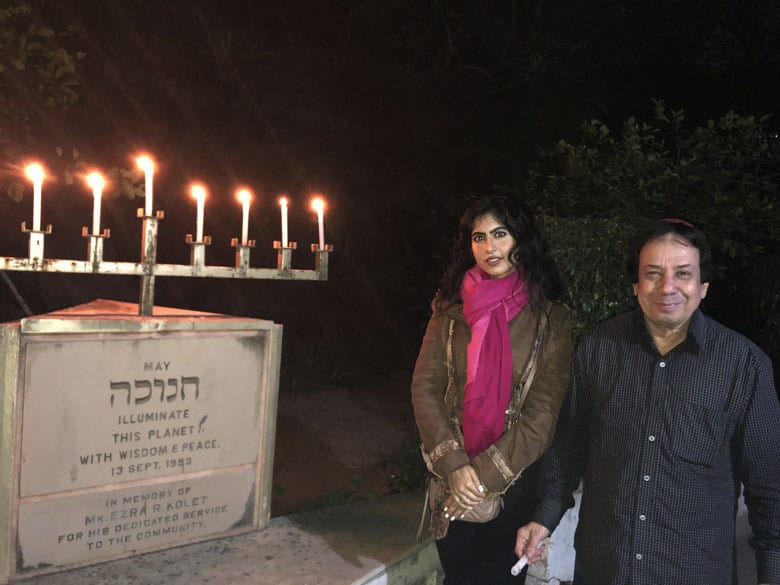
By the time I celebrated Hanukkah in New Delhi, however, there were very few Jewish Indians left in the city. Most Bene Israelis live in Mumbai, and the three groups have slowly been making Aliyah. Although there are many synagogues in Mumbai and Calcutta, there is only one synagogue in New Delhi called Judah Hyam Synagogue. That is where I went on the first and last day of Hanukkah. Judah Hyam is taken care of by Rabbi Ezekiel Isaac Malekar, who loves to learn about every other religion in order to find similarities with Judaism. This was the first synagogue I attended where men and women were allowed to sit together. Rabbi Ezekiel told me that “Since the mother determines if a child is Jewish or not, I have a matriarchal approach to practices. I believe in equality between men and women.” His decision is appropriate for the Indian culture, where the woman is the queen of the house.
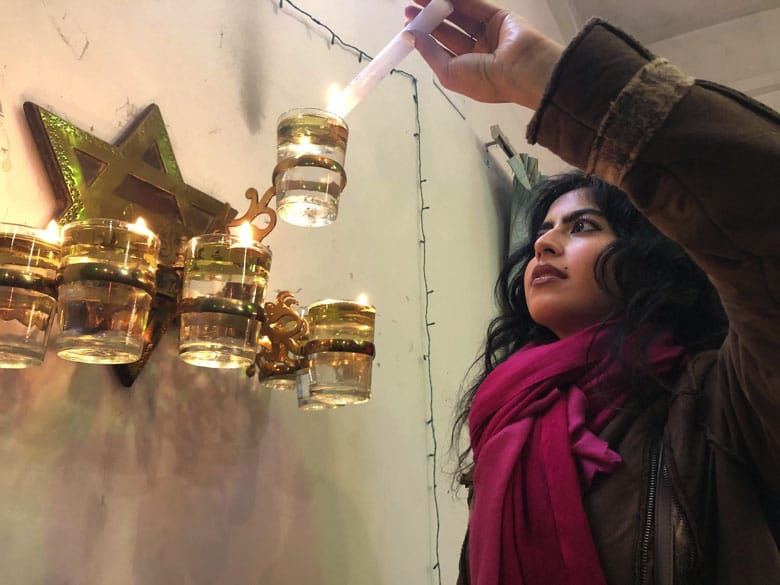
When we added the shamash to the menorah, I felt the true essence of sharing your light with others.
Rabbi Ezekiel’s approach to pluralism extended to Hanukah, too. On the first night at Judah Hyam, the congregation added the first candle to the menorah and recited the “Rock of Ages.” On the last night of Hanukah, I noticed that two Christian and one Muslim family had joined us. It was heartwarming to experience such unity. When we added the shamash, the ninth candle, to the menorah, I felt the true essence of sharing your light with others.
Me with Rabbi Ezekiel Isaac Malekar
This blend of cultures also, thankfully, extended to the fried food. India is home to delicious fried desserts, such as Golab Jamun (fried dough balls with rose water) and pakoras (fried vegetables). And Jewish Indian communities have created unique dishes of their own, such as malida, a dish of flattened rice that’s unique to the Bene Israel community. This Hanukkah was my first time eating the malida. Rabbi Ezekiel’s wife fluffed the rice until it was light and airy and then added sugar, spices, dry fruits and raisins. As she made the malida, we said a prayer in honor of Prophet Elijah and then ate coconuts and dates to remind ourselves of how our people came from the desert. The matzo ball soup and latkes had their own spin with lots of Indian spices, and were followed by tea to help you believe you have quickly digested all that food.
As someone who has been all around the world during Hanukkah, I was happy that I got to experience Hanukkah in India this year and could witness India’s multiculturalism in the synagogue firsthand. The shamash on top was learning from Rabbi Ezekiel that Calcutta has a synagogue called Magen David Synagogue, which a Muslim family has been taking care for the past 61 years. This Hanukkah has only confirmed for me that even though 2020 has seen a lot of conflicts around the world, pluralism is on its way.
Aneesha Madhok graduated in Theatre from the University of Southern California and will be appearing as the main lead in the upcoming Hollywood feature “Bully High.” She is also the writer of the play “Aliza-Free” and hosts a weekly comedy show, “The Mad Hawk Show.”
When COVID-19 hit and everything shut down, comedian Modi turned his camera on. Since he couldn’t do live shows anymore, he decided to bring some joy into the world and keep his audiences laughing by creating two original characters: Yoely, a Hasidic man who reviews secular TV shows like “The Tiger King” and “The Crown,” and Nir, an Israeli who made a lot of money in the United States and now thinks he knows it all.
In one of his first Yoely videos, which Modi put on his Instagram (@modi_live) and YouTube, the comedian jokes, “These [people] in the Tiger King are goyim from Oklahoma they come from. This is places you can’t even imagine. But the head guy in the story, his name is Joe Erotic [sic]. This is the ugliest man you ever… I never saw something so ugly.”
Later videos show Yoely running for president. Though he ultimately failed in his bid for office, Modi claimed Yoely will now be the Secretary of Simcha instead.
In a phone interview with the Journal, Modi said he chose to create an Orthodox character because the community was getting a bad rap about how they handled COVID-19. Then the show “Unorthodox” made them look bad, too. “I love Hasidim and they’re funny people. They have a great sense of humor and an amazing culture.”
Born Mordechi Rosenfeld, the Israeli native moved to the Five Towns on Long Island with his family when he was 7-years-old. When he began his career, he worked as a Wall Street international banker until he decided to pursue comedy instead. He was formally passed at the legendary Comedy Cellar in New York City in 1994.
Before the pandemic, Modi, who lives on the Lower East Side, would play for audiences around the world, from secular crowds to Jewish ones of all denominations, including Hasidim. The Jerry Seinfeld of the Orthodox Jewish community, as fans have referred to him, didn’t have much time to create content. “I was a comic who was busy working so I never really focused on Instagram and that kind of stuff. But once I began doing jokes, people loved them and commented and started to follow me.”
Now, Modi has over 27,000 followers on the site. He said that he’s gotten views from new fans in places like Israel, Australia and Sweden, and he credits much of his success to WhatsApp. “The biggest thing in the Jewish world is WhatsApp,” he said. “As soon as someone sees a video of mine on Instagram they put it on WhatsApp and it goes wild.”
he’s gotten views from new fans in places like Israel, Australia and Sweden, and he credits much of his success to WhatsApp.
Along with establishing his presence on Instagram, YouTube and WhatsApp, Modi has been doing shows on Zoom. One memorable show was for an audience in Australia of 30 people who gathered in person to watch him on a monitor. Remotely, an additional 800 viewers tuned in. “People are coming up with crazy, fun ideas and being very creative,” he said.
When the weather was nicer in New York, he performed outdoors, and back in May, he hosted the 24-hour Hatzolah telethon. “There was a big rabbi with a white beard on one side of me and a heavyset guy on the other,” he said. “Standing between them, I looked like Paul Newman. I want that at every gig now.”
While Modi enjoys performing live, he said he is happy to not have to travel right now. “I haven’t been in an airplane since March 13 and I don’t miss it,” he said. “But I’m looking forward to the live shows and seeing people’s faces when the joke hits. I want to perform in all these places where people discovered me. I want to see all these people live.”
He’s hopeful that he’ll get back there soon. For now, he’s taking everything in stride.
“When everything comes back it’ll be stronger than ever,” he said. “After the plague of 1919, we had the roaring ‘20s. I think we’ll go into again. And it’s going to be amazing.”
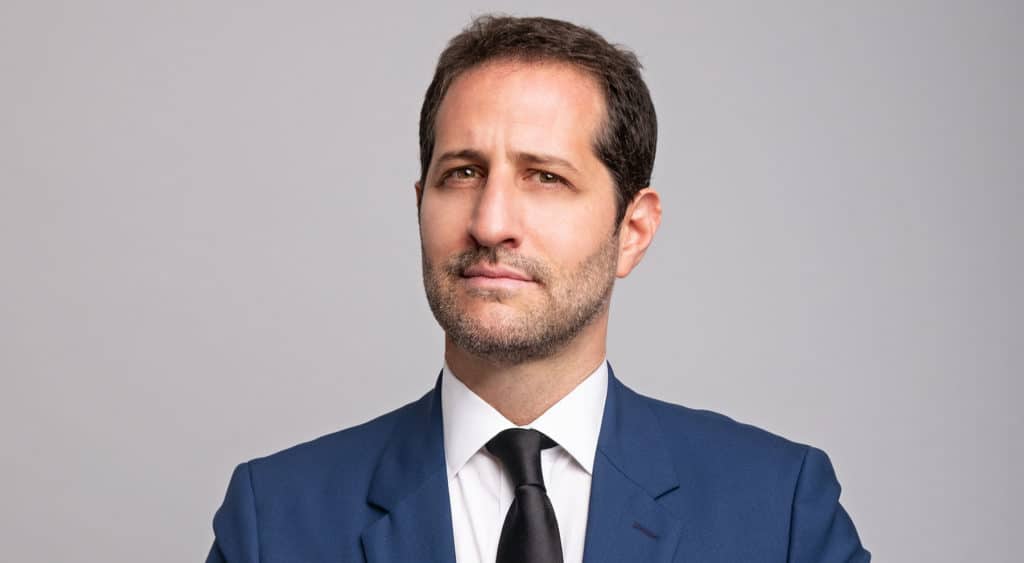
Secretary of State-elect Antony Blinken was reared for his job. His father, Donald Blinken, was an American Ambassador to Hungary in the post-Communist years of 1994-1998. His stepfather, Samuel Pisar, with whom Antony began to live with at age nine, was an international lawyer in Paris and New York, with PhDs from both the Sorbonne and Harvard.
Blinken’s home with Pisar was a gathering place of artists and musicians, presidents and prime ministers, philosophers and writers from the East and West. Blinken grew up watching his stepfather attempt to bridge the gap between the then Soviet Union and the West at a time when divisions were deep and discourse strained.
But what stuck with Blinken the most, as evidenced by his speech accepting his nomination, was how far his stepfather had come. Pisar, as Blinken mentioned, “was one of 900 children in his school in Białystok, Poland, but the only one to survive the Holocaust after four years in concentration camps.”
Blinken’s invocation of his stepfather in his acceptance speech prompted me to reread Samuel Pisar’s memoir, “Of Blood and Hope,” which he wrote in the late 1970s at the peak of his distinguished career. Like many survivors’ memoirs, Pisar’s work is divided into a Before, During and After. Unusually, however, Pisar gives more attention to his hopes as a man of prominence — a man who is comfortable in the corridors of power but deeply uncomfortable with the direction that government and industry leaders were taking to the world.
The Before
Pisar was born to an affluent family in Bialystok, Poland, where Jews constituted almost half of the city’s 91,000 residents. His early life was comfortable; his father established the first taxicab company in the region and his family were well-integrated into the Jewish and general community. But war shattered the tranquility of a ten-year old Sam’s life.
The During
On September 1, 1939, Germany invaded Poland from the West, and 16 days later, the Soviet Union invaded from the East, dividing Poland. Bialystok was under the control of the Soviets, who did formally end anti-Semitism but were hostile to all religions and punished individual capitalists and bourgeois. Polish citizens were offered Soviet citizenship in 1940. Those who declined faced deportation to the East, where they would likely face starvation, disease, extreme temperatures and malnutrition — but not systematic murder, so most survived. The Pisars accepted Soviet citizenship and stayed in Bialystok.
When the Germans attacked Soviet forces in June 1941, the Jewish of Bialystok, the Pisars among them, were ghettoized. Samuel’s father David was taken away one morning and shot, leaving 12-year-old Samuel with his mother, Helania, and younger sister, Freida.
Polish ghettos were a place of hunger and squalor. For the Jews, ghettos constituted a way of life. For their captors, ghettos were a place to contain the Jews until the infrastructure for their destruction — industrialized killing centers with gassing facilities — was set in place. Death camps were opened in the winter of 1942, and within 15 months, 80% of the Jews murdered in the Holocaust were already dead.
In 1942, Samuel was deported with his mother and sister, both of whom were killed upon arrival. The 13-year-old Samuel avoided immediate death by declaring himself 18. His three years in captivity took him to the slave labor camps of Majdanek and Blizyn, the death camp of Auschwitz, the German concentration camps of Sachsenhausen, Oranienburg, Dachau and finally to the slave labor complex of the Engelberg Tunnel.
With the help of two friends, Ben and Niko, Pisar resisted the isolation and loneliness, desperation and despair as he went from camp to camp, and he made it to liberation.
With the help of two friends, Pisar resisted the despair as he went from camp to camp, and he made it to liberation.
Blinken repeated the story his stepfather told of liberation in his confirmation speech:
The tank resumed its advance [toward the barn], lumbering cautiously toward me. I looked for the hateful swastika, but there wasn’t one…Instead, I made out an unfamiliar emblem. It was the five-pointed white star…I was in front of the tank, waving my arms. The hatch opened. A big Black man climbed out, swearing unintelligibly at me…I fell at the Black man’s feet, threw my arms around his legs and yelled at the top of my lungs: “God bless America.”
Even with his freedom, Pisar could not go home. There was no one waiting for him. Pisar stayed with Niko and Ben in the immediate post war years, and the trio put their survival skills to hustle, profit and prosper — all the while living on the edge. Pisar tells the story with verve and pride, knowing how he later learned to use his survival skills creatively, legally, brilliantly.
Pisar’s maternal uncles invited him to Australia, where he was tamed, began his education and tried to adapt to the norms of society. With a caring family and the protections of democracy and order, Pisar discovered that not only could he survive, but also that he was gifted. Ben joined him, furthering their deep and enduring friendship.
Pisar excelled in school and was admitted to Harvard for a PhD in Law, where he met other gifted refugee boys, among them Henry Kissinger and Zbigniew Brzezinski. At his graduation, Senator John F. Kennedy was awarded an honorary doctorate, together with Cardinal Cushing of Boston and future Secretary of the Treasury Douglas Dillon. At the ceremony. Kennedy joked, “four doctorates were awarded today; only one of them earned.”
Samuel Pisar (Screenshot from YouTube)
Pisar chose to begin his career a working as a U.N. diplomat in Paris. Like many of his generation, he was roped into the Kennedy Administration. After a time in government, Pisar began his work as an international lawyer in Paris and New York, becoming an advocate of globalization through legal work and through his well-received book, “Coexistence and Commerce.” Having lived under Soviet rule and been less-than-impressed with Soviet power, Pisar saw commerce as the key to coexistence. He also despaired over the burgeoning arms race, calling it madness.
Secretary Blinken
Given Blinken’s acknowledgment of Pisar in his speech, one can’t help but wonder what additional impact Pisar might have on Blinken as secretary of state. Several suggestions come to mind:
He is a natural diplomat. Blinken has been around diplomats and world leaders since the age of nine. Before he studied the craft, Blinken saw it around his family’s table. He will need no learning curve.
He understands evil. No one who grew up in a survivor’s home cannot understand human cruelty and the dangers of authoritarianism. No one needs a reminder of the importance of human rights, human dignity and human decency. Blinken lived with people who knew what it was like to be enslaved, who yearned for freedom, who never took freedom for granted and who cherished its blessings.
He will take Holocaust denial personally. When the leaders of Iran, other radical Islamic regimes, white supramacists and neo-Nazi proclaim that the Holocaust is a hoax, Blinken will remember the numbers on Pisar’s arm. To Blinken, Auschwitz is not an abstraction, Majdanek more than a place on a map. Holocaust denial will end the conversation.
He will cherish Europe, even as the United States turns its attention to the Pacific Rim. Blinken lived in Europe as a child, and he is at home in French.
He will be a globalist. Blinken’s parents and stepparents saw the United States as indispensable to a stable world — but not if it chose isolation. Blinken understands soft power and not just military power. Pisar believed profoundly in economic cooperation, human dialogue, sharing knowledge, innovation, a need for mutuality, cooperation and collaboration — even with one’s adversaries.
He will be creative. His stepfather was constantly, yet willingly and creatively at odds with prevailing geopolitical views of his generation. Pisar thought differently, more imaginatively, and one might presume that he trained Blinken to be the same
He understands the importance of American ideals. Blinken’s stepfather and his stepmother were immigrants; his grandparents also came to the United States as part of the Ellis Island immigrant generation to enjoy its freedom.
He has a connection to Israel. Blinken visited Israel as a child with his family in the company of Israeli relatives. Pisar wrote with evident pride of Antony climbing Masada as a kid while the family rode the cable car. Blinken’s stepfather, like most survivors, saw Israel as a haven and viewed its establishment with gratitude and sometimes with the guilt of having gone elsewhere. Israeli leaders were guests in Pisar’s home and friends of the family.
Blinken’s story is familiar to many of us, and his history and values will be a welcome addition to the State Department. As Blinken takes the premiere seat of foreign policy decision-making, we should hope that he will not forget his roots, roots he was proud to embrace as he was introduced to the country.
Michael Berenbaum is director of the Sigi Ziering Institute and a professor of Jewish Studies at American Jewish University.
One verse, five voices. Edited by Salvador Litvak, the Accidental Talmudist
And Israel dwelt in the land of Egypt in the land of Goshen, and they acquired property in it, and they were fruitful and multiplied greatly. -Gen 47:27
Romain Hini-Szlos Photographer, rhsgallery.com
Throughout history, the Jewish people have settled in an array of countries. With great hardship, some communities found success and were fruitful in the galut. But like their namesake, Israel (which means “to wrestle”), Jews outside the land of Israel have wrestled with the dual challenges of assimilation and anti-Semitism for thousands of years.
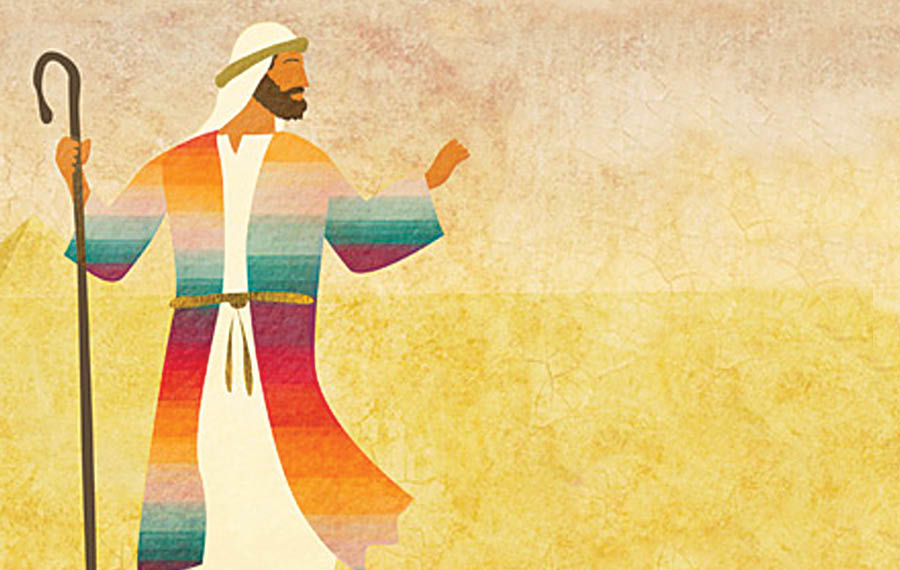
At surface level, this pasuk tells us that Hashem will give Jews the capability to “be fruitful and multiply greatly” in other lands (here meaning Egypt). But the deeper meaning of this promise is not without its conditions: in the diaspora, the Jewish people will have the capacity to thrive materially, but the temptation to forget the source of these blessings will be great. The moment the Jewish people forget that their blessings are given by God (and God alone), they will have to toil and wrestle to maintain these blessings.
Such effort also applies to the Jewish state itself. God gave the land of Israel to the Jewish people as a covenant, and it is precisely in moments when we forget (or even shun) the gift of this land that we return to a state of wrestling: wrestling with a lack of connection to Israel as well as wrestling with the notion that Israel is God’s gift to us.
To that end, we would be wise to remember Deuteronomy 8:18: “You shall remember the Lord your God, for it is He who gave you strength to acquire wealth.” It is a remembrance that precedes gratitude.
I grew up in a bubble. Jewish schools, camps, synagogues, neighborhoods. My birth essentially moved me from one womb to another as I entered the nurturing environment known as the Jewish Community. The transition was seamless.
Goshen was the first bubble in Jewish history. It was the brainchild of Jacob and Joseph and was the first planned Jewish community. It cultivated contemplation, service and morality and was a place designed to nourish souls and shield its inhabitants from the corrupting impulses of the world around them. We thrived there and proliferated there. But here’s the thing. There’s no proof that we had any sublime impact on the world outside of our bubble.
I have absolutely no source for what I’m about to share but I’m left to wonder whether our failure to influence the hearts and souls of the Egyptians was a result of a bubble experience that sought to protect, not to inspire.
Our verse can be interpreted as “the land acquired us” rather than “we acquired land”. The bubble experience is comfortable and secure and it’s easy to be “acquired” by the warmth and depth of such a life. While it’s perhaps justifiable to prioritize one’s own fulfillment and security, I suspect that G-d has a higher aspiration for us. At the risk of “bursting our bubble”, the Jewish people aren’t here to merely live elevated lives. We’re here to be beacons and “influencers” and our bubbles should launch us and prepare us for those roles.
Miriam Mill-Kreisman Tzaddik Foundation
This pasuk may be a description of the first exile when the Israelites went down to Egypt but it is really the archetypical exile to happen time and time again. How often did we leave (or more often were forced from) a land, arrive at another land as figurative shepherds, simple and holy, sheltered from outside influences, and proceed to have unbelievable success materially?
We arrive, we grow, we expand, we influence, we leave and the cycle continues. For what? And what should we say to the non–Jews who ask “What are you doing here in our land?” We need not say the easy answer such as “for religious freedom, or security or prosperity” which are all nice things. Instead, we should tell them the plan that we are not here to stay but to transform and help perfect the world, to bring down the light of the Shechinah, the Divine Presence, to share the truth of the Torah just by our presence and by living Torah-true lives.
But why the success? Maybe the answer is simply that our growth and success gets us noticed, raises eyebrows, and makes us heard. Because the job we have to do is not easy, but someone has to do it. G-d entrusted the Jewish people with that holy mission. May we all be successful both materially and spiritually.
Rabbi Cheryl Peretz Associate Dean, Ziegler School of Rabbinic Studies at AJU
Reconciling with his family, Joseph brings them to Egypt promising a better life than the starvation and depravation that had befallen them in Canaan. Twenty verses prior, we are told that Joseph’s family and those who accompanied them ‘sojourn’ in Goshen, the Hebrew word lagur indicating they are thus fulfilling the strategy Joseph earlier outlined to his brothers.
Now we read that the collective group of Joseph’s family and those who accompanied them are ‘settled’ in Goshen, the finest area of Egypt, amassing property and multiplying.
Commentators question this evolution from alien sojourner to land-owning settlement. Eleventh century commentator Ibn Ezra contends that the people are no longer happy with Joseph’s allocation of property, so they purchase even more land. Other commentators label this an act of assimilation into Egyptian culture. But 16th century commentator, Kli Yakar, offers a different take. For him, the establishment of deeper roots in Egypt shows that the people no longer saw themselves as alien sojourners, but rather as permanent residents and that this is necessary for the later fulfillment of God’s promise to free the Israelites with an outstretched arm. Still, the challenge to this type of determinism lies in the final phrase – Israel living out the fulfillment of the Abrahamic promise of progeny.
The enduring message?
The path is never guaranteed nor is it necessarily circuitous, but God’s promise for each one of us travels with us wherever we go. It is in front of us and is ours to make permanent and create meaning.
Salvador Litvak Executive Director, accidentaltalmudist.org
We could all be more productive. Because I run a Torah education nonprofit, I know that any time I waste on the organization’s dime is tantamount to stealing from a public trust, so I’m strongly incentivized to be productive at work. But what about when I’m wearing my screenwriting hat, and working on a spec script? No one pays for my time, so the only person I let down is myself, right?
Wrong. All of us were sent into this world on a mission. The nature and extent of that mission are not spelled out in some kind of contract available for review, but we get a strong sense of its terms when we ask, “What contribution can only be made by me?”
Earlier this year, as I prepared for Rosh Hashana and the Days of Awe, I was wondering if I could find some support from halacha, Jewish law, for becoming more productive in my own projects. I found it in the very first commandment written in the Torah: p’ru ur’vu, be fruitful and multiply (Gen 1:22), the same words used in our verse. The command is normally understood to mean “reproduce!” but if that’s all it means the second word, multiply, would have been sufficient. How then are we to “be fruitful?”
I believe it means I’m commanded to make the unique contribution only I can make, just as you are commanded to offer your unique gift to the world. Are you creative? Are you generous? Are you funny? Are you a great listener? A great ball player? Do you come up with the best recipes or costumes or gadget ideas? Then befruitful!






 Blinken’s invocation of his stepfather in his acceptance speech prompted me to reread Samuel Pisar’s memoir, “Of Blood and Hope,” which he wrote in the late 1970s at the peak of his distinguished career. Like many survivors’ memoirs, Pisar’s work is divided into a Before, During and After. Unusually, however, Pisar gives more attention to his hopes as a man of prominence — a man who is comfortable in the corridors of power but deeply uncomfortable with the direction that government and industry leaders were taking to the world.