fbpx

December 16, 2020

Taste of the Bronx: the Original Rugelach

Growing up in the Bronx in the 1950s was like living in a small Polish village set at the tempo of a Scorsese movie and shot in Yiddish. Everyone played his or her part.

A plump grandma in sensible shoes kibitzed with her customers while plucking kosher chickens by hand all day. Kids hung out at the candy store after school, slurping frosty egg creams and dunking pretzels while anxious numbers runners studied the New York Post. A pizza place sold slices on credit to kids from good families, a deli kept fragrant pickle barrels outdoors for impulse purchases, and a fireplug of a Polish dairyman totaled your bill with a well-worn pencil stub stationed behind his ear.

Ida, my mother, was a player. Nothing like the 1950s suburban housewives I saw on TV — the ones who wore shirtwaists and high heels while vacuuming. She was more Ethel Merz (Lucy’s sidekick) than June Cleaver. Ida was a working mother, and she had no time for decorating cupcakes.

But a few times a year, she slowed down, got out the flour and baked a simple Jewish cake or pastry. I would watch her not so much to learn how to bake as to lick the bowls. Mom wasn’t into sharing her kitchen knowledge. In fact, while Betty Friedan was honing her rage into “The Feminine Mystique,” Ida took a stand by not teaching me anything about cooking. Her dream of assimilation involved me getting out of the kitchen and having a profession — the kind where you earned lots of money, lived in Manhattan and left meal prep to someone more qualified. I became interested in cooking in my twenties while living in a studio apartment in New York.

My mother’s rugelach, though, remained a warm childhood memory. So when I was writing the “Totally Cookie” cookbook, and she was well into her seventies, I asked her to teach me how to make them. She arrived at my apartment with a scrap of paper that had a few faded words scribbled on it in pencil. She showed it to me then flipped it into the trash. Then she put on her Bronx face and made these divine little Eastern European roll-ups from memory.

She put on her Bronx face and made these divine little Eastern European roll-ups from memory.

Skip ahead 35 years to when my granddaughter Piper requested rugelach for one of our pastry-making sessions. I was shocked by the request, but then I recalled that when Piper lived in London, there was a great grocer called Panzers in St. John’s Wood. They sold many of the Ashkenazi specialties from my childhood alongside pains au chocolat and Irish scones. It was a chic, global neighborhood.

Since rugelach involves multiple steps, our in-person visit in October was the perfect time for me to pass along Piper’s great grandmother’s recipe. I saved it for the last day of my visit, knowing it could take hours and wanting to stretch out the time. The next day, my husband and I would drive off to Santa Fe without knowing when we would see the grandkids again. On y va! Or oy vey, as they say in the Bronx.

Unlike simple drop cookies, rugelach has a delicate dough. As long as I’ve been at this, I still get nervous when that dough is involved. So, after consulting the recipe for about the thirtieth time, Piper gingerly inquired, “Grandma, have you ever made rugelach?”

“Are you kidding?” I responded. I had made these cookies exactly three times in 20 years, but I didn’t tell her that. Her question reminded me of when I took her to school in an unfamiliar car in a town that I had never visited. Piper got tired of sitting in the backseat watching me adjust the mirrors and asked, “Grandma, are you sure you know how to drive?” I laughed and got on with it.

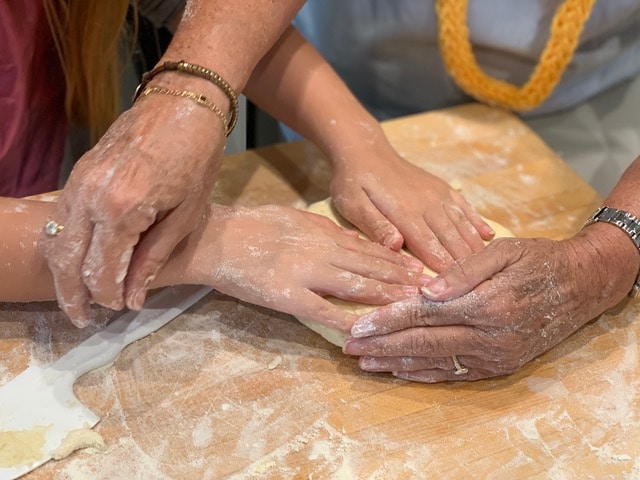
Piper summed up rugelach-making precisely when she said, “It’s a procedure.” She loved all the handwork with the dough: rolling, folding, filling and pinching. “It looks like a weird burrito,” she noted when the doughy pillows were ready for the oven. Since they were a little drippy and uneven, I decided to pass along a key piece of baking wisdom: “They may look ugly, but they will taste delicious.” Fingers crossed. The verdict came in the next morning, just as we were tearfully parting. My finicky grandson Finn ate two for breakfast. Parfait!

Recipe note:
Before we started baking that morning, Kate, Piper’s mom, pulled me aside and diplomatically whispered that Piper doesn’t eat raisins. Quoi? We left them out, and no one was the wiser. Chocolate chips, of course, are popular alternatives, minus the jam.

This “burrito” style filling is easier to make than traditional crescents since you don’t have to handle the dough as much. I’m sure it was Ida’s preference for sheer efficiency.

RECIPE
The Original Rugelach

Pastry
2 sticks butter, softened
1 cup full fat sour cream, natch
2 ¼ cups flour

Filling
1 cup walnuts, finely chopped
½ cup raisins (optional, but recommended)
¼ cup sugar
½ tsp cinnamon
1 cup apricot jam
1 egg white
¼ cup sugar mixed with ½ tsp cinnamon for sprinkling

Cream together butter and sour cream at high speed until light and creamy. Slowly beat in flour until the dough is smooth and elastic. Lightly knead on a floured board to form a disk. Cover with plastic wrap and chill at least one hour.

For the filling: In a medium bowl, combine nuts, raisins, sugar and cinnamon. Stir with a fork to combine.

When ready to bake, cut dough into four equal parts. Place three pieces back in the refrigerator.

On a lightly floured board, with the palm of your hand, pat flat the first piece of dough. With a well-floured rolling pin, roll the dough to form a 5 x 10-inch  rectangle. Working lengthwise, coat the center third with about ¼ cup apricot jam. Sprinkle the jam with the cinnamon nut mixture. Fold over one side lengthwise to nearly enclose. Then fold over the other side to enclose the filling. Lightly pinch the end pieces and center edges of dough to seal. Brush the top with egg white, sprinkle with cinnamon sugar and transfer to a large, uncoated cookie sheet.

Repeat the process with each portion of dough. Then slice each across the width in ½-inch thick slices. Chill for ½ hour on the cookie sheet.

To bake: preheat oven to 400F. Bake for 10 minutes. Reduce oven heat to 375F and bake 15 to 20 minutes longer, until the pastry is golden. Transfer to racks to cool.


Los Angeles food writer Helene Siegel is the author of 40 cookbooks, including the “Totally Cookbook” series and “Pure Chocolate.” During COVID-19, she shared Sunday morning baking lessons over Zoom with her granddaughter, eight-year-old Piper of Austin, Texas.

Taste of the Bronx: the Original Rugelach Read More »

Illuminate: Biggest, Brightest Celebration in the Jewish World

STARTS 12/17 AT 5PM PT/8PM ET


This Hannukah, Jews around the world are tuning-in for a historic unity event on December 17.  Illuminate, broadcast from Jerusalem, celebrates the President of Israel’s endorsement of the Declaration of Our Common Destiny, which brings the common values of the Jewish people to life.

The event launches a new global campaign to unify the Jewish people. It will feature a special address by President of Israel Reuven Rivlin, inspiring performances by international artists Idan Raichel and Jess Glynne, and actress Shira Haas as the Master of Ceremonies.

Illuminate is powered by Our Common Destiny, a collaborative effort founded by Genesis Philanthropy Group and Israel’s Ministry of Diaspora Affairs, under the auspices of the Office of the President of Israel. Over the last 15 months, the joint initiative has crowdsourced the Declaration, which aims to unite global Jewry through a shared vision for their future.

Starting after Shabbat on December 12 and continuing for five nights, Jerusalem’s Old City walls were colored by photos, videos and written blessings from Jewish organizations and individuals worldwide affirming the Declaration.

In the spirit of the Festival of Lights, Illuminate shines a light to the power of Jewish unity. The event demonstrates that the Jewish world is brighter when bringing the international Jewish community together.

Click here for event information or visit OurCommonDestiny.org to learn more.

Illuminate: Biggest, Brightest Celebration in the Jewish World Read More »

Table for Five: Miketz

One verse, five voices. Edited by Salvador Litvak, the Accidental Talmudist

Then Pharaoh said to Joseph, “Since God has let you know all this, there is no one as understanding and wise as you.” -Gen 41:39


David Sacks
Torah Podcaster at LivingwithGod.org

I learned from my Rebbe that there are two kinds of secrets. The first type is when you don’t know something and then you find out. This category is easy to understand.

But then there is the other kind of secret.

That’s when even after you learn the secret it remains a secret. For example, how did G-d create the world? The answer is He made something out of nothing. Now we know the secret… but how He did it… that remains a secret. We know, but we still don’t know.

Secrets are all around us.

How do you access those hidden aspects of holiness that are there yet remain elusive?

I don’t know.

But here is some holy advice from a holy Tzadik, the Kohziglover Rav, the Rosh Yeshiva of Chochmei Lublin, the greatest yeshiva in pre-WWII Europe.

Do you want to be for real? Then you must hide the good and holy things you are doing. Not only from other people, but even from yourself. There are exceptions to this rule. For educational purposes you can tell your children or students to set them on the right path, but other than that the mitzvahs you do are to remain a secret between you and Gd.

In this way, you become a secret.

Once you are a secret you are able to access the wavelength of secrets that surround us.

Now you know the secret. How it works exactly… that remains a secret.


Rabbi Nicole Guzik
Sinai Temple

What happens when you think you have achieved your dreams and accomplished your goals, only to realize that happiness is still not attained? At least, the pride in success is severely tempered when you realize that what you received isn’t actually what you need or what you really hoped to hear.

Joseph is lauded by the Pharaoh, named the wisest man in all of Egypt. But how important are these words? From whom does Joseph really need to hear? Joseph’s dreams may give us a glimpse into his authentic desires. In his book, “Inner Work: Using Dreams and Active Imagination for Personal Growth,” Jungian analyst Robert Johnson explains, “Dreams show us, in symbolic form, all the different personalities that interact within us and make up our total self.” In other words, each dream we have is an unconscious manifestation of our own inner conflicts. Our dreams construct images of our insecurities and wounded egos; a constant balancing act for the mind to be at peace. In Joseph’s dreams, we see someone constantly surrounded by others. Someone longing for credibility, acceptance and aching for love.

Our dreams may reveal pieces of our soul that are excruciating to see. And yet, these uncomfortable questions help us to build an honest life, motivating repair in the relationships we hold close. Joseph’s dreams help us scrutinize our own: To feel secure, confident and loved, whose voice is it that we need to hear? What are your dreams whispering to you?


Gershon Schusterman
Rabbi, Businessman, Mashpia

In Pharaoh’s dreams, seven robust cows rise from the Nile, then seven gaunt cows rise which swallow the robust ones. In his second dream, seven healthy ears of grain blossom, followed by seven meager ears of grain, which swallow up the healthy ones without leaving a trace. Troubled by the unsatisfactory interpretations by his sorcerers, Pharaoh calls for Joseph. Spirited from his dungeon, Joseph comes before Pharaoh, and interprets: There will be seven years of abundance followed by seven years of famine. Unbidden, he advises Pharaoh to appoint a superintendent to store the cornucopia “so the land shall not perish by hunger.”

Pharaoh praises Joseph, “there is no one as understanding and wise as you,” and immediately appoints him viceroy, empowers him with his signet-ring, bedecks him in fine linen and gives him a wife…

Joseph’s interpretation was so well received by Pharaoh that, even before any demonstration of its veracity, Pharaoh intuitively knew that it was the true meaning. Joseph wisely focused on underlying clues. How was that?

Pharaoh dreamt these dreams on his birthday, two years after Joseph’s début as a dream-interpreter (Gen. 40:20; 41:1).

Although Pharaoh had two dreams, he consistently refers to them in the singular. Pharaoh was convinced that this was one prophetic dream foretelling him as king of Egypt, on his birthday, that something momentous would be happening, which he must forestall. When Joseph interpreted the overlaying dreams as one and boldly advised him what he must do, it resonated with Pharaoh perfectly.


Kylie Ora Lobell
Contributing Writer, Jewish Journal

Before Pharaoh asks Joseph to interpret his dreams, he goes to “all the necromancers of Egypt and all its sages” to figure out what they mean. However, the necromancers and sages fail. Unlike Joseph, they do not have understanding and wisdom because they do not believe in HaShem. Even though they might have been able to perform impressive magic tricks, they were essentially snake oil salesmen.

In today’s world, we have our own necromancers and sages. There are false prophets and belief systems that try to trick us into thinking that life without G-d is better. Maybe they teach us to believe in money, or power, or politics instead of in the Almighty. But we know what’s real: When you believe in HaShem, you gain knowledge and truth. We may not have the clarity that Joseph did, but the more we learn Torah and turn to HaShem, the deeper our understanding becomes.

When I have a negative experience, I look at what HaShem might be trying to teach me. If I stub my toe, I think, “HaShem wants me to stop being anxious and rushing around so much.” If I lose a job, I conclude, “HaShem wants me to do something different now.” There is no guarantee that I’m right, but as long as I constantly try to interpret the messages I get and think, “What would HaShem want?” then I will be that much closer to gaining that understanding and wisdom we should all be striving for.


Rabbi Miriam E. Hamrell
MHL, MAEd. ahavattorahla.org

In the ancient world, Pharaoh was in essence a god-king ruling the upper and lower worlds. When Pharaoh’s wise men were not able to interpret his two dreams, Pharaoh summoned Joseph, who was a slave for thirteen years, and now out of prison. Pharaoh told Joseph that he heard about his powers to elucidate dreams.

While in prison, God gave Joseph the opportunity to mend his own character. Now, standing before powerful Pharaoh, Joseph was humble, honest and courageous. He gives all the credit for his talents to his strong relationship with God, no matter what the circumstances in his own life were.

Joseph lays out his amazing economic, “National Disaster Relief Program” to Pharaoh. When Pharaoh asked his advisors to execute the job, they admit that they cannot. Pharaoh makes an astonishing declaration, “Since God has let you know all this, there is no one as understanding and wise as you are.”

No competition!

Rashbam (Rashi’s grandson, France, 1085-1158) writes that Pharaoh was able to see and hear God’s wisdom through Joseph, and he actually understood that Joseph’s God is more powerful than his own power. This meant that Pharaoh’s power was diminished and Joseph’s power was increased.

Joseph became a role model for all of us to never give up at tough times. He found strength to conquer the challenges and never waiver in his trust in God, that it was all for the best. May we all be strengthened in our faith in God like Joseph the Tzadik. Amen.

Table for Five: Miketz Read More »

Miketz (or How the Wheat Was Won)

If there ever was a series of Torah Portions
worthy of binge-studying, this is it.

Cliffhanger after cliffhanger – The Story of Joseph: Episode 2.
Our hero in jail, where we left him last week.

Still scarred from the pit, his best friend, the butler, gone.
Things aren’t looking great – It’s a real page-scroller.

Our new antagonist, Pharaoh, it’s like an origins story,
not such a bad guy at this point.

But he’s the pod-racing young Anakin Skywalker
to his Vader-like descendants.

It’s gonna be trouble, right here in Egypt city.
He’s dreaming of cows.

Joseph, still in jail, still wearing the pajamas
of the house of Potiphar, happens to be an expert

in dreams about cows, saves the day! Wheat for everyone!
Pharaoh, like an Emperor Palpatine, no-one yet suspects

gives Joseph the keys to the Kingdom.
Joseph, in one of the best relationship plot twists

since his dad married the wrong woman,
marries the daughter of the woman who accused him of rape.

Soon little Josephs running around the kingdom,
and Mrs. Potiphar can’t say a thing.

And this is where the writers
(or writer if you believe such things)

make their money, focusing on character development.
Joseph’s brothers, in search of Egypt wheat

find themselves bowing in front of a man
they do not know they know.

The youngest, accused of stealing a silver goblet
and the credits roll, another cliffhanger.

That’s how they keep you coming back.
You only have to wait ’til next week.

You might remember the outcome from last season.
We do this every year. But no spoilers please.

For some people
it’s their very first time.


Rick Lupert, a poet, songleader and graphic designer, is the author of 23 books including “God Wrestler: A Poem for Every Torah Portion.”

Miketz (or How the Wheat Was Won) Read More »

Ed Asner Plays a Holocaust Survivor in ‘Tiger Within’

The unlikely friendship between Samuel, an elderly, lonely Holocaust survivor and Casey, an angry 14-year-old runaway sex worker with a bad attitude and a swastika on her leather jacket, is the premise of “Tiger Within,” a redemptive story about the power of forgiveness and unconditional love to transform lives and overcome ignorance, fear and hate.

Ed Asner and newcomer Margot Josefsohn star in the absorbing drama, which was directed by Rafal Zielinski (“Fun,” “Ginger Ale Afternoon”) and written by Gina Wendkos (“The Princess Diaries,” and “Coyote Ugly”).

“We tried to make this movie for many years but it kept falling apart,” Zielinski told the Journal. He first read Wendkos’ script some 30 years ago and was touched by the story’s themes of love and compassion. Observing an elderly Jewish man visiting a grave at a cemetery was the catalyst for the idea. “There’s so much anger and darkness in this world that we need more messages like this. It touched me deeply,” he said.

“Anti-Semitism is so strong these days and getting worse,” Zielinski continued. “It’s so sad and tragic. The youth of today is so clueless about the Holocaust and there’s so much Holocaust denial. The racial divide exists all over the world. I feel that the film resonates on a bigger scale. The story could take place anywhere, and I feel that it will touch people from all around the world.”

Over the years, the film was variously supposed to star Jerry Lewis, Kirk Douglas, and Martin Landau.  Ultimately, through a neighbor who was making a movie with Asner, Zielinski got the actor’s number and brought him the script. “The next day he called to say he loved it and would play the role,” the director noted.

Shot in the summer of 2018, the film takes place on the streets of Hollywood and around the city and was in post-production for the last two years. Zielinski faced many challenges in getting it made. Asner, now 91, “Has a very sharp mind, but he could barely walk,” Zielinski said. By the end of a day shooting on the streets, “He was very tired and could not remember one line. We shot one line at a time and cobbled it together.”

Casting Casey posed different problems. Zielinski insisted on choosing a girl of the right age, but faced resistance because Josefsohn was so inexperienced. “She had never done anything before,” he said. While accompanying his son to an audition, he spotted Josefsohn and her mother in the waiting room and captivated by her “piercing eyes,” he introduced himself and gave them the script, “not even knowing if she could act. But she came in to audition and became the character.”

When he brought her to Ed’s house to have them read scenes together while videotaping them, he knew he’d made the right choice, even though using her meant extending the shoot and increasing the budget. “You can only shoot for five hours with kids that age, but I believe in authenticity. I wanted to use the real thing, and I fought hard for her,” Zielinski said. Per child labor laws, Josefsohn was body-doubled and not on the set when any sexual activity was implied

Zielinski’s initial budget was a meager $100,000, which became $250,000 by the time the film was finished, but he’s accustomed to working on a shoestring. “I come from a documentary background, I studied with Richard Leacock who used low budget techniques and worked with a tiny crew, and in my youth, I made a bunch of movies for Roger Corman. I learned how to make something beautiful and magical from nothing,” he said.

“Sometimes it was difficult to get permits for the crew and we had to shoot with a tiny pocket camera. We’d shoot a scene that normally took two hours in 15 minutes. When you shoot hand-held, you’re much more mobile.”

Zielinski has wanted to make films since his father gave him a camera when he was seven. Of Polish descent and born in Canada, he spent his youth traveling around the world while his father worked for the Ford Foundation. Always the new kid at school, he hid his awkwardness behind the camera but later realized he wanted a more collaborative experience and pivoted into filmmaking, graduating from MIT with a degree in Art and Design with a concentration in documentary film. “It’s one big family when you make movies,” he said.

For the future, Zielinski has “a whole suitcase of dream projects I would love to make but I’m worried because I’m getting older. They’re grand scale projects and I hope I get a chance to make them,” he said. Topping the list are a futuristic film about the war between men and women and another based on the Tibetan Book of the Dead and reincarnation. He’s a Buddhist, but his mother has Jewish roots and he identifies as a Member of the Tribe as well.

He hopes to show “Tiger Within” in schools and to youth groups “to teach kids about the Holocaust so something like it will never happen again, which was Wenkos’ intention when she wrote it, he said.

He also hopes a bigger distributor will pick the film up after the virtual release on Dec. 18, and help with award season campaigns to “spread the message as much as possible. I hope the film has an illuminating effect. Forgiveness has a tremendous healing power on people. I don’t want to suggest that we forgive the Holocaust, but forgiveness and love will change the world.”

“Tiger Within” begins streaming at Laemmle Virtual Cinema on Dec. 18. Visit Laemmle.com for tickets.

Ed Asner Plays a Holocaust Survivor in ‘Tiger Within’ Read More »

Radio Station Cuts Ties With Polish Program Over Allegations of Anti-Semitism

On December 11, a Canadian radio station ended its relationship with Radio Maryja, a Polish radio program based in Poland, due to allegations that the program promulgates anti-Semitic content.

Matt Caine, vice president of CJMR 1320, a multicultural station that covers the Greater Toronto, sent a letter to the far-right Radio Maryja stating that Father Jacek Cydzik, who represents the station, failed to give an adequate response to B’nai Brith Canada’s allegations of anti-Semitism against the station.

“Fr. Cydzik failed to acknowledge or refute the specific examples that B’nai Brith Canada cited from credible institutions around the world, including Poland’s own National Radio and Television Broadcasting Council,” Caine wrote. “CJMR has been provided [with] multiple examples of anti-Semitic statements made by guests and commentators on Radio Maryja broadcasts and online publications. We have also had negative input about your program from the Anti-Defamation League and Jewish World Congress.”

He concluded that “despite our long business relationship we believe that we have clear and overwhelming reasons to immediately cancel our contract.”

B’nai Brith Canada CEO Michael Mostyn said in a statement, “With this latest important development involving CJMR 1320’s decision to cut its ties with Radio Maryja’s broadcasts, we’re seeing further results of B’nai Brith’s efforts to combat the scourge of antisemitism in all of its manifestations.”

“we’re seeing further results of B’nai Brith’s efforts to combat the scourge of antisemitism in all of its manifestations.”
— Michael mostyn, b’nai brith canada

In a December 14 press release, B’nai Brith Canada stated that the evidence they had sent to CJMR included “conspiracy theories about imagined efforts by Jews to control Poland and exploit the Holocaust for personal gain, referring to Jews as ‘greedy,’ and slandering Judaism as a religion of ‘trade,’ among other forms of antisemitism and prejudice against other minorities.”

Additionally, the Roman Catholic Archdiocese of Edmonton banned Radio Maryja founder, Father Tadeusz Rydzyk, in October at the urging of Thomas Lukazek, the former deputy premier of Alberta. The Canadian Jewish Record (CJR) reported, “In on-air comments in 2016, Rydzyk lambasted ‘synagogue-type behaviour’ among some of his followers, and in private conversations, leaked to a Polish magazine said that then-Polish president Lech Kazcynski was taking orders from Jews. His radio station has also promoted Holocaust denial, with a guest in 2000 claiming that gas chambers at Auschwitz didn’t exist.” 

According to the Anti-Defamation League (ADL), in 2016, Radio Maryja commentator Stanislaw Michalkiewicz accused the “Jewish lobby” of “demonstrating its racial solidarity with the Ukrainian oligarchs” and alleged that “mischievous Jews” were infiltrating left-wing political parties in Poland. The ADL also noted that in the same year, “Poland’s State Council of Radio and Television sanctioned Radio Maryja for a show which alleged that United States Senators were criticizing the Polish government because the Senators were Jewish.” Also that year, Poland’s right-wing ruling Law and Justice Party funneled $7.5 million in subsidies to the Radio Maryja, according to the ADL.

Radio Station Cuts Ties With Polish Program Over Allegations of Anti-Semitism Read More »

Temple Ramat Zion Hanukkah ‘Car-nival’ Gets Turnout of 200 People

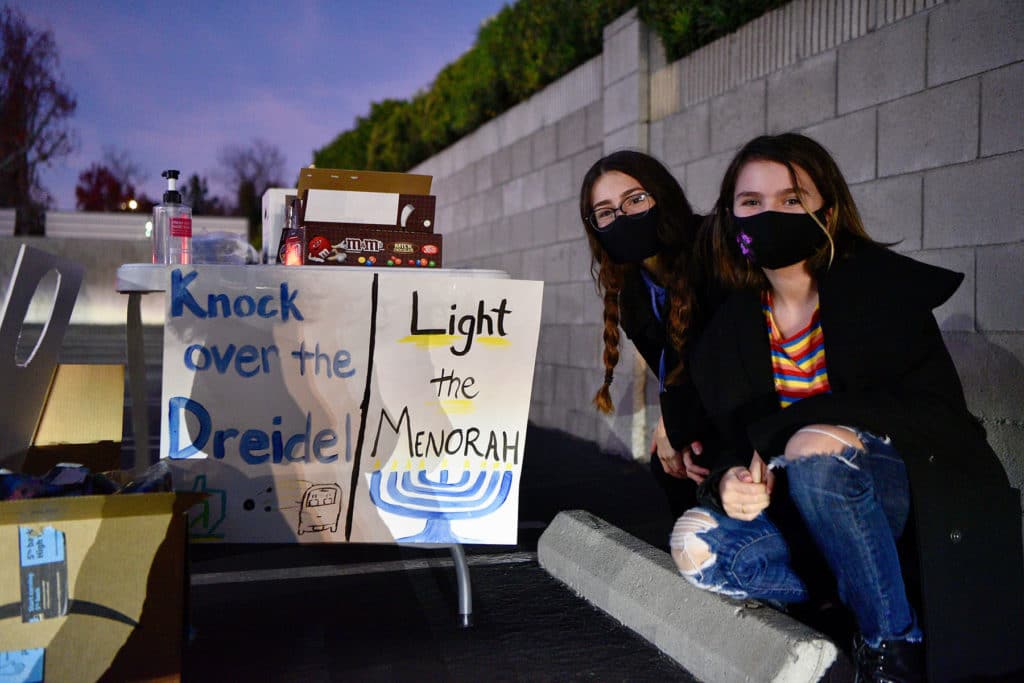
Around 200 people in 80 cars gathered at Temple Ramat Zion’s parking lot in Northridge, Calif. to celebrate the sixth night of Hanukkah on Dec. 15. The festival of lights “Car-nival” was the first major community gathering the temple has had since March.

Temple Ramat Zion Rabbi Ahud Sela told the Journal in an email they wanted to hold the Car-nival “because even in these dark times, it is important to stay positive and hopeful, and we can do that by celebrating the warmth and joy of Hanukkah.”

The temple made sure to comply with COVID-19 guidelines from the Centers for Disease Control and Prevention (CDC) and mandates from Los Angeles County. Festivities included a hanukkiah lighting followed by a sing-a-long, a performance by a fire dancer, fresh latkes and Krispy Creme doughnuts delivered to car doors car-hop style and games for kids and families to play. Everyone stayed in their cars and wore masks when windows were rolled down.

Games including “Knock over the Dreidel,” “Get the Latke in the Pan,” “Get the Doughnut on the Ring” and “Light the Candle” (by throwing socks through a hole in a candle poster) were all played from inside the vehicles. The temple also provided games, word searches, mazes and trivia that could be played through an app or on paper.

Attendees were also encouraged to bring socks to the party, a past Ramat Zion tradition, so they could be donated to Pacoima nonprofit MEND (Meet Each Need with Dignity). MEND provides food, clothing and homeless care services to those in need.

“The fact is, at Hanukkah, we are commanded to light the Hanukkah candles but more importantly, we are beholden to be the light ourselves. This car-nival reminds us to think of others not as fortunate as we, which is why we are collecting new pairs of socks for MEND,” Sela said.

While this year has brought sorrow to the local community, Sela says now more than ever it’s important to be the light that shines on others and help keep others safe.

“That begins by being responsible and not spreading the virus, which we do by wearing our masks, washing our hands, and watching our distance,” Sela said. “We support our frontline healthcare workers. We help those who have lost jobs and income because of the recession. And we continue to help those who were already struggling before the pandemic.”

Temple Ramat Zion Hanukkah ‘Car-nival’ Gets Turnout of 200 People Read More »

Ignoring Racial Progress Hurts Future Progress

The best intentions can have unintended consequences. Eliminating racism and uplifting Black communities are the most noble of intentions. But we are falling into a negative and demoralizing approach that will set back racial progress rather than move it forward.

One example is a United States Commission on Truth, Racial Healing, and Transformation recently proposed by Congressional representatives. The title sounds hopeful, but the actual resolution makes America look like an incorrigibly racist country that must be put on trial.

The resolution acknowledges that while slavery came to our land 400 years ago, it “subjugated African Americans” for 250 of those 400 years. What happened over the ensuing 150 years? Well, progress happened, but the resolution glosses over that. Instead, it focuses on “a legacy of this oppression that haunts us to this day.”

This is the crux of the longstanding debate over racism: What better defines America — the arrival of the first slave ship in 1619 or the long arc of justice since the founding of the country in 1776?

It’s more dramatic, certainly, to argue that America has been irredeemably racist since 1619. But this ignores the progressive movement of history. As far back as 1998, a research study from Brookings concluded that “Progress is the largely suppressed story of race and race relations over the past half-century.” Among the study’s findings:

“In 1940, 60 percent of employed black women worked as domestic servants; today [1998] the number is down to 2.2 percent, while 60 percent hold white- collar jobs.

“In 1958, 44 percent of whites said they would move if a black family became their nextdoor neighbor; today the figure is 1 percent.

“In 1964, the year the great Civil Rights Act was passed, only 18 percent of whites claimed to have a friend who was black; today 86 percent say they do, while 87 percent of blacks assert they have white friends.”

This has never meant that we should be satisfied with progress. We still have a long way to go. Progress should never stop. But it’s dishonest, if not counterproductive, to downplay America’s long history of racial progress, however halting and imperfect it has been.

Today’s activists against “systemic racism” seem to do just that. When they bring up history, it’s to focus on the sin rather than the long arc of progress. Strategically, that may make sense. The more racist America looks, the more attention and power the anti-racist movement will attract.

We pay a price, however, for ignoring progress. For one thing, it’s demoralizing. It lowers our collective self-esteem. If we’re constantly being told that we’re a hopelessly racist nation, what is there to love? Why put in the effort?

More importantly, how does the noise around systemic racism actually uplift Black communities? Does it improve education in the inner cities? Does it reduce violence, drug use and social decay?

A useful national conversation must begin right there, with the real impact of the anti-racist movement on Black communities.

But instead of focusing on, say, improving educational opportunities for Blacks, the “1619” movement seems more focused on changing the education of whites. Critical Race Theory is now all the rage throughout American schools. The New York Times’ 1619 Project has entered the formal curriculum in a growing number of schools.

This new direction maximizes white guilt while maximizing Black victimhood. The gains from such an approach are more cosmetic than real. Corporations put the Black Lives Matter logo on their websites, inclusion training sprouts everywhere, and performative social justice rules.

In San Francisco, for example, the Unified School District decided that Abraham Lincoln High School will be renamed because the 16th president “did not show through policy or rhetoric that black lives ever mattered” to him. How will this actually improve education?

The ones who win most in this agitation are not those suffering on the streets but activists who gain more power. Their currency, their source of power, is permanent victimhood.

As a result, instead of mending our racial divisions, we are reinforcing them. Instead of looking toward Martin Luther King’s “I Have A Dream” speech, we’re stuck on a static 400-year legacy of “oppression that haunts us to this day.”

Telling America it is irredeemably racist undermines faith in our country. It encourages the taking down of institutions rather than their reform. It fosters a cancel and revenge mindset.

Progress, however halting, feeds on itself. It is empowering. It reminds us that we can do it, because we’ve done it before.

The alternative is to recognize that the founding ideals of 1776 provided the remedies that have nourished the long arc of justice. Progress, however halting, feeds on itself. It is empowering. It reminds us that we can do it, because we’ve done it before.

The more we can acknowledge past progress, the more we will encourage future progress, the more we will help those who need it most.

That intended consequence can be called systemic progress.

Ignoring Racial Progress Hurts Future Progress Read More »

Poem: Olive

A taste as old as cold, cold water,
don’t put them in long drinks, but shorter
martinis or a Bloody Mary.
They clear the head and make it airy,
with taste more frugal than fresh meat,
more old than ancient wine, as neat
as cashews, macadamias,
and roasted tongue, not gamey as.

If still your fancy is not tickled,
try having one the Greeks have pickled.

Now as for olives’ essence, oil:
to butter man is only loyal
if he has never tasted theirs,
an essence the Almighty cares
so much about that He demanded
to light menorahs and  commanded
that olive oil should by the Jews
be burnt and constantly in use,
as if to say: “The olive tree
was made by me so you may see
how lovely are my groves.”  Oh Lord!
The greatest glimpse you can afford,
to those few who try hard to qualif-
y holiness-wise, it is the olive!

So don’t burn candles every night
of Hanukkah––they may be bright,
for olive oil on Hanukkah
is purer and organicker.

Gershon Hepner

Chanukah 5781

Photo by Peter Spiro/Getty Images

Christopher Lehmann-Haupt reviews Mort Rosenblum’s Olives: The Life and Lore of a Noble Fruit:

Americans may well be catching on to the wondrous benefits of good olive oil, as Mort Rosenblum reports hearing from several experts in his edifying new book, ”Olives: The Life and Lore of a Noble Fruit.” Nonetheless, he writes, ”as of 1996 only one American household in five had tried olive oil.” Most people in this country still think of an olive as ”no more than a humble lump at the bottom of a martini.” Too few understand what moved Lawrence Durrell to write in ”Prospero’s Cell” of black olives: ”A taste older than meat, older than wine. A taste as old as cold water.”


Gershon Hepner is a poet who has written over 25,000 poems on subjects ranging from music to literature, politics to Torah. He grew up in England and moved to Los Angeles in 1976.  Using his varied interests and experiences, he has authored dozens of papers in medical and academic journals, and authored “Legal Friction: Law, Narrative, and Identity Politics in Biblical Israel.” He can be reached at gershonhepner@gmail.com.

Poem: Olive Read More »

The True Cost of Americans Hating Each Other

Last week, I attended the White House Hanukkah Party. It was a privilege to celebrate the Jewish festival of lights in the people’s house. This tradition, carried out by both Republican and Democratic presidents, is a cornerstone of promoting the miracle of the menorah.

But judging from people’s reactions, you would think I opened fire on a school bus.

The White House protocols were for everyone to be masked, and the event had plenty of room for social distancing. Yes, people took off masks to take photos when they could employ sufficient distance from other guests. But masks — whose necessity I of course fully believe in — were the order of the day, with the exception of people eating latkes and other foods, a standard that is accepted in many states.

Yet the amount of hatred that my attendance unleashed on social media was unprecedented. “You’re an enabler. You enabled Trump’s denial of his election loss to Joe Biden.” Actually, I attended a White House Hanukkah celebration.

“You allowed Trump to get away with trying to steal the election.” Actually, I ate latkes.

The irrational, near-demonic hatred for Donald Trump has now been extended to anyone in his vicinity, including those who simply celebrate Jewish holidays with the country’s elected leader, a practice that will no doubt continue in the White House of President-elect Joe Biden.

U.S. President Donald Trump, first lady Melania Trump, White House senior advisor Jared Kushner and Ivanka Trump at a Hanukkah Reception at the White House on December 11, 2019. (Photo by Mark Wilson/Getty Images)

In my career as a Rabbi, I have experienced plenty of controversy and hatred, from those who opposed my publishing “Kosher Sex,” to those who fought me on the publication of “Kosher Jesus,” to those who thought I had lost my mind when I appointed a young Cory Booker — today a Senator from New Jersey — as student president of my Oxford University L’Chaim Society in 1992. “You made a non-Jew the head of a Jewish student organization? You’re promoting inter-marriage.”

But nothing I have done seems to have been as controversial as being in Trump’s orbit on Hanukkah.

It’s time to respond.

Now that he has exhausted all legal recourse, Trump must concede the election. And Republicans should embrace President-elect Joe Biden’s “time to heal” approach in trying to unify the country.

But the political left must halt the vitriol they’re fostering. Maturity requires an ability to parse the good from bad in people, things and ideas. Immaturity is where you simply reject — in totality — something you find distasteful, even when it has things that deserve to be applauded or embraced.

I need not vote for Joe Biden to agree that in his fifty-year public career, he has displayed decency and humanity. And I need not agree with all of Donald Trump’s policies to concede that in four years he has utterly reshaped the Middle East and the U.S.-Israel relationship, a fact for which all American Jews should be grateful.

Just a day after the event, Trump announced a peace deal between Israel and Morocco. Let’s not forget that former U.S. Secretary of State John Kerry swore that Israel would never have peace with its Arab neighbors or the Gulf States unless they first made peace with the Palestinians.

Kerry could not have been more wrong. It turns out that the Arab states were as weary of Palestinian intransigence as were the Israelis. None of us would have believed the miracles that are taking place in the Middle East. Those who hate Trump so much that they will give him no credit on this achievement are as blind as those who are pretending that Biden did not win the election.

I am grateful to Trump for having secured a lasting peace for Israel with so many previously implacable foes. And I’m grateful to have been invited to celebrate the miracle of Hanukkah at the White House. I hope that President-elect Biden will continue Trump’s policies of unrivaled support for Israel and crushing sanctions on Iran.

It’s a challenging time in America because so many Americans have gone insane with hatred, both on the left and the right. And we’re talking real hatred. It’s disgusting, embarrassing, inane and depressing. Ordinarily, we could have blamed such American insanity on the paranoia that comes from a global pandemic. But then we’d just be shifting responsibility away from the real ones to blame — each of us. Every single one of us.

The Trump haters (including some close friends) — who told me they won’t speak to me anymore because I went to the White House Hanukkah party — should question whether they are uniting a fractured country or ripping it apart. My Republican friends who told me that they will never accept a Biden presidency — just as so many of the Democrats never accepted Trump — should ask themselves the same question. They’re harming the country. And humiliating themselves.

Because the only thing worth hating in life is unalloyed, unconditional evil. Mass murderers, genocidaires and those who destroy human life warrant what I call “Kosher Hate” (the title of a book I am currently writing), the kind of emotional revulsion that causes us to resist and fight wickedness. But your political opponents? Hating them as if they were murderers and terrorists? Seriously?

Hating mere political opponents is immoral not only because it destroys a nation but also because it allows the true evil-doers to go unchecked, as we misdirect our revulsion away from legitimate targets.

Hating mere political opponents is immoral because it allows the true evil-doers to go unchecked.

The consequences of this political hatred are grave. Take the United States during World War II, which was a bystander for more than two years after Hitler’s invasion of Poland. Had Japan not attacked Pearl Harbor, America would certainly have delayed its entrance in the war — if not stayed out altogether. For some reason, we could not, as a nation, summon sufficient hatred of the Nazis to fight them, even as they conquered all of Europe and began the annihilation of the Jewish people.

After the Holocaust, Jews and others adopted the slogan “Never Again.” Yet the slaughter of innocents has happened again and again in the 70 years that have passed since the liberation of Auschwitz.

The history of the modern world is a history of genocide and the indiscriminate slaughter of innocent men, women and children. Historian Paul Johnson estimates that at least 100 million civilians were murdered in the twentieth century alone by bloodthirsty tyrants. This is a staggering number. The world could not summon enough hatred of these individuals or their dastardly deeds to bring them to justice.

Depressingly, the trend has continued into the twenty-first century. December 9, 2004, was the fifty-sixth anniversary of the approval of the Genocide Convention by the United Nations General Assembly. Meanwhile, another genocide was taking place in Sudan.

In sixth millennium that Judaism counts since creation, evil is growing with increasing strength, with brutal regimes continuing to control hundreds of millions of lives and terrorism striking throughout the world. Seventy years after Hitler’s demise, madmen run nations, gas their own people, torture civilians and fill mass graves with the bodies of innocents, which we are currently witnessing in Syria.

Amid the world’s protests of “Never Again!” no fewer than at least seven genocides have occurred since the Holocaust, including Cambodia, Rwanda, Srebrenica, Bosnia, Darfur and now Syria. Bashar al-Assad has murdered more than 500,000 Syrians and has used chemical weapons against his own people. Other than a missile strike launched by Trump following one of the chemical weapons attacks, the world has been a bystander.

Instead of “Never Again!” the reality has been “Again and Again!”

And one of the principal reasons? We have to learn not only to love the victims of murderer but to hate and resist the murderers themselves. And when we spend all our time directing our hatred toward fellow Americans over political rifts, we allow those who are truly deserving of our revulsion to be overlooked.

It’s time for Americans to stop hating each other and instead work together — amidst legitimate political differences — toward making the world a place that is bereft of injustice and filled with the light of love, peace and human brotherhood.

Boy, would that be a Hanukkah miracle.


Shmuley Boteach, “America’s Rabbi,” whom The Washington Post calls “the most famous Rabbi in America,” is the author of the forthcoming “Holocaust Holiday: One Family’s Descent into Genocide Memory Hell.” He is the international best-selling author of 33 books. Follow him on Twitter and Instagram @RabbiShmuley. 

The True Cost of Americans Hating Each Other Read More »