Sharon’s Turn: I started reading Seventeen Magazine as a young girl in Sydney, Australia. I was fascinated by the glimpse into American culture, American products, American marketing, American celebrity and American fashion. I learned that it was chic to wear pearls with a basic white t-shirt and to pair grey clothing with a pop of yellow. But ironically enough, it was a salad recipe featured in the magazine that has had the most lasting impact on my life. You see, I learned the skill of “arranging” a salad like a work of art.
Just when the spectacular summer stone fruits fade from the produce bins, the most brilliantly colored fall fruits make their debut. Bright crimson pomegranates, exotic coral persimmons and vividly burgundy and orange streaked blood oranges tempt the palate. Greens taste so much more exciting when they’re paired with fabulous fall fruit. Every salad is taken to sublime heights with the addition of creamy avocado and lemon and olive oil is always light and fresh. (Make sure to scrape the lemon rind and take a deep whiff—the scent of lemon is scientifically proven to improve your mood!)
We hope you’re inspired to brighten your table and bolster your immune system with these incredibly beautiful, delicious and healthy salads.
Rachel’s Arugula and Persimmon Salad
16 oz arugula
8 oz endive
3 persimmons, thinly sliced
2 watermelon radish, thinly sliced
Arrange ingredients in a bowl
Garnish with avocado, toasted walnuts or almonds, and chopped dates
Sharon’s Blood Orange and Fig Salad
16 oz mixed baby greens
1 Persian cucumber, thinly sliced
1 blood orange, peeled and segmented
10 fresh or dried figs, halved
1 cup pomegranate arils
Arrange ingredients in a bowl
Lemon and Olive Oil Dressing
1/3 cup olive oil
1 lemon, juiced
1/2 teaspoon kosher salt
1/4 teaspoon freshly ground pepper
Rachel Sheff and Sharon Gomperts have been friends since high school. They love cooking and sharing recipes. They have collaborated on Sephardic Educational Center projects and community cooking classes. Follow them on Instagram @sephardicspicegirls and on Facebook at Sephardic Spice SEC Food.
The 14th annual Other Israel Film Festival, presented by the Marlene Meyerson JCC Manhattan, goes virtual with a lineup of more than two dozen Israeli features, documentaries and shorts that will stream online from Dec. 3-10. Each day’s lineup includes moderated Q&A sessions with actors and filmmakers.
“This year’s lineup is our most diverse to date, and we will explore Israeli society like never before,” said Isaac Zablocki, director of the festival. “This is the third film festival that the Marlene Meyerson JCC Manhattan is running virtually, and we are excited to use technology to take our community and the conversation to new levels.”
“This year’s lineup is our most diverse to date, and we will explore Israeli society like never before.” — Isaac Zablocki
Feature selections include Amos Gitai’s “Laila in Haifa”–the closing night film–and documentaries about Golda Meir and radical Rabbi Meir Kahane (“The Prophet”). Themes include Israeli-Palestinian stories (“My Dearest Enemy,” “Crossings”) and Israel’s Druze community (“One Hundred Percent”). Among the short subjects are “White Eye,” about a bicycle theft that prompts a crisis of conscience and “Birthright,” about a young woman who ponders her future on a trip to Israel.
“Through dozens of films and conversations, Other Israel will take a deep dive into Israel’s Arab and other underrepresented populations,” festival founder Carole Zabar said. “We present other narratives and new perspectives with the hope of enlightening and challenging our audiences.”
Festival passes cost $90 and tickets to individual films are $13. Click here for schedules and registration.
New York has Central Park, London has Hyde Park, and Barcelona has Parc Güel. Unlike these metropolises, Los Angeles does not have a central green space that serves as the city’s prime gathering spot. In downtown LA, Grand Park re-opened in 2012 after a complete remodel, wants to fill this void. The multi-tiered rectangle stretches from City Hall to the Music Center responsible for the park’s free programs. The Jewish Journal caught up with park director Julia Diamond, 40, to discuss Grand Park’s role pre and post-pandemic and her connection to LA.
JJ: Tell me about Grand Park and what you do there.
JD: Grand Park is a 12-acre green space in downtown Los Angeles. My job there is the director of the park. I run a team that oversees facility management, the programs and events, leasing, and marketing. Our job is to figure out, “how do you create LA’s central gathering space?” We [in LA] don’t necessarily think of ourselves as a city with a center. Grand Park is not trying to be a geographical center, but it is there to serve as the obvious place where we come together. The aim of our programming is to uplift Angelinos, to bring us together, to help bridge Angelinos to each other, to develop a stronger sense of connection – it has lofty goals!
JJ: How has the coronavirus pandemic affected your work?
JD: The park itself never closed, but our events moved online. We still look for opportunities that a lot of people can connect to. Our slogan says Grand Park is the park for everyone, so access was at the heart of our shift to digital. Instead of the annual festival that draws 50,000 people, we did a TV special for the 4th of July. Another prime example is the day of the dead celebration. Dia de los muertos is primarily a Mexican and Mexican American holiday. It’s such a personal holiday; people create altars to celebrate their loved ones. We usually present about 50 altars in the park every year. The amazing thing about that holiday is that it’s rooted in one tradition that’s very present in Los Angeles, but almost anyone, no matter where you come from, can connect to that. This year, day of the dead marked our first time returning to the park with a public art installation.
Our slogan says Grand Park is the park for everyone, so access was at the heart of our shift to digital.
JJ: How did you get into this line of work?
JD: I think in the way that most people do – wanting to be an artist. My first love was the theatre. Over time, I fell more and more in love with dance because it has a bit more of a universal language. I have also worked in opera for a long time. Grand Park was an interesting new chapter for me because I was used to theater production and work inside four walls, and the park blows that model totally out of the water.
JJ: Are you Jewish?
JD: I’m half Jewish. Technically I’m not Jewish. My mother is Catholic; my father is Jewish. My parents are divorced, and my father remarried a woman who is Jewish and practicing. I grew up in a funny world of having a little bit of everything, very much feeling a connection to my Jewish heritage and the Jewish community on the Westside of LA. Jewish holidays were celebrated in my home. For reasons I can’t quite put my finger on, I’ve always felt a stronger connection to Judaism than Catholicism. Especially coming out as a grown-up, the Catholic faith didn’t feel very welcoming to the LGBTQ community.
JJ: Do you feel like your Judaism is influencing your work, and can you describe how?
JD: One thing about the park that is interesting is the landscape design. The plants of the park are a metaphor for immigrant communities that have come from around the world. They came to Los Angeles, planted a seed, and flourished here and made it rich and beautiful and colorful and diverse. As the head of the park, it’s in some ways very helpful to know which community I represent. It has helped foster greater empathy and respect, and care when I engage with a community that’s not my own. I think about how I would want my community to be reflected or represented, and my cultural traditions respected. Also, a love of nature, a connection to the natural world, and a sense of care for the natural world.
JJ: Do you feel even more connected to religion as an adult now that you have children of your own, and you’re experiencing Jewish life with them?
JD: I definitely feel more connected as a mom. We made a conscious choice to raise our children Jewish. To give your children Judaism is an active choice, and it needs constant attention and care. Part of it is my wife and I experimenting with whatever our tradition is gonna look like. How do we celebrate Hanukkah? How do we do Passover? We are in the process of figuring out what our celebrations look like. It requires a little homework and prayer-refresher YouTube videos and some research and some experimenting in the kitchen. Also, some very intentional going back to my wife’s mother and saying, “come for Passover and teach us how to make this dish that you make.”
JJ: Do you think the park’s role or mission will change after the pandemic?
JD: I think that we will think a lot more about how we contribute to social and public health.
We won’t shift away from being a space that uses cultural experiences to unite people, but I think we will focus our lens on that so we can have a bigger impact. Much of what brings us ‘bigger picture’ health is a sense of being connected, a sense of belonging. I’m a big believer that parks and art organizations are parts of that really critical social infrastructure that keeps us healthy.
JJ: There’s another crisis plaguing the country: systemic racism. How did the park fare during the summer of unrest, and how is it addressing the situation?
JD: In late May, early June, after the killing of George Floyd, the park was the site of protest against racial injustice and sustained some damage, mostly graffiti. We wrote a statement in response to that, re-affirming the work and the mission of the park. It is the park for everyone, and we try to tell the stories of black and brown communities in addition to white communities. The statement is still up on the homepage, and I don’t know when it will feel right to take it down because that work is never done.
Jessica Donath is a freelance journalist in Los Angeles.
In my last piece, I explained why the Jewish community is in the midst of a “Pandemic Revolution.” Twenty-first-century economic and social changes have suggested that our community will be courting a new generation of Jews with different modes of engagement, operating with fewer resources, and managing amid a destabilized political and social environment.
Will our traditional organizations survive this moment, and are they likely to be responsive to this new generation’s tastes and interests?
Based on the current recession, some of our communal structures will leave the scene or face major reductions in size. Cultural institutions, for example, may not survive in an economy that focuses primary resources on core human needs. Institutions without alternative income streams, sufficient financial reserves, and a fiscal gameplan are also unlikely to survive. Already, more than 1,000 Jewish organizations and synagogues received over $500 million in government loans as part of the federal stimulus packages introduced this spring. Yet, despite this financial assistance, numerous Jewish groups have been forced to lay off personnel.
The institutions that do have the financial means to survive aren’t off the hook — they must adapt to younger generations of Jews and the new “Jewish poor,” a cohort of older Jews, young families and singles adversely impacted by the recession. This cohort of Jews may resist the former model of Jewish engagement — holding multiple memberships at institutions that addressed niche interests. If the mergers and downsizings from the 2008 and 2020 recessions are any indications, paying to belong to synagogues and JCCs may no longer be tenable.
How, then, should Jewish institutions change their modus operandi to remain relevant, funded, and inclusive? Our organizations must revisit the core values that defined twentieth-century Judaism to create a coherent twenty-first-century response. Judaism must now be understood and interpreted as a “moveable feast,” where we adjust our institutions to evolving economic circumstances, cultural realities and social forces.
How, then, should Jewish institutions change to remain relevant, funded, and inclusive?
Here are just a few trends to watch to assess where the “feast” has moved:
Changing Numbers. Community requires a significant number of constituents to thrive and prosper. The Jewish community is undergoing a significant demographic transition as our core population base changes through assimilation, aging and atrophy.
Changing Generations. Generations reflect different interests, lifestyle choices, and cultural tastes. Who we were as a twentieth-century constituency will not be how we will behave in a twenty-first-century environment. How we engage a new generation will be the defining test for organizations after the pandemic.
Changing Needs. As cultural themes, generational behaviors, and social norms shift, so do our needs. Because our organizations aim to serve communal needs, assessing generational trends will allow us to see if an existing institution is properly serving the masses.
But identifying the need for change is one thing — acting on it is another. We will need leaders to be bold and creative, challenging historical assumptions and past practices. To adapt to a new generation, leaders must introduce innovations to learning and living. Here are just a few ideas:
Ditch the Physical. As COVID-19 has proven, buildings do not define our community. Our institutions should realize that we can shed many of our physical plants, allowing us to shift the costs of operating facilities to the costs of growing programs to adapt to new needs. Of course, there are cultural, emotional and historic connections to our physical locations, but that is not the central tenet of who we are or will become!
Excise Sexism and Racism. This new generation of Jews largely prioritizes inclusion. To cater to them, our institutions should ensure that women are accorded equal access and recognition in achieving leadership positions at comparable pay. Our institutions must also welcome and embrace Jews of color, Jews of differing sexual orientation and Jews by choice, so that all may fully participate in the community.
Maximize Use of Resources. As the recession has proven, resources are finite, but that doesn’t mean they can’t be negotiable and moveable. Flexible funding will require donors to become our essential partners, helping us identify collective priorities and chart the new essentials.
Promote Collaboration. New generations of Jews are seeking coherence in their lifestyle choices, pushing back against separation in favor of a collective experience, where culture and community are bound together. Cross-institutional and cross-cultural learning are essential to this new generation. Integrative organizations will thrive in this changing environment.
As the Jewish community experiences the “Pandemic Revolution,” leaders will need to adapt to these new winds of change, modeling the capacity to provide individual forms of Jewish expression and promoting new and exciting avenues of collective participation. We are committed to not only responding to the question, “So, Why be Jewish?” but also to the operational principle of “How do we be Jewish?”
To all the communal disrupters and individuals who are prepared to take us in a different direction — this is your moment. Experimentation and adaptation will be the language and the content of this new order. By constructing avenues for Jewish learning, re-building conversations, and recreating community, we can invite Jews of diverse backgrounds and viewpoints to the table as we construct a new Jewish paradigm.
Steven Windmueller is the Rabbi Alfred Gottschalk Emeritus Professor of Jewish Communal Studies at the Jack H. Skirball Campus of HUC-JIR, Los Angeles.
The assassination on Friday of Mohsen Fakhrizadeh — Iran’s top nuclear scientist and the father of the still-in-utero Iranian atomic bomb — has sparked debate and indignation about the United States’ Iran policy. According to analysis in both the New York Times and the Washington Post, the assassination of Fakhrizadeh was probably carried out by Israel with approval from the United States and may have been timed to increase friction between the United States and Iran before the Biden presidency begins. The purpose would be to torpedo any warming of relations between Iran and the United States under Biden, who has already announced his intention to reenter the Iran nuclear agreement brokered by Obama and abandoned by Trump.
I’m no fan of Trump, to say the least, and when Biden won the election I breathed a sigh of relief for American democracy and the well-being of Planet Earth. But there is something eerie, even spine-chilling, about the way Iran is reported on in the left-leaning media and conceived of by left-leaning politicians.
For me, as the son of a refugee from Nazi Germany, my main concern with the Iranian regime is its total, unrelenting and enabling involvement over the last 9 years in the Syrian civil war, which has taken the lives of hundreds of thousands of innocents and displaced nearly twelve million people, turning them into refugees — half within Syria, half outside of it. Yet the left-leaning media, whom I agree with on many issues, has utterly ignored this crucial bit of context.
When we talk about Syria, we are not just talking casualties of war. According to a 2018 report by the Syrian Observatory for Human Rights, 104,000 political prisoners have been executed in cold blood by the regime of Bashar al-Assad. In 2017, Amnesty International published a report which stated that between 2011 and 2015 the Syrian government had murdered an estimated 13,000 people, mostly civilians, at the Saydnaya military prison alone (the United States later discovered a crematorium just outside the prison that was used for burning the bodies).
Syria, with Iran’s support, has used chemical weapons to kill hundreds of civilians at a time — and has continued doing so long after Obama set his “red line” in the sand — when he promised “enormous consequences” if Syria continued to use chemical weapons against its own people. A year later, Syria was found to have massacred 1400 people, 426 of them children, in a chemical weapons attack; despite his threat, Obama decided not to attack, instead signing an agreement with Russia to dismantle Syrian chemical weapons capability. Syria, however, continued its use of chemical attacks after the agreement was signed.
The Iranians are not just allied with Syria’s Assad — they are more like his big brother. Destroying the Sunnis in Syria has been part of Iran’s master plan — hatched by General Qasem Soleimani, who was assassinated in January — for creating a Shiite arc that stretches from Iran through Lebanon. “Without us, Bashar would not have survived,” claimed Ali Akbar Velayati, the international affairs advisor to Iranian Supreme Leader Ali Khamenei, in November 2017.
The extent of Iran’s support for the murderous Assad regime bears Velayati’s statement out. Iran has sent its Islamic Revolutionary Guard Corps as well as regular army ground troops to fight for Assad. It has funded the movement of thousands of Hezbollah troops into Syria from across the border in Lebanon. And it has brought thousands more Shiite fighters, including Afghans, Iraqis and Pakistanis, into Syria — estimates range from fifteen thousand to many more. Even more importantly, Iran has sent many of its top officers to command troops in Syria. Ten Iranian brigadier generals have died in combat in Syria in the last eight years — a startling measure of the extent to which this genocidal war, in which ninety percent of civilian deaths are estimated to have been committed by pro-Assad forces — is being prosecuted through an Iranian command. And since 2014 — after the Iran deal unfroze the country’s financial assets, Iran has spent billions of dollars funding Syria’s war machine, changing the course of the war.
Yet when the New York Times and the Washington Post report on Iran in the context of Obama’s Iran deal, the murderous actions of the Iranian regime are often not even mentioned in passing. In an opinion piece published in the New York Times on Saturday by Barbara Slavin, director of the Future of Iran Initiative at the Atlantic Council, she castigates an aggressive Israel for the assassination of Fakhrizadeh but makes no mention of Iran’s role in the Syrian genocide. Nor was there even a throwaway line about the genocide in Ishaan Tharoor’s column on the assassination’s potential complications to Biden’s Iran policy in Monday’s Washington Post.
People hold posters showing the portrait of Iranian Revolutionary Guard Major General Qassem Soleimani and chant slogans during a protest outside the U.S. Consulate on January 05, 2020 in Istanbul, Turkey. (Photo by Chris McGrath/Getty Images)
This blind spot extends beyond right now and beyond the papers. After the targeted killing of Soleimani in January, Stephen Colbert — whose comedy I love — interviewed Senator Bernie Sanders on Iran. For eleven cringeworthy minutes (an eternity in television time), Sanders and Colbert talked about the killing of Soleimani, how it violated diplomatic norms and might drag the United States into a war. Sanders even referenced the evils of the Saudi regime, a U.S. ally, and the murder of the journalist and Saudi dissident Jamal Khashoggi, as if Iran wasn’t so bad in comparison. Neither Colbert nor Sanders said a single word about the role of Iran in the worst atrocities of the twenty-first century. I mean, chopping up a journalist in your embassy is always a bad thing, to my mind. But to mention that and leave out half a million dead and twelve million refugees? To fail to acknowledge that Obama’s Iran Deal resulted in crucial financial support for the tottering Assad regime?
I’m not arguing that Biden shouldn’t reenter the Iran deal if it is properly renegotiated to force Iran to abandon its murderous crusades in Syria and elsewhere. I’m not even saying that killing Fakhrizadeh was the right strategy — luckily, I don’t have to make those decisions. I’m saying that the proven genocidal impulses of a murderous regime is highly relevant to any discussion of how it should be treated, how much it should be trusted, whether the original agreement was effective, and whether or not an agreement should eventually “sunset” into the possibility of Iran getting a nuclear bomb. When that part of the story is left out, it’s difficult to trust the rest of the narrative.
Why are some on the left ignoring Iran’s role in the Syrian genocide and how the Obama administration enabled it? Is it because they don’t care about Arab lives, unless they are taken by Westerners? Is it a form of racism — giving Iranians a free pass because they don’t expect them to know better? Is it because Iran has been Netanyahu’s obsession, and no one on the left can stand Netanyahu? Because Obama can do no wrong? Because Syria seems so sad and intractable that Americans would rather close our eyes to the tragedy of what has happened there?
As an Israeli who identifies with much of the left’s agenda on social justice and the environment, I cannot abide by the left’s blind spot when it comes to Iran.
We may never know the answer. But as an Israeli who identifies with much of the left’s agenda on social justice and the environment, I cannot abide by the left’s blind spot when it comes to Iran, no matter if it is an inconvenient truth.
Micha Odenheimer is a writer, rabbi and social entrepreneur and the founder of Tevel b’Tzedek, an Israeli organization working with the extreme poor in the Global South.
Jewish groups have called out two online retailers for selling “Holocough” t-shirts on their platform.
The Stop Antisemitism.org watchdog first brought attention to the shirts in a December 1 tweet stating that “disturbing #antisemitic clothing” were on the platforms RedBubble and Teespring.
“The attire references ‘Holocough’, a white supremacist meme that was circulated in May – ‘If you have the bug, give a hug. Spread the flu to every Jew. Holocough,’” the tweet read.
The attire references 'Holocough', a white supremacist meme that was circulated in May – "If you have the bug, give a hug. Spread the flu to every Jew. Holocough"
The tweet linked to a Daily Beast article from September explaining that the term “Holocough” was first documented in a meme on the encrypted messaging app Telegram in March and has since spread to “neo-Nazi groups already urging followers to cough on synagogues, and to lick items in Kosher aisles.”
Associate Dean and Director of Global Social Action Agenda at the Simon Wiesenthal Center (SWC) Rabbi Abraham Cooper told the Journal that the “Holocough” message was “created and promoted by White Supremacists” and that the “SWC will try to get this hate product removed.”
Teesprings replied to Stop Antisemitism.org with a tweet stating that they “have removed the content. We apologize for any distress this may have caused.”
Thank you for bringing this to our attention. This is prohibited under our policies and we have removed the content. We apologize for any distress this may have caused.
Redbubble did not respond to the Journal’s request for comment. Earlier in the day, Holocough shirts appeared on the retailer site but as of publication, they no longer do.
“We are deeply disturbed that apparel emblazoned with the antisemitic meme ‘I survived the Holocough’ was available for purchase at Redbubble and Teespring,” Anti-Defamation League CEO Jonathan Greenblatt said in a statement to the Journal. “We are glad the products have been removed from both websites, but it is incumbent upon vendors that allow users to submit and sell their own designs to apply their stated policies and ensure such antisemitic and disgusting products aren’t listed in the first place.”
StandWithUS CEO and co-founder Roz Rothstein also said in a statement to the Journal, “Appalling and shameful that any company would make jokes about systematic torture and murder of millions of people because they were Jews. Those of us who grew up in the shadow of the Holocaust find this deeply offensive and painful. Far too often we see online stores being used to promote antisemitism. No one should be making a profit from the spread of hate, so it’s crucial that such websites do more to monitor what is being sold in their name.”
Redbubble is an Australian-based retailer that previously came under fire in August for selling shirts on their website stating “Make Israel Palestine Again.”
UPDATE: Redbubble confirmed in a statement to the Journal that they have removed the “Holocough” shirts from their platform.
“The works cited violate our Community Guidelines found here, and have been removed,” the online retailer said. “Redbubble continues to be committed to keeping racist and violent content off the marketplace, and we appreciate you bringing it to our attention.”
Last year, Kaitlin* was an energetic undergraduate at the University of Southern California (USC). With a double major in business and international relations, she’s intelligent, engaging and intuitive.
In fact, Kaitlin looked like many other young women at USC, with a stack of books in her backpack, a youthful energy that’s as much a testament to her age as it is to the Southern California spirit and a group of close, studious girlfriends who talked and laughed while scrolling on their phones and walking to class.
There was only one difference between Kaitlin and her peers: Last year, Kaitlin was almost homeless.
On a sunny afternoon in March, Kaitlin, dressed in the Trojan colors of gold and cardinal, stopped to gaze at the famous globe that sits atop the School of International Relations. It inspired her to make travel plans, though she’s never traveled anywhere “for fun.”
She tied back her long, blonde hair and walked past another building where one of her former professors held office hours to meet with students. That professor, Kaitlin recalled, was the one who let her sleep on her couch when the dormitories closed for the summer, and Kaitlin didn’t have a place to live.
Kaitlin was familiar with nearly every nook and cranny of campus and knew precisely where bathrooms were located inside various buildings. It was in those bathrooms that she pulled large amounts of toilet paper to use as napkins and paper towels throughout the day and as a substitute for menstrual pads — which she couldn’t afford — during her monthly period.
“I always bled through the toilet paper,” she told the Journal. “It was terrible to walk into class, bleeding through my jeans. I should have tried to find ways to get free pads on campus, but I had so much more on my mind because I was terrified of having to sleep on the street.”
Last year, Kaitlin was one of the 68,000 college students nationwide who are homeless or facing housing insecurity while trying to complete courses, hold down jobs and inch closer toward graduation.
The figures on college homelessness are staggering, particularly in California. In a 2019 report, the Hope Center — a research and policy institute — confirmed that nearly 20% of students enrolled in the Los Angeles Community College District were listed as homeless, and half of the district’s 250,000 students were considered housing insecure. In Oakland’s Peralta Community College District, 84% of students surveyed reported being homeless or housing insecure in 2017.
In addition to community colleges, the California State University (CSU) system is also facing unprecedented levels of student homelessness. A 2015 CSU study estimated that 10% of the school system’s 460,000 students were homeless at schools ranging from Humboldt State to Cal State Long Beach. In the University of California (UC) system, that figure was five percent in 2016.
“‘Homeless college student’ seems like a contradiction in terms,” Wayne State psychology professor Paul Toro told the New York Times in 2017. “If you’re someone who has the wherewithal to get yourself into college, well, of course you should be immune to homelessness. But that just isn’t the case.”
Each of the 68,000 homeless students in the nation has their own story of resilience, fighting their way to a degree as they search for a place to sleep. Here are just a few of their stories:
Kaitlin
Kaitlin was born to a schizophrenic mother and an alcoholic father in Las Vegas, Nevada. The parents and their six children lived on food stamps, and due to allegations of domestic violence, police were a regular presence in their home. At age ten, Kaitlin was separated from her siblings and placed into foster care, and by the time she was 16, she had moved around to a dozen different homes.
Kaitlin’s relationship with her biological mother, however difficult, was still crucial to her sense of feeling loved and secure. “My mom tried so hard to make our childhood good,” she said. “She would wait in line for hours at the Salvation Army to buy us toys for Christmas, and more than anything, she just wanted to be able to talk to us. But she was mentally ill.”
During her sophomore year of high school, Kaitlin was adopted by a family in Jackson, Mississippi, who, she claims, often “kicked” her out, forcing her to live with friends for weeks at a time. When it came time to apply for college, she had set her sights almost 2,000 miles west of Jackson, at USC.
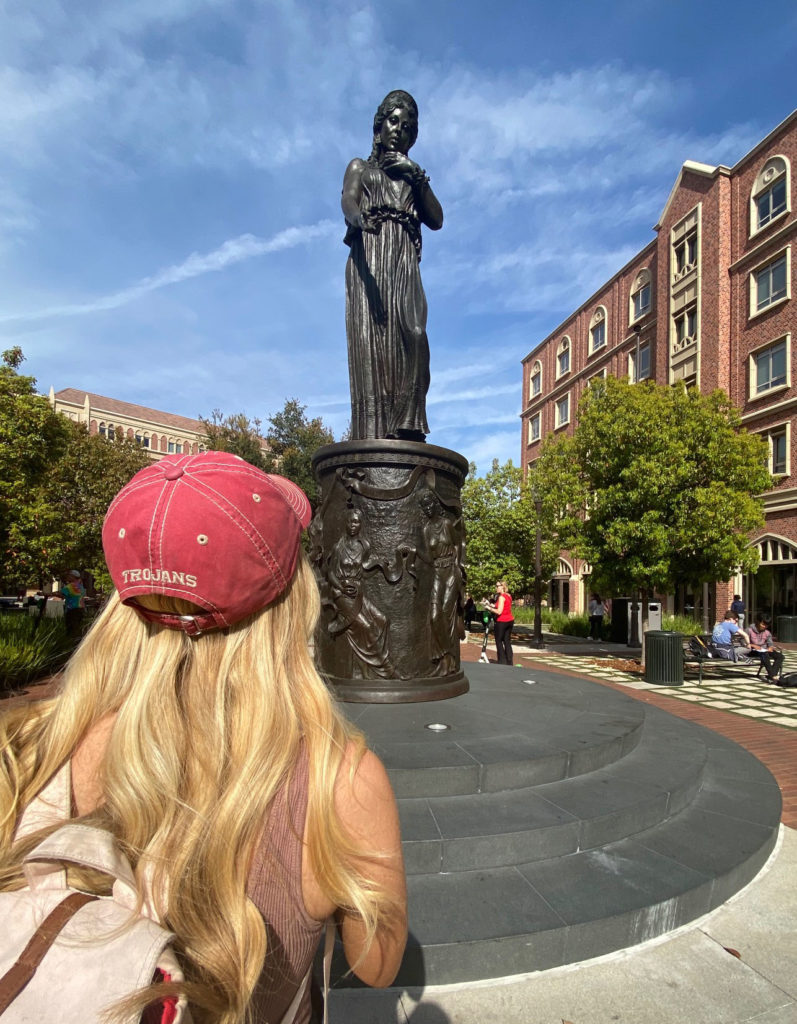
*Kaitlin, a 2020 graduate of USC who almost became homeless, gazes at a statue of Hecuba, Queen of Troy, at USC Village. Photos by Tabby Refael
“Even if my home life was really bad, I was always going to go to college; that was something I had always known since I was young,” she said.
At USC, Kaitlin qualified for need-based financial aid, but only a few weeks after starting college, her adoptive mother sent her a devastating letter telling her she had been disowned.
“They said that ‘I chose this life,’ meaning leaving Mississippi and coming to California, and they cancelled my health insurance and forced me to send back my modest cell phone,” she said. “Not having a phone like everyone else was really hard, and I badly needed any device with access to Wi-Fi, so I could at least know where my classes were on campus.”
Although USC covered her costs for housing during the first two academic years, Kaitlin soon faced the reality of summer housing. “I couldn’t stay in the dorms any longer, and while everyone else’s parents came to help them move their belongings out, I was alone. I didn’t even have a car, and I put everything I had into some bags, and a kind professor let me stay with her for a few days,” she recalled.
She spent the summer couch-surfing in a 200-square-foot “nasty room over-piled with trash” that belonged to another student, who was soon forced to move out and live in his car because he no longer could afford to pay for housing near USC.
At the start of her junior year, Kaitlin was deeply anxious because she had yet to secure a new job for the year. When her rent for an off-campus apartment was one month overdue, her landlord threatened to evict her.
A representative from a USC support program for former foster children (called Trojan Guardian Scholars) referred Kaitlin to the Jewish Free Loan Association (JFLA) to apply for an immediate loan. Kaitlin’s biggest concern was that she didn’t have a co signer.
With only $3 in her bank account, Kaitlin took a bus to the JFLA office in the Miracle Mile neighborhood. When she received a $1,300 interest-free loan, Kaitlin was overjoyed, but the stress of housing insecurity had begun to take its toll on her academic success.
“I started skipping school because making it to class was the least of my problems,” she said. “I needed to first protect my mental health; I was barely getting by and was living on $10–$15 a week, but I was very resourceful. I bought a few clothes from a local Goodwill, and if having access to a shower was ever an issue, I just didn’t shower.”
JFLA provided critical help in the form of preventative support so Kaitlin wouldn’t find herself homeless. Without a car, her worst fears would have come true.
The organization’s Homeless Student Loan Program was the brainchild of JFLA Executive Director Rachel Grose. Launched in January 2019, it’s the first loan of its kind that doesn’t require a co-signer, and it was exactly what Kaitlin needed to feel a semblance of housing security and continue to attend classes like everyone else.
“Getting through college is hard enough, much less if you are consumed with where you are going to sleep and if you will be safe at night,” Grose told the Journal.
Prevention is at the forefront of JFLA’s services for homeless college students. “The statistics are clear that once a person is on the street, it is much harder to get them back into housing,” said Grose.
In the past year, JFLA has distributed over $121,000 to 21 students, and the repayment rate has stood at an impressive 99%. Those interested in applying for help may email nikki@jfla.org.
Increased poverty as a result of the COVID-19 pandemic has made the work of JFLA more crucial than ever. “In general, we are making many loans for rent,” Grose said. “The homeless situation in general in L.A. is even more precarious now despite the rent moratorium. Our clients continually tell us they are afraid they will be evicted without a loan from JFLA.”
With fewer housing worries, Kaitlin was able to stay in class and in the summer of 2019, she found an internship in the field of banking. This May, she graduated with a bachelor’s degree in international relations and business, and she secured a full-time job at the banking firm where she interned. The job also offers health insurance.
“Senior year was more stable because I had somewhere secure to live,” Kaitlin said. “It was the greatest gift.”
August
Last February, before the COVID-19 pandemic forced UCLA and most other colleges to close in-person classes, August*, a 23-year-old who was enrolled in his fourth year of undergraduate studies, sat down at a long table inside Mt. Olive Lutheran Church in Santa Monica, home to the nation’s first homeless shelter for college students run by college students. He removed his headphones and proceeded, in a soft-spoken voice, to tell his story.
His parents are Somali refugees who escaped the country’s famine and deadly civil war in the mid-1990s, (the latter resulted in 500,000 deaths and over 1 million displaced people and continues today).
August and his eight siblings were born in San Diego, home to a Somali diaspora community of 10,000. Although his hard work and impressive grades earned him a place at UCLA immediately after high school, the emotional toll of his family’s financial burdens soon wreaked havoc upon his mental health.
“I couldn’t handle the financial pressures anymore because my family has nothing. And the wait to see a therapist at UCLA was too long,” he told the Journal. “On top of everything, I began to have arguments with my roommates on campus and didn’t feel safe anymore. I finally had an emotional breakdown and moved out, even though I didn’t have anywhere to go.”
For months, August couch-surfed with a slew of friends and even took time off from classes. In Spring 2019, August’s counselor at UCLA suggested he apply to Mt. Olive’s student shelter, called Students 4 Students (S4S). In January (before UCLA stopped in-person classes), August re-enrolled in classes, and in 2021, he’s set to graduate with a bachelor’s degree in linguistics.
One of the most striking aspects of August’s story was that his mother and father believed he still was living in on-campus housing.
“If my parents found out I sleep here, they would never allow it,” he said in February, “and because they can’t afford to help me live in Los Angeles, they would force me to move back down to San Diego.”
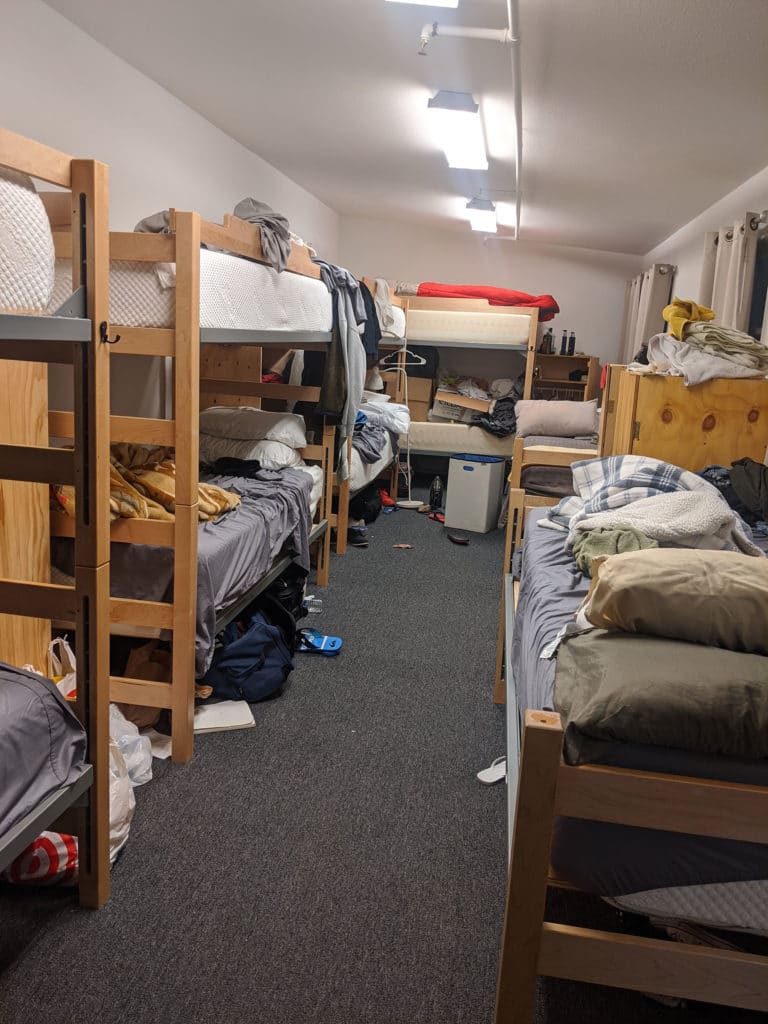
The bedroom at Students for Students shelter
This, in effect, was the painful crux of August’s dilemma: He desperately wanted to stay enrolled at UCLA, but if his parents found out he was homeless, he would have had to move back home and enroll at a community college.
When asked how he kept his struggles a secret from his parents, August solemnly admitted his mother and father had neither the time nor the means to visit him in Los Angeles.
“My parents work so much that they can’t even come here to see where I live,” he said.
For August, the best part of staying overnight at the shelter was “not having to be at the mercy of people who let me couch-surf, no matter how kind they are, and not having to wait outside their door to have them let me in.”
Before the pandemic, students spent the night there and left by 7 a.m. to accommodate a preschool program at Mt. Olive. The students were able to return to the shelter at 7 p.m. During closed hours, August attended classes and spent time on campus. On weekends, he saw friends or passed the hours at various campus libraries. He loved that a hot meal (dinner and breakfast) was always waiting for him at the shelter.
“I’m really glad I’m at the shelter,” he said in February. “They’ve gone above and beyond for me.”
When asked whether his seven siblings knew about his housing situation, August said they live all over the country — from Southern California to the Midwest — and he communicated with them via video telephoning outside the shelter, so they never suspected anything,
August and his older brother are the first in his family to graduate college. Back in February, he was trying to find a job earning some extra money in a restaurant, although, as a linguistics major, his dream is to work with language researchers.
“I never realized how good it would feel to know I’m about to complete something,” he said about finishing UCLA next year. “I guess at some point, maybe at graduation, I’ll have to tell my family about everything.”
The S4S shelter is closed due to the pandemic.
The Importance of Saying “Yes”
On a cold night in February, the parking lot of Mt. Olive Lutheran Church in Santa Monica was nearly full. Before the pandemic, a local chapter of Alcoholics Anonymous regularly rented space at the church. As the rain began gently falling over vehicles parked outside, nearly a dozen young people passed by a sign that read, “A church for the whole community,” before opening lock boxes to gain access to the building.
The residents of S4S homeless shelter had arrived for the evening.
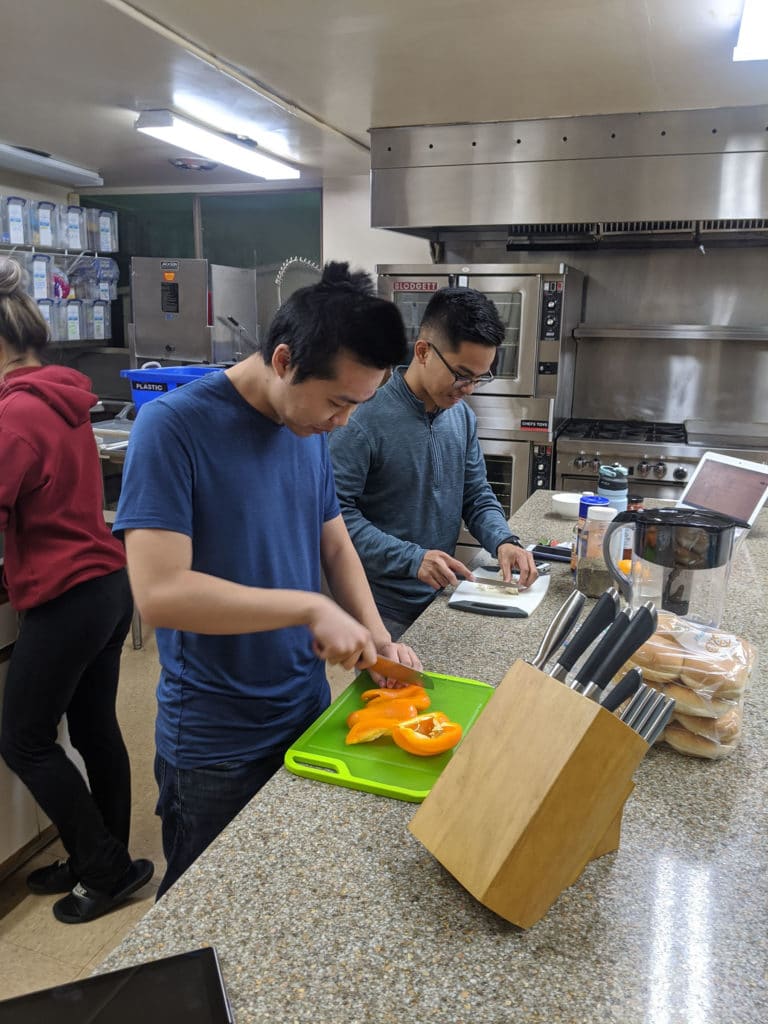
Some of them headed straight for the kitchen, where they helped volunteer student supervisors prepare dinner. On the menu that evening: Sloppy Joes, made with fresh ground beef and bell peppers. As one of the residents began chopping red onions with the skill and precision of someone who’s worked in a restaurant kitchen, he told everyone there’s a story behind his skill, but he wasn’t comfortable sharing it. Not yet.
Other students quickly filled “the study,” a room with a large table, black office chairs, a piano, and a four-way computer screen that showed images from security cameras outside. There were many evenings when residents stayed up all night to study for finals or write papers.
Upstairs, an innocuous room with five bunk beds accommodated ten people. Like a typical college dorm room, blankets, backpacks and clothes were strewn around the beds.
Whether a large dormitory building or a rowdy fraternity house, we often think of collegiate housing as anything but a homeless shelter. But in 2015, UCLA graduate student Louis Tse had a vision for the nation’s first homeless shelter for college students.
At that time, Tse was living in his car to save money. On his backseat windows hung family photos, and he ate non-perishable food he kept in a duffle bag.
“Many students persist despite the odds, yet there are many who do not — the margin for error is razor-thin,” Tse told the Journal. “It’s much harder to focus in class when you don’t have enough food to eat; it’s much harder to do homework without a home.”
“It’s much harder to do homework without a home.” — Students 4 Students founder Louis Tse
He quickly recruited his good friend, Luke Shaw, and the two spent many nights and weekends developing the idea. Tse then visited 50 local houses of worship with the idea of using their facilities overnight for a student shelter. They all declined.
That was the case until Darci Niva, Director of the Westside Coalition for Homelessness, Health, and Hunger, introduced Louis to Reverend Eric Shafer, the senior pastor at Mt. Olive.
“The shelter was/is Louis’s dream,” Shafer told the Journal. “Without his vision, there would be no shelter. We were the 51st house of worship he turned to, and we said ‘yes.’”
When asked why Mt. Olive’s leaders and congregation of 250 people agreed to open the space to homeless students, Shafer responded, “Why not? We had the facilities, so why wouldn’t we do it?”
The result was a homeless shelter, operated by an organization Tse and Shaw founded called S4S. According to its website, S4S “meets the basic needs of homeless college students from all area schools, while connecting them with resources to finalize post-shelter housing plans and a path to graduation.”
S4S, formerly known as Bruin Shelter, had been used by students enrolled at schools such as UCLA, Santa Monica College (SMC), and Loyola Marymount University (LMU). One advantage of the shelter is that it’s located directly along a bus route to UCLA and is within walking distance of SMC.
When open, the shelter provides ten beds, hot meals, access to a shower and a washer/dryer, and three volunteer supervisors, known as “RAs,” or Resident Assistants, on-site at all times, known as “RAs,” a term commonly used to refer to a “Resident Assistant” in a campus dormitory. The RAs are all UCLA students, and incredibly, there are 90 of them who rotate schedules to sleep overnight at the shelter. Each year, S4S volunteers raise $20,000 to provide hot meals for residents.
Student resident advisors helping prepare dinner in the kitchen at Mt. Olive Lutheran Church
When Mt. Olive ran into difficulties with the City of Santa Monica due to a need for major renovations and a zoning change, its “angel,” according to Shafer, was Michael Folonis, a local architect. The shelter also received help from the Santa Monica City Council, the Office of Los Angeles County Supervisor Sheila Kuehl, and even The Church of Jesus Christ of Latter-Day Saints, also known as the Mormon Church.
“Our church leaders as well as our neighbors have been amazing, and the shelter actually makes the neighborhood safer, because it’s one of the few buildings here that’s never left unattended overnight,” Shafer said.
Shafer acknowledges the concerns other houses of worship have about giving homeless students access to their facilities, but makes an important argument: Although it’s understandably difficult for most of us to reach out to the homeless on the street — particularly those with mental health or addiction problems — there’s a soft start in reaching out to college students, most of whom simply fell on hard times and lack a basic safety net of parental help. Many of those students, Shafer noted, are “LGBTQ youth who were kicked out of their homes, as well as children of single parents, foreign students who have run out of funds, undocumented students, etc.”
“Why are homeless college students invisible?” Shafer asked. “Because they don’t look like the homeless population we’re used to seeing; they couch-surf and take showers at the school gym.”
“Why are homeless college students invisible? Because they don’t look like the homeless population we’re used to seeing; they couch-surf and take showers at the school gym.” —Reverend Eric Shafer
Shafer has a message to other faith communities about “the importance of saying ‘yes.’” He challenges leaders nationwide to ask themselves, “What does it mean to be a community of faith in the twenty-first century?”
For its part, Mt. Olive was once the largest Lutheran church west of the Mississippi River, but as with many houses of worship, its size and impact dwindled over time. “The shelter and the community involvement have been the resurgence of this place,” Shafer said.
Shafer’s passion and vision have many roots, including growing up in Reading, Pennsylvania, and watching his schoolteacher parents deal with their students through patience and compassion. He is also inspired by biblical verses, most notably Matthew 25:40, which states, “And the King will answer them, ‘Truly I tell you, whatever you did for one of the least of these brothers and sisters of mine, you did for me.’”
Tse, who once slept in his car and parked anywhere he could find Wi-Fi to complete his coursework, is now a thermal engineer at NASA’s Jet Propulsion Laboratory (JPL) in Pasadena. Shaw, his S4S co-founder, also works at JPL, as a mechanical engineer.
When UCLA closed in-person classes in March, the residents of S4S still remained at the shelter. They left in June, as residents do each year, because the shelter isn’t open during the summer (due to the unavailability of RAs).
“In March, all the UCLA students were told they had to attend classes from home. Well, for our residents, this was their home,” Shafer said. RAs worked hard to get all of the residents into alternative housing after June. Although they are unable to work directly at the shelter, the leaders of S4S at UCLA continueto advocate for homeless students on the state and national level. They’re also working with students who send them online inquiries, helping them find alternative food and housing. The student group is currently led by its president, senior Michelle Lu.
Shafer hopes the shelter will re-open in January 2021, but has received no confirmation.
Reverend Eric Shafer
Before the pandemic, a shelter came to life when two students at UCLA’s crosstown rival USC, Esther Cha and Abigail Leung, co-founded Koreatown’s Trojan Shelter. Like their colleagues at UCLA, Cha and Leung were aided by a passionate student board, and the shelter is operated by its umbrella organization, S4S. Trojan Shelter is currently led by student co-presidents Hannah Mulroe and Cathy Wang.
Trojan Shelter opened in November 2019 in St. Mary’s Episcopal Church. As with the shelter at Mt. Olive Lutheran Church, Trojan Shelter had a team of undergraduate volunteers from USC, three of whom were tasked with overnight supervision every evening. Many of the residents at Trojan Shelter were enrolled at nearby trade and technical colleges.
Although the S4S shelter at UCLA remains closed, Trojan Shelter is open, with three residents and one paid RA — a smaller number than usual due to COVID-19 safety concerns. “They’re in a house and can isolate the facility much better,” said Mt. Olive’s Shafer, now a sponsor of both the S4S and Trojan shelters .
Once the shelter near UCLA reopens, its regular housing requirements will be in effect, which means that student residents at both shelters must be between the ages of 18-24 and enrolled full-time at a local college or university. The shelter has a strict policy against alcohol, smoking, drugs and guns, and RAs are trained to deal with various emergencies. Residents stay for one semester or the whole year, and word-of-mouth is key in letting local students know that the shelter exists (applications are online at www.s4sla.org).
“We, as a society, should intervene so our students can use their smarts on their books, not on finding a safe place to sleep every night,” said S4S’ Tse. “There is immense human talent we are leaving on the table. You might be helping a future MacArthur ‘genius grant’ award winner, someone who’s majoring in the same field you studied, or someone who might save a life, maybe even yours or mine.”
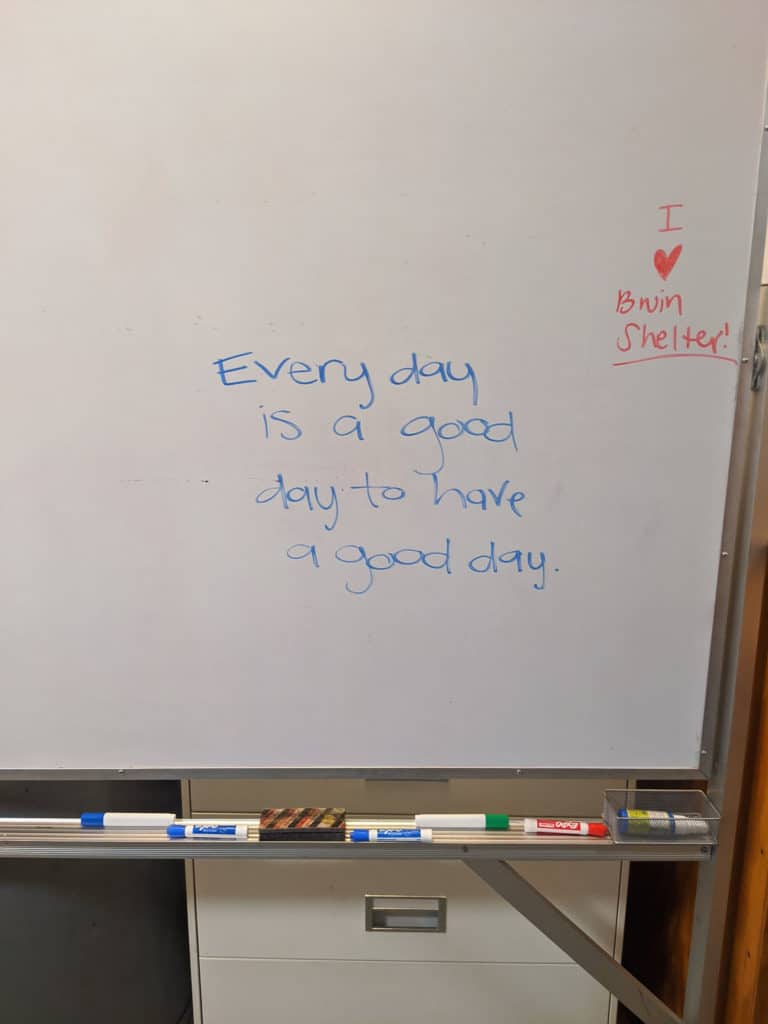
A whiteboard with a hopeful message at Students for Students shelter
“The Most Pernicious Crisis in Our Midst”
“Let’s call it what it is, a disgrace,” California Governor Gavin Newsom said about the state’s homelessness crisis during his second State of the State on February 19, 2020. In a telling deviation from custom, Newsom’s speech focused almost exclusively on the state’s housing crisis.
The term “crisis” is a devastatingly apt term for homelessness in California. In 2019, homelessness in Los Angeles increased 12% from the prior year (with a 17% and 19% increase in San Francisco and Sacramento, respectively). With the state’s homelessness population ballooning up to 151,000, Newsom’s state budget is set to direct more than $1 billion toward the crisis.
“No amount of progress can camouflage the most pernicious crisis in our midst,” Newsom said, “the ultimate manifestation of poverty: homelessness.”
In 2019, Newsom proposed adding $10 million to the $30 million he sought in his January budget of the same year to help homeless college students, although he stopped short of expanding the Cal Grant program, which would cover all costs for food and rent for students in need.
“This hunger, homeless and housing crisis is real at UCs, community colleges and CSUs,” he stated in his address.
That reality was depicted in a 2018 documentary short made by UC Berkeley student Robbie Li, titled “Invisible Students: Homelessness at UC Berkeley,” which followed two Berkeley undergraduates, Leo and Tavi, as they struggled to attend classes while being homeless.
“There is immense power in storytelling,” Li told the Journal. “Change is gradual and incremental, so we need good storytelling to keep laser-focused on the issue. I think the documentary was a good attempt at telling authentic stories about student struggles, and I hope there [is] more organic storytelling, which would emerge and shed light on student experiences.”
Gimme Shelter
“This is a disturbing reality, and one from which any leader—or individual—of conscience cannot turn their face away,” Dr. Kathryn Jeffery, President of SMC, said in an interview with the Journal in regards to the nearly 20 percent of California community college students who reported being homeless. “Finding ways to meaningfully address these issues is a topic of discussion at every conference I have recently attended,” Jeffrey claimed in March.
SMC works with community organizations, such as Safe Place for Youth (SPY), St. Josephs Center, Los Angeles Homeless Services Authority (LAHSA) and S4S, and also matches homeless students with case managers to ensure they can access housing. But its most inspiring success is in the realm of combating food insecurity among college students. In February, SMC announced a partnership with the social enterprise Everytable to open the first SmartFridge Lounge on a college campus (located at the SMC Center for Media and Design).
Back in early March, Jeffrey described the Lounge: “In lieu of paying rent, Everytable would donate 300-500 affordable, delicious and healthy meals per week to SMC’s new centralized food pantry. It will have refrigeration for these meals as well as all the fresh produce previously made available through a weekly free farmers market. Students who are food insecure can come pick this food up for free!”
Unfortunately, the Lounge was shut down due to the pandemic. “As a result, the College and the SMC Foundation quickly pivoted and implemented a free meal delivery program, called the Meal Project, which sends seven fresh, healthy Everytable meals to hundreds of students each week,” Jeffrey said. “To date, we have delivered over 120,000 meals to 17,000 students. Everytable continues to be a vibrant, critical partner in our fight to end food insecurity for all students.”
At SMC, the pandemic has had a tremendous impact on the college’s efforts to combat student food insecurity. “SMC’s ten food closets located throughout the campus, the new centralized food pantry that was just days shy of a launch, the free Corsair farmer’s market and a food voucher program funded by Associated Students were just some of the on-ground resources no longer accessible to students as a result of COVID-19,” Jeffrey said.
But the college pursued new initiatives to ensure students’ access to food: a drive-through pop-up food stand (spearheaded by the SMC Foundation); the weekly meal delivery program; and access to a social worker who can help students apply for CalFresh assistance (formerly known as California’s Food Stamp program) remotely. “These food resources are essential to ensure students can be successful in the virtual academic environment,” Jeffrey said.
According to a spring 2020 survey by the Hope Center, 44% of two-year college students, such as those who attend SMC or other community colleges, are struggling with food insecurity. In addition to hunger, hygiene is a growing struggle for many college students who are housing insecure. In September 2016, then-Governor Jerry Brown signed Assembly Bill (AB) 1995 into law, which ensured homeless students access to on-campus showers at community colleges.
More information about SMC’s food security programs may be found on this website.
Safe Parking Here
Kaitlin, the USC student who was almost forced to live on the street, stressed that homeless college students are often invisible. In her case, neither her classmates nor her on-campus co-workers knew she had nowhere to live.
“I looked like the typical USC girl, but I was very poor,” she said. “And when you’re actually attending classes alongside someone every day, everyone just assumes you go back ‘home’ at the end of the day.”
“I look like the typical USC girl, but I’m very poor. And when you’re actually attending classes alongside someone every day, everyone just assumes you go back ‘home’ at the end of the day.” — Kaitlin
Even before the pandemic, college students could often find themselves laid off from a job or suddenly without access to parental assistance. A $200 monthly increase in rent could be enough to force a student who is already living month-to-month out of an apartment and into his or her vehicle (if he or she owns one).
In fact, more than one-third of Los Angeles County’s unsheltered homeless population is forced to live in their cars, and before the pandemic, when overnight parking was restricted in many areas, they often received citations. Without funds to pay outstanding citations, these individuals often lost their cars and were forced onto the street.
Valley Beth Shalom Rabbi Noah Farkas currently serves as a commissioner (and former chairperson) for LAHSA, which oversees safe parking strategies for the City and County of Los Angeles. With over 20 sites, LAHSA helps with everything from financial assistance to connecting participants to case managers. It also provides grants to help prevent homelessness.
LAHSA’s former chair, Sarah Dusseault, knows firsthand that no one is immune to the homelessness crisis. In a poignant 2014 op-ed in the Los Angeles Times, Dusseault — who previously served as policy adviser to Eric Garcetti during his term as city councilmember and as deputy mayor for housing and homelessness for Mayor James Hahn’s administration —shared her brother John’s struggles with mental illness and homelessness. In the op-ed, titled “Have You Seen My Brother Standing in the Shadows?” Dusseault estimates nearly $1 million has been spent by community and government efforts to help her brother.
“And all of us — taxpayers, my family and John — are getting nothing for that money. The government could have bought him a cute single-family home in Pasadena with a full-time social worker and spent less,” she wrote.
“Last year, we saw a 24% increase in youth experiencing homelessness,” Dusseault told the Journal. “We have to do more to support kids finishing school and achieving educational success by providing more affordable housing options for students and, at a minimum, a roof over their head. We are expanding shelter options for youth and some great universities and community colleges are doing the same to meet this urgent need.”
Another program that aims to help the 15,700 Angelenos who sleep in their vehicles every night is called Safe Parking LA (SPaLA). Founded in 2016, it operates nine lots between 8:30 p.m. to 6:30 a.m. (Its first “safe parking” lot opened in 2018 in Koreatown). SPaLA also refers participants to health and social services.
In January, UCLA rejected a local neighborhood council proposal to create on-campus parking for homeless students. “We do not think sleeping in cars is safe,” Administrative Vice President Michael Beck said during the council meeting. “It’s not sanitary. It’s something that the University of California, in general, doesn’t support.”
“That is what it means to be a Jew”
“Eliminating homelessness is a Jewish mandate,” JFLA Board President Jordan Lurie said during a February 8 benefit called “Facing Homelessness” at the Luxe Hotel. The event honored Dusseault and philanthropist Bruce Whizin.
“Eliminating homelessness is a Jewish mandate.” — JFLA President Jordan Lurie
“The Talmud notes that the Biblical injunction to provide ‘everything that a needy person requires’ specifically includes housing,” Lurie told the Journal. “The Prophet Isaiah emphasized this point when he instructed: ‘Provide the poor with shelter.’ For all those who are homeless, it is our obligation to provide a home. JFLA takes this directive seriously.”
Across the country, Jewish leaders are issuing a call to action, which, at its core, leaves little room for ambiguity: To live a Jewish life is to dynamically embrace responsibility.
“Judaism is very clear about our communal responsibility to take care of the poor,” said Farkas. “There is a section of Talmud (Baba Batra 9a) that has the Roman General ask Rabbi Akiva, ‘If God loves the poor, why does God not support them?’ Rabbi Akiva said, ‘It is through the poor that we become righteous.’ That is, it is through our agency to take care of the poor that we act godly. At its heart, Judaism is a religion that expresses love through expectation.”
A Roman General asked Rabbi Akiva, “If God loves the poor, why does God not support them?” Rabbi Akiva said, “It is through the poor that we become righteous.”
Because Los Angeles has the third-highest rent burden in the nation (behind Miami and San Diego, according to a 2019 report by the Federal Home Loan Mortgage Corporation), millions of Angelenos across ethnic, religious, and political divides particularly feel the sting.
“Affordability — especially when it comes to housing — is getting harder and harder to reach in Los Angeles,” District Four Councilmember David Ryu told the Journal. “Students are facing this crisis particularly hard, with the cost of education so high and a bright future feeling so out of reach. One thing that I have learned from the Jewish community as I’ve focused on these issues and served the city the past five years is that when we start from a spirit of service and giving back, we can make real progress.”
Adeena Bleich, Ryu’s deputy chief of staff, is a member of JFLA’s board of directors, who co-chaired the benefit dinner to fight homelessness.
“I remember my mother, z”l, always used to say, ‘We may not have a lot of money, but we have a home. And if for some reason you ever have financial problems, I may not be able to write you a check to pay your rent, but you will always have a home here with your father and me.’ Unfortunately, so many young people don’t have parents who can help them. These students often live in their cars or are couch surfing and putting all of their funds towards school and food,” said Bleich.
In addition to housing, access to food is also critical for college students facing homelessness. Swipe Out Hunger is a local non-profit that distributes meal credits to students facing food insecurity so they may access warm meals in dining halls along with other students. In the past five years, the organization has served close to 2 million meals and sent $20 million to campuses through legislation that supports anti-hunger programs in California.
In response to the COVID-19 crisis, Swipe Out Hunger has launched several initiatives, including a Student Navigator Network that offers one-on-one online student referral services, and a #fairCARES student advocacy campaign which, according to its website, is aimed at “urging students to ask their institutions to disburse the Coronavirus Aid, Relief, and Economic Security (CARES) Act funding in a fair, equitable, and transparent manner.”
“Someone asked me if I do this work because of my Jewish values,” Swipe Out Hunger’s CEO and co-Founder Rachel Sumekh told the Journal. “It took me a second, but the answer is absolutely ‘yes.’ What’s more Jewish than giving someone a warm meal that’s going to help them focus on school?”
“What’s more Jewish than giving someone a warm meal that’s going to help them focus on school?” —Rachel Sumekh, CEO and Co-Founder of Swipes for Hunger
Farkas ties the Jewish response to homelessness to a sense of community responsibility. “When you are loved, especially by God, that love comes with an expectation to act in a certain way,” he said. “We express our best selves by living up to the highest expectations of what it means to be a human. We take care of each other. We are a voice to the voiceless. We were liberated so that we can become liberators. That is what it means to be a Jew.”
“We were liberated so that we can become liberators. That is what it means to be a Jew.” — Rabbi Noah Farkas, Valley Beth Shalom
The community has met this challenge through leadership and philanthropy. In 2019, the Jewish Community Foundation of Los Angeles awarded a Cutting Edge Grant of $300,000 to a program called Jewish Community Safe Lots, which aims to provide homeless populations living in their vehicles with a safe place to park and access to helpful resources. That same year, IKAR, a Los Angeles congregation, became the first Jewish space to participate in the Safe Parking LA program and raised over $10,000 to give parking guests access showers through a monthly membership at a local 24-hour health club.
As part of its 2019 General Community Grants, the Foundation also awarded a record-high $600,000 to three organizations that help provide housing to the homeless. That figure was evenly distributed among three recipients: Brilliant Corners (a motel conversion project), LA Family Housing (shared family interim housing) and The People Concern (scalable permanent supportive housing). In total, the Foundation has donated nearly $1 million in grants to combat homelessness.
“The homelessness epidemic in Los Angeles requires every possible resource devoted to reducing the number of people sleeping without roofs over their heads,” Lori Klein, vice president at the Center for Designed Philanthropy at the Jewish Community Foundation, told the Journal. “This is a pressing social issue that impacts us all. We hope that our action encourages other funders and local leaders to step forward, work together and find comprehensive ways to address this crisis.”
In July 2019, Cedars-Sinai Medical Center announced it would donate $500,000 to JFLA over five years to create the Cedars-Sinai Housing Stability Loan Fund, with the aim to provide those on the brink of homelessness with immediate housing assistance.
The Graduate
Kaitlin is thinking about decorating options for an apartment she hopes to find in Palms — her first choice in a multitude of neighborhood options in the city that now feels accessible to her. She’s excited about buying a new wardrobe for her full-time job at a banking firm. And she’s exploring a once seemingly impossible option to travel somewhere, anywhere.
But these milestones come with a sense of unease, since this is the first time in Kaitlin’s life that she doesn’t feel financially insecure.
“My whole life, I’ve been struggling, and I’ve been so stressed out. And now that those pressures have been taken away, I wonder who I really am, if I’m finally out of survival mode,” she said.
She recently found and reread the letter from her adoptive mother stating she had been disowned. But this time, she knows she can take care of herself, even if she graduated with $30,000 in student loan debt.
“I’ve never been in a place like this in my life — a good place. The pain of that letter truly feels like such a long time ago,” she reflected.
But Kaitlin admits to one, deep yearning: To feel the love of a family. And although she’s grateful to complete college, when I spoke to her last spring, the topic of her graduation ceremony in May brought her to tears.
“Graduation is a sore spot for me,” she said in February, before USC announced a virtual commencement due to COVID-19. “I don’t want to go to graduation if I’m going to be alone. I know I’ll see how much love and praise my friends’ parents will give them at the ceremony, and that’ll be so painful.”
The person whom she would have most loved to have seen most at her graduation? Her birth mother. But Kaitlin’s longing is mired in the tragedy of the unknown and a humanitarian crisis that seems to leave virtually no one immune.
“I wish my mom could come to graduation, but I think she may have passed away,” she said with a gentle sob. “I haven’t heard from her in years, since she became homeless.”
*Names indicated by an asterisk have been changed to protect privacy.
Tabby Refael is a Los Angeles-based writer, speaker and activist.
So much seems to have crashed in 2020. Our lives have been turned upside down by the pandemic. We’ve rarely seen so much pain and devastation around us, with lost lives and livelihoods, not to mention rampant isolation and loneliness.
We were especially unprepared for all this bad news, because we’ve been conditioned by a modern-day epidemic of optimism. We can succeed, if only we work hard enough. We can awaken the giant within. We can take control of our life and live it to its fullest. We can repair the world. We can find meaning in everything we do — and so on.
Advertising and the self-help industry, with their utopian promises, have been driving this optimism inflation for years. They’ve made many of us believe that the “ideal life” was not just attainable but to be expected. The implication was that if we couldn’t reach that ideal, well, maybe we did something wrong or bought the wrong stuff.
This is, needless to say, a recipe for high anxiety. When expectations are so high, we’re bound to disappoint ourselves, to feel envious of others, to feel like we’re always falling short.
When expectations are so high, we’re bound to disappoint ourselves, to feel envious of others, to feel like we’re always falling short.
There is a whole school of thought around the value of healthy pessimism. In a 2014 article in The Atlantic, “The Upside of Pessimism,” Olga Khazan writes that “imagining—and planning for—worst-case scenarios can be more effective than trying to think positively.”
She interviews Julie Norem, a psychology professor at Wellesley College, and author of “The Positive Power of Negative Thinking.”
As Norem says: “When people are being defensively pessimistic, they set low expectations, but then they take the next step which is to think through in concrete and vivid ways what exactly might go wrong. What we’ve seen in the research is if they do this in a specific, vivid way, it helps them plan to avoid the disaster. They end up performing better than if they didn’t use the strategy. It helps them direct their anxiety toward productive activity.”
The problem is that if one doesn’t think of “negative possibilities in very specific terms,” it’s easy to “spiral out of control.” It’s what clinicians call “catastrophizing,” where the negative thoughts are generalized: This talk is going to be a disaster. My whole life is a mess. I’m going to lose my job and my partner’s going to leave me.
“Specificity,” Norem asserts, “is key to having positive effects as opposed to negative effects.”
None of this means that the power of positive thinking isn’t real.
“You have to find ways of working in the world that fits for you,” she says. “If thinking positively leads you to productive action, that’s great. But it doesn’t for everyone. For people who use defensive pessimism, it’s hard for them to force themselves to think positively, and it doesn’t address the real issue of their anxiety.”
One of the popular mantras of the business world is Murphy’s Law: “Whatever can go wrong, will.” I once knew someone whose own mantra was, “Murphy was an optimist.”
It certainly feels like we’ve had plenty of Murphy’s Law in 2020. The COVID-19 pandemic—an event unlike any of us have ever experienced—has crashed expectations. We’re left humbled and sober.
Perhaps one of the great lessons of 2020 is that we need healthy doses of both optimism and pessimism.
As we approach the post-COVID world, perhaps one of the great lessons of 2020 is that we need healthy doses of both optimism and pessimism. It’s easy to settle for the middle position—realism– but I like the dynamism of opposites. Healthy pessimism can help us better prepare for all the stuff that can (and will) go wrong; while healthy optimism can motivate us to wake up every morning and try to make that stuff go right.
This October, Gal Gadot, the Israeli actress best known for playing Wonder Woman, announced that she would star in a movie about Cleopatra. In response, the actress was widely lambasted for appropriating a role that some thought should be played by a woman of color. Gadot’s critics insisted that an Israeli Jew of Ashkenazic background — even one who can stop bullets with her bracelet — does not qualify.
“Shame on you, Gal Gadot,” one critic tweeted, “Your country steals Arab land & you’re stealing their movie roles.” Those who mistakenly believe that Cleopatra was a person of color accused Gadot of denying “important roles to women of color” in “another attempt to whitewash a historical figure.”
But the Macedonian Greek monarch was not the only person who was whitewashed. Long before the Cleopatra kerfuffle, debate raged as to whether people like Gadot, as a Jewish woman, should be considered white.
Over the years, research has shown that Jews have been viewed as white, not-white, off-white, newly white, continually negotiating whiteness or constantly shifting position on a scale of whiteness. Jews have been perceived as Black or Asian, depending on the nature of the perceiver’s prejudice. Indeed, Jewish skin has tended to reflect whatever hues are most disliked.
To make a complicated situation worse, philosopher Kwame Anthony Appiah weighed in on the topic. Appiah, whose New York Times column is self-styled (unironically) “The Ethicist,” addressed a reader whose question was summarized as, “I’m Jewish and Don’t Identify as White. Why Must I Check That Box?” Appiah acknowledged that some Jews might prefer not to self-describe as white, either because of anti-Semitism or to avoid racial dichotomies. Nevertheless, Appiah insisted that Jews must stay within the “white” box.
“Alas,” he wrote, “it is not up to us as individuals to determine the meaning of our racial terms.” Jews must identify as white. “Being white is not just a matter of identifying as white; it involves being treated as white, and that isn’t up to you.”
Appiah concluded that Jews have only one choice. They may “speak up in all-white settings when people venture anti-Black remarks.” Jews are, in other words, trapped in others’ perception of their skin with no escape except to fight anti-Black racism. “In the struggle against racism,” Appiah concluded, “it sometimes helps if you don’t have skin in the game.”
For those who doubt whether Jews have “skin” in the racism “game” (in other words, those who lack rudimentary knowledge of world history), the Gray Lady went further. In the pages of that same newspaper, Professor Natalie Hopkinson wrote a glowing article about Louis Farrakhan. When pushed about why she did not mention Farrakhan’s long record of anti-Semitism, Hopkinson tweeted, “somehow among a million possible concerns, you believe yours are supposed to jump to the top. That is called privilege.”
These comments all come as anti-Semitism continues to soar globally and in the United States. The Anti-Defamation League recorded more anti-Semitic incidents in 2019 than any year since it began tracking them in 1979. And the American Jewish Committee released a survey reporting that 43 percent (nearly half) of American Jews feel less secure.
On college campuses, this scenario plays out repeatedly. At the University of Illinois at Urbana-Champaign, the student government recently passed a resolution that combines support for the anti-racist Black Lives Matter movement with endorsement of the anti-Semitic Boycott, Divestment and Sanctions campaign. As a statement read by Jewish students during debate so aptly described, Jewish students were given the “impossible choice between renouncing Zionism or selecting a position inconsistent with our support for human rights and the quest for equity.” In other words, students were asked to give up the skin they have in the game, stay in the box they were assigned, and condemn both anti-Black racism and their own Jewish identity.
What does it mean to be stripped of our skin? The most horrifying scenes in the work of Haruki Murakami may be those in “The Wind-Up Bird Chronicle,” where prisoners are skinned alive. The novel’s main character imagines himself stripped of skin, left as nothing but a “bright-red lump of flesh.”
What does it mean to be stripped of our skin?
In Oskar Panizza’s nineteenth-century novella, “The Operated Jew,” the main character sought to escape his Jewishness through plastic surgery. The doctor excised his stereotypically Jewish features, including wheat-colored skin, his hooked nose and a Jewfro. This skinning and fixing was intended to make the Jew more white. Freed of his Jewishness, bleached a “Caucasian color of skin,” the character wedded a blonde gentile. Unfortunately, the groom’s old Jewish features unavoidably resurfaced. He then crumpled into his quivering old “Asiatic” flesh, his Jewish self unable to fully assimilate.
In the United States, some have sought to escape discrimination through assimilation. Others have doubled down on their ethnic identities. Both have faced resistance from those who insist that they fit themselves into one box or another. The fact is, there is no right answer other than what one chooses for oneself.
To be clear, Jews should speak out against anti-Black racism. African Americans should likewise condemn anti-Semitism. Many have. But no one should be asked to step out of their own skin to do so, or be told they have no skin in the game, or be urged to undermine their own community in order to support another. We support one another best when speaking from our own experience, not as whitewashed lumps of operated flesh. Wonder Woman, above all, should be whomever she wants to be.
Kenneth L. Marcus is Chairman of The Louis D. Brandeis Center for Human Rights Under Law, which is supporting Jewish students at the University of Illinois. He served as Assistant U.S. Secretary of Education for Civil Rights (2018-2020).
During this year’s Rosh Hashanah service, just as I read about Abraham leading an unsuspecting Isaac up Mount Moriah, intent on sacrificing him, the Lev Shalem machzor downloaded onto my phone cut out. I was momentarily spared the trigger of a father taking his own son’s life, a reminder of a painful relationship with my own father. Restarting my phone didn’t help. My ancient tablet took forever to load. I had no choice but to go analog and reached for the Adler High Holiday prayer book my parents used.
It was bittersweet holding what they davened from, there in the flicker of their yahrzeit candles. The book’s cloth covers were as black as my bar mitzvah suit and the boxy Hebrew typography on its glossy pages as prim as the sitcoms of that period. Paging through this relic was at least as uncomfortable as confronting one’s bad hair in a high school yearbook. Worse, it beamed me right back to the suffocating Old Boy Judaism of my Conservative synagogue in the Bronx in the mid-1960s.
Adler’s consistently masculine pronouns gave God a distinctly male voice that the men of our shul — rabbi, cantor, sexton and their counterparts in the junior congregation — no doubt felt addressed them personally. This masculine language also reinforced my impression of Judaism as a men’s club, right down to the suits checking High Holiday tickets at the door or the boys reciting Torah blessings in their unsure, post-bar mitzvah voices. The women of our shul worked in the office and sang in the Sisterhood musicals; none shared the bimah with me during my bar mitzvah. The minyan, drawn exclusively from this men’s club, was trusted to open the ark and carry its Torah. Along similar lines, the locker room wisecracks made by my father and uncles at the first bris I attended gave Judaism the feel of a fraternity that would hardly welcome a faygele like me.
The Adler’s literary translations, worthy of a Norton Critical Edition, reproduced the meter and structure of the original Hebrew as faithfully as period instruments recreate early music. Its archaic King James Version vibe, complete with walkeths and goeths (this in 1959) betrayed its eighteenth-century English origins, appropriate for a sovereign claiming divine right. It stripped any Thou from the I and Thou and rendered God an unapproachable divine monarch, which more or less sums up the approach of my shul’s cheder classes. No wonder I learned to picture God as the proverbial old man with a white, flowing beard — not unlike that Al Hirschfeld drawing of Bernard Shaw on the cover of my mother’s recording of My Fair Lady — and a New York Yankees baseball cap. (We lived near the stadium.)
My ten year-old mind saw such hypermasculine Judaism spilling over into the equally gendered realm of sports. Both worlds emphasized feats of skill, tribal loyalty and shaming. Both made me anxious; I feared mixing up the meat and dairy silverware or flubbing a left-field catch in equal measure. God and softball tested and demanded; shirkers were exposed and lackluster performance punished. Still, if one could go home after nine innings of softball, God-as-umpire, scorekeeper and team-chooser never quit the diamond of the Jews. My pitifully unathletic self saw God’s stern hand in all those who made sure guys would “man up”: my gym teacher, father, grandfather and camp counselor. If God was nigh, as we sang around Boy Scout campfires, he was ready to call balls and strikes and banish those who couldn’t hit a softball if their lives depended on it.
Judaism’s male focus is particularly apparent in Adler’s rendering of High Holiday Torah texts. Abraham not only attempts to kill one son but is ready to off a second by banishing him and his mother. Slacker Jonah’s self-absorbed misanthropy endangers the lives of others. Yet I was taught to admire Abraham’s steadfastness and show no compassion for Jonah’s spiritual crisis. I was supposed to take Abraham’s potential violence in stride, even when it reminded me of bullying classmates, and I was to condemn Jonah’s fecklessness and his flight, even if the closeted person I was at the time recognized the need to keep secrets by keeping one’s distance. Abraham forgoes parental love, while God’s tone-deaf reaction to Jonah’s spiritual impasse compares with police arresting a disturbed person instead of helping them. These stories identify blind obedience and a very masculine abhorrence of weakness as essential Jewish values demanded by an alpha-male God.
I was taught to admire Abraham’s steadfastness and show no compassion for Jonah’s spiritual crisis.
The Lev Shalem machzor, by contrast, realizes there’s a problem with this depiction. A marginal note suggests that Abraham should have protested God’s orders. A later gloss reads Jonah’s story as a searing inner conflict rather than mere weakness in Jonah’s disobedience. Both interpretations favor understanding over judgement; they make allowances for human complexity. Adler, however, delivers these texts straight out of the box with nary a comment. Its flowery Jacobean renderings tacitly advocate submission over reflection. They ignore the cost of what these men do to themselves as well as others, condoning zero-sum, toxic masculinity.
I was glad when Lev Shalem’s gender-diverse service lit up on my phone again. The tally of three patriarchs heralding the Amidah is rounded out with the four matriarchs. Blessings appear in variant forms, not only pronoun-wise but offering gender- and theologically-neutral renderings of God’s name. Such Judaism feels less feminized than normalized, reflecting a world I want to live in. Yet traces of musty black-and-white Adler lurked in the “traditional” translations paired with contemporary versions, which prompted me to wonder when tradition becomes oppressive. When is it time, for example, to take down Confederate statues? The stories recounted during the High Holidays are part of who we are, yes, but that needn’t preclude some retooling.
And then there’s Avinu Malkeinu, the magisterial prayer for forgiveness that rarely leaves me dry-eyed. Still, the repetitions of father and king marching down the pages of both the Adler and Lev Shalem can be daunting. Lev, however, leaves these words untranslated, somehow diluting their masculine authority just enough — for English readers, at least — for them to become figures of comfort rather than power. This year, each iteration of these words clapped against my heart, releasing a tear of forgiveness for my own father.
Adler’s issues center less around text or translation but around God, an idea both fluid and amorphous, an expression of universal good and human striving that is ultimately too infinite to be contained between the covers of any book. Yet the idea has been commandeered by those who might be politely termed spiritual administrators, usually male, who, for example, prevented women from becoming Conservative rabbis until 1985. And in 2009, after Avi Weiss, my parents’ rabbi, ordained Sara Hurwitz, the Orthodox Rabbinical Council of America forbade its members from ordaining women. Ten years later, the Open Orthodox yeshiva founded by Weiss himself refused to ordain a gay rabbinical student. The best translations won’t easily loosen the chokehold of such male-centered Judaism; only a change of heart and mind can. In 2016, for example, my husband and I were married by a gay male rabbi.
The rabbi leading the services I streamed began this year’s Kol Nidre service as always: by announcing that she believes in a God who doesn’t care whether someone believes in God. It is easy for nonbelieving Jews such as myself to feel comfortable with a genderless, non-judgmental divine presence, unconcerned if I choose not to play softball that evening or ever again.
Eric Gabriel Lehman’s work has appeared in the New York Times, Brooklyn Rail, Raritan and elsewhere. He lives with his husband and two turtles in New York and teaches at Queens College.


 Rachel’s Arugula and Persimmon Salad
 Sharon’s Blood Orange and Fig Salad