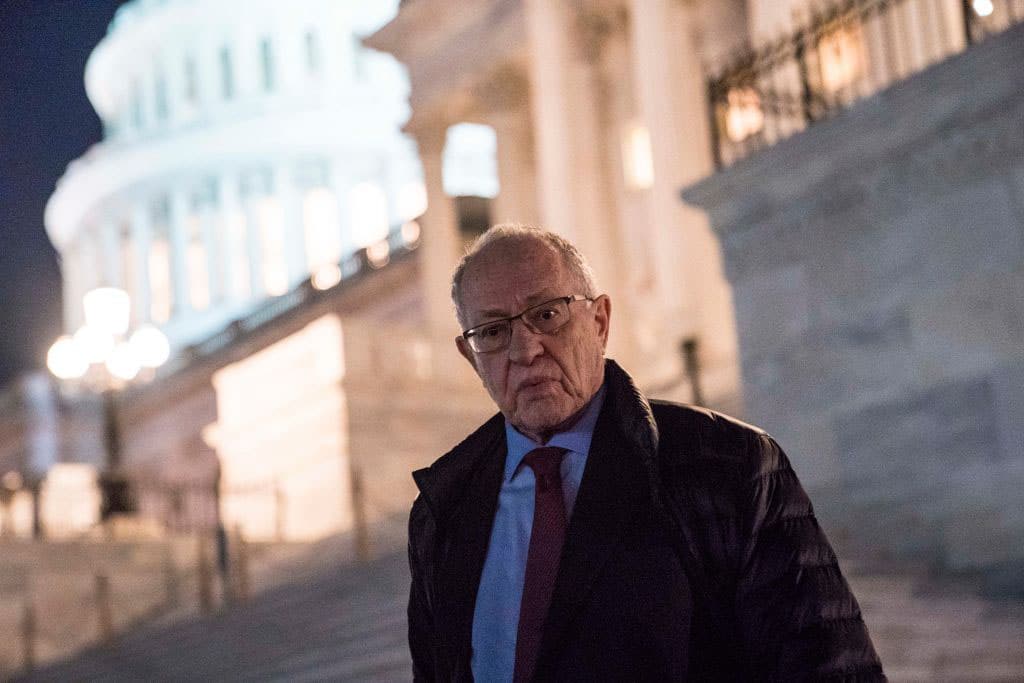
Prominent lawyer Alan Dershowitz said during a November 20 Jewish Republican Alliance Zoom webinar that he thinks former Vice President Joe Biden’s projected presidential election victory will likely hold in the face of President Donald Trump’s campaign lawsuits.
Dershowitz, a Democrat who has defended Trump in certain instances, said that the Trump campaign’s legal strategy seems to be more focused on denying Biden 270 Electoral College votes rather than getting Trump to 270, which would then “immediately” turn the election to the House of Representatives.
“It means you don’t get vote after vote in the Electoral College,” Dershowitz said, although in the House it could be “vote after vote” until a president is elected.
But in order to get to that point, a “perfect storm” would have to happen for the Trump team, Dershowitz said. He thinks that the Trump team’s best chance for victory lies in Pennsylvania, arguing that the Pennsylvania Supreme Court violated the Constitution by declaring that mail-in ballots could be accepted three days after the election,even if they weren’t postmarked. Although Dershowitz acknowledged that the policy may have been a good idea to help voters deal with the ongoing COVID-19 pandemic, he argued that the Constitution only gives such authority to state legislators.
“I think that case would win in the Supreme Court 5-4 or 6-3,” Dershowitz said.
However, Dershowitz thinks that the Supreme Court would only intervene if there are enough invalid votes to change the outcome in Pennsylvania.
“What we don’t know is how many challenged votes there are,” Dershowitz said, noting that Biden currently has a 60,000 vote lead over Trump in Pennsylvania and he has heard that only 30,000–40,000 votes are being challenged in the state.
Even if Trump’s legal team were to flip Pennsylvania in the courts, they would still need to flip two other states to reach 270. The lawsuits in other states — Arizona, Georgia, Nevada, Michigan and Wisconsin — could only succeed if Trump’s team were to show that enough individual votes were fraudulent, which would be a “tall order,” according to Dershowitz. The Trump campaign has claimed to have evidence showing widespread instances of voter fraud; election officials have largely denied that widespread fraud took place during the election.
As for the Trump legal team’s recent claims about systemic irregularities in computer voting, Dershowitz thinks the Trump team could score some victories there, but “we need evidence. I haven’t seen it.” He also pointed out that the challenge with such lawsuits is that it would have to go to the state courts first, since state legislatures voted for the use of computers for election voting.
Dershowitz said if he had to bet on it, he would bet on Biden being sworn in as president in January, but he thinks the Trump team should pursue these legal challenges.
Dershowitz said if he had to bet on it, he would bet on Biden being sworn in as president in January, but he thinks the Trump team should pursue these legal challenges.
“There are a lot of novel constitutional questions that have never been answered [about the electoral process],” Dershowitz said. “Will we get some answers? I don’t know.”
As for the incoming Biden administration, Dershowitz said that Biden “is generally more pro-Israel, generally closer to the center,” but he’s going to keep an eye on the new administration to ensure that the United States. continues to support Israel and that Biden rejects the fringes of his party, especially if the Democrats take control of the Senate.
“Would [Biden] have the courage to veto a House/Senate law that packs the courts?” Dershowitz said. “I don’t know the answer to that.” He acknowledged that Biden personally opposes packing the courts, but argued that a veto requires a different level of strength than just personally opposing a policy.
On November 13, IKAR Rabbi Sharon Brous found out that she is among the few religious leaders being considered to consult President-elect Joe Biden when his term begins in 2021.
Since 2000, when President George W. Bush established in the White House a permanent liaison for outreach to religious groups, interfaith leaders around the country have offered their insights when asked by the sitting president.
“Advisers to Biden say that for official matters, Biden might turn to Rabbi JulieSchonfeld, former chief executive of the Conservative movement’s Rabbinical Assembly, or to Rabbi Sharon Brous, the leader of IKAR, a prominent Los Angeles congregation,” the Washington Post reported on November 13.
“I would be deeply honored to be in conversation with the Biden-Harris administration in whatever way would help advance the work that we’ve been doing now for many years in building a multi-faith justice movement that can really have a voice in building a more just and loving society,” Brous told the Journal.
The list of potential faith leaders includes Rev. William J. Barber II and Rev. Liz Theoharis, co-chairs of the Poor People’s Campaign; Rev. Jennifer Butler, head of the advocacy group Faith in Public Life; Rev. Gabriel Salguero, founder of the National Latino Evangelical Coalition; and Rev. Traci Blackmon, senior pastor of Christ the King United Church of Christ, to name a few.
Although Biden has not made any official decisions, the Washington Post said that the Democratic president-elect is likely to select various religious leaders who will rotate in a fixed advisory council underneath a White House faith office.
For 16 years, Brous has created a spiritual roadmap for her community at IKAR. A major component for her and her religious team is creating faith-inspired, justice-driven Judaism in Los Angeles, with messages and programs that can be used around the country. She and her team fight for an array of social justice causes, such as climate change, support for refugees and a more united Los Angeles community by working alongside interfaith leaders.
Regardless of who offers faith-based insights to the White House, Brous believes faith leaders, in addition to lawmakers, must go through a healing process before they can make substantial changes.
Regardless of who offers faith-based insights to the White House, Brous believes faith leaders, in addition to lawmakers, must go through a healing process before they can make substantial changes.
“People are so torn apart in our country… more than a quarter of a million people have died from this pandemic, and the [issues] we are still talking about are still unresolved,” she said. “How do you move through a time of trauma and begin to heal again? There is some really important spiritual work that has to be done so that healing can be done. Healing is the last step in a long process to transform our hearts. I don’t even think unity is the goal right now.”
Since March, Brous has looked to the rabbis who documented the destruction of the first and second temples in Jerusalem for guidance on how to handle multiple catastrophes. Brous explained that Americans are “experiencing one world dying and another world being born.” To move forward better and stronger, the rabbi said the country needs to grieve, seek out the nation’s truths and then rebuild.
“This has to be a time for national public grieving. It is absolutely essential. [The rabbis] didn’t just move on; they took the time to honor what had been los[t]. There is strength that comes from mourning,” she said. “The second piece is about truth-telling… This is so critical in our time. There are truths in our country we have been unwilling to tell for hundreds and hundreds of years. Those truths are part of what lead to this massive upheaval we’ve seen over the last several years. The public health crisis, climate crisis, the racial injustice crisis — these all came from a failure to tell the truth about our country.”
Brous said once the rabbis grieved and sought out the truth, they went to rebuild. They didn’t build back the same way; they built for an evolved new reality. If Brous is asked to contribute anything to the administration, she will share these insights because she believes they’re critical. She also believes the clergy who have been called upon will do the same.
“There is so much wisdom in our traditions,” she said. “In whatever way it is, whether we’re invited into an official conversation with the administration or whether each of us is called to use our own pulpit to preach a Torah of healing and a Torah of hope, that’s what we are going to be called to do in these coming days.”
Jewish groups have praised recent changes to California’s Ethnic Studies Model Curriculum (ESMC) draft.
On November 18 and 19, the State Board of Education’s Instructional Quality Commission (IQC) revised the draft to remove a lesson that accused the Jewish community of having “racial privilege” while failing to mention anti-Semitism, according to StandWithUs. Additionally, the latest revisions included a lesson plan called “Antisemitism and Middle Eastern Jewish Americans,” according to Jews Indigenous to the Middle East and North Africa (JIMENA).
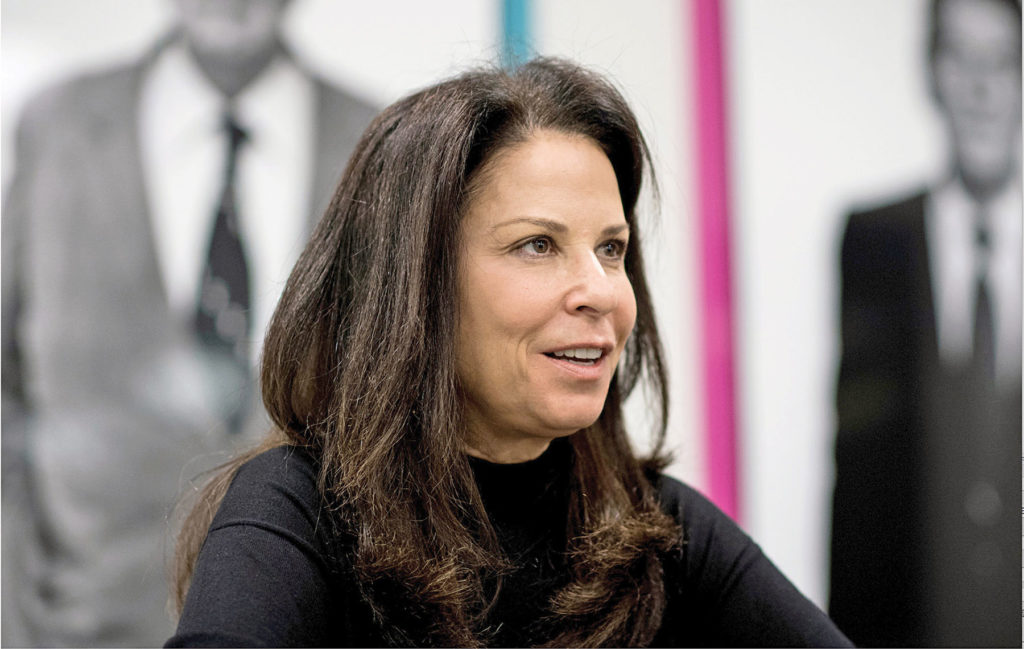
“Positive changes were made to include Jews and add safeguards against hate and bias in the curriculum,” StandWithUs CEO and co-founder Roz Rothstein said in a statement. “While the curriculum is headed in the right direction, there are still key changes we all have to fight for. Among the most important is a strong definition of antisemitism in all its forms, rather than a weak definition that caters to the biases of anti-Israel extremists.”
JIMENA Executive Director Sarah Levin similarly said in a statement to the Journal, “As [the] recently published FBI 2019 statistics noted, Jewish Americans are the second most targeted group after African Americans and so we commend the CDE and IQC for listening to the demands of over 10,000 Jewish individuals who explicitly requested the inclusion of our lesson on antisemitism. We are delighted at the prospect of California public school students learning about Middle Eastern Jewish Americans, also known as Mizrahi, Sephardic, and Iranian Jews in their classrooms.”
Tyler Gregory, executive director of the San Francisco Bay Area Jewish Community Relations Council, also said in a statement, “The IQC has endorsed holistic and equitable changes to the curriculum that protect our community and other communities through the inclusion of language that seeks to prevent discrimination against any group in the classroom. Although we believe some further edits to the curriculum will strengthen it further, we believe the process is on the right track.”
According to Jewish News Syndicate, the latest draft will be subjected to public comment for 45 days; the deadline for a final draft of the curriculum is in March 2021.
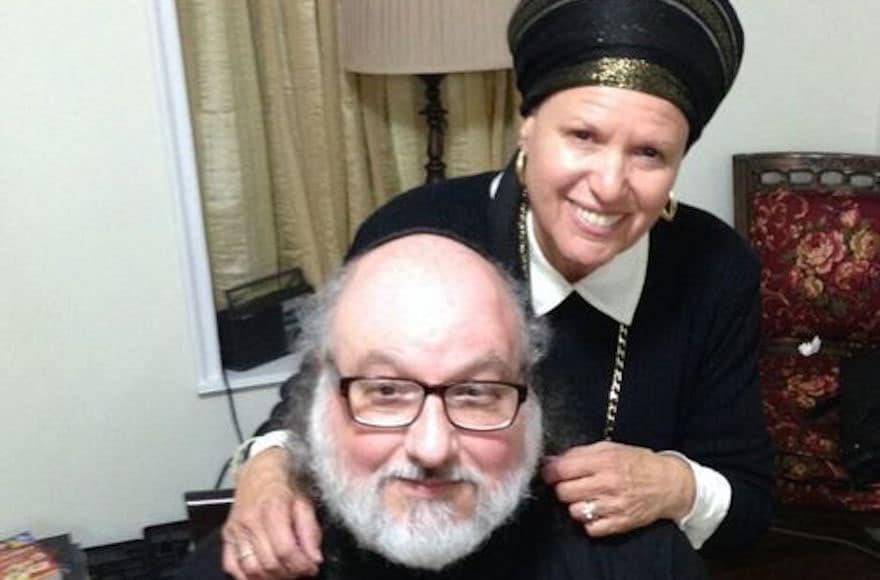
(JTA) — Almost 35 years to the day after his arrest outside the Israeli embassy in Washington D.C., Jonathan Pollard was granted the freedom to do what he wanted that day — travel to Israel.
Pollard’s lawyers announced Friday that the U.S. Parole Commission had lifted remaining restrictions on him, five years after he was paroled from federal prison, and 35 years since his Nov. 21, 1985 arrest. Pollard and his then-wife, Anne, were turned away from the embassy that day as law enforcement closed in on the U.S. Navy civilian analyst who had for several years spied for Israel.
“Mr. Pollard is no longer subject to a curfew, is no longer prohibited from working for a company that does not have U.S. government monitoring software on its computer systems, is no longer required to wear a wrist monitor that tracks his whereabouts, and is free to travel anywhere, including Israel, for temporary or permanent residence, as he wishes,” said the statement from Eliot Lauer and Jacques Semmelman, two prominent lawyers who have for years represented Pollard for free.
“We are grateful and delighted that our client is finally free of any restrictions, and is now a free man in all respects,” the statement said. “We look forward to seeing our client in Israel.”
Pollard had since his conditional release sought assistance from the Israeli government among others, saying the restrictions were keeping him from attending to the needs of his wife, who has cancer.
“Mr. Pollard is happy to finally be able to assist his beloved wife Esther, who is fighting an aggressive form of cancer,” the statement. “Mr. Pollard would like people to know that it was his wife, more than anyone else, who kept him alive during all the years he was in prison.”
Pollard, through the lawyers’ statement, thanked among others Ron Dermer, the Israeli ambassador to Washington, and Israeli Prime Minister Benjamin Netanyahu; his lawyers; Rabbi Pesach Lerner, the leading advocate stateside for his release; and “all people of good will who have kept him in their prayers and hoped for this day.”
Last Passover, my mom, my sister and I sat at our kitchen table and ate thick slices of New York pizza.
“We are bad Jews,” my mom said, taking a bite of the forbidden crust. We laughed, but this statement was nothing new to us. She had voiced similar comments before, at other unconventional dinners, on other unconventional holidays.
My parents separated when I was 12 years old, a few days before Thanksgiving. I remember eating dinosaur nuggets on our cold kitchen floor with my older sister and her best friend, wondering what the holiday season would look like with this new severed version of our family.
At the time, I was the only kid in my sixth-grade class whose parents were not together. In our tight-knit Jewish community, the pressures of convention still reigned supreme.
There were many holiday seasons after that where my family would play make-believe — squeezing into button-up shirts and navy dresses, stuffing stale kugel and sour cranberry sauce into our mouths in order to fit into some other family’s picturesque Hannukah or Thanksgiving.
The holidays are about celebrating family and fullness, so I understand and appreciate what prompted my parents to fit into the version provided to us. But of course, those gatherings always felt forced — tense and unnatural — and I began to dread the string of weeks between Thanksgiving and New Year’s.
The “holiday blues” has now become a known phenomenon — WebMD and the national suicide prevention line seasonally put out articles on how to cope with holiday-related depression and anxiety. They warn against behaviors like over-eating and over-drinking. But it runs so much deeper.
The longstanding traditions associated with the American holiday season are exclusionary by nature. Through holiday rituals, society continually affirms that being in a conventional family structure is what makes people happiest. So many of these rituals also imply the need for travel, limitless leisure time and a disposable income in order to fit in. Anything short is criticized — no family holiday card? No celebratory thanksgiving meal? No fancy presents? No Christmas vacation? Always a faux paus.
For many reasons this year, these larger societal traditions are being tested. What are the holidays about when stripped of the giant family reunions and fancy getaways?
This will be my first holiday season without my mom. I’ve avoided writing that sentence for months. Last Thanksgiving, my sister and I sat in a cold hospital waiting room with protective gowns and plastic masks on so that we could visit her one last time.
This year, I’m thinking of the many other people that will be in sterile hospital waiting rooms, chilly cemeteries or alone in their overheated studio apartments, unable to get on a plane to see friends or family.
I keep going back to last year in the hospital waiting room that I sat in. I felt like I was 12 years old again — waiting for some holiday magic to erase my reality, only to be met with disappointment and then shame as I scrolled through the collages of happy families on Instagram.
Of course, I’d rather have been anywhere than in that hospital for the holidays last year. Of course, I’ve done everything I can to avoid the overwhelming emptiness this year that will surely come with no longer having my mother and my spiritual home. Of course, so many of us are frantically scrambling to carry on some sense of tradition during such an uncertain time. Sometimes those traditions can serve us, but they can also make us miss something.
Sometimes those traditions can serve us, but they can also make us miss something
After those years of play-pretend with my parents before my mom got sick, something quite wonderful began to happen — my mom started to create new, odd traditions, just for us.
I think the first time was a Thanksgiving when I was in high school, when only my mom and I lived at home. We decided to skip the dinner we’d been invited to and instead order Chinese food and watch romcoms in her bed late into the night. It was chilly, pitch-black by six o’clock, but warmth streamed into our house. I remember my mom was oddly giddy, child-like. Looking back, I see this as the first time she could really release those societal pressures and just do as she pleased.
With her new sense of freedom came a new light.
After that, there was the Christmas that my older sister, my mom and I got drunk on margaritas and gossiped about our burgeoning love lives. The Hanukkah where we ate flaming cheese and danced, uninhibited, at a Greek restaurant. There was the Friendsgiving where the women drank wine and ate cheese, while the men waited on us — preparing meatballs and pastas and chocolatey desserts.
Even though I had some lingering sense telling me that these events were not the “right” way to celebrate, those unconventional moments were the fullest I’ve felt during a time where there is so much pressure to feel and be a certain way.
I know that my mom was always insecure about the non-traditional way we did things in our family, comparing us to the rest of our community. But those odd memories are the ones that I cherish most. They were most emblematic of my mother at her core — authentic, fun-loving, whimsical, wacky.
In order to sink into what the holidays should really be about — inclusion, compassion, love — we need to shed traditions that don’t work for us and accept that there is no “right” way.
I’ve already begun to feel bouts of grief as the holidays approach. It’s all the little things — seeing the cornbread mix my mom used on the display shelves at Trader Joe’s, hearing “Love Actually” come on the TV, baking compost holiday cookies in our kitchen without her.
It is easy to sink into the simple devastation of all that’s been lost this holiday season. It is easier still to try to push loss away and force old conventions. But as I move through the natural waves of sorrow and joy and then sorrow again, I find that the answers always lie somewhere in between.
Perhaps this holiday season, we can accept what is missing and also throw out conventions that didn’t serve us to begin with. Find something unexpected in the nooks and crannies of tradition.
… Maybe even go get some Chinese food on Thanksgiving. And simply appreciate that we are here.
Rebecca Katz just received her master’s in Journalism from USC Annenberg. She works in audio journalism and is in the works of starting her own podcast. twitter:@rebeccaerinkatz.
At a time of such bitter partisanship — lawsuits and recounts for the 2020 presidential election; control of the U.S. Senate hinging on two run-off elections in Georgia; and a closely divided U.S. House of Representatives — can you imagine trying to negotiate legislative compromises and bipartisan public policy results?
But as the ideological breach has grown, so, too, has an unlikely bipartisan force in Washington called No Labels. Over the years, the organization has built a base of federal legislators focused on compromise and getting things done across the partisan aisle.
A Big Hill to Climb
According to the group’s website, No Labels is “a groundbreaking movement led by Americans who embrace the new politics of problem solving and are collaborating to find commonsense, nonpartisan solutions to our toughest challenges.”
The organization was envisioned in 2009 by former Clinton-era veteran Nancy Jacobson, former U.S. Representative Tom Davis (R-VA), then-Atlanta City Council President Lisa Borders, and Clinton White House advisor and Wall Street Journal columnist Bill Galston, among others, as a way to bridge the divide between the two parties. It was formally founded in 2010 by Democrats and Republicans concerned that increasingly hardened disagreement was incompatible with effective solutions during the global financial crisis. Key early leaders included Senator Joe Lieberman (D-CT), Governor Jon Huntsman Jr. (R-UT), and Representatives Kurt Schrader (D-OR) and Tom Reed (R-NY).
And in 2020 and beyond, their work is more needed than ever.
Unlike previously, when the Senate was divided 50–50, and a “power-sharing” arrangement was established for committee chairmanships and votes, the partisan split in Congress today is not a close bunching between the center-right and center-left. Instead, the Republican Freedom Caucus and the Democratic Congressional Progressive Caucus are now the dominant forces in the U.S. House, and they are more polarized than ever. These caucuses are the two significant groupings of sincere but hardened ideologues — rooted in divergent views of American history — that influence the economic and social agendas of the two parties.
Each party is polarized within its ranks, too. Although Democrats lost seats in the upcoming 117th Congress (2021–2022), reducing their House majority, their left-wing continued to gain power with the defeat of moderate, seasoned legislators by younger, more progressive additions to the so-called “Squad.”
In this political environment, therefore, it will take some extraordinary finesse for a “lame duck” Congress to pass even the mandatory legislation that keeps our nation paying its bills.
At a minimum, Congress must pass 12 appropriations bills and the National Defense Authorization Act.
No Labels is undaunted by the odds and is stepping into this breach.
A Problem Solving Approach
Seeking to “bridge the growing chasm” between (and within) the two political parties and “create incentives for leaders to put country above party,” No Labels has worked to create a counterweight to dysfunction and stalemate.
For starters, in 2017 No Labels supported the creation of the Problem Solvers Caucus in the House of Representatives. Split evenly between Democrats and Republicans, the 48 members of this caucus pledge not to campaign against each other and to listen to each other through weekly calls and meetings. These shared norms build respect through sincere communication and produce the trust necessary for the give-and-take of creating legislation.
Notably, Problem Solvers Caucus legislators are not required to give up their party loyalties or passionate ideological commitments. What they believe, however, is that moving to “yes” may achieve more of their individual and party policy goals — even in compromise — than remaining in permanent “no.”
Founder and CEO Nancy Jacobson told the Journal that “No Labels inspired the creation of the Problems Solvers Caucus in the House and is now urgently at work on building a companion forum in the United States Senate. We call it the ‘bicameral.’ As long as we have leaders willing to embrace both sides, focus on the future, and move on from the past, there is huge potential for a national ‘reset’ at this moment in time, much needed by the country.”
Nancy Jacobson
To support the Problem Solvers Caucus members, No Labels created a national movement of business leaders and activists who are tired of the extreme partisanship coming out of national politics. No Labels initiatives include frequent conference calls with thought leaders and journalists, a citizen’s toolkit, and a Youth Congress to inspire more support for its nonpartisan goals.
Ryan Clancy, No Labels’ chief strategist on Capitol Hill, notes that the biggest obstacle faced by those who come to Washington, D.C. is to pursue reasonable public policies that help their constituents rather than play party politics. This is confounded by the consolidation of power in the hands of party leaders, who often seem more interested in passing “message” bills their members can campaign on instead of developing bipartisan legislation that can be signed into law.
And so, acting as a bloc and rejecting extreme partisanship, the Problem Solvers have in recent years played a key role in budget negotiations, debt ceiling compromises, infrastructure spending ideas, immigration reform, Southern border humanitarian funding, health care drug pricing, and, this year, the (still delayed and disputed) additional COVID-19 stimulus relief package.
And so, acting as a bloc and rejecting extreme partisanship, the Problem Solvers have in recent years played a key role in passing legislation.
Problem Solvers Caucus members pledge to vote together once they achieve a broad bipartisan consensus. The caucus has become a permanent working group, though much larger than its ad hoc predecessors, such as the Gang of Eight that former Senator John McCain (R-AZ) led. The White House and congressional leaders are well aware of the Problem Solvers Caucus bloc of votes, which often helps to “center” partisan negotiations.
Clancy believes that “when members of Congress stick together as [a] cohesive voting bloc, they can have immense influence. 218 votes are required to pass a bill in the House and if leadership needs your votes to get a majority, and a bloc of members is willing to use their votes as leverage, they will get a lead seat at the table in shaping a bill.
“Unfortunately, members of the Problem Solvers Caucus have faced negative feedback for sitting outside the larger ideological camps in both parties. Some have lost committee assignments for refusing to toe the party line. Others have faced primary election challenges from the right or the left explicitly due to their willingness to be bipartisan. In recent years, pragmatism has been punished and extremism has been rewarded. This is the incentive structure that No Labels is working to change.”
But the No Labels movement continues to grow. Problem Solvers Caucus leaders now include independent-minded legislators, like Senator John Cornyn (R-TX) and Representative Josh Gottheimer (D-NJ), who are building reputations as legislators who want to get the people’s work done. And the movement continues to address pressing issues: the recent Supreme Court nomination battle and the threats by some Democrats to “pack the court” inspired No Labels to support the idea of lengthy term-limits for Supreme Court justices.
A Movement Toward Compromise
Despite the work of the Problem Solvers Caucus, the confrontational nature of electoral politics has led many Americans to worry that citizens, too, are irredeemably polarized.
But Jacobson disagrees. She points to a recent Wall Street Journal article, which reveals that most citizens are not as extreme as firebrand right-wing or left-wing politicians and many internet political personalities present. Firmly believing the tide is turning away from the ideological camps and toward the problem-solving camp, Jacobson asks, “Isn’t the zeitgeist of the moment that people want problems solved?”
Perhaps so. But it’s always fair to refresh our reading of James Madison and the Federalist Papers. The American founders knowingly created judicial review, presidential vetoes that can only be overturned by congressional super-majorities, and the cooling saucer of the Senate against the heat of legislation from the more activist House.
Brookings scholar and No Labels co-founder Galston agrees that the constitutional framers “feared concentrations of power in any one institution (let alone a single individual) as the road to tyranny. They designed a system of divided powers to safeguard liberty, not to promote efficiency. They saw lengthy deliberation as the key to balanced, sustainable legislation. Our Constitution was designed for stability, not speed.”
But Galston cautions that “the Founders did not anticipate, and would not have liked, our current situation, in which a system of checks and balances has degenerated into multiple veto points and gridlock. They did not design our [C]onstitution to function with a deeply polarized and mutually mistrustful party system. And they did not believe that institutions built to address the people’s problem could endure indefinitely if they lost the power to govern.
“With the political parties closely as well as deeply divided, neither can force the other to give way. The failure to work together means a continuation of the fighting and gridlock that have undermined the people’s trust in government. For this reason, it is essential that the parties relearn the art of cooperation and compromise, which is what No Labels was created to promote a decade ago.”
Clancy is optimistic that there is a rising momentum among the American people against the brutality of winner-take-all political warfare. He argues that “for years, the American public has been demanding bipartisan problem solving from Washington, but our leaders have refused to give the people what they want. But now, Washington’s new political math demands it. The implication of this new legislative math is clear: In 2021, Washington will either solve problems on a bipartisan basis or they won’t solve them at all.”
If the next President wants to be successful, he might choose to rely on the model of cooperation offered by No Labels, who are supporting the Problem Solvers in their focus on a COVID-19 relief package, immigration reform, infrastructure and health care as their top policy agenda items for the new Congress.
Every bit as determined to achieve results through compromise, consensus, and collaboration as their partisan colleagues are committed to their respective principles and purity, No Labels appears poised to grow and play a key role at the center of American politics.
Larry Greenfield is a Fellow of The Claremont Institute for the Study of Statesmanship & Political Philosophy.
JNS — The Pentagon, prompted by U.S. President Donald Trump, ordered a drawdown this week of U.S. troops in Iraq and Afghanistan, a move that experts told JNS might actually empower Iran.
The drawdown to 2,500 in both places is slated to take place by Jan. 15, said Acting Secretary of Defense Chris Miller, who was installed in the top Pentagon role last week after Trump fired U.S. Defense Secretary Mark Esper.
That date is five days before President-elect Joe Biden is set to be sworn in on Jan. 21. He has expressed support for U.S. troop withdrawals from the Middle East, though has called for the United States to have a small counterterrorism force there.
Currently, approximately 3,000 troops are stationed in Iraq and 4,500 U.S. troops in Afghanistan.
Danielle Pletka, a senior fellow in foreign and defense policy studies at the American Enterprise Institute, said these upcoming moves are counterintuitive to Trump’s overall Iran strategy.
“On the very day that Donald Trump seeks to up the pressure on Iran, he does the exact opposite in removing pressure on the Tehran regime in Syria, Afghanistan and Iraq. The policy is incoherent,” she said. “Worse, the policy is dangerous. This is an ‘Iran-first’ move that I would expect from Obama retreads, not the Trump administration.”
In fact, four Katyusha rockets reportedly hit in Baghdad’s heavily fortified Green Zone on Tuesday with the U.S. embassy in their crosshairs. A child was killed and five people were wounded. While U.S. officials have blamed Iran-backed groups for such attacks, no such groups have claimed responsibility for the incident.
Ilan Berman, senior vice president of the American Foreign Policy Council, said that the impact of troop removal “is likely to be mixed.”
“On the one hand, a reduced American presence in Iraq is likely to remove impediments to Iran gaining an even greater strategic and political presence there,” he said. “If history is any judge, that will be a deeply detrimental scenario. It will also reverse major political efforts by Washington and Baghdad in recent years aimed at bolstering Iraqi sovereignty.”
“On the other hand, however, a drawdown of U.S. forces in Afghanistan is likely to empower the Taliban and other radical actors to Iran’s east,” continued Berman. “These are actors that Iran also sees as threats, and the Iranian regime may therefore be forced to think more locally, and to invest greater resources in mitigating threats in its immediate neighborhood. That is something that could turn out to be an aggregate good for regional security.”
‘Whether the withdrawals will embolden Iran is moot’
Others see the withdrawal as not having a major impact on Iran’s influence in the region, which has been consistently growing for years.
Aaron David Miller, a senior fellow at the Carnegie Endowment for International Peace, stated that the missions in Iraq and Afghanistan, and Trump’s “maximum pressure” campaign against Iran, have not been successful; therefore, whether the withdrawals will embolden Iran is moot.
“If we couldn’t succeed in Afghanistan and Iraq with a number 50 times those, do you think it matters now we’re now down to 2,500?” he posed. “Iran’s influence, especially in Iraq, won’t be boosted or degraded by those numbers. Trump’s ‘maximum pressure’ campaign against Iran is failing. They want us out of Iraq, and Trump has brought them a little closer to that goal.”
Gold Institute for International Strategy senior fellow Matt Brodsky, on the other hand, expressed hope that the withdrawals “will not hinder the U.S. ability to deter Iran from additional regional aggression and prevent the resurgence” of the Islamic State.
“Clearly, the president has made clear his preference to bring America’s troops home and to stop what he calls ‘endless wars,’ ” he said. “The problem is that our enemies also get a vote and these are their wars. America has made tremendous progress in the Middle East in the past four years. I’d hate to see those gains jeopardized.”
‘A cautionary tale of a premature decision’
United Against Nuclear Iran policy director Jason Brodsky (no relation to Matt Brodsky) said that the drawdowns “are inconsistent with a strategy of maximum pressure on Iran.”
“In Iraq, Iran’s Axis of Resistance wants to see Washington gone. Withdrawing also reduces U.S. leverage and influence in Baghdad. Iraq’s government remains trapped between an American rock and an Iranian hard place,” he said. “Iraqi officials who are allies of the United States are already concerned about a premature return to the Joint Comprehensive Plan of Action (JCPOA), as that would empower Tehran in the country as a result of sanctions relief.”
He continued, saying that “a drawdown coupled with the prospect of a return to the flawed JCPOA would embolden Iran’s partners and proxies in the country even further. Iran also wants to see the United States leave Afghanistan, and has been cultivating the Taliban to retain influence and leverage in the country. The Obama administration’s withdrawal from Iraq in 2011 is a cautionary tale of a premature decision divorced from conditions on the ground, as only a few years later did American forces have to be sent back again to deal with the threat from ISIS.”
Jonathan Schanzer, senior vice president at the Foundation for Defense of Democracies, said that “Trump is unwittingly undermining American deterrence in the Middle East.”
“Even a downsized or right-sized troop presence can serve as a deterrent to malign actors, as we saw in Syria over the past few years,” he said. “America’s departure will invite the likes of Russia, Iran, Hezbollah and others to fill the void left by the United States. This will have a deleterious impact on Israeli security, as well as the security of our other Arab allies.”
“Also lost in all of this is the cost to America, both in financial and human terms, when redeployment to these areas becomes necessary once the security situation unravels,” he pointed out. “This was the case with the U.S. deployment to Iraq after the ill-advised withdrawal from Iraq.”
A hallmark of spirituality has always been the ability to abandon one’s fixation on material things to pursue a loftier aspiration. But it’s not only the spiritually-inclined who claim to chase a life free from the bondage of material things. Having spent years in graduate classes in philosophy and literature, I can tell you that although spirituality is hardly a consideration in these circles, the emphasis on the life of the mind over the life of the material is clear. It seems that radically different circles agree on at least one thing: the dangers of materialism.
Outside of the walls of churches and academies, the verdict on the evil of material things is hardly disputable. Publicly, most of us contend that the material isn’t important. We champion the idea of love over money and objects. We make statements like, “It’s not about how much money you make; it’s about whether you love what you do.” But secretly, most of us care deeply about material things. We are, after all, humans with an ever-increasing drive to have more.
Still, we continue to claim that we really don’t need much to survive and be happy. We need only shelter, food and love. And, in some cases, perhaps we can allow ourselves the luxury of a quiet room of our own, as Virginia Woolf suggested. I’ve always done my best writing when I’m away at a conference, sitting in an almost-empty hotel room, without the burden of all the things I’ve acquired. Nothing but a suitcase, pen and paper and my thoughts. How romantic!
But then came March 2020. The beginning of a new era.
It would be a hideous understatement to say times have changed. It’s not only times that have changed — we have changed, too. We have become more outwardly focused on possessions. Or, perhaps we’ve simply become more honest about the significance of material things in our lives. Has the quarantine life driven us back to an obsession with material things?
When my husband, son and I locked down in March, we knew that we were lucky to be quarantining in a home with plenty of space, a yard and more than a month’s worth of non-perishable foods. In January, I had seen what was coming and acquired a 60-gallon water tank to keep in our garage — just in case. After keeping a watchful eye on Italy, I went to Costco and stocked up on necessities for the next few months. I’m a pessimist at heart, and this time it paid off. I purchased toys, books and puzzles — as many material things as I could think of to stave off the boredom that would undoubtedly accompany an indefinite quarantine in a world that seemed to grow darker each day.
The irony is that only weeks before, my family had committed to downsize, to shed our excess of material goods. We spent weeks giving things away to people in need. It felt good to be free of so much. But suddenly, it was the excess of things that made us feel safe. In a time of crisis, we clung to our material things.
We thought we had enough, especially when others had so much less. But in April, we looked around and decided that we should redo the exterior of our house since we were spending so much time there. We decided that we needed new patio furniture since our backyard was our new world. We realized that we needed to order some new Lego sets for our son to make him feel less anxious about what felt like the end of the world. We unabashedly increased our dependence on material things.
And you know what? Despite the accompanying guilt of having the ability to make those purchases when others don’t, it made us feel better. It made us feel safe.
Since the beginning of the pandemic, people have talked about how this moment of crisis has forced us to be introspective, to think about what really matters. The insistence that the pandemic has allowed us to spend more time with our families and is, therefore, not all that bad plays on repeat like a broken record. And, sure, maybe those things are true for many people. But what has not been addressed is the significance of material things in this cultural moment. Things have not become less important; they have become more important than ever.
Material things are symbolic beyond their tangible nature. They are shape-shifters, symbolizing power, safety, happiness or memory in different contexts. And in some cases, they can tell us whether we are living or dying.
I can’t help but think of the summer’s peaceful protests of police violence, some of which were tainted by rioting and looting. We’ve all watched videos of people smashing glass storefronts and flooding into stores to retrieve armfuls of goods. And in some cities, we’ve seen protestors enter upscale residential communities with signs that say, “Eat the Rich,” taken from a quote attributed to the French Revolution’s Jean-Jacques Rousseau: “When the people shall have nothing more to eat, they’ll eat the rich.”
Frenzied attempts to redistribute wealth and material things by force or shame will forever be a part of the hellish American landscape of 2020. Still, riots and looting are nothing new. Material things have always been an important symbol of power, regardless of whether we deem it culturally acceptable to say so. Are you scared? You need things. Are you frustrated? You need things. Depressed? More things.
Are you scared? You need things. Are you frustrated? You need things. Depressed? More things.
For many, the pandemic has signaled a loss of livelihood. Without jobs, people cannot buy food or pay rents and mortgages, let alone purchase material things to distract from the pain of their reality. Jobs make possible the acquisition of things like homes, clothing and other necessities. Things matter. They matter very much, especially to those who can no longer afford them.
But despite the countless and varied ways in which material things take on meaning, perhaps their capacity to create and hold memories is most palpable right now. Some might say that things are always about memory, and I think about that idea more now — when we are surrounded by so much death or fear of death — than ever before.
In “Summer Hours,” a 2008 French film, the aging matriarch of a French family contemplates what will happen to her material belongings (which include paintings that Paris’s Musee d’Orsay had tried to acquire) when she dies. In one scene, she sits in a dark room, contemplating her mortality, after having just hosted all her children and their families. The matriarch tells her maid why she is not making the proper arrangements to deal with her things. She suggests that already, her children bear too much responsibility for family memories and that all of her material things would make navigating the world in the wake of her loss even more difficult, given that they carry these memories.
The idea that we should relinquish our rights to material things may sound like a noble one. But I’m not sure it always plays out like this in the real world. Often, after a loved one dies (or even after a divorce), the subsequent fighting over the material objects is not so much about the things themselves but about what they represent, about the memories.
We fight for the possibility of being able to touch something that contains memory within it or can create and hold memories to be accessed in the future, when we most need to be sustained. Perhaps in moments of crisis or uncertainty, we are afraid, afraid that when our hands cannot close around an object, when our fingers cannot trace its lines, angles or curves, we will have lost the ability to remember both a past and a future.
I don’t mean to be an apologist for materialism. I hated hearing my parents talk about what should happen to their belongings upon their deaths. I don’t want to replace the sound of my mother’s laughter with one of her beautiful Depression-era glasses, so meticulously collected over the years. Yet the truth is that if I can’t hear that laugh, I want to hold the glass in my hand because it might bring just a glimmer of her back to me. These are glasses from family dinners around a big table, where we sat, year after year, laughing together. I imagine that these glasses carry the memories of my mother — especially those that will rise to the surface when, one day in the darkest of futures, she is no longer with us. My father died last year. It never occurred to me to want any of his military medals when he was alive. But now that he’s gone, all I want is to have one of them. I want to keep it in my nightstand and look at it when I miss him, which is all the time. I want to hold it in the absence of holding him.
Yes, I admit that I want things. I want meaning and memory, which cannot always be separated from material things. But I also want to feel safe. The pandemic has cut us off from so much the world has to offer. Zoom meet-ups don’t feel as meaningful as sharing a coffee or a glass of wine at a café with a friend. And holidays spent virtually with family are downright sad. So maybe it’s okay that we feel drawn to material things right now. Maybe we just need to have a moment where we can touch something tangible and real. Maybe it’s a poor substitute for real and vibrant human connections, but it’s what we have for now. Because the truth is that new patio furniture might make me feel better for a little while, but at a certain point, it’s going to be useless without friends and family to share it.
I want meaning and memory, which cannot always be separated from material things.
There’s nothing shameful about connecting to material things right now. Perhaps we can even discover meaning within them that we may have otherwise missed. In August, for example, my husband, son and I left Los Angeles to work in Vancouver, Canada, for six months. We were happy to get out of Los Angeles for a while, and during the first couple of months in our rented apartment, we said to each other at least a dozen times, “Isn’t this great? See? We don’t need all of our things! We were right after all.” And it felt that way for a while — like we were free once again from the burden of material objects. But over the past few weeks, I confess that I have really been missing my things. I feel sad when I think about my Staub Dutch oven — the one in which I always make soup — sitting unused in my kitchen. I long for my cast-iron skillet so I can make salmon the way my son likes it (I feel like a good mother when he raves about my brown butter salmon). I miss my unique coffee maker, around which so many of my daily rituals revolve. I miss my endless shelves of books, all of which speak to me in meaningful ways. I long to step on Lego bricks scattered around the floor and say loudly to my son, “We have too much stuff!” And I can’t stop thinking about that patio furniture. These aren’t just things — they carry memories of safety and security, as well as hopes for a more stable future. That is comfort we need now more than ever.
So as much as we’d like to say that material things don’t matter, 2020 has shown us that they do. They matter to those looking for a sense of stability and the experience of living a normal life, and they matter even more to those who have lost their jobs and who don’t have the luxury of saying that material things aren’t the most important thing in life. So, yes, let’s focus on what really matters. And maybe, just maybe, materialism isn’t always a dangerous thing. Maybe, in this year, taking solace in the memories our objects hold is exactly what we need.
Monica Osborne is a scholar of Jewish literature and culture. She is the author of “The Midrashic Impulse and the Contemporary Literary Response to Trauma.”
New David Suissa Podcast Every Tuesday and Friday.
Some thoughts on improving our lives, and a conversation with a millennial.
How do we manage our lives during the coronavirus crisis? How do we keep our sanity? How do we use this quarantine to bring out the best in ourselves? Tune in and share your stories with podcast@jewishjournal.com.
In light of the conversations about race sparked by the 2020 killing of George Floyd, many American schools are revising their approach and curriculum on race. Whatever their intentions, their approach too often features sources that engender contempt for America. Students are indoctrinated using texts such as the New York Times’ “1619 Project,” which claims that the United States was founded to preserve and protect slavery, and Robin DiAngelo’s White Fragility.
What, then, should American schools teach about race?
They should, of course, teach students about slavery and racism.
But, if truth and moral clarity are to matter, students must go beyond an American-centric focus and also learn that slavery was universal. They would therefore learn about Muslim-Arab slavery, slavery among Africans, slavery among Native Americans and Native South Americans, and slavery in Asia and India.
If truth and moral clarity are to matter, students must go beyond an American-centric focus and also learn that slavery was universal.
They would learn that it was the West, beginning with England and America, that abolished the slave trade. And they would learn that the abolitionists were overwhelmingly religious Christians, animated by the Bible and Judeo-Christian values.
They would learn that, as horrible as all slavery was, unlike, for example, the slaves under Arab-Muslim rule, most black slaves in America were allowed to have children and form families. They would read Herbert Gutman’s The Black Family in Slavery and Freedom, 1750-1925, about which the New York Times wrote when it was published in 1976: “Gutman has performed an immense service in burying the idea that slavery destroyed the black family.” (For the record, Gutman was a professor of the left and a member of the American Academy of Arts and Sciences.)
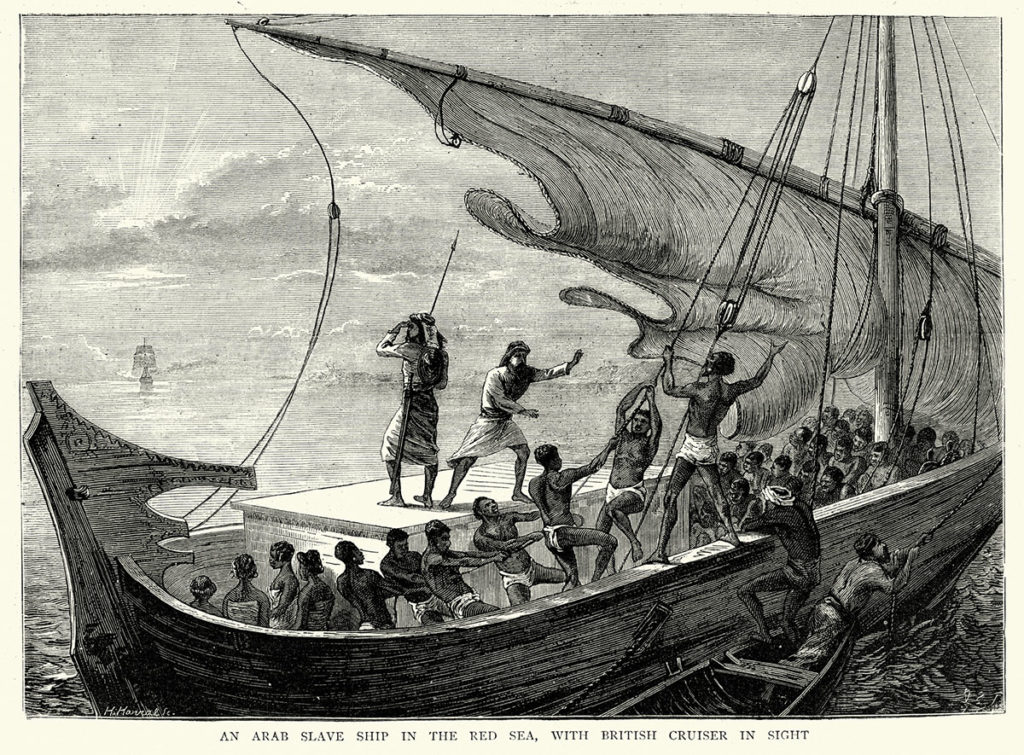
They would learn that the tens of millions of African slaves under Islamic-Arab rule were not allowed to form families (most males were castrated). They would learn that while about 388,000 African slaves were transported to North America, about 12 million were transported to South America and the Caribbean. They would learn that far more blacks — about 3 million from Africa and the Caribbean — have come willingly to America post-slavery than came as slaves. They would read a 2005 article from the New York Times titled “More Africans Enter U.S. Than in Days of Slavery,” in which they would also learn how much less racist America became: “Agba Mangalabou, who arrived from Togo in 2002, recalls his surprise when he moved here from Europe. ‘In Germany, everyone knew I was African,’ he said. ‘Here, nobody knows if I’m African or American.’”
They would learn about white slavery, too, from one of the greatest economists of the last half-century, Thomas Sowell, who wrote: “More whites were brought as slaves to North Africa than blacks brought as slaves to the United States or to the 13 colonies from which it was formed. White slaves were still being bought and sold in the Ottoman Empire, decades after blacks were freed in the United States.”
None of that would be taught to diminish the evil of the transatlantic black slave trade, let alone to justify it. America’s schoolchildren should be taught about the horrors of the slave auctions, the separation of many families, the rapes, the beatings, and the lynchings. But nothing in history is understandable without perspective.
As regards the Arab-Muslim slave trade, students should read Ghanaian professor and minister John Azumah’s book The Legacy of Arab-Islam in Africa, who summarized some his findings in a later interview:
“While two out of every three slaves shipped across the Atlantic were men, the proportions were reversed in the Islamic slave trade. Two women for every man were enslaved by the Muslims.
“While the mortality rate of the slaves being transported across the Atlantic was as high as 10%, the percentage of the slaves dying in transit in the trans-Saharan and East African slave market was a staggering 80 to 90%.
“While almost all the slaves shipped across the Atlantic were for agricultural work, most of the slaves destined for the Muslim Middle East were for sexual exploitation as concubines in harems and for military service.
“While many children were born to the slaves in the Americas, the millions of their descendants are citizens in Brazil and the United States today, very few descendants of the slaves who ended up in the Middle East survived.
“While most slaves who went to the Americas could . . . have families, most of the male slaves destined for the Middle East were castrated, and most of the children born to the women were killed at birth.”
Vintage engraving of a Arab slave ship in the Red Sea fleeing from a Royal Navy cruiser. The Graphic, 1874 (Getty Images)
They would read some of the left’s favorite “America-is-racist” books, such as the national bestseller White Fragility. But, unlike any school in America that assigns that book, they would also assign a black professor’s review of it. In the Atlantic, John McWhorter, a Columbia University professor of linguistics, wrote that White Fragility “is actually a racist tract. Despite the sincere intentions of the author, the book diminishes Black people in the name of dignifying us.” McWhorter continues, “White guilt and politesse have apparently distracted many readers from the book’s numerous obvious flaws. For one, DiAngelo’s book is replete with claims that are either plain wrong or bizarrely disconnected from reality.”
They would read and listen to a variety of black thinkers and authors, not just those who detest America. Here is a partial list, in alphabetical order, including one of their books:
Larry Elder, What’s Race Got to Do With It?
Ward Connerly, Creating Equal
John McWhorter, Losing the Race
Deroy Murdock, any of his many columns
Candace Owens, Blackout
Jesse Lee Peterson, The Antidote
Jason Riley, Please Stop Helping Us
Thomas Sowell, Intellectuals and Race
Shelby Steele, White Guilt
Carol Swain, Abduction
Clarence Thomas, My Grandfather’s Son
Walter Williams, Race and Economics
That these brilliant thinkers are unfamiliar to most Americans is proof of the bias and superficiality that pervades American academic and intellectual life.
If students read these books and are taught the truths about race outlined in this article, it is perfectly acceptable for them to read black and white leftists on race. In fact, it would be advisable.
But they won’t because, current “education” about race in America seems not to teach history but to foster contempt for America.
Dennis Prager is a nationally syndicated radio talk show host, president of PragerU and author of “The Rational Bible.”Copyright 2020 creators.com. Reprinted with permission.