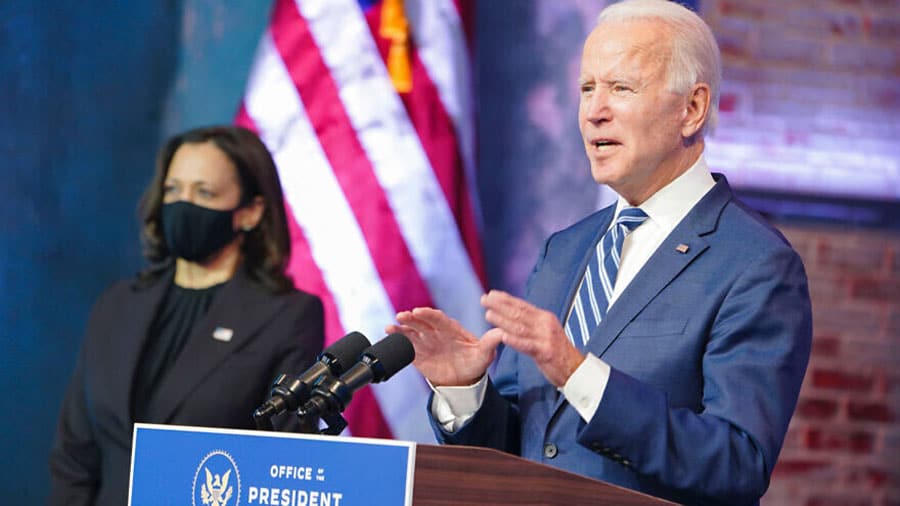
JNS — As President-elect Joe Biden forms his upcoming administration, certain positions should spark interest in the Jewish and pro-Israel community. Whoever is nominated would likely signal the direction that the next White House would take on issues relevant to the relationship between America and Israel, including combating anti-Semitism, Diaspora Jewry, Mideast relations, the Iranian threat and more.
All eyes are turned towards Georgia as two seats for the U.S. Senate go to runoffs on Jan. 5.
Already in place is a coronavirus task force made up of medical and health professionals. And Biden has chosen as his chief of staff Ron Klain, 59, who served as chief of staff for former Vice President Al Gore and for Biden when he was vice president in the Obama administration. Klain, who is Jewish, was also charged with countering the Ebola breakout in the United States in 2014.
Below are possible candidates for positions in a Biden administration that are of interest to the Jewish and pro-Israel community.
U.S. SECRETARY OF STATE (Requires U.S. Senate confirmation)
Chris Coons: The U.S. senator from Biden’s home state of Delaware serves on the Senate Foreign Relations Committee and has reportedly expressed interest in the job. Coons supported the Iran nuclear deal, but opposed the Obama administration from abstaining from U.N. Security Council Resolution 2334 in December 2016, condemning Israeli settlements as opposed to exercising its permanent veto, thereby allowing the resolution to pass. Coons has cautioned against Israel possibly applying sovereignty to parts of the West Bank. As someone known to work with both sides of the aisle, Coons would likely get confirmed even if the GOP maintains control of the Senate.
Tony Blinken: One of Biden’s senior foreign-policy advisers, Blinken served as U.S. deputy secretary of state and deputy national security advisor in the Obama administration. Beforehand, he was Biden’s national security advisor. A GOP Senate would likely be receptive to Blinken, as he said during the campaign that a Biden administration would keep some U.S. sanctions on Iran and reiterated Biden’s stance that the United States would not return to the 2015 Iran nuclear deal unless Iran returned to compliance.
Tom Donilon: He served as former U.S. President Barack Obama’s second national security advisor. In this role, he had a cordial relationship with Israel. If nominated, expect the GOP Senate to confirm this foreign-policy veteran.
William Burns: After preceding Blinken as deputy secretary of state, Burns retired from a 33-year diplomatic career under Democratic and Republican administrations. Currently the president of the Carnegie Endowment for International Peace, in May 2019, Burns wrote an opinion piece in The Washington Post slamming the Trump administration’s approach to the Israeli-Palestinian conflict before its peace plan to resolve it was released the following January, saying that the White House’s approach “appear[s] to be animated by a set of terminally flawed assumptions and illusions.”
In August, however, Burns wrote that Israel and the United Arab Emirates normalizing ties was “a significant achievement, with considerable potential if—and it’s a big if—it is tethered to more serious diplomacy on either the Israeli-Palestinian issue or the challenge posed by Iran.”
Burns criticized the Trump administration’s effort to snapback U.N. sanctions against Iran as “not only silly, but guaranteed to further embarrass and isolate the U.S., further alienate our closest allies, and further risk collisions with Tehran.” Those sanctions were ultimately snapped back after the United States failed to get the U.N. Security Council to indefinitely extend the U.N. arms embargo on Iran.
Whether a GOP-controlled Senate would confirm Burns is unknown.
Susan Rice: If the GOP holds onto the Senate, Rice, who served as national security advisor in the Obama administration, won’t likely be a candidate due to Republican objections about her record from the controversy in the aftermath of the 2012 attack on a U.S. diplomatic post in Benghazi, Libya, which left four Americans dead, to her record on Israel and Iran. She withdrew from consideration to be the nation’s top diplomat during Obama’s second term due to the Benghazi controversy.
SECRETARY OF DEFENSE (Requires Senate confirmation)
Michèle Flournoy: If confirmed, she would be the first female leader of the Pentagon. In an interview with The Jerusalem Post in 2018, she slammed U.S. President Donald Trump for withdrawing U.S. troops from Syria. She said that while the Trump administration had used strong rhetoric against Iran, it hasn’t really engaged on the ground in Syria in terms of showing up at negotiations as a major player or changing any of their activities on the ground to counter Iranian influence or to counter Shi’ite militias.”
She added, “Who is looking out for Israeli interests in negotiations about a resolution in Syria? Someone needs to think about what will be on Israel’s borders in the end … Shi’ite militias with [Islamic Revolutionary Guards Corps] connections? Another Hezbollah? This would be unacceptable. So what will it look like?”
However, Flournoy, who declined an offer to be U.S. deputy defense secretary under Trump, supported the Iran nuclear deal, claiming that it “did succeed in putting time on the clock [in terms of] pushing back against Iran’s nuclear program, in terms of taking more time from today [for Iran] to get to an actual nuclear weapon.”
“The only thing that would be worse than a malign Iran across the region would be a nuclear-armed malign Iran across the region,” she continued. “For the decade of the deal, that is not going to happen.”
Ash Carter: He served in this role under Obama and had a cordial relationship with Israel, despite the Jewish state’s objections to the Iran nuclear deal. Carter was confirmed under a GOP-led Senate in 2015 before the deal was completed later that year.
Pete Buttigieg: The former mayor of South Bend, Ind., and Democratic presidential candidate was an intelligence officer in the U.S. Navy Reserve, serving in Afghanistan for several months in 2014. However, his stances on conditioning U.S. assistance to Israel and calling the 2019 U.S. recognition of the Golan Heights an “intervention in Israeli domestic politics”—even though analysts say that the Golan is a strategic security barrier for Israel against its enemies including Hezbollah, a U.S.-designated terrorist group—could hurt his chances of confirmation by a GOP-led Senate. Openly gay, he brought both his husband and LGBTQ issues to the forefront of his presidential run.
Tammy Duckworth: Currently a senator from Illinois, she is a U.S. Army veteran who served during the Iraq War, suffering combat wounds that caused her to lose both of her legs and some mobility in her right arm. She was reportedly considered as a running mate for Biden, who ultimately went with Sen. Kamala Harris (D-Calif.). Duckworth would more likely be considered to lead the U.S. Department of Veterans Affairs, given her experience at the VA and having been the director of the Illinois Department of Veterans Affairs.
NATIONAL SECURITY ADVISOR (No Senate confirmation required)
Tony Blinken: While Biden’s top foreign-policy advisor during his campaign could be considered for secretary of state, it’s more likely he would be the top candidate for national security advisor.
Jake Sullivan: Sullivan succeeded Blinken as Biden’s national security advisor and, along with Burns and other senior U.S. officials, reportedly met with Iranian officials in 2013 in order to foster a possible nuclear agreement with the regime. If Blinken becomes secretary of state, then Sullivan could very well be the frontrunner for national security advisor.
Ben Rhodes: If Blinken becomes secretary of state, expect Rhodes to be considered for national security advisor. During his time in the Obama administration, Rhodes was known to be responsible for creating an “echo chamber” to promote the Iran nuclear deal.
U.S. AMBASSADOR TO THE UNITED NATIONS (Requires Senate confirmation)
Pete Buttigieg: While he may be an unusual choice to be the U.S. envoy to Turtle Bay, Buttigieg has been touted as someone getting a top position in a Biden administration. This may be the position he is rewarded with for dropping out of the Democratic presidential primary and endorsing Biden just before the Super Tuesday primaries in March.
Wendy Sherman: The word is that she has almost no chance of confirmation if the GOP holds onto its Senate majority, given Sherman’s major role behind the U.S. nuclear deals with North Korea and Iran.
U.S. AMBASSADOR TO ISRAEL (Requires Senate confirmation)
Robert Wexler: The former Florida congressman was reportedly considered for the role in the Obama administration. He campaigned for Biden. Wexler’s support for the Iran nuclear deal could give Republicans pause if they keep control the Senate.
Norm Eisen: The Democratic counsel during the U.S. House Judiciary Committee’s impeachment inquiry of Trump, Eisen served in the Obama administration as an ethics czar and U.S. ambassador to the Czech Republic. With strong ties to the Jewish and pro-Israel community, Eisen could be a contender for the role of U.S. envoy to Israel if he’s not named to another prominent post, such as White House counsel. A GOP-controlled Senate could reject Eisen solely because of his role during the impeachment inquiry.
Steve Israel: The former New York congressman campaigned for Biden and is respected on both sides of the partisan and ideological spectrum, including within the Jewish and pro-Israel community. However, even if a GOP-controlled Senate would confirm him, his opposition to the Iran nuclear deal could cause Biden to pass up on him.
Eliot Engel: After being upset in a primary earlier this year, Engel, chairman of the powerful U.S. House Foreign Affairs Committee, will be unemployed for the first time in 21 years. As a strong Democratic ally of Israel, he could be in contention for the ambassador role and would likely be easily confirmed by a GOP-controlled Senate.
SPECIAL ENVOY FOR MONITORING AND COMBATING ANTI-SEMITISM (No Senate confirmation required)
Ira Forman: He served in the role under Obama.
Eric Lynn: He was a Jewish liaison for the 2008 Obama presidential campaign and served in the Obama administration.
Oren Segal: With the Biden campaign emphasizing the threat from white supremacism, the vice president of the ADL’s Center on Extremism would be a logical choice for this role.
Deborah Lipstadt: One of the world’s preeminent Holocaust scholars, Emory University professor and historian Lipstadt supported Biden’s campaign and appeared in virtual Jewish outreach events during the campaign.
Stuart Eizenstat: A longtime diplomat who has made the issue of Holocaust restitution part of his life’s work, Eizenstat, who wrote a CNN opinion piece about why Jews should vote for Biden, would make sense as a candidate for this position.
SPECIAL ENVOY FOR HOLOCAUST ISSUES (No Senate confirmation required)
Cherrie Daniels: She has been in this position since 2019. She is a career U.S. State Department official, so she may end up staying in this role since she has avoided showing partisan bias.
Stuart Eizenstat: Holocaust restitution has been a staple in this veteran Democrat’s work, so if Daniels is replaced, Eizenstat would likely be the top candidate to succeed her.
Deborah Lipstdat: One of the world’s prominent Holocaust scholars, Lipstdat supported Biden’s campaign and appeared in virtual Jewish outreach events during the campaign.
WHITE HOUSE LIASON TO THE JEWISH COMMUNITY (No Senate confirmation required)
Gabriel Barnett: He served as the deputy Jewish liaison during the Biden campaign.
Gidon Feen: He interned in the White House in 2013 under Matt Nosanchuk, who served as the White House liaison to the Jewish community. Feen, who is gay and an Orthodox Jew, could serve as a bridge between the progressive and Orthodox Jewish communities, especially amid tensions within the American Jewish community.
Aaron Weinberg: Currently the director of government relations at the Israel Policy Forum, he has served in the U.S. House of Representatives working on foreign policy and other issues. During the 2016 election, he was the director of Jewish engagement at the Democratic National Committee. He has worked for the American Jewish Committee and the American Zionist Movement and is an alumnus of the Obama campaign.
Andrew Dolberg: He served as the Florida Jewish vote director on the Biden campaign.
Dan Siegel: He served as the Pennsylvania deputy coalitions director, focusing on Jewish outreach, for the Biden campaign.
Samantha Joseph: She was part of the Jewish outreach effort on the Biden campaign.
Noah Arbit: The Michigan Democratic Jewish Caucus founder and chairman, Arbit is in his 20s, representing a younger demographic, and his organization campaigned for Biden in a crucial state that the president-elect won.