fbpx

October 19, 2020

Progressive Zionists Urge CA Dept. of Education to Keep BDS Out of Ethnic Studies Curriculum

The Progressive Zionists of California (PZC) sent a letter to the California Department of Education to keep the glorification of the Boycott, Divestment and Sanctions (BDS) movement out of the Ethnic Studies Model Curriculum (ESMC).

The letter, addressed to State Superintendent Tony Thurmond, Chief Deputy Superintendent Stephanie Gregson, and Instructional Quality Commission (IQC) Executive Director Shanine Coats, stated that while PZC agrees with Thurmond that an ethnic studies curriculum is needed, the curriculum should not contain any form of anti-Semitism in it. PZC noted that it’s against federal and state law to discriminate on the basis of national origin or religion and that anti-Semitic hate crimes in California have increased by 72% since 2016.

“Antisemitism is not just the enterprise of white supremacists,” the letter stated. “It is a persistent hatred that ebbs and flows, coming from the political right, political left, and religious extremists.”

The letters proceeded to highlight how in the initial 2019 draft of the ESMC, the glossary called BDS a “freedom movement” and had a poem suggesting that Jews control the media. The most recent draft of the ESMC uses a book co-edited by San Francisco State University Professor Rabab Abdulhadi, which has a chapter on “the suicide bomber through Western feminist eyes” as a resource.

“Groups like Jewish Voice for Peace, which support the inclusion of these elements, are not representative of the Jewish community as a whole,” the letter stated. “Only three of the over 45,000 letters and petitions sent to the IQC last month were from JVP members. Moreover, they represent only 5-7% of Jews across the United States.”

The letter also noted that one of the leaders advocating for pro-BDS language in the ESMC is Lara Kiswani, executive director of the Arab Resource and Organizing Center, who tweeted in 2014 that Zionism needs to be kicked “out of the Bay Area.” She also said during a meeting at UC Berkeley that year that she will “hate” anyone that sides with Israel.

The letter argued that BDS is anti-Semitic since it aims to delegitimize the Jewish people’s right to self-determination.

The letter argued that BDS is anti-Semitic since it aims to delegitimize the Jewish people’s right to self-determination.

“The Ethnic Studies Model Curriculum must not include BDS, and other highly politicized conversations about Middle Eastern conflicts that create unsafe classrooms for Jewish and Middle Eastern minority students throughout California,” the letter concluded.

California Governor Gavin Newsom, a Democrat, vetoed a bill on September 30 that would have required California high school students to take a course on ethnic studies, stating that the most recent ESMC draft “still needs revision.” Various Jewish and pro-Israel groups have argued that while the most recent ESMC draft scrubbed all mentions of BDS, it excludes the experiences of Jews in the Middle East and opens the door for pro-BDS advocacy in the classroom.

The State Board of Education will vote to approve an ESMC draft in 2021.

Progressive Zionists Urge CA Dept. of Education to Keep BDS Out of Ethnic Studies Curriculum Read More »

US Envoy Carr: 1.7 Million Anti-Semitic Posts on Facebook, Twitter So Far in 2020

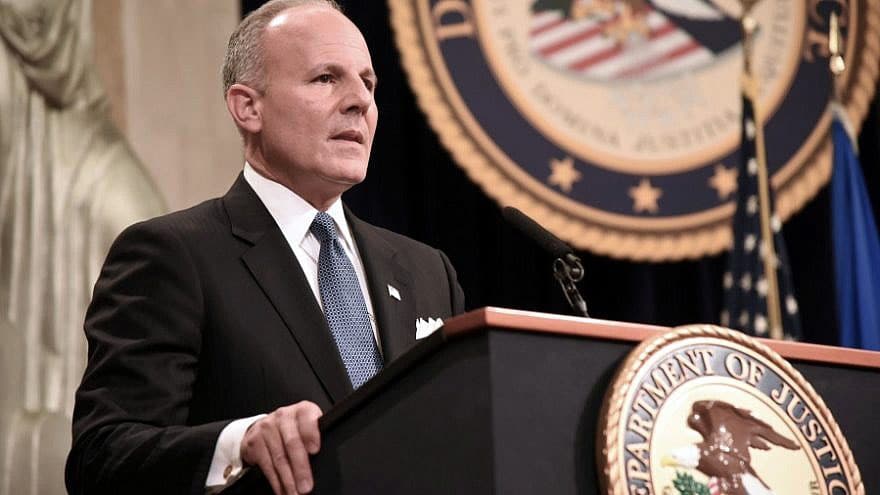
(JNS) – Elan Carr has served as U.S. Special Envoy for Monitoring and Combating Anti-Semitism since February 2019.

Previously, he was a deputy district attorney in the Los Angeles County District Attorney’s office. He was also a judge advocate in the American military’s judicial system, prosecuting enemy combatants before Iraqi judges at the Central Criminal Court. He also served as the international president of Alpha Epsilon Pi (AEPi).

Carr, 51, a Republican, unsuccessfully ran for Congress in 2014 against Democratic Rep. Ted Lieu of California.

He and his wife, Dahlia, have three children.

JNS talked with Carr by phone on Oct. 15. The interview has been edited for brevity and clarity.

Q: Does the federal government have an obligation to go after Big Tech for aiding and abetting anti-Semitism and anti-Zionism?

A: Obviously, a portion of online anti-Semitism rises to the level of crime, and, of course, that should be addressed and addressed aggressively. But the vast majority of online hate is protected by the First Amendment, so the government can’t go after protected speech nor should it.

Q: Would a free-market approach be best to combat anti-Semitism and anti-Zionism on social-media sites?

A: Competition is always a good thing, and certainly, the government has expressed that view specifically in the context of the social-media platforms. At the end of the day, you’ve got some bad actors who are spouting hate on the Internet. One can decide to regulate this or that platform, but at the end of the day, we’ve got to go to the source of the problem. The source of the problem is people hold despicable views. The First Amendment protects despicable views, but it doesn’t mean we can’t condemn them or call them out. I think that is absolutely critical.

One of the things I think is fundamentally important is that the social-media platforms adopt the IHRA definition of anti-Semitism. They haven’t done that yet. We’ve encouraged it publicly and privately. We will continue to push them to do that publicly or privately because I think it’s incredibly important.

You can’t confront a threat unless you define the threat. We have a widely accepted vehicle that defines that threat. The State Department uses the IHRA definition. U.S. President [Donald] Trump issued an executive order that employs the definition for the federal government at large. I think the social-media platforms ought to adopt it and use it as a tool. This is a tool not of censorship, but a tool of education. We want to deal with the haters by meeting their speech with, first of all, condemnation, and second of all, education.

Q: Which platforms specifically aren’t willing to combat anti-Semitism?

A: I don’t want to name names. Obviously, there’s a deep web. We focus a lot on social media and rightfully so. On Twitter and Facebook alone, 1.7 million anti-Semitic posts were made in the first eight months of this year. I was shocked by the kind of things that are said openly and notoriously on these fringe deep-web platforms, so I absolutely think there’s a very, very big problem. This is just raw hate that is being spewed, and it’s dangerous. There are real effects to this.

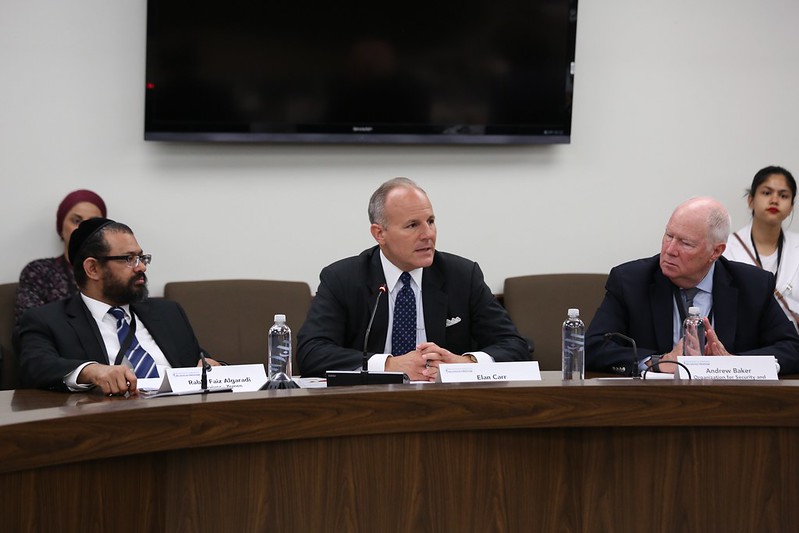
Special Envoy to Monitor and Combat Anti-Semitism Elan Carr speaks at a breakout session on Combatting the Rise of Anti-Semitism at the Ministerial to Advance Religious Freedom at the U.S. Department of State in Washington D.C. on July 17, 2019. Credit: State Department photo

Q: What do the Abraham Accords mean for the fight against anti-Semitism? Could it help diminish anti-Semitism in the Arab world?

A: The Abraham Accords are a game-changer for the Middle East and mark a sea change not only in Arab-Israel relations, but yes, in terms of the global fight against anti-Semitism. A lot of anti-Semitism in the world today is expressed in terms of Israel hatred—the delegitimization and demonization of the Jewish state, and the denial of participation in economic intercourse and ordinary relations with other countries. For the UAE and Bahrain to not only normalize relations with Israel, but to do it in the manner in which they’ve done it—a full embrace, and enthusiastic and affectionate embrace of the Jewish state—is historic, profoundly important and world-changing. I think while this doesn’t spell the end of the BDS movement or the end of anti-Semitism, it is an enormous loss for the anti-Semites of the world who want to continue to exclude Jews and demonize them.

I had the privilege of attending the signing. It was incredibly emotional. A senior member of an Arab delegation came up to me and say, “We’re going to do great things together. This is not going to be a cold peace. This is going to be a warm peace. This is going to be a real friendship.”

You’re going to see more Arab states normalizing relations with Israel. This is an incredible time we’re living in.

Q: For countries like Saudi Arabia that sponsor anti-Semitic content directed at American universities, should eliminating that problem be a contingency for normalization with Israel?

A: From the first days of my appointment to the role of special envoy and in fact my first public speech, I’ve talked about anti-Semitic curricula in the Arab world and how important of a policy priority this is for me. When children are indoctrinated in hate, first of all, it’s an appalling injustice. It amounts to child abuse. But also it does intergenerational damage that’s so difficult to undo, so this is something I have stressed, that I have worked on, and that I will continue to work on as long as I’m in this role. This is a critically important issue. Given the changes in the Middle East, I think Arab states are now more willing than ever before to give a fresh look at their curricula, and how Jews and Israel are treated, and how Jewish history in the Arab world is treated, which is an issue of deep, personal significance to me.

Q: What was your reaction to the Council on Foreign Relations recently hosting a Zoom event with Iranian Foreign Minister Javad Zarif?

A: Javad Zarif is the chief propagandist for the world’s leading state sponsor of both terrorism and anti-Semitism. Any place that welcomes representatives of a country that brutalizes their own people and have committed mass murder through their proxies in Syria, that funds and influences and at times even controls one of the most dangerous terrorist organizations on earth, Hezbollah, that regularly threatens to commit genocide on the Jewish people, that calls Israel “a cancerous tumor.” That recently called the president’s Jewish son-in-law a “filthy Zionist agent”—the list of offenses of this regime is long. It is beyond imagination why any reputable entity would want to give them a platform.

Q: What was your reaction to the settlement earlier this month between New York University and the U.S. Department of Education?

A: The Title VI case. I don’t want to comment on internal matters to the Department of Education, but the allegations that I heard coming out of New York University were very, very troubling. NYU isn’t the only place. We saw several Jewish students run out of elected office at the University of Southern California. We’ve seen harassment all across the country and everywhere in between. It’s been very rough for Jewish students on far too many campuses.

Q: Despite Trump recognizing Jerusalem as Israel’s capital and moving the U.S. embassy to there, U.S. citizens born in Jerusalem still cannot list “Jerusalem, Israel” as their place of birth on their U.S. passports. Is the administration considering making a move to allow U.S. citizens to do so otherwise?

A: I am aware of that issue, and I know that issue has been actively discussed and looked into it by the appropriate people and I will say at a very senior level.

Q: Is it still under active consideration?

A: I don’t know.

Q: As we head into the election, how has your current role compared to your previous jobs? Has your current position been your greatest challenge?

A: It’s been my greatest joy. I loved being a criminal prosecutor. I loved and still am a U.S. Army officer. As a criminal prosecutor, I fought to keep our communities safe. As an officer, I fought to keep my country safe. And now in this role, on behalf of the United States of America, fighting to keep Jewish people safe across the world. It’s an incredible privilege. And it’s also a privilege to serve my country in a substantial capacity. It’s a privilege to serve in this administration. It’s been an absolute joy to do this. Is it a challenge? Of course. But what isn’t a challenge. Any substantial office in the U.S. government is very challenging. Fighting what’s often called the world’s oldest hatred is certainly challenging.

But I’m optimistic. There is a lot of good news out there. Yes, we have every right to highlight the bad news because that’s a good thing to do. You want to know what’s bad so that you know what to fix. But we should never ever forget that there is a lot of good news. The changes that are being made. The partners that we have, non-Jewish leaders at all levels of government from the most senior on down who are champions of this cause. Who are deeply offended by Jew hatred and fight it with every fiber of their being. It’s one of my greatest privileges in this job to be able to work with leaders around the world who are so committed to fighting for the Jewish people because it’s the right thing to do.

US Envoy Carr: 1.7 Million Anti-Semitic Posts on Facebook, Twitter So Far in 2020 Read More »

What’s Behind The Biden Door?

2020 may be the first election in American history when a majority of voters will cast their ballots against a sitting president rather than for his challenger. Joe Biden doesn’t have the burden to convince Americans why they should vote for him. The incumbent is disliked by enough voters to render irrelevant how uninspiring and slippery the former vice president is.

Early voting has commenced in some states, and many reports indicate that Biden is benefitting from widespread disillusionment with Trump’s presidency—the boorishness and crassness, the flouting of diplomatic norms, the anti-Democratic and authoritarian impulses, the scaremongering and wedge-driving, the apparent self-dealing, and the poor moral example he has set for the country. For these voters, any achievements of the Trump administration must go unmentioned. There is too high a risk of some having a change of heart at polling sites. Best to let the disgust linger.

And there has been plenty of disgust to go around. The mainstream press, for instance, voted earlier than anyone. Their minds were made up immediately after Trump’s inauguration. And they have been voting ever since with unfavorable coverage of the president.

Of course, all of Trump’s unpresidential “fake news” and “enemy of the people” chants didn’t win over the Fourth Estate, although he was a ratings sensation these past four years. Biden’s blandness doesn’t sell papers, but the mainstream media, like many voters, has been rooting for the vice-president anyway.

And in so doing, they have actually proven Trump’s case that news is not simply censored, it can actually be “fake”—as in, slanted, not objective, and agenda-driven rather than painstakingly true. The disinterest in the Hunter Biden story is but one example. Or look at the scant mention of Joe Biden’s predilections for plagiarism, given that every personal failing of the president is scandalized.

Biden’s ambivalent support also includes some of the cool kids. A gnarly blue wave of A-list academics, writers, artists, and student bodies have long lined up against the president even though many of them preferred Senator Bernie Sanders or Mayor Pete Buttigieg to Biden. Undeniably, for most Democrats, Biden is the safe, lackluster choice in an aberrational election where any candidate who can deny Donald Trump a second term will do.

But is such one-dimensional, single-hatred voting a good idea?

First, counting out this president is a huge mistake. After all, Democrats have had trouble winning elections, often because their read on red states borders on the illiterate. “The Hillbilly Elegy” — a bestselling memoir that addresses the failure of social welfare policies and the virtues of self-reliance and hard work in Kentucky — became a manifesto for conservativism, the kind of text that, for blue-state Democrats, is as alien as a page from the Talmud. Sneering contempt for white, non-college-educated Americans is a bizarre partisan fetish. And Biden’s propensity for ill-advised remarks should be of concern to anyone who still fails to grasp how calling half the country “deplorables” (as Hillary Clinton did in 2016) will result not in the punching of the Democrat ticket, but the punching of smug Democrats!

But there’s also an elephant in the room, and it involves Democrats, not Republicans. We have no way of knowing the true extent of Trump’s electoral support, because far too many are afraid to acknowledge that he’s their man.

Who can blame them? We live in such a polarized, balkanized political culture that a vote for Trump is likely to detonate nuclear families and torpedo friendships. Exercising the franchise in favor of this loathsome candidate could not possibly be more unfashionable, if not downright lethal. It is the kind of hatred that has brought us to the brink of civil war — even within families. Moral banishment and social ostracism are the new ethic, all because only one opinion of Trump is tolerated.

Moral banishment and social ostracism are the new ethic, all because only one opinion of Trump is tolerated.

And so undecided voters sit silently while neighbors bicker and talking heads seethe. But why are they undecided — especially if they are Democrats? Doesn’t everyone know the chaos of this presidency?

Yes, they do. But casting a vote against Trump is not without risk. After all, Biden is not really the people’s choice. His support is tenuous, his candidacy a ricochet, his campaign beside the point. He’s the man behind door number  two, but standing behind him is a cast of avowed Democratic Socialists who may transform America in ways that would make the Age of Trump seem tame by comparison.

Biden is not really the people’s choice.

Those who are wary of Biden have reasons to fear his presidency — a doddering man who by all accounts is a placeholder and not a leader. He was nominated as a moderate who could win. In order to accomplish that, he may become indebted to those who wish to abolish and transform. There are many waiting in the wings, the left wing to be precise, for this very purpose, like Senator Sanders, who better reflects the new zeitgeist of the party, which pays allegiance to a political philosophy that has little in common with mainstream liberalism.

Will Biden be able to hold them back?

Look, for instance, at the fresh-faced leaders of this new brand of American Democratic Socialism: the sisters of the congressional “Squad,” who bring with them more woke than wonk. A politburo of progressive wildcards seeking universal college tuition and healthcare coverage with no means to pay for it, school admissions guaranteed without regard to merit (including the end of blind auditions for orchestras), a rewriting of history that demands a snubbing of Founding Fathers, prison reform where paroled offenders roam the streets, Occupy Wall Street decimations of businesses, the defunding of the police with soft spots for rioting and looting, social conditions that could replicate the crime rates of the 1970s, a blind commitment to intersectional catechisms and moral absolutes, a return to the misguided Iran deal, a BDS-based foreign policy that seeks an end to the Jewish state, and the flight of young professionals and families from urban areas in search of shelter and security elsewhere.

This is the kind of transformational change that hasn’t been seen since the New Deal of FDR.  Do we believe that this new progressive agenda will change the country for the better, or will the mere prospect of such policies influence enough voters to consider another four years of Donald Trump?

It was an ominous sign that Congresswoman Alexandria Ocasio-Cortez rebuffed a memorial to Israeli peacemaker Yitzhak Rabin. Biden may head the ticket, but this might become the Democratic Party of Bernie Sanders, not Bill Clinton.

Biden repeatedly states that he’s not a socialist. That may be true. But he may end up defenseless to the progressive voices within his party. That’s where all the energy and excitement is nowadays. But it’s also where illiberal assaults on free speech and open inquiry, in the name of racial justice and white atonement, are alarmingly located. This mass movement is bound to accompany Biden to Washington. And its leaders might serve as his entourage in the White House.

Be careful what you wish for, America. What’s behind door number two looks like a bounty of buyer’s remorse. Wouldn’t it just be awful if whiplash left you longing for the madness of Donald Trump.


Thane Rosenbaum is a novelist, essayist, law professor and Distinguished University Professor at Touro College, where he directs the Forum on Life, Culture & Society. He is the legal analyst for CBS News Radio. His most recent book is titled “Saving Free Speech … From Itself.”

What’s Behind The Biden Door? Read More »

Perspective Home Shalom Toolkit

Henry Good, Teen Consultant with Home Shalom

What do we see and how do we see it? Perspective is an extremely important part of life, and how we see the world. In life, perspective is all about being in the right place and the right feeling. When we approach our daily activities and duties, we must be aware to have a positive outlook and perspective. Sometimes, we wake up on the wrong side of the bed in the morning, and that can lead to poor trains of thought throughout a day. We can see that the general wrong perspective on life, generally a pessimistic and sad attitude can lead to unfortunate outcomes and life choices. With this, we must do things to ensure that our attitude and perspective towards life is good. When you wake up, text somebody “good morning!” When you go for your morning coffee, purchase one for the person behind you! Do mini mitzvah for those around you, and your perspective on life will change! Perspective is all about how you visualize the world, and if you do good things, the world will reward you with a wonderful perspective and view on life!

***

Rabbi Steven Carr Reuben, Ph.D., Founder of Home Shalom

Two thousand years ago, the Talmudic Sage Hillel wrote “Don’t judge your neighbor until you have stood in your neighbor’s place.” This empathy challenge is found in nearly every culture in the world. Whether it be the Native Americans urging us to “walk a mile in another’s moccasins,” or Atticus Finch in To Kill a Mockingbird, saying, “You never really understand a person until you consider things from his point of view, until you climb inside of his skin and walk around in it,” we are reminded that our way of thinking and seeing the world is not the same for everyone. This proverb comes to life most dramatically in a remarkable exhibit inside a giant shoe box located in Ibirapuera Park in Sao Paulo Brazil. The exhibit is entitled, “A Mile in My Shoes,” and is Brazil’s “Empathy Museum.” It has no paintings or other works of art, only well-worn shoes and recordings of the personal stories that accompany each pair of shoes, allowing each visitor to experience walking a mile in the life of another. Judgments close down the mind, and empathy opens the heart.

***

Judy Gordon, Home Shalom Consultant

My dad once told me that to be true to my friend I needed to look through their eyes. I remember being so confused. I said, “But, what if I’m right?”  

Being right is okay as long as we remember that, with some exceptions like scientific fact, right and wrong are based on our perspectives. Where do we come from? How does our culture view things? Perspective is not fact, nor is it truth. Perspective is what we feel about truth or facts.  Facts are not good or bad. They just are. Perspective is how we each see those facts affecting our lives. We choose the facts that are most important to us and they vary from person to person.  

Facts don’t change, but perspective can. I learned that looking through someone else’s eyes, or walking in someone else’s shoes may not change my perspective, but it will help me appreciate where others are coming from. And perhaps, if I truly listen and truly see, I will truly consider what they are saying, feeling and believing.

***

Naomi Ackerman, Founder, The Advot Project

Perspective is Subjective Interactive Exercise

When we communicate with each other, it is important to remember that people have different perspectives and what I see as “blue” someone in a different light might see as “red.” If we don’t come into the conversation respecting different perspectives there will be no way to move forward. 

This is a great place to explore the concept of “I agree to disagree.”

Introduce:

Explain that during this exercise we are going to explore perspective.

Ask:

Can someone define the word perspective? Explain that perspective can be synonymous with point of view or viewpoint or opinion and is an individual experience.

Act:

Ask for two student volunteers.

Provide each student with a large prop phone.

Explain that they are two classmates, talking on the phone about the fact that “last night, a boy and a girl were seen leaving a party together.”

Any other scene details can be decided before as a group, or you can encourage the pair to improvise.

The two students may play two students, two boys/two girls, the opposite of their gender, the parents of the kids who left the party, etc.

Discuss:

Discuss how different each scene was and how that illustrates that perspective is subjective.

Discuss the differences when it was two boys discussing the incident versus two girls and how a parent discussion also changes things.

Bring it back to the group understanding that when they are in conflict with others, or there is confusion about details of what “went down,” it is essential to understand that every person’s perspective is subjective to their personality, experience, and viewpoint.

You can use any situation here and explore it from different peoples’ perspectives: 

Example – A snow day from school 

How would two students talk about this?

How would two parents talk about this?

How would two teachers talk about this? 

Each couple will react to the snow day differently based on their perspective.

The post phone call discussion is important to establish that sometimes people’s perspectives are different because they have a different relationship to a situation or event.  

A teaching point can be to say, “This may be true. However, I…“ and take the time to explain your perspective.

Perspective Home Shalom Toolkit Read More »

Happy Trails to You

We met in 1985 at an Aish Hatorah class. He didn’t look like a Rabbi and she didn’t look like a Rebbetzin. They looked like two young people you would hang out with and shoot the breeze. But there are a few people in life that, every time you see them, you feel a shot of happiness shoot through your veins. Rabbi Nachum and Rebbetzin Emuna Braverman are two of those people.

Now thirty-five years later, Nachum and his wife Emuna are moving to New Jersey from the Pico Robertson community in Los Angeles. Can you believe they want to leave us to be closer to their children and grandchildren? How selfish.

In leaving, they are saying goodbye to so many people they touched with their kindness and Torah wisdom. I took my first ever Torah class with Nachum, and he was the first person I ever considered my Rabbi. I remember Emuna was busy putting out pitchers of water and cookies for after the class. It was probably the same spread they gave Sharansky on his birthday in the Soviet Prison.

In leaving, they are saying goodbye to so many people they touched with their kindness and Torah wisdom.

One Shabbos lunch, they invited me and my parents to join them. Nachum asked me what my definition of a “hero” was. After I babbled some nonsense, Nachum pointed at my father and said, “He’s a hero. He showed up every night at the dinner table for 39 years. That’s a hero.” I cried, and my father cried.

Jacob and Debby Segura go back three decades with the Bravermans. Jacob said what he loves about Nachum is “his inside and outside are the same. There is no difference between his essence and what he shows to the world.” For the last ten years on Shabbos, his wife Debby would walk to Emuna’s house to learn. Debby gets emotional when speaking about Emuna leaving. “She’s so generous and never loses patience.” Debby hopes she can continue her studies without her rock Emuna.

In 1999, Mitch Julis went to Israel with his family. Except for Mitch, this was his family’s first trip. A concerned Nachum flew out to Israel for 24 hours to see how they were doing. Mitch said, “Nachum taught me a framework and value system, so I did not have to make up my own. Nachum is my Rabbi, friend and a brother.”

The Braverman’s impact on Diane Faber’s life has been enormous. She said, “The Bravermans made me feel valued during the long dry spell which preceded my late life marriage. These are two vastly different individuals, who together have built a world. They are among my very dearest friends, and central to my spiritual pantheon.”

When Sarah Weintraub speaks of the Bravermans, you sense her deep love and respect for them. She told me, “Great friends are hard to find, difficult to leave, and impossible to forget. At some time in everyone’s life, our inner fire goes out. If we are lucky, it bursts into flame by an encounter with another human being. Nachum and Emuna kindled my inner fire and fanned my flames. Their wisdom, love and kindness changed the course of my life forever and a new world was born.”

Michael Abramson was at the first class Nachum ever taught in Los Angeles. He said, “They are a guide to a world I’d never imagined. Guide to Hashem and instructions for living.” He moved here from the Valley so that he could be closer to them.

Holly and Terry Magady met each other in Nachum and Emuna’s living room. Nachum eventually married them. Holly said, “It feels like an end of an era. We’ve all been on this journey together. I can’t imagine life in the Jewish community without them.” Terry added, “The Judaism that drew us to Torah, they reflect that and embody that. They changed lives through loving people. They invested in each person.”

I believe that what they tried to teach us in this community for the last 35 years is, most importantly, that we should know that God loves us. And we want them to know we love them. Until we meet again, Bravermans.


Mark Schiff is a comedian, actor and writer.

Happy Trails to You Read More »

Joel Miller on His New Book ‘Memoir Of A Roadie,’ Judaism’s Role In His Career

Now into my late 30s, I have been writing articles and conducting interviews for over 20 years. In turn, whether I like or not, I get pitched new products and press-related opportunities – for coverage purposes, of course – around the clock just about every day of the week. And quite honestly, the majority of these pitches have nothing to do with what I am interested in, or even what I write about.

Earlier this month, I got a pitch related to a California-based author named Joel Miller. The pitch talked about how Miller’s new book “Memoir Of A Roadie,” which had recently hit the #1 spot on Amazon within the site’s “biographies” category. As a music-oriented person, I saw the word “roadie” and kept reading that e-mail. Ultimately, I caught onto the fact that Miller had worked on the road crew of a lot of major rock bands, including Guns N’ Roses, Stone Temple Pilots, Poison and The Cranberries. I next picked up on the fact that Miller was of Jewish descent – and let’s face it, there traditionally aren’t a lot of Jews on the touring crews of hard rock bands. And in the words of long-time Guns N’ Roses keyboardist Dizzy Reed after reading Miller’s book: “I was forced to relive moments I’d intentionally blocked out. Great read!”

I promptly started reading the e-book version of “Memoir Of A Roadie” and within a few days of that pitch, I had not only finished reading the book but had set up a time to speak with Joel Miller via Zoom. We chatted on October 14, 2020, as embedded below, and also discussed his award-winning 2006 film “The Still Life,” which he wrote, produced, directed, cast and financed. A great guy – to say the least – with lots of great stories to tell.


More on Joel Miller can be found here and here.

Joel Miller on His New Book ‘Memoir Of A Roadie,’ Judaism’s Role In His Career Read More »

Thinking Outside the Scantron

This week, I, along with millions of my fellow high school students, learned that the SATs had been canceled once again.

As a high school senior, I’ve gotten used to the massive disappointments that have come with 2020. And like students everywhere, I’m doing my best to stay motivated, even during the pandemic.

But this news was a serious gut punch — even more so because it could have been avoided.  The College Board, which oversees the SATs, has undermined our hard work with its failure to find creative ways for us to take this important test.

I wasn’t exactly looking forward to taking my SATs. Nonetheless, I signed up to take them at a local high school in March. But I soon changed my test date to May to participate in a rescheduled soccer game. That game and the May test were canceled due to COVID-19. I then registered for the August SAT, only to have that canceled because of the pandemic, too. I tried to sign up for the September test, but the closest slot was at a school nine hours away—on the other side of an active brush fire.

Determined to be a competitive college applicant, and filled with the renewed hope of the new year, I signed up for the October SAT at a neighboring county school. But that was canceled, too. I signed up for November, and then this week found out that it was—you guessed it, canceled. My last chance is December; I am currently scheduled for the test at the same school where I was supposed to take it back in March.

Cancellation after cancellation, I have kept studying, learning how to fill in the right ovals on the test page, poring over Greek and Latin etymology, and reviewing mathematical theorems. I’ve taken multiple full-length practice exams and have consistently scored in the range that will put me in play for my target schools.

But I’m not holding my breath. California’s case numbers are simply not decreasing quickly enough to allow schools to provide the tests in their traditional format. Even if I get to take the SAT, some of the schools I am applying to will already have made their decision.

Even if I get to take the SAT, some of the schools I am applying to will already have made their decision.

This blow is softened somewhat by the decision by most colleges –– including the University of California system –– to not require SAT scores.

But the College Board has failed to adapt to the times. There are so many ways it could rise to this moment: Offering outdoor SATs by using high school stadiums or basketball courts to sit students safely apart. Offering the test more often so they could have fewer people taking them at a time. Finding a way to offer the test online, which they did for the AP exams at the end of the 2020 school year. Finding ways to show that this educational non-profit cares about the students it purports to serve.

Instead, the College Board has left high school students across America to fend for themselves. The organization simply schedules tests, cancels them, and tells students to keep trying. Meanwhile, college applications are due starting in November. There is no more time for the class of 2021.

I am not suggesting that all colleges prohibit using SATs in admissions decisions. In fact, I hoped to gain an advantage in the admissions process with a strong score. With many of my extracurricular activities and most of soccer season canceled, that advantage would have been more important than ever. And we do need to have a wider discussion about the fairness of the test overall, as many studies have shown that it favors white and wealthy test takers. But that is not the issue I am raising here.

I am one of 3.7 million U.S. students who will graduate from high school this year. My fellow students from the class of 2021 are adjusting: We take classes online. We have soccer practice wearing masks. We hope for a prom. We go to virtual birthday parties and sit apart from each other in our backyards. Where we once had part-time jobs and freedom, we now have health regulations and TikTok. We have creatively adjusted to our new reality as well as we can.

We’ve done our part –– why hasn’t the College Board done theirs? The College Board must be held to the same standard that high school students are being held to: Adapt. Adjust. Be resilient. Don’t give up. Think outside the box –– or in this case, outside the tiny little ovals that we fill in on the way to college.


Libby Smith is a high school senior at New West Charter+ in Los Angeles, California.

Thinking Outside the Scantron Read More »

Shabbat Project Delivers Candles to Homes

In 2017, shortly after a mass shooting occurred in Las Vegas, plans for an open-air Shabbat dinner on Pico Boulevard (as part of the global unity program, Shabbat Project) were cancelled.

Similarly, this year, the COVID-19 pandemic has forced the hundreds of volunteers behind the 2020 Shabbat Project to get creative with how they plan their programs.

Emphasizing the at-home nature of this year’s Shabbat Project, a group of volunteers — including students from Bais Yaakov, an Orthodox girls school near Hancock Park — are planning to deliver 150 kits of a yearlong supply of Shabbat candles to women of all backgrounds across Los Angeles.

“Since lighting candles is an important, easy, and beautiful mitzvah, the thought of encouraging other women to light really appealed to our group,” Sharon Wiener, a L.A. Shabbat Project committee member, said in an interview. “Lighting candles really sets the mood in our homes for Shabbat, and really helps us set the time as special, away from the obligations of the rest of the week. Lighting candles tells us it is time to stop, unplug, [and] spend time with the people and things that are most important in our lives.”

The kits will not only have candles but also will have candle holders, blessings to be recited, and contact information for people in the Shabbat Project community — “anything like that to stay connected with someone in the community,” Wiener said.

The kits will not only have candles but also will have candle holders, blessings to be recited, and contact information for people in the Shabbat Project community.

Started in 2013 in Johannesburg, the Shabbat Project is a worldwide, independent, and grassroots movement that encourages Jewish communities around the world to observe a single Shabbat.

Although previous years’ Shabbat Project programs gathered people for a variety of in-person events, including concerts, challah bakes, and dinners, this year’s Shabbat Project, held November 6-7, will be all virtual programs, from cooking classes to challah bakes, Shabbat flower deliveries to storytelling, arts-and-crafts events to discussions over Zoom.

Those interested in receiving the candle-lighting kit can sign up by emailing lashabbosproject@gmail.com.

“The team at the Los Angeles Shabbat Project was attracted to doing something home-based this year,” Wiener said. “We like the idea of bringing more light and peace into the world and into our homes.”


Shabbat Project Delivers Candles to Homes Read More »

NYT Criticized for Running ‘Glowing’ Op-Ed on Farrakhan

The New York Times has come under fire running a “glowing” op-ed on Nation of Islam leader Louis Farrakhan on October 17.

The op-ed, titled “The Women Behind the Million Man March,” details how Black women gave Farrakhan advice on how to counter “critiques that the Million Man March was exclusionary and sexist” and helped register “hundreds of thousands of Black men” to vote.

Bari Weiss, who resigned from The New York Times in July, noted in an October 18 Twitter thread that the op-ed would make you “think [Farrakhan] was a gentleman” and “deferential to women.” Weiss then highlighted various anti-Semitic quotes from Farrakhan, including Farrakhan saying in 2019, “Pedophilia and sexual perversion institutionalized in Hollywood and the entertainment industries can be traced to Talmudic principles and Jewish influence. Not Jewish influence, Satanic influence under the name of Jew.”

“When The Times ran the infamous anti-Semitic cartoon [in 2019], the issue was not that editors were hardened anti-Semites,” Weiss tweeted. “It’s that they didn’t even *notice* it. This shouldn’t surprise. It’s part of a worldview in which Jew hate does not count.”

Jewish groups also condemned The New York Times op-ed.

“Stunned NYT ran a piece describing Louis Farrakhan in such glowing terms, ignoring his history of hate & #antisemitism,” Anti-Defamation League CEO Jonathan Greenblatt tweeted. “Even in discussing women’s unsung role in the Million Man March, failing to mention the serial bigotry of its organizer normalizes it.”

Greenblatt subsequently wrote a letter to the editor to the Times pointing out that Farrakhan said in February 1995 “that it was Jews who got America into World War II and that ‘international bankers’ (code words for Jews) financed both sides of the war effort.” He also noted that in July, Farrakhan called Jews “the enemy of God” and referred to certain Jewish leaders as “Satan.”

“While Mr. Farrakhan may have created opportunities for women of color, his long and unapologetic record of hateful slurs and conspiratorial statements about Jews long ago cemented his status as a serial bigot,” Greenblatt wrote. “When this type of hatred is ignored, it normalizes such intolerance and makes it more acceptable for others to hold such dangerous views. This cannot be omitted from any honest appraisal of him.”

The American Jewish Committee also tweeted, “Bravo, @bariweiss, for your moral clarity in calling out this shocking @nytimes op-ed about the Million Man March. Louis Farrakhan is a vile antisemite and racist who preaches vitriol and hatred. His bigoted views must not be glossed over or mainstreamed.”


CNN’s Jake Tapper also noted in a tweet that the late Rep. John Lewis (D-Ga.) “didn’t participate in the Million Man March because Farrakhan had made comments that were ‘divisive and bigoted.’”

The author of the op-ed, Howard University assistant professor Natalie Hopkinson, tweeted in response to criticism that she didn’t mention Farrakhan’s history of anti-Semitism, “You don’t center the marchers. You dont center the Black women who are named and linked. You dont even center Farrakhan. You center yourself and your feelings. Exactly the problem with history.”

https://twitter.com/NatHopkinson/status/1317908612086419457?s=20

In a subsequent tweet, she stated that such concerns are an example “privilege;” in another tweet, Hopkinson wrote that people “who have become white should not be lecturing Black [people] about oppression.”

https://twitter.com/NatHopkinson/status/1317923473155624962?s=20

https://twitter.com/NatHopkinson/status/1317930965726040064?s=20

Weiss tweeted that in Hopkinson’s “worldview, ‘people who have become white’ — Jews — cannot call out Farrakhan’s evil.”

The Times did not respond to the Journal’s request for comment.

Hopkinson said in a statement to the Journal, “The Black women whose voices I elevated in the NYT essay speak for themselves. The other tweet on the new book ‘Caste: The Origins of Our Discontent’ was not related to the essay. I suspect that is where most of the misunderstanding came from. Bigotry is our common enemy so I would like to stay focused on uniting and defeating that moving forward. This Wednesday, I will be talking about the book, not as an expert on religious identity of any kind, but as a reader grateful to learn more about the intersections between our two historically marginalized communities.”

NYT Criticized for Running ‘Glowing’ Op-Ed on Farrakhan Read More »

Life, Liberty, and the Pursuit of Victimhood

With so many crises and news events swirling around us, it’s not easy to notice an underlying cultural shift that may threaten the very essence of America.

The COVID-19 pandemic, tribal political warfare, racial unrest, and upcoming elections are sucking up much of the media attention. But however epic these events may be, they’re not likely to fundamentally change the nature of our country.

What is more threatening is a rising culture of chronic victimhood.

If the coronavirus threatens our physical well-being and economy, the worship of victimhood threatens the aspirational promise of America. It does so by replacing the resiliency and imagination of optimism with the fragile passivity of victimhood.

Victimhood means that anything bad that happens to you is someone else’s fault. It is a liberating sentiment because you need not take responsibility for any misfortune. You are constantly off the hook, free from the oppressive pressure of self-blame.

A recent article in Scientific American, “Unraveling the Mindset of Victimhood,” notes another benefit of victimhood — a “sense of moral elitism.” Those who score high on the victimhood scale “perceive themselves as having an immaculate morality and view everyone else as being immoral. Moral elitism can be used to control others by accusing others of being immoral, unfair or selfish, while seeing oneself as supremely moral and ethical.”

Embracing victimhood, in other words, doesn’t just free you from responsibility, it also gives you a higher moral standing. That seductive combination may help explain the rise of the grievance industry.

Among the first to recognize this trend were Greg Lukianoff and Jonathan Haidt in their 2018 book, “The Coddling of the American Mind.” The authors introduced and made prominent a new vocabulary of grievance prevalent on college campuses. Terms like microaggressions, safetyism, safe spaces, identity politics, and cancel culture have become ubiquitous.

They all revolve around one main idea: Nothing is ever my fault. If something goes wrong, if I feel offended or “unsafe” in any way, the solution is never within me — it is always outside of me.

This sugar high of feeling like a victim, of course, comes with a serious downside. Any therapist will tell you that chronic victimhood is not good for one’s emotional or psychic health. The Scientific American article asserts that “focusing on grievances can be debilitating.” For instance, those with a high level of victimhood “constantly ruminate and talk about their interpersonal offenses and their causes and consequences rather than think about or discuss possible solutions.”

We also know from personal experience that blaming others for our woes is hardly the path to success, happiness and progress.

President John F. Kennedy knew this as well, which is why he uttered one of the great callings in American history: “Ask not what your country can do for you; ask what you can do for your country.” His line was the antidote to victimhood.

And yet, six decades later, we have allowed a pervasive culture of victimhood to permeate our society.

One reason this trend has snuck up on us is that genuine grievances can generate enormous empathy. Who can argue with the grievances of racism, discrimination or social injustice? All too often, though, the anger triggered by these grievances nourish pervasive victimhood more than they nourish solutions.

The Black Lives Matter (BLM) movement is a good example. The slogan is certainly beautiful and moral, and excising racism is a supremely worthy goal. But awash in their victimhood, some BLM activists have lost sight of actual solutions and reforms. As Andrew Sullivan writes, “BLM’s critical race activists do not support reforming the police, they want to abolish them entirely. In fact, they demonize all cops as ‘bastards,’ and they justify violence and exonerate crime as legitimate resistance to the far greater crime of white oppression.”

And let’s not be naïve: the grievance industry is lucrative. Virtue-signaling corporations are eagerly donating to BLM-connected causes, while the cultural pillars of society, from the media to academia to Hollywood, have scrambled to catch up. Because victimhood is a source of power, it has become an end in itself.

The fallout from this thriving grievance/victimhood industry is that we are eroding two pillars of the American dream: Hope and optimism. Victimhood engenders the very opposite of the “can-do” spirit that built America through impossible challenges.

The fallout from this thriving grievance/victimhood industry is that we are eroding two pillars of the American dream: Hope and optimism.

If you believe, for example, that America is an irredeemably racist country, what is there to protect or defend? If you ignore the considerable progress America has made over its history, where do you find hope and optimism?

There’s a difference between fighting against injustice and fighting against a hopelessly racist country. In the first, which was the approach of Dr. Martin Luther King Jr., you use the tools provided by our constitutional system of laws and rights to seek redress and progress. In the second, you’re so angry at the system that you’d rather overturn it than reform it. The first offers hope; the second reinforces victimhood.

Perhaps the epitome of the grievance industry is exemplified by The New York Times’ 1619 Project, which reframes the birth of America around slavery rather than its founding ideals. The project, which is being introduced in schools, has come under sharp criticism from historians, scholars, and, most recently, New York Times columnist Bret Stephens.

Perhaps the epitome of the grievance industry is exemplified by The New York Times’ 1619 Project, which reframes the birth of America around slavery rather than its founding ideals.

“Contrary to what the 1619 Project claims,” Stephens writes, “1776 isn’t just our nation’s ‘official’ founding. It is our symbolic one, too. The metaphor of 1776 is more powerful than that of 1619 because what makes America most itself isn’t four centuries of racist subjugation. It’s 244 years of effort by Americans — sometimes halting, but often heroic — to live up to our greatest ideal.

“That’s a struggle that has been waged by people of every race and creed. And it’s an ideal that continues to inspire millions of people at home and abroad.”

In a conversation with Bill Kristol on July 22, 2020, Princeton Professor Sean Wilentz challenged the idea that the arrival of slaves in 1619 defines America.

“The United States didn’t even exist in 1619,” he said. “By the time you get to the American Revolution, and by the time you get to the Constitution … The American colonies had given birth to the anti-slavery movement in the Atlantic world. They had begun with the Quakers very early on in 1688 or so but, actually, in the 1760s and 1770s there were plenty of Northerners who were railing against slavery, saying in fact that how can we call ourselves lovers of liberty if we have these slaveholders among us?

“And, in fact, the Northerners were starting the very first successful emancipation projects, again, in Atlantic history. The very first national emancipation law was passed in Pennsylvania in 1780. The first Constitution actually that banned adult slavery was enacted in Vermont in 1777. The first anti-slavery society in the history of the world was established in Philadelphia in 1775, about five days before Lexington and Concord.

“So, this is America, and it’s not that America is anti-slavery. It’s a fight; it’s an argument from the very beginning. There is no one thing about America and slavery. To say that racism and slavery are foundational to America obliterates the fact that when the United States was being formed there is anti-slavery out there as well, not only coming from the enslaved.”

When Wilenz says that “it’s a fight, it’s an argument from the very beginning,” he is expressing one of the founding ideas of America — a struggle to create a more perfect union.

In his last speech as president, Barack Obama spoke of this struggle as “the great gift that our Founders gave to us: The freedom to chase our individual dreams through our sweat and toil and imagination, and the imperative to strive together, as well, to achieve a common good, a greater good.”

Regardless of which political side you’re on, if you don’t believe in that America, then you don’t believe in hope.

The horrible pandemic of 2020 has made it hard to believe in hope, creating millions of real victims who have every right to feel victimized. But rather than politicize the reactions to COVID-19, we ought to struggle and strive together, as Obama said, “to achieve a common good, a greater good.”

In that spirit, we have a choice: Do we want America to be defined by irredeemable sins or by a relentless drive to perfect itself? If we pick the former, we will nurture a generation of resentful victims who will always be angry at America, regardless of circumstances. If we pick the latter, we will nurture a generation of can-do Americans who will renew the promise of life, liberty, and the pursuit of what we can do for our country.


Life, Liberty, and the Pursuit of Victimhood Read More »