fbpx

September 30, 2020

Without RBG, a Rosh Hashanah Like No Other

I cooked meals for my family for Rosh Hashanah. I reviewed the service I had planned to lead that night from my home. There would be no big in-person family meals or services, only Zoom. But if ever I needed a new beginning, it was now. I wanted to put 5780 into the trash bin and start over in joy.

Then I heard the news that Supreme Court Justice Ruth Bader Ginsburg had died. My eyes filled with tears and my spirits fell. How could I lead festive services when my heart was filled with sorrow? How could I find the words to pay tribute to her life with so little time to reflect? How could we start the new year like this? With the pandemic, the killings of Breonna Taylor and George Floyd, the shooting of Jacob Blake, the fires, and now this — it was all too much.

Somehow, as the service began, seeing familiar faces of congregants on the screen lifted me a little. To pay tribute to RBG, I needed to look no further than the song we had intended to begin the service, “Pitchu Li” — “Open for me the gates of justice, I will enter them and thank God.” (Psalm 118:19). That’s what RBG did. She opened the gates of justice wider for women and for everyone in this country.

The words she embodied are also in the first sentence of the Torah reading of the last week of her life, read on Shabbat before Rosh Hashanah. With these words Moses summoned the whole people to ratify the covenant:

“You stand this day, all of you, before Adonai your God, your tribal heads, your elders, and your officials, all the men of Israel, your children, your wives, even the stranger within your camp, from the woodchopper to the water drawer — to enter into the covenant of Adonai, your God.”

Moses specified that everyone was to be included in the community.

Ruth Bader Ginsburg conveyed the same idea in her speech at her nomination hearing for the Supreme Court in 1993:

“One of the world’s greatest jurists, Judge Learned Hand, said that “the spirit of liberty that imbues our Constitution must lie first and foremost in the hearts of the men and women who compose this great nation … a community where the least shall be heard and considered side by side with the greatest.” I will keep that wisdom in the front of my mind as long as I am capable of judicial service.”

RBG opened the gates of justice wider for women and for everyone in this country.

Ginsburg’s decisions showed that she fulfilled this promise.

I take comfort in the idea that I spent Rosh Hashanah in a way Ginsburg may have liked. After leading virtual services on erev Rosh Hashanah, for the rest of the holiday, I watched the virtual services led by Rabbi Naomi Levy of Nashuva and Rabbi Sharon Brous of IKAR — who both paid tribute to Ginsburg. Levy and Brous had the courage to create their own congregations from scratch, and they have grown into large, thriving communities. Both are true prophets in the spirit of Ginsburg.

On Rosh Hashanah day, my stepmother, Melissa, recounted the time she met RBG during Ginsburg’s Senate confirmation. “Jewish women everywhere are proud of your accomplishment,” Melissa told Ginsburg.

“My grandchildren call me Bubbe,” Ginsburg replied.

How fitting now that Melissa retells this story as a Jewish grandmother to our children (who call her Safta).

We then had dinner over Zoom with our children’s other Safta and Saba and family. Over the rest of the holiday, I read the biography that my mother, Linda Bayer of blessed memory (who my children called Bubbe), wrote about Ginsburg. On the inside cover, my mother wrote me an inscription:

“May you continue to break down the barriers of discrimination and ignorance that hurt us all.”

In this New Year, in memory of Ginsburg, may we all resolve to do just that.

Rabbi Ilana Grinblat is the vice president of community engagement for the Board of Rabbis.

Without RBG, a Rosh Hashanah Like No Other Read More »

Are the Proud Boys Anti-Semitic? Your Primer on the Far-Right Group Trump Told to ‘Stand Back and Stand By’

(JTA) — Who are the Proud Boys, the far-right group that Donald Trump name-checked at the first presidential debate? And do they hate Jews?

The answer to the second question: Some of them — including their founder — certainly do.

Let’s back up: At the debate Tuesday night, moderator Chris Wallace asked Trump whether he would condemn white supremacists from the debate stage. He did not. What he did say, amid denunciations of the far-left Antifa, was this:

“Proud Boys, stand back and stand by, but I’ll tell you what, somebody’s gotta do something about Antifa and the left because this is not a right-wing problem, this is a left-wing problem.”

The group Trump referred to, the Proud Boys, is a far-right, “western chauvinist” fraternal organization founded by Gavin McInnes that supports Trump and has engaged in street violence. Anti-Semitism is not core to the group’s ideology, but according to the Anti-Defamation League, the group has allied with white supremacists, and McInnes has made a series of anti-Semitic statements. The ADL estimates that it has several hundred members.

A former member of the Proud Boys, Jason Kessler, was the primary organizer of the 2017 white supremacist rally in Charlottesville, which Joe Biden again criticized for its anti-Semitism during the debate Tuesday. Chapters of the Proud Boys have marched with neo-Nazis on other occasions as well.

Just as members of the Boogaloo Bois, another far-right group, frequently wear Hawaiian shirts, the Proud Boys have adopted a specific quasi-uniform, in their case a black polo shirt with yellow trim produced by the British company Fred Perry. Late last week, the company announced that it would stop selling the shirts and issued a forceful statement reiterating its top executive’s previous condemnation of the Proud Boys.

Fred Perry, the Englishman who founded the company in 1952, “started a business with a Jewish businessman from Eastern Europe. It’s a shame we even have to answer questions like this. No, we don’t support the ideals or the group that you speak of. It is counter to our beliefs and the people we work with,” John Flynn, the company’s chair, said in 2017 and again in the new statement.

“And, in case anyone has any doubts, the Proud Boys are a virulent strain of American right-wing extremism,” ADL CEO Jonathan Greenblatt tweeted on Tuesday night, following the debate. “They have a long track record of violence, including in Portland this past weekend.”

He wrote that Trump “owes America an apology or an explanation. Now.”

McInnes went on an anti-Semitic rant in 2017, in which he defended Holocaust denial and repeated anti-Semitic stereotypes. The rant came in a video he originally titled “10 things I hate about the Jews.”

“I felt myself defending the super far-right Nazis just because I was sick of so much brainwashing and I felt like going, ‘Well, they never said it didn’t happen. What they’re saying is it was much less than 6 million and that they starved to death and weren’t gassed, that they didn’t have supplies,’” he said, before adding, “I’m not saying it wasn’t gassing.”

He also blamed Jews for Josef Stalin’s starvation of millions of Ukrainians. “I think it was 10 million Ukrainians who were killed,” he said. “That was by Jews. That was by Marxist, Stalinist, left-wing, commie, socialist Jews.”

He then said Jews have a “whiny paranoid fear of Nazis.”

Are the Proud Boys Anti-Semitic? Your Primer on the Far-Right Group Trump Told to ‘Stand Back and Stand By’ Read More »

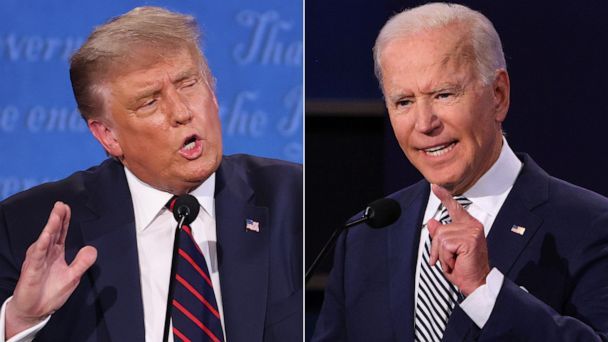
In First Debate, Trump Fails to Condemn White Supremacists

(JTA) — In the first presidential debate, President Donald Trump did not explicitly condemn white supremacists when challenged by the moderator.

“Are you willing tonight to condemn white supremacists and militia groups, and to say that they need to stand down and not add to the violence?” Chris Wallace, the Fox News Channel moderator asked the president at the debate Tuesday at Case Western Reserve University in Cleveland.

One of the topics of the evening had to do with the violence that has afflicted some of the anti-police brutality protests in cities across the country.

“I’m willing to do that,” Trump said. “I would say almost everything I see is from the left-wing, not from the right,” Trump said.Wallace kept pressing. “Are you willing,” — he said.

As he did throughout much of the 96 minutes, Trump interrupted. “I’m willing to do anything, I want to see peace!” he said.

“Then do it, sir,” Wallace said. “Do it, say it,” chimed in Joe Biden, the Democratic nominee.

There was a split-second pause. “What do you want to call them, give me a name, give me a name,” Trump said.

“White supremacist, racists,” Wallace said.

“Proud Boys,” Biden said, referring to an extremist militia that recently rallied in Portland, Oregon.

“Proud Boys, stand back and stand by!” Trump said, and pivoted once again to criticize the left.

“It’s astonishing that, when asked a simple question, will you condemn white supremacists, POTUS responded — ‘The Proud Boys should stand back and stand by’,” the Anti-Defamation League’s CEO, Jonathan Greenblatt, said on Twitter, using the acronym for President of the United States. “Trying to determine if this was an answer or an admission. POTUS owes America an apology or an explanation.”

Trump has in the past condemned white supremacists multiple times and other times has equivocated. Biden, the former vice president, during the debate, repeated the reason he decided to run: Trump’s equivocations after the deadly neo-Nazi march in Charlottesville, Virginia in 2017.

“It is truly the reason I got in the race,” Biden said. “Close your eyes remember what those people look like coming out in the fields carrying torches, their veins bulging and just spewing anti-Semitic bile and accompanied by the Ku Klux Klan a young woman got killed and they asked the president what he thought he said ‘there were very fine people on both sides.’”

In First Debate, Trump Fails to Condemn White Supremacists Read More »