When I arrived for Open Temple’s Rosh Hashanah services at the Electric Lodge in Venice, the parking lot resembled an asphalt beach club. Family “pods” consisting of two to four folding chairs sat on top of square AstroTurf pads, shielded by individual umbrellas and spaced at seven-foot intervals like individual islands.
Unlike virtually every other synagogue in Los Angeles, the Open Temple, led by Rabbi Lori Shapiro, created an environment to allow about 50 congregants to gather safely and worship this Rosh Hashanah outside together. As Rabbi Shapiro expressed in her opening remarks, “Judaism has always adapted through time, so we allow Judaism to adapt through this incredible experience today.”
Full disclosure: my sister was recently appointed president of the Open Temple board, and I was there primarily to support her in this new role. In a normal year, my family would have attended our local Chabad with friends we’ve known for decades. But nothing about this year is typical. Not in the world and not in my home. It’s only September, yet 2020 has already handed me an abrupt marital separation, a worldwide pandemic, a city-wide lockdown, a youngest child’s departure for college, and in the midst of it all, an urgent and final deadline to finish a book about—unbelievably—grief.
I work in the bereavement world, but that doesn’t make me immune to sorrow. Suffice it to say, I’m ready to symbolically and literally turn the calendar on this year, be it 2020 or 5780. So when Rabbi Shapiro stepped over to a tub of water and asked everyone to call out what they were washing away from the past year—“Judgment!” “Shame!” “Zoom!” “Kids on iPads!”—I shouted, “Loss!” and “Fear!” It felt good to hand it over in such a loud and public manner.
Sometimes it’s possible to show up with an open mind, not knowing what you’ll find, and to discover exactly what you need.
The Open Temple’s tag line is “Reinventing Judaism for the Jew-ishly Curious and Those Who Love Them,” so from the start, you get the idea that their version of Rosh Hashanah will be an adventure. Rabbi Shapiro led the service from behind a plastic face shield, donning a cordless head mic and an iPad hanging from a long harness. She wore a floor-length crimson dress and black Doc Martens with embroidered red roses climbing up the sides. She’s like the quirky, cool girl in high school that everyone wants to be nearby. I’ve heard her referred to affectionately as the Janis Joplin of Judaism, and I’d agree with that statement if Janis Joplin had also been a true spiritual leader.
Something very special happens at an Open Temple service, and it has a lot to do with the environment that Shapiro herself fosters. Everything from remixing age-old prayers with popular songs—who could have imagined pairing “Mi Chamocha” with “Question” by the Moody Blues?—to reading quotes from Martin Buber using the Keynote app on our iPhones, to the layout of the parking lot was carefully curated for a twenty-first-century user experience. We sat on our islands, surrounded on three sides by hanging tapestries that alternated between vibrant colored patterns and plain white sheets. This was to remind us that we were dwelling in “the space in between,” Rabbi Lori explained, what she called the space of numinosity, of mystery, of awe. “We are in the space between order, and things must fall away so they can come together again,” she said. That was the best and most hopeful reframing of this past year I could have come up with.
As a child, I reflexively memorized Hebrew prayers in a Conservative synagogue in suburban New York. I could never have imagined that forty years later, I’d be singing them in a California beach town parking lot to the accompaniment of an electric guitar, a set of drums, and a trumpet played by a musician with blue hair. Yet there was a very special and very specific beauty to the way it all came together under the stewardship of a fierce and vibrant rabbi.
Something very special happens at an Open Temple service, and it has a lot to do with the environment that Shapiro herself fosters.
When Rosh Hashanah falls on Shabbat, Rabbi Shapiro reminded us, it is not a day to emphasize penitence, but a day to celebrate joy. So we stand together in defiance of the chaos of 2020, she said, and we can change ourselves in this new year as a means of helping to create a better and more just world. To which I say a fervent “Yes.”
That afternoon, I renewed my existing pledge to myself to be more patient, more compassionate, more giving. To focus not just on what was lost, but what is also to be gained. And to continue alchemizing personal distress into something publicly useful for others.
I didn’t know what I was looking for when I arrived at the parking lot that morning. But sometimes it’s possible to show up with an open mind, not knowing what you’ll find, and discover exactly what you need.
Hope Edelman is the author of eight nonfiction books, most recently “The Aftergrief: Finding Your Way Along the Long Arc of Loss” (Ballantine, 2020).
(JTA) — Is it OK to compare Donald Trump to a Nazi?
In line with their longtime opposition to such rhetoric, anti-Semitism watchdog groups are speaking out against the use of Nazi comparisons to attack Trump and his administration.
But that bright line appears to be blurring for many with the president stepping up his efforts to discredit the election results in November and refusing to promise a peaceful transfer of power should he lose to Joe Biden.
The immediate flashpoint in the debate is a new 30-second ad released Tuesday by the Jewish Democratic Council of America that draws parallels between the rise of fascism in Germany and the Trump presidency.
In swift and strong rebukes, the anti-Semitism watchdogs condemned the ad as offensive. One came from the Anti-Defamation League, which has been anything but shy in calling out a range of Trump’s statements and actions.
However, some endorsed the ad, notably the prominent Holocaust scholar Deborah Lipstadt and the ADL’s former longtime national director, Abraham Foxman, himself a Holocaust survivor. They expressed sympathy for such concerns about the state of America under Trump.
The condemnations of the ad were part of the longstanding effort of Jewish groups to make Nazi and Holocaust comparisons taboo. But a growing number of historians, activists, politicians and journalists — many, but not all of them liberals or Democrats — have taken up the line that Trump and his administration are deploying rhetoric and breaking norms in a manner similar to the Nazis as they rose to power and took control of Germany.
The Jewish Democrats’ ad contrasts images from the rise of fascism in Europe in the 1930s with images from the nearly four years of the Trump presidency. They include neo-Nazi marchers in Charlottesville, Virginia, in 2017, Trump speaking at a rally and the massacre of 11 Jews in the 2018 Pittsburgh synagogue shooting. A synagogue defaced with graffiti in the present day is presented alongside photos of graffitied Jewish shops in the ’30s.
Titled “Hate doesn’t stop itself, it must be stopped,” the ad implies that Trump is responsible for the anti-Semitism of the far right. It comes days after Biden said Trump is “sort of like Goebbels,” referencing the Nazi propaganda minister Joseph Goebbels.
“You say the lie long enough, keep repeating it, repeating it, repeating it, it becomes common knowledge,” Biden said on MSNBC.
The ADL did not directly weigh in on Biden’s Goebbels comment, but it did issue a sharp condemnation of the Jewish Democratic Council’s ad.
“This has no place in the presidential race and is deeply offensive to the memories of 6M+ Jews systematically exterminated during the Shoah,” tweeted Jonathan Greenblatt, the ADL’s CEO, using a Hebrew word for the Holocaust. “[T]he hate [and] extremism in this race is alarming and should be repudiated unambiguously. Elected leaders who engage in lying, scapegoating, and routinely call for violence should be condemned, full stop. At the same time, we urge leaders & their surrogates to refrain from invoking the #Holocaust in the context of the current election. It is not the same. Stay focused on the issues.”
The American Jewish Committee and Simon Wiesenthal Center also called for the ad to be taken down.
The Jewish Democratic Council did not appear to be chastened by the condemnations from legacy groups. Its executive director, Halie Soifer, seized on Trump’s “Proud Boys moment” to reinforce the ad’s message.
“Trump just refused to condemn white nationalism,” she said on Twitter, reposting the ad. “He called on Proud Boys and others featured in this ad to ‘stand-up and stand-by’.” (Trump, in fact, said “Stand back and stand by.”)
Rep. Ted Deutch, a Florida Democrat who is a leader in the unofficial Jewish congressional caucus, said it was Trump who had pushed boundaries.
“Does the ad seem to push the boundaries? It does,” he said Wednesday. “But last night Donald Trump once again obliterated the boundaries when he refused to condemn white supremacists.”
Soifer said in an interview that the ad is set to play on web platforms in swing states with substantial Jewish populations, including Florida, and a TV ad buy was being considered.
In a text to the Jewish Telegraphic Agency, she noted the expressions of joy that Trump’s “stand by” call elicited from white supremacists on social media.
“The president’s blatant refusal to condemn white supremacists — which has clearly incited the Proud Boys — underscores the importance of our message,” she said. “I hope those who are concerned by the president’s words last night understand that the urgent warning in our ad — that hate does not stop itself, it must be stopped — is both accurate and timely.”
On Twitter, a rabbinical student named Talia Kaplan questioned the priorities of Jewish organizations that rushed to condemn the Jewish Democrats’ group.
“Jewish orgs: now would be a great time to express as much outrage about ‘stand by’ as about Holocaust analogies,” she said.
In a sign of how disorienting the discourse has become, Greenblatt found himself condemning Trump on Twitter hours after he had condemned the Jewish Democratic Council for analogizing Trump’s presidency to the rise of fascism.
Trump “owes America an apology or an explanation,” the ADL leader said.
On Wednesday, Trump told reporters that he had not heard of the Proud Boys, but added “they need to stand down.”
The ADL and the Wiesenthal Center stood by their statements condemning the ad after Trump’s Proud Boys episode on Tuesday, and the AJC had not answered a query by Wednesday afternoon. The Wiesenthal Center said it “is extremely disappointed and troubled that President Trump did not explicitly denounce white supremacists. He needs to.”
Deborah Lipstadt at a showing of “Denial” at the 11th Rome Film Festival, Oct. 17, 2016. (Elisabetta A. Villa/WireImage)
The Jewish Democratic Council did not exactly come empty-handed to the debate over whether invoking Nazi comparisons was legitimate when talking about Trump. Lipstadt, the Holocaust historian, argued that in fact it was fine to compare 1930s Germany and what critics call Trump’s breaking of norms.
Lipstadt, who endorsed Barack Obama twice but has been tapped by administrations of both parties for her Holocaust-related expertise, also stressed that the ad made use of images of Nazi Germany but not of the Holocaust itself.
“I would say in the attacks we’re seeing on the press, the courts, academic institutions, elected officials and even, and most chillingly, the electoral process, that this deserves comparison,” she said in a videoconference hosted Tuesday by the Jewish Democratic Council. “It’s again showing how the public’s hatred can be whipped up against Jews. Had the ad contained imagery of the Shoah, I wouldn’t be here today.”
Likening a political opponent to Nazis has long been a taboo that some leading Jewish institutions and organizations have sought to enforce: The Holocaust was unprecedented and unmatched since in the breadth of its horror and its ambition, the total destruction of the Jews. Comparisons, the argument went, diminished the Holocaust and deprived its lessons of the potency to prevent its recurrence.
Lipstadt has taken that stance in the past.
“When you take these terrible moments in our history, and you use it for contemporary purposes in order to fulfill your political objectives, you mangle history, you trample on it,” she told Haaretz in 2011.
But in the current era, Lipstadt said, the key to acceptable Holocaust comparisons is precision and nuance. Is it the Holocaust? No. But does the current era presage an authoritarian takeover? Maybe.
“People ask me, is this Kristallnacht?” she said. “Is this the beginning of pogroms, etc.? I don’t think those comparisons are correct. “However, I do think certain comparisons are fitting … it’s certainly not 1938,” when Nazis led the Kristallnacht pogroms throughout Germany. “It’s not even September 1935, and the Nuremberg Laws” institutionalizing racist policies.
“What it well might be is December 1932, Hitler comes to power on Jan. 30, 1933 — it might be Jan. 15, 1933.”
Foxman, the former ADL director, also said comparisons to Weimar Germany are apt. Even more than Lipstadt, Foxman has long spoken out against Nazi comparisons.
“Germany did have institutions and they did have democracy and it did fall apart so, yeah, it’s not Germany, and it’s not Nazism, but our antennas are quivering,” Foxman told JTA.
Soifer, the Jewish Democratic Council’s leader, defended the ad’s tone.
“We’re not calling Donald Trump a Nazi,” she said. “We are warning against the ominous parallel of the rise of Nazism and the use of hatred for political purposes and the numerous signs that Donald Trump is doing the same.”
The Republican Jewish Coalition has condemned the ad, and called on Biden to retract and apologize for his reference to Goebbels.
“The rule in debate is that if your only argument is to call your opponent a Nazi, you have no argument at all,” RJC Executive Director Matt Brooks said in a statement.
The Zionist Organization of America’s president, Morton Klein, in a tweet Tuesday called the Jewish Democratic Council’s ad “disgraceful.” In July, on the same social media platform, he had accused the liberal political donor George Soros, a Holocaust survivor, of “helping Nazis find Jews” — an extreme misrepresentation of one of Soros’ experiences as a child.
Brooks on Twitter called on Lipstadt to address the ad. Lipstadt directly replied in the Zoom call, saying Trump was emulating Goebbels in repeating a lie until his followers had internalized it.
“Goebbels was very successful at what he did, and I think the comparison by Vice President Biden was a very apt comparison because we’re seeing a lot of this now,” she said.
Foxman said the intensification of hatred, including the rise of anti-Semitic attacks and attacks on other minorities, did not have to rise to the level of Nazism to set off alarms.
“There is serious hate out there which is reminiscent of the hate that we lived through, part of our history,” he said. “Jewish antennas quiver — it doesn’t have to be Nazism to worry us that hate is out there, and hate is not being challenged.”
A good friend of mine who is active in Democratic politics says he “fervently” desires that “the repudiation of the Republican Party in November is so complete and total that the stupidest Republican will understand that Trumpism is a dead end.” This, he hopes, will lead to “the Republican Party recovering from its insanity.” My friend understands the danger that, as he puts it, the “lunatic left” in the Democratic Party will “gain strength.” Nevertheless, he thinks it is a necessary risk and that “hopefully a rational alternative vision will return, perhaps in the form of a new political party or perhaps in the Republican Party.”
But he may be wrong.
The genius of our Constitution is the concept of checks and balances. The President, the Supreme Court, and Congress each limits the power of the other. Legislation can be passed by the House and Senate, vetoed by the President, and challenged by citizens up to the Supreme Court. Our Founding Fathers designed the system to prevent the tyranny of an otherwise transitory faction which, without that restraint, can convert temporary popularity into permanent dominance. In many nations, the lack of checks and balances has enabled one-party rule, preventing the ascendancy of competing interests and ideas. The Democrats’ proposals threaten to do exactly that.
In many nations, the lack of checks and balances has enabled one-party rule, preventing the ascendancy of competing interests and ideas. The Democrats’ proposals threaten to do exactly that.
Consider the likely outcome of the “repudiation of the Republican Party” that my friend so fervently desires. This would mean that the Democrats take control of the Presidency, the House of Representatives, and the Senate. Should this occur, the combination of policies for which many Democrats have advocated will create serious risks to our system of checks and balances and the consensus-building that it is intended to assure.
One proposal from many Democrats is to admit two new states—Washington, D.C. (population about 700,000) and Puerto Rico (population about 3.1 million)—to the Union. Biden explicitly supports the former and would leave the latter to the people of Puerto Rico. The last time the Union was enlarged, sixty years ago, a compromise brought in the Republican-leaning Alaska and the Democratic-leaning Hawaii. This time, both new states would likely be Democratic, adding four Democratic Senators, six Democratic representatives (one for D.C., five for Puerto Rico), and perhaps ten Democratic electors (three for D.C., seven for Puerto Rico). In a closely divided America, these changes could determine presidential elections and control of the House and Senate.
Another suggested Democratic policy is to do away with the Senate’s filibuster rule, a change that Biden refused to disavow in the recent debate with Trump. Today, 60 votes are needed to end debate and begin voting on many types of legislation, which means that a mere 41 senators can block a bill from passing. That 41 person delay requires senators on both sides of the aisle to try to work together, compromise, limit extremists on both sides, and recognize the diverse interests that exist. The filibuster has been part of Senate rules for over 100 years. Although it has been eroded (for example, it is no longer applicable to voting on budget reconciliation bills), it still applies to most legislation.
While some argue that the filibuster encourages intransigence, in fact it is the threat of the filibuster itself that can motivate a bill’s sponsors and supporters to compromise in order to widen a bill’s appeal. For instance, Senator Angus King of Maine, an Independent, recently stated, “I know it can be frustrating, but I think legislation is better when it has some bipartisan support.” Even President Obama, when he was a senator, argued that the filibuster should be maintained (he has since reversed his position).
Of course, the filibuster can be misused, but its benefit—building a workable consensus—outweighs its detriments—reducing the opposition to impotence. Consider, for instance, what has already happened to Supreme Court nominations. In 2013, the Democrats abolished the filibuster for lower federal court appointees; in 2017, Republicans upped the ante by abolishing the filibuster for Supreme Court nominees. Its abolishment has hardly promoted compromise: in 1993, the Senate confirmed Ruth Bader Ginsburg by a vote of 96-3, and in 2009 confirmed Sonia Sotomayor 68-31. But after the filibuster was abolished, Neil Gorsuch prevailed only by a vote of 54-45 in 2017, and the present nominee, Amy Coney Barrett, is unlikely to do any better.
Ending the filibuster is seen by many Democrats as a means to an end—a way to remove restraints on partisan legislation and, more importantly, “pack” the Supreme Court—yet another policy Biden refused to condemn during the debate. The Constitution does not designate the number of Supreme Court justices, but for over 150 years, its number has stood at nine. Appointments are lifetime, which was designed to ensure the Court’s independence from political pressure. Witness, for instance, the current, “conservative” Supreme Court upholding abortion rights, extending the 1968 Civil Rights Act to protect LGBTQ employees, upholding DACA (Deferred Action for Childhood Arrivals), and requiring President Trump to turn his tax records over to a New York grand jury.
The Supreme Court is not a third legislative branch, susceptible to the vagaries of public opinion and political pressure. It is a judicial body, guided by legal and constitutional principles and aware of the value of precedent and continuity. It is presently, by far, the most trusted branch of government. While justices may have different views as to how to interpret the Constitution or legislation, to enlarge the Court for political ends is not only destructive to its intended non-political role, but also to the public’s perception of the Court and willingness to accept its rulings. Even President Franklin Roosevelt, in the midst of the Great Depression, was unsuccessful in his effort to pack the Supreme Court, precisely because of the risks it posed to checks and balances. Yet a Democrat-controlled Congress would threaten to do that in the interest of their political agenda.
Given our closely divided country, these changes—all likely to succeed should the Democrats control the Presidency, the House, and the Senate—risk undermining the checks and balances core to our democracy. Should these structural changes come about, it is democracy that will be the loser.
One need not doubt the good intentions of those advocating these institutional changes. But the road to hell is paved with good intentions. Given the likely outcome of the presidential election, only a Republican Senate can assure that these risky innovations will not be adopted.
This is what should be fervently desired.
Gregory Smith is an appellate attorney practicing in Los Angeles.
A survey released on Sept. 30 found that only 1 in 5 British universities have adopted the International Holocaust Remembrance Alliance (IHRA) definition of anti-Semitism.
The Jewish Chronicle reported that the Union of Jewish Students (UJS) survey found that 29 of Britain’s 133 universities had adopted the IHRA definition, which states that the demonization and delegitimization of Israel is anti-Semitic. Eighty of the remaining 104 universities said they wouldn’t adopt it; some said that it wasn’t necessary while others considered it an abridgement of free speech. Oxford and Cambridge were among the universities that said they wouldn’t adopt it.
Seventeen universities said they would weigh adopting the IHRA definition of anti-Semitism.
Communities Secretary Robert Jenrick, who has said that he would cut funding to universities that don’t adopt the IHRA definition of anti-Semitism, said he was “extremely disappointed” in the results of the UJS survey.
“Education is one of the most powerful tools we can use to combat anti-Semitism and adopting and actively using the IHRA definition of anti-Semitism sends a clear signal that Universities are serious about tackling antisemitism on campuses,” Jenrick said. “Some progress has been made since I urged all universities and the Higher Education Institutions adopt the IHRA definition, but I urge others to do so without delay. It is simply unacceptable that universities accept public money, but refuse to take this step.”
UJS similarly said in a statement, “Whilst pleased that that almost 30 institutions have taken steps to protect the Jewish students by adopting this definition, we continue to be frustrated and dissatisfied that universities have failed to sufficiently protect their Jewish students from anti-Jewish racism, the oldest form of racial hatred.”
Pro-Israel Twitter accounts also expressed disappointment in the UJS survey’s findings.
“80% think it is more important to spread lies about Jews than protect their Jewish students,” British researcher David Collier tweeted. “That’s the state of UK academia.”
Only 1 in 5 of UK univerisites has adopted the IHRA definition of #antisemitism – even though government threatened to remove funding.
1 in 5.
80% think it is more important to spread lies about Jews than protect their Jewish students.
Sussex Friends of Israel also tweeted, “Important that the utter apathy with which many of our universities have had towards the IHRA was exposed. Thanks to @UJS_UK for doing just that.”
Important that the utter apathy with which many of our universities have had towards the IHRA was exposed. Thanks to @UJS_UK for doing just that. https://t.co/jYnNodTFXO
A July report from the Community Security Trust (CST) found that anti-Semitic incidents in Britain declined 13% from 2019 to 2020, but the total number of anti-Semitic incidents at that point in 2020, 789, was the third highest figure that the CST ever has recorded.
Who will be more motivated in the closing weeks of a presidential campaign taking place with the backdrop of a historic Supreme Court nomination debate: pro-choice or pro-life voters?
We are about to find out.
The current Supreme Court fight is a prelude to the larger battles for the White House and the Senate majority, which, in turn, are preludes to an even bigger war for the future of legal abortion in this country.
Barring an extraordinarily unexpected turn of events, Amy Coney Barrett will be confirmed as the nation’s next Supreme Court justice. Senate Democrats cannot prevent her confirmation; the only question is how loudly they will protest. But the intended impact of those complaints won’t have anything to do with Barrett herself, but rather, the makeup of the other two branches of our federal government. Depending on how effectively Democrats can mobilize their supporters in the aftermath of what normally would be a dispiriting defeat, Barrett could be sworn in as the court’s newest justice only days before Democratic nominee Joe Biden is elected as the nation’s next president.
Or not.
The presidential election already was going to be determined almost entirely by which of the candidates would be more successful in turning out their party’s respective base. But both the circumstances surrounding Barrett’s nomination and the dramatic ideological shift in the Supreme Court’s makeup that her confirmation will bring have intensified the passions of liberals and conservatives alike. Yet to be determined is which side will use Barrett more effectively as emotional fuel for its most loyal supporters.
Given the enormous stakes represented in this election, it’s notable that Biden and President Donald Trump have faced noticeable challenges in motivating some of their parties’ critical voting blocs. Since the Democratic primary, Trump’s struggles to effectively address the coronavirus pandemic and the nation’s renewed debate over race relations has caused many older voters, suburbanites and other cultural conservatives to drift away. For his part, Biden has failed to excite young people, voters from minority communities and other progressives.
A highly visible debate over Barrett and the high court’s future will remind less-enthused voters on why this election matters so much. In public, Democrats will emphasize the potential overturn of the Affordable Care Act rather than the more volatile topic of abortion rights. Although swing voters are with Democrats on both issues, there are a lot more conservative voters who care more passionately about abortion than they do about health care policy. So, concentrating on Obamacare is less likely to inflame the opposition. However, abortion rights are the issues that motivate Democrats above all others.
A highly visible debate over Barrett and the high court’s future will remind less-enthused voters on why this election matters so much.
A Democratic president and Congress could not remove Barrett from the court, but there are many potentially mitigating steps they could take if they controlled both ends of Pennsylvania Avenue. The idea of increasing the Supreme Court’s membership to outnumber the conservative justices has received considerable attention and is being taken more seriously than at any time since Franklin Roosevelt’s ill-fated court-packing effort of the 1930s.
The idea of adding additional justices is a cathartic one, and if it does inspire additional turnout among angry progressives, then it will have served a useful short-term purpose for Democrats. But the downside to the plan is the payback: If Republicans retain control of the White House and the Senate, at some point in the future, they simply will expand the court.
There are other alternatives. A Democratic Congress could pass legislation to provide legal protection for abortion rights, and a Democratic president could sign that legislation. While a pro-choice law would be vulnerable to being overturned by a future GOP-controlled government, such a move would be a much greater political risk than the same decision being made by the judicial branch.
But neither option can be pursued if Trump is reelected or if Republicans retain control of the Senate. The question is whether Democrats are sufficiently motivated to prevent those outcomes.
Dan Schnur teaches political communications at UC Berkeley, USC and Pepperdine.
StandWithUs filed an amicus brief on Sept. 29 supporting Fordham University’s decision to decline to recognize the school’s chapter of Students for Justice in Palestine (SJP).
In 2016, Fordham Dean of Students Keith Eldredge wrote in an email to then-student Ahmad Awad, who would have led the chapter, “I cannot support an organization whose sole purpose is advocating political goals of a specific group, and against a specific country, when these goals clearly conflict with and run contrary to the mission and values of the university.” The university’s decision was challenged in court; in July 2019, a New York judge ruled in favor of SJP, arguing that the university’s rules “do not empower the Dean of Students to restrict the university’s recognition of a student club based on its potential for raising issues or taking political positions that might be controversial or unpopular with a segment of the university community.”
The university, with campuses in Manhattan, the Bronx and Westchester County, appealed the decision to the Supreme Court of the State of New York Appellate Division in January 2020. In its brief to the court, StandWithUs argued that the courts have “limited” jurisdiction in reviewing private universities’ decisions and can’t use their own judgment to overrule a private university’s judgment. A court can only overrule a private university’s decision if the decision is arbitrary and capricious.
“Here, the Dean of Students specifically articulated the scope and nature of his review of SJP before making his final determination,” the brief stated. “He conferred with multiple campus stakeholders, including faculty, staff and students, and looked over SJP’s own stated goals and purposes. His actions were not arbitrary, capricious or in bad faith.”
The brief later argued that Eldredge’s actions before his decision show that he had conducted “a thorough review of the facts and was neither irrational or capricious.”
The court had essentially used “its own determination that SJP’s mission was consistent with Fordham’s own mission,” which is outside of the court’s purview, according to the brief. The brief also argued that because Fordham is a private school — it is the oldest Catholic university in the Northeast — students are not afforded the same free speech and due process rights that public school students have.
Additionally, the brief stated that Fordham’s decision not to recognize SJP is consistent with Title VI of the Civil Rights Act, arguing that SJP’s activities fall under the International Holocaust Remembrance Alliance (IHRA) definition of anti-Semitism. The IHRA definition of anti-Semitism states, in part, that the demonization and delegitimization of Israel as well as subjecting the Jewish state to double standards is anti-Semitic.
“SJP regularly demonizes the State of Israel and denies Jews the right to self-determination, including through substantially disruptive conduct targeting Jewish and pro-Israel students,” the brief stated. “Clearly, permitting a student organization on campus which by its very constitution indicates an intention to interfere with the civil rights of Jewish students raises potential implications under Title VI.” As an example, the brief pointed to a 2016 article from The Tower, a publication of The Israel Project that is an Israel advocacy nonprofit, chronicling various examples of groups such as SJP alienating Jewish students from progressive spaces on campus.
StandWithUs CEO and co-founder Roz Rothstein said in a statement, “Fordham University is one of the first universities — if not the first — to recognize SJP’s bigotry for what it is and stand up against hate. We understand the administration’s decision to reject SJP as a university-recognized student organization. As a private university, Fordham should have the freedom to make such choices to protect what they perceive to be the well-being of its students and integrity of its campus, and the Fordham administration should be commended for their efforts to do that.”
(JTA) — Jewish students and their supporters have called on school officials in Northern California’s Marin County to take action against anti-Semitism at a local high school.
More than 5,600 people have signed the Change.org petition addressed to the Tamalpais Union High School District and its superintendent, Tara Taupier.
Last month, an Instagram account associated with the Redwood High School in the city of Larkspur, 13 miles north of San Francisco, called on followers to identify Jewish high school students in Marin County. School officials later said that they believed they had identified the student running the Instagram account and provided the information to local law enforcement. The account was removed.
“Our safety is threatened by the list and the pictures posted by the student,” reads the petition signed by Redwood students. “The list of Jewish students paired with the image of the swastika and the bullet produces an uncanny resemblance to the use of lists during the Nazi Regime. The idea of going back to school with a student whose beliefs align with those of Nazis is inconceivable.
“We believe the ‘action’ taken thus far by the administration has done nothing to make us feel secure and safe. This student has gotten away with offensive behavior for far too long and this recent escalation is a direct result of the lack of attention given by the district.”
The action taken so far, according to the petition, was an email from the district that “focused too much on the history of anti-Semitism and the actions of the community rather than the action plan of the district.”
If you can’t remember where you were when the Second Intifada started, it’s not surprising. Unlike most wars (the Yom Kippur War, for example) and unlike most terror events (such as 9/11), the Second Intifada didn’t start on a specific date. When it started, it was not yet an intifada, only scattered violent incidents and demonstrations. No one knew at the time that these alarming incidents were going to continue for years and alter the Israeli-Palestinian conflict, and with it, the Middle East.
While there was no specific date, the Second Intifada began somewhere between the end of September and the beginning of October 2000. On Sept. 28, the then head of the opposition, Ariel Sharon, visited the Temple Mount amid a violent protest. The following day, Palestinians rioted and a few were killed by police fire. An Israeli officer was killed by a fellow Palestinian officer. Two days later, a French TV station aired video footage of a Gazan boy, Muhammad al-Durrah, killed when he was caught in the crossfire between Israelis and Palestinians, which spurred even more anger and violence.
The circumstances surrounding al-Durrah’s death are still being debated. Israel was blamed for the shooting and apologized. But it’s far from clear that he was killed by Israeli gunfire.
On Oct. 1, 2000, Palestinians raided Joseph’s Tomb in Nablus in the West Bank and shot an Israeli soldier. The soldier was supposed to have been evacuated by Palestinian Authority (PA) forces, but he was left to die. Much like al-Durrah, the abandoned soldier, Madhat Yusuf, became a household name, signaling the end of the period during which Israel still trusted the Palestinians’ good intentions. After Yusuf’s death, security ties between the Israel Defense Forces and the PA crumbled. A friend became a foe.
The Second Intifada doesn’t have an official day of observance. It was a long slog, with thousands of deaths; tens of thousands of incidents and attacks, large and small; hundreds of attempts to change policies; and dozens of debates about cause and effect. Suicide bombers became the symbol of its horrors. When the Second Intifada died down — again, there was no specific end date — the corpse of the peace process was revealed, bruised and mutilated. It was buried without fanfare or dignity. The stench of death erased the smell of White House Rose Garden peace ceremonies.
Young soldiers today can’t remember these consequential events. For them, the Second Intifada isn’t much different than the Six-Day War or the first Lebanon war: material for study and history, not one of personal meaning. Older Israelis, like me, still shudder at the thought of raising these young soldiers as young children in those cursed years of terror.
Since the Second Intifada, many Israelis no longer see peace with the Palestinians as a realistic goal.
There are still enough of us around to remember some of the lessons we learned back then: we live in a dangerous neighborhood; we can’t trust anyone except ourselves; a disappointing peace process is worse than no peace process; festive speeches are no match for a suicide bomber; cold equilibrium is better than illusory progress.
Since the Second Intifada, many Israelis no longer believe in the peace process as it was designed in the 1990s. Many no longer see peace with the Palestinians as a realistic goal. Many wouldn’t even consider an arrangement that compromises on their future security. And sadly, many of them lost interest in the plight of the Palestinians. Many lost their ability to sympathize with the Palestinians. It isn’t easy to empathize with someone who has tried to kill you, your children and your parents, who rejoiced when your friends, relatives or neighbors were killed.
But isn’t making peace something you do with enemies? It is. And it was attempted in the 1990s, but we were deceived. At least, that’s the story as most Israelis understand it. That’s the narrative that directs their behavior. And if Palestinians have a different story to tell about the Second Intifada, we can’t hear it — because our ears are still ringing from the blast of the bombs in the center of our cities.
After 20 years, you might expect hindsight. But there is none. We live the hindsight. Our policies are the hindsight. Our realities are the hindsight. Where were we all when the Second Intifada started? We were here, learning lessons.
Rosner online
The latest edition of the Sunday Israel File explained the political dynamics of recent weeks:
The right bloc is getting stronger, even though right-wing Likud is getting weaker, thanks to the rise of right-wing Yamina. Yamina’s leader, Naftali Bennett, is focusing on the fight against the coronavirus and is seen as an adult in a field of juveniles. Bennett attracts voters from Likud, but also from Blue and White and other parties.
A week’s numbers
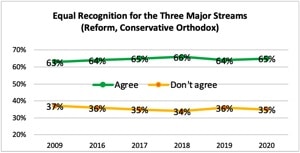
The survey “2020 Israel Religion & State Index” conducted by the organization Hiddush for “Freedom of Religion for Israel” reveals some things barely change:
Insight: After 10 years, it’s clear that passive public support isn’t the issue. The streams that fight for recognition need active support.
A reader’s response
I wrote that Rep. Alexandria Ocasio-Cortez’s (D-N.Y.) decision to withdraw from a memorial event for the late Prime Minister Yitzhak Rabin “is not a disappointment. It is a wake-up call.”
Shany Mor tweeted: “The big story is neither AOC nor BDS. The big failure here is APN’s and the kind of politics that this organization, along with J Street, runs. APN brought on this mess and it highlights their perceptual failure when it comes to American (and Israeli) politics.”
My response: Because I agree with Mor, I’ll just clarify the abbreviations: AOC = Alexandria Ocasio-Cortez; BDS = boycott, divestment and sanctions; APN=Americans for Peace Now (the organization that invited and was shunned by AOC).
Shmuel Rosner is senior political editor. For more analysis of Israeli and international politics, visit jewishjournal.com/rosnersdomain.
As we continue to find ways to celebrate this holiday period differently, American Jewish University (AJU) is tackling Sukkot, Shemini Atzeret and Simchat Torah by creating unique, family-friendly, socially distanced getaways.
At AJU Brandeis-Bardin’s 2,700-acre campus in Simi Valley, the Brandeis-Bardin team is inviting families, couples and individuals to the campus for two weekends: Oct. 2-4 and Oct. 9-11. The holiday weekends are taking place under the leadership of Navah Becker, director of programming at Brandeis-Bardin’s campus; John Luong, senior director for hospitality services; and Michelle Starkman, vice president of communications.
Pre-COVID-19, AJU Brandeis-Bardin’s campus was used year-round to host a multitude of retreat programs for students, families and campers. Also home to Camp Alonim, Brandeis-Bardin this past summer was able to modify camp plans with its outdoor Alonim Adventures program. The campus also offered drive-in graduations. With the experience of running COVID-19-friendly programs over the summer, campus officials decided they were ready to implement similar programming for the Sukkot getaway weekends.
“People were so thankful just to be together and to see other people’s faces in real life,” Becker said. “I think that sparked a series of conversations and we decided to sort of take advantage of that … to be able to open and create space for community and for people to come together safely in a Jewish context.”
To maintain Ventura County’s COVID-19 rules and regulations, each guest or unit must wear a face covering when walking around the campus and will go through a health check upon arrival. Individuals or families will have their own cottage, which will include one to two rooms for sleeping and one room for private dining.
Because of contact restrictions, officials encourage individuals and families to bring games, toys and sports equipment. Common areas and frequently touched surfaces will be cleaned and sanitized multiple times each day. AJU staff members also will participate in mandated daily health checks. According to the campus’ website, should there be potential or confirmed COVID-19 exposure on the facility, the campus may temporarily close and a full refund will be issued.
Becker said because of safety concerns, services will not be provided. However, everything else is taken care of. Seven kosher “to-go” meals will be provided to each person throughout the weekend; multiple sukkot, lulavim and etrogim will be scattered throughout the campus for assigned and staggered meals.
Kids participating in an archery program on campus. Photo courtesy of AJU
Activities also will be offered throughout the weekend including archery, tomahawk throwing, hiking, horseback riding, challah baking and holiday programming. Becker said the design is to be as inclusive as possible and guests can opt in or out of programs. The goal is to be a Jewish “all-inclusive resort,” she said. “We will build them a sukkah if they want it. These are holidays we can host; people are looking for it. People are craving community and contact.”
Prices start at $425 for children ages 3-17; $595 for adults older than 18, and $2,000 for a family of four. Becker added that the number of reservations will be limited to 12-14 units per weekend.
“We are trying to meet people on their Jewish journey,” she said. “I think by nature, who we are and the programs we are offering, it did attract more families, but we do have a few singles and a few people who are bringing their in-laws with them.”
Becker acknowledged that this is a challenging time for people who want to get away but are afraid to do so because they are restricting activities in order to maintain their safety. Hopefully, she said, people will take advantage of the campus so they can have a meaningful holiday vacation.
Photo courtesy of AJU
Starkman added that the program is all about AJU’s mission to serve Jewish institutions, groups and communities to enhance their Jewish life. “We really just want to help communities build their structures and offer programs that promote and advance Jewish wisdom and Jewish living,” Starkman said. “Anything our team can come up with to help people achieve those goals— Jewish or not Jewish. With the restraints of COVID and shelter at home … our teams have all been fast and furious at figuring out ways to bring [the] community together.”
The pandemic, Becker said, pushed them to “widen their scope” on what Jewish programming can be. Because the walls of comfortable Judaism are gone, she said, they can use their space to engage in a wide variety of ways, including weekends like those paired with AJU’s virtual learning opportunities. Seeing people explore the campus and run around on the grass or have a picnic is something Becker said she enjoys viewing, especially now, when people have been stuck inside for so long.
“[People are asking], ‘What else is out there? I was used to going to X and Y for my Jewish world, but now there’s A, B, and C,’ ” Becker said. “The Brandeis-Bardin campus is this jewel in Simi Valley. We have been around for over 70 years, and the fact that we can still creat[e] programs that are relevant and meaningful, I think [it] is incredible. We can support Jewish community and emphasize the idea that Jewish life is still important and Jewish connections are still important.”
For more information and to make a reservation, visit their website.
CORRECTION: An earlier version of this story said Camp Alonim hosted “Sundays in the Park with Camp Alonim” this summer when that program was hosted pre-COVID-19.
The death of George Floyd while in police custody in May, and the ensuing demonstrations and conversations about racism have permeated current national discourse ever since. One of the recurring conversations is around how to become not just “not a racist,” or “non-racist,” but an “anti-racist.” To address this goal, Eastside spiritual community Nefesh hosted its first anti-racism training over three weeks in July, in partnership with the Silverlake Independent JCC and East Side Jews.
“We watched what happened to George Floyd and felt the injustice, despair and sorrow, Nefesh Rabbi Susan Goldberg told the Journal. “It cracked our hearts open. Something shifted because of tremendous grief. It opened our hearts to finding information and history that was already there — terms, language, books, films.”
The six-hour training included information sharing, learning and dialogue in small groups. About 160-170 people attended all three sessions, which Goldberg called “one of the first deep engagements for white Jews to look at racism and anti-Semitism and how they connect and relate.”
In a recording of the first session that Goldberg shared with the Journal, she introduced the Exodus from Egypt to liberation as “our central story” and a core motivation for Jewish action, that “our liberation is tied up with the liberation of everyone.”
The organizers say this will be part of an ongoing dialogue about anti-racism, in tandem with the Tikkun Collective, the wing of the Nefesh community working with other organizations around specific campaigns and social issues. Plans in progress for community collaboration will be finalized after the High Holy Days, Goldberg said. Resources, including future trainings, will be available through nefeshla.org.
Nefesh member Jason David, who organized the training with fellow Nefesh member Rachel Hamburg, said it was important to talk about anti-racism within the Jewish community and to examine with more nuance the place that white-skinned Jews occupy in America.
“We’re not always safe in being assimilated into whiteness and yet we experience significant levels of resources and access to resources because of being part of this larger white group,” David said. “In light of George Floyd’s murder and Breonna Taylor’s and Ahmaud Arbery’s and seven years of Black Lives Matter organizing and shifting the narrative around this whirlwind moment, people are willing to think about structural racism and their role, especially for people who identify as white, what is our role in anti-racism? … We want to learn but we want to be part of the solution.”
He added that Jews have a lot of “mutual interest” with BIPOC (Black/Indigenous/People of Color) communities fighting structural racism, and “stand to be much safer when we act in solidarity with a BIPOC community.” David also acknowledged the struggle of white Jews of European descent to find a place in America’s racial dynamics, “to both own the way in which we’re privileged but also [that we] face real, unique threats from white supremacy in this country.”
“If you’re not anti-racist then you’re not actively seeking to dismantle racism. To be neutral is to not participate in working against it. You end up colluding.”
— Melanie Weiner
Nefesh community member Melanie Weiner, who participated in the workshop along with her 15-year-old daughter, Olivia Potruch, said, “What I’ve taken away from [the workshop] is if you’re not anti-racist then you’re not actively seeking to dismantle racism. To be neutral is to not participate in working against it. You end up colluding.”
For those who are feeling guilty for not acting sooner to fight racism, Goldberg said, “Guilt is helpful because it shines a light on something that’s happened to us, or something we did or didn’t say that’s out of alignment with our values. It’s a good feeling because it puts us into action.”
Shaping an actively anti-racist Los Angeles, she continued, begins with taking an active stance “to become aware of racism around and inside of me, and will actively work to transform that in my thoughts, workplace or neighborhood …. There are places to make an impact everywhere.”
Some actions, Goldberg said, might involve criminal justice and police reform, committing to local public schools, seeking out qualified candidates of color who may not know about open workplace positions and bringing in experienced facilitators to hold conversations about “what change — not just awareness —looks like in our communities and institutions,” especially around inclusion for Jews of Color.
Olivia said that being an anti-racist means “actively pushing back against racism in systems and trying to reform [them] in a way that brings equality. And pushing back against racism in our everyday lives, questioning when people say or do things that are actively oppressive against minorities.” She added, “Find something by someone who’s verified in the movement and read something. Learning something is the first and easiest step in being an anti-racist.”
David suggested that white people who want to be anti-racist must “have at least one uncomfortable conversation with another white person about racism [to combat the] unspoken rule about silence” that helps perpetuate it.
Conducting the training within a trusted community was a key component of its effectiveness, participants said.
“To be in a community, where we’re strengthening bonds to each other and the work, I think it brings us into a deeper commitment to these values and ability to act as well,” Weiner said, “giving people space to question their racism [and] having safe conversations in a loving and trusting environment so people can be vulnerable.”
“One of my favorite things is to do activism within a community,” Olivia said. “I have this massive community of people that I love and trust and feel happy with, and then ‘yay activism’ with them.” Goldberg called the work “frustrating but also moving. Racism tampers with the life force from everyone living in a nation where there’s such a profound legacy and so much grief and trauma that’s unseen,” she said. “To do this healing work will deeply benefit the soul of our nation and all of us.”
She added that creating the training program enabled people “to come to awareness in a deeper way and to take an active stance, take responsibility to transform racism. We’re trying to build an anti-racist community through Nefesh, and figure out what that looks like.”