fbpx

August 28, 2020

Online Journalist of the Year! We Said Go Travel Summer News August 2020

Summer News 2020 with We Said Go Travel:

I am honored to be nominated for Online Journalist of the Year!

I am a finalist for FIVE Southern California Journalism Awards!

Thank you to everyone who has supported me and to all of the outlets who published my work. Please click here for my print, digital and broadcast content which is nominated. Thank you to the Los Angeles Press Club for this opportunity to be recognized!

Thank you to THRIVE GLOBAL for publishing my three articles about books:

During COVID-19, I have now been in Los Angeles since March 9, 2020. That is 172 days! I have been focused on what can I do and have been publishing new voices on my site! Learn about these projects here.

THANK YOU TO:::

Enjoy my new video of the waves at Santa Monica Beach. I filmed with my new LGV60ThinQ phone:

WHERE CAN YOU FIND MY TRAVEL VIDEOS?

Here is the link to my video channel on YouTube where I have over one million two hundred thousand views on YouTube! (Exact count: 1,240,000 views) Thank you for your support! Are you one of my 2,812 subscribers? I hope you will join me and subscribe!

For more We Said Go Travel articles, TV segments, videos and social media: CLICK HERE

Find me on social media: Instagram, Facebook, Twitter, Pinterest, YouTube, and at LisaNiver.com.  My social media following is now over 160,000 and I am verified on Twitter.

My fortune cookies said:

“Be patient. The Great Wall didn’t got built in one day.” (It really did say didn’t got built! We all have things to learn and work on!)

“Be not simply good; be good for something.”

Stay safe and healthy! We will travel again….Happy Summer!

Lisa

Sunset in Santa Monica in Feb 2020

Online Journalist of the Year! We Said Go Travel Summer News August 2020 Read More »

‘Israel’ and ‘Elites’: The Republican Convention Sends Mixed Messages to Jews

(JTA) — Israel came up every one of the four nights of the Republican convention. So did “elites.”

Speakers as diverse as Vice President Mike Pence and a lobsterman from Maine cited moving the U.S. Embassy to Jerusalem as evidence that President Donald Trump is a man of his word.

Just as reliable were the invocations of “elites,” an amorphous class of people who at best ignored the average American’s needs and at worst sought to control your thinking.

The mention of the Jewish national homeland and a mythical centralized control-wielding power tied together the two strands woven through the fraught story of President Donald Trump’s administration and America’s Jewish community: its tight embrace of right-wing pro-Israel orthodoxies and its perceived bigotry.

Trump at times has denounced anti-Semitism and the extreme right. But he’s also questioned the loyalties of this country’s Jewish voters, equivocated after a deadly neo-Nazi and white supremacist march in 2017, embraced unfounded conspiracy theories about billionaire philanthropist George Soros and deployed the term “globalist,” a word often used to accuse Jews of having no natural loyalties.

It didn’t help that one of the scheduled speakers, hours before her appearance, amplified an anti-Semitic screed on Twitter, or that another cheerfully admitted to likening abortion to the Holocaust — a comparison that Jewish groups have called a softer form of Holocaust denial. Or that a congressional nominee who has peddled anti-Semitic theories scored an invitation to Trump’s speech on Thursday night accepting the nomination.

Asked for comment, the Trump campaign referred the Jewish Telegraphic Agency to an interview given by communications director Tim Murtaugh on Wednesday morning to MSNBC.

“Anti-Semitism is foul and repulsive in all of its forms, and we denounce it fully,” Murtaugh said.

An MSNBC anchor had asked Murtaugh about a convention speaker, Mary Ann Mendoza, who posted the screed that included references to “The Protocols of the Elders of Zion,” notorious forgery. The convention pulled her speech before it was broadcast.

Yet there were Jewish listeners who inferred similar if less blatant tropes throughout the convention.

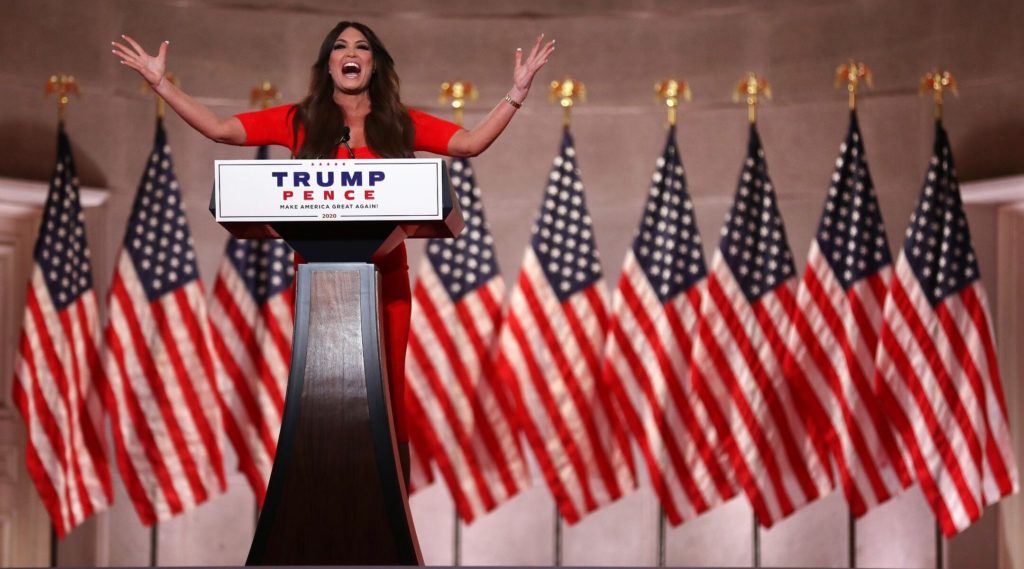
At least twice on the first night, “elites” was modified by adjectives that raised Jewish eyebrows. Kimberly Guilfoyle, the girlfriend of the president’s son, Donald Jr., referred to “cosmopolitan elites” and Sen. Tim Scott of South Carolina coupled “Manhattan elites” with “Hollywood moguls.”

“That’s one of their solutions for the pandemic,” Scott said. “They want to take more money from your pocket and give it to Manhattan elites, and Hollywood moguls, so they get a tax break.”

Jason Stanley, a Jewish professor of the philosophy of language at Yale University, was among many who criticized Scott’s comments.

“I am disgusted by the basically open anti-Semitism of Senator Tim Scott’s speech,” Stanley said on Twitter. “He said Biden wanted to enrich ‘Manhattan elites and Hollywood moguls’ (dog whistles for Jews) and that this was part of a plan for ‘a cultural revolution’ to bring about ‘socialist utopia.’”

Scott has close ties with Jewish groups; he was one the authors last year of a bill, the Anti-Semitism Awareness Act, that earned plaudits from the Anti-Defamation League. His first years in Washington he made time for bible study with an Orthodox Jewish aide, Nick Muzin.

Guilfoyle, whose decibel level got much more media attention, placed “cosmopolitan elites” on the wrong side of the battle for the “soul of America.”

“We stand for our flag,” she said. “This election is a battle for the soul of America. Your choice is clear. Do you support that cancel culture that cosmopolitan elites of Nancy Pelosi, Chuck Schumer and Joe Biden, who blame America first?” (Schumer, the Senate minority leader, is Jewish; Biden and Pelosi, the House speaker, are not.)

Alexander Nazaryan, a national correspondent for Yahoo! News, who is Jewish and whose family emigrated from the former Soviet Union, heard an unpleasant echo. 

“Kim Guilfoyle rails against ‘cosmopolitan elites,’ which is suspiciously close to Soviet ‘rootless cosmopolitans,’ i.e., Jews,” he said on Twitter.

Last year, Sen. Josh Hawley, a Missouri Republican, became embroiled in controversy for invoking “cosmopolitan elites.” His critics noted the Soviet-era associations, while Hawley’s defenders said the term was commonplace. The Anti-Defamation League said the term was not necessarily anti-Semitic but called on Hawley to exercise greater care in the future.

“Our president refuses to surrender his beliefs to score points with the big political elite,” Ivanka Trump said On Thursday, introducing her father. “To my father, you are the elite.”

For years, Republicans have derided “coastal elites” and extolled mythical simple working men and women who occupy the country’s center, to the extent that HBO is set to launch its first pandemic-era production, “Coastal Elites.”  The title appears to be an ironic reference to the Republican insult; the production team and cast are packed with Jews, including Paul Rudnick and Bette Midler, who found herself facing criticism this week after she mocked Melania Trump’s accent.

Trump during the 2016 campaign was faulted for using the term, “America First,” which echoes the anti-Semitic movement led by Charles Lindbergh during World War II. The Anti-Defamation League asked him to drop the term; he ignored them and others and used it again in his acceptance speech Thursday night.

“Together, we have ended the rule of the failed political class – and they are desperate to get their power back by any means necessary,” he said. “They are angry at me because instead of putting them first I put America first!”

In some cases the speakers themselves were problematic. There was Mendoza, the mother of a hit-and-run victim who on the day of her speech urged Twitter followers to read a thread from an anti-Semitic conspiracy theorist. The convention uninvited her.

There was Abby Johnson, an anti-abortion activist who in 2017 said on Twitter, “I have a hard time understanding how people can’t see the connection between abortion and the Jewish holocaust.”(“Yes I am!” she said on Twitter on the day of the speech in response to Russel Neiss, a Jewish activist who drew attention to her earlier tweet and said “This woman is speaking at the Republican Convention tonight.” She blew him an emoji kiss.) Groups combating anti-Semitism call promiscuous Holocaust comparisons “soft denial,” arguing that they diminish the significance of the Holocaust.

Then there was the invitation to Marjorie Taylor Greene, who won a primary in a heavily Republican Georgia district, to attend Trump’s acceptance speech, to be broadcast from the White House. Greene has long subscribed to QAnon, the conspiracy cult that traffics in anti-Semitic tropes, although she insists she has quit the habit.

Murtaugh, pressed on the Greene invitation in the MSNBC interview, seemed to suggest that anti-Semitism needed to be obvious to be called out.

“We hear from the media all the time about this QAnon business, and we have a lot of things we work on in the campaign, and chasing down conspiracy theories is not one of them,” he said. “Anti-Semitism is something that is clear and everyone understands.”

He pivoted to the Democrats, noting that the Palestinian-American activist Linda Sarsour, whom he called an “anti-Semite,” spoke at a forum for Muslim voters at the Democratic conference last week. (The campaign of Democratic presidential nominee Joe Biden denounced Sarsour, then appeared to walk back the denunciation before apparently walking back the walk-back.)

“They gave her a slot at the DNC, and we reacted in real time during the day,” Murtaugh said.

Mendoza’s anti-Semitism has long been in evidence, and Greene has trafficked in precisely the same tropes that have gotten Sarsour into trouble, insinuating that Jews hold to a supremacist worldview.

When it comes to Israel, there was less to parse: The convention clearly made the case that Republicans love Israel with mentions of Trump’s moving of the embassy to Jerusalem by Trump and his daughter on Thursday, Pence on Wednesday, Secretary of State Mike Pompeo  (with a Jerusalem backdrop) on Tuesday and former ambassador to the United Nations Nikki Haley on Monday.

“Unlike many presidents before me, I kept my promise, recognized Israel’s true capital, and moved our embassy to Jerusalem,” Trump said.

Speakers hailed Trump’s decision to pull out of what they view as the deeply flawed Iran nuclear deal, negotiated by the Obama administration and adamantly opposed by Israel.

On Wednesday night,  Pence cheered Trump’s ordering of the assassination of Qasem Soleimani, the leader of Iran’s Islamic Revolutionary Guard Corps — believed to be behind the killing of hundreds of U.S. troops in Iraq and attacks on Israel and other American allies across the region. Pence contrasted Trump’s decision to take out Soleimani with Biden’s public skepticism of the move.

The crowd Thursday night gave a standing ovation when White House adviser Ivanka Trump celebrated her father’s success in setting up the launch of a normalization process between Israel and the United Arab Emirates.

Israel even cropped up as an addendum to Trump’s pledges to make Maine lobster great again.

“He keeps his word, like eliminating the European tariffs and moving the U.S. Embassy from Tel Aviv to Jerusalem,” Jason Joyce, lobsterman, told Republicans on Tuesday.

‘Israel’ and ‘Elites’: The Republican Convention Sends Mixed Messages to Jews Read More »

Dream a Little Dream

In a rare escape from our home, my husband and I were driving through West Los Angeles, admiring the sunset and towering palm trees. Something compelled me to ask him, “What’s one of your dreams?” And I qualified the question, “Something you haven’t shared with me before. What’s something you want to do in your lifetime?”

After a moment’s hesitation, he looked at me and said, “One day, I want us to live in Jerusalem. For a month, for a summer, but live in an apartment and share Jerusalem with our children.” We have always pined to go on an Israel trip as a family, but we never discussed making Jerusalem a part-time home. In sharing his dream, my husband created a new dream of mine.

During this month before the High Holy Days, we spend time taking a cheshbon ha-nefesh — an inventory of our souls. And yet, I wonder, do we share that inventory with others? When is the last time you sat down with a loved one and shared your latest dream? Your goals and aspirations? So often, we keep those wishes to ourselves and forget that our own hopes may serve as the spark to ignite another’s passion.

Freud said, “Dreams are the royal road to the unconscious.” He was probably speaking about the dreams that occur deep within the middle of the night. I dare say that when we share the unspoken desires of our lives, our visions may become the royal road to someone else’s dreaming. Someone else’s awakening. Someone else’s latent wants coming to fruition.

Right now, many of us are looking for a little hope. Share your dream so that someone else can find theirs.

Shabbat shalom.

Dream a Little Dream Read More »

Joe Biden Calls Delaware Chabad Torching ‘Deeply Disturbing’

(JTA) — Democratic presidential nominee Joe Biden condemned the torching of the Chabad center at the University of Delaware.

The incident “is deeply disturbing — as an alum of @UDelaware and as an American,” read a tweet Thursday from Biden’s Twitter account. “We need a full and swift investigation into what happened Tuesday night. With anti-Semitism on the rise across the country, we all have a moral obligation to speak out and give hate no safe harbor.”

The Tuesday night blaze, which resulted in damages estimated at $150,000-$200,000, was ruled an arson by the state fire marshal on Wednesday. The blaze required 45 firefighters, including from neighboring fire companies, to bring the fire under control, according to local media reports.

“It is heartbreaking to learn the fire at the Chabad Center was set intentionally,” Jerry Clifton, the mayor of Newark, Delaware, said in a statement. “This is a sickening act of hostility that threatens the safety and security of our inclusive, welcoming neighborhoods. My thoughts are with the Jewish community and those affected by this tragedy.”

The Delaware fire comes just a week after another Chabad center, in Portland, Oregon, caught fire twice, though the cause of those blazes is still unknown.

Joe Biden Calls Delaware Chabad Torching ‘Deeply Disturbing’ Read More »

A Moment in Time: Polarized or Non-Polarized?

Dear all,
I was in the market for a new set of prescription sunglasses this week. The salesperson asked, “Would you like them polarized or non-polarized?”
Rather than consider what the difference meant for glasses, my mind floated to the reality of our world right now.
We are living in an unprecedented time where polarization of humanity is greater than at any time I can remember. It’s nearly impossible to share a thought, idea, or vision without being labeled. And while it’s important (and yes, responsible) to speak up for our values, it’s harder to do so because of this world polarization.
And so, I looked back at the salesperson, and for this one moment in time I said, “I just want lenses that make things come together rather than apart.”
With love and shalom,
Rabbi Zach Shapiro

A Moment in Time: Polarized or Non-Polarized? Read More »

How I Spent My Summer ‘Vacation’

I placed the plastic watering can in the kitchen sink and turned on the faucet, when I heard the screams of our 4- and 2-year-old sons, fighting again. After a few minutes of stellar parenting, during which I reminded them about kindness (and keeping their fists to themselves), our oldest son said, “Mama, can you stop talking? We want to eat.”

Back in the kitchen, I realized that in my haste to break up the fight, I’d forgotten to turn off the water. The watering can, with its spout positioned over the counter, had overflowed. Water was all over the kitchen floor and even in the cupboard below the sink.

Searching for something extra absorbent, I found a rug in the kids’ bathroom. Cleaning up the water, I smelled something odious. Sniffing closer, I realized the rug reeked of urine. I turned to see our 2-year-old looking slightly penitent. There I was, on my hands and knees, cleaning our kitchen floor with a rug full of “pee pee,” cursing under my breath and standing up every few minutes to stir an omelet for the kids.

That was the start of my [pandemic] summer vacation, which technically started in mid-June — or depending on whom you ask — mid-March, after schools and day cares closed.

Incidentally, the water was for the corn. Yes, corn, which we were growing on the balcony of a residential building in Pico-Robertson. Weeks earlier, I had taken the boys to a local nursery, which was the closest we were going to get to an enchanted garden during this pandemic, except our enchanted garden came with overpriced ceramic planters and even more overpriced dirt. And instead of a garden gnome, there was an expert on plant fungal diseases.

Our 4-year-old squealed at the sight of some sprouts with a small picture of corn on them. The smile on his face was too good to resist. At that moment, I became a corn farmer.

Did I know anything about growing corn in a box planter on an unshaded balcony? I did not. But I bought some expensive, organic fertilizer, assuming whatever animal it had come from had been fed top-of-the-line, organic feed. I also bought some expensive dirt. Only in America can you be persuaded to pay for something you can dig up on the side of the road — late at night, with no onlookers.

Amazingly, the corn grew and soon, sprouted silk — those shiny, threadlike fibers that look like soft, white hair. They were a perfect match for the white hairs that have sprouted all over my head the past few months, especially since demands increased for me to stop talking and serve meals. In his defense, very few of those demands came from my husband.

Our sons felt a sense of responsibility for our “crops” and helped me sprinkle fertilizer in the box planters, but soon, the corn — much like my hopes for using the bathroom without a desperate toddler banging on the door — withered away.

 The corn — much like my hopes for using the bathroom without a desperate toddler banging on the door — withered away.

With my hopes of summer gardening dashed, I visited a craft store in search of anything that could entertain the kids. Each week, I came home with felt, sequins, glitter paper, stickers, popsicle sticks, beads and my favorite, googly eyes. Everything looks better with googly eyes. My best purchase was a box of sidewalk chalk, which kept the kids busy for 30 minutes each day.

On one occasion, my husband and I took the boys on a two-hour whale-watching cruise in Newport Beach. Nauseated from the choppy waters, they threw up all over our clothes. On another day, we explored tide pools on a beach in Rancho Palos Verdes and bruised our feet on jagged rocks searching for hermit crabs. But it was worth it because I got to use the public bathroom in peace.

This summer has been a blur: Face masks during a heat wave, “outings” consisting of nothing but drawing circles on the sidewalk, and in my case, stress-eating that involved one box of pasta after another.

The silver lining of summer was folding laundry. I taught our oldest how to fold towels and match socks. If he won’t sit down to learn the ABCs with me, at least he can learn some important life skills.

The kids returned to school this week and I’m feeling the ambivalence. Although I’m loving the respite, I already miss them. I even miss their fights. I’m wrestling with a lot of anxiety over whether they would be safer staying at home, and I’m worried I’ll hyperventilate the first time one of them comes home sneezing. 

I know I’ll never get this summer back, and there were many magical moments. That said, if this pandemic is still wreaking havoc next summer, my husband knows to tell the boys that “Mama went to visit the asylum for a while.”

Still, there’s a lot to look forward to. I promised the kids we’d plant a pumpkin in the fall. Given how I resembled the last vegetable we bought, I can’t wait to see how I’ll look once we plant a plump pumpkin.


Tabby Refael is a Los Angeles-based writer, speaker and activist. 

How I Spent My Summer ‘Vacation’ Read More »

Are Jewish Institutions Fighting Racism Wrong?

In recent weeks, I’ve been delighted to see the many strides American communities, particularly Jewish ones, have been making to fight racism. There have been countless events, forums and Zoom calls during which we’re having difficult conversations about the discrimination that people of color experience.

I noticed Hillel was sponsoring a “Racial Justice Learn In,” a day devoted to introspection for the Jewish community around race. Given that Hillel has such wide reach among Jewish youth, I was excited to see it “building a big, wide tent for this gathering, as we come together to confront white supremacy, learn from many JOC teachers, and hold up the diversity of our Jewish community.” This event was sponsored by major institutions, mainly the Charles and Lynn Schusterman Family Foundation, and others, including the Jewish Multiracial Network, Jewish Women’s Archive, Jews of Color Initiative, Keshet, Moishe House, T’ruah, and National Council of Jewish Women.

Then I scrolled down to the speakers’ list. I could not find a single Mizrahi Jew. Not one.

It was truly disappointing to see Asian Jews, Black Jews and even people who do not identify as Jews of color lead panels about racism, while not a single Jew from the Middle East or North Africa was offered the same opportunity.

Out of 35 events, not a single one focused on the Mizrahi experience or Ashke-normativity.

There are more than 4 million Mizrahi Jews in the world. That’s double the population of Jews in the New York City area. It’s not hard to find one of us to talk about our experiences. The challenge seems to be getting American Jewish institutions to invite us into the conversation.

I travel to universities around the world to lead discussions on Jews of the Middle East. After speaking, many Jews tell me I am the first Mizrahi Jew they have met. Some say they had never even heard of Mizrahim before.

Meanwhile, Mizrahi Jews tell me they feel invisible — both in Jewish communities and in the fight to make them more inclusive.

That invisibility stems from systemic inequalities. Today, Mizrahi Jews are more than 50% of Israeli Jews, yet still are treated as a minority. Choose a sector in Israel, and Mizrahi Jews are underrepresented in it. Just look at these demographics of Ashkenazim — 30% of Israel’s population — compared with Mizrahim in public life:

    • Academic staff at Israeli universities: 91% Ashkenazi
    • Students in Israeli universities today: 61% Ashkenazim, 20% Mizrahi (18% Arab Israelis)
    • Presidents of Israeli universities, all-time: 60 Ashkenazi, 1 with one Mizrahi parent
    • Israeli Prize recipients: 221 recipients, fewer than 20 of them Mizrahi
    • All-time presidents of Israeli official theaters: all Ashkenazim
    • Senior judges in Israel: 90% Ashkenazi, 9% Mizrahi
    • Israeli State Attorneys: 10 Ashkenazim, 0 Mizrahi
    • Governor of the Bank of Israel: 8 Ashkenazim, 0 Mizrahim
    • Head of Mossad: 11 Ashkenazim, 1 with one Mizrahi parent
    • Prime Minister of Israel: all Ashkenazi

Meanwhile, American Mizrahim not only are a minority; they are an invisible one. In 2020, three Mizrahi synagogues were vandalized, with little public outcry or press. This makes sense when you look at American Jewish publications, which predominantly are staffed by Ashkenazi journalists.

When The Forward sought to diversify its ranks, it did not hire a single Mizrahi columnist. Jewish Telegraphic Agency, particularly its vertical Hey Alma, has come under fire from Mizrahi Jews for repeatedly publishing content that misrepresents and tokenizes us. Meanwhile, Jewish Currents, which swings even farther left, has published only one article discussing the inequalities Mizrahim experience. However, it has printed multiple pieces criticizing Mizrahi advocacy groups. The only American Jewish publication that consistently features the Mizrahi experience is the Jewish Journal, likely because its editor-in-chief, David Suissa, was born in Morocco, and it is based in Los Angeles, where there is a large population of Persian Jews.

 I scrolled down to the speakers’ list. I could not find a single Mizrahi Jew. Not one.

If anything, institutions such as Hillel and the Schusterman Foundation should make extra efforts to invite Mizrahim to the table, particularly because many of us lack the resources to build a platform on our own. We do not have any Mizrahi equivalent of the Schusterman Family Foundation.

In raising these issues with Hillel International’s CEO Adam Lehman, he both acknowledged the concerns regarding the “Racial Justice Learn In” and shared numerous steps Hillel is taking to better represent and include the Mizrahi Jewish community in its work. It recently launched an Employee Resource Group to support Mizrahi Jews serving as professionals in the Hillel field and is actively working to increase the number of Mizrahi Jews working as Hillel professionals. Hillel has also held several sessions for students through its Hillel@Home online platform focused on various aspects of Mizrahi experience, including Mizrahi music, spiritual practice, food and culture. Some campus Hillels have made notable efforts to engage their Mizrahi communities, such as Queens College Hillel’s Mizrahi LEAD program. And Hillel International recently established a board task force on racial justice, which is committed to highlighting and addressing the prevalence of Ashkenormativity in its communities, among the task force’s priorities.

My parents and my 27 uncles and aunts are the children of refugees. I am the only one in my family able to write and speak in English. I’m personally responsible for giving voice to hundreds of family members. I am saying what millions of other Mizrahi Jews would have said if they were just given the chance.

Mizrahim are invisible not only in Jewish communities but in diversity initiatives as a whole. American Jewish institutions should do more to make Mizrahi Jews feel welcome in the conversation about racial justice in the United States. As Jews, we pride ourselves on being the pioneers of justice. Let’s show the world just that.


Hen Mazzig is an Israeli writer, speaker and a senior fellow at the Tel Aviv Institute. Follow him: @HenMazzig

Are Jewish Institutions Fighting Racism Wrong? Read More »

Wisconsin Synagogue Vandalized With ‘Free Palestine’ Graffiti During Kenosha Protests

A witness recorded a man spray painting “Free Palestine” on a Wisconsin synagogue’s driveway on the evening of Aug. 27. The witness, Julio Rosas, posted the video on social media.

The vandalism occurred during protests in Kenosha, Wis., in response to a police officer-involved shooting of a Black man named Jacob Blake, who was shot in the back seven times during a dispute on Aug. 23. The incident was recorded by several witnesses; Blake was hospitalized and reportedly is paralyzed.

Rosas, a reporter for the conservative website Townhall.com, tweeted footage of the vandalism:

Beth Hillel Temple Rabbi Dena Feingold told Jewish News Syndicate (JNS), “We support the movement for Black lives, and we know that one person with a can of spray paint does not speak for an entire cause. We pray for Jacob Blake and decry the vigilante murders that took place a block from our synagogue two nights ago. Our call is for justice and peace in our community and around the world.”

The “vigilante murders” is an apparent reference to a shooting on Aug. 25 that resulted in two dead and another seriously wounded. The suspect, identified as Kyle Rittenhouse, 17, has been charged with first-degree intentional homicide.

Jewish groups condemned the graffiti.

“This is anti-Semitism,” the American Jewish Committee (AJC) tweeted. “Full stop. If you don’t understand why, you need to educate yourself. If you try to justify or explain this in any way, you are part of the problem.”

AJC Director for Combating Anti-Semitism Holly Huffnagle tweeted, “An American synagogue — a Jewish house of worship — was just vandalized in response to a conflict in the Middle East. Blaming Jews for the actions of a nation state is antisemitism. Racial justice can never be accomplished by the disparagement of others.”

The Anti-Defamation League Midwest chapter also tweeted, “We are deeply disturbed by this act of antisemitism and hate and will be in touch with the Temple to offer our support.”

Israel-based writer and Journal contributor Hen Mazzig tweeted, “How in a crowd of protesters, no one had the moral courage to stop a person vandalizing a synagogue? Doing this isn’t just bad for Jews, it’s bad for the movement.”

Wisconsin Synagogue Vandalized With ‘Free Palestine’ Graffiti During Kenosha Protests Read More »