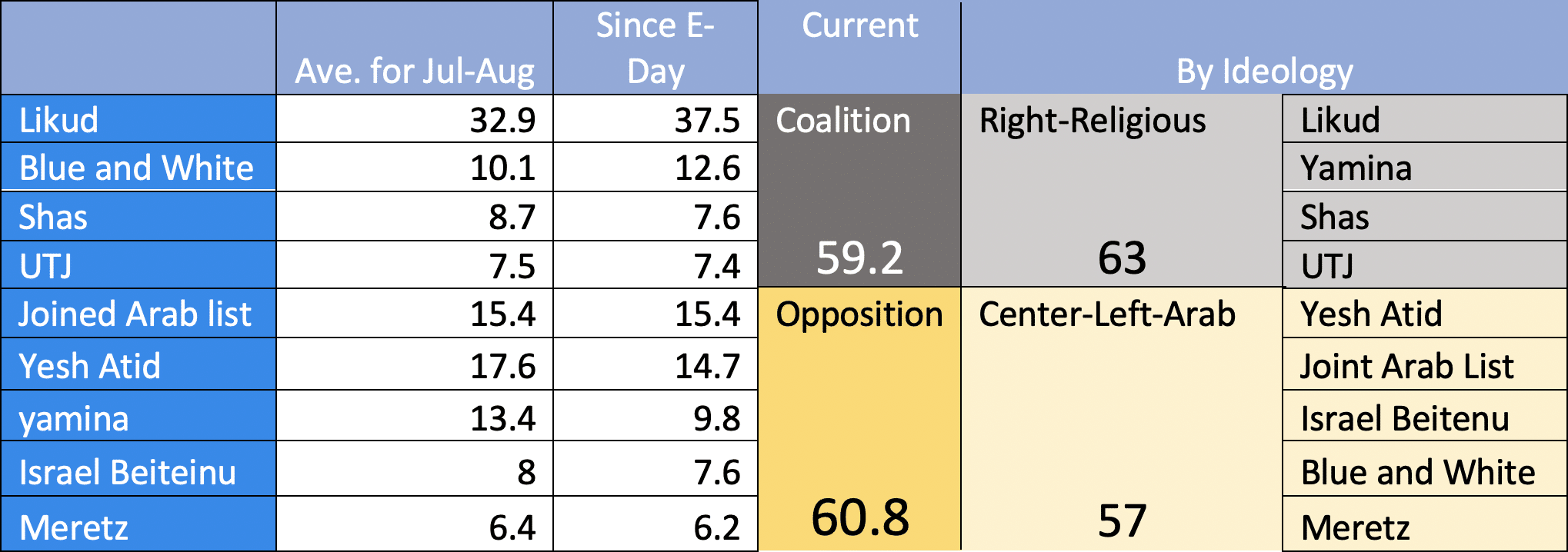
The early August polls continue the July trends. Likud is the largest party with just over 30 projected seats. Yesh Atid is the second largest party, but is trailing Likud. Yamina is the fast surging party, with an average of more than 13 seats.
What does this tell us?
Prime Minister Benjamin Netanyahu can still form a coalition with the base of right-religious parties. The price will be high. The race will be tight.
Yamina no longer has a reason to join a Netanyahu coalition. New elections are good for the party.
Blue and White is still losing. Some pundits believe that come election day, Blue and White will have disappeared.
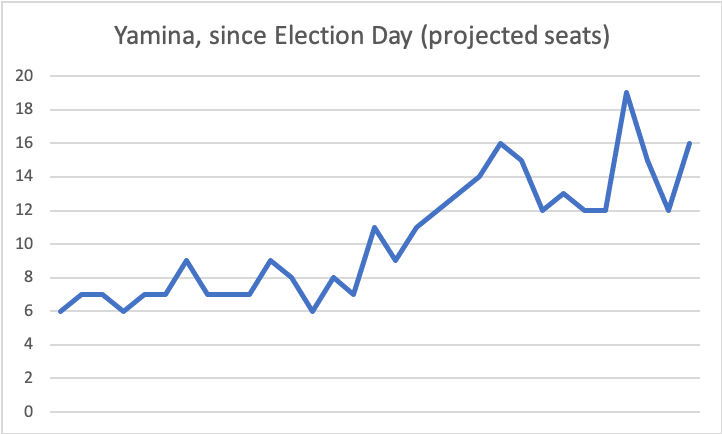
The graph below shows how Yamina has surged in the polls since election day. This is not because of annexation, or other settlement related issues. This is about the coronavirus. Yamina’s leader, Naftali Bennet, keeps hammering the government’s incompetence when it comes to dealing with the virus. As a result, he has become the go-to guy for many rightwing voters who’d never consider voting for a center-left party but admit that Likud does not deserve their vote. In other words, when you wonder how the right can keep its advantage when Likud does so purely as a governing party, Bennet is the answer.
This post is part of The Israel File, our new Sunday newsletter that summarizes everything you need to know about the last week and the coming week in Israel.
WASHINGTON (JTA) — Gen. David Goldfein, who for a time was in line to become the first Jewish chairman of the U.S. Joint Chiefs of Staff, has retired as Air Force chief.
Goldfein, 60, stepped down as scheduled on Thursday, The Washington Post reported.
James Mattis, the defense secretary in 2018, had tapped Goldfein to be the country’s next top uniformed military official. In December, just as President Donald Trump was falling out with Mattis over the president’s insistence on pulling U.S. troops out of Syria, Trump instead named Mark Milley, then the army chief, to the role. Mattis quit in January 2019.
Goldfein was named to the top Air Force job by President Barack Obama in 2016.
In June, Goldfein took the unusual step of issuing a declaration on the police killing in Minneapolis of George Floyd, calling it a “national tragedy.”
(JTA) — It’s official: A “Dirty Dancing” sequel is coming, and it’s starring Jewish actress Jennifer Grey, who played Frances “Baby” Houseman in the 1987 original.
Lionsgate CEO Jon Feltheimer confirmed the news to Deadline on Thursday, while keeping the plot secret.
“It will be exactly the kind of romantic, nostalgic movie that the franchise’s fans have been waiting for and that have made it the biggest-selling library title in the Company’s history,” Feltheimer said on a company call, according to Deadline.
Jewish filmmaker Jonathan Levine, known for helming “50/50” and “Warm Bodies,” will direct. Grey, 60, will also executive produce the film.
The original movie took place at a resort in the Borscht Belt, the vacation destination popular with New York Jews for decades in the mid-20th century, which has also been lovingly depicted in the hit show “The Marvelous Mrs. Maisel.”
A poorly received prequel of sorts, “Dirty Dancing: Havana Nights,” was released in 2004.
WASHINGTON (JTA) — Democratic presidential candidate Joe Biden is expected to name his running mate in the next two weeks, and while the list of contenders has changed constantly for months, most reports have now whittled the group of front-runners down to Kamala Harris, Elizabeth Warren, Susan Rice, Karen Bass, Tammy Duckworth and Keisha Lance Bottoms.
In that list is a range of opinions on Israel policy, varying levels of history with the Jewish community and multiple other X factors of interest to Jewish-American voters. We’ve broken those down here in a guide (in alphabetical order) to why Biden could pick any of them — from a Jewish angle.
Karen Bass
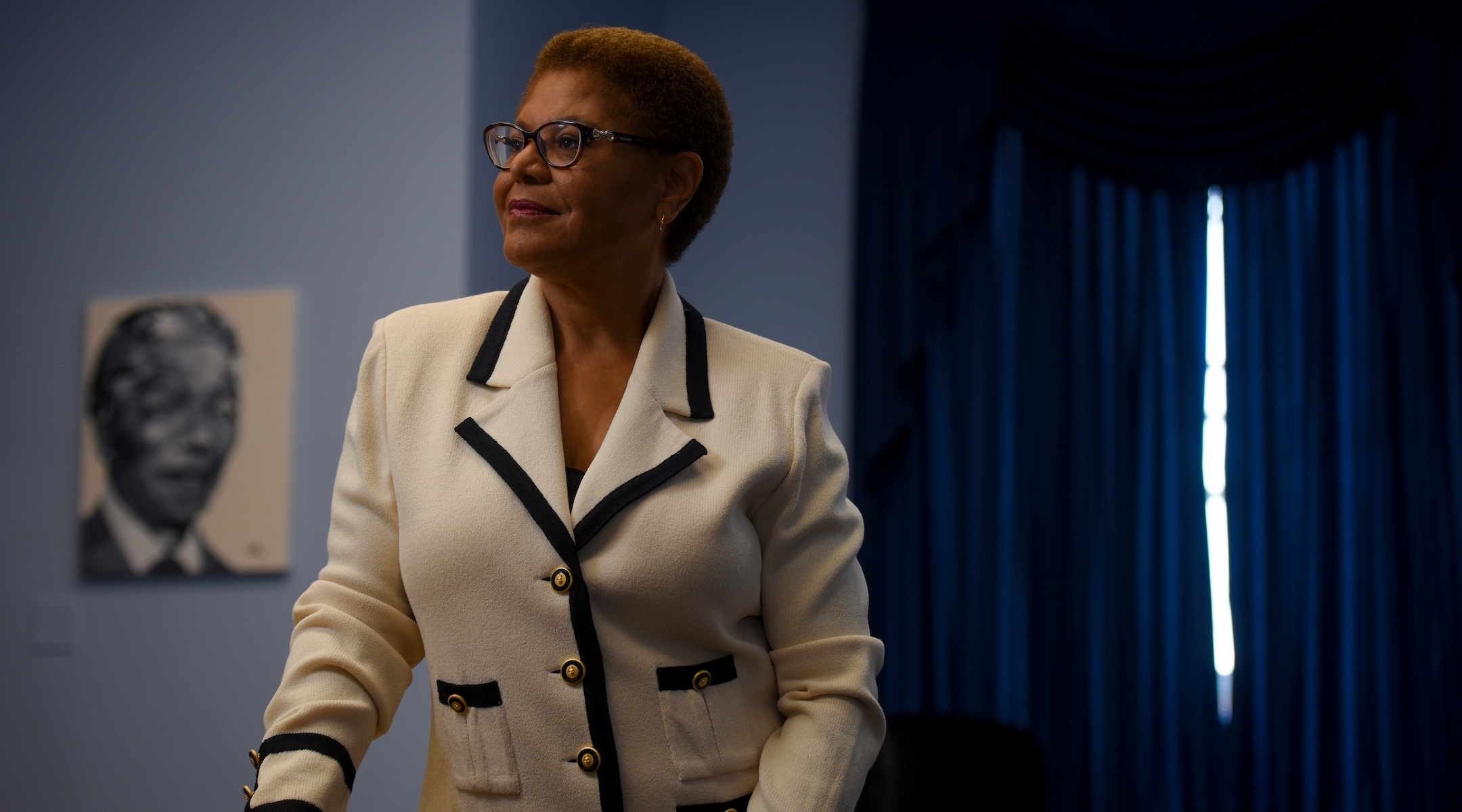
Rep. Karen Bass in her office at the Rayburn House Office Building, July 30, 2020. (Jahi Chikwendiu/The Washington Post via Getty Images)
Background: The Los Angeles representative to the U.S. House of Representatives has the rare reputation of being a solid progressive who works well with Republicans. She is known for her preternatural calm, evident when as speaker of the California Assembly she worked with GOP Gov. Arnold Schwarzenegger during the 2008-10 financial crisis. Her background in Black civil rights activism would stir excitement among African-American voters.
On Israel: Bass, who chairs the Congressional Black Caucus, was protective of Rep. Ilhan Omar of Minnesota last year after Omar came under fire for comments that a large part of the pro-Israel community saw as anti-Semitic. Bass said that some of the attacks on Omar, a freshman Democrat, were Islamaphobic. But she also agreed that Omar’s insinuation that pro-Israel groups control Congress with money was “inflammatory” and “viewed as anti-Semitism.” Last summer, Bass co-authored a House resolution to voice support for the two-state solution after Israeli Prime Minister Benjamin Netanyahu promised in political campaigns that he would annex parts of the West Bank, which some believe would endanger the possibility of two states. This June, as Netanyahu edged closer to making annexation a reality, Bass came out strongly against the move and lobbied Republicans to support a letter opposing it.
Eyebrow raisers: Bass has lavishly praised the Castro regime in Cuba and the Church of Scientology. The support for a communist leader could concern some U.S. Jews who fled persecution in other communist regimes, such as the former Soviet Union and places in Latin America.
Fairfax connection: Bass has spoken about growing up with Jews in the historically Jewish Fairfax area of Los Angeles (it was badly damaged after some recent George Floyd protests) and making Jewish friends through civil rights activism. Her first encounter, she told the Jewish Journal, was when she turned up at school on Yom Kippur and was the only one there. “That’s how I contacted the Jewish community,” she said.
Her VP case: Bass has said she regrets those statements on Castro and Scientology, but they could harm Biden, particularly in Florida, with its large Cuban-American community that includes many Jews. Florida, home to one of the nation’s biggest Jewish communities, is not a must-win for Biden, but if he knocks Trump out there — and it looks like he has a chance — the president is finished.
Keisha Lance Bottoms
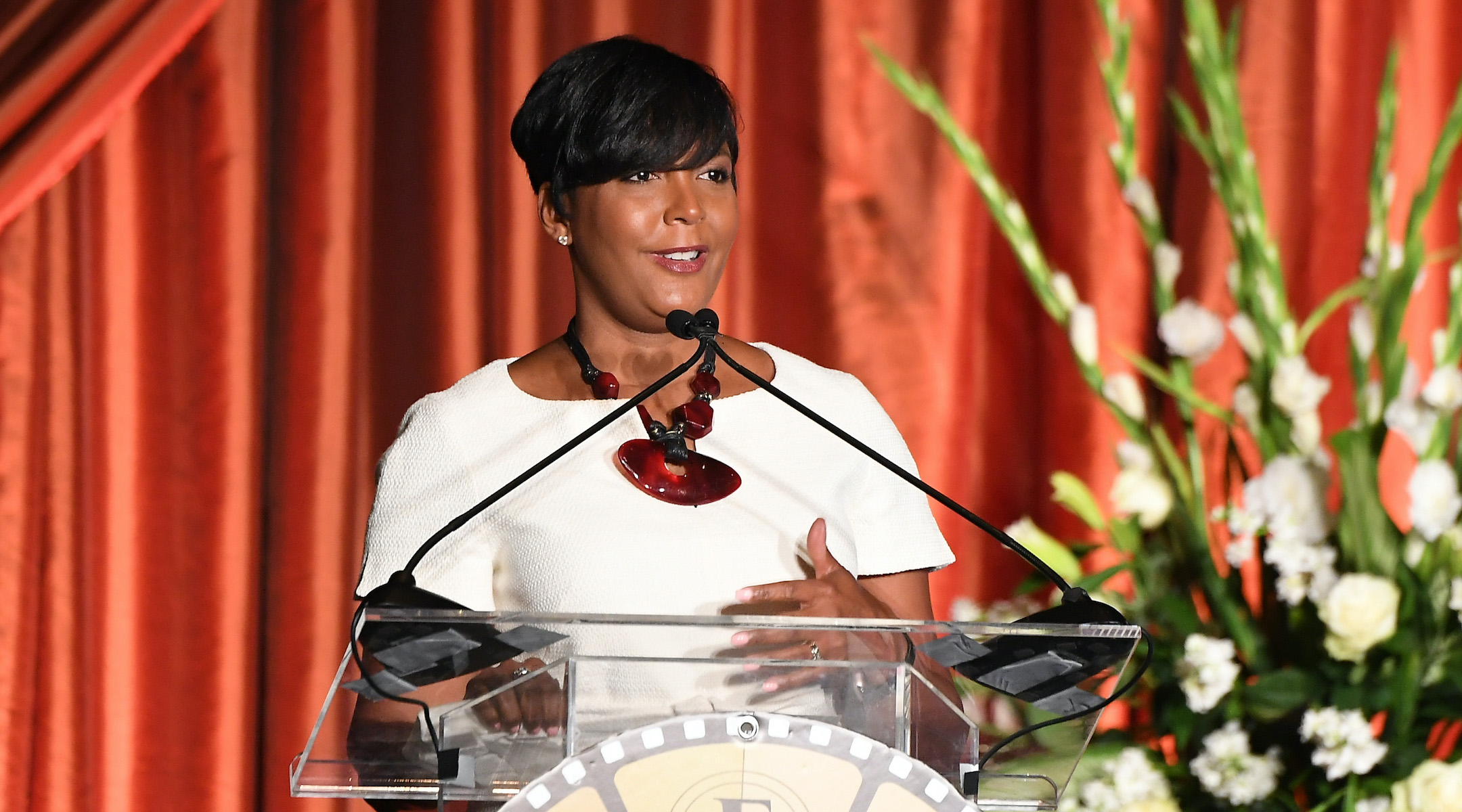
Atlanta Mayor Keisha Lance Bottoms speaks at the BronzeLens Film Festival Women Superstars Luncheon, Aug. 23, 2019. (Paras Griffin/Getty Images)
Background: The Atlanta mayor since 2017 has been given high marks for resisting Republican Gov. Brian Kemp’s anti-mask doctrines during the pandemic and for her sympathetic ear to Black activists. She also has been with Biden through highs and lows: At last year’s Democratic presidential debate in her city, at a time when Biden was down in the polls, she was his surrogate to reporters, forcefully making the presidential case for him.
On Israel: Managing Atlanta is a tough and maturing gig, but she has not developed substantial foreign policy chops. She did chair the drafting committee for the Democratic National Committee’s party platform this year, which hewed to a centrist outlook, calling on Israel’s government to stop settlement expansion but omitting any mention of the word “occupation.”
Her VP case: Bottoms is the most unknown to the Jewish community — and the wider political community — on Biden’s short list. But she has shown an ability while in the national spotlight to weather pressure and critique from progressives while strongly advocating for the Black community. And she has been a solid Biden advocate, signaling that she could back him up on Jewish issues.
Tammy Duckworth
Sen. Tammy Duckworth speaks at the 2019 AIPAC Policy Conference in Washington, D.C., March 25, 2019. (Cheriss May/NurPhoto via Getty Images)
Background: The Illinois senator is a military veteran who lost her legs in combat in Iraq. She has been outspoken and cutting in her criticism of President Donald Trump, coining the sobriquet “Cadet Bone Spurs,” an allusion to the dubious pretext Trump used to avoid the military draft. Like Biden, she is a centrist, and her legislative achievements are in the area of veterans’ affairs.
On Israel: Duckworth has been a solid AIPAC Democrat, making a point of publicizing her meetings with its activists at a time that some progressive activists were counseling a boycott. More recently, however, she was one of 18 senators who signed on to a letter that warned Netanyahu that his plans to annex part of the West Bank would “fray” U.S. bonds with Israel. That countered the centrist Democrat line that advocates for strong criticism of annexation while making clear that U.S.-Israel ties are sacrosanct. J Street has endorsed her.
Chicago Jews love her: “Senator Duckworth has been a great friend to the Jewish community and a champion on the issues they care about, from helping the widow, orphan and stranger, to ensuring a safe and secure Israel as a democratic, Jewish state,” Jewish House Rep. Brad Schneider told Jewish Insider. And this from Lauren Gash, a former Jewish member of the Illinois House: “Personally, I feel as an American Jew that she is the kind of leader we can trust to fight for Israel, and that matters to me.”
Her VP case: On paper, she does not bring the progressive balance to the ticket that the party’s left says is needed to galvanize the voters disappointed by the defeat of Bernie Sanders. And the conservative line on her is, as an Illinois Republican operative told Jewish Insider: “On issues in the Jewish community, [she’s been] absent or on the wrong side.” But her identity as both a woman of color and a decorated military veteran hints at the potential of intriguing a wide swath of voters.
Kamala Harris
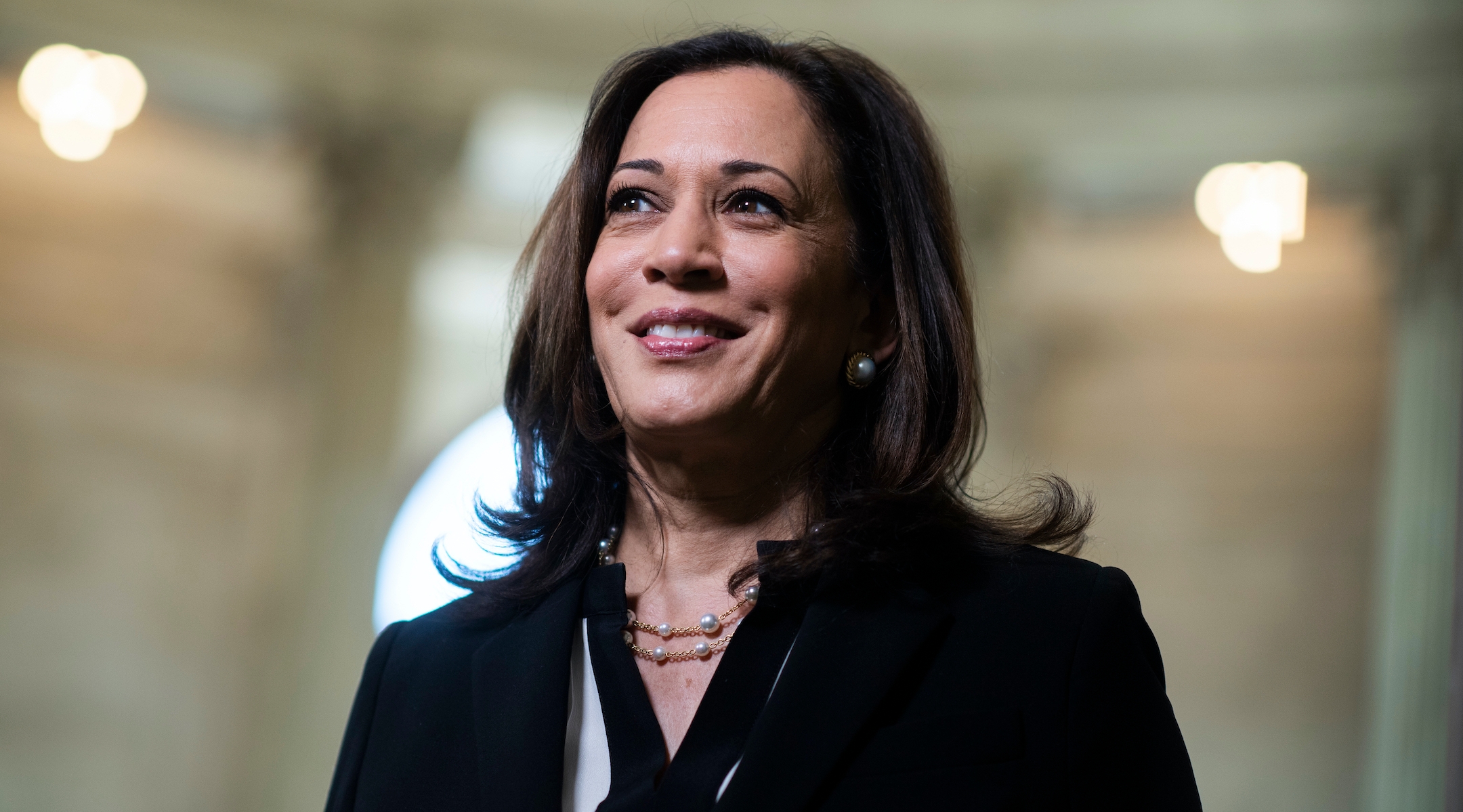
Sen. Kamala Harris in the Russell Senate Office Building, June 24, 2020. (Tom Williams/CQ Roll Call/Getty Images)
Background: The California senator briefly led the presidential contenders in the polls in mid-2019 when she stood out in the crowded debates — in part by bashing Biden on his civil rights record. Her outspoken feminism and her blunt prosecutorial style on the Senate Judiciary Committee has earned her support from Hillary Clinton-style Democrats and some progressives, while her background as a prosecutor has made her vulnerable to attacks from others to her left.
On Israel: Despite her progressive bona fides, Harris is a staunch pro-Israel liberal who is more AIPAC than J Street — in fact, J Street, the liberal Israel lobby, has never endorsed her, despite the fact that they endorse more than half of Senate Democrats. She pushed back against claims in 2019 that she was boycotting the American Israel Public Affairs Committee by releasing a picture posing with its conference activists. She backs a two-state solution and says that “a resolution to this conflict cannot be imposed” on Israelis or Palestinians. Harris isn’t just talk, though: She also co-sponsored a Senate resolution in early 2017 that essentially rebuked the Obama administration for allowing through a U.S. Security Council resolution condemning Israel’s settlement policies.
She has already broken some glass: She married Jewish lawyer Douglas Emhoff in 2014. His Twitter feed can get sappy about her, in a good way.
Blue box connection: “So having grown up in the Bay Area, I fondly remember those Jewish National Fund boxes that we would use to collect donations to plant trees for Israel,” she said at the AIPAC conference in 2017. “Years later when I visited Israel for the first time, I saw the fruits of that effort and the Israeli ingenuity that has truly made a desert bloom.”
Her VP case: On paper, Harris is very aligned with Biden, who is also a centrist Israel defender, on Israel policy. By picking her, Biden could rest easy on that front while earning some points with progressives who are not thrilled by his record.
Susan Rice
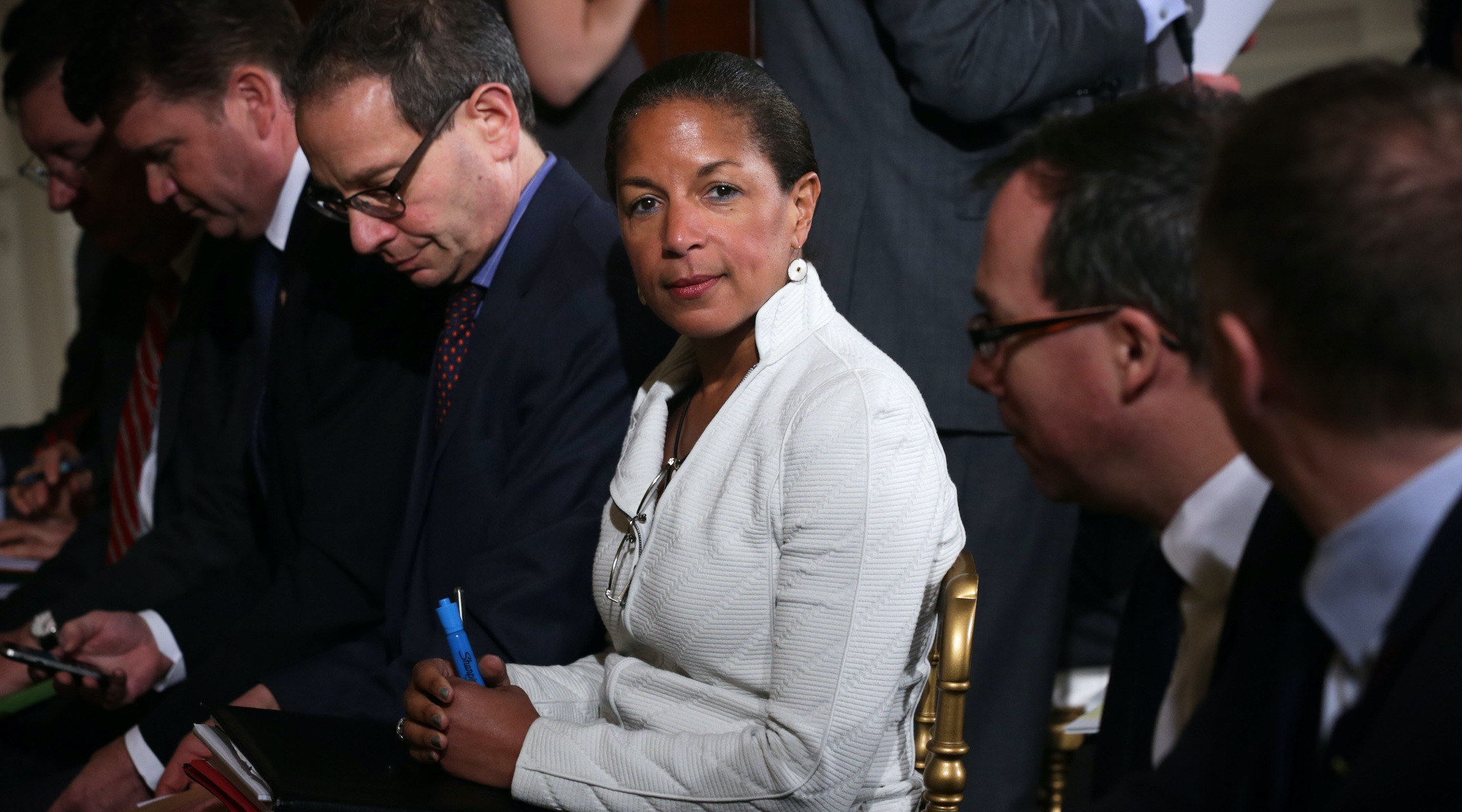
Susan Rice, then the national security adviser, sits in the audience of a joint news conference conducted by President Barack Obama and British Prime Minister David Cameron in the White House, Jan. 16, 2015. (Alex Wong/Getty Images)
Background: Rice is a veteran diplomat and White House adviser who has served as the U.S. ambassador to the United Nations, President Barack Obama’s national security adviser and foreign policy adviser to multiple other Democratic presidential nominees. Her strength, clearly, is in international relations. Republicans associate her with the controversy that followed the 2012 attack on the U.S. consulate in Benghazi, Libya, and she has since then been a lightning rod for critics of Obama’s foreign policy failures.
On Israel: Rice got high marks from the pro-Israel community for defending Israel during her tenure as ambassador to the United Nations from 2009 to 2013, and she has said that countering hostility to Israel took up the largest part of her time at the body. But those plaudits might not resonate so much these days — the Israel advocacy of Rice, or almost any past U.S. ambassador to the body, pales next to the closeness that Trump’s first envoy, Nikki Haley, has forged with Israel and the pro-Israel community. If she is selected, Rice will also have to explain the U.S. abstention in December of 2016 on a U.N. Security Council vote to condemn Israel’s settlements. As national security adviser, she was the person who called then-Ambassador Samantha Power instructing her not to use the U.S. veto to kill the resolution.
Her VP case: From a non-Jewish political standpoint, Rice brings a wealth of experience handling the entire machinery of government. But Politico reports that Republicans hope Biden chooses her because they believe her associations with Obama, Hillary Clinton and Benghazi would rev up their base. Those connections with Obama extend to the Jewish arena — Jewish voters might see her as a continuation of the Obama-era foreign policy school. For pro-Israel Jews who were not pleased with the friction between Obama and Netanyahu, that could be a liability.
Elizabeth Warren
Sen. Elizabeth Warren speaks at a presidential campaign rally in Detroit, March 3, 2020. (Jeff Kowalsky/AFP via Getty Images)
Background: The progressive Massachusetts senator has built a big base of support thanks to her rigorously detailed policy stances, her persistence in taking on corporate interests and her commitment to tackling feminist issues. Early on in the presidential campaign, she was a leading candidate.
On Israel: Warren is pro-Israel and firmly believes in Israel’s right to exist and defend itself. In an Jewish Telegraphic Agency op-ed in February, she wrote that she is “committed to Israel’s security and safety.” But she added: “At the same time, branding all criticism of Israel as automatically anti-Semitic has a chilling effect on our public discourse and makes it harder to achieve a peaceful solution between Israelis and Palestinians.” Due to her strong disagreements with Netanyahu policy and Israel’s treatment of Palestinians, Warren said she would consider conditioning assistance to Israel to influence that policy. She also boycotted this year’s AIPAC conference. She disagrees with the boycott Israel movement, but a member of her presidential campaign, Max Berger, helped found the anti-occupation group IfNotNow and tweeted in 2017 that he “agree[s] with BDS.” Warren as a senator is endorsed by J Street.
Close with the locals and immigrants: After a gunman killed 11 worshippers at the Tree of Life synagogue in 2018, Warren joined the American Jewish Committee initiative called “Show up for Shabbat” and spoke at Temple Emanuel in Newton, Massachusetts. Her official presidential campaign Twitter account tweeted about several Jewish events: twice in the wakeof Pittsburgh, and once each after the Chabad of Poway shooting, the Halle synagogue shooting in Germany, on Yom Hashoah (Israel’s Holocaust Remembrance Day) and on U.S. Holocaust Memorial Day.
Warren also pledged during the January 2019 government shutdown to donate her wages to HIAS, the leading Jewish group dealing with immigration issues and the victim of a social media attack by the Tree of Life gunman before the attack.
Her VP case: In terms of winning the Jewish vote, choosing Warren likely wouldn’t net Biden too much — many of Warren’s liberal Jewish supporters will likely swallow the moderate pill and vote for Biden regardless of who is on his ticket. Picking Warren could raise questions about his steadfastness on Israel and other foreign policy.
TEL AVIV (JTA) – To pull off its plan to reopen schools safely this fall, Israel needs to hire 15,000 new teachers. But the hiring spree will begin in earnest only next week, in hopes of delivering half of the needed educators to classrooms by January — five months into the school year.
“This is a national effort,” Yoav Gallant, the country’s education minister, said Thursday. “It won’t happen in a day.”
When school opens Sept. 1, “it will not be possible to enable full education for everyone,” Gallant said.
Smaller-scale efforts to steer Israelis into the classroom are underway already. But emerging tensions suggest that the road ahead may be anything but smooth for the country’s school system, which is already reeling from a rocky reopening this spring that was characterized by dozens of outbreaks connected to schools.
Among the looming challenges: potential resistance among some Israeli educators to fast-track training programs that may leave new teachers ill-equipped to handle the job at a particularly difficult time.
“Teachers are not babysitters,” Ruti Anzel, director of the Tel Aviv Department of Elementary Education, told the Jewish Telegraphic Agency. “Their work can’t be taught in an instant.”
Israel reopened schools for all students in all grades in May. But last month, officials said they would not repeat that approach this fall and instead would reduce class sizes for younger children while allowing older students to attend class in person only part-time. Both decisions would require additional teachers.
On Thursday, Gallant revealed new details about the plan: Kindergarten through second grade will open as usual, with around 30 to 35 children per class, on the belief that they are the group with the lowest risk of contagion. Third and fourth grades will open in pods of up to 18 students, about half a regular class size. Students older than that will learn on Zoom most of the time but meet in person in some form two days a week.
Next week, Gallant said, the government will begin working on programs to recruit and train the thousands of new teachers needed to make all of that happen. Israel plans to spend 4.2 billion shekels ($1.2 billion) on reopening schools, including on the new teacher hiring.
The centralized effort joins many others that are already underway to address Israel’s dual crises of unemployment and teacher shortages, which long predated the pandemic but have been exacerbated by the need to reduce the number of students gathering at any one time.
Rishon Letzion, a city in central Israel, has announced plans to provide teaching training in the coming year for unemployed residents. The Israeli Airline Pilots Association has announced plans to train some of the almost 950 member pilots who are furloughed or out of work while the skies remain virtually closed. A free teachers’ course is under consideration for new immigrants who were educators in their home countries but have been deterred by the bureaucracy required to convert their degrees for Israeli schools.
The national government also launched a modest effort this spring to retrain workers whose jobs disappeared during the pandemic to become teachers.
After Dana Yadlin became one of Israel’s nearly 1 million “coronavirus unemployed” last spring when her job at a nonprofit became irrelevant, she decided to pursue a long-held dream to become a teacher. In May, she joined some 400 students who were accepted to a government-backed program to fast-track the teaching certification process through three months of intensive Zoom classes.
Cleaning workers disinfect the entrance to a high school in Jerusalem, June 3, 2020. (Yonatan Sindel/Flash90)
By the end of August, Yadlin and the other students in her training program will have fulfilled about 80 percent of the credits needed for certification. They’ll get further training, including a mentor, during the school year, while they teach in their own classrooms. They’ll also get a grant of up to 14,000 shekels ($4,100).
“I had always wanted to pivot to teaching, but life had never made it possible,” said Yadlin, who has two children and whose husband has been furloughed from his job since the outbreak of the virus. “I want to find a job that’s stable, but I’m also coming from a place of feeling that this is a mission. That if we want to see an Israeli society that’s more tolerant, more compassionate, more loving of others, we have to do something about it.”
Not everyone participating in the fast-track training program appears to have come into it with the same intentions. Shirli Bithan, who lost her managerial position in a large hotel chain this spring, drew sharp criticism after she told Israel’s Channel 12 in June that she felt she had no choice as she tried to replace her income, which had been twice what Israeli teachers typically earn.
“What’s the alternative? At the moment, the income from the hotel industry is zero,” Bithan told the TV channel. “It’s either zero [income], or going to teach.”
Facebook groups with Israeli educators erupted in anger. “I guess the status of teachers wasn’t low and worthless enough that the Education Minister decided he needed to lower it and trample upon it even more,” Saar Zemach, a teacher in Ramat Gan, replied in one of them.
Israeli teachers’ starting salaries — around 6,000 shekels ($1,760) monthly before taxes — can be lower than the typical wage for waiters or cleaning staff. The 2018 Global Teacher Status Index found that Israeli teachers rank among the least respected worldwide. According to a survey published by The Marker, one in five Israeli teachers drops out of the profession within the first three years.
Teachers have long bristled at education administrators being drawn from outside the country’s education corps. Gallant, who became education minister in May, was formerly a high-ranking commander in the Israel Defense Forces.
“This very militaristic style, it’s not suited for this crisis,” said Tammy Hoffman, the director of education policy at the Israel Democracy Institute. “We’re not in combat now, it’s not a hierarchy like in the military, or in a factory. There are a lot of players in the field: civil society, parents, teachers … A lot of principals and teachers feel a lack of trust.”
The pandemic has deepened those dynamics. This spring, teachers were asked to figure out how to reach both students who are in the classroom and who decided to learn from home; work with students whose families may not have computers or internet access to allow them to work remotely; and address swelling needs among families. The nonprofit organization Elem reported that as budget cuts led to the closing of educational and social programs for at-risk youth, that population experienced a 57% spike in homelessness.
Some educators say they would prefer to tackle the new challenges presented by the pandemic with the people and resources already present in their schools. Anzel, the Tel Aviv schools official, said teachers this fall will be better prepared to handle the logistics and demands of teaching during the pandemic than they were this spring.
Liron Filos, a first-grade teacher at the Pa’amonim School in Raanana, said that in May, when elementary schools moved to pod learning, teachers’ schedules were shuffled around to make room for the halved class sizes. That might work again this fall, she said.
Government recruitment programs, Filos said, “can’t be some kind of Band Aid, and it can’t just be made available to everyone. It needs to be something that’s very, very supervised.”
The new program that Yadlin is participating in can be a model, said Rony Ramot, the head of teachers’ training at Seminar Hakibbutzim in Tel Aviv, which has accepted 120 students as part of the government program. She noted that, though expedited, the training requires students to participate for roughly seven-hour days, five days a week.
Ramot said the coronavirus situation demands creative solutions to staffing Israel’s schools and noted that it’s hard to be a new teacher under any circumstances.
“The acclimation process into a new school is always really difficult, it’s a chaotic place,” Ramot said. “But we chose people who we saw would have enough knowledge, would be able to integrate into a system in a very short period of time.”