fbpx

July 24, 2020

Josh Malina: Madonna Amplified ‘the Voice of an Anti-Semite’ in Sharing Farrakhan Video

Actor Josh Malina has criticized pop star Madonna for sharing a video of Nation of Islam leader Louis Farrakhan on Instagram.

Madonna posted a trailer of Farrakhan’s July 4 address earlier that same day. In his address, Farrakhan accused Anti-Defamation League CEO Jonathan Greenblatt of being “Satan” and said that Jews should abandon the Talmud.

Malina tweeted to Madonna on July 23, “The little red string you wear doesn’t count for s— when you amplify the voice of an anti-Semite, @Madonna.”

“The little red string” is a reference to how, in the past, Madonna considered herself a follower of Kabbalah, a more mystical interpretation of Judaism. Madonna popularized a Kabbalah teaching of wearing red string bracelets as a means of preventing bad luck.

The American Jewish Committee also criticized Madonna for promoting Farrakhan.

“.@Madonna, Louis Farrakhan is a vicious anti-Semite and homophobe who has referred to Jews as vermin and is widely regarded as one of the most prominent purveyors of hate in America,” the Jewish group tweeted. “We urge you to take down this ill-advised post.”

The Algemeiner compiled screenshots from Madonna’s recent Instagram stories calling for Apple and Google to put “Palestine back on the map,” referencing how a rumor had spread on social media that Apple and Google had removed the word “Palestine” from their respective maps. A spokesperson for Google told Agence France-Presse that their maps have never labeled the Palestinian territories as “Palestine.”

The Algemeiner also posted a screenshot of Madonna glorifying a quote from progressive activist Angela Davis that read, “Black solidarity with Palestine allows us to understand the nature of contemporary racism more deeply.”

Journal contributor and Israel-based writer Hen Mazzig tweeted, “Madonna should face the same level of criticism as Nick Canon and DeSean Jackson, especially since she has been appropriating and fetishizing Jewish identity and traditions for years. No one gets a free pass on anti-Semitism.”


Mazzig wrote in response to a question on how Madonna has appropriated Judaism: “Other than the Kabbalah stuff, featuring Tfilin in her music videos and throwing a Bar Mitzvah for her son?”


Madonna has held concerts in Israel multiple times in the past, including during Israel’s hosting of the Eurovision contest in 2019. Her dancers wore both Israeli and Palestinian flags on their backs during the performance.

Josh Malina: Madonna Amplified ‘the Voice of an Anti-Semite’ in Sharing Farrakhan Video Read More »

Don’t ‘Opt Out’ in COVID-19 Times

This week, I am going to write about terms that are being thrown around in an unfortunate way: “opting out” or “taking a break.”

In choosing whether to belong to a synagogue or support nonprofit institutions, many are deciding to take a “year off” and consider rejoining the following year. Jewish professionals across the world are reaching out to colleagues and peers, understanding that if enough people decide to opt out, the Jewish world that once was will never look the same. The Jewish world that once was will not have a solid foundation to rebuild and reconstruct in the innovative, vibrant, spiritually uplifting ways we so desperately need. With each person that decides to “sit this one out” means a chipping away of the Jewish homes thousands rely upon for comfort, solace, celebration, companionship and connection.

The COVID-19 era has devastated the world — stolen lives, impaired people’s health, injured financially, stricken mentally and emotionally. There are many who cannot afford to rejoin our communities, yet these are the members of our faith communities who  must hear our support and feel our love.

But for those in our communities that question the spiritual nourishment of online services, feel disconnected without in-person gathering, and have the means to continue to join sacred communities, my plea is to you. A real community is one that upholds those who have fallen. A true community exists even when times are difficult and scary. A sincere community is choosing to remain active as the world falls apart.

Phrases like “opting out” or “taking a break” don’t exist when you see yourself as a spark of a greater light that penetrates the darkest corners of this world. Staying a member of a community is a covenant, a promise to God and one another that you will step up when your voice is needed. And if you find yourself not currently in a community, we welcome you to join one, strengthening all of our souls during these moments of great uncertainly and fear.

Hillel wisely said, “Do not separate yourself from the community.” Look deep inside your soul. We need you. We need one another. Next year and years after, may we look back at this time in which we saw humanity join hand in hand, lifting one another, letting our fellow Jews know that together, we are not alone.

Shabbat shalom.

Don’t ‘Opt Out’ in COVID-19 Times Read More »

Taking a Virtual Trip to Israel with JNF

Tourism is a huge part of Israel’s economy and it has suffered as a result of the COVID-19 crisis. The Israel Hotel Association predicts the tourism industry will lose $1.6 billion this year. 

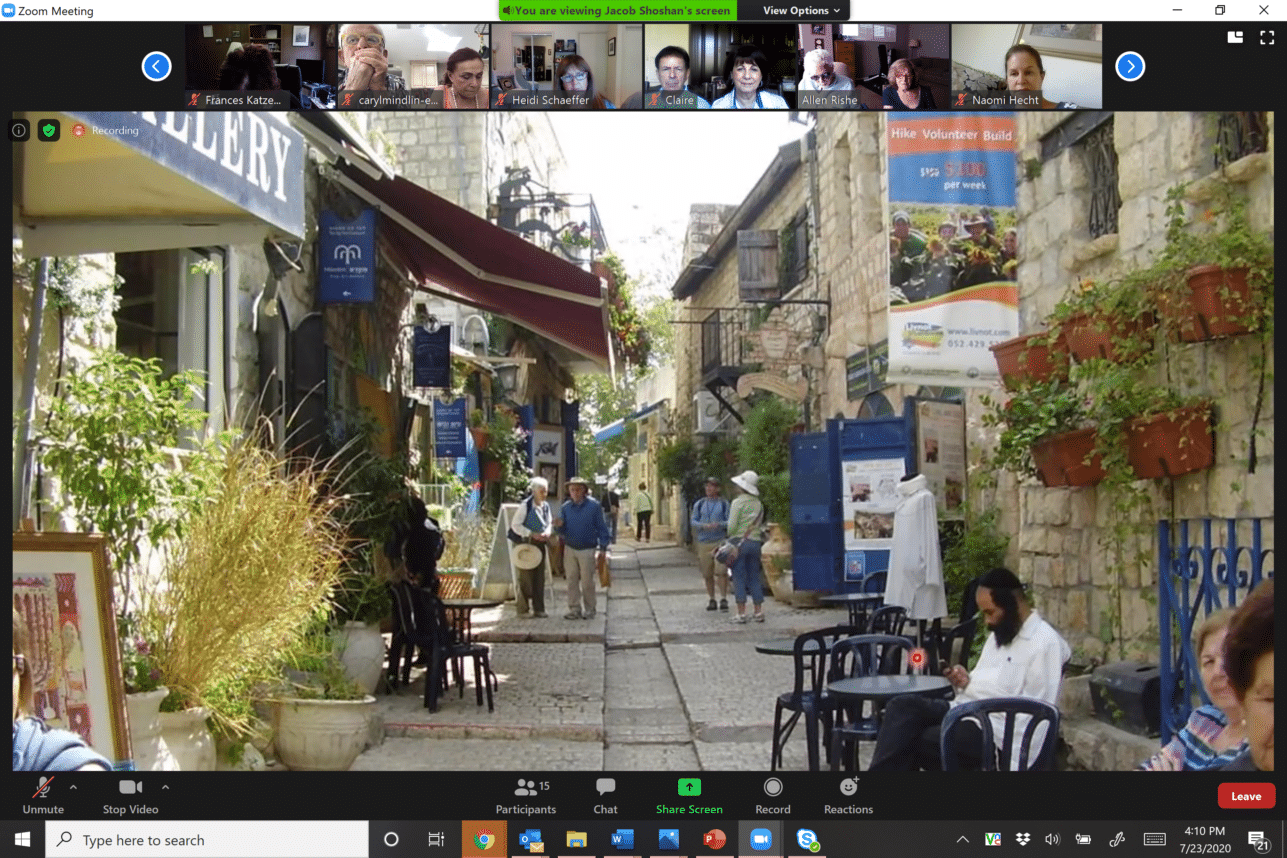
In an effort to help struggling Israeli tour guides, as well as educate people about Israel, the Jewish National Fund (JNF) is offering virtual tours of the country via Zoom through its program JNF Virtual Travel & Tours. During the week of July 20, JNF held a tour for the Valley Beth Shalom Sisterhood. The daily, hourlong tours ran from 4-5 p.m. Monday through Thursday, followed by a cocktail hour. On Friday, participants were invited to a pre-Shabbat gathering. 

Photo courtesy of JNF

“This tour is a unique opportunity to engage people in the United States, while at the same time helping the economy in Israel,” said Louis Rosenberg, executive director of the JNF in Greater Los Angeles. “I’ve heard from people who have visited Israel many times that they found out new information they never knew before.”

He added that to date, JNF has run about 100 tours around the U.S, and more than 2,500 people have participated. 

The VBS Sisterhood’s tour started in Jerusalem, where 25 participants “landed” at Ben-Gurion Airport, visited the Kotel, heard the story of the city’s reunification at Ammunition Hill, visited the religious neighborhood of Mea Shearim, and saw Hadassah Medical Center’s Chagall windows. Throughout the week, they toured with guide Jacob Shoshan and visited Tel Aviv, Akko, the Sea of Galilee, the Golan Heights, Jaffa and Be’er Sheva. 

Additional stops on the tour included visits to JNF projects including the Sderot Indoor Playground, a 21,000-square-foot space that doubles as a bomb shelter; the 9/11 Living Memorial Plaza in the Arazim Valley of the Jerusalem suburb of Ramot (the only memorial to 9/11 outside of the U.S.); and The Boys Promenade in Gush Etzion, dedicated to yeshiva students Gilad Shaar, Naftali Frenkel and Eyal Yifrach who were kidnapped and killed by Hamas in June 2014. 

JNF’s Greater Los Angeles Board President Alyse Golden Berkley and VBS member was the lay leader for the tour. She told the Journal, “We need to maintain the connection between us and our homeland and a political connection to the country and ensure its growth, health and safety.”

“This tour is a unique opportunity to engage people in the United States, while at the same time helping the economy in Israel.” — Louis Rosenberg

The latest tour was the second one for VBS, and it sold out within 24 hours. “On the tour, you have the opportunity to jell with other guests,” Berkley said. “I can’t tell you how many people from my tours are not only interested in returning to Israel, but going on a JNF mission as well.”

Grace Mitnick said she learned things she never knew, including the history of Jaffa and how the historical society got involved to preserve buildings there. “It’s these little details you don’t learn when you’re roaming the streets on your own,” she said.

Rosenberg said that there are people on the tours like Mitnick who are very familiar with the country, while there are others who haven’t visited since the Six-Day War, and some who have never set foot in the country. The cocktail hour at the end of each day is the perfect opportunity for people to share their experiences, he said. “It’s become an awesome networking thing with people since we can get together with friends and experience unique opportunities to visit Israel. The discussion part is the most interesting.” 

Mitnick added she is excited to hopefully go back to Israel next year to see her extended family. “When [my family and I] visit Israel, we don’t usually go on a tour,” she said. “But now, we’re going to go back and see all these places we never knew existed.”

The tours cost $50 per person for the entire week. All monies go directly to the guide who runs the tour. 

For more information or to book a tour visit JNF.

Taking a Virtual Trip to Israel with JNF Read More »

Stephen Miller Rejects Claim Grandmother Died of COVID-19, Despite Death Certificate

WASHINGTON (JTA) — Stephen Miller, a top adviser to President Donald Trump, is insisting his grandmother did not die of the coronavirus, despite a death certificate that states otherwise.

Miller’s maternal uncle, David Glosser, who has criticized Miller in the past for crafting Trump’s restrictive immigration policies, took to Facebook to commemorate the death of his mother, Ruth Glosser, who died at 97 in Southern California, Mother Jones reported Thursday. He said in the post she died of “the late effects of COVID 19.”

The White House has come under fire for mishandling the pandemic. On Thursday, the number of infected in the United States hit 4 million. The death toll tops 141,000.

Mother Jones asked the White House for a response.

“This is categorically false, and a disgusting use of so-called journalism when the family deserves privacy to mourn the loss of a loved one,” the White House said. “His grandmother did not pass away from COVID. She was diagnosed with COVID in March and passed away in July, so that timeline does not add up at all. His grandmother died peacefully in her sleep from old age. I would hope that you would choose not to go down this road.”

The White House doubled down, saying Ruth Glosser had recovered from a “mild” case of COVID-19 in March. David Glosser told the liberal online news site that she never recovered.

In 2018, Glosser wrote a broadside against his nephew calling him an “immigration hypocrite” for crafting policies that Glosser said would have consigned their Jewish immigrant ancestors to the mercies of Nazi Europe.

Stephen Miller Rejects Claim Grandmother Died of COVID-19, Despite Death Certificate Read More »

Holocaust Survivor, 90, Stabbed to Death in Her Moscow Apartment

(JTA) — A 90-year-old Holocaust survivor was murdered in her Moscow apartment.

The body of Irina Shur, a former professor at the Gerasimov Institute of Cinematography, was found at her apartment late last week, TASS reported Wednesday. She had been stabbed multiple times and had been dead for at least 24 hours.

A 69-year-old woman was arrested in connection with the murder. The woman had been a case worker charged with caring for Shur as recently as 2016. The two women remained in contact thereafter, an unnamed official told TASS.

The door to Shur’s apartment showed no signs of forced entry, leading investigators to believe she knew her killer and opened the door for them. The apartment was found in neat condition with no valuables missing, making it difficult to ascertain the motive, the report said.

One theory being investigated is that Shur was killed by perpetrators seeking to take over her apartment, which is situated in the pricey Dorogomilov district, Moskva24 reported.

“Everyone respected her,” Maya Sakvarelidze, vice-rector at the cinematography institute, told Moskva24. She was “intelligent, educated and adored by her students.”

Holocaust Survivor, 90, Stabbed to Death in Her Moscow Apartment Read More »

Add Vitamin D to Your Tisha B’Av Diet With Fish

We’ve just entered the nine days of mourning on the Jewish calendar. Among the many tragic events we mourn during these nine days are the destruction of the First and Second Temples, the exile from Spain and the deportation of Jews from the Warsaw Ghetto to the concentration camps. For many, this period comes with a litany of customs, including refraining from listening to music and holding weddings and not buying new clothes until after Tisha b’Av.

There also is a custom not to eat meat or drink wine during the nine days. The Torah makes clear that these foods are indicative of festivity, joy and celebration: “And you shall sacrifice peace offerings, and you shall eat there, and you shall rejoice before the Lord, your God.” (Deuteronomy 27:7); “And wine, which cheers man’s heart.” (Psalms 104:15). They also were used in the Temple service. Therefore, we refrain from consuming them until after Tisha b’Av.

In lieu of eating meat, we eat fish. While I was growing up, my family ate fish for almost the entire nine days.

This year, we have the added challenge of a pandemic and everything that entails. In our case, that has meant not having a regular daily routine; managing through work instability; and having the kids at home all day.

Also take into consideration that like most Americans, we have spent a disproportionate amount of our time indoors since mid-March. As a result, we are not getting our regular dose of vitamin D. Vitamin D’s functions include absorbing calcium, aiding in bone development and controlling inflammation. A deficiency of this crucial vitamin can cause a host of health conditions, including muscle weakness, pain, fatigue and mood disorders.

Fortunately, in addition to sunlight, we can obtain vitamin D from supplements and a handful of foods. And fatty fish is a good source of  vitamin D. In addition to healthy omega-3 fats and protein, certain fish contain copious amounts of vitamin D.

Which fish is the best source of this crucial vitamin? Wild salmon, followed by farmed salmon, ahi/yellowfin tuna, trout, smoked whitefish and sardines.

Fish is easy to prepare. It cooks quickly and it can be extraordinarily flavorful. With a little seasoning and some ingredient ingenuity, you can whip up a memorable fish dish with a vitamin D bonanza. The best way to preserve the vitamin D is to bake or boil the fish. Frying may cause vitamin D to break down.

Here are some fish dish ideas to get you started:

    • Canned salmon or tuna salad: Mix in mayonnaise, diced onions, paprika and fresh-squeezed lemon juice.
    • Salmon ceviche: This is excellent for hot Shabbat days. Combine small strips of raw salmon with thinly sliced onions, fresh-squeezed lemon juice, salt, pepper and cilantro. Marinate in the fridge for a day.
    • Fish stew: Sauté onions, garlic and red peppers in oil, add tomato sauce, sweet or regular tomatoes, and throw in sliced carrots and some potatoes. When almost ready, add your fish of choice. Season with salt, pepper and paprika.
    • Fish ball soup: Like matzo ball soup but with fish. Combine ground fish with matzo meal, eggs and seasonings. Add to a pareve soup broth.
    • Salmon patties: Mix ground fish with eggs, flour, chopped onions and seasonings. Bake.

With summer well upon us, let’s hope the pandemic lifts enough so we can spend more time outside. Our bodies will appreciate receiving vitamin D from sunlight. And let’s hope the Temple is rebuilt speedily, so the first nine days of Tisha b’Av become about rejoicing rather than mourning.


Michael Tanenbaum is a writer and marketer living in Los Angeles. He is the founder and editor-in-chief of Consciously Kosher.

Add Vitamin D to Your Tisha B’Av Diet With Fish Read More »

Table for Five: Devarim

One verse, five voices. Edited by Salvador Litvak, the Accidental Talmudist

How can I bear unaided the trouble of you, and the burden, and the bickering!- Deuteronomy 1:12


Miriam Yerushalmi
Director SANE, author and counselor

Hebrew is called “lashon hakodesh, the holy tongue/language,” which also can be read as an injunction to keep our speech holy. Parashat Devarim — meaning “words, things” — usually is read before Tisha b’Av, the holy day connected to rectifying the past and rebuilding unity within our nation and with HaShem. 

In his final talk before Bnei Yisroel, Moshe Rabbeinu relates that in the past, he became momentarily disheartened by the people’s “trouble and burden” and by their “bickering” — which seems comparatively insignificant. Yet it is the last word, literally and figuratively, in Moshe’s statement here. The root of “rivchem” can mean “contend, complain” as well as “increase, multiply.” Small complaints multiply and increase one’s troubles and burdens, until they can challenge even the greatest of men, Moshe Rabbeinu. How much more can they affect us! 

Moshe — despite a speech impediment, possibly the world’s most influential speaker — teaches us that words can be used in a way that will diminish disputes, bring about therapeutic realignment, and increase unity. We can speak the language of love, where the intent of our speech matters as much as the content: Words that come from one’s heart will enter the heart of another. The more we use our devarim in lashon hakodesh, increasing our words for holy purposes — for prayer, learning, sympathy, encouragement — the more we arouse in ourselves the specific power that God used to create the world: the power of speech. The holier our speech, the holier and more powerful we become. Holy speech empowers us to be co-creators.

Rabbi Mark Blazer
President, Jewish Life Foundation, JLTV

As Deuteronomy/Devarim, the Second Telling begins, Moses expresses a frustration early on at Mount Sinai. What is ironic is that Moses says these words at the beginning of the book, just as he begins to recount the journey from there to Eretz Yisrael. Did he feel that way 40 years before, or was this statement reflective of his perspective as he was looking back over all that time, and so many frustrating and disheartening experiences? 

We are left with this testimony as well, not just the report we remember from earlier in the Torah. As we reconcile these two versions, we take an important lesson: We know each person has a unique point of view but in addition, every individual also can have different perspectives within his or her lifetime. As we age, our vision of the world changes, as may our beliefs and even the assessment of our lives. 

Our actions today always affect the future, but we have to appreciate that during times such as these, they may even have greater power. We have to try to envision what greater, long-lasting effects we may have. This requires imagining what we would like our future selves and our descendants to say about how we lived in this present. 

The lesson from Moses’ life, his retelling of our history, is that each of us shapes our narrative, and by consequence, effects the lives of so many who will inhabit this world for years to come.

Heftsibah Cohen-Montagu
Arevot Women’s Beit Midrash of the Sephardic Educational Center

Why did Moses need to retell the story of the wandering in the desert in the first person, from his viewpoint? Perhaps we can answer this question by seeing the verse not as a reproof to the people but as Moses reflecting on his leadership. 

“How” suggests uncertainty, lack of self-confidence, and helplessness. It also is the opening word in the lamentations for the 9th of Av, expressing pain and grief. Together with “unaided,” it emphasizes Moses’ feeling of isolation. 

Perhaps Moses’ sensation that he is bearing a heavy burden alone stems from his spiritual distance from the people. God was closer to Moses than to anyone who ever lived, said Maimonides (Shemona Perakim, 7), and this intimacy intensified the gulf between him and the people. Moses did not speak to the people with his own voice but as an intermediary for God’s words, and Moses had Aaron as an intermediary because he was slow of speech. In other words, maybe Moses’ elevated spiritual level and his lack of direct speech to the people made him see their behavior as petty and intolerable. 

Perhaps Moses moves to addressing the people directly at the beginning of the book of Deuteronomy because he realizes that his remoteness from the people has shaped his approach as a leader. Through him we understand that leadership cannot be achieved by speaking across a spiritual gulf and via an intermediary, but by direct speech and partnership between the leader and the community.

Rabbi Elchanan Shoff
Rabbi, Beis Knesses of Los Angeles 

From Moshe’s frustration at the enormity of his job description, we can, says Nachmanides, determine (wait for it…) the job description! What is a rabbi for? What is a Torah leader meant to do? Nachmanides writes that here, the Torah clues us in to the three major responsibilities of a rabbi. 

First, “tarchachem,” the trouble, means the hard work of teaching the Jewish people Torah. A rabbi must spend time teaching Torah. Far from creating great sermons and lectures, teaching Torah means seeing to it that people are learning more of the texts of the Torah and Talmud. Without studying the Torah, Judaism can no longer thrive. Torah study is likened to water; as plants need watering, Judaism needs Torah study. 

“Masachem,” the burden, the second responsibility is to pray for the Jewish people. A rabbi must pray on behalf of his or her congregants. When a rabbi thinks it is his or her behavior that makes all this difference in things, that is an unacceptable arrogance. God is in charge and it is to Him that we pray in order to be able to influence the world. If you have encountered a rabbi without such a humble orientation, you will know just why this is so crucial. 

“Rivchem,” the bickering, means that a rabbi must quell quarreling and disagreement between people. It is the responsibility of our leadership to bring us together, to live in peace as a people. Teaching authentic Torah, humble reliance upon God, and peacemaking. Look for these in a Torah leader.

Michael Berenbaum
Professor of Jewish Studies, Director of Sigi Ziering Institute, American Jewish University

Even Moshe cannot give his father-in-law the credit. 

The book of Devarim is Moshe’s swan song. 

By verse 12 we learn that an event and the memory of that event can differ dramatically. “How can I bear unaided the trouble of you, and the burden, and the bickering?” Moshe recounts his suggestion that power be divided, judges of the thousands, hundreds, 50 and the 10. The Israelites accepted his proposal, so he reports.

Discerning readers of the Torah will recall it differently. 

Father-in-law Jethro came with his daughter — Moshe’s wife — and his grandchildren. He observed Moshe working from morning to night as judge and juror. Midian was a more advanced society than the Israelites, who had just been released from slavery, and Jethro a priest, suggested they diffuse power and create a hierarchy. Retain ultimate power and delegate the small stuff. 

A typical father-in-law, Jethro was worried that Moshe’s demanding job would interfere with his marriage and his responsibility as a father. He was seemingly saying create time to take care of my daughter and my precious grandchildren. 

Forty years later with almost none of the original generation still alive to contradict him, Moshe takes all the credit. Why does he not want to give his father-in-law credit for sagacious advice? Moshe also now experiences the Israelites as burdensome and bickering. The Torah graciously describes Moshe as undiminished, yet however regretfully, knowingly or unknowingly, he is ready for the transition of power — only not before he has had his final say. He still wants to enter the Promised Land. But that’s next week’s drama. 

Table for Five: Devarim Read More »