fbpx

July 23, 2020

5 Arguments Against ‘America Is a Racist Country’

The left-wing allegation that America is a racist country is the greatest national libel since the Blood Libel against the Jews. America is, in fact, the least racist, most multiracial and  multiethnic country in world history.

Neither the claim that American society is racist nor the claim that America is the least racist country can be empirically proven. Both are assessments. But honest people do need to provide arguments for their position. I have found every argument that America is racist, let alone “systemically” racist, wanting. For example, the police almost never kill unarmed Black Americans and, on the rare occasions they do (about 15 times a year), there is almost always a valid reason (as in the infamous 2014 Michael Brown case in Ferguson, Mo.); police kill more unarmed white Americans than Black Americans; the reason there are proportionately so many more Black people in prison is that Black people disproportionately commit violent crimes; and so on.

There are very powerful arguments against the allegation that America is a racist society.

I offered one in a recent column:

No. 1: If there is so much racism in America, why are there so many false claims of racism and outright race hoaxes?

I offered 15 recent examples. Moreover, there were probably no racist hoaxes when America really was racist, just as there were no anti-Semitic hoaxes in 1930s Germany, when there was rampant anti-Semitism. You need hoaxes when the real thing is hard to find.

No. 2: The constant references to slavery.

If there were a great deal of racism in America today, there would be no reason to constantly invoke slavery and the Confederacy. The very fact that The New York Times felt it necessary to launch its “1619 Project,” citing the year when the first African slaves forcibly were brought to America, is a perfect illustration of the point. The fact that “The 1619 Project” was labeled false by the leading American historians of that era (all of whom are liberals and at least one of whom led a campaign to impeach President Donald Trump) adds fuel to the argument. Even regarding the past, the promoters of the “America is racist” libel need to lie to paint America as bad as possible.

No. 3: The reliance on lies.

“The 1619 Project,” which now will be taught in thousands of American schools, is based on lies. All Americans who care about America and/or truth should inquire if their children’s school will teach this and, if so, place their child in a school that does not.

Two of the biggest lies are that preserving slavery was the real cause of the American Revolution and that slavery is what made America rich.

Even the accusations of endemic racist police brutality is a lie. There are undoubtedly racist police officers but racism doesn’t characterize police interactions with Black Americans.

No. 4: The large African immigration to the United States.

Nearly 2 million Black Africans and more than 1 million Black people from the Caribbean have emigrated to the United States in just the past 20 years. Why would so many Black people voluntarily move to a country that is “systemically racist,” a country, according to the promoters of the “America is racist” libel, in which every single white is a racist? Are all these Black people dumb? Are they ignorant? And what about the millions more who would move here if they were allowed to? How does one explain the fact that Nigerians, for example, are among the most successful immigrant communities?

No. 5: The preoccupation with “microaggressions.”

According to the University of California’s list of racist “microaggressions,” saying, “There is only one race, the human race,” is a “racist microaggression.” This is, of course, Orwellian doublespeak. Anyone who believes there is only one race is not, by definition, a racist. If everyone in the past had believed there was one race, the human race, there never would have been racism, let alone a slave trade based on racism.

The very fact that the left came up with the intellectual farce known as “microaggressions,” like the race hoaxes, proves how little racism there is in America — because the entire thesis is based on the fact that there are so few real, or “macro,” aggressions.

The race riots, the ruining of people’s careers and lives over something said or done at any time in their lives, the ruining of professional sports (especially basketball and football), the tearing down of America and its history, the smearing of moral giants like Abraham Lincoln — all of this is being done because of a lie.

As I wrote in a column three years ago: “The Jews survived the Blood Libel. But America may not survive the American Libel. While the first Libel led to the death of many Jews, the present Libel may lead to the death of a civilization. Indeed, the least oppressive ever created.”

Copyright 2020 creators.com. Dennis Prager is a nationally syndicated radio talk show host. His latest book, published in 2019, is “The Rational Bible,” a commentary on the Book of Genesis. His film, “No Safe Spaces,” was in theaters fall 2019. He can be contacted at dennisprager.com. Reprinted with permission.

5 Arguments Against ‘America Is a Racist Country’ Read More »
Former British Chief Rabbi on China’s Treatment of Uighur Muslims a ‘Moral Outrage’ That ‘Must Be Challenged by the Global Community’

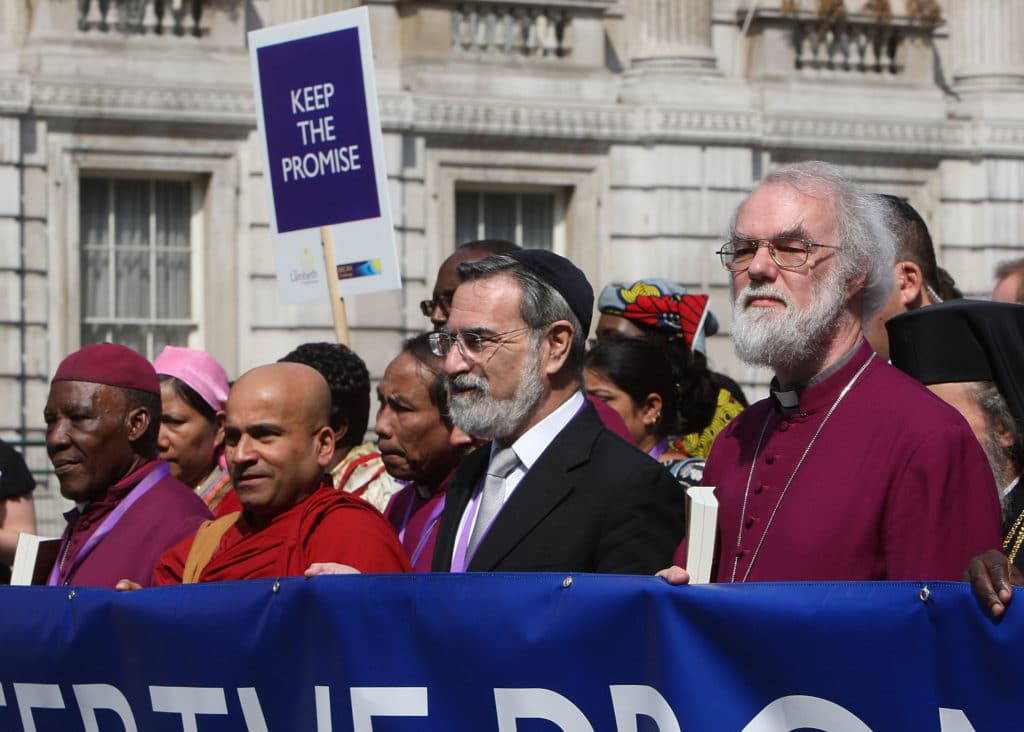
Former British Chief Rabbi Jonathan Sacks wrote in a July 22 Facebook post that the Chinese government’s treatment of the Uighur Muslims needs to “be challenged by the global community.”

Sacks wrote that “the sight of people being shaven headed, lined up, boarded onto trains, and sent to concentration camps is particularly harrowing. That people in the 21st century are being murdered, terrorized, victimized, intimidated and robbed of their liberties because of the way they worship God is a moral outrage, a political scandal and a desecration of faith itself.”

He noted that Article 18 of the United Nations Declaration of Human Rights protects freedom of religion and that the international community needs to ensure that right is protected everywhere, including protecting minorities from being demonized.

“The Nazis called Jews vermin and lice,” Sacks wrote. “The Hutus of Rwanda called the Tutsis inyenzi, or cockroaches. When the world allows the dehumanization of the Other, evil follows, as night follows day.”

He concluded: “Today, this is happening to the Uighur population in China and it must be challenged by the global community in the strongest possible terms.”

https://www.facebook.com/rabbisacks/posts/3311288075588991

Sacks’ Facebook post comes after leaked drone footage from 2019 that recently resurfaced on social media showed Uighur Muslims that were blindfolded and shackled and were being led to trains in Xianjiang, which is located in northern China. Board of Deputies of British Jews President Marie van der Zyl wrote in a July 20 letter to Chinese Ambassador to Britain Liu Xiaoming, “China risks squandering its achievements and sabotaging its own legacy if it fails to learn the lessons of history. The World will neither forgive nor forget a genocide against the Uyghur people.”

Liu told the BBC that the video just showed “a transfer of prisoners … Uighur people enjoy peaceful, harmonious coexistence with other ethnic groups of people.”

International human rights lawyer Arsen Ostrovsky noted in a July 23 Newsweek op-ed that Europe and the United Nations have been silent on China’s treatments of the Uighurs, and that China is expected to be elected to the U.N. Human Rights Council soon.

“In his 1986 Nobel Peace Prize acceptance speech, Holocaust survivor Elie Wiesel warned us ‘there may be times when we are powerless to prevent injustice, but there must never be a time when we fail to protest,’” Ostrovsky wrote. “Here, too, we cannot remain silent, thereby giving China impunity for its crimes. We must speak up for the Uyghur people.”

The Simon Wiesenthal Center tweeted, “We can’t wait while [the] Muslim world remains largely silent, while PA’s [Palestinian Authority President Mahmoud] Abbas endorses [China President Xi [Jinping]’s torture of fellow Muslims, while European countries continue business as usual with #Beijing. Never again means never again.”

Former British Chief Rabbi on China’s Treatment of Uighur Muslims a ‘Moral Outrage’ That ‘Must Be Challenged by the Global Community’ Read More »

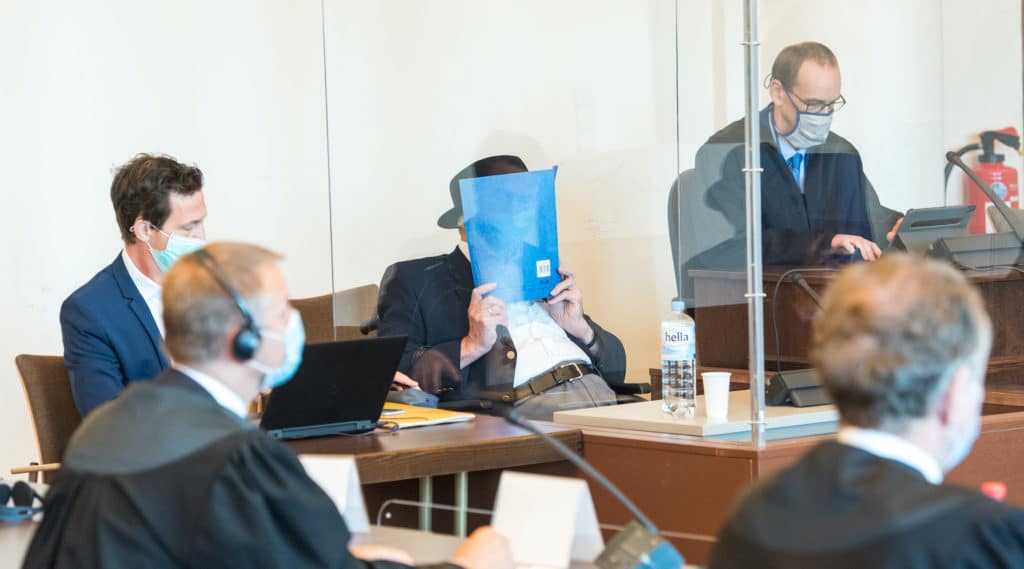
Former Concentration Camp Guard, 93, Gets Suspended Sentence as Accessory to Murder of 5,230

BERLIN (JTA) – In likely one of the last such trials, a 93-year-old former concentration camp guard was given a two-year suspended sentence on Thursday – a decision that the Simon Wiesenthal Center’s chief Nazi hunter is calling a travesty.

A Hamburg court found Bruno Dey guilty as an accessory in the murders of 5,230 people in the Stutthof camp near Gdansk, today in Poland but then a part of Germany. The count is reportedly based on the number of people murdered while Dey was stationed there.

Efraim Zuroff of the Wiesenthal Center’s Jerusalem office told the Jewish Telegraphic Agency that the suspended sentence sent the wrong message.

“He goes home happy and survivors have to live with their nightmares,” he said in a telephone interview.

About 14 former concentration camp guards and members of Nazi mass killing squads are under investigation, he said, adding that there is “no documented case of any German being executed for refusing to kill Jews.”

Their advanced age and that of survivors make future trials difficult.

Dey, who was tried in juvenile court because of his age at the time of the crimes, had admitted being an SS guard in Stutthof from August 1944 to April 1945 after being drafted into the German Wehrmacht. He was assigned to the camp after being found unfit to serve on the front.

According to a BBC report, Dey said he was shaken by the testimony of survivors during his trial and apologized to “those who went through the hell of this madness.” But he also said that though he had known of gas chambers and witnessed people suffering, he had not known of the extent of the atrocities.

Of the estimated 100,000 people deported there, more than 60,000 died. Most of the prisoners were non-Jewish Poles, along with some Polish Jews.

State prosecutor Lars Mahnke contended that Dey had known what was going on and actively prevented people from fleeing.

“If you are part of the machinery of mass murder, it is no defense to say you looked the other way,” he told the court, according to German media reports.

Germany has prosecuted several accused accomplices to Nazi war crimes since the 2011 conviction in Munich of former concentration camp guard John Demjanjuk, who was found guilty as an accessory in the murders of nearly 30,000 Jews in the Sobibor death camp in Nazi-occupied Poland.

That case set a precedent in that being a guard at a death camp was sufficient to prove complicity in murder. Since then, Zuroff has sought tips on possible perpetrators in an effort titled Operation Last Chance. But none of the war criminals convicted since has served jail time, he said.

Former Concentration Camp Guard, 93, Gets Suspended Sentence as Accessory to Murder of 5,230 Read More »

What it Takes: A Poem for Torah Portion Devarim

How can I bear your trouble, your burden, and your strife all by myself?

It takes a village
It takes a shtetl
It takes two or more
It takes divine intervention

It takes thirty nine years in the desert
It takes a population explosion of complainers
It takes the words of a spiritual
It takes men appointed over men appointed over men

It takes wise men
It takes men you know
It takes an acknowledgement that it takes women
It takes ancient cities on today’s maps

It takes commands
It takes the memory of mountains
It takes a vanquished enemy
It takes verbal acknowledgement

It takes lawyers
It takes not playing favorites
It takes leadership training
It takes all the things you should do

It takes the right order of the right words
It takes righteous words
It takes five books
It takes ten more chapters

Before you leave the fantasy novel of our past
Before you enter the archaeology of our past
Before the promised land has its golden age
Before it all goes to Sheol again

You cannot do this alone
The trouble, the burden, the strife
Do not do this alone.
You’ll fall apart.


God Wrestler: a poem for every Torah Portion by Rick LupertLos Angeles poet Rick Lupert created the Poetry Super Highway (an online publication and resource for poets), and hosted the Cobalt Cafe weekly poetry reading for almost 21 years. He’s authored 23 collections of poetry, including “God Wrestler: A Poem for Every Torah Portion“, “I’m a Jew, Are You” (Jewish themed poems) and “Feeding Holy Cats” (Poetry written while a staff member on the first Birthright Israel trip), and most recently “Hunka Hunka Howdee!” (Poems written in Memphis, Nashville, and Louisville – Ain’t Got No Press, May 2019) and edited the anthologies “Ekphrastia Gone Wild”, “A Poet’s Haggadah”, and “The Night Goes on All Night.” He writes the daily web comic “Cat and Banana” with fellow Los Angeles poet Brendan Constantine. He’s widely published and reads his poetry wherever they let him.
What it Takes: A Poem for Torah Portion Devarim Read More »

Kenneth Hoffman­: Executive Director of the Upcoming Museum of the Southern Jewish Experience

Although Jews have been a part of the American South for hundreds of years, their stories are largely unknown. The Museum of the Southern Jewish Experience hopes to change that. Slated to open in New Orleans in the first quarter of 2021, the museum will explore the lives of Jewish Southerners from 13 states. Leading the effort is Executive Director Kenneth Hoffman. 

Jewish Journal: How did you get involved with this project?

Kenneth Hoffman: I grew up in Baton Rouge, La., and went to Jacobs camp. I went to Tulane University and in grad school my thesis was on Southern Jewish history. In the 1990s, I was working at the [National] World War II Museum. When the committee came to New Orleans, they looked me up. I consulted with them for a while and eventually they needed a director. I took a leap of faith and left my job to take on this project. I’m thrilled to be executive director. 

JJ: Where did the idea for the museum come from?

KH: It’s actually a reboot of a museum that started at a Jewish summer camp in Mississippi in the 1980s. They wanted to preserve physical artifacts from Southern Jews in small towns. Small-town Southern Jewish communities had been shrinking for decades, but by the ’80s they were really going out of business, so to speak. So, the camp director built the museum to collect and display items. It was a great idea but difficult to access for the public. 

JJ: What happened to the collection?

KH: In 2012, they shuttered the museum, put all the artifacts in storage and started to look for a new home. New Orleans was chosen and the mission was expanded to include Southern Judaism writ large, over 13 states and 250 years. And this is where we are now.

JJ: What will the exhibits be like?

KH: We’re working with a wonderful museum exhibit design firm, Gallagher & Associates. They’ve done exhibits for a ton of museums around the country and around the world. It will be a modern, interactive experience. There will be artifacts, documents, oral history and all the things you’d expect in an engaging museum experience. The same rules apply: Engage the visitor. Show them something they didn’t know before. And get them thinking about themselves and the world they live in.

JJ: Do you think the museum will have universal appeal?

KH: We’re hoping and striving to create a museum experience that lets everyone see a little bit of themselves. You can learn about yourself by exploring people who are different than you. What often happens is that you start to identify with stories because they are human stories and we’re all human beings. Being a stranger in a strange land is a very universal thing. It could be because you fled a repressive country. Or it could be a first day in a new high school where everyone is a stranger. It’s about people having to navigate a new environment and make decisions about what you’re going to hold on to and what you’re going to let go of in order to assimilate. There is no right or wrong answer. 

JJ: How does the Southern Jewish experience relate to the larger American experience?

KH: We’re a country of immigrants, except Native Americans. Even though it’s focused on Jews in the South, it’s an American story. It’s part of American history, religious history, civil war and civil rights. It’s also going to be fun. We want it to be a great experience that educates, engages and entertains. People will get a richer understanding of themselves but also what makes a community strong, and the country as a whole.

JJ: Why don’t more people know about the history of Jews in the South?

KH: It’s mostly about the numbers. The immigration story most people have is the Ellis Island model, but that’s not the whole immigration picture. Many Southern Jews came to Ellis Island and made their way south. But fewer Jews came south than stayed up north. There are fewer [Southern Jews’] individual stories as a percentage, but I’d say the impact Jews had in the South was possibly greater than that in the Northeast. 

JJ: Why is that?

KH: There were a surprising number of Jews elected mayors in small Southern towns and cities, and they had a big impact. It’s important for people to understand the contributions a group can make, and maybe even a group you hadn’t thought about. 

Golden Bagel, a much-coveted Mardi Gras “throw” from the Jewish-themed Krewe du Jieux parading organization. From the collection of the Museum of the Southern Jewish Experience.

JJ: Aren’t there Jews living all over who are originally from the South?

KH: There is a large Southern Jewish expat community outside of the South. Some people grew up in the South and now live in Los Angeles, New York, Chicago or London — all over the world. I’m curious to know how they have been received when they tell people, “I grew up in Dothan, Alabama, and I’m Jewish.” Or maybe it’s Galveston, Texas. Do their friends say, “I had no idea there were Jews there”? Or do they have misconceptions about Jewish life in the South? I’m very excited to reach out to people everywhere who’ve had experience with Southern Judaism, as well as people who know nothing about it. 

JJ: What’s been the response to this project?

KH: There’s been a lot of enthusiasm and fundraising, and volunteer efforts have been very strong. We’ve raised money from all 13 states and beyond, including San Francisco, Los Angeles and New York, and others. This includes Southern expats and people who just have a belief that the museum can shine a light on diversity and community. They believe it’s a good mission. 

JJ: How can people share their stories?

KH: We’re still collecting stories on the website. Everyone is an expert of their own experience, and we want people to participate. People can do that by going to msje.org/share.


Allison Futterman is a writer based in North Carolina. 

Kenneth Hoffman­: Executive Director of the Upcoming Museum of the Southern Jewish Experience Read More »

Rep. Ilhan Omar Comes Under Fire for Mailer That Names 3 Donors to Her Challenger, All Jewish

WASHINGTON (JTA) — Rep. Ilhan Omar has come under fire for a campaign mailer that names three donors to her Democratic primary opponent, and they are all Jewish.

“Can We Trust Antone Melton-Meaux’s Money?” said the mailer obtained by Vice News, which posted a story on Thursday.

The flyer features quotes that have appeared in national media from people outside the Minnesota congressional district who are giving to Melton-Meaux, Omar’s challenger in the Democratic primary on Aug. 11. It also cites others.

Among those mentioned are billionaires Seth Klarman, a hedge fund executive, and Jonathan Gray, president of the Blackstone Group private equity firm. Those quoted include Stanley Weinstein, a retired real estate executive from Miami Beach, and someone named Michael of Scarsdale, New York, also likely Jewish.

Rabbi Avi Olitzky of St. Louis Park, a Minneapolis suburb, who has defended Omar against previous claims that she is anti-Semitic, told Vice News he was “beyond dismayed.”

“Most disappointing were the presence of tropes that we’d personally discussed as hurtful, as offensive, and that I received a commitment not only would it not happen again but education would take place to learn more as to why it’s a problem,” said Olitzky, who had met with Omar last year after she was criticized for a number of statements in which she imputed undue influence to pro-Israel groups. She apologized for some but not all of her remarks.

Omar is leading in the only known poll by double digits, but Melton-Meaux has outraised the incumbent: $3.2 million to less than $500,000 in the last quarter. The challenger, a lawyer, is drawing support from pro-Israel donors. Omar is one of two representatives in Congress who back the boycott Israel movement; the other is Rashida Tlaib, D-Mich.

Vice also quoted Jewish figures defending Omar.

“The campaign is just speaking truthfully and honestly about opposition to its agenda and the counter-movement against progressive change in this country,” Evan Stern, a local progressive activist, told Vice.

Rep. Ilhan Omar Comes Under Fire for Mailer That Names 3 Donors to Her Challenger, All Jewish Read More »

When Tears Turn to Laughter

It happened more than a decade ago. I lie on the living room couch under the whirring ceiling fan, trying not to think about my dry mouth and the 9 1/2 hours until the end of the fast. Tisha b’Av is the hardest day of the year for me. On Yom Kippur, at least one sits on a regular chair in synagogue, listening to the evocative sound of the chazan’s voice. But Tisha b’Av is a day of mourning, when you sit on the synagogue floor, back aching, listening to the mournful tones of the book of Eikhah (Lamentations), listening to the story of the grisly deaths of our people, and the destruction of our Temples and of the fabric of our national life. The promise of the  Messiah feels like a distant fantasy.

But I am a poor faster, so in recent years, I just lie on the couch.

The afternoon hours lighten up a bit, when one can read regular books, even watch television. But on Tisha b’Av morning, one can’t even study Torah — only study or read about what relates to the destruction of the Temple in Jerusalem, and similar tragic events in the lives of the Jewish people.

So, I picked up the book “Witness” by renowned photo-journalist Ruth Gruber. It included, among other things, her experiences as a reporter during World War II. I had bought it from her personally earlier that year, when, at the age of 95, she spoke inspiringly at the Cinematheque in Jerusalem. I thought it would be heavy enough reading for a day of mourning, but it began with her escapades in Alaska, and she made me laugh. Maybe I shouldn’t be laughing on Tisha b’Av, I thought.

Finally, it was 11 o’clock. I had heard that a young woman — we’ll call her Tamar — was going to give a talk on the Temple, the Beit HaMikdash. She had made several visits to the Temple Institute of Jerusalem, which teaches about the Beit HaMikdash, and which prepares the gold and silver vessels to replace those plundered by the Romans 2,000 years ago so that when the Messiah comes, we can hit the ground running.

The women filled Tamar’s apartment — solemn, but happy to see one another. Tamar’s personal journey had included rebellion against some of her family’s religious norms. So, there we were, women in head coverings and long skirts, sitting around Tamar, with flaring ponytail, in jeans and a cool T-shirt, clearheaded and sweet, teaching us about the Temple in Jerusalem.

She spoke about the gathering of the scattered tribes who came from far away to rejoice at the Temple on the holidays; of the joy on Simchat Torah; of the exquisite garb of the Kohanim (high priests); of the breathless waiting to see if the High Priest would exit the Holy of Holies on Yom Kippur, alive.

It’s not enough to give. Sometimes, you have to let others give to you.

Partway through her riveting description, she said, “The temples were destroyed because of corruption and hatred.” She paused. “There are two ways to prepare for the rebuilding of the Beit HaMikdash: physically, by preparing the vessels, and spiritually, by creating an atmosphere of ahavat Yisrael — love for each other. Look at our community. Look at all the chesed, the acts of charity and kindness, people do that reach so far beyond our town. Everyone does something — for the hungry, for the sick, for soldiers, for victims of terror.”

Then Tamar suddenly took a different track. “Love your children,” she said. “Love them even if they are not the way you raised them. Embrace them. Hold them close to you. You don’t know what God’s plan is.” She spoke passionately about families. I felt the tears welling up in me. I looked to my left and my right, and saw friends trying to swallow their tears and not sniffle in public. Had none of us thought to bring a tissue?

Tamar finished her haunting and passionate class, and we hugged her as we left. A friend I’ll call “Avigayil” gave me a ride home. Her young, married daughter was ill with cancer, and Avigayil spent long days at the hospital and helping with her grandchild. “Stop rejecting our offers of help,” I said. “Let us have a hot meal waiting for you every night. It’s not enough to give. Sometimes, you have to let others give to you.” She squeezed my hand.

I walked up the steps, under the hot sun, back into my house, and looked at my watch. Eight hours to go.

The rabbis say that when the Messiah comes, our tears will turn to laughter. I lay back down under the ceiling fan, closed my eyes, and smiled.


Toby Klein Greenwald is the Israel-based editor of Whole Family, an award-winning director of Raise Your Spirits Theatre, and a recent recipient of an American Jewish Press Association Simon Rockower Award for excellence in Jewish journalism.

When Tears Turn to Laughter Read More »

Israeli Embassy, Canadian Jewish Groups Rebuke MP’s ‘False Claim’ That Israel Demolished Palestinian COVID-19 Center

The Israeli Embassy in Canada as well as Canadian Jewish groups rebuked a tweet from New Democratic Party (NDP) Member of Parliament (MP) Matthew Green that said Israel demolished a Palestinian testing center for COVID-19.

Green tweeted on July 19, “Hundreds have contacted my office with serious concerns over the Israeli gov’s military stoppage of a #COVID testing centre in #Hebron #Palestine. I condemn this blatant disregard for human life during this pandemic.”

https://twitter.com/MatthewGreenNDP/status/1284833161449558017?s=20

The Israeli embassy responded to Green noting that the facility in question had been operating illegally in Silwan — which is located in Jerusalem’s Old City — and there are several health centers close to Silwan that provide free COVID-19 services to anyone.


B’nai Brith Canada and the Centre for Israel and Jewish Affairs (CIJA) tweeted a link to a July 23 Jerusalem Post story stating that the demolish facility was a planned car dealership and not a COVID-19 testing center or health clinic. The building was located in Area C of the West Bank, which Israel controls.

“Do your homework before sharing conspiracy theories with your base,” B’nai Brith Canada tweeted in response to Green. “While you are at it, kindly delete this tweet & apologize for spreading false claims.”

The CIJA similarly tweeted, “@MatthewGreenNDP perpetuated a falsehood about #Israel demolishing a #Palestinian #COVID19 testing centre. That is a lie. Mr. Green should delete his tweet and apologize.”

Green’s office did not respond to the Journal’s request for comment.

A May 7 Jerusalem Post report highlighted how Israel has donated test kits and testing swabs to Palestinians as well as provided training to Palestinian doctors on how to properly handle COVID-19 patients. In March, United Nations Special Coordinator for the Middle East Process Nickolay Mladenov hailed the Israel-Palestinian cooperation on the COVID-19 pandemic as “excellent.”

Israeli Embassy, Canadian Jewish Groups Rebuke MP’s ‘False Claim’ That Israel Demolished Palestinian COVID-19 Center Read More »

A Moment in Time: “If You Could Mail One Letter ….”

Dear all,
On July 21, Ron and I celebrated our chai – 18th wedding anniversary! Ron planned an extraordinary outing, including a picnic in the park, a siesta by the sea, and a dinner with delicious delights! The afternoon really allowed us to slow down and just be.
During our outing, we came across this solitary mailbox. In the theme of our afternoon, I really thought about that mailbox. In a world of instant messaging, quick email responses, and video conversations at the push of a button …. what would it be like to slow things down and carefully write one handwritten letter?
What would the letter say?
How carefully would you check the spelling?
Would you look it over before sending it?
Will the contents appear on social media?
And, perhaps most important:
To whom would it be addressed?
As “Rabbi” Paul Simon taught, “Slow down you move too fast.” So we take a moment in time to think deeply about that one letter.
Slow down, write it carefully, and bring meaning to your soul – and to the world.
With love and shalom,
Rabbi Zach Shapiro

A Moment in Time: “If You Could Mail One Letter ….” Read More »

Judges Uphold Firing of British University Lecturer for Saying ‘Jewish People Are the Cleverest in the World’

A tribunal of employment judges upheld the firing of a part-time engineering lecturer at a British university who said that “Jewish people are the cleverest in the world.”

Stephen Lamonby reportedly had lectured at Solent University in Southampton for six years until his dismissal in March 2019. The Algemeiner reported that Lamonby was in a meeting with Janet Bonar, his course leader, who mentioned she had a physics degree. Lamonby then asked Bonar if she was Jewish, saying that Jews have “a particular gift” at physics. Bonar became enraged at the remark, prompting Lamonby to respond: “I believe that the Jewish people are the cleverest people in the world. They are much maligned because of it. I asked if you were Jewish because of your ability with maths/physics etc. Which is a specialty of theirs.”

Lamonby also said during the meeting that Germans make for good engineers that Black people need extra help because they grow up without fathers. The university subsequently fired Lamonby for the remarks, calling it gross misconduct.

Lamonby appealed the university’s decision to an employment tribunal, arguing that his remarks about Jews were “positive stereotyping,” although he admitted that he was clumsy with his language and that he should have been given only a warning instead. When asked about his remarks about Black people, Lamonby said that he thinks Lithuanians need extra help too.

“I worked in Africa, Brunei, all over the world with these people,” he said during a tribunal hearing. “Perhaps it is inappropriate of me to say so but sometimes they need extra help.”

He also said that people who grow up in different countries have differing skills because of “high exposure.”

Bonar argued to the tribunal that she didn’t think that a person holding racist views should be teaching students. On July 21, the tribunal upheld the university’s decision to fire Lamonby. Judge C.H. O’Rourke stated in the ruling that although Lamonby intended for his remarks about Jews to be positive, it’s still stereotyping and could therefore be viewed as offensive.

“A Jew may well consider that as demeaning their personal intellectual ability [and] hard work,” O’Rourke said. “Secondly, it could also be simply grossly offensive, as the person may not actually be Jewish, but feel some characteristic is being ascribed to them. Thirdly, even if they are Jewish, they may quite properly consider it none of Mr. Lamonby’s business.”

Lamonby plans to appeal the ruling, arguing that it was the result of a “woke judge,” adding that “free speech is totally dead at universities.”

A petition was launched in support of Lamonby on July 22; the petition, which has more than 250 signatures at the time of this writing, calls on the university to reinstate Lamonby.

Judges Uphold Firing of British University Lecturer for Saying ‘Jewish People Are the Cleverest in the World’ Read More »