Tensions brewed at “Day of Rage” rallies and vehicle caravans nationwide on July 1, protesting Israel’s plans to apply sovereignty to parts of Judea and Samaria, more commonly known as the West Bank. The name refers to times when Palestinians riot and hurl rocks against Israeli soldiers and civilians, most recently near the border with the Gaza Strip.
Approximately 300 people associated with BDS Boston—a coalition of far-left anti-Israel organizations—chanted Hamas slogans on Wednesday night in front of the offices of the Anti-Defamation League and the Jewish Community Relations Council in the Massachusetts capital.
The BDS organizers said that they were protesting police brutality in the aftermath of the killing of African-American George Floyd, 46, on May 25 in the custody of Minneapolis police.
“The protesters hijacked legitimate outrage over the death of George Floyd to justify an ugly display of hostility towards Israel and Jewish organizations on the streets of Boston,” said Dexter Van Zile, an analyst at the Committee for Accuracy in Middle East Reporting and Analysis, or CAMERA, which is based in Boston. “This wasn’t about changing American police policies, but about coarsening and brutalizing the discourse around Israel and Jews through the exploitation of black suffering.”
CAMERA staff filmed the rally. A speaker for BDS Boston is on video leading the large crowd in the Hamas chant “From the river to the sea, Palestine will be free,” which is a call for the replacement of Israel with a majority-Arab Muslim country.
At other times, the crowd can be heard loudly chanting “Intifada, Intifada,” the name of violent Palestinian uprisings. Hamas is a U.S.-designated terrorist group.
“Kaffiyeh-wearing college students and mostly middle-class white activists with Palestinian flags were shouting for the violent elimination of the world’s only Jewish state,” said Van Zile. “Think about that: They’re chanting eliminationist rhetoric outside the offices of mainstream American Jewish organizations—a fact that shows that this wasn’t simply about Israel, but about Jews as Jews.”
CAMERA’s Hali Haber said “what struck me about the rally wasn’t just the hatred, but the outright lies. An SJP leader at Boston University repeatedly screamed into the microphone that Israel is guilty of ‘genocide,’ a lie easily disproved by looking at Palestinians’ soaring birth rates and increasing lifespans. I can’t decide whether the people at this rally were ignorant or malevolent—maybe both.”
She added that “whatever their motivations towards Jews, their exploitation of the black American experience should be opposed by good people everywhere.”
In Los Angeles, demonstrations border on violent
Elsewhere, protests in California and New York set off tensions between pro-Israel and pro-Palestinian supporters. The demonstrations are being organized by groups such as Al-Awda, American Muslims for Palestine and Jewish Voice for Peace.
In Los Angeles, a caravan of approximately 150 cars drove around the Israeli consulate with their windows down, honking their horns and waiving Palestinian flags. Pro-Israel and pro-Palestinian supporters also stood outside the consulate with the demonstrations became nearly violent, according to The Forward. There were 10 Los Angeles Police Department officers there to keep the peace, reported the Los Angeles-based Jewish Journal.
In San Diego, about 50 cars as part of a pro-Palestinian caravan escorted by police drove past various Jewish institutions, including, but not limited to, the Hillels at University of California, San Diego and San Diego State University, as well as the local office of the American Israel Public Affairs Committee, reported the San Diego Jewish World.
In Portland, Ore., rioters torched “a police precinct and set a fire [to] Portland’s iconic Elk statue, which has stood since 1900,” reportedThe Post Millennial.
In Brooklyn, N.Y., police officers stood between pro-Israel and pro-Palestinian demonstrators.
In the vicinity of the demonstrations nationwide, SWU have been using truck ads with messages such as “Israelis Want Peace,” “Palestinian Leaders: Stop the Hate, Negotiate Peace,” “Palestinian Leaders: Stop Teaching Hate & Rewarding Violence,” “Palestinian Leaders Said No to Peace in 1937, 1947, 2000, 2008 and 2020?” and “Israel Needs a Partner for Peace.”
On July 2 in Miami, protesters blocked the SWU truck in the area.
“Day of Rage” events were scheduled for on July 4 in Toronto and Misssissauga, Ontario.
Separately, while not a “Day of Rage” event, Black Lives Matter protesters in Washington, D.C., chanted “Israel we know you, you murder children, too,” referring to Palestinians in the West Bank and Gaza Strip.
The family of a biracial Jewish woman in Wisconsin who said she was set on fire by four white men issued a public thank you for “the overwhelming outpouring of support that Althea is receiving.”
Althea Bernstein, 18, of Madison said last week that the incident took place early on the morning of June 24 while her car was stopped at a light. She was treated at a hospital for burns to her face.
There is now a $10,000 reward for anyone who can provide police with information that leads to the arrest of the attackers, according to reports.
The Center for Combating Antisemitism, a division of the nonprofit organization StandWithUs, in conjunction with the Mizel Family Foundation, is offering a $5,000 reward in addition to Madison Area Crime Stoppers’ reward of $5,000.
“Our family is still asking for privacy at this time so that Althea may focus on healing,” its statement said, the local ABC affiliate WKOW reported. “We ask for your continued prayers and positive thoughts not only for Althea’s healing, but for the healing of the collective wounds of our society whose history of ongoing racial inequity has come to the forefront in recent years.”
According to Bernstein, someone yelled a racial epithet at her while her car was stopped and the window was down. One of the four white men she saw sprayed liquid and threw a lighter on her.
Two young Israeli superstars have released a music video that includes five different languages, a chicken dance and a range of outfits, from cowboys to Arabs to mariachi dancers. Unsurprisingly, many are confused, and some are angry about it.
Eden Ben Zaken and Omer Adam, two of Israel’s most popular pop stars, released a peppy duet this week titled “Kuku Riku” that quickly went viral. “Kuku Riku” is the Hebrew version of the sound that a rooster makes — “cockadoodle doo” in English.
Despite the fact that the lyrics are not that complicated — mostly trite phrases about love and dancing — there’s a lot going on in the video.
The stars sing in English, Spanish, Italian, Arabic and Hebrew and wear outfits from some of those various cultures. Ben Zaken also gives a nod to Israel’s 2018 Eurovision winner Netta Barzilai, whose chicken clucking rendition of her song “Toy” is popular both in Israel and around the world.
“Yalla come on boy, I’m not a toy, so catch me yalla bye,” Zaken sings. (Yalla is Arabic for “let’s go.”)
There are also several dancers in huge rooster costumes, for no apparent reason.
But the outfits didn’t leave a positive impression. In an op-ed in Haaretz, Arab-Israeli LGBT activist Khader Abu Seif accused the artists of cultural approbation for dressing up as Arabs. He compares it to blackface, and noted that it just serves to highlight the inequality of Arabs in Israel.
“When Adam and Ben Zaken, who have no real interest in Arab culture and music, dress up like Arabs, it’s a deep cultural problem. They claimed that as Eastern (Mizrachi) singers, it is also their culture and they are allowed to dress as they want… Before you are Arabs, you are Jews in Israel. Until Jews in Israel learn to accept the Arabs, there’s no point in them being dressed as Arabs,” he wrote.
Ben Zaken is half Moroccan.
They are not the first Israeli pop singers to dress up like Arabs. Superstar Noa Kirel, who earlier this month announced that she had inked a multi-million dollar deal with Atlantic Records, just last year appeared in multiple forms of Arabic garb in her music video for “Pouch.”
Ben Zaken, 26, came in second place in the first season of Israel’s version of “X Factor” in 2014. She has released three albums, two of which have gone platinum in Israel.
Omer Adam, also 26, participated on the seventh season of Israel’s “Kochav Nolad,” or “A Star Is Born,” in 2009, but was disqualified because he was 15 at the time of registration, when the minimum age is 16. He has released six albums and is known for his ballads.
As a child in Israel, Amir Nathan dined at Sami VeSusu, an innovative restaurant in Beersheba named after a popular children’s television show from the 1960s and ’70s.
So when it came time for Nathan, now a restaurateur in New York City, to name his latest venture, he replicated the name — and an atypical approach to serving food.
Sami and Susu opened two weeks ago as a takeout and delivery service operating out of a Brooklyn bar. Nathan and his executive chef and business partner, Jordan Anderson, sling Jewish-influenced Mediterranean food in a model designed to keep locals well-fed even as the coronavirus pandemic seems likely to make traditional restaurant dining impossible for some time.
The menu in some ways is an homage to the restaurant’s television namesake. The show, which has been called an “Arabic cross between ‘Mr. Rogers’ and ‘Sesame Street,’” involved both Arab and Israeli actors and was broadcast in Arabic with Hebrew subtitles. It was popular among both Arabs and Jews, and Nathan — an outspoken critic of the current Israeli government — says it is a time capsule from an era when Israelis and Palestinians were much more hopeful about peace than they are now.
Amir Nathan, left, and Jordan Anderson have adapted their menu for the era of COVID-19. (Briana Balduci)
“The Ottoman Empire cuisine that we worked with, it spread through the entire Middle East. Some of our recipes are also from Lebanon, from Palestine — so the food itself symbolizes unity. I wanted to have a name that kind of symbolizes the idea,” Nathan told the Jewish Telegraphic Agency. (He’s not the first in the U.S. to have the idea: A kosher restaurant by the same name in Miami closed late last year.)
Sami and Susu is a far cry from the Israeli restaurant Nathan opened in New York five years ago, well into the decade-long Israeli food boom resonating across the U.S. Timna was popular and well reviewed, if a bit over the top. A New York Times article described some of its elaborate dishes: “cured tuna is laid over black-quinoa tabbouleh,” and “quenelles of steak tartare, separated by tiny wobbles of eggplant purée.”
It closed four years later, in early 2019. Nathan explained that even in years before the coronavirus pandemic, many New York restaurants that seemed to be performing well on the outside were actually straining under a precarious labor-cost-to-revenue-ratio and rising urban rents. Now COVID-19 has derailed all of them, shrinking their dining rooms to sidewalks for now, and forcing them to adapt their menus for the world of takeout and delivery.
As the renowned chef Gabrielle Hamilton put it in a New York Times Magazine essay about her New York restaurant Prune: “Does the world need it anymore?” Her thesis: The upscale restaurant as we know it, especially in New York City (Israeli and other Jewish ones included) could be a thing of the past.
With that in mind, Nathan developed a model that could be the restaurant of the future: There are no traditional restaurant accoutrements, like menus or indoor tables or silverware. Even patrons who sit at outdoor tables with drinks from the bar have to order Sami and Susu food on their phones to have it delivered from inside. There is also plenty of longer distance ordering happening though, through services like Seamless, GrubHub and Caviar.
The food is influenced by what Ladino-speaking Jewish communities in Spain, Turkey, Greece, Italy and North Africa ate after the Spanish Inquisition, during the time of the Ottoman Empire. Half of Nathan’s family are Turkish Jews, and he developed the Sami and Susu culinary framework from books on Sephardic culinary history.
Sami and Susu’s menu is inspired by Ottoman Empire-era Sephardic cooking. (Briana Balduci)
But Anderson brought along some of his American Askenazi Jewish mother’s recipes and blended them into the idea. The result is a menu that includes bourekas, pita sandwiches, stuffed peppers, tabbouleh with corn, baba ganoush and harissa-spiced carrots — but also cauliflower rubbed with pastrami seasoning, as well as a matzah ball soup that the pair refer to as a kind of Jewish ramen because of its rich broth and inclusion of yakisoba noodles.
Anderson’s mom used to put Polish kluski noodles, akin to egg noodles, in her soup. He said he took his mom’s recipe and tried to intensify the flavors.
“I told Amir that the other night, instead of having a beer, I drank a pint of the soup. It was awesome,” Anderson said. “At 10 o’clock it was so comforting. Then I just went to bed.”
Eventually Nathan, 34, and Anderson, 28, want to have their own brick-and-mortar space, which they envision as a store, takeout counter and casual cafe spot where a few customers can sit and eat or drink a glass of wine. But the current reality has refined their takeout business model and influenced the menu — every decision they make about what to include is based on whether it can survive at least 45 minutes of transit time.
“Amir and I always say, ‘Is it gonna be hot when it gets there? Is the bread gonna be too mushy?’” Anderson said. “If I serve this pita in a menu, I would add more of the sauce to it, whereas I now say ‘OK, this is gonna be 45 minutes and this bread is gonna take a lot of the sauce in, so let’s kick it down a little.’”
Sami and Susu also sells natural wine and ice cream from the Brooklyn-based OddFellows brand. (Briana Balduci)
They also have pivoted away from the more specific highbrow concept that Nathan had originally imagined (he calls it “geeky”) to thinking about what people want to eat right now. That includes Jewish and Middle Eastern comfort food, and preferably comfort food that can be taken to a socially distanced picnic, last in a fridge for days and taste good after being reheated in a microwave.
“You cook food for your whole career that you don’t cook at home for yourself,” Anderson said. “You cook this really beautiful food for strangers in a restaurant who are paying an exorbitant amount of money for it, and you know there definitely is some incentive to do it, you love it, and you’re kind of told to want to do that.
“But at the same time, you go home at midnight and that’s not what you want to eat, that’s not what you want to cook,” Anderson said. “No one’s gonna go home and say ‘I wanna whip up some Bernardin food right now.’”
Anderson, who is from Monmouth Beach, New Jersey, wasn’t sure he would stay a chef after the pandemic hit and nearly obliterated the service industry. He also never imagined himself cooking this type of food.
“I didn’t think I would be cooking stuffed peppers or matzah ball soup, but in a weird way it kind of feels right,” he said. “After cooking French and Italian food, all these types of food, it’s kind of a breath of fresh air to cook some home company food. It kind of feels like I’m cooking at home.”
“Baba,” I told my father in Persian a year after we arrived in the United States, “My teacher says I have four fathers.”
Upon hearing this, my mother looked a little nervous.
“Was your teacher referring to Abraham, Isaac, Jacob and … me?” my father asked.
“She doesn’t go to a Jewish school, remember?” my mother said. “They’re not going to teach her those things. Maybe it’s some Christian value.”
“I think Christians have a father, a son and one more name, I forget which one, but she doesn’t go to a Christian school, either,” my father said.
They were both right. I attended a wonderful public school, made even more wonderful by the fact that it was free.
“Well, you must have heard wrong, Tabby. You have one father, although he eats as much watermelon as four.”
“No!” I snapped. “She said I have four fathers and then she showed me paintings of a bunch of old men wearing white wigs.”
I couldn’t fathom how I was related to these men. Brown-skinned and brown-eyed, my father boasted a full head of black, curly hair, as did nearly every ancestor I’d ever heard about.
“Can I borrow a picture of grandpa to take to school?” I asked. The picture showed my grandfather wearing a fez and standing next to a Persian rug hanging from the ceiling. “Maybe my teacher thinks I was adopted by old, American men. I can show her my real fathers.”
“Wait a minute!” my father said. “Did she say any names like George Washington or George Jefferson?” My father had learned a lot about American culture while studying abroad in New England in the mid-1970s, and his primary source of education was television.
“I think so,” I said. “I think there was a ‘George’ in there.”
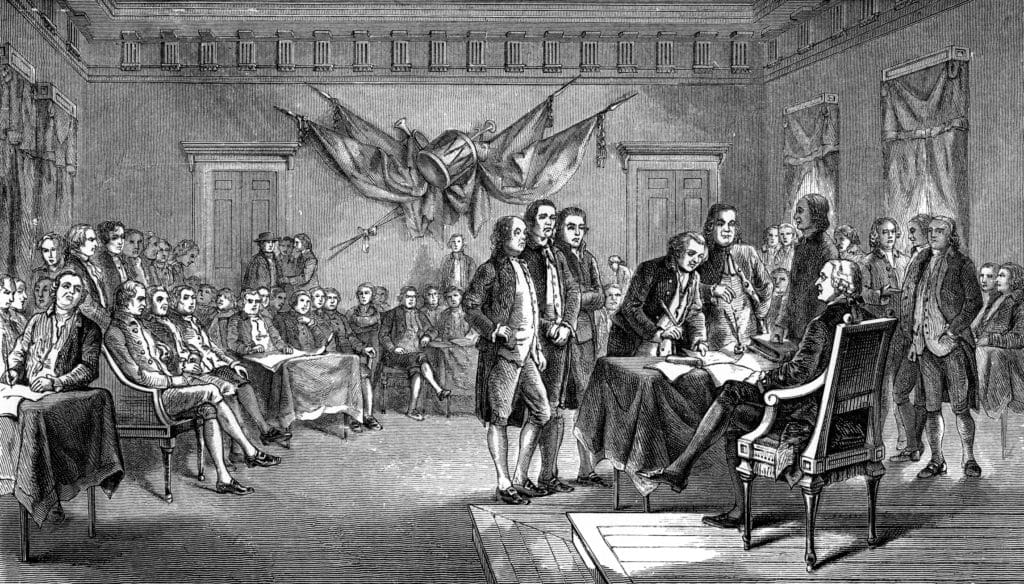
“Then she didn’t mean ‘four fathers,’ but ‘forefathers’! This is the word Americans use for the founders of this country,” my father declared excitedly.
She said I have four fathers and then she showed me paintings of a bunch of old men wearing white wigs.
I had a lot of questions. When did these forefathers live? What kind of leaders were they? And what could I, a Jew whose family had lived in the Middle East for 2,700 years, possibly have in common with men who most likely had never met a Persian or maybe even a Jew?
“Why does my teacher think I’m related to these people?” I asked my father. In hindsight, his answer expressed a hope that some Americans still long for today:
“Because the people who founded this country wanted it to belong to everyone who lives here.”
That sounded noble but I still wasn’t convinced. Those men looked ancient.
“But I didn’t live here when they were alive,” I protested. “We just came here last year.”
In my 8-year-old understanding of history, statehood and democracy, I couldn’t fathom how 214 years before, the forefathers could have set up this miraculous country with a little Persian Jewish girl and her family in mind. I thought for a long time, then asked, “Baba, are we American?”
“Technically no. Not yet. But we’re American up here,” he said, pointing to his head. “You and your sister are going to get the best education here. You’ll have total freedom. You’ll move forward, instead of backward.”
“OK. I’ll try to be American up here,” I said, pointing to my head.
A few days later, my mother banged on the bathroom door, wondering what I’d been doing in there for 45 minutes. Little did she know that I’d used Elmer’s glue to stick together every single cotton ball she owned to make a white curly wig.
I wore it on my head during Shabbat dinner.
“Did you know we have forefathers?” I asked my cousins. I then pointed to the wig and explained being American “up here.”
That night, we recited ancient Hebrew prayers, ate Persian delicacies and watched Barbara Walters discuss critical American issues on “20/20” before changing the channel to a Lakers game.
Happy Fourth of July.
Tabby Refael is a Los Angeles-based writer, speaker and activist.
The Dutch parliament passed a number of motions that speak of the need to fight anti-Semitism. A draft motion calling for the government to pay for security around synagogues failed to pass, however.
The motions were voted on earlier this week at the Tweede Kamer, the lower house of the parliament, in the framework of a two-day session of the house’s Justice and Security Commission.
The rejected motion stated that the Jewish community in the Netherlands “often lacks the means to adequately protect their infrastructure, events and synagogue services” and called on the government to supply the finances for this purpose.
The motion, filed by Geert Wilders and Gidi Markuszower of the anti-Islam Freedom Party, received 28 votes in the 150-member Tweede Kamer, with the ruling VVD party, Dutch Labour, the Socialist Party, and the D66 and Green Left progressive parties voting against it.
Institutions from the Dutch-Jewish community, which belongs to a minority of about 40,000 people, spend over $1.2 million annually on security, according to community leaders.
Motions that did pass included a nonbinding call on the government to appoint a national coordinator for the fight against anti-Semitism and the creation of special police units to deal with anti-Semitic crimes.
Thank you to Rabbi Adam Lutz whose leadership has created “JewItAtHome” through his synagogue, Temple Emanuel of Beverly Hills. He knew that “Social Distancing Does Not Mean Social Isolation” and even though “COVID-19 continues to disrupt every single aspect of normal life…and community doesn’t exist in person” we can create a Jewish community online. “We are “jewing” it so that Judaism continues to bring light into a world that too often appears full of darkness and we invite you to join as at Jew It At Home to “Jew it” with us.“
It all started with a simple conversation that would frighten many in the world of Jewish institutional life. In early March 2020, my colleague, Rabbi Dara Frimmer, and I discussed the imminent closure of our synagogues due to the COVID-19 outbreak. We shared how we planned to offer digital worship, online religious school, and distance preschool programming. In our conversation, I posed a seemingly innocuous but somewhat provocative suggestion for Jewish institutions to date: “Why don’t we share resources? Share material? Share online classes? That way, while people are stuck at home, they will have plenty of opportunities to remain connected. And by sharing, we don’t have to shoulder the entire load ourselves.” And thus, JewItAtHome.com was born.
We launched JewItAtHome.com as a spiritual, Jewish farmer’s market of sorts. It is currently a world-wide partnership of over thirty Jewish institutions that share resources to provide high quality spiritual nourishment during this challenging time. But we have discovered a need in the Jewish world that will persist in the post-COVID-19 world. Our users can access a multitude of diverse, cost-free programing 24/7 – from Jewish yoga to text study and Tot Shabbat services to challah baking and more. Similar to a farmer’s market, JewItAtHome’s business model centers around partnership and sharing virtual space for the benefit of everyone, Jews-in-the-pews and Jewish institutions alike. Our model revolves around “free-samples” of Jewish content. Like at a farmer’s market where fromageries offer free cheese samples to entice would-be buyers, JewItAtHome partners offer a high-quality sampling of what their institution offers on a regular basis.
Rabbi Adam Lutz
Despite the current success of the platform, our model challenges many preconceived notions and fears surrounding the sharing of synagogue resources. Recently, a potential partner told me that they were afraid of losing members to those with whom they might collaborate. Although I completely understand this fear of losing members and, potentially, dues revenue to other Jewish institutions, this fear is rooted in a scarcity mentality that there is not enough of the pie to go around and we must protect our slice. But, are we really so naïve to think, in the small Jewish institutional world, that if our “product” is not quality then our members won’t leave anyway?
Another potential partner shared concerns about providing content for free, wondering how his institution would support itself if there was no income. I also understand this perspective – of course without a revenue stream Jewish institutional life cannot exist. However, JewItAtHome does not require that institutions offer everything they do for free. Additionally, synagogues have been offering this type of free service forever – it is called Shabbat worship. JewItAtHome makes it possible to offer additional entry points for potential Jewish patrons.
Like farmer’s market shoppers, JewItAtHome users can, of course, satiate themselves by taking samples from here and there. But such sampling makes a wide cross-section of Jews aware of teachers and of approaches to Judaism that were previously, not on the wider radar screen of Jews in the community. For too long, we have only lived within the walls of our own Jewish institutions.
One anecdote: JewItAtHome attracted an active user from Tennessee, who attends our “Hebrew Bootcamp” weekly. During his first class he explained that he has always wanted to learn Hebrew, but there are no synagogues close enough to his home to justify weekly classes. JewItAtHome has finally provided him meaningful Jewish practice through a synagogue affiliate. The hope is that he will join this affiliate as a “remote member” because he loves the “free sample” and wants more.
The key to the success of JewItAtHome has been the willingness of partners to place the needs of Jewish people over the needs of Jewish institutions. We’ve framed our decisions around three core values:
1) Integrity – all the content provided should increase the Jewish community’s trust in our platform;
2) Usefulness – everything that we offer must increase our usefulness to the Jewish world;
3) Freedom of Expression – there is not only one way to express Judaism, therefore our partners provide content for the entire breadth of Jewish expression.
Since our launch in March, over seven thousand unique users have accessed our site and viewed approximately twenty-five thousand pages. Jews from across the world have logged into classes from locations as far away as Israel and Amsterdam. Instead of letting fear drive the decisions made for JewItAtHome, we have embraced the plethora of possibilities that a diverse and dedicated partnership of shared resources provides. Just recently, we engaged all of our partners at JewItAtHome to host a Global Tikkun for Shavuot. We offered eighty classes throughout the evening, saw fifteen-hundred unique users accessing content and over two-hundred households attend our opening plenary.
At this point you might be wondering, “If this is all free, who pays for JewItAtHome?” The entire JewItAtHome enterprise is funded by my synagogue, Temple Emanuel of Beverly Hills (TEBH). TEBH holds to its core mission of always leading the world in Jewish expression, Jewish communal involvement, and Jewish social justice. The synagogue leadership empowered me to continue to grow JewItAtHome from the first few partners into the world-wide partnership that exists today. Of course, as JewItAtHome continues to grow, costs will increase, so we are currently exploring options to offset anticipated expenses.
Just like a farmer’s market forces purveyors to select what offerings are free and exciting enough to entice a customer to make a purchase, JewItAtHome is forcing Jewish institutions to do the same. Partner offerings must be high quality so that users will return again and again with the hope that, at some point, they will make a deeper financial commitment. I recently asked a user of JewItAtHome how her experience with the platform has affected her Jewish identity and impacted her relationship with her home congregation. She told me that she loves having access to so many high-quality Jewish programs, allowing her to better engage and develop her Jewish identity. And it has not lessened her connection to her own congregation. She continues to plug into her own congregation’s programs and worship services, each time bringing her the pleasure of returning to a familiar set of faces, customs and clergy. Most users have similar experiences.
When synagogues collaborate and partner with one another on a common platform like JewItAtHome provides, we can cultivate a more engaged Jewish community. Noted concerns notwithstanding, my experience with JewItAtHome shows that by supporting one another we can create avenues of access for Jews who are disengaged, unaffiliated and otherwise, uninterested. We can help them discover the riches of our tradition known to us, but which are often hidden from the average lay-person. But first, we have to change by letting go of our fears and collaborating.
We live in a world of physical distance, but our work–now more than ever–is to demonstrate that physical distance does not prevent us from joining hearts, minds, and souls.
An aerospace engineer turned rabbi, Adam Lutz works to design meaningful Jewish life for the 21st century. He is the Assistant Rabbi/Director of Education at Temple Emanuel of Beverly Hills, the creator of JewItAtHome.com, and a proud first-time parent with his wife, Cantor Emma Lutz, to 5 month old, Ruby Mira.
This article is part of the partnership between eJP and the Clergy Leadership Incubator program (CLI). CLI is a two-year program to support and encourage congregational rabbis and rabbinic entrepreneurs in the areas of innovative thinking, change management and institutional transformation.
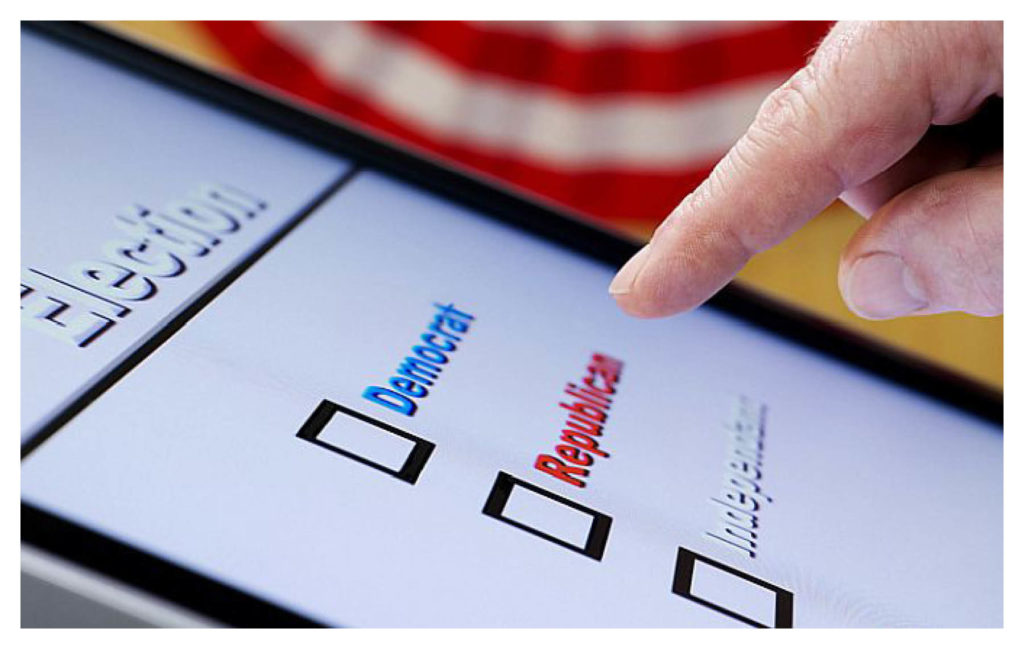
In years past I have sat among crowds rallied by Jewish campaign surrogates in packed synagogues in Ohio and bingo halls in Florida, and I’ve followed canvassers searching for mezuzahs in neighborhoods known for having large Jewish populations.
Severe limits on in-person campaigning imposed by the coronavirus pandemic means we’re not likely to be bringing you those stories this season. But a very different election year doesn’t mean the Jewish vote in swing states is less important.
This week, I asked people working to get out the Jewish vote — partisan and nonpartisan — where they’re concentrating their efforts, how much they’re planning to spend, what adjustments they’re making because of the pandemic and what is preoccupying them down-ballot. Here’s what they told me.
RJC’s 2019 advertisement. Screenshot from Youtube
Democratic Jewish groups have a presence in more states than Republicans
The Republican Jewish Coalition appears to have the most advanced operation in place. With $10 million pledged to reelect Donald Trump and secure GOP control in Congress, that may not be a surprise.
The RJC’s get-out-the-vote operation already has four workers on staff in Florida, according to Matt Brooks, its executive director, and volunteers have made 300,000 phone calls to Jewish voters in swing states — a preliminary round of phone banking where the goal is not persuasion but identification, to see how committed a voter is to reelecting Trump and what issues they are considering ahead of Election Day. This lays the ground for more calls and texts later in the season that are tailored to the individual voter.
But with Trump’s polling in freefall, the group doesn’t have that many states to direct that energy. Brooks told me his swing-state operation was focusing on Florida, Ohio, Arizona, Pennsylvania and Georgia.
“We’re monitoring and looking at and ready to pivot to see how Michigan and Wisconsin continue to shape up,” he added.
Brooks said the RJC chose those states because the vote there is “competitive.” That’s notable: Trump’s 2016 victory included narrow wins in Wisconsin, Michigan, Pennsylvania, Florida and Arizona.
Including Georgia and Ohio in the mix indicates the deep trouble Trump is in. In 2016, he won Georgia by 5 points and Ohio by 8.
From Brooks’ map it would appear that the RJC doesn’t think there’s a chance for Trump to win in Michigan or Wisconsin. Polls show Joe Biden leading Trump in both states by double digits.
Meanwhile, the Jewish Democratic Council of America has a much more expansive map. In addition to the five states the RJC is targeting, along with Michigan and Wisconsin, the JDCA says it is ready to target Jewish voters in Colorado, Maine, Minnesota, Nevada, New Hampshire, North Carolina and Virginia — a 14-state plan, as director Halie Soifer put it.
Soifer said she hoped to spend over $1 million and as much as $5 million in pushing out the vote.
“They are the states where we think the Jewish vote can make a difference in the presidential and key Senate and House elections,” she said.
JDCA has organized a number of webinars, and has launched phone banking. Soifer told me she hopes to reach “hundreds of thousands, if not over a million” Jewish voters. “First it will be persuasion methods, and then get out the vote,” she said.
WASHINGTON, DC – JUNE 17: U.S. President Donald Trump arrives for an East Room event to announce the “PREVENTS Task Force” at the White House June 17, 2020 in Washington, DC. President Trump held the event to announce plans to prevent suicides among U.S. military veterans. (Photo by Alex Wong/Getty Images)
The tea on the down-ballot
The political action committee associated with the Democratic Majority for Israel is planning to highlight Biden’s pro-Israel record in a digital campaign. (The RJC already launched a video, titled “Sunrise,” that calls Trump “the most pro-Israel president in history.”)
But the PAC’s emphasis will be down-ballot, Mellman said, because that’s where it makes more sense to spend money; both presidential campaigns have plenty of resources already. The messaging down-ballot will not necessarily be about Israel, he said, but about issues of importance to local voters.
During the primaries, the PAC has already run ads targeting opponents of its favored candidates on themes that have nothing to do with Israel. Its $1.5 million spent to protect veteran N.Y. Rep. Eliot Engel included ads raising the fact that his challenger, Jamaal Bowman, had an unpaid tax bill. (Bowman has declared victory in that race, but Engel is waiting out the counting of the mail-in ballots.)
Mark Mellman, the Democratic Majority for Israel’s president and CEO, has proven to be a prodigious fundraiser and said his group would be spending in the millions of dollars in a broad campaign. (He declined to be more specific on the amount.)
“We will be on TV, we will be in the mail, we will be on the telephone, we will be digital,” he said. “We will be in every form of communication known to human beings.”
When it comes to the Senate, Republicans have 23 seats up for reelection, while the Democrats have only 12. That means Republican Jewish groups must be on the defensive, especially as Trump’s sinking popularity threatens to derail down-ballot Republicans, while Democratic groups can focus on flipping seats.
This week, the Jewish Democratic Council of America added 17 names to its congressional endorsements, bringing the total to 89. Significantly, most of the new batch is challenging Republicans in states that Trump won in 2016, including Ohio, Georgia, Missouri, Pennsylvania, Wisconsin, Alaska, South Carolina and Tennessee. Among the 17 are four Senate candidates — Jon Ossoff in Georgia, James Mackler in Tennessee, Al Gross in Alaska and Jaime Harrison in South Carolina — challenging incumbent Republicans. Ossoff, Mackler and Gross are Jewish.
Here are some Senate races where the partisan PACs will go head to head, according to their endorsements:
Maine: The Republican Jewish Coalition has endorsed Sen. Susan Collins; the Democratic Majority for Israel, J Street and the Jewish Democratic Council of America are backing her challenger, Sara Gideon.
South Carolina: RJC, Sen. Lindsey Graham; JDCA and J Street, Harrison.
Georgia: RJC, Sen. David Perdue; JDCA and J Street, Ossoff.
Colorado: RJC, Sen. Cory Gardner; JDCA, DMFI and J Street, challenger John Hickenlooper.
Michigan: JDCA and DMFI, Sen. Gary Peters; RJC, challenger John James.
Arizona: RJC, Sen. Martha McSally; JDCA and J Street, challenger Mark Kelly.
The sweeping endorsements do not mean that Democratic Jewish groups are banking on their candidates winning, but it does suggest that those candidates have a chance and will force Republicans to spend defensively.
And in one notable effort, five state-level Jewish Democratic organizations are working together to influence down-ballot elections in their states. They are the Florida Democratic Party Caucus of American Jews; Jewish Democratic Women’s Salon Atlanta; Michigan Democratic Jewish Caucus; Democratic Jewish Outreach Pennsylvania; and Wisconsin Jewish Democrats.
“There are two Senate races in Georgia — Pennsylvania as you know has no U.S. Senate race,” said Jill Zipin, the founder of Democratic Jewish Outreach Pennsylvania. “So if they’re doing a phone bank for example for Ossoff, I would encourage our Jewish voters to help and call down there.”
Counting on digital
Door-to-door canvassing is not completely out of the question — hanging flyers on doorknobs is still a thing, even during a plague, as anyone living in a competitive district will tell you. And the partisan Jewish groups are also counting on the old standby, direct mail.
But the pandemic has accelerated what already was a trend of moving toward text message blasts and targeted social media ads.
“In 2008, we would go door to door and look for the mezuzah,” said Soifer, who ran Jewish outreach for Obama’s Florida campaign that year. “Now we can purchase lists of Jewish voters and with a click of a button target hundreds of thousands with digital advertising. So in some ways, the ability to reach voters has become much more efficient.”
Brooks’ RJC has rolled out the highest-profile digital campaign so far, and he said he has money to spend on broadcast and cable ads.
The Jewish Democratic Council of America has just launched two ads on social media platforms. And Mellman said he had available technology that would allow the Democratic Majority for Israel’s PAC to target individual voters depending on their known preferences.
“We have a pretty sophisticated way to figure out who the targets are that are going to be most movable, persuadable, in the House and Senate races,” he said. “We can identify those people, and we can target ads on digital directly to those people, and do the same thing with the mail and with the phones.”
In Other News
Days of Rage: A march this week in Washington sought to tie the Black Lives Matter moment to Palestinian fury at Israel for its planned annexation of parts of the West Bank. The marchers chanted “Israel, we know you, you murder children, too.” The RJC, wanting to make this Biden’s Charlottesville moment, is calling on the presumptive Democratic candidate to condemn the chanting. But it’s not clear to what degree the organizers of the “Days of Rage” event are connected to the broader Black Lives Matter movement, and the march ended peacefully, while the Charlottesville march was violent and deadly.
Vouching for vouchers: Orthodox Jewish groups declare a victory in a Supreme Court decision that extends government aid to religious schools. Hanau examines the consequences.
Art had been living with his mother for more than 30 years when she lost her apartment a little over a year ago. Though the mother was able to move in with one of Art’s brothers, the 49-year-old former tennis coach had nowhere to go and started sleeping in his car.
That meant a nightly struggle to find a place to park — and sleep — undisturbed. Sometimes he would park in a supermarket lot, only to have employees attempt to tow his car or call the police. And there was nowhere to take a shower or use the bathroom.
“Your rhythm is out. You feel almost like a zombie,” Art recalled. “The day just continues rolling into the next day.”
Things turned around for Art, who asked to be identified by his first name only, after Jewish institutions in this Southern California city invited him and other homeless people here to sleep on their property.
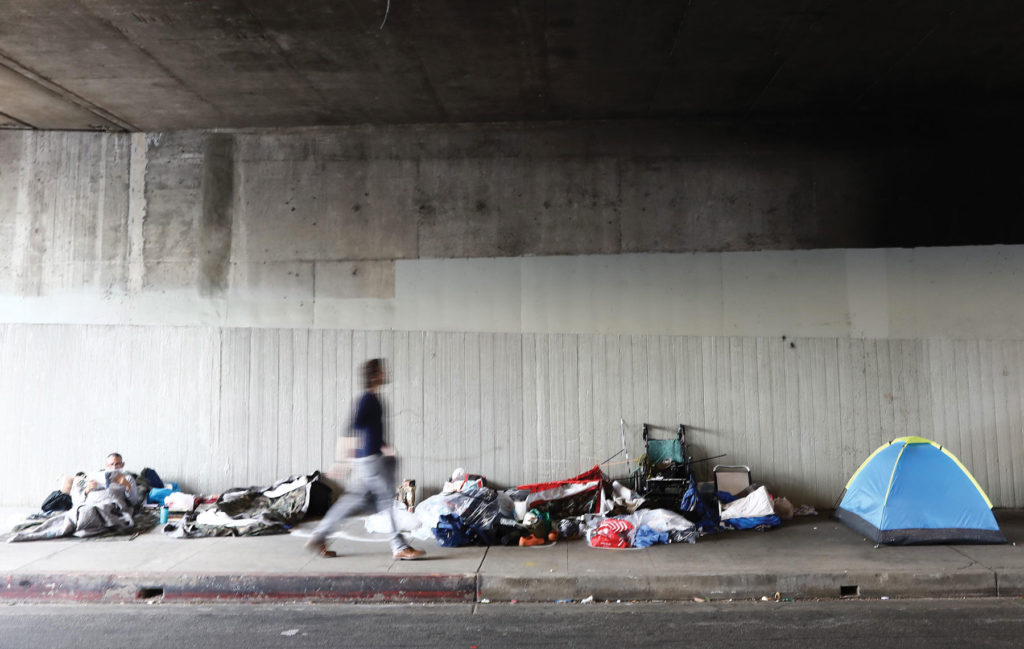
Through a program called Safe Parking LA, founded by three congregants at a local Reform synagogue, parking lots that otherwise would sit empty overnight are turned into safe spaces for the thousands of city residents who sleep in their cars because they do not have access to housing.
Art first parked at a synagogue, then at a Jewish residential addiction treatment center. At night, a security guard watches over him and others staying there. There’s a port-a-potty on site and, before the pandemic began, a free gym membership gave him access to a shower.
Tents and tarps erected by homeless people are shown along the sidewalks in the skid row area of downtown Los Angeles, California. MIKE BLAKE June 04, 2019 10:47pm EDT
“They offer a little sanctuary,” he told the Jewish Telegraphic Agency in early March over dinner at Ikar, the synagogue that provided the parking lot for his overnights until the recent move to the treatment center Beit T’Shuvah.
Safe Parking LA is the brainchild of Scott Sale, along with Pat and Ira Cohen, members of the Leo Baeck Temple. In 2010, they were inspired by a similar initiative in Santa Barbara, a city about 110 miles north.
“That would be the major principle in Judaism that I espouse to, which i think Pat and Ira do, too, and so that was the major principle — to have our doors open, whether it’s Passover for Elijah or the stranger walking by my community,” he said, referring to the tradition of welcoming the biblical prophet to the Seder.
It took time for the trio to launch the initiative. Their efforts included lobbying the city to change a law that prevented organizations from housing people overnight.
“If you look at all tools in the toolbox to address homelessness, safe parking is one of those tools,” said John Maceri, the CEO of The People Concern, a Los Angeles social service agency dealing with homelessness. “It is not the only solution. It is a solution that has a very specific application to very specific types and numbers of people experiencing homelessness … but for those individuals who have vehicles it can be a very effective intervention.”
Safe Parking LA now has a $1.8 million budget, most of which comes from the Los Angeles Homeless Services Authority, and operates nine lots in the city with a total of 150 parking spots. Some of the lots are public — libraries, municipal buildings and the county Health Department. The private ones include Beit T’Shuvah, an Episcopal church and, until recently, Ikar.
Photo by David McNew/Reuters
Safe Parking LA does most of the work — vetting applicants as well as providing liability insurance, a security guard and the port-a-potty.
Sale and the Cohens had originally tried to operate a lot at their Leo Baeck Temple but found the area was not in demand — few homeless people worked or received services there.
That meant Ikar, a nondenominational congregation with 800 member families, was the first Jewish organization in Los Angeles to participate in the initiative, in November 2018, shortly after acquiring its own space for the first time. The congregation had previously rented space for its programming.
“When we started to think about what it meant for Ikar to have a home in Los Angeles, it seemed clear to us that we needed to use our home to address the crisis of people living without housing in our city,” said Brooke Wirtschafter, the synagogue’s director of community organizing.
This January, Beit T’Shuvah opened its lot. Safe Parking LA decided in March to consolidate the two nearby lots, neither of which was at capacity, to cut costs — each lot costs $200,000 to run per year. The Ikar participants moved to the Beit T’Shuvah lot because it was larger and gated.
For the Jewish rehab center, the opportunity to help those struggling resonated, said Adam Siegel, its director of community development.
“As a community made up of individuals [where] many have struggled within the margins of our society, we recognize that we are now in a position to help those that are facing these kinds of challenges,” he said.
Siegel said that turning the center’s lot into a safe parking lot has “gone smoothly,” and that staff and community members are happy that the organization can “utilize this space to its full potential.”
Photo by Mario Tama/Getty Images
Some elements of the program are suspended because of the coronavirus pandemic, which has hit this city’s homeless population hard and drawn attention to the inadequate options for safe short-term housing.
Ikar members had raised money to buy every program participant a gym membership, so they could have a place to shower. That is no longer an option. And the twice-monthly dinners for participants and volunteers to come together are also on hold.
Those dinners were designed to foster connection and community. Tables were set with tablecloths, plates and silverware. Volunteers and program participants go together to get the food from a kosher vegetarian buffet. Board games provide some entertainment.
“We want it to actually feel warm and to feel like a hosted dinner, where people are sitting together to build relationships, not like a charity event,” Wirtschafter said.
At a time when many synagogues are increasing security, Wirtschafter said that participating in the program made Ikar safer.
“This is an area where there is quite a bit of street homelessness and other stuff going on, and we actually think that our building is safer overnight with trusted people who just want a safe place to sleep,” she said.
Indeed, one 54-year-old woman who stayed in Ikar’s lot for more than 10 months with her 23-year-old son described the program as “a necessity.”
“You’re not harassed by the cops,” said the woman, who asked that her name not be used. “You have a safe place to come and go to the restroom and park and plug in for your medical [devices], for your car, for charging your phone.”
A California trade union placed a political advertisement on Facebook about a Jewish state senator that evoked anti-Semitic stereotypes about Jews and money.
The State Building and Construction Trades Council later removed the ad and apologized after being called out by the California Legislative Jewish Caucus, the political news website CalMatters reported Tuesday.
The ad accuses Sen. Scott Wiener, a San Francisco Democrat, of “selling out” to developers and the real estate industry. It featured an image of Wiener against a backdrop of a Monopoly game board, clutching a handful of Monopoly money.
The union objects to a bill authored by Wiener that would allow churches and other religious organizations to more speedily develop low-income housing on their property. The union wants union-level wages and union-trained workers for the projects, which would make them more expensive. The state Senate passed the legislation on Friday.
Jeremy Russell, a spokesperson for the Jewish Community Relations Council of San Francisco, called the ad “cringeworthy,” CalMatters reported.
“Everyone wants to be careful not to use that term (anti-Semitism) too lightly. But there’s not a question that it touched on anti-Semitic stereotypes and tropes,” Sen. Ben Allen, a Democrat from Santa Monica and chair of the California Legislative Jewish Caucus, told CalMatters. “So at the very least the folks who put it up ought to be made aware of how problematic moving in that direction is.”
The union’s president, Robbie Hunter, at first denied that the ad could have anti-Semitic connotations and suggested that Wiener was trying to deflect attention from the legislation. He said the union had designed ads using Monopoly money for non-Jewish lawmakers, too, but never released them publicly.