Former Malaysian Prime Minister Mahathir Mohamad reportedly called for terror attacks in a recent interview on a Lebanese television network.
According to the Middle East Media Research Institute (MEMRI), Mohamad said in a June 29 interview on Al-Mayadeen TV, a station that reportedly is allied with Hezbollah, that Israel loves to see Islamic countries fighting one another because then Israel doesn’t have kill to Muslims.
“The whole of Israel was created through taking Palestinian land. That is very wrong,” Mohamad said. “So for that reason, we have always been against the creation of the State of Israel. Unfortunately, the big powers back Israel, because they were the ones who created the State of Israel to solve their Jewish problem. They were having a problem in Europe with the Jews, so they wanted to create a homeland for the Jews and they took Palestinian land.”
He cautioned against terror attacks in Western countries because that would undermine the Palestinian cause.
“The enemy is Israel,” Mohamed said. “[If] you want to do anything, do it to the Israelis, like some of the Palestinians in Jerusalem, who individually attack Israeli soldiers. That is the enemy. But if you go and attack the Europeans, Americans and all that — you only create more enemies.”
Mohamed proceeded to accuse Jews of controlling the media in the United States.
“If they [the American people] think we are wrong, we have to tell them that we are doing something that is right,” he said. “It is propaganda campaign on the part of the Jews. They are very good. They own all the newspapers in America. They own the TV stations. So they have tremendous influence.”
The Simon Wiesenthal Center condemned Mohamad’s reported remarks in a tweet.
“Lifelong Jew hater Mahatir never held accountable for his anti-Semitism,” the Jewish group wrote, adding that Mohamed has previously been invited to speak “by #Oxford, @Cambridge_Uni Union, @Columbia University. Why won’t Western Ivory Tower academics denounce his bigotry?”
Lifelong Jew hater Mahatir never held accountable for his anti-Semitism urging the murder, contrary invited by #Oxford, @Cambridge_Uni Union, @Columbia University. Why won’t Western Ivory Tower academics denounce his bigotry? https://t.co/gYCZeg85Wq
— SimonWiesenthalCntr (@simonwiesenthal) June 30, 2020
Mohamad previously spoke at Columbia University in September, where he defended his past remarks questioning if 6 million Jews had died during the Holocaust.
“I am exercising my right to free speech,” he said at the time. “Why is it that I can’t say something against the Jews when a lot of people say nasty things about me and about Malaysia and I didn’t protest?”
Columbia University President Lee Bollinger condemned Mohamad’s past comments before his speaking engagement at the university.
“I find the anti-Semitic statements of Prime Minister Mahathir to be abhorrently contrary to what we stand for, and deserving condemnation,” Bollinger told the New York Post at the time. “This form of open engagement can sometimes be difficult, even painful. But to abandon this activity would be to limit severely our capacity to understand and confront the world as it is, which is a central and utterly serious mission for any academic institution.”
Mohamad resigned from his position as prime minister in February and was ousted from his political party in May after accusations that he violated the party’s constitution. Mohamad has said that the ousting was illegitimate. He currently is involved in efforts to take down Malaysia’s current government.
New David Suissa Podcast Every Monday, Wednesday and Friday.
A conversation on raising kids and maintaining a career in pandemic times, with Jewish Journal weekly columnist Tabby Refael.
How do we manage our lives during the coronavirus crisis? How do we keep our sanity? How do we use this quarantine to bring out the best in ourselves? Tune in every day and share your stories with podcast@jewishjournal.com.
Holy One, we quiver when we consider how long you’ve taught us to love one another, to have one law that governs us all,one standard of right and wrong by which we are each measured.
How long you have taught us that we are to be brothers and sisters to one another, to nurture one another,to defend one another, to protect one another.
And how long we have, whenever we attain any degree of authority, used our fragile hold on power to try to make ourselves great by keeping others down.
And we grieve at how much sorrow we have brought to You.
We can imagine the pain of a parent who sees children quarreling, bullying, abusing.
We know what that must do to Your heart.
So we pray that You give us those promised new hearts, quickly and in our time. For Your sake and for ours.
We pray that You remind us, as it says in Your Torah, “lo Tukhal Lehitalem”You shall not be indifferent.”
We shall not be indifferent when we hear the cries of our brothers and sisters, whether they look like us or not.
We shall not be indifferent when we cling to the privilege of our own lives yet passively watch others having their comfort stripped from them, and we do nothing.
We shall not be indifferent when suffering people say, “Hear our cry!” Help us to unstop our ears and to allow our hearts to break wide open and, finally, to listen.
The prophet Isaiah speaks about those people who “have ears but do not hear, eyes but do not see.” Don’t let us be those people.
Open our eyes so that we truly see, open our ears so that we can truly hear.
And let us rest in Your love so that we are able to stand, rooted and tall, and do what battered humanity, your children, require.
God bless the hands of all who are giving their strength to the work of justice, whether new to the effort or long-practiced.
Let us resolve to birth a new America, one that retains the very best of its aspiration of equal justice for all, but one that now extends that vision to all of its children equally and without discrimination, so all of us can sit at Your table and shape redemption together.
And let us all say, Amen.
Rabbi Bradley Shavit Artson is the Abner & Roslyn Goldstine Dean’s Chair and professor of philosophy at the Ziegler School of Rabbinic Studies.
(JTA) — Swastikas were found drawn on a public bench and on the side door of a home in a Jewish neighborhood of Baltimore.
The symbol on the home, in the northwest section of the city, was drawn with a black marker and discovered on June 24, the local CBS affiliate WJZ reported, citing the police report.
Area residents found the swastika spray-painted on the bench.
A white piece of paper colored with a heart with the words “Love Not Hate” was taped over the swastika on the bench, according to the report.
Sophie Singer is a 20-year-old social butterfly with a passion for baking and knitting. Every month, along with other kids and young adults with intellectual and developmental disabilities (IDD), she hangs out with neurotypical peers in a “connecting with friends” social group that meets near her home in the Pacific Palisades. She has an entire other group of friends from Ramah sleep-away camp. Her popularity is no surprise to her parents, Jeff, a real estate investor, and Kellie, a stay-at-home mom. They describe her as “funny and fun with a great attitude.”
Singer’s independence and social life are central to her experience as a high-functioning young adult with IDD. Because of optic nerve hypoplasia, which manifests in some visual impairment due to an abnormality at the junction of her optic nerve and brain, Singer’s hypothalamus and hormones operate differently than her neurotypical twin sister, Rylee and older sister, Emily. As a result, she gets some extra support from social services organizations that offer vocational and life skills training to encourage her independence.
Finding the balance between independence and support services that will enable Singer to continue to thrive is a major focus for her parents. This fall, Singer is ready to experience off-campus housing when she attends UCLA. Kellie has full confidence in her daughter. “She cooks, cleans, does laundry. She can do it all,” Kellie told the Journal.
When they look to Singer’s future, her parents hope she will always have the ability to live an independent life surrounded by community. “Foremost on our minds has always been that she be in a safe environment after we are gone, that she can live independently and have personal relationships with her peers,” Kellie said. “We never want Sophie to feel lonely or isolated.”
For decades, Los Angeles families with adult children who have intellectual and developmental disabilities have longed for a housing solution that will provide them peace of mind while enabling their children to live fulfilling, independent lives.
For decades, Los Angeles families with adult children who have IDD have longed for a housing solution that will provide them peace of mind while enabling their children to live fulfilling, independent lives with access to the health, vocational and educational support services they need. This also is an urgent need nationwide, as more than 70,000 teenagers with IDD enter adulthood every year. According to the California State Council on Developmental Disabilities, the lack of housing options results in about 6 in 10 adults with IDD continuing to live with their families past the age of 35.
However, that is all about to change with the creation of The Village, an innovative and groundbreaking housing solution specifically designed for the IDD community. Envisioned primarily by a group of motivated parents and Jewish philanthropists, the state-of-the-art building will be constructed in the heart of Pico-Robertson as a solution to meet the pressing needs of dozens of families in Los Angeles. It also will serve as model for the nation on how to build inclusive housing solutions that embody the Jewish premise of b’tzelem Elohim — that all people are created in God’s image — and deserve to be treated with dignity.
Clinical psychologist Michael Held is a long-time advocate for the IDD community and founder of ETTA, the largest Jewish agency in Los Angeles serving the disabled community. Established in 1993, ETTA’s professional team of 220 provides a full spectrum of services rooted in Jewish values to more than 150 adults with IDD and their families. “It’s really been the driving force and joy in my own life to create opportunities that broaden and include adults with IDD in the Jewish community,” Held said.
“The intention is that The Village serve as a model on how a pioneering approach can be used in cities around the world to solve the challenge of meaningful, affordable housing for adults with disabilities.” — Cathy Gott
As recently as the 1960s, many adults with IDD were housed by the hundreds in large institutions on the outskirts of urban centers where living costs were much lower. “The philosophy was out of sight and out of mind,” Held said. As social justice efforts advanced and progressive opinion shifted, California passed the Lanterman Developmental Disabilities Act in 1977. The state began to shut down these institutions and developed the Regional Center system, a collection of nonprofit private corporations that provide resources and services to individuals with developmental disabilities and their families.
Support services for children and adults with IDD vary according to each person’s needs. ETTA, for instance, provides social, recreational, independent living and vocational skills services. To encourage independence, service providers teach skills such as making medical appointments, navigating public transportation, job coaching, building and keeping social relationships and participation in recreational activities. Although California is a state that offers many entitlements for social and welfare services for people with IDD, rent is not a covered expense.
“Housing services are unfortunately far behind these other areas of support,” Held said. “Over the past 30 years, there have been countless families and clients that have been asking for the creation of a housing community that can model the inclusion that so many have worked for within the Jewish community.”
Currently, there are only three housing options for families that include an adult with IDD. The first is being able to afford to rent an apartment for an adult child. “Families already brave the high cost of living in cities like Los Angeles and covering a second living situation is cost-prohibitive for most,” Held said.
The second option, he explained, is for three or four adults with IDD to live together and share the cost of rent. ETTA currently operates four group homes of this nature that provide about 24 residents in Los Angles with urban housing. They also provide support services to 20 additional individuals who live in other homes. Held said that the smaller group homes are “a good trend in terms of philosophy, but it’s a very harsh trend in terms of economics.”
The third option is via real estate developers who are required to include low income units in all new building construction in Los Angeles. Securing these units is arduous and rare, with dozens of families seeking housing of this nature.
In response to this gap in supportive housing options, a group of community activists — many of whom have family members with IDD — joined with philanthropic leaders from the real estate and finance sectors in early 2019 to form the nonprofit Cornerstone Housing for Adults With Disabilities (Cornerstone), where Held serves as senior adviser. Together, they are working to revolutionize the housing services industry for adults with IDD.
Cathy Gott, a philanthropist and longtime volunteer in the autism support community, is on the board of Cornerstone. A parent to Danny, an adult son who lives with autism, Cathy is also a volunteer for the Los Angeles County Commission for Disabilities. She has been involved in many conversations over the years about how to solve the housing problem for adults with IDD in Los Angeles and nationwide. She told the Journal everything finally clicked when the current group of high-powered individuals formed a board. “These people are giants in their fields and I’m a passionate mom who has no fear of asking for money,” she said. “When you marry two sectors — the power players with the passionate advocates — that’s when something big happens.”
Along with the retail space, the common rooms and rooftop garden deck will be available for public use, encouraging community engagement with and full integration of adults with IDD.
The Village aims to be a forward-thinking housing solution that will include more than 60 individual apartments situated above high-end retail establishments, all in one state-of-the-art building. The project is set to be located in the heart of the Beverlywood community at 9224 W. Pico Blvd. between Cardiff Avenue and Glenville Drive. After obtaining their nonprofit status, the priority of Cornerstone’s all-volunteer group of lay leaders has been securing the property, which meant securing funding.
In just nine months, the group of real estate professionals, architects and community leaders raised $9 million of their $12 million goal from private donors within the Jewish community including Hendel and Eric Schwartz and family, the Nancy and Jonathan Glaser family, the George and Irina Schaeffer Foundation, Kam and Lily Babaoff and family, Peter and Andrea Roth, Judah and Astrid Hertz, Aviva and Scott Krieger, Kellie and Jeffrey Singer and the Caplow Family Foundation.
With a major portion of funds secured, the Cornerstone team plans to close escrow on the land later this summer. Plans currently are being reviewed by the city of Los Angeles and Cornerstone projects to break ground by the end of 2021 and open to residents some time in 2023. Said Gott, “We already have more people interested in the project than we have units being built.”
Board member Kam Babaoff, a local real estate developer, recruited architectural partner Urban Architecture Lab to design the project. Richard Solares, the firm’s president and founder, told the Journal, “Kam and the board of Cornerstone challenged us to create a showpiece building. Though it will be run by a nonprofit, he pushed us to create a modern design equivalent to any other building at market rate.”
With experience building other mixed-purpose buildings, Solares’ design includes Americans With Disabilities Act-compliant amenities in all residential units and important details such as color-coordinated floors to more easily orient residents to their personal unit. Known as “wayfinding,” Solares’ colleague and a principal at the firm, Ewa Opasinski added that in a project like this, “we pay extra attention to detail on signage and user flow to make sure that the residents can thrive.”
Similarly, the six-floor building has dedicated communal spaces on the second floor and a rooftop to encourage socialization and community involvement. “We’ve designed many buildings at our firm with modern amenities, but I can’t think of any previous project that had an entire floor dedicated to common areas with a full commercial kitchen and dining room,” Opasinski said.
The multipurpose floor also will include a fitness center, office spaces, a laundry facility and an outdoor area Solares described as “an indoor-outdoor living room.” The rooftop deck will have 360-degree views of the city as well as a garden to provide fresh produce, learning opportunities and entertainment for the residents.
Key to the vision is The Village’s central location on prime real estate at the core of the Jewish community. “The Jewish community will play a key role in proving that this paradigm shift is not only a possibility, but a paragon,” Held said, adding that with many neighboring businesses, synagogues and organizations, “the neighborhood will have a prominent role in modeling the inclusion that generations of advocates in the IDD community have worked for.”
The central location also will ensure families can stay geographically close and connected. The building will be situated on a bus line to give residents flexibility and mobility for work and easy access to the socializing and entertainment options available in the neighborhood. The retail space on the ground floor also will provide employment opportunities for some residents. “It’s a vibrant place to live. It’s a meaningful place to live,” Held said.
Along with the retail space, the common rooms and rooftop garden deck will be available for public use, encouraging community engagement with and full integration of adults with IDD. “It’s going to precipitate a shift in the way our society sees adults with IDD,” Held said. Gott agreed. “The Village is being built to serve as a nexus for residents, neighbors and businesses to come together and make an inspired statement about the unique value of every person,” she said. “It is the start of a new movement.”
The ethos of the movement espoused by Gott, Held and the Cornerstone board is all about choice, or what disability rights experts call “person-centered planning.” Federal mandates and best practices are embodied by an enormous shift in which adults with IDD must be supported in making their own choices. As such, Gott said that The Village is just like any other apartment building. There are no set dinner times or curfews and residents are not required to work with any particular support service provider. “This is an independent apartment community built to ensure residents can grow and reach their full potential,” she explained. “You couldn’t enforce those regulations in a building for neurotypical people, so you can’t enforce them in The Village either.”
Gott also noted that to further encourage inclusivity, The Village will be open to residents from all denominations and backgrounds, as well as those without disabilities. “We want to have an element of neuro-diversity in the building with neurotypical people living alongside people with developmental disabilities,” she said, adding, “We’re building something that hasn’t been built with such attention to inclusivity ever before.”
As initial plans were being formulated, Miller Ink, a strategic communications firm based in Los Angeles, did market research and focus groups with many parents of adult children with IDD. Gott said with the information gained from that research, the Cornerstone board is partnering with the Regional Center and Department of Developmental Services to ensure the building meets as many of their needs as possible. “We are staying in close contact to ensure we are compliant with federally mandated statutes so that families’ access to support services are not jeopardized when their adult with IDD moves into The Village,” she said.
According to Gott, the “Cornerstone board will work with working with parents, professionals and service providers to identify a fair, clear and equitable process for residency.” She added that using the person-centered model, residents can use any service providers they prefer, including ETTA.
With the permit process halted for several months because the city permit office is closed during the COVID-19 pandemic, Held said that the team is “looking forward to things loosening up and resuming.” Gott added the team also hopes to return to fundraising. “We had many fundraising meetings scheduled in April, but all of that changed,” she said. “I am hopeful that as things stabilize, that we will pick up where we left off.” The team currently is seeking an additional $3 million in donations before the fall.
“The Jewish community will play a key role in proving that this paradigm shift is not only a possibility, but a paragon. The neighborhood will have a prominent role in modeling the inclusion that generations of advocates in the IDD community have worked for.” — Michael Held
Gott also will be celebrating another milestone in August when her son Danny turns 27. He currently lives in his own apartment with service staff, accessed through Regional Center. “He’s very dependent for transportation,” Gott said. “If you’re not there to remind him of basic tasks, I’m not sure he’d do it. He’s a grown man that needs a lot of prompting and reminders and encouragement to stay the course.” Gott added she is inspired by the idea that Danny might live in a community like The Village, where he’ll see peers modeling independence for one another. “It’s going to help everyone living at The Village step up,” she said.
For Cornerstone, the focus is local, but the influence is national. “The intention is that The Village serve as a model on how a pioneering approach can be used in cities around the world to solve the challenge of meaningful, affordable housing for adults with disabilities,” Gott said.
The Singers are early donors to the development not only financially, but emotionally. They hope to move their daughter into The Village as soon as it’s open.
Said Jeff, “We believe the success of The Village from concept to reality will create a blueprint for other communities around the world to establish a safe and nurturing future for those with disabilities.”
For more information, contact info@thecornerstonevillage.org.
Janelle Eagle-Robles is an LA-based entertainment professional and LGBTQ Jewish activist.
When I was on my morning walk, I saw a Native American man walking to the hospital that is near my house.
He was wearing jeans and a white button-down shirt. He had a long gray braid in his hair with three feathers coming out of it.
He walked tall, proud, and confidently, which made me happy.
There was so much poise in his stride. He saw me looking at him. I waved because with a mask on I knew he could not see my smile. We ended up standing at the light together. “Your feathers are beautiful,” I told him.
He bowed his head. “Thank you,” he said and then asked me about the Advot Project Listen-Act-Change tee shirt I was wearing, which I explained.
We walked six feet apart, but we were together.
He told me a little of his story, that he was born on an Indian reservation before he became a doctor.He always wears his feathers so people know who he is and so that he doesn’t forget where he is from. His eyes were gentle, and his heart was kind.
I can’t imagine that life is easy going to work wearing feathers on your head.
He turned into the hospital, waved to me, and said,
“Thank you for liking my feathers. That brings me happiness,” and then he disappeared through the doors of the building.
Later that day one of my students called me and told me,
“Happiness has left my life. Everything is hard and I am sad. I spent so many years locked up. I got out and I felt happiness filling me up. Now living is so hard, I’m bummed, Ms. It’s like she left for good.”
I love that happiness has become a person in her story.
For people who have been incarcerated for years and/or decades, when they get out everything is new, and everything, and I mean everything, is a challenge.
You need to catch up, re-learn and adapt, which is not easy, to say the least.
I can totally understand why happiness left and went for a walk.
This student of mine has so much to face, so much, and she is doing it with so much grace.
“It’s a funny thing about happiness,” I tell her. “When she leaves, it feels like she is never coming back, but she is a sneaky one, that happiness. When you least expect it, she will come back.
I can also tell you,” I add. “Happiness will sometimes drop in for a moment only to go away again. You simply need to leave the door open for her and have faith that she will come back.”
“I don’t know,” my student tells me. “I’m feeling beat down.” And then she tells me how hard all these things are that she is trying to learn and to do. “I don’t want to go back to jail,” she adds.
“I know,” I tell her. “Of course not.”
Listening to her made me think of the man I saw in the morning.
“What are your feathers?”I ask her.
“What?” she asks. “I don’t understand.”
I am not sure I understand what I am asking, but there was something about this doctor with the feathers in his braid that made me think about the keys to happiness.
I think of what he said to me. “Thank you for liking my feathers. That brings me happiness.”
I share with my student my morning encounter.
“The doctor’s feathers are his heritage, his spirit, and what he stands for. His happiness hangs out there. What are your feathers? What do you stand for and feel good about in all the hard things that you have to face? Maybe there is where you can find some happiness.” I am sounding a little airy-fairy to myself.
I think this is a serious stretch. But it is all I have at the moment.
I am not really sure even I understand what I am saying.
I think for a moment about my own happiness. She, too, has been giving me some heartache lately.I think of many of my village who like me are looking for ways to keep happiness from slipping away in these challenging times.I get a little lost in my thoughts and the quiet, and then, of course, my brilliant student gets it better than me.
“That is dope, Ms.” she said. “How do you think up this shit?” and she laughs a big laugh.
“My feathers, huh???” She says“Well, my feathers, let me tell you something about my feathers. My feathers are the 23 years I sat locked up. My feathers are my good heart that I kept clean of hate. No matter what happened, I try to be kind and nice. My feathers are my will. I am going to get my license and my car. And I am not going back to jail. Wow, Ms. You are right! Bam! There is my happiness.”
Now I am quiet. I feel my eyes tear up. I am happy we are on the phone and not on Zoom on the computer.
I think to myself; my happiness is not too fond of all these Zoom meetings I am doing.You see, my happiness is a people person.
“Ms., you there?”
“Yup,” I tell her.
“Thank you. Happiness is back.”
“That is great,” I say. “You know, she is tricky,” I warn.
“Oh, Ms., happiness is a bitch. I know that. But now I got me my feathers, so I’m good.”
I laugh out loud and say, “Terrific!” and we talk a little more.
I hang up the phone. I sit a few minutes. I try to think of my feathers. What are they?
And then I think of the doctor with the feathers in his hair and I know that this would make him oh so incredibly happy.
July 1, marks the day that Skirball Founding President and Chief Executive Uri Herscher hands over the reins of the cultural center to Jessie Kornberg. In honor of the occasion, we are revisiting the Journal’s January cover story, when Herscher officially announced his retirement.
It’s hard to imagine that the 15-acre site housing the Skirball Cultural Center at the base of the Santa Monica Mountains didn’t exist 24 years ago. The landmark center that opened in 1996 and links West Los Angeles and the San Fernando Valley has become a permanent fixture alongside the Getty museum in the Los Angeles landscape, and to date has drawn nearly 10 million visitors.
But the vision for this remarkable structure that boasts a permanent museum alongside regularly changing exhibitions, film events, music and theater performances and cultural programs belongs to 78-year-old Rabbi Uri Herscher, its founding president and chief executive.
And while Herscher first floated the idea to the Reform movement’s Hebrew Union College-Jewish Institute of Religion (HUC-JIR) in 1980, the seeds for the center stretch all the way back to his boyhood in Tel Aviv, where he was born and raised until the age of 13, when his family came to the United States and settled in San Jose in 1954.
Herscher is one of the most revered people in the community — a rabbi, a professor, a teacher, a mentor, a philanthropist, an author, a historian and a seeker, who has used his talents to raise millions of dollars and bring Jews and non-Jews together.
Anyone who has met him and has spent time in the company of this erudite man whose love for Judaism and all humanity is infectious will tell you that Herscher is one of the most generous and warm people they’ve met.
Indeed, on my visit to Herscher’s vast office, despite the large, wooden desk in one corner, I’m ushered to a series of soft armchairs in the opposite corner, situated around a low, circular table. Late afternoon light bounces off the large window overlooking the Skirball’s sun-dappled courtyard. Herscher, dressed casually in gray slacks, an open-necked cornflower blue shirt and soft, black leather loafers sinks into one chair and gestures for me to take the one next to him.
We’re here for a serious interview; for Herscher to announce his official retirement on June 30 and discuss his successor, Jessie Kornberg, the young, dynamic president and CEO of Bet Tzedek, the nonprofit human and poverty rights organization. And yet, there is nothing formal about this interview as Herscher settles in for what can only be described as an almost two-hour chat.
Despite the extraordinary institution Herscher has built, he refuses to take sole credit for the Skirball. “There is no ‘I’ in Judaism,” he says. “We say ‘anachnu’ (we) in Jewish prayers. When I speak with Moshe Safdie (the Israeli-born architect who designed the Skirball Cultural Center), we always say, ‘Mah Shlomeinu?’ (How are we?)”
Which is why, Herscher explains, he’s been cognizant of succession since his late 40s. “I also was very frightened by the history where successors did not do well in passing the baton and I was not going to be one of those people,” he says. “My goal was all about the Skirball and not about me. You can’t do anything alone and the Skirball was built with that knowledge. I call upon everybody constantly. This is an open door and it feels safe but it also takes one person to lead this institution.”
He then reveals that he started to take the issue of succession seriously eight to 10 years ago, when he was in his late 60s. And despite four decades between them, Herscher says that 37-year-old Kornberg is absolutely the right person to succeed him.
“Her lenses are so clear on the world and we want [the Skirball] to remain young, and she is a young woman with a timeless soul,” he says. He also cites Kornberg’s “character, her integrity, out-of-the-box thinking, courage, knowledge and her passion for advocating for those who need it most,” along with her “intelligence and eloquence and her capacity to connect with everyone meaningfully in the room and her commitment to pursuing social justice in whatever she does.”
Early sketch of the Skirball Cultural Center by Safdie Architects.
Herscher says he is confident Kornberg “will lead the Skirball in expanding our reach and fulfilling in new ways, perhaps, our mission to create a more civil and a more just society.”
In a separate phone interview, Kornberg says, “I am so excited. It’s been a long time coming. It’s still a ways off. I’ve been keeping the excitement at bay.” She adds that while she’s thrilled about taking on this role, “I’m also totally cognizant of the challenge. The Skirball is a huge institution with a really serious responsibility, not the least of which is Uri’s legacy. Replacing a founder, the creative genius behind the vision and the construction of the place is not a small thing, and I care about protecting his legacy and his vision.”
As to their generation gap, Kornberg says, “I’ve always been lucky to be in intergenerational environments. I grew up very close to my grandparents. We were kids who sat at the adults’ table. At Bet Tzedek, we are not just an agency that has a unique focus on elder law and delivering services to low-income seniors, but we are a community made possible by the volunteerism of retired lawyers and judges and a staff with real intergenerational exchange.”
Kornberg also speaks passionately about the warmth that Herscher generates, describing him as “warm and welcoming. I felt so at ease with Uri and felt so lucky that he was willing to spend time with me. I walked away from [our] first meeting feeling really special. But what I’ve come to appreciate over the years is that really is how he is with everyone. It is not we who are special but he who is special. He just really opens himself up and creates with people in an extraordinarily short amount of time a deep connection.”
And while both Herscher and Kornberg attest to their deep connection, to truly understand how and why Herscher chose Kornberg also requires an understanding of his legacy and vision. Publicity material on the Skirball emphasizes that the center is a place for all people to come together, guided by the Jewish tradition of welcoming the stranger and inspired by the democratic ideals of freedom and equality.
The center itself is designed to be like a sukkah and open on all four sides, much like the biblical Abraham’s tent. It’s built around essential Jewish tenets, welcoming the stranger being just one of them. The others are building community, pursuing justice, seeking learning, showing kindness and honoring memory.
Herscher’s vision was so singular and unique, when asked where his ability to dream big came from, he hesitates and says, “I’m not sure, but let’s try it.” After a few moments, he declares, “It has to start very early. My brother, who is seven years younger, and I were born in the basement, and there’s no question that I always desired light.”
Uri Herscher likens Los Angeles to Ellis Island. “It still remains an immigration port and I wanted to be with other immigrants. I was one myself. I couldn’t think of a better place to build a Jewish institution embracive of the total community.”
It’s an incongruous statement given that his name, Uri, means “my light,” in Hebrew. In 1948, during the establishment of the State of Israel, Herscher was only 7. “Tel Aviv was bombed,” he recalls. “My mother remembers my giving her a heart attack by not being in the shelter and then she sent out some people to find me. They found me with a slingshot aiming at the Arab airplanes. I can’t tell you what drove me to do that. I think I became a fighter at that time because the first Israeli young soldiers died then and they paraded them in a funeral procession on Sderot Rothschild in Tel Aviv. I was standing on a bench watching it. I saw their yellow feet. They were dead. And I heard crying. And the spirit that I instilled in myself was that I’m alive and I have to do something to make a difference.”
That passion also was fueled by the summers he spent on kibbutzim in Israel, where his cousins lived. “My mother’s brothers were all kibbutzniks,” he says. “I appreciated the ideology — of how important equity and social justice was; how important it was to create a safe community. Everybody was equal. I loved it.”
Uri Herscher
He also recalls how culture would be brought into the kibbutzim by inviting poets and writers and musicians-in-residence. “So I got a flavor of what that culture meant and how elevated that was for me. It very much defined my thinking about what is right and what is wrong when it comes to the treatment of human beings.”
Officially, Herscher conceived the Skirball as an outreach effort of HUC-JIR when he was executive vice president and dean of faculty. He moved his office from Cincinnati to Los Angeles in 1979, and in 1980 approached HUC-JIR’s board of governors about his radical idea for a cultural center.
He knew after graduating from HUC in 1970 that he would not become a congregational rabbi. “I struggled with theology,” he says. “So I think [the cultural center] vision started while I was still a student and then as a member of the faculty.”
He chose Los Angeles to create his vision because “L.A. was not and still is not rooted, allowing us to have the type of freedom rarely seen in other cities. No group ran the city of Los Angeles and that was a huge attraction for me. There was always that opportunity for new thoughts. And this was a mighty thought.”
Herscher likens Los Angeles to Ellis Island. “It still remains an immigration port and I wanted to be with other immigrants. I was one myself. I couldn’t think of a better place to build a Jewish institution embracive of the total community.”
He confesses the meeting with the board of governors was “tough. I think HUC had different plans for me. It was an academic institution. Basically, I was reaching out beyond the walls of study. I was saying, ‘Let’s take our learning to the streets.’ There’s a really important space for the ivory tower. But I was born in the streets and I wanted to go back there.”
Which is why, Herscher believes, the seeds for the center were first planted during his high school graduation, when his father gave him a stack of old family letters written by his grandmothers. While Herscher’s parents had escaped Germany in the 1930s and fled to Israel, most of his family (on both of his parents’ sides) perished in the Holocaust. Herscher’s paternal grandmother’s last telegram in 1942, a month before she was sent to Auschwitz, said “Kiss Uri for me.”
“My goal was all about the Skirball and not about me. You can’t do anything alone and the Skirball was built with that knowledge. I call upon everybody constantly. This is an open door and it feels safe but it also takes one person to lead this institution.” — Uri Herscher
That telegram is framed on Herscher’s wall, along with letters and photographs from family members who perished. “I took that kiss and wrote my own narrative,” Herscher says. “I don’t know what was in [my grandmother’s] mind, but I think what she was messaging to me was, ‘I hope you create safe environments.’ ”
Then, after graduating from UC Berkeley in 1964, Herscher hitchhiked through Europe for 3 1/2 months to learn his family’s history. That trip had a profound effect on him and, he notes, “I think my grandmother’s hopefulness helped create a safe place on Sepulveda Boulevard.”
He also credits his parents with having the courage to leave their families and homeland — first from Germany and then from Israel — “to come here [to San Jose]. We were fully welcomed by our neighbors, and that was a very special embracive welcome.”
Herscher talks about how his parents were blue-collar immigrants (his mother was a laundress and his father a cabinetmaker) and how their employers did not always treat them with dignity. “That’s why when I talked about the Skirball and its creation, I wanted to make sure everyone felt respected and valued.”
He also speaks of having always seen the Skirball as a storyteller. “Our core exhibition is the story of the Jewish people,” he says. “[The] Noah’s Ark [exhibition] is the story of immigration. Every visitor becomes Noah and is taught to take people in a storm and find shelter for them. The story has to do with when we first immigrate, we stick with our groups because we are unsafe. As we journey toward the rainbow, we no longer need to be in these groups because we feel safer. The rainbow is all about possibilities and the Skirball is all about possibilities, and I see the rainbow within us.”
This was also part of Herscher’s evolving vision for the Skirball, and after he was appointed to the Ethics Commission of Los Angeles in 2001, he expanded the Skirball’s mission statement to go beyond just the Jewish community and include “people of every ethnic and cultural identity.”
Back in 1980, Herscher told HUC-JIR’s board that he wanted the center to attract unaffiliated Jews. “I knew at the time 80% of Jews in L.A. were unaffiliated. I said they were uninspired and I felt the Skirball could possibly bring them back to being affiliated through culture and learning about their heritage.”
It’s one of many things that Herscher and Kornberg bonded over. Kornberg, who was born in San Diego and raised in Northern California before moving to New York as a teenager, didn’t move to Los Angeles until 2004, to study law at UCLA.
“My Jewishness has been largely cultural,” Kornberg says. “I don’t come from a religious family, and what I have learned over time is that makes me more similar to more people my age who identify as Jewish than I realized.”
She notes that 90% of Jews in America are unaffiliated “and for a long time that identity of Jewish by tradition and heritage and not active and organized made me feel like I was getting it wrong and that I wasn’t fully a member of the community that was still my identity.”
In spending time at the Skirball, though, over these past five years, Kornberg says it has been a “gift. It’s a place that is overtly and expressly Jewish that tells me I am welcomed and I belong and I’m OK.”
Herscher and Kornberg first met when Kornberg was appointed president of Bet Tzedek. Herscher recalls attending her first Bet Tzedek gala in February 2015.
“I had such an appreciation for her elegant character,” he says. “With all of her great achievements, humility is at her core. There is no egomania here.” He rattles off some of those achievements, including her expansion of Bet Tzedek, and the number of people whom she has brought in to support the organization, which he says, “is very much because of her leadership. She has a leadership gene.”
And in terms of the Skirball’s mission, Herscher says his and Bet Tzedek’s dovetail. “We apply them differently,” he explains, “but it’s essentially the same mission. We do it through performance and the arts and they do it as legal aid.”
Jessie Kornberg
He also recalled her speech that night describing Bet Tzedek’s mission. “It certainly entered my heart,” he says. “I’m just so confident that she is a star in this community. For me, she gets a standing ovation for what she’s achieved.”
The two got to know each other better after Kornberg approached Herscher at that gala five years ago.
“I was aided in my transition [as president of Bet Tzedek] by several of my predecessors, Mitch Kamin and David Lash,” Kornberg explains. “They helped me by putting a list together of people they felt I had to know in my first 60 days. The list was like 400 people long and right at the tippy-top of it was Uri Herscher, who I had not known before.”
Herscher recalls Kornberg approaching her at the gala and saying, “You’re at the top of my list. You’ve been suggested as a leader in the community to meet with and learn from as it applies to my job.” And so, over the next few years the two would meet for lunch.
“[Herscher] gave me great advice about thinking about a board of directors and thinking about managing the finances of a nonprofit and thinking about leadership,” Kornberg says. “He has deep experiences with all of those things and I had a very shallow experience with those things. He was a mentor, really, from my very first days.”
She also recalls initially calling him up every six to 12 months and they’d have lunch. “We’d check in and I’d share with him how things were going at Bet Tzedek. Over time, looking back, I realized we transitioned from me inviting myself over to him saying, ‘Come on up. I haven’t seen you in a while.’ It really became a friendship.”
At some point, Kornberg says, Herscher started to talk to her about his own professional plans and the idea that he was thinking about succession and retirement, but she didn’t think it had anything to do with her. It was only a year ago, she says, that he started specifically talking to her about taking over from him. For his part, Herscher says he spent the entire five years interviewing Kornberg for the position without her knowledge. Kornberg laughs upon hearing this and quips, “The next time someone says a hiring process seems slow, I’m going to make sure to revisit that story.”
“Those meetings were meetings of trust and confidentiality,” Herscher reveals. “I think it was [philosopher Martin] Buber who said all living is meeting. [Kornberg] certainly was the person I met who brought enlightenment to my journey.”
“Jessie Kornberg’s lenses are so clear on the world and we want the Skirball to remain young, and she is a young woman with a timeless soul.” — Uri Herscher
Herscher was also delighted to learn that Kornberg has a background in ballet and was a professional dancer for a time, and Kornberg says she feels lucky “to have come circuitously back into arts and culture. It’s a gift and I’m so excited about that.”
The Skirball, she adds, is doing a little bit of what she did as a dancer, “which is stewarding the original creator’s work. My mother is a poet, my sister is an artist, my uncles are musicians and I always looked at those creators as very special, precious people who are able to share their view of beauty in the world in a way that can bring beauty to mine. And I’m just thrilled and lucky to get to participate in that kind of work again.”
Moving away from the law may seem like a seismic shift, but Kornberg says, “What I came to feel was that my work at Bet Tzedek is the best job I’ll ever have with my law degree and that I could either do it for the rest of my life or try a different direction.”
She saw the opportunity Herscher handed her as the “chance to learn new skills, different from the legal work that I have done but also in a context in which my experience will be useful and I will be of value to the institution. It is hopefully of mutual benefit. To have an opportunity professionally like that at a place that is also inspiring and personally meaningful is incredibly rare.”
And it’s why, Herscher says, it’s easy to pass the baton to Kornberg. “There’s that talmudic statement: ‘It’s not for us to complete the task.’ I live that, he says. “I’m totally realistic. The baton was passed to me by my mentors telling me, ‘We have confidence in you, Uri,’ just as I have confidence in my successor. They were my cheerleaders as I am the cheerleader of my successor.”
Mentors, Herscher says, have guided him his entire career, starting with those letters from his grandmothers and his family, to his teachers at HUC, other philanthropists, Safdie and, of course, rabbi, real estate developer, film producer and philanthropist Jack Skirball, for whom the center is named.
When the HUC-JIR board of governors approved the center, they told Herscher he would have to raise the funds independently. Skirball was among the first to invest in Herscher’s vision and also was instrumental in locating the site.
Herscher first met Skirball in 1965 when Skirball was on HUC-JIR’s board and established a sermon prize. Herscher was one of the first to give his sermon, on the life of Moses.
“[Skirball] came up and introduced himself and said, ‘I want to congratulate you. You will win the prize.’ ” Herscher recalls asking him how that was possible given that there were still many people who hadn’t given their sermons. Skirball told him, “I was impressed with the content, but truthfully much more impressed by your brevity. I doubt others will be as brief.”
From that point on, Herscher says Skirball became his “lifelong mentor and he championed [the center’s] mission. I was looking for the grandmothers and grandfathers I lost and he became a surrogate grandfather.”
Kornberg also cites a list of mentors, including Kamin — her mentor at both Bet Tzedek and the law firm she worked at before moving to Bet Tzedek, her family, including her husband, her parents and her late grandfather, whom she calls a “teacher and a discoverer and a pioneer.”
After his death, Kornberg’s sister found an interview her grandfather gave to a television station where he said his advice to young people was, “Be bold because you don’t have as much time as you think. This chance to do something bold and audacious is fleeting, so make the most of it.”
Kornberg says, “I have turned back to that advice in moments of insecurity and at forks in the road and said, ‘Don’t settle for complacency.’ That advice has been empowering for me.”
She also confesses to a mentor/hero she’s never met that “comes out of left field”: Dolly Parton.
“I think that she is an incredibly inspiring person,” Kornberg says. “She is an artist, an incredibly talented creative person, but I also think of her as this very strong spark that flew out of the Smoky Mountains and has lit up so many homes and minds, and she does it in a way that I’ve described Uri and the Skirball. She does it for everyone. She refuses to allow her message to be made exclusive.”
“I promise to come to the Skirball every day with my heart open to the visitors I meet there. I promise to be at the Skirball every day to welcome, the way that [Uri] welcomed me. And I promise to do for others what he has done for me, which is to raise the horizon of the future I saw for myself to something I had yet to imagine.” — Jessie Kornberg
None, though, she says, have had as transformative an effect on her life as Herscher. Although she had visited the Skirball in the early 2000s with her father (who is an architect) and had attended a wedding at the center, it wasn’t until she met with Herscher that she appreciated “how differently the security and informational staff acted with the community compared with other institutions. The parking attendants, the docents in the lobby and every person I interacted with was, to use a word important to the Skirball, so welcoming. And that, of course, is an echo of the welcome Uri extended to me, and that is an important value the Skirball continues to express every single day.”
Herscher concurs. “The biggest, most wonderful surprise [over the years at the Skirball] has to do with the relationships; the depth and strength of collaboration that kindness does exist, that goodness persists. ‘May I help you?’ is the first word out of everyone’s mouth. People who serve as guards also say, ‘Do you remember where you parked? Can I help you find your car?’ Those to me are the tenets that help undergird the Skirball.”
In taking the reins on July 1, Kornberg says she is willing to talk about one aspect of her vision for the center, with the caveat that “anything I say is automatically in the context of speaking from the outside.”
The Skirball’s mission, she says, “speaks of Jewish values broadly and then articulates one in particular and that is to welcome the stranger. That resonates strongly with me. It’s often referred to in the context of stories of migration and immigration. At Bet Tzedek, I have been up close and personal with the day-to-day experiences of underserved immigrants. One of the things I have longed for is a place where immigration advocates and migration storytellers and immigrant communities could come together to think more creatively and more audaciously about what the future could hold for similar people in similar circumstances.”
In passing the baton, Herscher says he is particularly proud of how the recognition of what the Skirball stands for has evolved. “We have now become embedded in the community with a mission that is recognized by the community and the pride in this place now has no boundaries,” he says. “People don’t just give you money because you’re Uri Herscher. You have to have a mission. And the non-Jewish community has funded this place to so many millions of dollars because they understand that we’re Jewish and they like that, because they don’t like people who hide.”
“The Skirball is a huge institution with a really serious responsibility, not the least of which is Uri’s legacy. Replacing a founder; the creative genius behind the vision and the construction of the place is not a small thing, and I care about protecting his legacy and his vision.” — Jessie Kornberg
In trying to pinpoint a couple of things at the Skirball that have stood out for Herscher, among them are the summer concert programs. “They are so welcoming and embracing of everyone, and the fact that we often give a first stage in America to some of these groups.”
From the center’s changing exhibitions, he chooses two “from hundreds”: the Albert Einstein exhibition in 2004-2005 and the 2018 Notorious RBG (Justice Ruth Bader Ginsburg) exhibition. He picked out the Einstein exhibition because “it introduced people to an Einstein we didn’t know. Everyone knows about his science and Nobel Prize but very few people knew his Jewish ethical compass.”
Both Einstein and Ginsburg, Herscher says, were “united in their pursuit for justice: one through science, the other through the law. [Ginsburg’s] story is seen through the Jewish values with which she was raised, and she quotes all the Jewish [biblical passages] that deal with justice, including ‘tzedek, tzedek tirdof,’ (justice, justice, shall you pursue.”)
Asked what he will miss most, Herscher flips the question on its head and says, “What I wish not to miss is the companionship of this community. I love to come here every day. I’ve never lived in such a kind and enriching community. I don’t want to miss that.”
Asked what she would like to say to Herscher, Kornberg says, “I think ‘thank you’ feels too small. The best way to repay his kindness is with the work that comes ahead. I promise to come to the Skirball every day with my heart open to the visitors I meet there. I promise to be at the Skirball every day to welcome, the way that he welcomed me. And I promise to do for others what he has done for me, which is to raise the horizon of the future I saw for myself to something I had yet to imagine before I met him but what has been made possible because of him. And better than to thank him for that is to do it for someone else, and that is what I promise to keep trying to do.”
As for what he would like to say to Kornberg, Herscher says he has to quote his dear friend, the late Rabbi Harold Schulweis, who died in 2014. He picks up a sheet of paper and says, “These are his last words he said to me before he died: ‘Uri, continue the dream. Expand the vision. Bring us together into a brighter, kinder, saner world. Remind us to sanctify our quest for meaning and purpose, to connect the shining stars above with the foundation stones below. We have come into being to build, to unite, to bless. To labor and to love the families of the Earth.’
“I would say to Jessie: ‘Continue the dream. Expand the vision.’ ”
Kelly Hartog is the Managing Editor for the Journal.
A group of women in the entertainment industry who sued Harvey Weinstein over allegations of sexual harassment, sexual abuse and rape have reached a $19 million settlement with the disgraced movie mogul.
Under the class-action settlement, a victims’ fund would be created allowing all women who were abused by Weinstein to make confidential claims for damages.
The attorneys for the women called the settlement unfair, saying that Weinstein does not have to accept responsibility for his actions and that it will prevent women from filing individual lawsuits against him.
On Tuesday, the women filed a motion for preliminary approval of the settlement in U.S. District Court in New York, according to reports. A bankruptcy court must approve the settlement.
The settlement resolves a lawsuit filed against Weinstein, his production company and his brother, Bob, in 2018 by the New York Attorney General’s office.
Weinstein was convicted of rape and sexual assault in February in New York and was sentenced to 23 years in prison. He still faces charges in a separate case in Los Angeles.
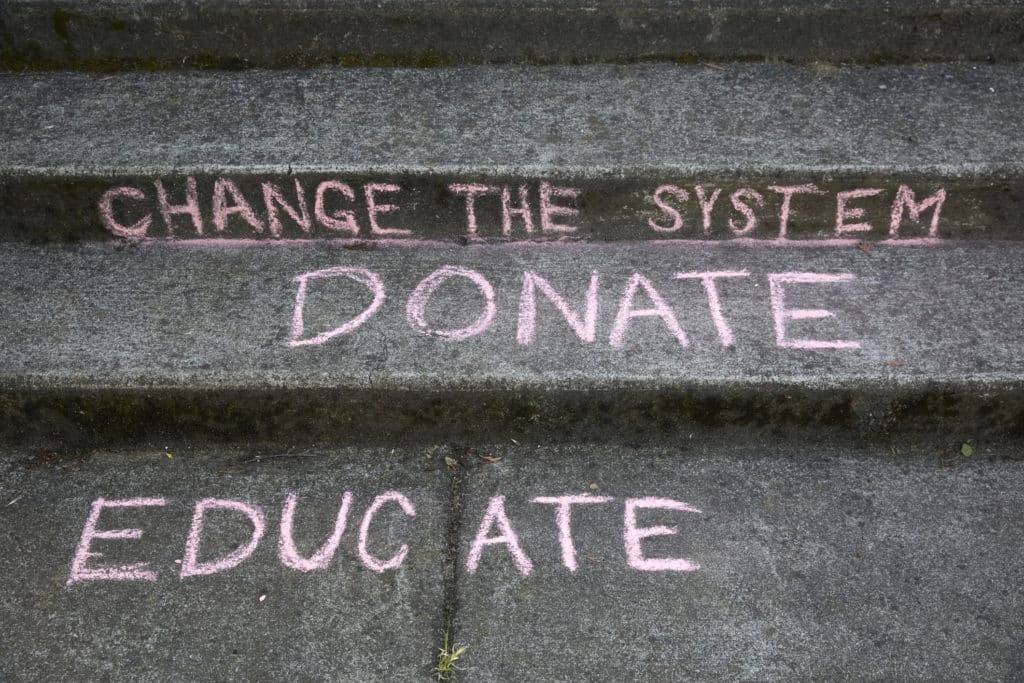
In an effort to combat hate and bigotry, allies have been marching, donating, uniting in solidarity on social media and signing petitions. While these are necessary steps, knowing what and how to argue also is crucial. To do so, education is key, and thankfully, there is a plethora of resources available, especially online.
During the school year, educational organization Facing History and Ourselves preps schools around the country with curricula. Karen Murphy, Facing History’s director of international strategy, told the Journal many lesson plans, videos, TED-style talks, poetry, art and articles are available on its website for middle and high-school students when they’re not at school.
“History is really important,” Murphy said. “I do think that one of the things that people have the opportunity to do right now is [think about] how much contemporary protests are legacies of the past and understanding what it means to inherit something … . [There are] events we sometimes treat as the property of victims, as if the Holocaust [only] belongs to the Jews and Trail of Tears belongs to Native people rather than saying, ‘This is our collective history, this is our collective inheritance.’ I think that there are lots of opportunities to read and listen this summer.”
Murphy also encourages families to write down their thoughts, questions and reflections in a journal, just as many students would in a classroom. She said it helps families write out“the rules of the road” when discussing difficult issues.
When it comes to learning about the Black struggle, she added it’s important to remember “Black people aren’t just the victims of racism.” They are filmmakers, poets, inventors, innovators, creatives and thinkers of society.
For older students and parents, Murphy recommends watching “Race: The Power of an Illusion,” “How Stereotypes Affect Us and What We Can Do” and “A Class Divided,” which are available on Facing History’s website.
“We all need to have that moment of confrontation to say, ‘There is so much I don’t know. And I want to know more because I want to be a more understanding, compassionate, radically empathic person.’ ” — Karen Murphy
“A Class Divided,” which has been gaining traction on social media lately,focuses on Jane Elliott, a third-grade teacher in Iowa who began conducting an experiment with her students in 1968, the day after Martin Luther King, Jr. was shot, because the students couldn’t understand why he had been killed. Murphy said, “The film itself is good learning. She divides her students up by eye color. What you see happen is how quickly the kids behave according to the ideas of inferiority. It’s disturbing and shocking, and it provides insight about human behavior. She is doing it because she wants kids to be more responsive about race. She exposes what we do all the time.”
Murphy added it can be frustrating to learn about historical U.S. racial events that were left out of American-history textbooks, noting it will soon be a requirement in Oklahoma that students learn about the 1921 Tulsa massacre.
“The U.S. is not unique in terms of being a country that hasn’t faced its violent past,” Murphy continued. “The idea is that there are places that said, ‘In order to have a more ethical and moral future, we have to look at our past,’ and there are places that avoid that.”
Jordanna Gessler, vice president of education and exhibits at the Los Angeles Museum of the Holocaust (LAMOTH), told the Journal it’s important to look at Germany’s history and the events that led to the Holocaust when understanding how to prevent genocide and oppression.
LOS ANGELES, CALIFORNIA – JUNE 28: A view of BEAR THE TRUTH Protest: A Pop-Up Art Curation of Teddy Bears for Children and Families in honor of #BlackLivesMatter at Los Angeles City Hall on June 28, 2020 in Los Angeles, California. (Photo by Chelsea Guglielmino/Getty Images)
“Hate doesn’t happen in a vacuum. Oftentimes, it’s not just one group that’s targeted,” Gessler said. “You need to learn what happens in a genocide before you can stop it. When you look at the 10 stages of genocide, murder is the second to last stage. So what is happening in the first eight stages? We need to ensure that it doesn’t happen.”
The LAMOTH has online resources for people of all ages, including survivor testimonies and resources about scapegoating and bystanders.
Gessler also spoke about the importance of “diversifying your bookshelves by thinking outside your echo chamber.” While she recommended the Holocaust memoir “Dry Tears: The Story of a Lost Childhood” by Nechama Tec, she said it’s also important to read stories that span white-driven narratives by white authors, and recommended Ibram X. Kendi’s 2019 book, “How to Be an Antiracist.”
And while racism is a topic teens and adults are starting to discuss frequently, PJ Library believes it’s equally important to teach anti-racism to preschoolers and elementary schoolers in a digestible way.
The organization, which sends free Jewish books directly to homes, recently launched a resource guide broken down by age group that includes a curated list of books, podcasts, videos and additional information for parents to discuss with their children. Among the books are“Yuvi’s Candy Tree” by Lesley Simpson, “Hurricane Child” by Kacen Callender, and “The Undefeated” by Kwame Alexander.
“This year … quarantine has led to a number of difficult conversations [about] mental health, the pandemic and death,” Meredith Lewis, PJ Library’s director of content, education and family experiences told the Journal. “When the conversation shifted rapidly to how we can talk about race and being anti-racist, not only is it a Jewish value, but it was a resource our parents were looking for, so we wanted to be there for them.”
She added that while the guide is diverse, American children’s books in general are not as diverse as they should be. “Kids are much more likely to see a family of animals than a family of color,” she said. To remedy that, PJ Library has an open submissions process where authors can send in their manuscripts. “We recognize we all have a lot more work to do, and we hope people can actively help us get there,” Lewis said.
For Murphy, it comes down to a simple acknowledgment: “We all need to have that moment of confrontation, which is humility, shame, maybe horror, to say, ‘My knowledge is incomplete. There is so much I don’t know. And I want to know more because I want to be a more understanding, compassionate, radically empathic person.’ ”