There was this woman in front of me in line at my favorite café in Bedoin.
Younger than me, in shorts and sandals and freshly-showered long hair in a topknot.
She was with her grandmother—petite silver-haired, but solid like a square, skin like paper, and blue veins snaking up her hands.
The young woman held her grandmother’s hand and stroked the top of it with her other free hand.
‘”You want a coffee? Or rather a glass of wine?”
“Coffee is fine.”
The young woman ordered two coffees, still holding her grandmother’s hand.
When she did take her hand away, it was to trace the tips of her fingers up and down her grandmothers back. Then she rubbed gently in circles. When the coffee’s arrived, she put her arm around her grandmother’s waist, and lead her to the table.
I tried not to stare but I was blinking back tears.
My own grandmother, who I adored, whenever I asked how she was while she was still alive she’d say, “ I’m OK, Dolly, I just feel lonesome sometimes.”
One time when I was in high school, she asked me to massage her shoulders. I did, and her shoulders were almost impossible to knead through, like two rocks.
It didn’t occur to me as a teenager how hard it must be, as a senior, to live without access to touch.
I sat drinking my coffee, watching this young woman with her grandmother.
And I wished to God that I had massaged my grandmother’s shoulders more often.
When I was little, she would pick me up from nursery school wearing sunglasses and a fur coat, even in the L.A. weather.
We’d go sit at Café Casino on Ocean Ave, and watch the birds in the bath.
She’d order coffee—Grandma loved coffee—and put in lots of cream and Sweet n’ Low from the pink packages.
I’d always ask for a “baby coffee” which meant her pouring a little of the sweet creamy coffee into one of the empty plastic cream containers.
“Don’t tell your mother,” she’d say.
And we’d solemnly clink glasses, two ladies, age 4 and 80, having coffee in the sunshine.
I’m glad she’s not here for the coronavirus—she wouldn’t have enjoyed this chapter.
But I do think she would love having coffee with me in a café in Bedoin.
And I would hold her hand, and stroke the top of it, and ask her to tell me stories about Brooklyn in the 1950s, and how she became a secretary, and about her sisters, and about beauty secrets like putting ice cubes and milk on her face.
And she would tell me to never cut me hair, and ask if I’m circulating (redundant question during coronavirus) and say, “ I love you, Dolly.”
Many have asked me the obvious Boaz question: Not going to the movies since March has put me into withdrawal, but am I going back to the theaters when they re-open in July?
I’ve been hoping the answer could safely be yes. I waited for the safety protocols. Then I contacted my extremely trusted epidemiological contact, and former interview subject Lakshmy Menon, MPH for guidance. Sadly, the answer is not what I was hoping for, and it appears that unless other measures are taken, I’m choosing not to go into any indoor theater.
The reasons are less about what you expect, and are specific to it being indoors. Generally speaking, six feet of distance and masking is more than enough. That recommendation along with hand-washing has not changed in months. (In fact outdoors if there’s six feet of distance between you and those outside your household, it’s quite safe even without the mask, but you better damn well have it ready to put on before you enter anyone else’s six feet of space.) The theaters are supposedly ensuring that distance by blocking the seats. And at least in California the state law mandates the masking (though it in no way ensures proper enforcement). But the issue unique to being indoors is that the air conditioning picks up those droplets and moves them around far differently than the outdoors. Yes they remains droplets which ultimately hit the ground, but outdoors those droplets will simply hit the ground within 6 feet and thus you should be fine beyond those 6 feet – assuming good hand-washing when you touch things. But inside any room with A/C you simply cannot trust the six foot rule. Those droplets can blow and circulate around.
This is why I choose to avoid any indoor space if it can be avoided, whether that be a place of worship, a grocery store, a casino, or any indoor setting with air conditioning. If it cannot be avoided then so be it, but other than within my own household, I will certainly wear a mask indoors at all times, even if I am not within six feet of anyone.
The good news is that there may end up being some theaters that invest in special air filtration that make it far more safe. But until those or other measures that change the recommendations occur, movie-obsessed Boaz and his wife will be limiting their movie watching to outdoor drive-ins, and their own living room.
Boaz Hepner grew up in LA in Pico/Robertson and now lives here with his wife and baby girl. Thus, the neighborhood is very important to him. He helped clean up the area by adding the dozens of trash cans that can still be seen from Roxbury to La Cienega. When he is not working as Registered Nurse in Santa Monica, he can be found with his wife and daughter enjoying his passions: his multitude of friends, movies, poker and traveling.
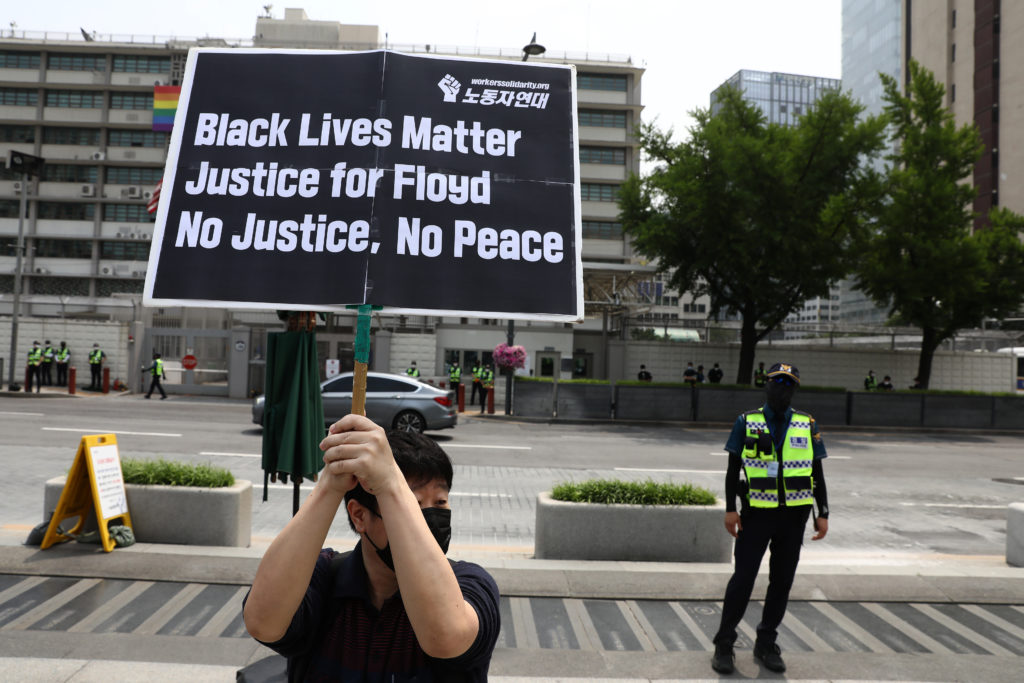
(JTA) — A prosecutor in Texas has resigned over her sharing of a Facebook post that compared demonstrators against racial injustice to Nazis.
Kaylynn Williford, a prosecutor in Harris County, which includes Houston, resigned Monday, days after she shared the post from a Facebook page that has criticized the Black Lives Matter movement and praised President Donald Trump, The New York Times reported.
Williford shared the post on Thursday and said she removed it shortly after, when someone pointed out how offensive it was.
A criminal defense lawyer in Houston saved the post in a screenshot and posted it on Facebook. Mauro Beltramini told The New York Times he saw it on Friday.
The post shows an image of hundreds of rings in a box, likely removed from a Nazi death camp. The caption reads: “Wedding bands that were removed from Holocaust victims prior to being executed, 1945. Each ring represents a destroyed family. Never forget, Nazis tore down statues. Banned free speech. Blamed economic hardships on one group of people. Institute gun control. Sound familiar?”
Williford in a statement emailed to the newspaper confirmed that she had shared the post, but had not intended to make a comparison to Black Lives Matter protests.
“What I interpreted as a post that promoted tolerance was taken in a completely different manner,” she said.
Williford has served as the trial bureau chief in the Harris County District Attorney’s Office since 1992, The Hill reported.
In one of Elia Kazan’s lesser-known films, “Panic in the Streets” (1950), Cmdr. Clint Reed, a doctor with the U.S. Public Health Service (Richard Widmark), diagnoses pneumonic plague in a corpse. With only 48 hours before the incurable disease spreads, he’s determined to track down anyone who may have been in contact with the unidentified dead man, a newly arrived foreigner, point of origin unknown. But Dr. Reed is up against resistance at every turn, most pointedly from Police Capt. Tom Warren (Paul Douglas). In his effort to prevent mass hysteria, the doctor is hell-bent on shielding the public from any and all information.
Its overstated, period elements aside, “Panic” is fun to watch and, more to the point, it has special resonance today in its depiction of a rapidly spreading uncontrolled disease with no known cure. And the cast of characters couldn’t be more politically and culturally spot-on from the good, admittedly authoritarian, doctor to the not-so-good police captain to the ill-informed, suspicious businessman to the sleazy underworld to the heroic newspaperman; each character awash in public and/or private agendas. Given our current crises, it’s a film ripe for analysis.
On June 24, Yiddishkayt (a Los Angeles-based Yiddish cultural and educational organization), partnering with the Los Angeles Review of Books (LARB),presented a virtual conversation on the film. The four panelists were Rob Adler Peckerar, executive director of Yiddishkayt; Boris Dralyuk, LARB executive editor; author-film critic J. Hoberman; and Karen Zumhagen-Yekple, a professor of English and gender studies at Tulane University. In May, the film series debuted with the 1922 silent vampire film “Nosferatu,” directed by F.W. Murnau. “Nosferatu” also embodied such topical issues as aliens and contamination.
During the hourlong, free-wheeling discussion about “Panic,” the four scholars covered a range of topics, including the film’s connection (and lack thereof) to Camus’ “The Plague”; Kazan’s body of work dealing with class, race and ethnicity (Think “Pinky” and “Gentleman’s Agreement”); its political vision; and its central metaphor: contagion and its origins.
It’s no fluke they all agreed that the disease in “Panic” can be traced to recently arrived foreigners on our shores, immigrants of some ilk who are closely allied to a criminal under class. It’s a viewpoint voiced by our current administration, but it has deep roots within our collective psyche.
Dralyuk pointed out that the movie originally was titled “Port of Entry,” adding how the prescient Dr. Reed views the sickness as a global (not simply local) crisis that needs to be contained. It’s not unlike like immigrants themselves or communism or the rise of Nazism or whatever imagined or real contamination the country faces at any given time. The film has many metaphorical and symbolic echoes the pundits agreed.
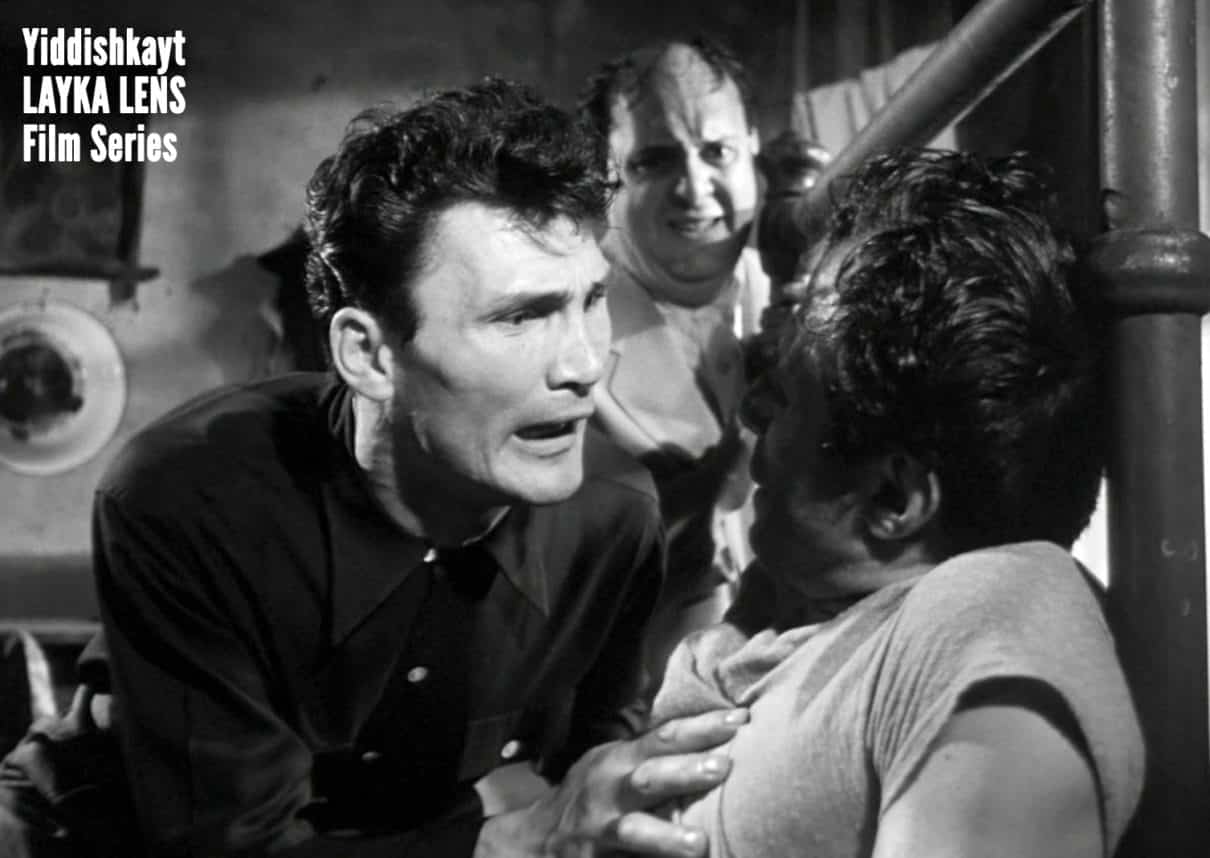
Jack Palance (in his film debut) with Zero Mostel in a still from “Panic in the Streets.” Photo courtesy of YIDDISHKAYT
Elaborating on that theme, Zumhagen-Yekple talked about the literal and metaphorical significance of setting the story in New Orleans with its multi-ethnic-racial population, an iconic demimonde that included Jews and many Blacks. New Orleans was a hub of slave trading, she noted. That said, the lack of African Americans in the movie (short of background players) was jarring. The panelists noted that the villain of the piece was named “Blackie” (played by Jack Palance with his trademark angular, hard-edged appearance). “He’s like the plague itself,” Hoberman said. And equally troubling, two Chinese characters in the film evoked caricatures.
“Panic in the Streets” is fun to watch and, more to the point, it has special resonance today in its depiction of a rapidly spreading uncontrolled disease with no known cure.
Yet all observed the paradox. Kazan, the undisputed auteur, was keenly in tune with racial/social justice issues. So, too, were the Jewish writers on board: Edward Anhalt, who co-wrote the story with his wife, Edna; and, most notably, Daniel Fuchs, a Brooklyn-born proletarian writer, who adapted the story. The screenplay was penned by a non-Jew, Richard Murphy. Still, the film subtly embodied a Jewish sensibility, the panelists concurred.
Peckerar said that “Panic,” along with “Nosferatu” and future films in the series, should be of special interest to Jews because in various ways, the movies deal with concepts of communities colliding, the fusion of communities and how those communities evolve. What can have greater resonance for the peoples of a diaspora whose self-definition shifts with time and place?
The designated hero is Dr. Reed, yet all agreed he is an ambiguous figure at best. Through a 21st-century lens, (and it’s hard not to view him that way), he’s well-intentioned, but he’s also an authoritarian. His medical license and especially his badge give him control over others and the right to withhold information that impacts their health and, in fact, people die as a result of his decisions. Peckerar described him as “a cad that saved the day.”
The police captain, the embodiment of law enforcement, is the more clearly drawn heavy, although even he comes around thanks to his friendship with Dr. Reed.Throughout, the two characters are in competition on every front including who makes more money and boasts greater social status. They are admittedly adversaries but in the face of a larger common enemy — the plague — they forge a bond.
Hoberman called the cop a Republican and the doctor a New Dealer, to which Dralyuk responded, “A Republican softened by a New Dealer.”
Dralyuk talked about the “cost of a career,” a topic Dr. Reed and his wife (Barbara Bel Geddes) discuss, suggesting that without spelling it out, the screenplay hints at why communism might be an appealing to alternative to Dr. Reed.
Perhaps, the purest character here is the reporter who is unfairly jailed for trying to inform the public. But at the same time, Hoberman said the paper lives off advertising and prints stories that promote spurious cures. “Still, the film does not sensationalize or denigrate the press,” he said. “The press feels the public has the right to know and the authorities don’t.”
In the end, the panelists talked about the film’s genre. Hoberman suggested it had elements of film noir, but it lacked its essential pessimism. Indeed, it’s a whole lot closer to “Father Knows Best,” he said. Reed is the iconic American male of the era: successful in his career, a good provider and a fine family man. His relationship with his son is paramount and compared with all the other men in the film, who can’t measure up (not coincidentally they are single and childless), he is “idealized masculinity that upholds the patriarchy,” Peckerar said, adding that there is resolution and, more important, the Reeds are expecting a second child. To that degree, its vision is arguably optimistic.
More information on the Yiddishkayt series is available here
Simi Horwitz is a New York-based award-winning feature writer/film reviewer.
As a stand-up comedian, Myq Kaplan has checked off all the aspirational boxes: performances on late-night shows including “The Late Show With David Letterman,” “The Late Late Show With Craig Ferguson,” “Late Night With Seth Myers” and Conan O’Brien’s TBS show. A finalist on “Last Comic Standing.” An appearance on “America’s Got Talent.” Specials on Amazon and Comedy Central. And a hit show at the world-renowned Edinburgh Festival Fringe.
It was at that festival that Kaplan performed his one-man show, “A.K.A.,” which he later recorded at Acme Comedy Club in Minneapolis. He released his fifth album on May 8.
The Journal caught up with Kaplan to chat about “A.K.A.,” his TV appearances and what it’s like doing comedy during quarantine.
Jewish Journal:Tell us about the name of your album “A.K.A.”
Myq Kaplan: The name of the album is “A.K.A.” and [it’s based on my Edinburgh Fringe show] “All Killing Aside.” That would have been the name if we weren’t in the midst of the pandemic, so we called it A.K.A., which is short for all killing aside, but also short for “also known as.”
JJ: Why did you record it at Acme?
MK: It’s one of my favorite comedy clubs. They have a great setup and audience. They treat comedians and audiences wonderfully and know what they are doing. It’s a great place, city and comedy town.
JJ: What’s it been like quarantining in New York?
MK: I’m in Park Slope, Brooklyn. I imagine in some ways it’s similar to quarantining anywhere. I’ve gone out on some walks. I live near a park and being near open spaces in nature or at least a nature-like thing where you can stay away from people is nice. I have an outdoor space behind our home. I’ve been spending lots of time in our rooms with my girlfriend and then electronically being in touch with my mother, my father and my other friends and family. We’re doing our best to make the most of our time.
JJ: Are you writing or performing comedy online?
MK: I’ve performed every week doing live-streamed comedy shows. There’s certainly no absence of the capacity to go on your phone or computer and make sounds and faces appear to others, though certainly, it’s without the standard response of people who are all in the same room as you. It’s enough to keep my mind at least pretending that it’s as close to stand-up as possible.
JJ: What’s it like performing that way?
MK: Doing a Zoom comedy show is not like doing a comedy show where you can see and hear people in the same room as you. For many of my shows, my girlfriend, Rini, has been in the home or room as my only audience member, so my jokes skew toward, “Here are a few of my girlfriend’s favorite jokes” or “I love my girlfriend.” It’s a different kind of performance. I’ve heard some comedians say it’s hard without the audience. One positive spin on it is if there’s no audience responding, even if you do your best joke, you’ll get a non-response. Anything you say, whether it’s new or experimental, will all get the same response. It’s freeing.
JJ: Why is it important that people listen to comedy during quarantine?
MK: For me, it’s valuable to be connecting with people. In a way, there’s something more special about watching something that’s happening now. It’s the closest thing to going to a live show. In these times, it’s tuning into a live stream and knowing everyone watching and participating is in the same boat and in this experience of solidarity.
JJ: I see some Jewish themes in your comedy. Did you grow up religious?
MK: My mom and dad are both Jewish. My dad was raised Conservative and was bar mitzvah. My mom was not a bat mitzvah. I guess it was a time when women were not as mitzvah-ed as boys were. I was given the choice and I said, “Sure, I’ll have a party.” They said you have to learn Hebrew, Torah and history and I said, “Too late, we’ve already agreed to the party.” I went to Temple Sinai in Summit, N.J., on Saturdays, Sundays and Wednesdays leading up to my bar mitzvah. After that we moved, and during high school, I don’t think we had a specific synagogue. We went to various families’ homes for Passover seders and the High Holiday-type celebrations. We were certainly a culturally Jewish family.
JJ: Why did you change the spelling of your name (from Mike Kaplan toMyq Kaplan)?
MK: I changed it in my teenage years. I was at this performing and creative arts summer camp. It was around when Prince changed his name to a symbol and I said, “That guy, he’s cool. I’ll do that.” I changed my name. He changed his back because it turns out it was for a legal copyright. I said, “OK, he’s Prince again and I guess I’m alone and weird now.” I liked it. It stuck. As a comedian, it helps to not have the name Mike or Michael because there are so many and it’s a little easier to search engine optimize and get social media handles that other comedians don’t have.
JJ: What was it like being on “Last Comic Standing” and “America’s Got Talent?”
MK: “Last Comic Standing” was the biggest jump in my career from when I was just starting to headline clubs. It now showed millions of people my comedy every week. After that, there were millions of people who might see me, or at least hundreds of people in different towns around the country [who could see me perform]. It was exciting to be on TV every week and doing comedy. It was a little nerve-wracking that it was a competition, but I had really great friends I went through semifinals and the finals process with.
At “America’s Got Talent,” you’re not just hanging out with comedians but also with people who regurgitate coins on command and children’s choirs. It’s like a zoo. I was grateful to be on it. Overall, those shows aren’t what I love about stand-up, which is getting to perform live. But they were valuable experiences that helped me reach wider audiences, who I can hopefully perform for later but not now.