fbpx

June 30, 2020

L.A. Sheriff Says He Won’t Enforce July Fourth Beach Closures

Los Angeles County Sheriff Alex Villanueva said in a June 29 statement that his department won’t enforce the county’s decision to close beaches during the upcoming Fourth of July weekend.

The county made the decision to close the beaches earlier in the day after nearly 3,000 new COVID-19 cases were reported on June 29, a record high, bringing the county’s total number of cases to more than 100,000. Those who violate the closure could be subjected to a fine of up to $1,000.

“It’s the responsible decision to protect public health and protect our residents from a deadly virus,” County Public Health Director Barbara Ferrer said.

Villanueva said in a statement to Fox 11 Los Angeles, “We were not consulted on the beach closure and will only assist our beach cities in closing parking lots and traffic enforcement on [the Pacific Coast Highway].  In regards to enforcing the beach closure, we will not be enforcing it because we are ‘Care First, Jail Last.’ ”

However, the sheriff department’s Lost Hills Station, which oversees Agoura Hills, Calabasas, Hidden Hills, Malibu and Westlake Village, announced on Facebook and Twitter that it would be enforcing the closures.

L.A. Sheriff Says He Won’t Enforce July Fourth Beach Closures Read More »

Rep. Ted Lieu Discusses Race, Israel and 2020 Elections With IKAR Rabbi Sharon Brous

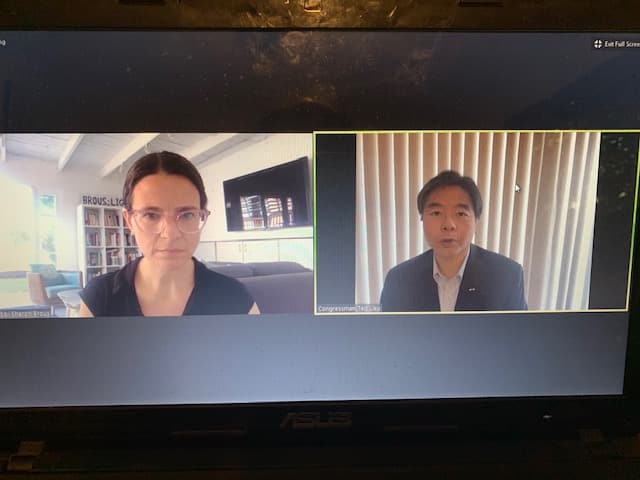
Congressman Ted Lieu supports a two-state solution for Israel; foresees significant change across a number of areas should voters flip the senate in November; remains optimistic that scientists ultimately will find a cure for the novel coronavirus; and encourages constituents to get in touch when something is going right or when they feel an issue needs attention.

“Public sentiment is everything, and social media resonates,” the three-term congressman and former California state senator told a Zoom audience during a “Meet the Rep.” panel organized by IKAR.

The hourlong discussion on June 29 was moderated by Rabbi Sharon Brous and IKAR’s Director of Community Organizing Brooke Wirtschafter who fielded questions from attendees. Lieu, who sits on the House Committee on the Judiciary, touched on an array of topics, ranging from the COVID-19 pandemic and Black Lives Matter to climate control and the allegations that Russia placed bounties on U.S. soldiers in Afghanistan.

In the midst of the pandemic, Lieu called it “insane” that certain people, including key politicians, refused to wear masks, but was diplomatic when asked his opinion of who should be Joe Biden’s running mate. “Many of the leading candidates are friends of mine, so I think they would all be great,” he said.

During his opening remarks, Lieu addressed the COVID-19 pandemic, the call for justice in the wake of George Floyd’s death, and the forecast of the upcoming November presidential election. He predicted huge lines at ballot boxes, encouraged people to vote from home, and hoped the nation’s 50 secretaries of state — Republican and Democrats alike — would do their best to run fair and uncontroversial elections in their respective states. He agreed with Brous’ view that President Donald Trump would likely contend that any results not in his or his party’s favor would be the result of voter fraud.

“He said that in the last election when he lost the popular vote,” Lieu said. “He sort of keeps saying this, but it’s not clear to me how much the American people actually believes it, so we’ll see what happens in November.”

On COVID-19 and the nation’s battered economy, Lieu referenced the Health and Economic Recovery Omnibus Emergency Solutions (HEROES) Act several times, expressing his hope that the Senate would pass it.

“We need to continue to have a strong U.S.-Israel relationship. That doesn’t mean that we need to agree with everything the Israeli government is doing. You have a number of members of Congress who are now expressing their views that the Israeli government should not go forward with annexation.”  — Rep. Ted Lieu

In the wake of the civil unrest and calls for change following the May 25 death of Floyd, Brous asked whether the United States had arrived at a moment to make substantive change “or is this going to be a moment of tweaking and slight reform and then people are going to lose interest and the next thing is going to come?”

“You have a lot of people who are still demonstrating, and I think when Black Lives Matter first came out, a lot of people didn’t quite understand what that term meant,” Lieu said. “The reason I think people now get it — when they saw the murder of George Floyd —  something clicked in their minds … that the system does not, in fact, treat lives the same way. It treats Black lives as less important. And that’s why you have had this persistent systematic murder of Black Americans by our government.”

Lieu emphasized his desire to see the Justice in Policing Act passed into law in 2021 if Trump is voted out of office. Asked later to commit to not accepting donations, contributions or endorsements from police, sheriff or prison guard unions or their political action committees, Lieu replied, “I have a different view. My view is not that police officers are bad people or police unions are bad. I think it’s a system that needs to be changed. The system allows not only bad cops to do bad things. It also allows good cops to look the other way. That’s what we’re trying to change.”

Toward the end of the event, Lieu was asked his opinion on the state of relations between the United States and Israel and his views on Israel’s potential plans to annex portions of the West Bank. The Congressman, who signed a Congressional letter opposing annexation, said that annexation “would bring us further away from a two-state solution.”

“We need to continue to have a strong U.S.-Israel relationship,” Lieu said. “That doesn’t mean that we need to agree with everything the Israeli government is doing. You have a number of members of Congress who are now expressing their views that the Israeli government should not go forward with annexation.”

“We share your view on that,” Wirtschafter replied, “and we want you to know that you have the backing of us and really, the vast majority of the Jewish community in this country and certainly in Los Angeles, for working toward a two-state solution and for calling on Israel to live up to its democratic values to respect the human rights of all people who live under the control of its government.”

Rep. Ted Lieu Discusses Race, Israel and 2020 Elections With IKAR Rabbi Sharon Brous Read More »

Josh Radnor and Ben Lee on New Album ‘Golden State,’ How Lee’s Bar Mitzvah Changed Him

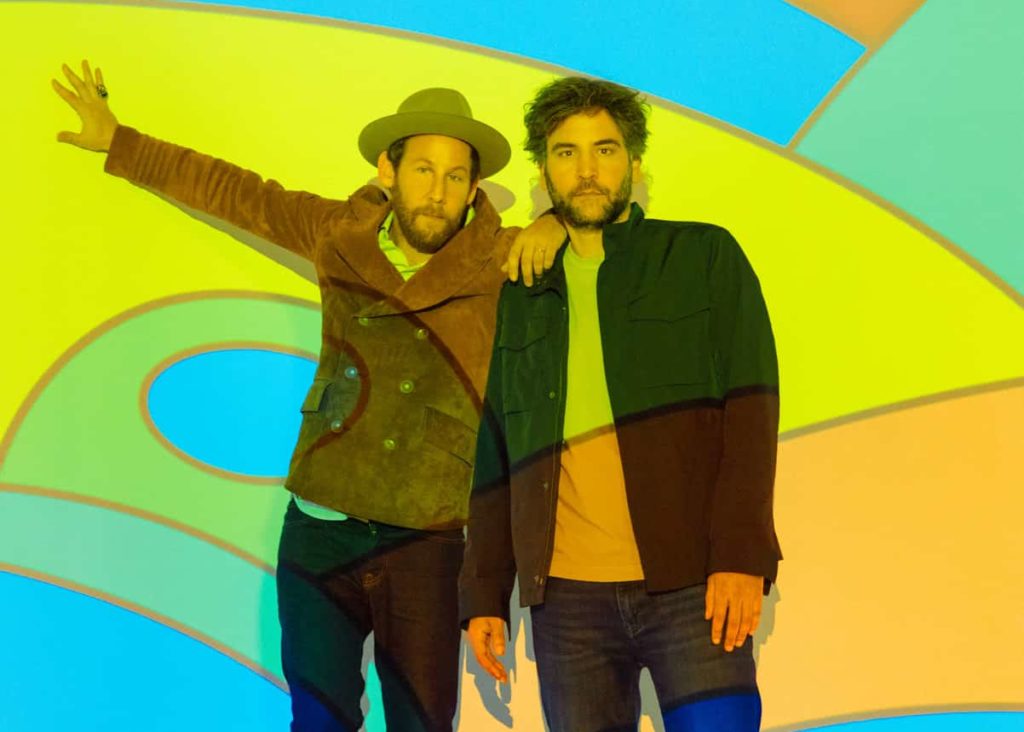
Radnor & Lee is the musical project of Josh Radnor (“How I Met Your Mother,” “Happythankyoumoreplease,” “Hunters”) and singer/songwriter Ben Lee (Noise Addict). In June 2020, the duo released its sophomore album “Golden State” via Flower Moon Records, as run by Azure Ray’s Maria Taylor. “Golden State” was written and recorded by Radnor & Lee, and produced by Justin Stanley (Beck, Eric Clapton, Sheryl Crow).

Last month “Gimme Your Mess” from the new album was premiered via PopMatters, while the album’s previous singles “Outside In” and “Simple Harmony” had hit Spotify prior to the release of “Golden State.” In addition, the official music video for “Simple Harmony” was directed by Sam Fragoso and in May was premiered via American Songwriter.

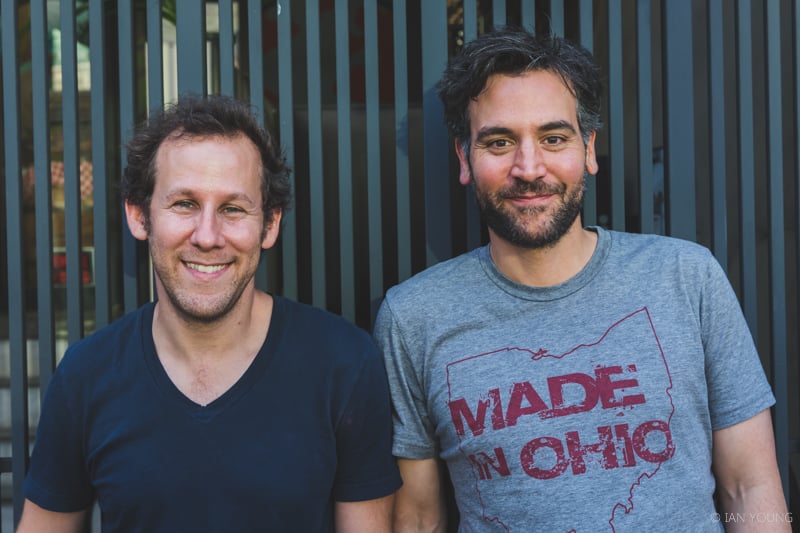
Ben Lee and Josh Radnor; Sofar Sounds in San Francisco August 3, 2017 by Ian Young.

I had the pleasure of speaking with both Josh Radnor and Ben Lee by phone about “Golden State” and plenty more on June 30 as embedded below. The full chat will also be appearing on a future edition of the “Paltrocast With Darren Paltrowitz” podcast.

Within our chat, I asked Ben Lee if it was true that he – as someone who first found international success in music as a teenager – got a guitar as his bar mitzvah present. He kindly answered this one, as exclusively transcribed for the Jewish Journal:

“I was playing guitar since I was 10 and I just wanted to be in a band… It’s funny because my music, the acoustic guitar ended up being my tool of choice, but the vision in my mind there was a barrier for entry into rock & roll. That involved having an electric guitar.

When I was 12 1/2 and had my bar mitzvah and got that electric guitar, that was I suppose when I went, ‘Okay, there’s nothing stopping me now. I have the same thing Slash has.’ I don’t know how to play it as well, but it seemed like we were all systems go.”

More on Radnor & Lee can be found here, here and here.

Josh Radnor and Ben Lee on New Album ‘Golden State,’ How Lee’s Bar Mitzvah Changed Him Read More »

Wiesenthal Center Report Highlights Farrakhan’s Efforts ‘to Inject Anti-Semitism Into Our Society’s Mainstream’

The Simon Wiesenthal Center’s historical consultant Dr. Harold Brackman released a report on June 30 highlighting Nation of Islam leader Louis Farrakhan’s efforts “to inject anti-Semitism into our society’s mainstream.”

The beginning of the report states that the Wiesenthal Center felt the report was necessary after actress and comedian Chelsea Handler shared a clip of Farrakhan on “The Phil Donahue Show” in the 1990s in a June 15 Instagram post; Handler called it “powerful.”

“Confronted by a growing crescendo of protest, Handler deleted the post and apologized, but the damage has been done,” the report stated. “Many other prominent Americans, including politicians, social activists, NGO leaders, and cultural figures, continue to praise and endorse Minister Farrakhan, who for four decades has exploited every opportunity to inject anti-Semitism into our society’s mainstream.”

The report notes that Farrakhan took over the Nation of Islam 10 years after Malcolm X’s assassination in 1965, which some have accused Farrakhan of inciting. He proceeded to become famous after hitching “his star as security head to Jesse Jackson’s 1984 and 1988 Democratic presidential primary campaigns.”

Among Farrakhan’s past remarks included in the report is Farrakhan saying in 1984, “That nation called Israel never has had any peace in 40 years and she will never have any peace because there can be no peace structured on injustice, thievery, lying and deceit and using the name of God to shield your gutter religion under His holy and righteous name.”

Additionally, in 1990, Farrakhan said, “I have warned you [Jews] that Allah will punish you. You are wicked deceivers of the American people. You have sucked their blood. You are not real Jews, those of you that are not real Jews. You are the synagogue of Satan, and you have wrapped your tentacles around the U.S. government, and you are deceiving and sending this nation to hell.”

Other examples include Farrakhan blaming Jews for the Holocaust, the slave trade and the 9/11 terror attacks, calling Adolf Hitler “a very great man” and saying in 2018, “I’m not an anti-Semite; I’m anti-termite.”

The report also argues that Farrakhan has made homophobic remarks, as he once said, “God [doesn’t] like men coming to men with lust in their hearts like you should go to a female. … If you think that the kingdom of God is going to be filled up with that kind of degenerate crap, you’re out of your damn mind.”

The report argues that Farrakhan still maintains relevancy because high-profile figures such as former Women’s March, Inc. leaders Linda Sarsour, Tamika Mallory and Carmen Perez have spoken highly of him.

“How has Farrakhan, an arch-male chauvinist, been able to establish such a grip on these professed feminists?” the report asks. “The answer, I think, is that progressive ‘intersectional’ ideology has given him a weapon to ‘include out’ (to use studio head Sam Goldwyn’s famous malapropism) Jewish women from today’s social change movement because they are both feminists and Zionists.”

The report concludes, noting that the United States currently is in perilous times between the COVID-19 pandemic, the protests against the death of Black man George Floyd while he was in police custody, and economic malaise.

“Against this backdrop, Louis Farrakhan’s divisive rhetoric puts in peril the vision of American unity and tolerance that this ageless demagogue has sought to destroy for more than four decades,” the report states. “Social Justice and Equity will never be achieved by embracing or excusing Farrakhan’s hate.”

Wiesenthal Center Report Highlights Farrakhan’s Efforts ‘to Inject Anti-Semitism Into Our Society’s Mainstream’ Read More »

Who is George Soros? What Do All The Conspiracy Theories Around Him Mean?

Journalist Emily Tamkin’s comprehensive dive into the influence of George Soros is coming out into a very different world than she thought it would be released into.

When she started, following the election of President Donald Trump, conspiracy theories about Soros were beginning to make the leap to mainstream in the United States.

More recently, far-right conspiracy theorists have also blamed the 89-year-old Jewish billionaire philanthropist for the Black Lives Matter protests — he is paying protesters and “funding antifa,” they say — and the coronavirus pandemic. Anti-Semitic conspiracy theories about Soros have reached new heights, with half a million negative messages flooding Twitter every day last month, according to an Anti-Defamation League analysis. World leaders, including Trump, have amplified them.

That means Tamkin’s book, “The Influence of Soros: Politics, Power, and the Struggle for an Open Society,” is arriving at a fortuitous time. Of course, the New Statesman editor said, there would never be a bad time for a book explaining some of the most durable anti-Semitic tropes of our time.

“On the one hand, I thought, wow, the book is coming out with all of these conspiracy theories about him swirling in the news!” Tamkin told the Jewish Telegraphic Agency from her home in Washington, D.C.

“And then I thought, well, part of the reason that I wrote the book is that conspiracy theories are seemingly always swirling about him in the news.”

Tamkin’s book addresses not only Soros conspiracy theories but the theories at the heart of his philanthropy and what drives Soros to give so much money.

“The protests really do drive home the relevance of the text of the book,” she said. “A protest is people demonstrating because they want to be able to more fully participate in democracy and in society, and that’s fundamentally what Soros’ philanthropy is all about.”

In a wide-ranging conversation, we talked all things George Soros, “perfect” anti-Semitism, the paradox of billionaire philanthropists and the Google alerts Tamkin uses to monitor the evolution of Soros chatter online. This interview has been lightly edited for length and clarity.

What surprised me the most was how recently the Soros conspiracy theories, or as you call it “Soros-as-bogeyman,” really entered the mainstream. For some reason, I thought it had been around for decades.

Tamkin: It’s both, right? It has been around for decades. In the 1990s, you do have leaders of European countries who are not fringe figures talking about it. 

Yes, true. It just struck me when you write about how much the conspiracy gained momentum in 2015. Can you expand upon why you think 2015 was such a turning point for the spread of the Soros conspiracy theory?

It’s a confluence of factors. One, it was the introduction of certain American political actors, namely Arthur Finkelstein. [Finkelstein, who died in 2017, was a conservative political strategist.] When people say, “Oh, wow, these conspiracy theories are the same in all these different countries,” in some cases, that’s because you literally have the same people working in these different places.

Two, it’s that you have people — specifically in Central and Eastern Europe — realizing that the European Union and the promised democratic liberal project was not going to give them everything that they had thought it was going to give them. For that reason, people are disaffected, they look for leaders who will play on that disaffection, and those leaders, in turn, need to do something because they can’t actually make it all better. In [Hungarian Prime Minister Viktor] Orban’s case, rather than attacking the political opposition, which would have only built up that political opposition, he attacks George Soros.

The [third] reason that I think 2015 specifically is such a turning point is that you have a migration crisis in Europe. Balint Magyar, who’s quoted in the book, is this sociologist [who] was in the pre-Orban government. And the way he put it to me is that the perfect “other” is not a liberal professor. The perfect other is a migrant. If you can have this famous, hated figure onto whom everyone can project their own prejudices and blame him for this uncertainty and the entrance of these people who you’d rather not have in your country, and you can vilify [those migrants] in the process, your political situation becomes much stronger and you can distract from some of the realities on the ground in your country. And you can distract from your own alleged corruption and you don’t need to build up any of your political opposition.

OK, I want to dive into all of that. Let’s start with Arthur Finkelstein. What was so interesting to me was that he’s a Jewish political strategist who is responsible for Orban and so many leaders’ embrace of the anti-Soros campaigns. Do you find it contradictory that this Jewish man helped spread one of the biggest anti-Semitic conspiracy theories? How do you understand that? 

I think that it speaks to two things. The first is that there are some people who point to this part of the story and say, “Well, it just goes to show that it’s not really an anti-Semitic conspiracy theory. It’s just an opportunistic conspiracy theory.” And to that I would say if you are willing to use anti-Semitism because of opportunity, then you are comfortable with anti-Semitism, which I would invite you to think perhaps means that you are an anti-Semite.

And the second thing is that Finkelstein had first worked with [Israeli Prime Minister Benjamin] Netanyahu. There’s a really important element to the story, which is that Israel also deals in these anti-Soros conspiracy theories. Soros has a very different understanding of what it means to be Jewish than Israel does. His Jewishness is not wrapped up in the State of Israel. For him, it’s more about universal human rights and universal values, and it’s not about support of the Zionist project.

When you have Netanyahu’s son [Yair] go to Budapest and bash Soros, and tweet out that Hungary is such a wonderful place because it’s bringing back Christian Europe, on the face of it there is a conflict there: Why is the offspring of the prime minister of the Jewish state spreading anti-Semitic conspiracy theories? But I don’t see it as “That’s crazy, a Jewish person is attacking a Jewish person!” I see it as one understanding of Jewishness sacrificing another understanding of Jewishness for greater political gain.

Soros doesn’t really engage with his Jewish identity in the way we typically see major Jewish philanthropists think about their Jewishness. You write about this in “The Influence of Soros,” but do you really think it was because of that one awful experience with the Jewish charity groups in the U.K.?

[As Tamkin writes in “The Influence of Soros,” when Soros made it to London after the Holocaust, he applied to the Jewish Board of Guardians for a stipend and was rejected. He then broke his leg, reapplied, and the charity agreed to give him money, “provided he came to their office, climbing stairs with a broken leg, to get it.” Soros, Tamkin continues, “wrote to the chairman of the board and said he was hurt to find that this is how one Jew treats another.” They then sent him money, and Soros kept collecting long after his broken leg had healed. Soros tells this story as an example of ways people take advantage of charitable giving.]

That is part of it; the reason that I’m comfortable saying that is that when I went to Sarajevo, I spoke to this man by the name of Jakob Finci. Finci got all these people out of Sarajevo during the war, went on to run the Open Society in Sarajevo, and is now very involved in Jewish life in Sarajevo. What he told me was that back then, in the ’90s, his was the first Jewish organization to which Soros ever gave money because [Soros] had these negative experiences with Jewish charities in London during his time there. Even when [Soros] gave them the money, he said, “I don’t want this to only be used for Jews, I want you to use this for everyone.”

I also think one needs to understand that in Budapest, at the time that Soros was there, many Hungarian Jews thought of themselves first as Hungarians. And that part of the tragedy of Nazi occupation and life under the Arrow Cross — besides the obvious tragedy of the Holocaust — was this trauma of having your identity taken from you. I personally am a Jewish woman — I’m not comfortable telling another Jewish person who’s lived through that how to process that. If that experience does not make you want to embrace your Jewishness or Judaism, I’m personally not going to say, “Oh, you’ve interpreted Jewishness wrong.”

Finally, I do think that there’s something to be said for the fact that the way he relates to his Jewishness is, “Oh, I was persecuted because I was Jewish; therefore, what I want to do is to help other people who find themselves persecuted because of whatever they are.” To me, that is also a Jewish value.

Going back to the reasons for the rise of Soros conspiracy theories in 2015, you write in the book that “the idea of the Jew bringing in immigrants is, in a certain sense, the most perfect antisemitism.” Can you expand on why the archetype of the migrant as “the perfect other” as you discussed before, and Soros as the archetype of anti-Semitic conspiracy theories is this powerful combo?

Let’s think about the reason that a Jewish person would want to “invade a country with foreigners.” What you’re saying is that Jewish American, that Jewish Hungarian, that Jewish whatever, is not really of that country — and that’s why they’re trying to undermine it. It’s the idea of perpetual otherness that you’ll never really be of this place, no matter if you’re from there, no matter how many years you’ve spent there — there’s nothing you can do.

The idea that it’s the Jew who corrupts the nation, either through his own being or by adding people from another place — not considering that these people are fleeing some of the most horrific experiences known to humankind, but that they’re being brought in because the Jew is trying to corrupt the nation — that is just, in my mind, powerful anti-Semitic sentiment. It’s the otherness, but it’s also the element of the puppeteer: The idea that there is anybody who’s bringing these people and they’re not, of their own agency and of their own will, fleeing.

I should add that it’s not only the most perfect anti-Semitism, it’s also many other forms of bigotry. Because ultimately, yes, Soros and Open Society are attacked by this, and yes, I personally don’t see how you can disentangle this from, for example, the shooting at the Tree of Life synagogue, which was attacked in part because of their work with HIAS. But in the case of immigrants, anti-Semitism is the means to an end [with regard to] xenophobia. So Jews are hurt by it, but also when you pass a “Stop Soros” law that makes it illegal to help asylum seekers and migrants, you’re also hurting those asylum seekers and migrants.

Yeah, it’s similar to how anti-Semitism is so tangled up in white supremacy.

Right, and how weaponization against Jewish people is used as a way to get at these other populations. I mean, you’re seeing that now with the [Black Lives Matter] protests. What does blaming Soros do? Does it hurt Soros and Jewish people? I would say yes, but it’s also meant to strip the agency and legitimacy of protests that are about Black Americans. The anti-Semitism is a means to this other discriminatory end.

That brings me to my next question. For me, Trump’s tweet blaming the Kavanaugh protesters on Soros showed how mainstream the Soros anti-Semitic conspiracy theory had really become. What was that moment for you? When you realized, wow, the Soros conspiracy theories are everywhere? Or have you always felt that way?

In 2017, I wrote a long article on Soros in Central and Eastern Europe. Soros conspiracy theories had been in the U.S., but the next year they were everywhere, and they were coming from literally the most powerful person in the country.

What I thought was so interesting about that was that people seized on the fact that the two women who confronted [then-Sen.] Jeff Flake in the elevator were associated with a group that got money from Open Society, as if that somehow meant that the claims that Soros had paid for the placards was true. There has to be some way to distinguish, “yes, this person is supportive of progressive causes, and, yes, his foundations have given tremendous money to those causes” from “Soros is organizing these protests.” The latter completely takes the agency away from the individuals and the legitimacy from the protests.

With regard to those #MeToo protests at Kavanaugh’s hearing, and now the Black Lives Matter protests, how do you respond to seeing Soros brought up again and again?

The more you look at it, the more you see — across the globe and across decades — there is a pattern here: The idea of “open society” is about expanding who gets to participate in the democratic process. Part of me when I see his name brought up, it’s like, “You’ve got to be kidding me! Again? Soros mentioned again?!” But mostly, of course he’s getting mentioned again because he’s being brought up in conjunction with the expansion of democracy. Of course he’s getting brought up in that because that’s what his foundations have given all this money to, and also people know that using his name is a quick and easy way to delegitimize what is legitimate criticism of different governments and different parts of society.

We haven’t actually talked about his philanthropy yet. In the book you talk about the paradox of philanthropy, how Soros’ giving reproduces inequalities, even as it is meant to lessen them. How does Soros navigate that? Do you actually think there is a way to navigate this paradox successfully?

OK, so three things. The first is it’s certainly more complicated than I maybe thought starting out, which was that everybody was going to come together and join me in [saying] that this is a bad system. When I went to talk to the people who work in these spaces, be it in Syria during the war, be it in Baltimore on criminal justice reform, they were like, “What are you talking about? No, it’s good that somebody is giving us money because nobody else would have.” It’s fine for me sitting here in Washington, D.C., to [say] we need to redistribute this wealth. I’m making that argument coming from a place of trying to be more supportive of more people, but there are times where I do think that it’s context-specific.

Two, I do think that Soros does understand it on some level because he has called for a wealth tax. I do think there’s some level of recognition, but he has said he kind of played by one set of rules making money and another set of rules in his political or philanthropic life. The way I see it, if you are a large enough financial player, you can make decisions that have political or social repercussions. In my mind, the division is not quite as clear.

And finally, especially when I spoke to people who were maybe a bit older than I was about this paradox, they [said], “but that’s the way it is,” as though I was naive for suggesting that we perhaps not be reliant on billionaire philanthropists. And, to this, I would say, if you look at the start of [Soros’ life], we’re in a world of empires, and now we’re not. And if you look at all the ways in which the world is different from how it was in 1930, it is not impossible to imagine a world — through taxation, through regulation — where we’re less reliant on billionaire philanthropists because people are themselves more empowered and in control to participate in the democratic process without foundations.

What do you find to be Soros’ greatest legacy?

The biggest legacy is the people who were the beneficiaries of the money. All of the people who had scholarships that they wouldn’t have been able to have, who went to a university that wouldn’t have existed without him; the cultural productions that never would have been put on; the literary prizes that were awarded in Sarajevo during the war so that people could still feel like they were humans. To me, it’s these individual experiences that will be used by people to demand fuller participation in society.

Soros is turning 90 this August. You can’t judge the past 90 years by what’s happening in August because you have to also look at all of the people who have benefited from his efforts and look at what they’re doing. And some of that is really disruptive, but some of it is also, in my opinion, tremendously positive and will continue to be tremendously positive.

OK, my last question. I have to ask: Can you talk about your Soros Google Alert?

Oh my God. 

What was the weirdest one you got? Do you still have it running?

I still have it running. Every day is a new adventure. The most surreal was when I was in Delhi this winter on a fellowship. India is one place where they hadn’t really had Soros conspiracy theories. And I [thought], this is a nice break because they have a lot going on there politically, but it wasn’t about Soros. Then he went to the World Economic Forum and gave a speech about Indian nationalism, how destructive it was, and the next day the whole Google Alert was Indian media freaking out about Soros and his comments and coming up with their own unique version of Soros conspiracy theories.

Which taught me that one, there is no escaping them, and two, that they’re very effective anywhere you are in this wild world of ours. If you are a strong man, you can make the theory fit your political ends.

Who is George Soros? What Do All The Conspiracy Theories Around Him Mean? Read More »

Jewish Comedy Icon Carl Reiner Dies at 98

TV legend Carl Reiner, the Emmy-winning writer, producer, director and actor who created “The Dick Van Dyke Show,” has died at 98. He passed away of natural causes at his home in Beverly Hills.

Born in The Bronx, N.Y. on March 20, 1922 to Jewish immigrant parents from Austria and Romania, Reiner got his showbiz start in summer stock, the Borscht Belt and an entertainment unit in the Army. After World War II, he appeared in a couple of short-lived musical comedies on Broadway before he was hired as a writer and cast member on Sid Caesar’s “Your Show of Shows.” There, he met and formed a friendship and creative partnership with Mel Brooks. Their “2000-Year-Old Man” routine became an instant and enduring hit, winning a 1998 Grammy Award for spoken-word comedy album.

In 1959, inspired by his experiences in TV, Reiner created a sitcom in which he intended to star. It didn’t sell. But trying again with Dick Van Dyke in the lead, he hit the jackpot. The series ran for five seasons and earned Reiner five Emmys. He was belatedly honored for playing Alan Brady as well: He reprised the role in an episode of “Mad About You” and won an Emmy for Outstanding Guest Actor in 1995.

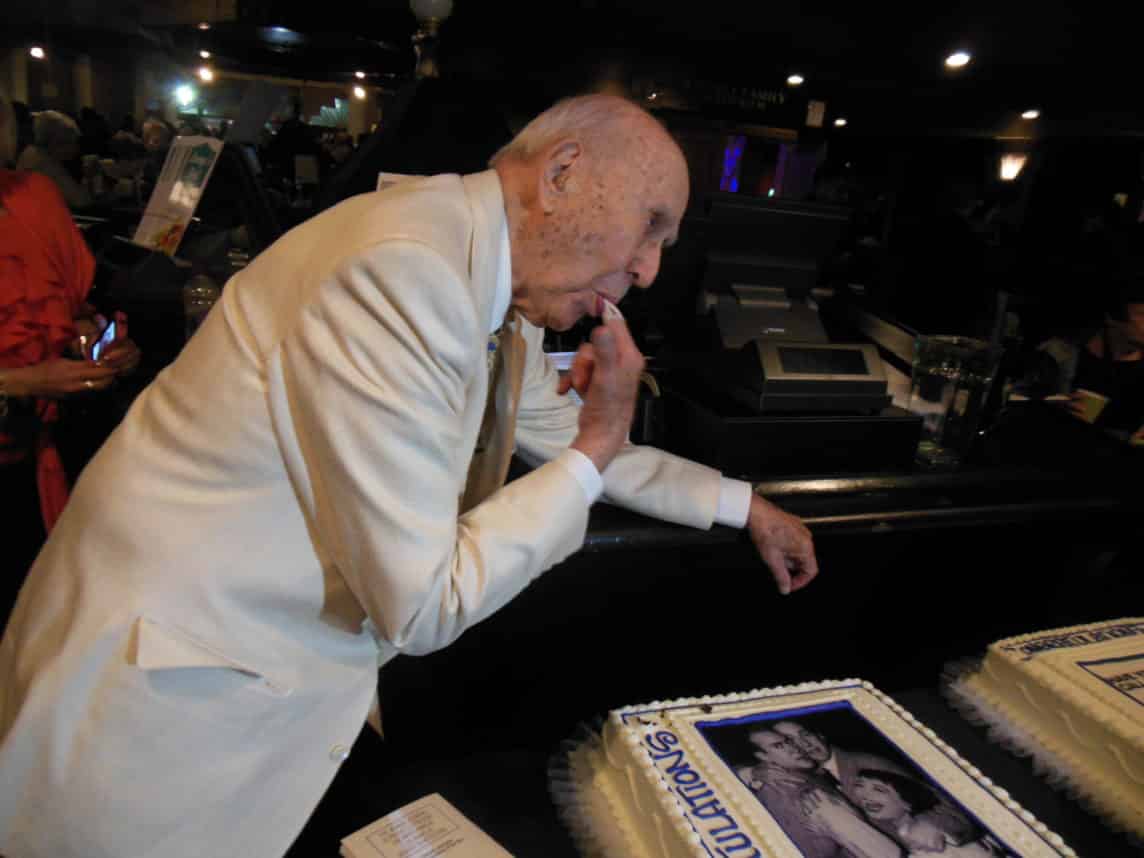
Carl Reiner enjoying the 2014 LAJFF opening night gala’s cake just for him. Photo courtesy of the Los Angeles Jewish Film Festival

Reiner reflected on his favorite roles in a 2003 interview with the Journal noting, “‘The Russians Are Coming, The Russians Are Coming’ is a favorite. “The Dick van Dyke Show, of course. I didn’t appear but once in a while because I couldn’t take time off writing,” he said. “But it was great fun, and of course any time I worked with Mel was great.” The two remained dear friends, most recently appearing together in an episode of Jerry Seinfeld’s “Comedians in Cars Getting Coffee.”

As a director, Reiner is known for the hit comedies “Oh God” with George Burns, “The Jerk” with Steve Martin, and “All of Me,” with Martin and Lily Tomlin. He continued to act, playing Saul Bloom in “Ocean’s Eleven” and its two sequels, and in recent years lent his voice to animated movies, most recently in “Toy Story 4” in 2019.

Reiner authored several memoirs and novels, beginning in 1958 with “Enter Laughing,” which was based on his own experiences. A film version followed five years later, marking his directorial debut. His other books include “Continue Laughing,” “My Anecdotal Life,” and “I Remember Me.”

“I’m so glad that I learned how to write late in life. I enjoy that more than anything. It lets people know who you are and what you’re about,” he said. “You don’t need any help besides your own brain and personal computer.”

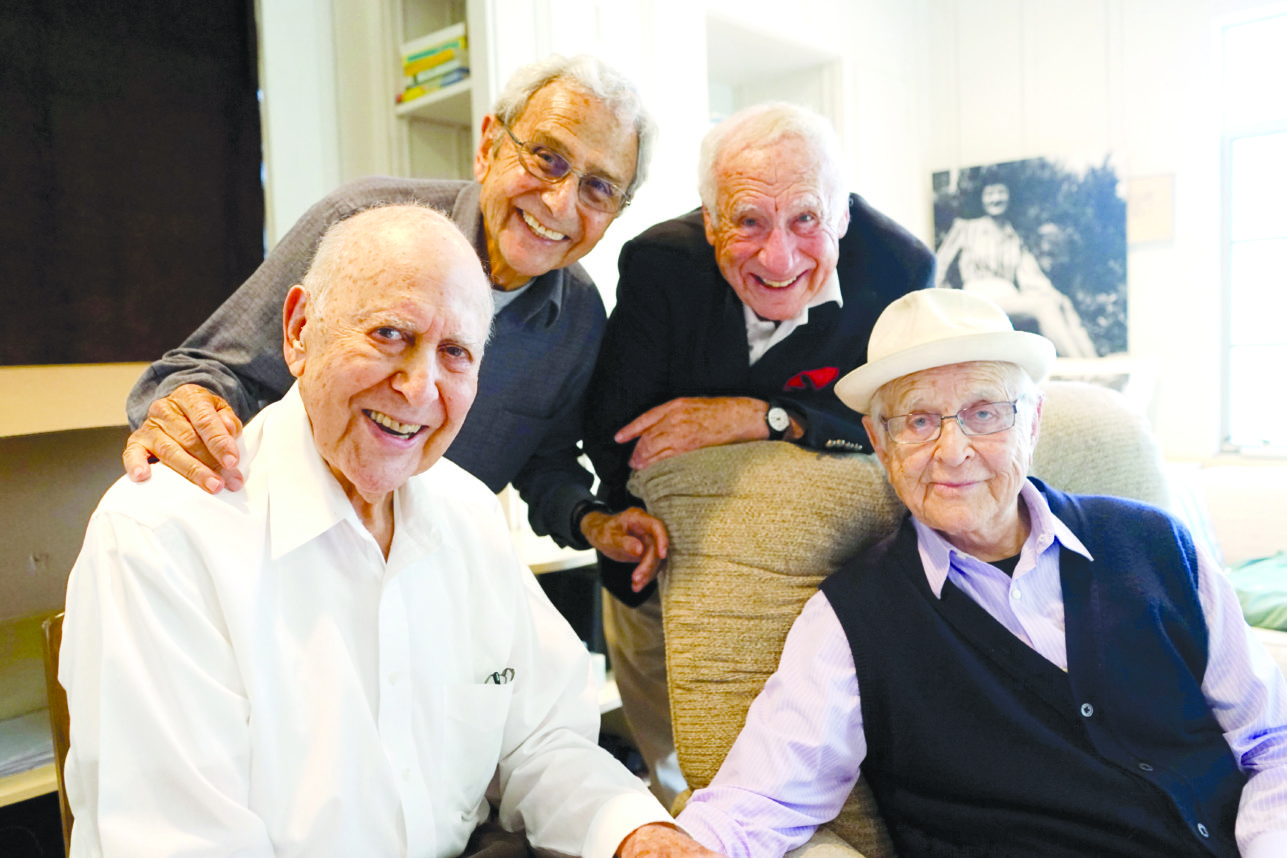
From left, Carl Reiner, George Shapiro, Mel Brooks and Norman Lear in “If You’re Not in the Obit, Eat Breakfast.” Photo courtesy of LAJFF.

In 2014, Reiner was honored with a lifetime achievement award at the 9th annual Los Angeles Jewish Film Festival, where he participated in a discussion for the documentary “If You’re Not in the Obit, Eat Breakfast,” in which he appeared. In it, he offered his advice for a long life. “The key to longevity,” he said, “is to interact with other people.”

Although he was not an observant Jew, Reiner strongly identified with his heritage. “Traditionally, we were very Jewish,” he told the Journal. “My mother lit candles on Friday but I don’t ever remember her saying any prayers. My father believed in God but he didn’t go any place to pray. But we lived in a very religious community. All my friends were very Orthodox, and I went to shul with them. They always wanted to know where my father was and I had to lie about it.” 

At 13, he had what he called “a bootleg bar mitzvah,” getting lessons from a rabbi for six months. “I learned the letters but I couldn’t really read,” he said.  “On a Thursday morning before Mincha, I was bar mitzvah-ed in front of 10 old Jews.” 

His nine decades of illustrious credits notwithstanding, Reiner was proudest of his family, the three children he had with his late wife, Estelle. “They’re really great human beings,” he said, praising writer-director-actor-activist Rob Reiner and his siblings, Lucas and Annie. 

In 2018, Rob told the Journal that his father was his greatest inspiration. “Yes, there is the pressure of having to live up to certain things,” he acknowledged. “But I admired him tremendously and looked up to him. I wanted to be like him.” 

On June 30, Rob posted on Twitter, “Last night my dad passed away. As I write this my heart is hurting. He was my guiding light.”

When he was asked to share a bit of wisdom that comes with a life lived long and well in 2003, Carl Reiner referenced the passage of time: “When you’re young you think you’re absolutely invulnerable, and now you realize how important time is and the many things you have to do that you will never get to do before you leave,” he said. “There are always things left undone.”

Jewish Comedy Icon Carl Reiner Dies at 98 Read More »

Palestinian Authority Says It Is Ready to Restart Peace Negotiations With Israel

JERUSALEM (JTA) — With the date set by Israeli Prime Minister Benjamin Netanyahu to begin annexing West Bank territory days away, the Palestinians appear ready to restart peace negotiations with Israel.

A four-page letter from the Palestinian Authority sent to the so-called Quartet – the diplomatic grouping of the United States, the United Nations, the European Union and Russia — said it was “ready to resume direct bilateral negotiations where they stopped,” according to AFP. The French news agency reported that it saw the text on Monday but not when it had been sent.

The letter said the counterproposal would be withdrawn if Israel went ahead with annexation “of any part of the Palestinian territory,” according to the report.

“We are ready to have our state with a limited number of weapons and a powerful police force to uphold law and order,” the letter said.

The government coalition agreement between Netanyahu and Defense Minister Benny Gantz allows annexation to begin taking place on July 1.

The Palestinians have rejected the Trump peace plan unveiled earlier this year allowing Israel to annex up to 30% of the West Bank and providing for a Palestinian state on the remaining 70%. The plan calls for direct negotiations between Israel and the Palestinians. No talks have been held since 2014.

The P.A. said it would accept an international force to monitor compliance with a peace treaty. It also proposed “minor border changes that will have been mutually agreed, based on the borders of June 4, 1967.”

P.A. Prime Minister Mohammed Shtayyeh said on June 9 that the P.A. had submitted a proposal to the Quartet.

Shtayyeh said at the time that the proposal calls for a “sovereign Palestinian state, independent and demilitarized” with “minor modifications of borders where necessary.” He declined to provide further details.

Palestinian Authority Says It Is Ready to Restart Peace Negotiations With Israel Read More »

Does Anyone Still Love America?

So many people are so angry about so many things in America it’s easy to overlook what we love about this country in the first place.

I get all the anger. It’s human. It’s a visceral reaction to injustice.

What I don’t get is the hate.

It seems as if the anger against injustice has morphed into a hatred of America itself. Simply put, a lot of people right now just don’t like this country.

Instead of “let’s make things better,” it’s more like “let’s tear things down.” Instead of “let’s create,” it’s more like “let’s destroy.” Revolutions rarely worry about the day after.

In this overheated climate, love of country is the last thing on one’s mind. Ask yourself: When is the last time someone told you something beautiful they love about America?

That’s right. You can’t remember. Neither can I. 

We’ve become so paranoid about looking politically correct and seeing only America the Bad, we no longer care to see America the Good. 

Saying anything decent about your country may even get you in trouble. Our newspaper of record, The New York Times, now publishes all the indictments against America that are fit to print. Slowly, inexorably, even our founders are being dismantled. Virtually every opinion piece on the subject goes in one predictable direction: America is a country born and raised and bathing in sin. 

This is not just an intellectual failure; it’s also a tactical one. Lost in the whirlwind of indictments are the values and ideals that have made this country the most sought-after destination for refugees the world over, and are the proven building blocks for any progress.

We have no leaders today to remind us of these cherished values and ideals. We used to have them even in our darkest times, as in the social upheavals of the 1960s.

If you think 2020 is bad, you should have seen 1968. 

That year, in the wake of assassinations, police brutality, insidious racism and the horror of the Vietnam War, The Los Angeles Times editorialized: “We are a sick society that has fallen far short of what we claim to be,” adding that a “kind of mental and moral decay is eating out the vitals of this country.” 

And yet, from that darkness came some of our most inspirational leaders, from John F. Kennedy to Rabbi Abraham Joshua Heschel to Martin Luther King Jr., all of whose words still resonate.

They resonate because they were fearless. Kennedy told us, “Ask what you can do for your country.” Heschel told us, “The rejection of reason is cowardice and betrays a lack of faith.” King told us, “Hate cannot drive out hate; only love can do that.”

When few others did, these leaders showed their faith in America’s ability to perfect itself.

Who are the fearless leaders today promoting that same faith and optimism? Who is telling us not what we want to hear but what we need to hear? Certainly not our politicians or our corporate and civic leaders or the mainstream media.

Who are the fearless leaders today promoting that same faith and optimism? Who is telling us not what we want to hear but what we need to hear?

Instead of leading and inspiring the masses, our nervous leaders are replicating their anger. They can’t afford to say anything that deviates from the accepted narrative, so they’re happy to play it safe and be foot soldiers against big, bad America.

Expressing love of country is now a courageous act. It makes me wonder: How will the America-bashing narrative play out when we celebrate Independence Day on July Fourth?  How many Americans will prefer to express national shame rather than national pride?

In President George Washington’s famous letter to the Hebrew Congregation in Newport, R.I., in 1790, he spoke of a new nation that “gives to bigotry no sanction, to persecution no assistance,” requiring only “that they who live under its protection should demean themselves as good citizens, in giving it on all occasions their effectual support.”

How would we define a “good citizen” today?

It’s an irrelevant question. We are at war with one another. “Good citizen” means anyone who can help your side win. There is no common hope, no common destiny, no common language. And there’s certainly no common love.

I love America not because it’s perfect, but because it’s constantly trying to improve. It is a messy and halting work in progress. It offers the freedom and liberty to fight for justice. It offers hope. 

I love America not because it’s perfect, but because it’s constantly trying to improve. It is a messy and halting work in progress. It offers the freedom and liberty to fight for justice. It offers hope.

It’s almost quaint to hark back to these words from President Barack Obama: “Instead of giving in to cynicism and division, let’s move forward with the confidence and optimism and unity that define us as a people.”

As naïve as those sentiments may appear, they are precisely what is needed at the moment. America is overdosing on guilt, which is demoralizing us and paralyzing progress. To move our nation forward, we need to reclaim some of our innocence.

Happy July Fourth.

Does Anyone Still Love America? Read More »

Once a Baker and Local Business Owner, Now the COVID-19 Police

It’s been a fair amount of time since I posted last. Even in this time of altered routines I’ve started to fall back into my old habit of just being busy.  This statement is contradictory, but I will say that while hasn’t gotten any less hard it is become a little bit easier. What I mean by that is it’s still more work than it once was; but, like most things we adjust to the new amount of effort required.

I want to spend a moment talking about dining-in. For a couple of weeks now – maybe it’s less, time has lost most meaning – Los Angeles has permitted people to eat in restaurants and not just do take-out and delivery. I have, up to now, been reluctant to reintroduce dine-in. The first reason is that we just started to really get into the rhythm of take-out/delivery only. We’ve made adjustments to the physical store and to our work routine and another series of changes will be a step back. The second reason is that the list of rules and regulations involved  in adding dine-in are extensive. Ultimately, for a small space like mine, I would gain only a few seats. And the simple business math is that I wouldn’t really gain enough additional revenue to justify the effort and the expense. The third and probably most compelling reason is that I’m not sure that the public is entirely ready. There are undoubtedly many people who want to eat out and we’ve started to get more and more phone calls asking about dine-in. But at the same time, we still have lots of people come in who are incredibly uncertain. I see a spectrum of people from those who think masks and all the restrictions are silly to those who would probably be more comfortable if everything, including themselves, was laminated!  We still have lots of people checking out everyone else’s behavior and of course, everyone is an expert. People are more and more comfortable sharing their expertise when it differs from someone else’s. 

What that boils down to is that we have – without volunteering for it – been deputized into being the COVID-19 police. When someone walks in without a mask, we have to tell them to put on a mask. When someone isn’t keeping their distance, we have to ask them to step back. And I can only imagine what will happen if we have someone sitting too close to someone else. I don’t really want to be the policeman. It’s hard enough being the salesman. 

All that said I’m considering opening a couple of tables outside just to give the option for people who do want to sit down. As I’ve mentioned before, I am fortunate that my success is not contingent on people sitting down to eat their bagel or muffin. 

In the good news department – we did a great promotion with Camp Ramah in California.  Recognizing how many kids and families are missing camp this summer, we offered a morsel of comfort in the form of their famous Shabbat morning chocolate muffins.  With a portion of sales going back to camp as a donation, we sold and shipped nearly 2000 muffins! It was a tremendous success and a real pleasure to work with such a vibrant community.

So now it’s summer. Schools are out. Summer camps are not really happening, though some day camps are. What would normally be the start of the tourist season is now just the start of summer 2020. I ‘m curious to see how the next few months feels different from the spring. People are clearly antsy to get out.  You can see it in the streets with the increased traffic. All of the activity seems to contradict the reports of more and more cases.  And once again we’re all experts as we parse the data of infections versus hospitalizations versus deaths. Spend five minutes behind a counter and you will quickly learn that everyone has an opinion. I’m so glad that my opinion is the right one ☺. 

Once a Baker and Local Business Owner, Now the COVID-19 Police Read More »

‘White Pride’ Flyers Found in East Bay City

Two flyers were found in Martinez, Calif., a city east of San Francisco, on June 28 containing the “white pride” white supremacist slogan.

According to Patch.com, the flyers targeted the Black Lives Matter movement as a “terrorist organization” that’s “aiming to kill white people and police officers in the name of justice of police officers killing n—– thugs in the line of duty.”

“Who will stand up for white people?” the flyer adds. “Through unification we will all be protected.”

At the bottom of the flyer are the words “white pride world wide,” which, according to the Anti-Defamation League (ADL), is part of the logo for the white supremacist website Stormfront.

Jewish groups condemned the flyers.

“The flier is an example of white supremacist propaganda filled with hate, vile racist slurs and vulgar threats of violence against our community and values,” Anti-Defamation League Central Pacific Regional Director Seth Brysk said in a statement. “Black lives matter. Menacing messages from extremists demonstrate another reason why it is an important affirmation.”

American Jewish Committee San Francisco Bay Area Associate Director Eran Hazary similarly said in a statement, “Martinez, like hundreds of cities across our country, has hosted peaceful rallies where people of all races and religions have stood together united for racial justice and equality. Juxtapose that movement to this flyer. Authored by an individual who proselytizes divisiveness, hate, and violence. This is becoming an all too often occurrence. Hate crimes and hate speech are reaching unprecedented levels in our lifetimes. We need stronger legislation such as the NO HATE Act to monitor, combat, and overcome this rising hate.”

Police are investigating the matter as a hate crime.

‘White Pride’ Flyers Found in East Bay City Read More »