fbpx

May 31, 2020

Longtime Head of Yeshiva University Dies at 92

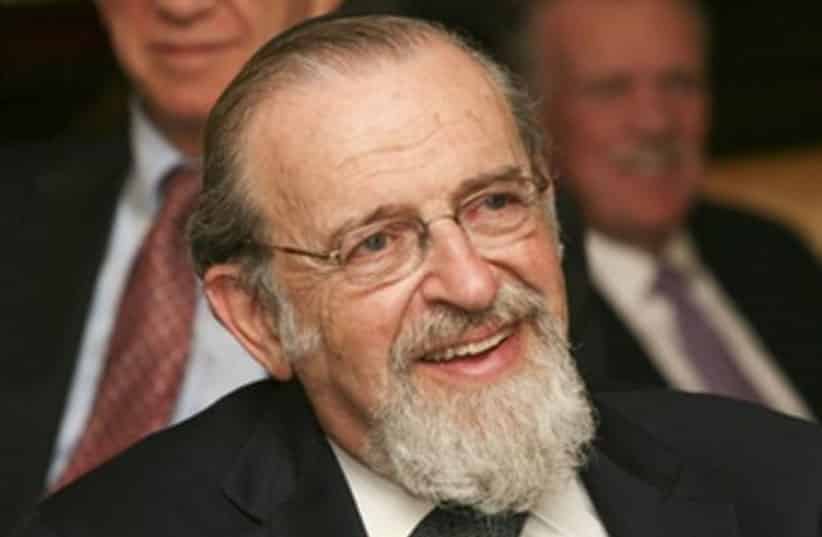
Norman Lamm, the prolific author and Modern Orthodox rabbi who headed Yeshiva University for nearly three decades, died Sunday. He was 92.

As president and chancellor of Y.U., Lamm helped rescue the institution from the financial brink in the late 1970s and rebuild it in the decades that followed into the flagship institution of Modern Orthodoxy. As a pulpit rabbi at Manhattan’s Jewish Center, in his writings on philosophy and Jewish law and as leader of Y.U.’s rabbinical school, Lamm also helped articulate an unabashed ideological basis for a movement that has often struggled to define itself.

“He was both an architect of and a spokesman for Modern Orthodoxy, and using his position at Y.U. as a perch he helped buttress that ideology in a substantial way,” said Rabbi J.J. Schachter, a professor of Jewish history and Jewish thought at Y.U. “He was uncomfortable with the word ‘modern,’ so he invented the word ‘centrist’ to describe his brand of Orthodoxy – between the extremes of totally favoring contemporary culture on the one hand and totally rejecting contemporary culture on the other.”

His wife, Mindella, died April 16 of COVID-19 at 88.

Lamm had a commanding wit and a poet’s ear for the spoken word. His sermons were widely admired, and he was as quick with a pun as he was with a religious homily.

In addition to being steeped in Jewish law and literature, Lamm was well-versed in history, philosophy and science. He earned his undergraduate degree from Yeshiva College in chemistry — he was the valedictorian of the Class of ’49 — and did some graduate work in chemistry at the Polytechnic Institute of Brooklyn. He also worked on a munitions research project during Israel’s 1948 War of Independence under the direction of Ernst Bergmann, who later became head of the Israel Atomic Energy Commission.

Ultimately Lamm was destined for a different kind of scholarship. One of his points of pride was that he was the only student to obtain both rabbinic ordination (1951) and a doctorate in Jewish philosophy (1966) under the tutelage of Rabbi Joseph B. Soloveitchik, the 20th-century luminary of Modern Orthodoxy, according to Lamm’s son-in-law, Rabbi Mark Dratch.

“The greatest asset of his leadership was leadership through ideas — through speaking and through writing. He wasn’t afraid to take a stand,” said Dratch, the executive vice president of the nation’s largest centrist association of Orthodox rabbis, the Rabbinical Council of America.

Lamm’s messages weren’t just particularistic – about how Orthodox Jews should relate to God or each other – but also outward-facing. He talked about how Jews should relate to the world, whether a famine in Bangladesh or moral codes governing other societies.

One of four children, Lamm was born in 1927 in Williamsburg, Brooklyn. His father, Samuel, had an odd assortment of jobs, including umbrella salesman and kosher inspector for New York state. His mother, the former Pearl Baumol, hailed from an illustrious rabbinic family.

Lamm’s maternal grandfather, Yehoshua Baumol, was the scion of a long line of rabbis in Poland and was himself ordained at the age of 13. It was Baumol who encouraged his precocious grandson to leave Mesivta Torah Vodaath, the Brooklyn institution he attended for elementary and high school, and go to Yeshiva College in Manhattan, where Soloveitchik would become his mentor.

Lamm’s first pulpit job was in Springfield, Massachusetts, at a time when when Orthodoxy was struggling for adherents. Even Lamm’s own synagogue had congregants who would work on the Sabbath after going to services.

While in Springfield, Lamm founded an Orthodox scholarly journal, Tradition, that dealt with contemporary matters of Jewish law and reflected his position between the Orthodox and secular worlds. Tradition mourned his passing on the RCA Facebook page as “a man of wisdom, scholarship, and leadership.”

It was also in Springfield that Lamm honed his talents as a master orator, following in the tradition of Rabbi Joseph Lookstein of Manhattan’s Kehilath Jeshurun, where Lamm had been an assistant rabbi.

By the time Lamm landed a rabbinic position at The Jewish Center, a high-profile Orthodox synagogue on the Upper West Side, his sermonizing had begun earning him wide acclaim.

“If Rabbi Lookstein was the master teacher, then Rabbi Lamm was the master student; he set the standard for his generation of Orthodox preachers,” Touro College history professor Zev Eleff wrote in a 2013 essay in Jewish Action magazine.

Lamm’s messages weren’t just particularistic – about how Orthodox Jews should relate to God or each other – but also outward-facing. He talked about how Jews should relate to the world, whether a famine in Bangladesh or moral codes governing other societies.

“The purpose of Torah is neither some kind of arbitrary spiritual exercise, nor the beating of man into submission in order to aggrandize the divine ego. Rather, Torah is the divine instrument for man’s spiritual welfare and fulfillment,” Lamm said in a 1971 sermon. “The Torah is God’s formula for man’s moral development. The prescriptions may be difficult, they may entail discipline and renunciation, but the purpose of Torah and commandments is the good of mankind.”

A history of The Jewish Center credits Lamm with showing that “traditional Judaism had something relevant, thoughtful and inspiring to say about the issues of the day.”

In 1959, Lamm became the senior rabbi at The Jewish Center and a professor in Jewish philosophy at Yeshiva University, where he helped make the case for Modern Orthodoxy at a time when it wasn’t at all clear that the embrace of both Orthodox observance and the modern world was possible. Lamm was the rare Orthodox rabbi who was well-versed in both secular and Jewish scholarship — and inordinately articulate when it came to both.

“He was a real model of a sophisticated Orthodoxy at a time when Orthodoxy was sorely lacking sophistication,” Schachter said. “He set the bar for what an elegant sermon should be. He was a master darshan [preacher], and of course he carried that over as president of Y.U. in all the speeches he gave.”

Lamm became Y.U.’s third president – and its first American-born one — in 1976, succeeding Samuel Belkin, who had led the institution for 33 years. At the time, Yeshiva was teetering financially, and Lamm proved adept at appealing to donors and bolstering the school’s academics. Y.U. gradually rose to become a top 100 school in university rankings.

Lamm wrote 10 books and edited or co-edited more than 20 volumes. His 1999 book “The Religious Thought of Hasidism” won the National Jewish Book Award in Jewish Thought. Lamm also launched the Torah U-Madda Journal.

Beyond his well-known public positions, family members said Lamm often played a key role in Jewish communal affairs behind the scenes. When ArtScroll publisher Mesorah Publications was going through a financial rough patch, Lamm helped introduce the publisher to philanthropist Jerome Schottenstein, who ended up bankrolling ArtScroll’s years-long work translating the Talmud into English.

After Lamm stepped down from Yeshiva’s presidency in 2003, he proved irreplaceable. Y.U. had always been led by someone who held both the post of university president and head of its rabbinical program – an arrangement that embodied the university’s dual mission of Torah U’madda, or Torah and secular learning. But the university could not find such a candidate to succeed Lamm.

In the end, the presidency went to Richard Joel, formerly Hillel’s international director and the first non-rabbi to occupy Y.U.’s top job, while Lamm stayed on as head of the rabbinical school, known by its acronym RIETS. Lamm remained head of RIETS and Y.U. chancellor for another decade.

When he finally announced his retirement in 2013, at age 85, Lamm surprised many by penning a resignation letter that included an apology for mishandling allegations of sexual abuse against faculty members at Y.U.’s affiliated high school for boys in the 1970s and ’80s.

Lamm said he was aware of concerns about two staffers, one an administrator who allegedly groped students and rubbed himself against them during wrestling bouts, and the other a teacher who allegedly sexually abused and sodomized students. But Lamm handled them the way many such incidents were treated at the time: quietly and internally.

“At the time that inappropriate actions by individuals at Yeshiva were brought to my attention, I acted in a way that I thought was correct, but which now seems ill conceived. I understand better today than I did then that sometimes, when you think you are doing good, your actions do not measure up,” Lamm wrote in his letter. “True character requires of me the courage to admit that, despite my best intentions then, I now recognize that I was wrong.”

At the time, a $680 million lawsuit against Y.U. by 34 former students of the boys high school was in the works. The lawsuit was dismissed ultimately due to the expiration of the statute of limitations.

Dratch said his father-in-law was plagued by guilt over his role in failing to halt the abuse.

“That people suffered was tremendously bothersome to him, and he regretted that,” Dratch said.

In his later years, Lamm faded from public life as he suffered from an illness that affected memory, a family member said.

Lamm was hardly the only famous member of his family. His brother Rabbi Maurice Lamm, who died in June 2016, was the author of the how-to shiva book “The Jewish Way in Death and Mourning,” among other works. His sister’s son, Shalom Auslander, wrote a popular 2007 memoir, “Foreskin’s Lament,” about rejecting Orthodoxy (and his father’s abuses), and also wrote and created Showtime’s “Happyish.”

Lamm is survived by two sons, Shalom, a real estate developer involved in a controversial Hasidic development in the upstate New York village of Bloomingburg, and Joshua Lamm, a psychiatrist; and a daughter, Chaye Warburg, an occupational therapist in Teaneck, New Jersey. His daughter Sara Lamm Dratch died in 2013.

Lamm also is survived by 17 grandchildren and numerous great-grandchildren.

Longtime Head of Yeshiva University Dies at 92 Read More »

A Lifeline in the Waves

Is there no maximum allowable level of tsuris (troubles)?

Last week, my daughter wore the dress we bought for her bat mitzvah party to my cousin Stanley’s Zoom funeral instead. (Stanley died from Covid-19 after seven weeks on a ventilator; my daughter’s party was previously canceled due to the coronavirus.) Then, on Saturday night, that same daughter, who is already terrified out of her mind of more family-members getting the disease, saw the video of the police officer’s knee on George Floyd’s neck and her beloved Hello Kitty store looted. She heard the police sirens. The destruction was a few miles from our house, three blocks from where her grandparents live, on the block where her friend lives.

“Why Mommy,” she asked, “did the police officer stand on the man’s neck until he died?” “Why Mommy, are people burning down the stores?”

I have questions too. As parents, we want to help our children feel safe, secure and confident. How is that even possible in a world like this?

At the beach, strong waves crash near the shore.  But if you swim out past them, calmer waters await. These past few months, I’ve felt that if I work hard enough at my job, try hard enough to help and comfort my children, then somehow I can get to more tranquil waters. But the waves keep crashing, harder and harder, and try as I may, I can’t get to the other side.  The current carries me away, and I feel like I’m drowning. Don’t we all?

This week’s Torah portion is called Naso because it starts with the words  Naso et Rosh — lift up the heads of the people of Israel. The phrase refers to the census. The portion begins with this uplifting start, but then in the next sentence, we learn that not everyone is counted. Since the census is for military purposes, only males between the ages of 30 and 50 are counted.

Lift up Your Head. I’ve been doing everything I can think of to hold my head high – to keep my hopes up through the last 12 weeks of the pandemic. But how? How can anyone keep their spirits up in a place where some lives seem to count more than others? Where some have so little and some have so much? Where some lives are lost much more easily than others?

Indeed, we must confess the pre-existing conditions THAT have plagued humanity for centuries and threaten our democracy today – racism, sexism, classism, homophobia, xenophobia, transphobia, and ableism.

The next lines of the Torah portion tell us the answer: We must remove from the camp anyone with a malady, and each person much confess the wrongs they have done and make amends.

What should we now confess?

In the Atlantic, George Parker wrote: “When the virus came here, it found a country with serious underlying conditions, and it exploited them ruthlessly. Chronic ills – a corrupt political class, a sclerotic bureaucracy, a heartless economy, a divided and distracted public – had gone untreated for years. We had learned to live, uncomfortably, with the symptoms. It took the scale and intimacy of a pandemic to expose their severity—to shock Americans with the recognition that we are in the high-risk category.”

Indeed, we must confess the pre-existing conditions that have plagued humanity for centuries and threaten our democracy today: racism, sexism, classism, homophobia, xenophobia, transphobia, and ableism. These ills all boil down to thinking some lives matter more than others. We must rid our world of these toxins to prevail against the coronavirus and whatever other threats come our way.

The Book of Psalms, teaches, “If Your Torah had not been my delight, I would have drowned in my sorrows.” We are all now at risk of drowning in tsuris.

But we have one rope to hold onto. The lifeline is Genesis 1:27, the idea that “each person is created in the image of God.” If everyone in this world could hold in their hearts that each person’s life counts: That shop owners, honorable police officers, black men walking down the street are all created in the image of God, and act accordingly, then we can stay afloat.

On Sunday morning, my daughter learned that her synagogue community, Temple Beth Am, gathered (with social distancing and masks) to clean up looted stores near her grandparents’ home. Maybe, just maybe, there’s still some hope yet.

Rabbi Ilana B. Grinblat is the vice president of community engagement for the Board of Rabbis.

A Lifeline in the Waves Read More »

LA City Councilmember Condemns Targeting of Jewish Institutions During Protests

Following the May 30 riots in the Fairfax District , Fifth District Los Angeles City Councilmember Paul Koretz publicly condemned the targeting of Jewish institutions.

“The attack on our community last night was vicious and criminal. Fairfax is the center of the oldest Jewish community in Los Angeles,” Koretz said in a statement. “As we watched the fires and looting, what didn’t get covered were the anti-Semitic hate crimes and incidents.”

Congregation Beth El was vandalized with graffiti stating “free Palestine” and “f— Israel.” The Baba Sale Congregation, in the same area, was spray painted during the protests.

Local Jewish businesses were also looted. Syd’s Pharmacy, which is Jewish-owned and had a sign advertising “Kosher Vitamins” in its front window, was robbed. The vandals broke the windows, knocked down the pharmacy shelves and stole drugs, including painkillers.

Across the street, the kosher Mensch Bakery and Kitchen and the Jewish-owned clothing store Go Couture, were also destroyed.

“Under the guise of protest, some advanced their anti-Semitic agenda,” Koretz said. “Synagogues and Jewish institutions were graffitied with anti-Semitic slogans and vandalized.”

He also took issue with how the statue of Raoul Wallenberg, who saved thousands of Jews from the Nazi death camps, was graffitied.

“I condemn these acts, as they are an affront to all people of the Jewish faith,” Koretz said “We must never allow anyone, for any reason, to get away with acts of hate against our community and neighbors.”

LA City Councilmember Condemns Targeting of Jewish Institutions During Protests Read More »

Healing Pain. Demanding Justice. 

George Floyd. Ahmaud Arbuery. Christian Cooper.  The recent victims of the pandemic of racism and bigotry have eclipsed our nation’s attention to the pandemic of flesh and blood. I had hoped and prayed that during this time of physical social distancing, we as a nation would have focused on increased spiritual closeness. Watching the raging headlines and the fiery violence engulfing the streets and social media channels I am left despondent.

Despondent but not without hope.

For there are other names that I can invoke who can heal the pain and chart a path toward justice for all: Martin Luther King Jr. Ellie Wiesel and the Lubavitcher Rebbe.

In 1967, in an essay titled “Where Do We Go from Here: Chaos or Community?” the champion of the civil rights movement proclaimed, “Returning violence for violence multiplies violence, adding deeper darkness to a night already devoid of stars. Darkness cannot drive out darkness; only light can do that. Hate cannot drive out hate; only love can do that.”

In 1986, Holocaust survivor and Nobel Laureate Elie Wiesel declared, “I swore never to be silent whenever and wherever human beings endure suffering and humiliation. We must take sides. Neutrality helps the oppressor, never the victim. Silence encourages the tormentor, never the tormented.”

And in 1991, following the Crown Heights riots, the Lubavitcher Rebbe blessed New York City Mayor David Dinkins and  stated, “We are not two sides; we are one side. We are one people living in one city under one administration and under one God.”

Fighting darkness with light. Championing the voice of the oppressed. Recognizing the unity within our collective community. These are the clarion calls that will vaccinate us against the opportunists who wish to loot our national soul of that simple but sagaciously salient mantra, composed by our Founding Father John Dickinson for the Union in 1768, “United We Stand.”

It is precisely during these times of proliferated political polarization that we must hearken back to the courageous heroes of our past, who stood up against that one weapon that is far more deadly than a nuclear bomb: an ideology of hate.

One of these heroes was my father’s ancestor, who fought at the Battle of Gettysburg to abolish slavery. He made the ultimate sacrifice for he believed that truth, often not so self-evident, that all people are created equal. He fought with a sword and a bayonet. The least I can do is pick up my proverbial pen and continue his legacy. And no, in this case, the pen is not mightier than the sword. For it is only through the heroes of our past, upon whose mighty shoulders we stand, that the evolution of democracy and liberty can continue to march forward.

This is especially true when the ugly face of bigotry can hide in plain sight under the cover of  “It’s just a joke,” “I didn’t mean it like that,” or “But it’s a nice thing to say about you people.” Insidious racism is a poisonous virus which swiftly spreads through the bloodstreams of our societies and institutions, unchecked and devastatingly destructive.

I may not be a statistician but the truth about stereotypes, especially the positive ones, is that they ensure the continued enslavement of a (minority) group by robbing each individual of free choice and shackling them with oversimplified expectations. Seemingly benevolent and innocuous stereotyping can quickly devolve into negative generalizations and then to flat-out racism, prejudice and violent hate.

Isn’t this attention to rhetoric about the “other” the message taught by the great Torah scholar Beruriah to her husband, Rabbi Meir, in Talmud, Tractate Berachot 10A? Or the prohibition against the angels singing for the death of ancient “Nazis” as depicted in Megilla 10b, Sanhedrin 39b, and Berachot 31a? Or the teaching from Rabbi Yehoshua ben Levi, in Pesachim 3a, about the superfluous letters Hashem added in the Torah just to ensure the dignity of mere animals?

The message I see from all these sources, and thousands more weaved through the glorious canopy of Torah tradition, is one salient truth: It is not external labels or oversimplified generalizations that define us. Rather, our value is determined by our intrinsic and internal individuality. In other words, our soul.

My spiritual leader, the Lubavitcher Rebbe, taught me that in the beginning, God created Adam and Eve. His two greatest creations. Two human beings, and only two, so that all future generations would know that no matter what pigment of the rainbow God gifts us with to wear on the outside, our souls (and bodies) all come from the same great grandmother and great grandfather.

The Torah teaches us to “Be holy, for I, the Lord your God, am holy” (Leviticus 19:2). From here, our sages learn that, “Just as God is called gracious, so you be gracious. Just as He is called merciful, so you be merciful. Just as He is called holy, so you be holy.” The famous 14th century Egyptian Torah scholar, Maimonidies, declares that we are bound by Torah law to “imitate God as far as we can” (Maimonides, Mishneh Torah, Hilkhot De’ot 1:6).

My father taught me that God did not create us to be creatures but to be creators ourselves. Creators of peace. Creators of holiness. Creators who can see a jungle, a place of survival of the fittest, and transform that place into a veritable Garden of Eden, with harmony for all.

Martin Luther King Jr. famously said that “A riot is the language of the unheard” and that “our nation’s summers of riots are caused by our nation’s winters of delay” in demanding justice against institutionalized racism. In response to the current pandemic of racism and rioting, his daughter advocated for non-violent protest and quoted Isaiah 1:17, “Learn to do good; seek justice; correct oppression.”

Elie Weisel said, “Human suffering anywhere concerns men and women everywhere.” In an inspiring social media post, his son said that the key to social justice and healing the world is an increased study of the “[Torah] texts that have sustained our culture.” One of those texts is the commandment to “love the stranger” (Deuteronomy 10:19). Many of us are already prepared to love the stranger. But are we “prepared to be the stranger?” When I read this, I heard the ancient words of the 1st century Talmudic sage echo in my heart: “Do not judge your friend, until you have reached their place.” (Pirkei Avot 2:5)

The Lubavitcher Rebbe  told CNN that redemption can come through doing “something additional in the realms of goodness and kindness.” He had no children. So that means it is up to each and every one of us to create a riot of love, a pandemic of goodness and kindness, and a demand for justice, equality and peace for all peoples.

In this way, we can heal the pain, and heal the world.


Rabbi Levi Welton is a chaplain with the United States Air Force and the spiritual leader of Lincoln Park Jewish Center in New York. 

Healing Pain. Demanding Justice.  Read More »

A Prayer for America on May 30, 2020

May Our Tears Remind us of Our Collective Humanity;
May Our Call for Justice be Reflected through Our Actions
May We Pray not only Through our Feet
but Through Our Hearts;
May We See Ourselves Reflected
in the Eyes of The Other;
May We Recognize that
We are All Children Held by a Numinous Presence:
One that is known through cycles –
of death and birth,
destruction and renewal,
transgression and forgiveness –
and May America Rebuild Upon a New Covenant:
One cultivated in the soils of Freedom and Justice
That take root and rise, Blowing in Winds of Love.

George Floyd:
You did not die in vain.
The 100,000:
You are not forgotten.
Our First Responders:
Godspeed.
Our Children:
Forgive us.

With Love, Blessings of Safety, and Prayers for Justice for All,
Rabbi Lori and Open Temple

Rabbi Lori Shapiro is the founder and artistic director of The Open Temple in Venice. 

A Prayer for America on May 30, 2020 Read More »

16-Year-Old Creates ‘Tikkun Olam Means Black Lives Matter’ Line For Charity

Sixteen-year-old Adam Garvey was not able to participate in the demonstrations decrying the death of George Floyd and police brutality. In his hometown of Orangetown, NY, there weren’t any protests he could easily attend.

“If I couldn’t go to a protest in person I wanted a way to help instead of just retweeting and whatnot,” Adam told the Journal in an interview. “I wanted to feel like I was making a tangible effort to help change things.”

So the teenager did what he does best: create art. He released a line of t-shirts, sweatshirts and stickers with the phrase “Tikkun Olam means Black Lives Matter” emblazoned on a Jewish star. All proceeds from the clothing, which is available on TeeSpring, will go to the NAACP Legal Defense Fund, a nonprofit legal organization that fights for racial justice. The fund, according to its website, “defends the gains and protections won over the past 75 years of civil rights struggle.”

Along with raising money for the fund, Adam said he “wanted to show solidarity as a Jewish person. Black and Jewish solidarity is super important and I wanted to spread that.” He believes that “standing up against injustice is a huge part of Jewish values.”

He added that Tikkun Olam also means “being anti-racist and anti-bigotry. Repairing the world or healing the world to me means fighting against broken systems and against systems designed to suppress people based on the color of their skin, or their gender/sexuality, or their religion.”

Some Jewish leaders have been at odds with Black Lives Matter as an organization due to its support of the boycott, divestment and sanction movement (BDS), describing Israel’s actions against the Palestinians as “genocide” and “apartheid” in its political platform.

However, Adam urged Jews to look beyond the rift. “I think that Black Lives Matter needs to go beyond the organization in terms of what it means to individual people,” he said. “Black Lives Matter means just that — that black lives matter. Using the organization’s BDS stance to say one doesn’t like the entire movement is frankly a cop out way to justify one’s silence.”

16-Year-Old Creates ‘Tikkun Olam Means Black Lives Matter’ Line For Charity Read More »

A Psalm for Cities on Fire

A Psalm for our cities on fire
Aflame with the fires of fear
With anger burning ‘bout brazen brutality:
From a kneed neck Floyd’s breath snuffed out over there

A Psalm for our cities on fire
Veering vigorously toward violence and hate
Preventing protests that promote another vision:
Of justice that we all must create

A Psalm for our brothers and sisters
Who fear for their lives, black and brown
When they jog, shop, go to church, or go bird watching
With their hands held up high, or when lying down

A Psalm to remind us ‘bout justice
And the debasement that threatens their lives
Because our silence can no longer silence
The real pain of widowed husbands and wives

So Pray for our cities on fire
And sing out songs of protest ‘gainst hate
But since lives, they are holy and matter
It’s time for action; we’re way past time of debate

Rabbi Paul Kipnes is the spiritual leader of Congregation Or Ami in the Conejo Valley. 

A Psalm for Cities on Fire Read More »

Holocaust Survivors Teach Us ‘There Is No Forgiveness Without Rage’

My neighborhood is burning. Buildings were smoldering as I walked my dog on the morning of May 31. Shattered glass was on the sidewalk, graffiti on the store windows and on the shuls.

George Floyd’s death has awoken our country to a tragic reality: Too many black Americans still live in justified fear of racist violence. It’s a weight that, too often, is carried by too few. The rest of us live most of our lives at a comfortable distance from the injustice we know persists.

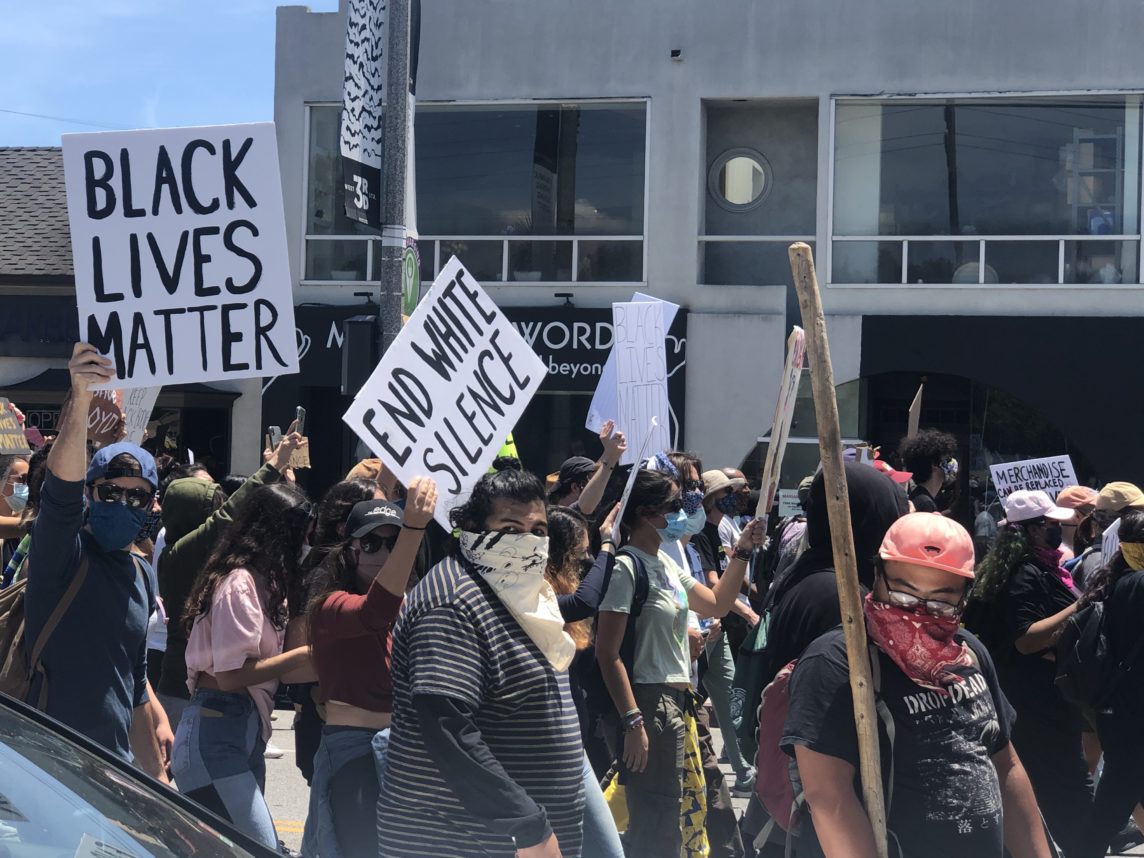
Today, we all feel a searing sense of shared anger. On May 30, tens of thousands gathered in Pan Pacific Park to protest — me included. The spirit of the protest gave me a cautious sense of hope. People of all ages, races and backgrounds stood shoulder-to-shoulder, donning their masks and risking infection to stand up against an even more insidious disease with an even higher body count: racism.

This is a moment to see past differences, to rediscover both our common humanity and our common fight against man’s ever-present inhumanity to man.

There are five people sheltering in my house in the burning Melrose district. A Christian parent, a Jewish parent, two Asian American kids and a house guest of  African descent. We will not allow others’ narrow-minded views to divide us. This is a moment for solidarity between communities.

Too many black Americans still live in justified fear of racist violence.

Solidarity is not easy. It cannot be boiled down to a neat equation of historical suffering. When you deal every day with Holocaust survivors, as I do, you know that each group’s suffering is incomparable and unique. The racial violence in Minnesota surrounding the death of George Floyd taps into four centuries of pain that is uniquely felt within the black community.

And yet it’s a pain that many of the Holocaust survivors I am proud to consider friends can understand viscerally. People like Edith Eva Eger, who 75 years ago survived Gunskirchen concentration camp. Eger knows what it means to have to explain to young people that the world is more dangerous than we wish it was; the shadow of injustice longer than we might realize; and the specter of cruelty closer at hand than we might wish to acknowledge.

“Forgiveness cannot be realized without justice,” Eger told me as the protests grew, “It’s OK to be angry … there is no forgiveness without rage.”

Protestors marching in Los Angeles following the death of George Floyd. Photo courtesy of Rachel McKay Steele.

She knows that generations of American Jews have their own need to reckon with persistent hate. Anti-Semitic killers who have attacked Jewish communities from Pittsburgh to Poway instilled in us the recognition: That could have been me. That could have been my father, my sibling, my partner, my friend, my community.

How many African American men and women must be thinking the same thing right now? How painful it must be for black communities to process not only the pain of George Floyd’s death, but to know that so many other victims came before George Floyd and too many will come after? How doubly crushing it must be to feel this pain in the wake of a pandemic that claimed such a disproportionate number of black lives.

One thing that Holocaust survivors often tell me is that loss can bring clarity about what really matters. My realization is that what matters today is being an ally and showing up for other communities as you would wish them to show up for you. Turning that common feeling into mutual support is painstaking, important work that must be sustained and cannot come and go with each crisis.

As Edith Eger reminded me during the increasing violence, “Love is not what you feel, it is what you do.”


Stephen D. Smith is Finci-Viterbi executive director of the USC Shoah Foundation. 

Holocaust Survivors Teach Us ‘There Is No Forgiveness Without Rage’ Read More »

Can We Keep the Focus on George Floyd’s Killer?

The death of George Floyd at the hands of Minneapolis cop Derek Chauvin, who dug his knee into Floyd’s neck, feels all too familiar. Like Eric Garner in New York, Floyd cried out, “I can’t breathe.” As with Michael Brown’s death in Ferguson, riots ensued. Floyd’s death also occurred not far from where an unarmed Philando Castille was killed by police in 2016.

In other words, we’ve seen this movie before.

Well, yes and no.

This latest episode of a heartless cop crushing his knee into a poor man’s neck, while his fellow cops just stood by, seemed to reach another level. The revulsion was instant and widespread, with condemnations from police chiefs across the country. No one was cautioning that we should “get all the facts” before “rushing to judgement.”

The cruel face of an abusive cop oblivious to the cries of a dying man was all we needed to see, and it sent everyone into a tizzy.

It also felt like a tipping point, a final straw that turned frustration and anger into rage and fury. In the midst of the pandemic crisis, when so many have lost their lives and livelihoods, Floyd’s death was the match that lit a national tinderbox.

Equally outrageous was the failure to immediately arrest Chauvin. The killing occurred on a Monday; authorities didn’t arrest him until Friday, well after the riots had started. As legal expert and former prosecutor Andrew McCarthy wrote in National Review Online, “The claim that the prosecutor had to wait to authorize an arrest until the investigators nailed down all the evidence is nonsense.”

He added: “This was not a fleeting incident, or a situation in which Floyd was resisting — he was pleading for his life… Obviously, it was a crime. When a violent crime has clearly happened, the person who committed it should be placed under arrest, immediately.”

It’s quite possible that an immediate arrest of Chauvin and his three accomplices might have prevented or at least mitigated the rioting. In any case, the failure of law enforcement to move swiftly and forcefully was unforgivable.

What especially pains me is that the rioting has taken over the story. Floyd’s murderer doesn’t deserve that we change the subject. His crime ought to remain the story. But that’s not how the media works. When the media sees burning police cars, the looting of small businesses or an attack on CNN offices, you can be sure they’ll be all over it.

Instead of talking about police violence, we’re talking more about protestor violence. That’s not justice. The rage among protestors is justified, but the rioting doesn’t advance their cause.

Even if it’s only a criminal minority that is exploiting the chaos, for the media, the optics of riots are like red meat to a lion. That is where we are now: “Violent Protests Break Out Across Nation” has become the major headline.

It goes without saying that there’s no excuse for violence, looting and destruction of property, just as there’s no excuse for an overly aggressive police response to the demonstrations. But the deeper tragedy, as I see it, is that the rioting is undermining and overtaking a worthy cause.

Instead of talking about police violence, we’re talking more about protestor violence that makes for dramatic media images. That’s not justice.

During a press conference on Saturday, Los Angeles Mayor Eric Garcetti urged people who would resort to violence, “Do not do a disservice to the memory of George [Floyd.] … Do not make a disservice to the folks who have died at the hands of the brutality that we all stand against.”

These are easy comments to make for those who are not victims of racism and violence, but the mayor has a point. The rage among protestors is justified, but the rioting doesn’t advance their cause.

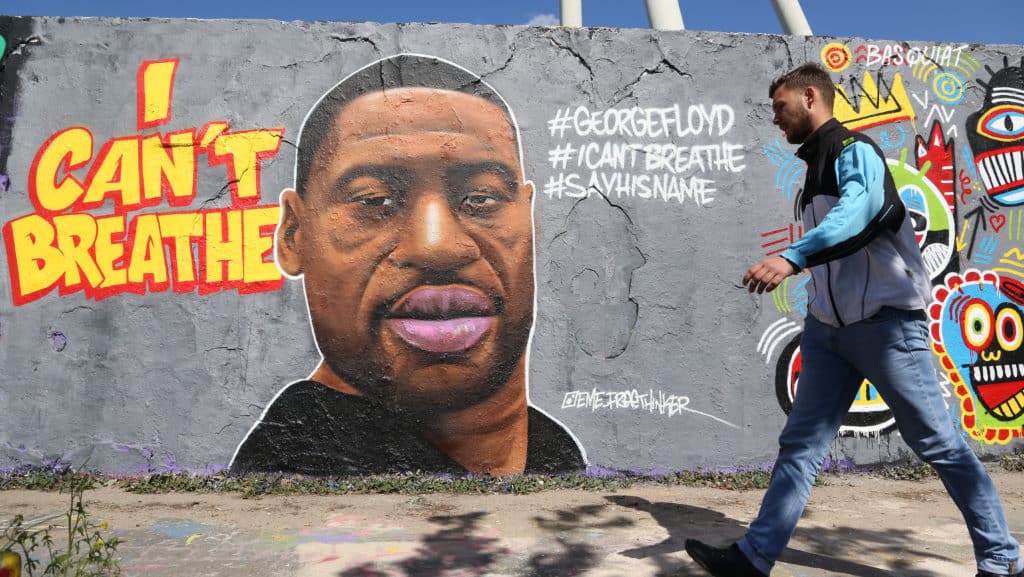
Instead of the Summer of Riots, this should be the summer of “I Can’t Breathe.”

If I had a magic wand, I would organize Million People Marches with protestors across the nation wearing masks that say, “I can’t breathe.” In fact, everyone who wears a mask during these pandemic times should write “I can’t breathe” on them.

An “I can’t breathe” solidarity movement that would rally the nation would keep the focus on the original crime and the original issue. Looking beyond the present riots, it’s not too late to plan national marches for July Fourth— our national holiday of freedom.

George Floyd and other victims of racism and police violence deserve nothing less.

Can We Keep the Focus on George Floyd’s Killer? Read More »

Jewish Groups Express Outrage Over the Death of George Floyd

Jewish groups are expressing outrage over the death of George Floyd, a black man killed last week by a Minneapolis police officer who has subsequently been charged with second-degree murder, and solidarity with the sweeping national protests that have followed.

Here are excerpts from the statements we’ve seen so far.

Truah, a social justice organization of rabbis, issued a statement May 27, after the first night of protests in Minneapolis:

This week, the divine image is diminished as we mourn the murder of George Floyd at the hands of the Minneapolis police. This is yet one more tragic example of the racist violence too often perpetuated by police officers, who are charged with protecting all of us–not only some of us. We again face the reality that people of color in our country live in fear that encounters with law enforcement will result in serious injury or death.

We say once again: Black Lives Matter. And we commit to creating a country that lives by this statement.

The Jewish Council for Public Affairs, an organization working with 130 local groups across the United States, tweeted an image of two dozen black men, women and, in one case, a child who have been killed by police officers:

The CEO of the Anti-Defamation League, Jonathan Greenblatt, connected George Floyd’s death to “an explosion of racist murders and hate crimes” across the United States:

We stand in solidarity with the Black community as they yet again are subject to pain and suffering at the hands of a racist and unjust system. While it is a necessary first step in the pathway towards justice that former Officer Derek Chauvin was taken into custody yesterday, it is simply not enough. Based on the horrifying cell phone footage that has rightfully outraged Americans across the country, it is clear that the three other former officers who participated in Mr. Floyd’s death need to be held responsible for their actions to the fullest extent of our legal system. The Hennepin County District Attorney and local investigators must do everything in their power to ensure the wheels of justice turn swiftly. As an organization committed to fighting all forms of hate, we know that this brutal death follows an explosion of racist murders and hate crimes across the U.S. As an agency that has stood for justice and fair treatment to all since our founding in 1913, we know that this has occurred at a time when communities of color have been reeling from the disproportionate health impacts and economic consequences of the coronavirus pandemic.

In short, systemic injustice and inequality calls for systemic change. Now.

Rabbi Jonah Dov Pesner, director of the Religious Action Center of Reform Judaism, reiterated his group’s commitment to ongoing action:

The national rage expressed about the murder of Mr. Floyd reflects the depth of pain over the injustice that People of Color – and particularly Black men – have been subjected to throughout the generations. In recent months we have seen, yet again, too many devastating examples of persistent systemic racism, leading to the deaths not only of Mr. Floyd but of other precious souls, including Breonna Taylor and Ahmaud Arbery.

We remember others before them: Eric Garner. Tamir Rice. Trayvon Martin. Sandra Bland. Oscar Grant. Philando Castile. Walter Scott. Terrence Crutcher. Samuel Dubose. Michael Brown. The list feels endless, and so too is our despair. But as we recite the Mourner’s Kaddish for them all, we say now, again: We will not sit idly by.

Our country simply cannot achieve the values of “justice for all” to which it aspires until we address ongoing racism in all sectors and at all levels of society. We remain in solidarity and action with the NAACP’s urgent #WeAreDoneDying campaign, whose policy demands cover areas of criminal justice, economic justice, health care, and voting, especially as the COVID-19 pandemic continues to disproportionately impact Black Americans.

Keshet, a group that advocates for LGBTQ Jews, expressed solidarity with black leaders:

For the past two days, the Jewish community observed Shavuot, a holiday rooted in learning and action that commemorates when the Jewish people were given the Torah. The Talmud teaches that anyone who destroys one life has destroyed an entire universe. The systemic racism that allows Black people to be murdered with impunity is destroying our world.

As we work to advance equality and justice for LGBTQ Jews, we take seriously the need to build a world in which people of all races and ethnicities can live in safety; a world in which the bodies of Black, Brown, Trans, and Queer people are treated with dignity and respect. Keshet stands in solidarity with Black leaders – in the Keshet community and beyond – whose wisdom and insights are instrumental to building a just and equitable future. We vow to voice our outrage and demand justice. #BlackLivesMatter

Sheila Katz, executive director of the National Council of Jewish Women, said this:

We will not remain silent. As a national organization made up of over 100,000 advocates in communities around the country — including Minnesota — we are outraged and devastated by the murder of George Floyd. Mr. Floyd was murdered by multiple police officers who held him down with their knees, however, the underlying cause of his death is systemic racism. It is both unacceptable and exhausting that in 2020, we still need to insist over and over again: Black Lives Matter. …

Through legislative reform, local activism, and by educating NCJW advocates, we will make sure each individual we engage helps end the toxic culture of racism that permeates our country. For now, it is important to support Black and Brown communities and the leaders spearheading the peaceful, anti-racist responses unfolding. Together, we will make sure the memory of George Floyd will be for a blessing.

Mazon, a group dedicated to combatting hunger, tweeted a four-part statement:

Here’s what the Jewish Federations of North America said:

Jewish Groups Express Outrage Over the Death of George Floyd Read More »