Cultural commentator Douglas Rushkoff has a unique take on the human condition in the modern world. Technology and culture alienates people from each other, and the central question today is how do we bring the human race together despite the unique challenges of our era.
In an April 29 webinar with the United States Holocaust Memorial Museum, Holocaust scholar Deborah Lipstadt discussed the history of anti-Semitism and it how it manifests today.
Lipstadt said she doesn’t spell the word “anti-Semitism” with a hyphen, “because anti-Semitism is not hatred of Semitism or Semites … anti-Semitism is Jew-hatred.” Semites, she added, is the term for a group of people who speak a Semitic language, including Hebrew and Arabic.
She went on to say that far-right journalist Wilhelm Marr popularized the term “anti-Semitism” in the late 19th century because he blamed the Jews for Vienna’s problems at the time. Marr wanted a word that was “all-encompassing … a word that would include Jews who were no longer practicing the religion, Jews who might even have converted,” Lipstadt said.
She added that when Marr was on his deathbed in 1904, he realized the Industrial Revolution, not the Jews, was the real cause for Vienna’s problems. “By then, as we like to say, the train had left the station or the horse left the barn, and the problem was out there,” Lipstadt said.
She explained that anti-Semitism is a stereotype, as it’s based on the notion that all Jews have inherently negative characteristics. “For a stereotype to be effective, it’s got to have a number of familiar traits associated with it so when you hear it, it makes sense to the listener,” she said, adding, “One of the characteristics of the devil is that he does his handiwork without your knowing he was there. He comes in disguise. So the Jew comes in disguise, or the Jew is behind the group doing evil.”
She then shared some examples, including how Jews were scapegoated for the plague in the Middle Ages and typhus in 17th-century London, when Jews were accused of poisoning the wells and intentionally spreading the disease.
Similar scapegoating can be seen today amid the COVID-19 pandemic, Lipstadt said. She cited an April 18 protest in Columbus, Ohio, against the state’s shelter-in-place order, where a sign was held that read, “The Real Plague” and had a picture of a rat donning a Star of David and a yarmulke.
“The image of a rat harkens back to Nazi propagandist Joseph Goebbels’ film “The Eternal Jew,” which compared Jews to rats spreading disease and ruining food. “What’s new is that we’re seeing it today in connection to the pandemic.” — Deborah Lipstadt
The image of a rat harkens back to Nazi propagandist Joseph Goebbels’ film “The Eternal Jew,” which compared Jews to rats spreading disease and ruining food, Lipstadt said. “What’s new is that we’re seeing it today in connection to the pandemic.”
Another example Lipstadt cited was that of the Iranian government accusing the U.S. and Israel in March of using COVID-19 as a bioweapon against Iran. She argued that the bioweapon accusation is a variation of a classic anti-Semitic stereotype, because Iran is accusing Jews of “not only spreaders of the disease … but they’re weaponizing it. [It] takes it up to a higher and more explicit level.”
She said it’s incredibly difficult to stop anti-Semitism from spreading, because it’s irrational. She urged people not to get into fights with anti-Semites and focus instead on how to win over the people anti-Semites are trying to reach. “You’ve got to do your homework,” she said. “You’ve got to know your facts.”
Lipstadt concluded it was important to fight against prejudice because it “never stays with one group, it spreads. So if you’re concerned about one particular kind of prejudice, be concerned about all of them, because if it hasn’t reached your group yet, just you wait.”
A married couple was arrested on May 10 in connection with an attack on a group of Chasidic Jews in Brooklyn.
The New York Daily News reported that the couple, identified as Paulo and Clelia Pinho, allegedly approached the Chasidic Jews and said to them, “The mayor says you Jews are the reason we’re getting sick.” Authorities said Paulo attempted to rip the face masks off some of the Jews, prompting three men in the group to confront Paolo, telling him to stay 6 feet away from them.
Paolo then is suspected of starting to punch one of the Jewish men; three Jewish men then held down Paolo, prompting Clelia to start kicking and punching them.
The Pinhos were arrested and charged with aggravated assault and hate crime.
Moshe Rosenbaum, who was one of the three Jewish men who confronted Paolo, told the Daily News that the group was just walking down the street and observing social distancing measures.
“[Paolo] saw whatever on social media, posted about Jews and he wanted to be a big man,” he said. “He wanted to be famous, but it didn’t go the way he thought.”
New York City Mayor Bill de Blasio condemned the alleged assault in a statement.
“We will not tolerate hate, we will act on it quickly,” de Blasio said. “Anyone who engages in an act of hate will be suffering the consequences of their action.”
Anti-Defamation League New York / New Jersey tweeted, “This incident is troubling and we are reaching out to law enforcement to learn more.”
This incident is troubling and we are reaching out to law enforcement to learn more. https://t.co/Bj9IkjJsRz
— ADL New York / New Jersey (@ADL_NYNJ) May 11, 2020
Former New York Democratic Assemblyman Dov Hikind, who is also the president of the Americans Against Anti-Semitism watchdog, also tweeted, “History on repeat: Step 1. Blame the Jews, Step 2. Attack the Jews, Step 3. Rinse and repeat. This time, however, @NYPDHateCrimes lost no time in arresting the offenders, and for that I’m thankful.”
History on repeat:
Step 1. Blame the Jews Step 2. Attack the Jews Step 3. Rinse and repeat
The Lawfare Project wrote in a Facebook post, “This attack is one example of why Mayor de Blasio’s comments on April 28 are so unacceptable and dangerous. Instead of uniting the city, he singled out and stereotyped the Jewish community. Instead of fighting anti-Semitism, Mayor de Blasio’s words added fuel to a fire that, sadly, still burns strong. Words matter, and we should expect better from our elected officials, especially when it comes to fighting discrimination and anti-Semitism.”
The Facebook post referred to the mayor’s reaction to the funeral of Rabbi Chaim Mertz on April 28 in Brooklyn. Video of the gathering on the street showed many of the estimated 2,000 participants failing to social distance properly. The New York Police Department issues a dozen summonses.
De Blasio tweeted afterward, “My message to the Jewish community, and all communities, is this simple: the time for warnings has passed. I have instructed the NYPD to proceed immediately to summons or even arrest those who gather in large groups. This is about stopping this disease and saving lives. Period.”
Jewish leaders blasted the mayor, calling the tweet anti-Semitic.
New York’s ultra-Orthodox communities have been hard hit by the virus, and officials cite Chasidic residents’ inclination to gather in large groups as partly responsible, with data suggesting the numbers likely exceed other ethnic and religious groups.
Jeffrey Gurian is a legend on the New York City comedy scene. He can also be found on his YouTube channel, Comedy Matters TV and making appearances on shows such as “Crashing,” “Kroll Show” and “The Real Housewives of New York.”
Gurian — who is also a retired dentist and author of the spiritual book “Healing Your Heart, By Changing Your Mind” — had a packed schedule as usual leading up to the coronavirus shutdown. In just a few days at the beginning of March, he recorded a podcast at Comic Strip Live, attended a Barry Sonnenfeld and Jerry Seinfeld event at the 92nd Street Y, filmed with comics at the New York Comedy Club and went to a National Lampoon show. When he got home from that last outing, he started to sneeze, cough and feel strange. Things went downhill from there.
“I was sick for 14 days before I went to the hospital,” Gurian said in a phone interview with the Journal. “I just couldn’t take it anymore. I was distraught and hopeless and so weak I could barely move. I needed help so badly.”
In the two weeks leading up to his hospitalization, Gurian, 63, experienced constant nausea, a fever, night sweats, full body chills and the shakes. He didn’t want to go to the hospital because he was in a high-risk group, having survived a widowmaker heart attack in which an artery was 95% blocked.
However, his children finally persuaded him to go. By the time the ambulance arrived, he didn’t even remember pulling himself up on the stretcher. He did recall that his nose was bleeding profusely.
“I had to do a lot of mind control not to feel sorry for myself,” Gurian said. “But I believe very strongly in grace. Everyone has a path. It’s easy to believe your principles when everything is going well but when [things aren’t] going well, it’s important to remain calm. After I had my heart attack, I was at the comedy club a few days later. The owner said I was crazy and I said, ‘Yeah, but it’s really hard to get a spot.’ ”
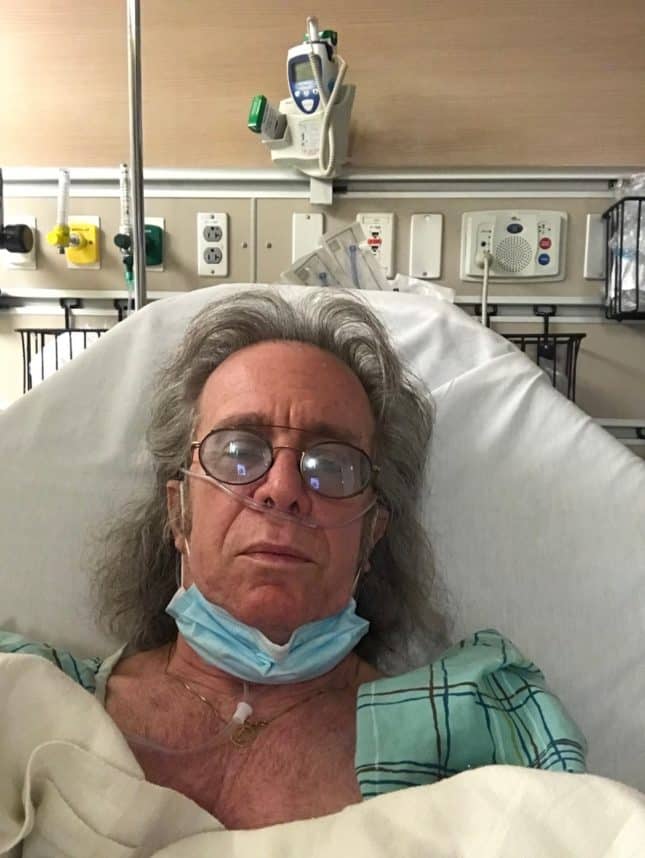
Gurian credits his spiritual beliefs and humor with getting him through the four days he spent in NYU Langone Health hospital, where his blood pressure dropped so low that the nurses couldn’t find his veins. They also did three uncomfortable nose swabs, took chest X-rays and performed an ultrasound of his lungs. A pulmonary specialist told him he had COVID-19 pneumonia in both lungs.
“Before I went to the hospital, I started myself on a Z-pack,” Gurian said. “They had me on oxygen and on the second day, they [removed it] to see how I would do without it. I was breathing 95-96% on my own. Hydroxychloroquine or Plaquenil helped me get better on my second day. They gave me zinc. The full regimen was what helped.”
“I always try to keep a sense of humor and look at things in a positive way. I kept reminding myself that for whatever reason, this is my path. I can’t engage in self-pity. There are a lot of people sicker than I was.” — Jeffrey Gurian
When Gurian’s temperature returned to normal, he was transferred from a private room to one with three other COVID-19 patients with whom he had to share a bathroom. One was an Orthodox Jewish man who was rushed to the ICU after his oxygen dropped. There was a woman next to him screaming with every breath she took.
“At the beginning, it was driving me crazy,” he said. “I needed to stay calm and centered. I had to flip the thought and step outside of myself and think how sick and scared she must have been.”
After four days in the hospital Gurian was allowed to leave, strapped on a stretcher so he couldn’t move his arms and wearing a mask with a shield on his face. “It was an overwhelming experience and it left me with what I think is PTSD,” he said. “I’m literally afraid to leave the house.”
In the past seven weeks, Gurian has still been sick, though to a lesser degree. He finished his third round of Z-pack, but he said it still hurts to breathe and he has a cough, which makes him very nervous. “I asked [at the hospital] if I have immunity or if I’m in danger of getting re-infected, and they said to be honest, it’s too soon. So I’m nervous to go anywhere.”
The only time Gurian gets outside is to stand on his terrace, but even then he wears a mask. A neighbor has been shopping for him, and around Passover, his friend Rabbi Shmary Gurary, with whom he often has dinner, dropped off a box of shmura matzo for him.
Photos courtesy of Jeffrey Gurian
“I got tremendous support from people, which helps so much when you’re sick,” he said. “Ron Bennington announced my situation on SiriusXM, and I got hundreds and hundreds of prayers and responses and messages.”
Some of those messages came from fellow comedians including Bill Burr, Nick Kroll, Jim Norton, Colin Quinn and Gad Elmaleh, as well as the owners of New York comedy clubs including the Comic Strip Live, Gotham Comedy Club and the Comedy Cellar.
It was that sort of outreach, along with the nurses, doctors and ambulance workers, a good attitude and a sense of humor that Gurian said kept him going. “I always try to keep a sense of humor and look at things in a positive way,” he said. “I kept reminding myself that for whatever reason, this is my path. I can’t engage in self-pity. There are a lot of people sicker than I was. A lot of it is about your ability to change the way you think. Try to stay positive and keep everything in perspective. That’s always my goal.”
What makes the American Jewish Committee (AJC)’s new director for combating anti-Semitism interesting is the fact that she’s a practicing Christian.
Holly Huffnagle was promoted from assistant director to director last month. Born in Thousand Oaks, Huffnagle told the Journal she became interested in combating anti-Semitism when she studied the Holocaust at Westmont College in Santa Barbara.
“Years of persecution of Jewish communities in Christian Europe … helped set the stage for the Holocaust,” Huffnagle said. “This didn’t happen in a vacuum. I actually entered the combating anti-Semitism space through the window of Holocaust education and Jewish-Christian dialogue, trying to figure out, can I somehow right an egregious past?”
Huffnagle’s background includes working as a research assistant at the United States Holocaust Memorial Museum and working as a policy adviser to monitor and combat anti-Semitism in the State Department. She joined AJC Los Angeles as assistant director in 2018.
Huffnagle views combating anti-Semitism as her calling. “[Anti-Semitism is] not a Jewish problem,” she said. “It’s a societal problem. It’s a reflection of our society, and effectively countering it requires non-Jews.”
“I actually entered the combating anti-Semitism space through the window of Holocaust education and Jewish-Christian dialogue, trying to figure out, can I somehow right an egregious past?” — Holly Huffnagle
Photo courtesy of Holly Huffnagle.
The biggest challenge in fighting anti-Semitism today, she said, is that it comes from more sources than ever before, thereby making the issue more complicated. “The danger is when we only focus on one source, like when we’re only focusing on white supremacists and we lose sight of what’s happening on the far-left or on college campuses,” she said.
Since her promotion, Huffnagle has been primarily focused on online anti-Semitic conspiracy theories blaming Jews and Israel for spreading the coronavirus. “Anti-Semites will always find a way to blame Jewish communities,” she said. “It’s nothing new but it’s just so much more [in] number. The real question is, what’s going to happen when we can go back to ‘normal’? Will these conspiracy theories change in any way [the] minds of people viewing them when they go back into the world?”
Because everything has moved online during the pandemic, tech companies have been overwhelmed when it comes to monitoring anti-Semitism and have had to use artificial intelligence to track and remove anti-Semitic posts from their respective platforms, Huffnagle said. Consequently, some posts that aren’t anti-Semitic have been mistakenly removed.
On the new phenomenon known as Zoombombing, in which people disrupt Zoom calls with neo-Nazi imagery, anti-Semitic messages and other hateful content, Huffnagle said that while there are only a handful of people doing this, “They’re still affecting multiple Jewish student meetings; they’re affecting board meetings where there’s Jewish chairs, so this has been a huge problem.”
What’s most concerning about Zoombombing, she added, is that white supremacists’ reach has been furthered through the tactic. “We’ve known that they’ve been growing, however, now they have more of an audience than ever before.”
AJC has been combating anti-Semitism online through partnering with social media platforms such as Facebook and Twitter in monitoring anti-Semitism and through their Advocacy Anywhere videos, Huffnagle said.
“One thing that we have now is further reach,” Huffnagle said, noting that the Advocacy Anywhere videos have received a million views on Facebook since the pandemic started. “The access that organizations combating anti-Semitism … have during this time is incredible.”
Americans are brewing tea. In this time of change and uncertainty, creating a tea ritual is the perfect way to enhance our physical and mental well-being.
Tea contains polyphenols, which are powerful antioxidants. Studies have linked tea to better cardiac health, blood pressure reduction and anti-aging benefits. Also trending in popularity is bright green matcha, made from crushed tea leaves. Steamed into a frothy latte or whisked into a cold brew, matcha boosts energy and metabolism and delivers a mighty dose of antioxidants. Depending on the brew you choose, tea can soothe or stimulate. Iced tea is a refreshing and healthy substitute for soda and other sugary drinks. With so many blends of tea in the marketplace, there is a tea for every taste and mood.
“Tea is a source of joy and comfort and solace,” says Steve Schwartz, owner and master blender of the Los Angeles-based company Art of Tea. “Drinking tea gives a sense of time and a sense of place.”
Legend has it that Chinese Emperor Nun Shen was visiting the far corners of his realm, when he and his servants stopped to boil water. A gust of wind blew some leaves from a tea tree into his pot, creating an aromatic brew. He became enthralled and introduced the fragrant brew to his subjects. History records that the Chinese have been drinking tea for more than 2,000 years.
In the sixth century, drinking tea spread to Korea and Japan, where green tea was elevated into the art of the Japanese tea ceremony and a part of the meditation process of Zen Buddhism.
Tea came to the Occident through the ancient Silk Road, which stretched from China to the Mediterranean. The precious tea leaves were so desirable that they were traded for jewels, spices and ponies.
In 1650, Dutch traders brought shipments of tea to Europe, where it slowly gained popularity.
Depending on the brew you choose, tea can soothe or stimulate. With so many blends of tea in the marketplace, there is a tea for every taste and mood.
The British started to drink tea in the late 17th century, and gifted the world the divine ritual of afternoon tea, a delicious repast of sandwiches filled with ingredients like smoked salmon, cucumber and egg with watercress, scones with fresh strawberries and whipped cream and sweet pastries, all served on delightfully floral, fine bone china.
Kalman Zev Wissotzky founded his eponymous company in Moscow in 1849, becoming the purveyor of tea to the Russian czar and the Russian military and the largest tea company in the world. When the company was nationalized after the Bolshevik revolution, the family rebuilt in Palestine, becoming the largest tea company there, with offices in London and the United States.
Rachel’s turn: No meal in a North African household is complete without the ritual of drinking mint tea from gold-painted and jewel-toned Moroccan tea glasses. My family makes fragrant and delicious Nana tea with a lot of fresh mint. If there’s some lemon verbena growing in the yard, we will add a branch to the pot. Several times a year, when the orange trees bloom with their sweet flowers, we can add orange blossoms to our teapot as a special treat. On Shabbat, when my family gathers, it’s my oldest brother’s job to pour the tea, and he’s become adept at pouring the liquid from high above the glass.
Sharon’s turn: My fondest memories as a child are of drinking tea with my grandmother. When my husband married into my Iraqi family, he made it his personal quest to learn how to brew a cup of tea as delicious as my grandmother’s. Her secret was black tea flavored with fresh mint and a generous dose of freshly ground cardamom, a spice that lends a strong, uniquely cool and aromatic flavor. One of the few phrases that my husband speaks in Hebrew is “Rot’za te?” (Would you like tea?). And that’s when I know I’m getting a mug of her special tea.
When the world reopens, there are so many places we’d like to sit and enjoy tea: Urth Caffe brews a fabulous white jasmine pearl tea and there’s nothing quite like the mango passionfruit tea at the Windows Lounge in the Four Seasons Hotel in Beverly Hills. We’re looking forward to visiting the Huntington Library, Art Museum, and Botanical Gardens in San Marino, where the Rose Garden Tea Room serves the Art of Tea’s delicious black tea infused with rose essences and fruit botanicals and where we can savor a Sencha green tea overlooking the lake in the Garden of Flowing Fragrance.
Rachel Sheff’s family roots are Spanish Moroccan. Sharon Gomperts’ family hails from Baghdad and El Azair in Iraq. Known as the Sephardic Spice Girls, they have collaborated on the Sephardic Educational Center’s projects, SEC Food Group and community cooking classes. Join them on Facebook at SEC FOOD.
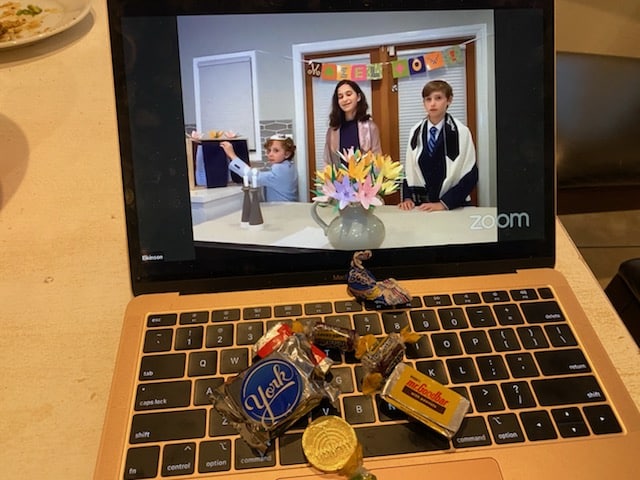
I have added many new credentials to my resume during this quarantine period. Last month, I became an at-home orthodontist, a mask seamstress, a dog groomer and a backyard referee. This past week I became a set designer, showrunner, photographer, caterer, event planner, talent manager, makeup artist and traffic director. You see, we decided as a family to move ahead with Friday night services for what would have been our twins’ b’nai mitzvah.
There is a well-known quote that has been misattributed for more than 100 years to Charles Darwin, and never could it have more applicability than now: “It is not the strongest of the species that survives, nor the most intelligent; it is the one most adaptable to change.” So much of our collective lives has changed, and so many milestone events have been altered, canceled or postponed. In April, we attended a Zoom bris, co-led a bi-coastal Zoom seder and have joined services online to watch their classmates become bar and bat mitzvah.
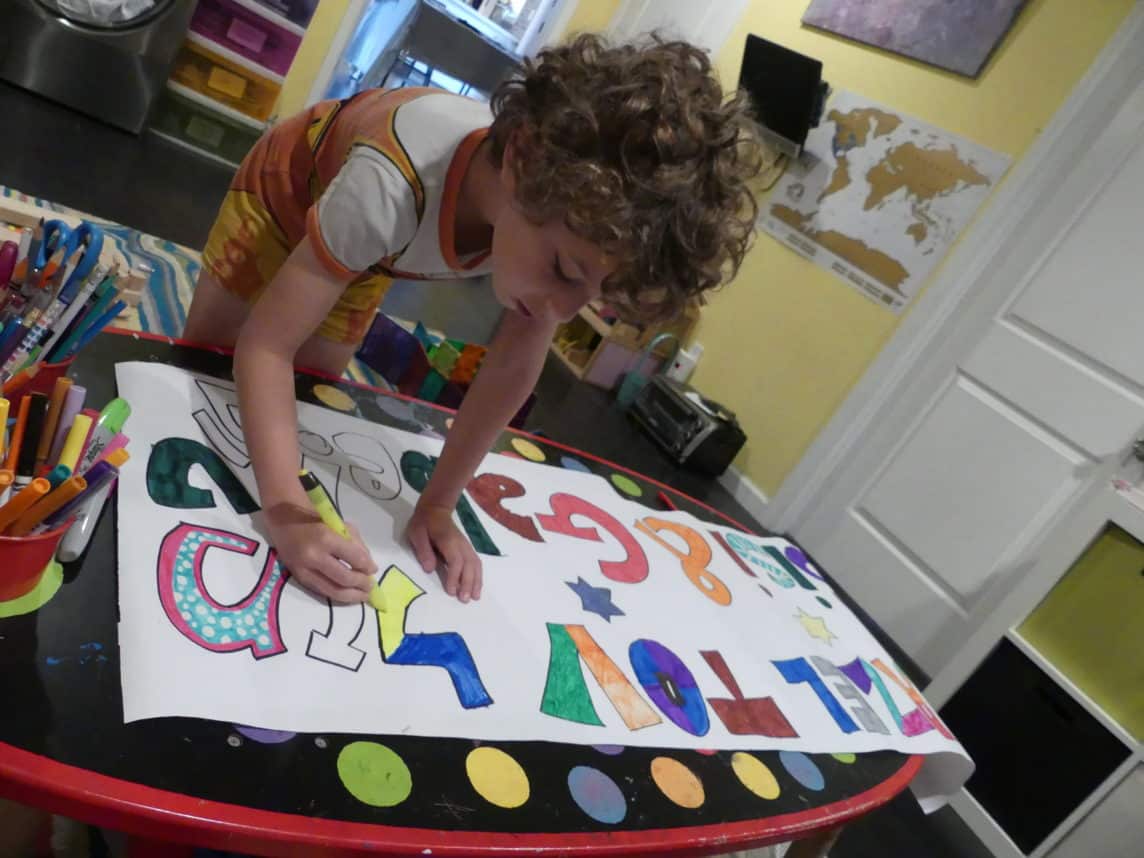
Ry Elkinson coloring the poster for the B’nai mitzvah.
Sisi and Gabe are part of Temple Akiba’s largest seventh-grade class, with back-to-back bar and bat mitzvah dates lined up from mid-March through the end of this year. By the end of March, the planned Simchas started falling like dominos, and with each day the prospects of our May 9 B’nai mitzvah grew dimmer. My husband Ken, a risk manager, eternal realist and self-proclaimed hypochondriac, had cautioned back in January that our event was in jeopardy because of the “Wuhan coronavirus,” as it was then known. I kept thinking so much could change in six weeks or a month. But once we were a month out, we realized that keeping the original date would mean doing this all from a distance. Everyone at Temple Akiba was incredibly accommodating, helping us and the many other families navigate these unchartered waters. Sisi and Gabe felt that having their B’nai mitzvah without their grandparents, aunts, uncles, cousins and friends wouldn’t feel complete, and so we voted unanimously to postpone.
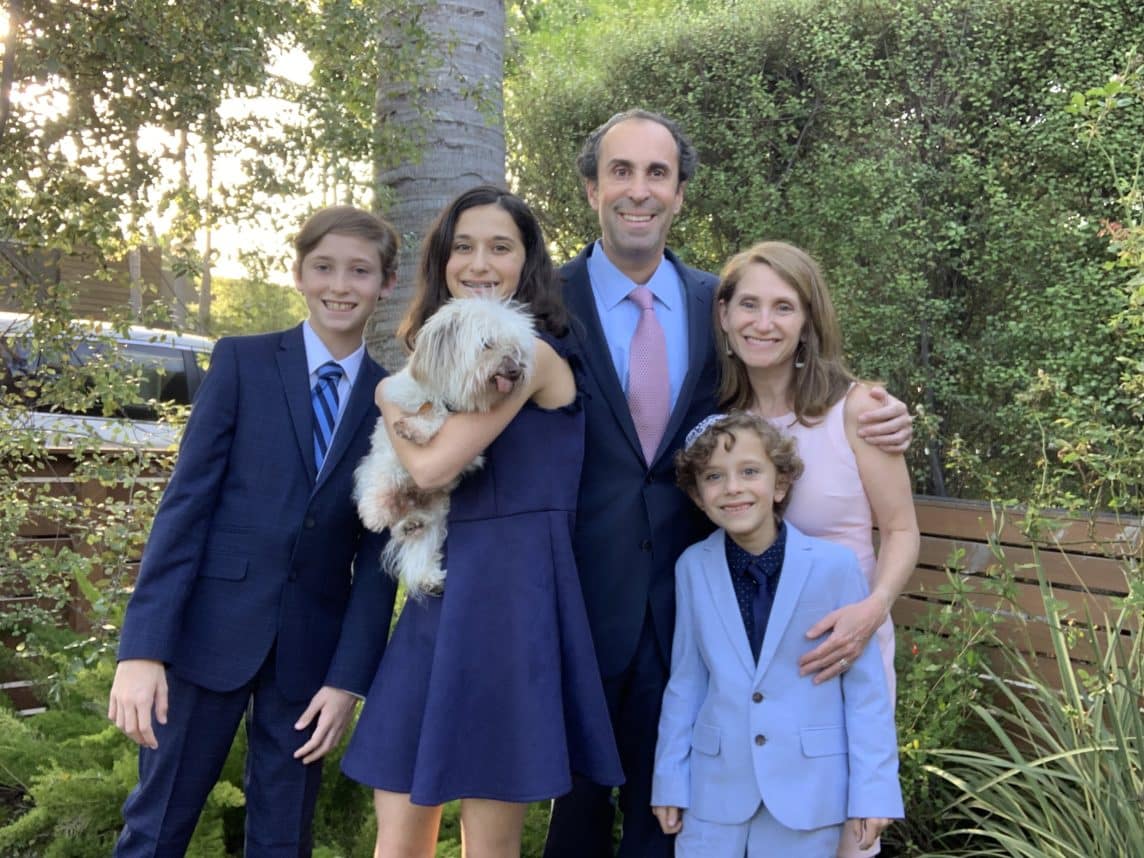
From left: Gabe, Sisi, Ken, Edie and Ry Elkinson stand together the weekend of May 8, 2020 to celebrate Gabe and Sisi’s B’nai Mitzvot. Photo courtesy of Edie Elkinson
Then, along came an option we hadn’t foreseen: Rabbi Zach Shapiro and Cantor Lonee Frailich discussed the possibility of Sisi and Gabe joining the Friday evening virtual Shabbat service as a placeholder for their postponed B’nai mitzvah, and an opportunity to bring some light to the community. We left the decision in Gabe and Sisi’s hands. Getting some Torah-reading experience under your belt without the added pressure of being in front of so many people seemed pretty appealing, so they said, “Sure, why not?”
Then we had to figure out logistics and details. The usual quandaries — what to serve at the kiddush luncheon, which tablecloth colors to choose — were quickly replaced by webcam dilemmas, lighting questions, tripod placement and audio feed.
The usual quandaries — what to serve at the kiddush luncheon, which tablecloth colors to choose — were quickly replaced by webcam dilemmas, lighting questions, tripod placement and audio feed.
Sisi and Gabe found out that instead of doing their individual prayers the way they had originally planned, they would be chanting them in tandem. We have Shabbat dinner almost every Friday night in our house, and there has literally never been a week when Sisi and Gabe have sung at the same tempo. Hats off to Cantor Lonee for getting these two in sync.
But then we found out that in addition to us, the rabbi, cantor, rabbinic intern and cantorial intern, members of the choir also would be joining the Zoom that would be broadcast live on YouTube and Facebook. To further complicate matters on our ‘set,’ we had two cameras — one on our home bima and one on our piano. We practiced the stop video, mute, silence volume, start the video, unmute sequence so many times that I think I might still be doing that in my dreams.
Photo courtesy of Edie Elkinson
With about a week left to plan, and logistics pretty well sorted, we asked ourselves how we could infuse a little more personality into the occasion. We played on everyone’s strengths, and it became a real family affair. Ken, a musician on the side, offered to play Shalom Rav during the service. Sisi, a budding artist, designed and cut a paper flower bouquet for our bima, and she and Ry, our spirited younger son, fashioned an ark out of a wooden block container, some extra fabric and friendship bracelet string. To replace the Oneg, we decided to invite nearby friends and family to a “Drive-by social distance Oneg.” We baked and wrapped brownies and chocolate chip cookies with big bows that could easily slip over the handle of an extended pole. That’s where Gabe’s problem-solving skills came into play. He helped design a 6-foot pole from a Swiffer and extra-long shoe horn that we could use to safely transfer the treats through visitors’ car windows.
A friend of Sisi and Gabe’s who is virtually throwing candy following their service. Photo courtesy of Edie Elkinson
The icing on the cake, though, was having the drive-by visitors honking, waving and holding signs.
The service went off without a hitch, and I have to admit I was taken aback by the virtual kibitzing in the chat section on YouTube. We threw candy after Gabe and Sisi each had their aliyah, and friends and family took pictures and videos. The icing on the cake, though, was having the drive-by visitors honking, waving and holding signs. It was probably hard to see behind our masks, but we were smiling so much to see so many warm, familiar faces for the first time in nearly two months.
Photo courtesy of Edie Elkinson
We chose a new date for Sisi and Gabe’s official B’nai Mitzvah: May 8, 2021. I’ve been thinking a lot about how so much can change in a year, especially for a teenager. Maybe by then Gabe will have caught up to or start towering over Sisi. Hopefully, Sisi’s braces will be a distant memory. Maybe Gabe will be the one with braces, then. Will they still like the idea of “Camp Elkinson,” our painstakingly thought-out party theme? How will their thoughts and speeches evolve in a year? While this all remains to be seen, right now I’m so thankful that Temple Akiba for giving us this chance to adapt, and create bonus memories while we all ride out this storm.
Edie Elkinson lives in Venice with her husband, three kids, dog and hamster and works in healthcare public relations.
Toward the beginning of the coronavirus pandemic surge in Los Angeles, local rabbis made the incredibly difficult decision to close most synagogues, day schools and other Jewish institutions. This was a very painful decision, guided by the Torah’s imperative to protect life and avoid danger. It has been profoundly challenging for our community, requiring sacrifices large and small. But it also has made a significant impact in protecting us and flattening the curve in our neighborhoods.
Now that we are two months into this crisis and protesters are demanding a return to “normal” life, it is understandable that local Jewish community members would like our institutions to begin functioning again as well. People miss their friends, their communal routines and the ability to live a full Jewish life. Kids have missed out on bar/bat mitzvahs and high school graduations. Extended families haven’t spent quality time together, not to mention missing out on Passover seders at the same table.
Despite the desire to reclaim our old lives and routines, many local rabbinic leaders continue to appeal for caution. The Orthodox Union, Rabbinic Council of America and Agudat Yisrael recently issued detailed guidelines declaring we are not ready to open Jewish community institutions yet, and that we will have to do so slowly and gradually, following many careful precautionary measures.
As a chaplain at Cedars-Sinai Medical Center, I have experienced firsthand how hard our Jewish community has been hit.
I understand this can be very frustrating for many of us, but our rabbis have good reason for caution. I know because I have seen the frontlines of this pandemic. As a chaplain at Cedars-Sinai Medical Center, I have experienced firsthand how hard our Jewish community has been hit. At the beginning of this crisis, I encountered too many seriously ill Jewish patients in our intensive care units. Many were tremendously ill for weeks, dependent on ventilators and an arsenal of drugs to breathe. Some died. Seeing this drove home the gravity of the situation for me. After physical distancing took hold across our Jewish community, the numbers of Jewish patients in our ICUs significantly declined.
As chaplains in the hospital, even as we remain on the frontlines, we have similarly had to develop new and creative ways of providing spiritual support, whether by phone, standing outside the doors of patients’ rooms, hanging signs in patients’ windows, or trying to connect to patients while our faces are mostly covered.
Coronavirus vaccine. A vaccine against COVID-19 Coronavirus in ampoules on aged wooden table
But not all of us take this level of precaution. We know the communal, close-knit and multigenerational nature of our interconnected community puts us at higher risk for rapid disease transmission. We frequently come together in the community for lifecycle events and worship. And that is why I have been encouraging, even pleading, with rabbis to beg our community to be extra cautious. In the Jewish community, we must be even more strict about physical distancing guidelines than what we are told by local government authorities. We all are responsible for one another. We have come this far and made an impact. It still is too soon to let up.
“As we have learned, the consequences of not taking physical distancing seriously can be a matter of life and death for too many.”
This nightmare is going to end. Things are going to get better. It is not only up to the rabbis. As we do every day in the hospital, we, as a community, need to plan carefully, constantly reevaluate changing data and involve diverse, interdisciplinary groups of communal, medical and public health experts in our decision-making. We all must do whatever we can to minimize the impact and to facilitate a return to normalcy. Doing this will enable us to return to our jobs again and to flourish spirituality as well. At the same time, we must ensure we simply survive physically. As we have learned, the consequences of not taking physical distancing seriously can be a matter of life and death for too many.
With the holiday of Shavuot fast approaching at the end of May, and with the High Holidays almost around the corner, we need to find creative ways to remain engaged in our Jewish lives, even if it won’t all be in person. Together, we can take the precautions that enable us to recharge this part of our lives and begin to return to some sort of normalcy. May it be soon.
Jason Weiner is the senior rabbi and director of the Cedars-Sinai Spiritual Care Department.
WASHINGTON (JTA) — Gilad Erdan, currently Israel’s public security minister, will serve simultaneously as the nation’s ambassador to Washington and the United Nations, Prime Minister Benjamin Netanyahu’s office said Monday.
The announcement comes three days ahead of the formation of a new coalition government between Netanyahu’s Likud party and Benny Gantz’s Blue and White party. The new government must approve the Erdan appointments.
Erdan, a Likud member, will replace Ron Dermer in Washington. Dermer, a close Netanyahu adviser, has served since 2013, an unusually long stint for an ambassador, and longs to return home.
At the U.N., Erdan will succeed Danny Danon, who has held the post since 2015, also a long tenure for an ambassador.
Under the new government agreement, Gantz will name his own ambassador to Washington once he assumes the prime ministership in 18 months and Erdan will keep the U.N. post.
“Minister Erdan is a committed public servant with deep connections to the American Jewish community,” said a statement from the leadership of the Conference of Presidents of Major American Jewish Organizations. “His most recent postings provide him with extraordinary credentials for representing Israel in the diplomatic arena at the United Nations, and with Israel’s greatest friend and ally, the United States of America.”
Theaters are dark during these days of self-distancing and quarantining at home, but like other forms of entertainment, the theatrical experience has shifted to cyberspace. Since 1985, the nonprofit L.A. Theatre Works (LATW) has been making audio recordings of theatrical productions available to the public, many of them by Jewish playwrights and with Jewish themes. Most of the more than 500 plays in the LATW catalog can be purchased for $4.99 each for digital works by Arthur Miller, Bernard Malamud and Isaac Bashevis Singer, or in the case of prolific playwrights such as Neil Simon, a collection of 10 plays for $14.99 (prices are higher for CDs).
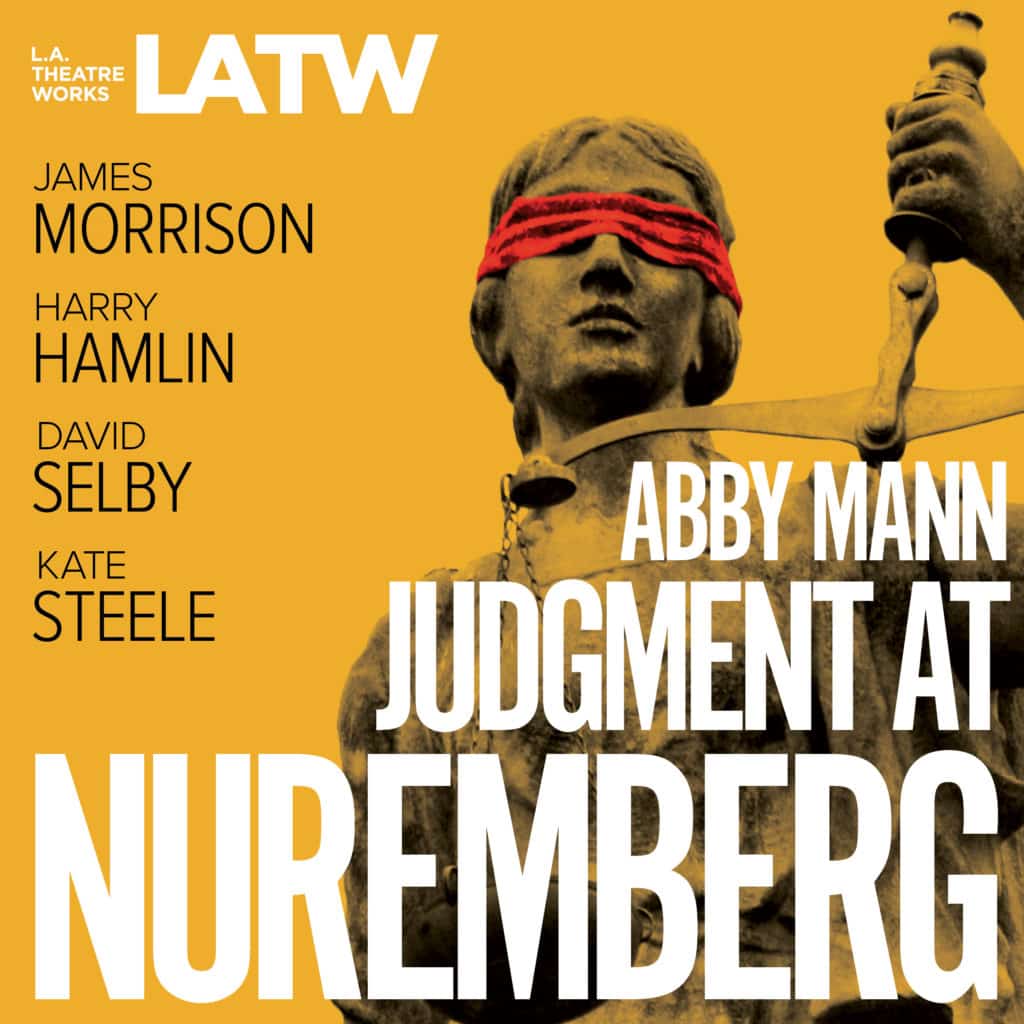
Selected titles are available free of charge, including this month’s broadcasts of James Lapine’s “Act One” on May 16 and Simon’s “The Goodbye Girl” on May 30. Listeners can hear other titles by subscribing to Spotify, Stitcher, Apple and NPR One, or via LATW’s nonprofit partners. Now through July 15, the Los Angeles Museum of the Holocaust is offering Abby Mann’s “Judgment at Nuremberg” and Diane Samuels’ “Kindertransport.” Florida’s Kravis Center for the Performing Arts also has “Judgment” and Simon’s “Lost in Yonkers.” And the Beverly Hills Temple of the Arts is streaming Peter Sagal’s “Denial,” about a female Jewish attorney defending a Holocaust denier, and Richard Greenberg’s “The Assembled Parties,” set during a dysfunctional family dinner.
“It has to be a good story with interesting characters. There has to be something moral, ethical, with a profound insight about human nature that gives the audience something to think about. You have to care about the characters and their plight and it has to evoke a larger question in you.”
According to LATW Artistic Director Susan Loewenberg, the criteria for choosing plays with and without visuals are the same. “It has to be a good story with interesting characters. There has to be something moral, ethical, with a profound insight about human nature that gives the audience something to think about. You have to care about the characters and their plight and it has to evoke a larger question in you.”
Nevertheless, audio productions require some adjustments. “The first thing we do is take a look at all the visual cues and think about how to transform them into audio cues. We almost never do narration to explain it. We figure out how sound effects can substitute for visuals,” Loewenberg said. “The sound stimulates your imagination and you think about what it really looked like.”
Loewenberg works with playwrights to identify issues and potential changes, such as identifying characters in the dialogue by name. “More often than not their input is very valuable,” she said. In the case of deceased authors, “We have to ask the estate for permission. It can be a very lengthy, complicated, frustrating process.”
Not surprisingly, “streaming, broadcasting, podcasting and sales of their audio have increased dramatically since the COVID-19 crisis began, she said. “We’ve been able to be a real service because what we do is suited to this terrible situation. After the pandemic broke, we put together a list of titles for the junior high and high school curriculum and sent them to teachers’ organizations all over the country and the world, offering 25 plays and study guides without charge. Hundreds of teachers signed up. We’ve also reached out to nonprofit organizations all over the country,” a group of science-themed plays in the Relativity Series among them.
What began in 1974 as theater workshops in prisons evolved over the years into a more conventional operation.
What began in 1974 as theater workshops in prisons evolved over the years into a more conventional operation, founding member Loewenberg revealed. She started as a teenage actress in the TV shows “The United States Steel Hour” and “Kraft Television Theatre.” “My dad’s friend was a theater and television director and recruited me,” she said, noting that she decided to quit performing when she was almost 30, “but I still wanted to be involved in the theater.”
Loewenberg grew up in Trenton, N.J., descended from Latvian and Lithuanian Jews on her father’s side and German Jews on her mother’s. Her grandparents were very religious and kept kosher, but her family, members of a Conservative synagogue, did not. She attended Hebrew school, learned to read (if not understand) Hebrew, and has been a member of a weekly Torah study group for 15 years. “We’ve also studied other religions, other aspects of Judaism [and] Israeli literature. We just had a Zoom yoga session with a woman in Jerusalem who teaches classes in how the Torah relates to the body,” she said. “I’m very involved in Jewish tradition, culture, ideas about morality and how you live your life. I’m not a believer in God, but all of the tenets of Judaism mean a great deal to me and I try to live my life as a righteous Jew.”
Typically, LATW records seven plays per year at UCLA in front of an audience from October to June and also records in the studio. “We do four recordings of each play and edit the best takes together. Every year we take a play and tour it around the U.S.” Loewenberg said. This year, it was “Seven,” about women who overcame obstacles to make a difference in the world. But the coronavirus put plans for live recordings on hold, and forced the cancellation of the final 11 performances. Several plays have been chosen for next season, plans for which remain on hold for now.
“We look forward to the day when audiences can gather to experience the magic of live theater again,” Loewenberg said. “Until then, put on your headphones and immerse yourself in all that LATW has to offer.”