Swastikas were found on a synagogue in Alabama on the evening of April 8, authorities said.
The Huntsville synagogue Etz Chayim had two swastikas drawn on it in red paint as well as anti-Semitic slurs, including the words “HoloHoax,” “Jew Rats” and “F— k—s.”
Huntsville, Alabama, synagogue Etz Chayim was hit with disgusting, neo-Nazi vandalism and threats last night, as Passover was beginning.
I hope the scumbag(s) who did this is/are punished.
Huntsville Police Lt. Michael Johnson told WAFF that people should come to them with any information, and that they’re “looking at charges anywhere from criminal mischief, to harassment, to possibly terroristic threats.”
Huntsville Mayor Tommy Battle condemned the graffiti in a statement.
“This despicable act took place on the first night of Passover, one of the most important religious times in the Jewish year,” he said. “We seek to find those who perpetrated this crime, and I urge anyone with information about the vandalism to report it to police. As a city, and as an inclusive community, we stand side by side with our Jewish brothers and sisters and people of all faiths.”
The Jewish Federation of Huntsville and North Alabama similarly said in a statement, “Passover is a time where we gather together to celebrate our freedom from bondage, yet this year, we had to do it in isolation because of the coronavirus pandemic. To think anyone would take advantage of such a time to commit such heinous acts is the lowest of the low.”
They added: “The vicious and repugnant images found on the walls of Etz Chayim are a powerful reminder that anti-Semitism is still here and we, as a community, must come together and work tirelessly to end it.”
The Interfaith Mission Service launched a donation effort to provide support to Etz Chayim.
“We stand together united against all forms of anti-Semitism and hate speech,” they wrote on the campaign page. “We are one people.”
On April 9, Hamas arrested several Palestinians in the Gaza Strip for having a Zoom call with Israelis.
The UK Guardian reported that among those arrested was Rami Aman, a Gaza activist and journalist who has been critical of Hamas and is the founder of the peace organization Gaza Youth Committee.
Hamas-run Interior Ministry’s spokesman Eyad al-Bozom said in a statement, “The Israeli occupation has not stopped using various methods to recruit Palestinians as informants in order to harm our people and its resistance and beautify its criminal image in front of the public opinion. Any activity or communication with the Israeli occupation under any cover is a crime punishable by law, and a betrayal of our people and their sacrifices.”
According to The Jerusalem Post, Aman said during the nearly two-hour call that the Gaza peace activists are aiming for “internal peace. We want to help the people find themselves, to follow their dreams, to follow their goals, and not to follow others’ dreams and goals.”
Aman also said the coronavirus is just one of many viruses infecting Gaza, citing “the blockade, unemployment, cancer, pollution, [lack of] electricity. We already have a lot of viruses.”
Throughout the call, Israelis reportedly asked about what daily life is like in Gaza; one Palestinian said music and parties are banned in Gaza.
Parody account The Mossad tweeted, “People in Gaza are being arrested by Hamas for having Zoom calls with Israelis. This should calm most Gazans’ worries that it’s not actually us watching you use the Internet.”
People in Gaza are being arrested by Hamas for having Zoom calls with Israelis.
This should calm most Gazans’ worries that it’s not actually us watching you use the internet. https://t.co/di8OCGxA46
— The Mossad: Espionage at ≥ 2 metres (@TheMossadIL) April 9, 2020
Twice in March, Hamas arrested Palestinian cartoonist Ismael el-Bozom, reportedly for criticizing the terror group in his cartoon and writings. UN Watch tweeted at the time, “Why is the U.N. Human Rights Council silent?”
Hamas arrests and harasses Palestinian cartoonist for criticizing its oppressive rule in Gaza.
I
In the age of closed doors and mandated distance
I tried ordering Matzah online.
The only single boxes, (because with only two of us
eating matzah with gluten in it, we don’t need the five-pack)
were labeled not kosher for Passover.
Who in their right mind wants to eat matzah
when it’s not Passover? We barely want to eat it
when it is Passover.
I don’t think we worried about this when we ran out of Egypt.
We took what we could and kept our eye on freedom.
We’re doing what we can in this nouveau Goshen.
Even if the rabbis didn’t have their eyes on it
there will be Matzah on my plate tonight.
II
An Instacartress is bringing
Manischewitz wine to our house.
She wants to see my ID.
I want to tell her Manischewitz wine
is awful,
shouldn’t count as actual alcohol
and
is tradition!
I show her my ID and now have the raw materials
I need to make harosetz,
as well as have a little drop for Elijah
when the time comes.
I wonder if Elijah will be wearing
an N95 mask this year?
They’re saying the rest of us should wear cloth masks
and leave the N95s for first responders…
but Elijah has to go to a lot of houses
so maybe he has special dispensation.
This year, FOR SURE, no tongue kissing Elijah.
I’m not even sure about opening the door.
A plague has come to Van Nuys and I’ve got
nothing to slather on the doorway.
Los Angeles poet Rick Lupert created the Poetry Super Highway (an online publication and resource for poets), and hosted the Cobalt Cafe weekly poetry reading for almost 21 years. He’s authored 23 collections of poetry, including “God Wrestler: A Poem for Every Torah Portion“, “I’m a Jew, Are You” (Jewish themed poems) and “Feeding Holy Cats” (Poetry written while a staff member on the first Birthright Israel trip), and most recently “Hunka Hunka Howdee!” (Poems written in Memphis, Nashville, and Louisville – Ain’t Got No Press, May 2019) and edited the anthologies “Ekphrastia Gone Wild”, “A Poet’s Haggadah”, and “The Night Goes on All Night.” He writes the daily web comic “Cat and Banana” with fellow Los Angeles poet Brendan Constantine. He’s widely published and reads his poetry wherever they let him.
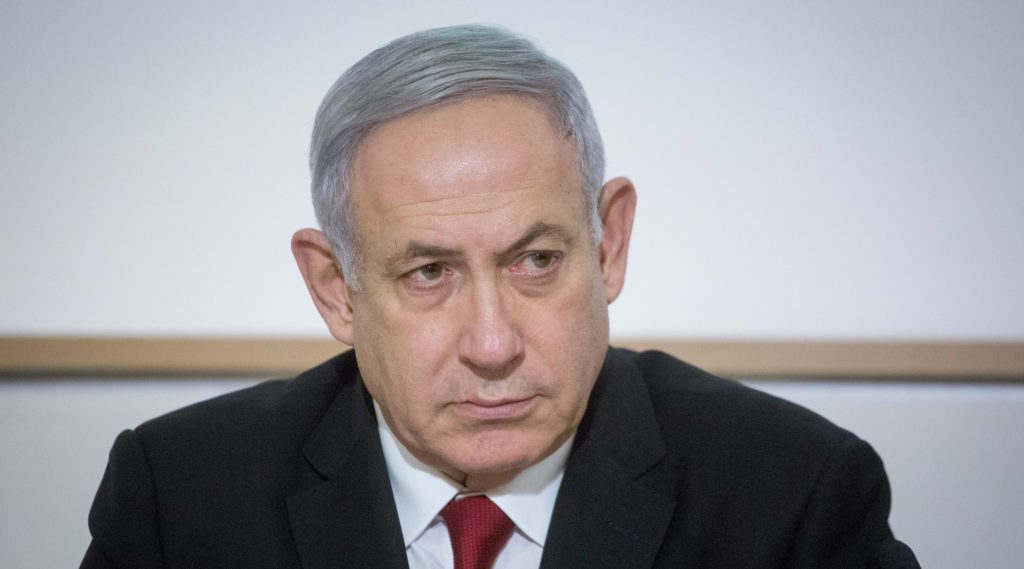
Israeli Prime Minister Benjamin Netanyahu is being criticized for having his son attend his Passover seder while Israel is on lockdown throughout the holiday.
Netanyahu released a video on April 8 in which he can be seen sitting at a table with his 25-year-old son, Avner, to his left. The video was filmed before April 8; Netanyahu had been in quarantine after Health Minister Yaakov Litzman tested positive for coronavirus on April 2.
According to Channel 13, a source from Netanyahu’s office told them that Avner has been staying at an apartment in the same compound as Netanyahu’s residence while adhering to social distancing measures. Netanyahu’s office also told Haaretz that Avner’s girlfriend “hasn’t visited her parents for the past five weeks or went to work.”
However, The Jerusalem Post’s Lahav Harkov pointed out that Netanyahu’s other son, Yair, had tweeted that Avner lives “across the street and only leaves to see his parents.”
“Wouldn’t it be great if we could all just leave our apartments to see our parents?” she added in a follow-up tweet.
Btw, the Prime Minister's Office said that Avner lives in an apartment in the same "compound" as the residence – the existence of which no one has ever been informed before. But Yair Netanyahu tweeted that Avner rents an apt across the street and only leaves to see his parents.
Pro-Israel activist Arsen Ostrovsky tweeted, “There was no excuse for this. We all had to make sacrifices, including many having Seders alone or without loved ones, at instructions of PM Netanyahu. He ought to lead by example here.”
As it should. There was no excuse for this. We all had to make sacrifices, including many having Seders alone or without loved ones, at instructions of PM Netanyahu. He ought to lead by example here. https://t.co/DeCPgRlWtd
Israel’s lockdown measures banning intercity travel are set to expire on April 10; after Passover ends on April 15 the Israeli government plans to start gradually easing social distancing measures.
Stuck at home under stringent directives, a record number of Israelis are contacting ERAN, the country’s largest mental-health hotline, to cope with elevated anxiety and stress linked to the coronavirus pandemic.
Each day, more than 1,000 people – and rapidly rising – are calling or reaching out to the organization online to report health concerns or request counseling on life under quarantine.
“I’m at ERAN for 11 years and we have never had this amount of calls,” Dr. Shiri Daniels, national director of counseling, told The Media Line, adding that the number is far surpassing those seen even during wartime.
“Calls rose 40 to 60%, but we didn’t double our calls like now,” she said. “I think it’s going to get even worse regarding anxiety.”
Israelis are typically seen as stoic during wars.
Israelis are typically seen as stoic during wars.
“History shows that [military operations] have a beginning and an end… but here we’re dealing with something you can’t see, that’s invisible and that people you love can [transmit to you], causing you harm,” she asserted. “Your body itself can betray you.”
Others in Israel are turning to social media for support.
“In the past few days I’ve barely slept, and when I do manage to fall asleep, I somehow dream about coronavirus,” a man named Idan wrote in a public Facebook post Friday night. “All day long, thoughts of the virus run through my head without stop.”
Another user named Nurit complained of panic attacks.
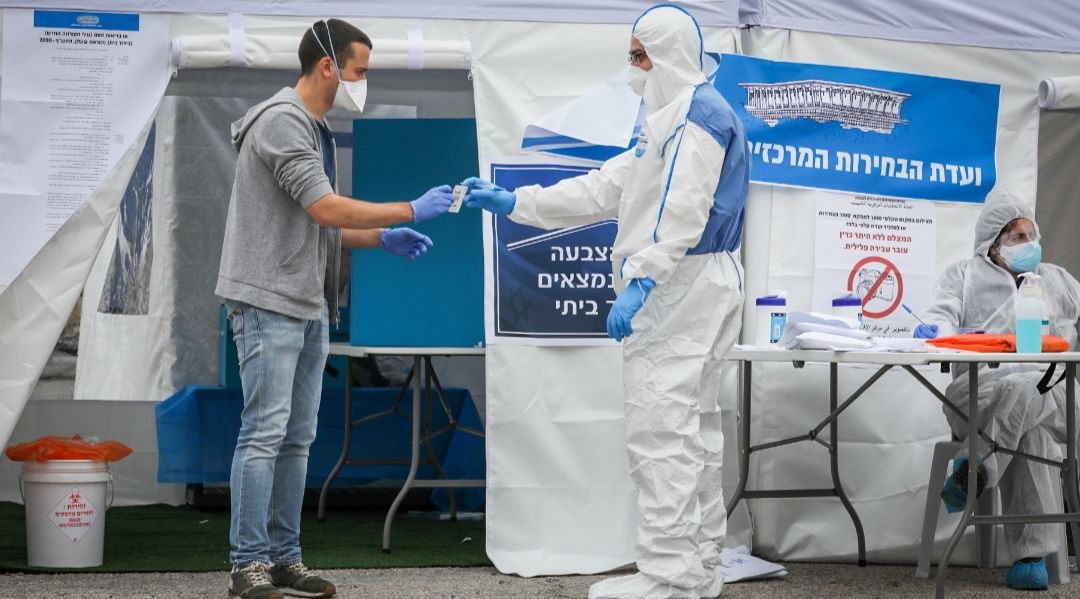
Israeli voters in quarantine due to possible exposure to coronavirus vote at a special polling station in Jerusalem during national elections, March 2, 2020. (Nati Shohat/Flash90)
“Two days ago, I reached the point where I started coughing and feeling as though I couldn’t breathe…. It turned out to be anxiety and stress,” she wrote. “It’s not an easy situation: Anxiety can kill even before the coronavirus.”
On an online forum dedicated solely to COVID-19 updates, a woman named Orly asked others at 3 a.m. local time: “Who’s awake? I can’t sleep.” Hundreds responded, admitting that they, too, were unable to catch any shuteye.
Daniels says that healthcare personnel are not exempt, fearing for the safety of loved ones as they regularly come in contact with patients who have COVID-19. In general, though, the majority of those seeking help are 35 to 55 and suffering from information overload.
“The information is controlling people instead of people controlling the information,” she explained. “They are glued to the media, social media [and] internet, and they find it difficult to restrain themselves.”
Prof. Nilly Mor, a child psychologist affiliated with the Hebrew University of Jerusalem, says broken routines are particularly difficult for children and families.
“Everyone being at home together brings on a lot of family discord,” she told The Media Line. “Kids not being at school and not doing their regular things… we see a lot of children with meltdowns and difficulty sleeping.”
While some parents are turning to tele-therapy, Mor says remote options are not always available – or useful – for children, especially if they are young.
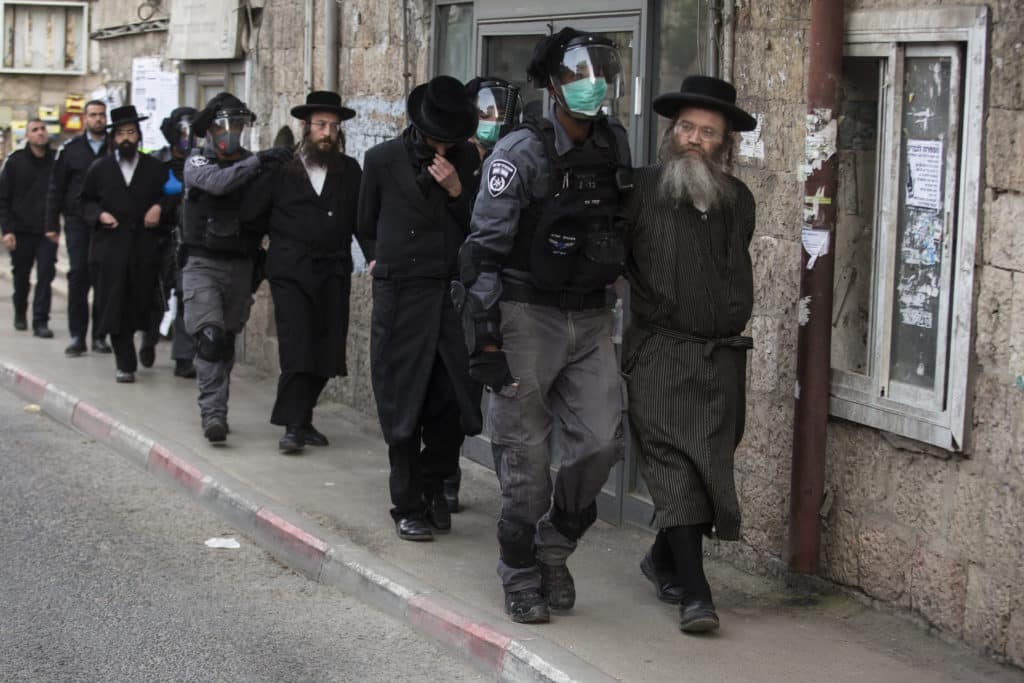
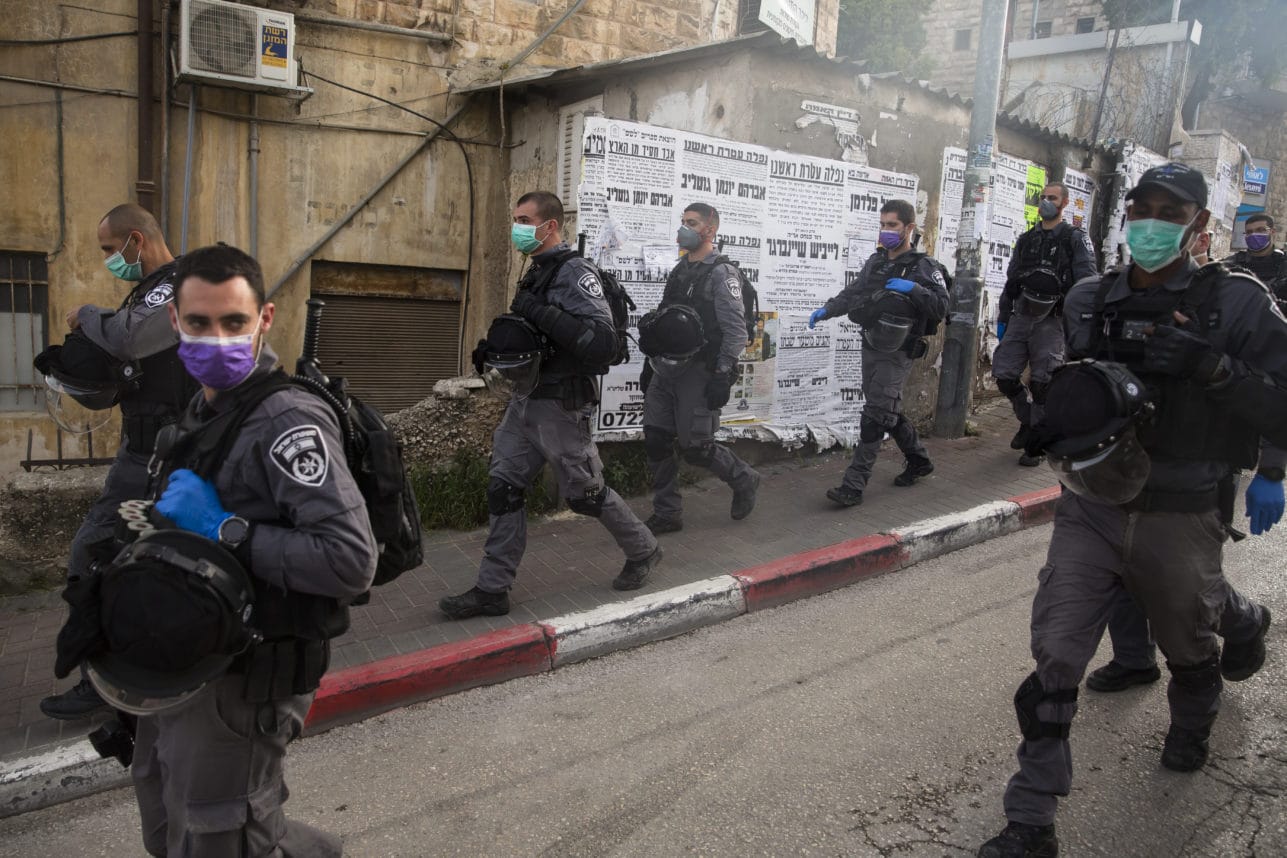
JERUSALEM, ISRAEL – MARCH 31: Israeli police troops patrol as they enforce a partial Coronavirus lockdown in the Mea Shearim nighborhood on March 31, 2020 in Jerusalem, Israel. The Coronavirus (COVID-19) pandemic has spread to many countries across the world, claiming over 30,000 lives and infecting hundreds of thousands more. (Photo by Amir Levy/Getty Images)
“With younger kids, treatments involve a lot of play and games and visual aids and activities, which are more difficult to transfer to online services,” she said.
So what tips do mental-health professionals have for those who need help?
Mor recommends that parents ensure they themselves are in a good mental state before trying to help others, and that they establish an active and diverse routine for their children in order to give their days structure. In addition, she suggests they monitor their children’s behavior and thoughts, and explain to them the situation.
“The sense of being helpless in this situation can make things worse for children,” she explained, emphasizing that while they should be encouraged to maintain social distance and wash their hands, they can still talk to friends and family over the phone.
ERAN’s Daniels recommends that adults, especially older people, maintain a daily routine that includes proper rest and healthy eating, and remain active. Those suffering from anxiety should practice deep breathing, engage in creative activities, express their emotions to friends and loved ones, and lower their news intake.
“Being frightened is natural and to be expected,” Daniels said. “We have to accept the fear and not judge it, while using different coping mechanisms….”
At the same time, she emphasized the importance of maintaining a positive outlook.
“It’s true that we don’t know this virus, but we have been through different crises in our lives and were able to deal with them.”
“It’s true that we don’t know this virus, but we have been through different crises in our lives and were able to deal with them,” she said. “We will also be able to deal with this challenge and get stronger in the process.”
People in Israel seeking more information can call the ERAN hotline at 1201 or visit online at https://en.eran.org.il/.
For the 270 or so Israeli kibbutzim, social cooperatives where people live together and share work among their members, halting group activities flies in the face of core principles. During the present coronavirus pandemic, residents have been forced to separate to reduce the spread of the disease. This has prompted “kibbutzniks,” as they’re affectionally called, and their leaders to find alternative ways to keep up their togetherness while being apart.
“This current situation turned everything on its head. How do we bring about social distancing in communities whose essence is about bringing people together and having us work in cooperation? The first step was to really evaluate how to protect ourselves from ourselves,” Richard Summers, responsible for resource development and external affairs for the Eilot Regional Council, told The Media Line.
Hevel Eilot, the southernmost regional district in Israel situated just north of the Red Sea city of Eilat, has 12 communities in its jurisdiction: 10 kibbutzim and two community settlements.
“The first thing we’ve done is to close our communal dining rooms,” Summers said, referring to a common characteristic of traditional, i.e., nonprivatized, kibbutzim. “Rather than turning around and saying each person has to fend for themself, we make deliveries [of meals to homes].”
Many kibbutzim went through financial struggles in the 1980s, leading a majority to privatize services and often property.
Many kibbutzim went through financial struggles in the 1980s, leading a majority to privatize services and often property, The Hevel Eilot region is unusual in the sense that many of the kibbutzim remain fully communal.
How people interact on the kibbutzim has been transformed during this time, and Summers argues that there have been unintended benefits.
“The hardest thing for communities used to interacting all the time is what happens when we start to lose communication with one another. Now, all the communal meetings we have on the kibbutz we’re doing through Zoom …, but what we’ve realized is that actually we are creating greater participation,” he said. “People who in the past would have been busy can now actually participate in the communal discussion on how we are going to deal with this situation,” Summers said.
Shari Nitzan, the director of social services for Hevel Eilot and a member of Kibbutz Lotan, has also seen an increase in community activities being carried out online.
“Kibbutz Lotan just celebrated 37 years since its founding this past weekend; a lot of things were done on Zoom. Brunch was distributed and left in front of people’s houses,” she told The Media Line. “Although it’s hard to see it now, in the end, we’ll see it’s an opportunity for creativity and trying to think together in a different way.”
Another plus is the growth of telemedicine as flights at the nearby airport have almost stopped. This resulted in fewer medical specialists coming to the area and prevented people who normally get treatment elsewhere from going to their providers.
“What we’ve done in this region is to take the idea of telemedicine to the next level. Our doctors now rarely take people into their clinics. They turn around and say we’re going to do everything online,” Summers said. “If you look at the upside of the coronavirus, some of the things that we’ve been talking about doing, we’re now doing. It was a huge deal to get these services in the past; today you can do it in your living room.”
When it comes to everyday life, children feel the greatest impact.
When it comes to everyday life, children feel the greatest impact.
“The kids are used to walking around; their front yard is the whole of the kibbutz. How do we make sure the kids are keeping distances from the adults … when some of the founding members are elderly…, a high-risk group?” Summers asked. “We have to take responsibility as parents, which is kind of an unusual thing on kibbutz, because we’re all everybody’s parents most of the time. What we’ve done is to go back to the family unit.”
Another major issue in his area is what to do with adult children who have left the kibbutz and now want to return, which poses a safety hazard to the rest of the community.
“One of the discussions that are going on at the moment is that, on the one hand, we live in a region that has the geographical advantage that we are so cut off from the rest of the country that at the moment, we have almost no cases of corona. … On the other hand, it’s a natural thing for parents to want to have their kids close to them in times of emergency,” Summers said.
“Whereas for you and I, who live in Jerusalem or New York,” he continued, “we can make the decision on our own and it’s our own responsibility. In a community the size of a kibbutz of 100 families living together, it’s no longer the responsibility of the individual family: the responsibility is the whole community’s.”
Only very close family members like children and parents are allowed onto the kibbutzim.
As a result, only very close family members like children and parents are allowed onto the kibbutzim. They must stay in isolation for 14 days once they enter the kibbutz so as to not spread coronavirus, potentially sickening the entire group.
According to Nitzan, in the event that such a calamity occurs, the regional council will step in.
“It’s possible for a kibbutz to be completely closed with everyone staying in their houses in order to prevent it from spreading, and then we’re going to have to provide food, essential services to the community from outside,” she said.
So far, only one person in the area’s kibbutzim has tested positive for the virus. She is isolated at her home in good condition.
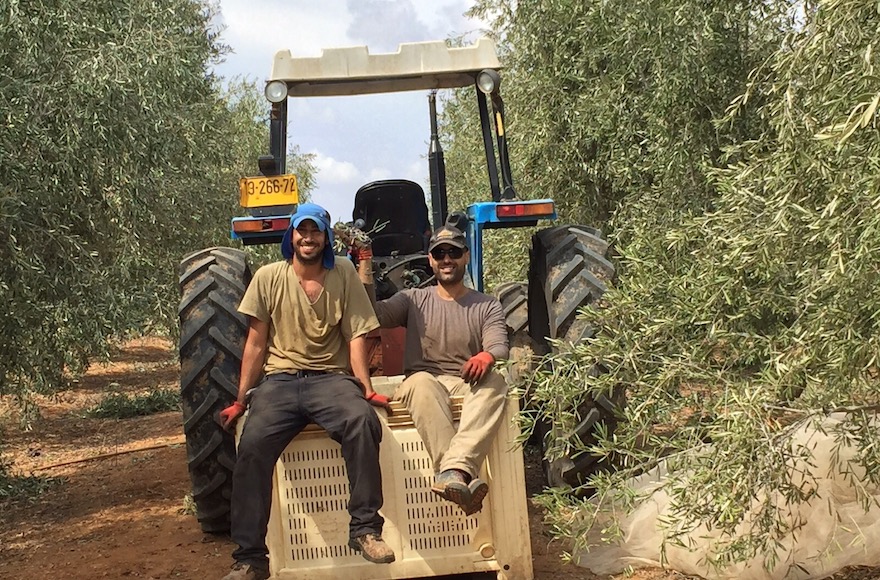
Kibbutzim in the area cannot shut out the outside world completely. Summers said that the kibbutzim and moshavim (communities with more individual ownership) from the far south up to the Dead Sea account for 60% for Israel’s agriculture.
“Above and beyond contemplating how we protect ourselves, we also have to continue with the responsibility that we have for ensuring there’s food for everybody in Israel,” he said. “It’s a huge source of pride here. We talk about those people who are working in the hospitals and teachers and delivery[men], but people forget it has to start somewhere, and it starts in the earth.”
Farming on kibbutzim in his area has suddenly become more expensive due to a shortage of recycled water from Eilat, the majority of which normally stems from the currently shuddered tourist industry in the nearby city. According to Summers, they must now use fresh water instead of the unusual 10-15% recycled water for crops, which has resulted in a 30-40% increase in expenses.
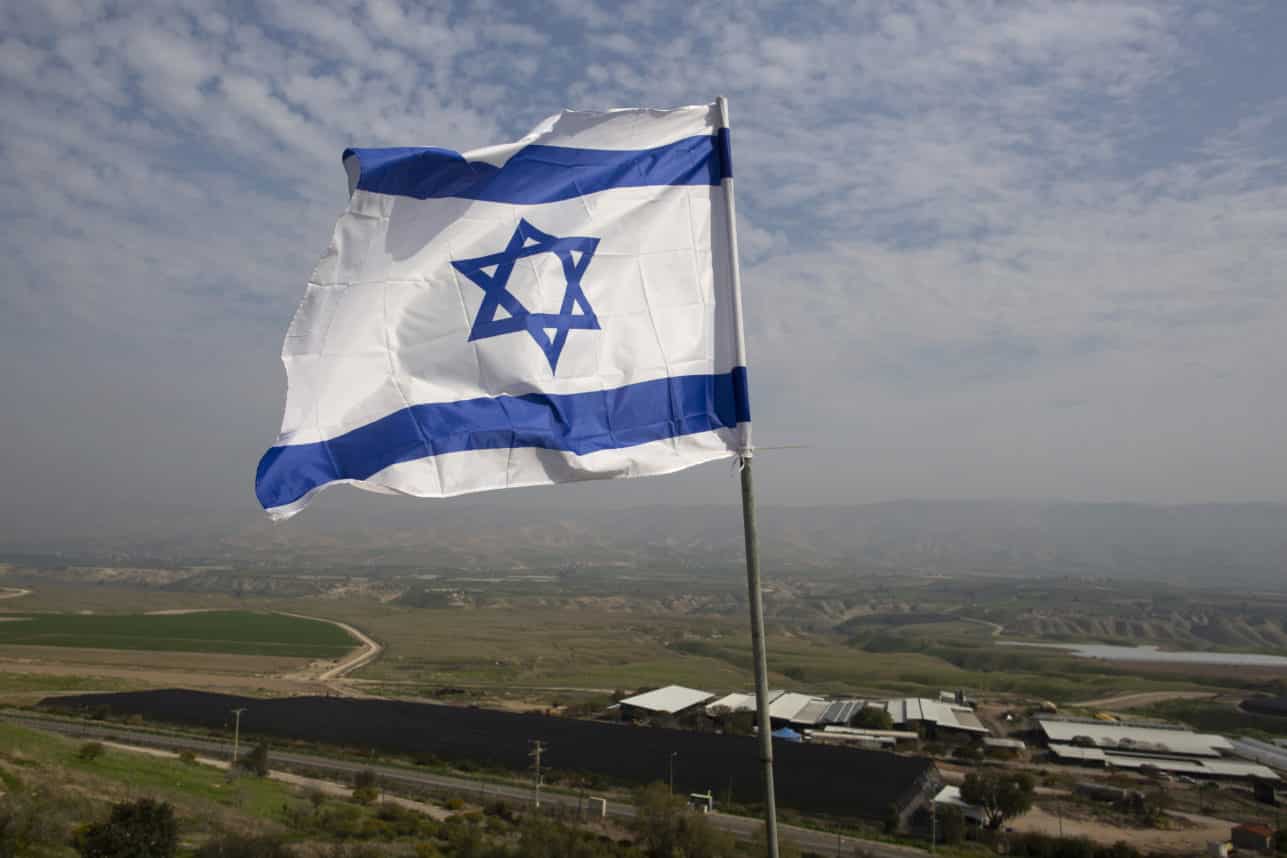
SHADMOT MEHOLA, WEST BANK – JANUARY 28: An Israeli flag flies in a Jordan Valley Jewish settlement on January 28, 2020 in Shadmot Mehola, West Bank. U.S. President Donald Trump says he’s offering the “deal of the century” to revive a peace process between Israel and Palestinians. Palestinian authorities have boycotted negotiations with the Trump administration over what they see as its pro-Israel agenda. (Photo by Lior Mizrahi/Getty Images)
“It may not seem like a big deal, but when you’re a farmer working on minimal profit margins, it’s very significant, especially when all of the other income that’s coming into the kibbutzim is also becoming less and less,” Summers said, referring to the fact that many people have lost their work as a result of the novel virus. Their salaries provide revenue for the kibbutzim, at a percentage dependent on whether and to what degree the kibbutz has privatized.
The economic consequences are of great concern to kibbutzim in the area and throughout Israel.
The economic consequences are of great concern to kibbutzim in the area and throughout Israel.
Dr. Hanan Ginat, the mayor of the Hevel Eilot region’s 5,000 residents and a founding member of Kibbutz Samar, told The Media Line:
“I’m a geologist and in geology you have the aftershock of earthquakes. The coronavirus [aftershock here] will be very strong. Tourism is really hurting now, and people have been fired or have to find new jobs and so this is the main thing I’m concerned about now,” he said. “The aftershock will come after we go back to the [normal] routine, which won’t be routine. And we have a lot of discussions about this; still no one knows when this event will end.
“Of course, we need to take care of the health issue and we are doing it very well,” Ginat continued. “We are looking at the near and far future and are really worried about it. … We are the far periphery, far away from the center, and we will need a lot of help from the government to build again the tourism [and other infrastructure]; everything is stuck now.”
Yael Shazit, spokeswoman for Kibbutz Ein Gev, located in northern Israel on the Sea of Galilee, said her kibbutz is taking a big financial hit from shuttering its hotel.
“Especially now, in this month, there should have been a lot of Christian people coming, and now we don’t have it, and Pesach was full already; people book a year or two years in advance,” she told The Media Line. “Of course, it will be a great loss economically, but the kibbutz is strong and the people are strong.
“I hope it will be gone in the summer, like the flu, and we can all return to the beaches together. The Kinneret [the Sea of Galilee] is beautiful and there is no there. It’s sad,” Shazit said.
Her kibbutz has had no coronavirus cases.
Israel’s kibbutzim are fighting the coronavirus in a way that they’ve never fought before.
Israel’s kibbutzim are fighting the coronavirus in a way that they’ve never fought before.
Hevel Eilot’s Summers said, “This is a very different type of war, where our strength is being able to stay a community while keeping our distance. It’s different from anything you’ve ever experienced here, where normally when you start looking at emergency situations, the idea is we’ll all come together in a bomb shelter and we have to figure out how to live with one another” in close proximity.
“Now, we have to learn how to live separated from one another, and it’s something that’s not in our DNA in this region,” he said.
The United Arab Emirates this week provided medical supplies and other assistance worth hundreds of thousands of dollars to Palestinians, including those in East Jerusalem, something the Israeli government views as an illegal act in its capital.
Ibrahim Rashid, head of the UAE International Humanitarian and Charity Organization for Palestine, met with Palestinian officials and prominent Jerusalem figures on Monday to brief them on a series of humanitarian programs and interventions for the city. These come in addition to the charity’s ongoing $500,000+ project to help 650 Palestinian orphans via the Zakat Committee for East Jerusalem.
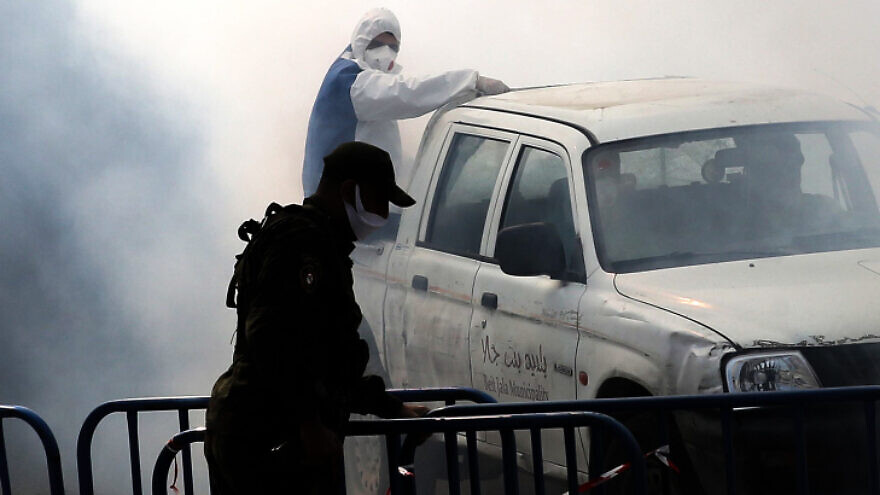
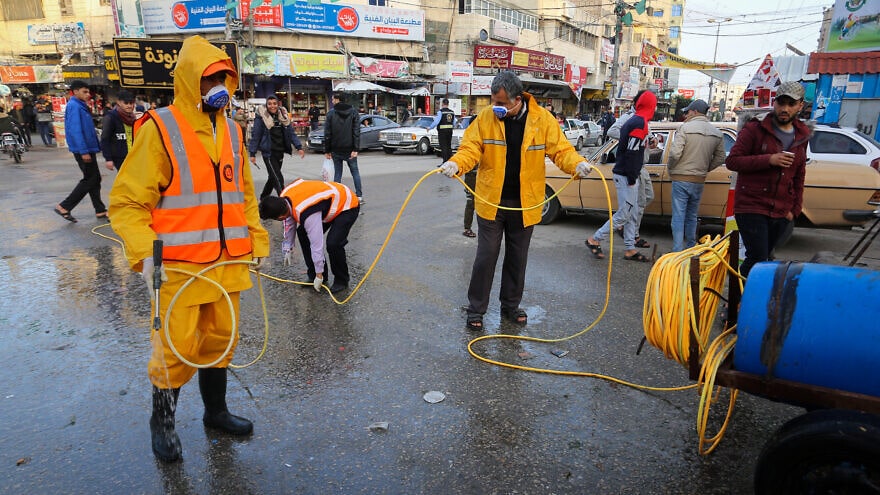
Municipality workers wearing protective clothes disinfect a street in Khan Younis, the southern Gaza Strip on March 14, 2020, as part of measures to prevent the spread of the Coronavirus. Photo by Abed Rahim Khatib/Flash90
Fleur Hassan-Nahoum, deputy mayor of Jerusalem, says that more than one player has been trying to further its political agenda by interfering in the eastern part of the city.
“We are fully aware of illegal donations in East Jerusalem,” she told The Media Line. “We are also aware that the Turkish government is involved with several organizations there.”
“We are fully aware of illegal donations in East Jerusalem,” she told The Media Line. “We are also aware that the Turkish government is involved with several organizations there.”
Hassan-Nahoum stressed that the only legitimate authority on the ground in East Jerusalem was the Jerusalem Municipality.
“Many try, but we are the official authority to serve the citizens there,” she said. “Last Thursday, we started work in East Jerusalem to face the coronavirus. We have hospitals for quarantine, and residents will be tested.”
The Palestinian leadership is adamant that East Jerusalem will be the capital of an independent Palestinian state when a political solution is reached with Israel. To this end, using civic and humanitarian organizations, they implement programs and activities to serve the population and bolster the Palestinian Authority’s position in the city, saying that Israel purposely marginalizes the area.
Fadi al-Hadmi, the PA’s Jerusalem affairs minister, declined to comment when reached by The Media Line. The Israeli authorities have arrested and released him four times – the latest coming this past weekend – for his activities, which Israel says violate the Oslo Accords.
Ahmad Majdalani, the PA’s minister of social affairs, told The Media Line that the ministry utilized NGOs to distribute about NIS 700,000 (about $200,000) worth of food packages to families in the city, the same as it does for Palestinian families in Ramallah and Bethlehem.
“The coordination is conducted through humanitarian organizations in East Jerusalem, not the Israeli government. We are committed to serving our people in a parallel and fair manner,” he said.
“The UAE International Humanitarian and Charity Organization distributed about 2,000 packages in Hebron. This comes as part of our continuing work with the organization to help Palestinians in all Palestinian governorates,” he explained.
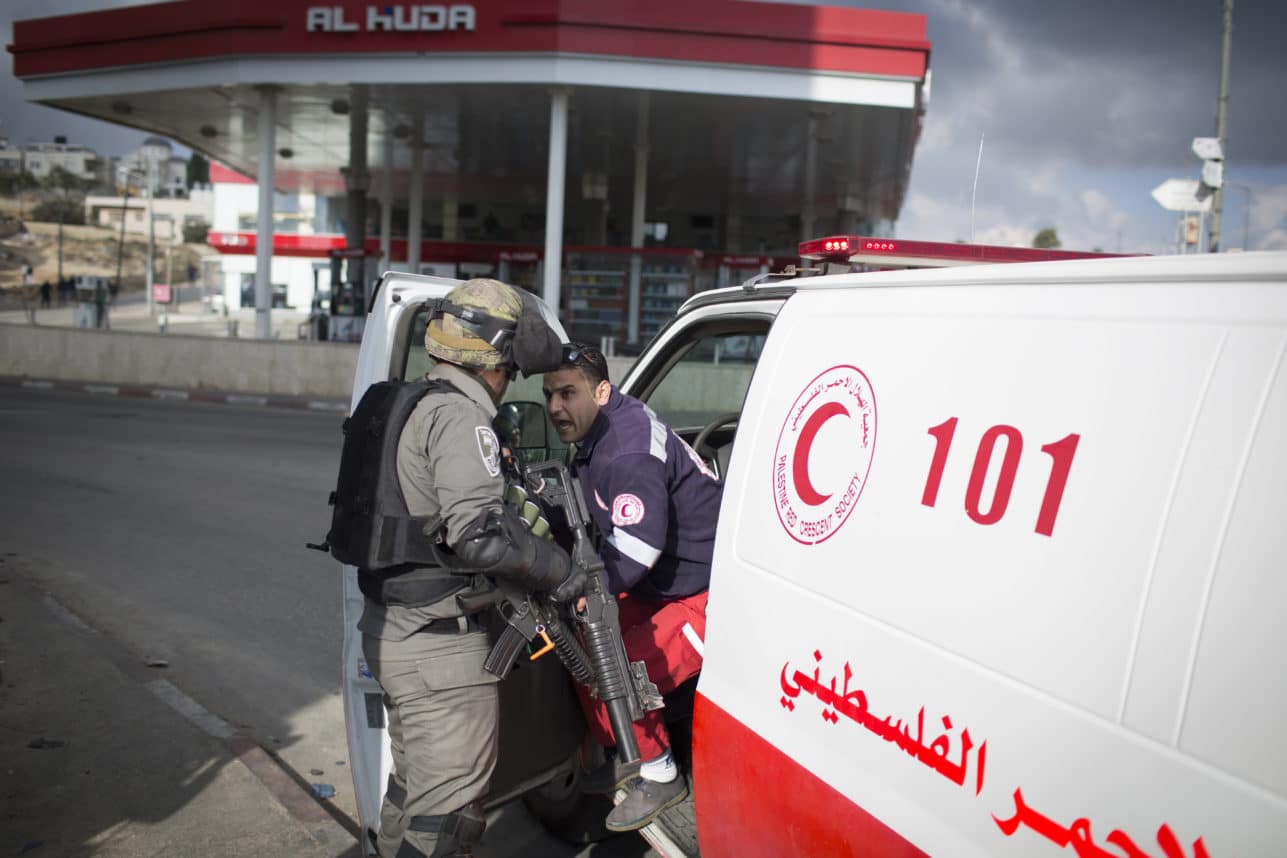
RAMALLAH, WEST BANK – DECEMBER 15: An Israeli border policeman talks to a Palestinian paramedic on December 15, 2017 in Ramallah, West Bank. Today is the tenth day of clashes in the West Bank, Jerusalem and Gaza following Donald Trump’s speech. (Photo by Ilia Yefimovich/Getty Images)
Rashid’s briefing on Monday took place at the headquarters of the PA’s Jerusalem Governorate in Dahiyat al-Barid, a suburb just outside the city’s municipal boundaries. Attending were Jerusalem Grand Mufti Mohammed Hussein; Adnan al-Husseini, a member of the PLO Executive Committee; Muatasem Taim, head of the Jerusalem unit in the Palestinian president’s office; and Issa Darwish, chairman of the East Jerusalem Zakat Committee.
Darwish was handed a check for NIS 787,994 (about $221,000) for the orphans.
Moshe Marzouk, an Israeli analyst and research fellow at the International Institute for Counter-Terrorism in Herzliya, told The Media Line that in light of the coronavirus pandemic, all aid was welcome, including for East Jerusalem and orphans, regardless of politics.
“We are now in a situation where all help is a blessing,” he said.
Israel’s battle to stop the spread of coronavirus appears to be bearing fruit and is leading many experts to express cautious optimism about these efforts.
There are more than 9,000 confirmed cases in the country, and as of Tuesday evening local time, 61 people were dead. However, the rate of new cases seems to have slowed following weeks of social distancing and stringent directives limiting movement.
Last week, Israel’s National Security Council released a report analyzing the outbreak. It found that the rate of new infections had fallen from 1.25 to 1.15 new cases a day for each previously diagnosed patient, according to The Marker, an Israeli news site.
Put together by a team of 30 experts, the report demonstrated that strict regulations were bringing about a positive trend, but also warned that isolation measures should remain in place, at least for now.
Put together by a team of 30 experts, the report demonstrated that strict regulations were bringing about a positive trend, but also warned that isolation measures should remain in place, at least for now.
“So far, the fight against the virus in Israel is [relatively] quite effective,” Dr. Shmuel Even, a senior research fellow at the Tel Aviv-based Institute for National Security Studies, told The Media Line. “The ratio of the number of dead to the number of known patients in Israel is only 0.36% [as of the end of March], which is very low relative to the rest of the world.”
Even stressed that early on, the Health Ministry recognized the threat that COVID-19 posed and proceeded to stop international flights. At the start of February, Prime Minister Binyamin Netanyahu limited – and soon after banned – flights from East Asia, a decision that was met with harsh criticism at the time.
“There are claims that Israel should have done more laboratory tests in the early stages,” Evan adds.
Israel’s first coronavirus case was confirmed on February 21 after a woman returning from quarantine aboard the Diamond Princess cruise ship, which had been docked in Japan, tested positive.
On February 26, Israelis were warned against traveling to Italy – where several people had already died – and were even urged to cancel all international travel plans. In early March, the Health Ministry announced that every traveler arriving from abroad would be required to self-isolate for a period of 14 days.
It was not until March 11, when 120,000 people worldwide had already tested positive, that the World Health Organization (WHO) declared a pandemic.
The same day, Israel limited gatherings to 100 people. A few days later, the number was restricted to 10 people. At the same time, citizens were strongly advised to keep a two-yard distance from one another.
Last week, the Deep Knowledge Group (DKG), a Hong Kong-based venture capital firm, ranked Israel first among countries keeping people safe from the pandemic, followed by Singapore and New Zealand. The United States was ranked 27.
(Courtesy DKG)
According to DKG, the survey relied on conventional parameters such as overall economic and technological development, in addition to data from the WHO, John Hopkins University and the Worldometer website.
“Two hundred data points were taken into account for each country, and in total, 10,000 data points were analyzed,” a spokesperson for DKG told The Media Line in an email. “The specific focus was on the capabilities of countries in applying advanced preventive progressive medicine, with the focus on AI [artificial intelligence] and digital medicine to extend healthy longevity.”
The firm said it looked at the reliability of diagnoses in each country, as well as the healthcare system, level of medical expertise, hospitals and medical equipment, military and other defense-mobilization capabilities, social discipline and several other factors.
The firm said it looked at the reliability of diagnoses in each country, as well as the healthcare system, level of medical expertise, hospitals and medical equipment, military and other defense-mobilization capabilities, social discipline and several other factors.
“We have significant concerns about the accuracy of the data provided by some specific countries and their official statistics,” the spokesperson said. “In some countries, the number of identified cases and number of deaths from coronavirus may be intentionally distorted.”
While others agree that Israel has shown leadership in its quick response to the outbreak, they do not believe it is currently possible to rank countries, saying the situation is still evolving at a rapid pace.
Prof. JacobMoran–Gilad, a medical specialist in clinical microbiology and public health at Ben-Gurion University of the Negev, told The Media Line that there was “a delay in the dissemination of coronavirus in Israel” due to travel restrictions and border closures.
“This bought Israel precious time in being able to prepare the health sector and the population for the later stages,” said Moran-Gilad, who is also a member of Israel’s national epidemic management team.
“The majority of countries are struggling and putting [the bulk of] their efforts and capacities into that,” he noted. “Israel is in a unique position because we had some more time to organize ourselves.”
“The majority of countries are struggling and putting [the bulk of] their efforts and capacities into that,” he noted. “Israel is in a unique position because we had some more time to organize ourselves.”
Still, he says, it is too early to rank national efforts.
“Even countries that appear to have succeeded in suppressing coronavirus infections in the very early stages may still experience a resurgence, so I would be very cautious,” he said.
Even if Israel is successful in containing the virus, Moran-Gilad says many will get sick, especially in those sectors that have exhibited opposition to embracing social distancing and heeding Health Ministry guidelines.
Israel’s laboratory-testing capacity has been another weak spot.
“I don’t think there was any harm done, but ideally it could have been faster,” Moran-Gilad stated. “Many professionals recommended performing wider surveys in the population to estimate the degree of dissemination of coronavirus. But to be honest, other countries have not succeeded in doing this either, barring a few.”
Prof. Cyrille Cohen, head of the immunotherapy laboratory and vice dean of the life sciences faculty at Bar-Ilan University, said he believes Israel’s COVID-19 testing capability is “quite good” compared to other locales.
“We’re doing a lot of tests, especially compared to other countries, like in Europe,” Cohen told to The Media Line. “We’ve reached 7,000 tests daily, which is a very good capability right now, and we’re trying to expand that. There are other countries that are not performing enough tests, so there are a lot of people who are not identified as carriers.”
Overall, Cohen believes the curve showing the coronavirus-infection trend in Israel is “not that bad” – though it could be better.
“In Italy, when they were at the same point as we are, more or less a month after the beginning of the infection, they already had 10 times more deaths than we do in Israel,” he said. “So we’re doing something right.”
A graph shows the number of new confirmed coronavirus cases reported each day, according to the Israeli Ministry of Health. (Screenshot/Wikipedia)
Despite his cautious optimism, Cohen says there has been a “race against time” to prevent medical systems and hospitals from becoming overwhelmed with critically ill patients, and that it was too soon to tell how successful Israel would be in this regard.
Key Challenges
Among the major obstacles facing Israel, Cohen points to a shortage of medical equipment and a lack of responsiveness from ultra-Orthodox, or haredi, Jews, many of whom were slow to adopt health guidelines.
“People have to obey and follow the Ministry of Health’s measures, so I’m a bit worried about what’s going on in certain parts of Israel where people are paying less attention to those guidelines,” Cohen cautioned.
His concerns appear well founded.
So far, Jerusalem’s ultra-Orthodox neighborhoods and the haredi city of Bnei Brak, near Tel Aviv, have the highest concentrations of infection. People living in these areas traditionally shun the internet and mainstream media. Some refused to close synagogues and schools in March, when the directives first came into effect.
Nearly one-third of Israel’s coronavirus cases are in Jerusalem and Bnei Brak, the Health Ministry revealed on Tuesday. What’s more, a report compiled by the National Knowledge and Research Center for Emergency Readiness, published by the ministry, revealed that roughly 75% of Jerusalem’s cases have been concentrated in haredi neighborhoods. It recommended that these areas be isolated from the rest of the city.
Following mounting pressure on authorities, police set up checkpoints around Bnei Brak and drastically limited movement in and out of the city. Residents are now allowed to leave only for medical assistance or emergencies.
Other experts remain unconvinced that Israel’s national strategy is a success, as has been portrayed.
Other experts remain unconvinced that Israel’s national strategy is a success, as has been portrayed.
A team of scientists at the Hebrew University of Jerusalem’s Racah Institute analyzed current data and forecast that 1,000 Israelis will become critically ill from coronavirus by mid-April. As of Tuesday, more than 150 Israelis were listed in serious condition.
Prof. Nadav Katz, who conducted the study along with Prof. Yinon Ashkenazi, Prof. Doron Gazit and Dr. Michael Assaf, told The Media Line that the number of Israelis who will need ventilators is not much better than in other countries.
“[The upward trend] is not quite as fast as Italy, but it’s similar to Germany and other countries,” Katz said. “But [at the same time] it’s not that different from Italy.”
While the measures Israel has put in place have certainly helped, he said, there is “always a very long delay” because symptoms take a week or two before they show.
“The future is always unknown, but the trends are pretty clear,” Katz continued. “The next week is going to play out with a large increase in critical patients.”
To stem the rise, Katz recommends that the government implement “much stricter” isolation measures, especially with at-risk populations such as the elderly, whom he argued should not be going out at all.
While he acknowledged that Israel’s response has been stronger than those of many countries, he said the current measures did not go far enough.
“The analogy to a brush fire is very strong,” he stated. “If you don’t put it out everywhere, it continues to burn. Half-measures won’t work.”
Medical Research Goes into High Gear
Medical researchers around the world are racing to develop treatments and vaccines, which will have to undergo several rounds of testing and clinical trials before going into production. While a vaccine is expected to take upward of a year to develop and test, other treatments could be just a few months away, health experts say.
“More than 20 vaccines are in development globally, and several therapeutics are in clinical trials,” a WHO spokesperson recently told The Media Line. “No treatment and vaccine exist yet, but researchers around the world [are working] hard on it.”
The state-run Israel Institute for Biological Research (IIBR) last week announced it had made “significant progress” toward developing a vaccine it will test on animals. It has been working on a prototype since early February.
Even though a vaccine will probably take between 12 and 18 months to be proven safe and effective, other treatments could emerge much sooner.
Even though a vaccine will probably take between 12 and 18 months to be proven safe and effective, other treatments could emerge much sooner.
Dr. Rivka Abulafia-Lapid, a senior virology lecturer at the Hebrew University of Jerusalem, said COVID-19 treatments will likely become available within six months, barring unforeseen developments.
“Israel already has 11 different drugs for trial… so I would say that the first thing to come out will be a drug that is commonly agreed upon by the world’s scientists and the FDA [the US Food and Drug Administration], followed by a vaccine,” she told The Media Line. “In a couple of months, they will come out with a future treatment or maybe a cocktail of drugs.”
Abulafia-Lapid, who for 25 years headed a research team in Israel dedicated to developing a viable vaccine against HIV and other autoimmune diseases, said a vaccine would have to undergo a lengthy testing period involving several phases of clinical trials.
Among the pharmaceuticals being examined in the meantime, she said, Gilead Sciences’ experimental antiviral drug Remdesivir − originally tested on humans with the Ebola virus − is a front-runner. The California-based biotech company’s medication is already being used in several coronavirus-linked clinical trials.
In the quest to repurpose existing drugs, researchers are testing more than 6,000 compounds, according to Israeli media. The drugs are already approved as being non-toxic to humans.
Others Join the National Effort
Israel’s defense and security establishments are devoting considerable effort to the struggle against COVID-19.
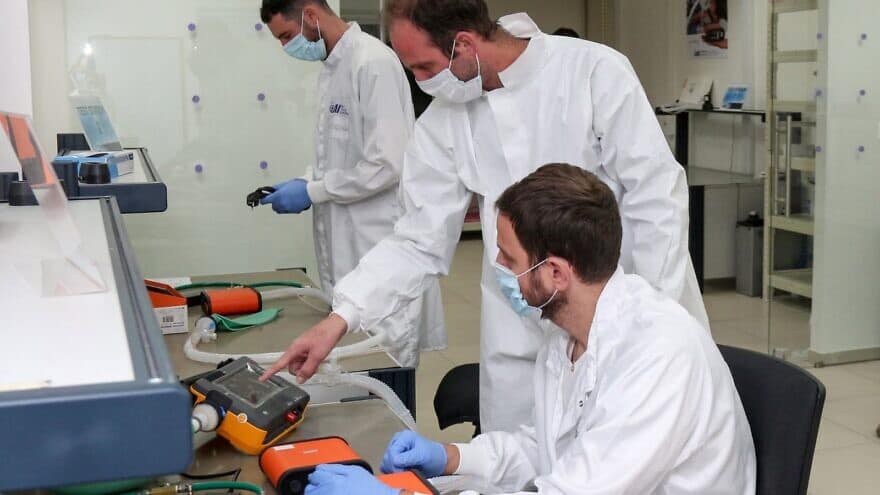
In collaboration with the Defense Ministry, the medical firm Inovytec and Israel Aerospace Industries have converted a missile factory into an assembly line for ventilators. The government body has also recruited a number of Israeli businesses to produce ventilators, masks and other protective equipment.
“The State of Israel is developing independent capabilities in its fight against COVID-19,” Defense Minister Naftali Bennett said in a statement last week. “This independence is essential to the national effort. We must not remain dependent on procurement from other countries.”
As of Sunday, 63 ventilators had been manufactured locally and delivered to the Health Ministry as part of DOPP’s efforts. (Courtesy Defense Ministry)
The ministry’s Directorate of Production and Procurement (DOPP) is helping the Health Ministry obtain the urgently needed medical equipment.
In a statement sent to The Media Line, the Defense Ministry said it was focusing on three main fronts: the purchase of protective gear and medical equipment; the “Hotel Initiative,” in which the DOPP is helping identify facilities that are appropriate for quarantining COVID-19 patients; and the import of essential medical equipment.
On Sunday, the ministry announced that 63 ventilators had been manufactured locally and delivered to the Health Ministry, and hundreds more would be produced in the coming weeks. Sion Medical, located in the southern city of Sderot, will meanwhile produce 35 million masks and hundreds of thousands of uniforms for medical professionals.
Israel’s security forces have also been mobilized and are helping to enforce Health Ministry directives.
Israel’s security forces have also been mobilized and are helping to enforce Health Ministry directives.
The Shin Bet internal security service is tracking confirmed and suspected COVID-19 patients via cellphone-location data. Hundreds of Israelis have received text messages notifying them that they must go into quarantine because they came in contact with infected people.
Thousands of police officers have been deployed across the country to ensure that lockdown directives are respected and no gatherings take place. Soldiers are assisting the police, especially in Bnei Brak, where they are also distributing food to the elderly.
To date, police have visited more than 73,000 Israelis who are required to be in isolation. There are 144 investigations into individuals suspected of having broken quarantine.
Looking to the Future
Even with optimism over Israel’s stringent health measures, the economic fallout is a major source of concern.
As of Monday, the country’s unemployment rate stood at an unprecedented 25.1%, with more than 1 million Israelis registered as jobless and nearly as many requesting unemployment benefits.
“This situation will continue at least until after Passover,” the INSS’s Even told The Media Line.
“This situation will continue at least until after Passover,” the INSS’s Even told The Media Line.
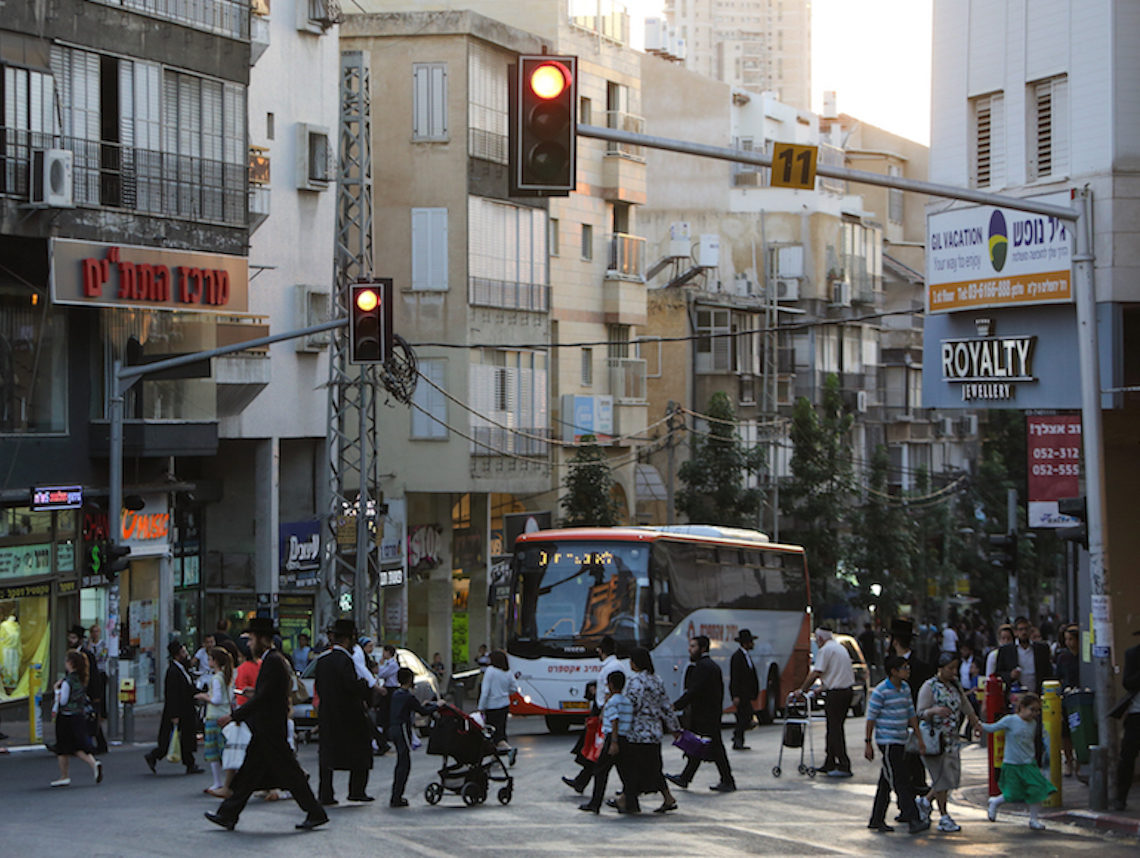
People walking through the mostly haredi Orthodox city of Bnei Brak, Israel, on July 16, 2015. Photo by Flash90
“The quarantine has very serious economic and social consequences,” he explained. “For example, economic damage to the gross domestic product this month is an estimated NIS 40-50 billion [$11-14 billion]…. Since this is a global crisis, it is appropriate that the crisis be managed on a global level as well.”
In expectation of a global recession, the Bank of Israel’s Monetary Committee lowered interest rates from 0.25% to 0.1% on Monday, marking the first such cut since 2015. The central bank also reported that the economy contracted by 5% in the first quarter. It further stated that the unemployment rate was expected to decline gradually and would reach pre-coronavirus levels only toward the end of 2021.
Despite the heavy economic costs, health experts warn that lifting restrictions too early could lead to a surge in new infections and undo all of Israel’s efforts.
“There’s a significant trade-off between mitigation and suppression, the economy and the welfare of the population,” Ben-Gurion University’s Moran-Gilad cautioned.
“There needs to be a balance,” he stated. “The next steps will have to try to offer the optimal way of balancing these factors. [We have to try] to get as many people back to work as possible, while keeping the risk for infection as low as possible. It will need to be very carefully monitored.”
Others agreed that the country needs to begin formulating a long-term exit strategy.
“Compared to other countries, I’m quite optimistic [for Israel],” Bar-Ilan University’s Cohen told The Media Line.
“There’s no doubt that COVID-19 is here to stay and we have to start learning how to deal with this long-term,” he said. “We have to hope that the research being done is going to result in a new therapy and give us the chance to win this fight.”
It’s the ninth question on the census, and for many Jewish respondents, it’s a surprising — and sometimes unwelcome — invitation to consider who exactly they are.
For the first time, the U.S. Census question on race is asking white and African-American respondents to dig deeper and fill in more detailed origins.
“Mark one or more boxes AND print origins,” the printed form says. For white, it adds, “Print, for example, German, Irish, English, Italian, Lebanese, Egyptian, etc.”
The request for “origins” has existed for decades for Native American, Hispanic and Asian/Pacific Islander respondents. But whites and blacks were previously asked to simply check a box.
The question has launched countless Jewish conversations: “What did you list?” “What should I?”
The answers reveal a community grappling with what it means to announce one’s Jewishness in the 21st century, and to consider the myriad paths that have brought American Jews to the present day.
“I didn’t see a box for ‘stateless people being abused and kicked out of one Eastern European region after another,’ so this seemingly straight-forward question turned out to be quite a head-scratcher,” said Jonathan Kopp, a communications strategist who lives in Brooklyn.
Kopp, 53, abandoned the form for a while before returning and checking “white.” He entered “Eastern European Ashkenazi Jew” in the origins box.
Jeff Weintraub, 72, an academic who lives in the Philadelphia area, said he thought the race/ethnicity/national-origin questions on the census form “were a little bizarre.”
“I checked ‘White’ and then, for elaboration, wrote something along the following lines in the box: ‘Jewish — grandparents from the former Russian Empire & the former Austro-Hungarian Empire,’” he said.
One complicating factor: The online census form makes it appear as if the “origins” question is not optional — but it is.
Leave the space empty, click continue and the page won’t change. The blank field will be highlighted, urging the user to fill it. Click one more time, however, and you’re able to move to the 10th question without filling it in. That’s not explained on the census form.
That hurdle led some to believe that the “origins” question required typing in an answer.
“Ashkenazi, just because,” said Debra Rubin, an editor in the Washington, D.C., area. “It didn’t allow me to skip, and I don’t understand why the question is there. I guess I could have put American.”
What’s in a question about race
Race has been a factor in the U.S. census since the first one, in 1790, but for the nation’s first century and a half, the answers were used as a means to codify rather than crush discrimination. The first census counted “free white males, free white females,” “all other free persons” and “slaves.”
Today, race is a means of redressing discriminatory practices.
Now it is a means of redressing discriminatory practices.
“This data helps federal agencies monitor compliance with anti-discrimination provisions, such as those in the Voting Rights Act and the Civil Rights Act,” it says on the census website.
For decades, the race category has had four broad categories: white, black, Native American and Asian, with “some other race” as the fifth option. Whether one is of Hispanic origin is a separate question.
This year’s extension of the “origins” option to whites and blacks was a result in part of lobbying by groups of Middle Eastern and North African origin who said their constituents were uncomfortable checking “white” and thought the “some other race” option was overly broad. For a period leading into the 2020 census, U.S. Census bureaucrats considered making “MENA” a separate category.
Austro-Hungarian what?
Many of those replying to a query from the Jewish Telegraphic Agency said they were not sure how to respond because their ancestors’ countries of origin no longer exist or have shifted borders, or because their ancestors were not precisely from a single place — born in one country to parents from another. For many, “Askenazi” or “Sephardic” became a default because it expressed an ethnicity in a simple way.
For many, “Askenazi” or “Sephardic” became a default because it expressed an ethnicity in a simple way.
“The vast majority of my family’s ancestral origins are Russian/Ukrainian Jews, but putting either of those didn’t seem quite accurate,” said Alex Dropkin, 29, a Chicago-area brewer who answered “Ashkenazi.” “The whole national origin for Eastern European Jews is complicated and not at all translatable to [one] modern country.”
Considering that history was also difficult emotionally, Dropkin said.
“Family records for Russian Jews rarely exist and it’s hard to know very much more about our ancestors because of all the pogroms,” he said.
Felicia Grossman checked “white” and entered “American” for “origins” after discussing it with her husband.
“We all came early enough that we were never considered full ‘citizens’ of any other country, and half the places don’t exist anymore as it is (i.e. ‘Bavaria,’ ‘Austria-Hungary’ and the Ottoman Empire — not to mention places that didn’t exist and now do i.e., Lithuania, Belarus, and Ukraine), so there’s an argument that it’s the most accurate answer,” said Grossman, 37, an author of historical romances who lives in the Cleveland suburbs.
Lloyd Wolf, an Arlington, Virginia, photographer, packed as much as he knew into his answer.
“I put in something like ‘Jewish of German, Austrian and Polish origin’ because that’s what my background is, at least the past several generations,” he said on Facebook.
Same country, different peoples
Morris Lewis, a health care consultant in Caldwell, New Jersey, said his neighbors growing up in Mississippi and Georgia were likelier to identify his family as Jewish than with the non-Jewish neighbors whose ancestors had arrived from the same countries.
“We may have shared space with Poles, Germans, etc., but we have a completely separate ethnicity and culture,” said Lewis, 59, who entered “Ashkenazi Jewish.”
“We may have shared space with Poles, Germans, etc., but we have a completely separate ethnicity and culture,” said Lewis, 59, who entered “Ashkenazi Jewish.”
Susan Turnbull, who lives in Washington’s Maryland suburbs and has held leadership positions in national Jewish organizations and the Democratic Party, took her cue from the categories made popular by the recent proliferation of DNA testing.
“Ashkenazi Jewish — 100% of my DNA description,” she said.
Suellen Shapiro Kadis, a lawyer who lives in the Cleveland area and is a board member of JTA’s parent organization, 70 Faces Media, said she entered “Russian” but was not happy with it.
“My dad was born in England on the way over. His immigration papers say ‘Hebrew,’ which I always thought was a way to discriminate, but maybe it’s more accurate than my answer,” she said.
Rafaella Gunz, a 26-year-old writer from New York, checked off “white” and entered “Jewish.”
“Though I am white in certain contexts, especially in the U.S., I’m actually ethnically distinct and come from a group of people with our own unique history.”
“I did this to document that though I am white in certain contexts, especially in the U.S., I’m actually ethnically distinct and come from a group of people with our own unique history,” Gunz said.
(Jewish) Pride and (anti-Jewish) prejudice
Some respondents welcomed the opportunity to celebrate their origins.
“I simply don’t identify as anything else other than Jewish,” said a Hasidic respondent who asked not to be named.
Judith Marks said she was proud to answer “Askenazi Jewish.”
“Being Jewish is a huge part of my identity, it’s my primary identity,” the program manager at a nonprofit in Boston said.
“Being Jewish is a huge part of my identity, it’s my primary identity,” the program manager at a nonprofit in Boston said.
Marks, 31, said she thought the question could help shatter the sense of privilege among other whites.
“It’s important for me to identify as white because I benefit from white privilege and am perceived as white,” Marks said. “When you are forced to dig deeper, to go beyond the just ‘I’m white,’ you’re put in the same boat as other people.”
Others welcomed the opportunity to express in the census the otherness that they feel separates them from being simply white in America.
Rebecca Einstein Schorr, a rabbi at Lafayette College in Easton, Pennsylvania, checked “some other race” and entered “Ashkenazic (Jewish).”
“My experience moving through society differs from those who are white,” she said. “The constant sense of being othered. The sense of anti-Semitism.”
“My experience moving through society differs from those who are white. The constant sense of being othered. The sense of anti-Semitism.”
Some respondents were wary of the question.
“I can’t think of anything good the census bureau would be using the ethnicity origin data for,” said Frederick Winter, 72, a retired federal employee living in Arlington. “I understand that by law census data is not shared with other agencies, but I have my doubts.”
He checked “white” and entered “USA” for origins.
For one couple, sensitivities about being Jewish in a non-Jewish society broke in opposite directions.
Gabriel Botnick, a Los Angeles-area rabbi, was set to enter the fifth option, “some other race,” and add “Jewish” because he does not identify as “white” — he said “I have been made to feel” not white in the past. His wife, also a rabbi and originally from Britain, asked him to check “white” and skip the origins.
“She said this current climate makes her uneasy with being listed as Jewish somewhere,” Botnick said.
Jewish celebrities are teaming up to hold an online “social justice Seder” this Thursday night.
The Passover celebration, called “This Year Together – A Digital Social Justice Passover Event,” will include inspirational readings, poetry, and music, with storytellers, artists and activists. Some of its Hollywood hosts include: One Day At A Time executive producer Norman Lear, Will & Grace star Debra Messing, This Is Us actress Chrissy Metz, The Hangover producer and Anti-Recidivism Coalition founder Scott Budnick, and Shameless lead Emmy Rossum.
“This year, our connection to the story of Passover feels more relevant than ever. A global pandemic has laid bare the many injustices that afflict modern society. Among them: access to healthcare, education and affordable housing; racial inequality; climate change; mass incarceration,” the event advertises.
“This Year Together” will be non-denominational and feature meditation, music, poems, and traditional Passover rituals, followed by a call to action.
Life coach Ryan Weiss will lead the event.
“Whether you are unable to spend the holiday with your friends and family while social distancing or are new to Passover and want to deepen your knowledge of the holiday, this will be an immersive experience that everyone can find a home in,” said Weiss.
The Seder will be streamed on Facebook and Youtube at 5:00 PT/ 8:00 ET PM.