fbpx

April 2, 2020

This Virus Represents The Global Death of Human Ego

As a deadly, invisible force sweeps the planet, something profound is happening. We are in Hollywood late-show host Jimmy Fallon’s home as his daughter climbs his backMullahs in Iran, unbreakable for four decades, fall deathly ill. A prince of England goes into quarantine. Healers are slain from China to Manhattan.

The coronavirus respects no power or status. It strips us of our lines of demarcation, identity and ego. It forces us to see one another as equally vulnerable.

Philosophically, this virus represents something deep: a global death of human ego.

We face the devastation of our ordinary, everyday selves with pushes to transfigure and redefine our identities. In Hinduism, this transcendence is represented by the goddess Kali severing the head, a symbol of the ego. In Buddhism, this transformation is illustrated by the concept of the Severed Head Vajrayogini, the severing of the head from the body again representing destruction of the ego.

Jewish kabbalists call the dissolution of the ego “bitul hayesh.” The ego is nullified and undergoes death. If the dying of the ego is facilitated carefully, it opens the doors to self-realization and renewal. The ego’s death opens the possibility of rebirth and a reconstitution of the self. In Islam, Sufis call the breakdown of the self “fana,” meaning annihilation of the ego − also a nullification meant to reconstitute the self.

Often spoken about mystically, one can understand an “ego death” existentially.

In ordinary life, we are starting to see a fissure in our egos, and the meaning of our lives called into question. Weeks ago, CNN host Chris Cuomo spoke about the “surrender of the me to the we.” Now, he lives in isolation in his basement after testing positive for COVID-19. In a “Pandemic Times” podcast last week, Jewish Journal editor-in-chief David Suissa asked, “Is there a transcendent, larger than life component to this global crisis, which is touching all of humanity?”

The long answer is yes.

The attachments that once defined our lives are falling away, turning us inward. We are abandoning attachments to the most mundane, from chai at Starbucks to Pilates and PTA meetings. Isolated in our homes and estranged from the familiar, our identities of the past are losing meaning − to be replaced with new identities.

There is no better time than now to get philosophical.

The pandemic is dissolving our ego’s sense of a “separate self.” Walking onto late-night host Steven Colbert’s show one recent Friday night, CNN contributor Dr. Sanjay Gupta held his hands together in a firm namaste that is part of his ancestral tradition in India. He said, “I don’t want to get too philosophical here, but I find it really fascinating in a way that, if not for me, if I don’t engage in good behaviors for me, then I should do it for you. I should do it for the people around me.”

There is no better time than now to get philosophical.

The ego, or the “ordinary everyday self,” as late Tibetan Buddhist scholar Traleg Kyabgon Rinpoche described it, informs our sense of reality and identity. When the ego dies, it is possible for its death to overwhelm and bewilder us. Our first principles lose their categorical nature, our sobriety becomes compromised, and our rational foundations start to shake. James Hollis, a Jungian analyst and director emeritus of the Jung Educational Center in Houston, describes it this way: “Either we die unto who we were, in order to move to the next stage, or we die through staying stuck, and suffer stasis and stultification.”

We can see the ego in the individual, but there also is something modern-day philosopher Eckhart Tolle calls the “collective ego.” Early 20th-century psychiatrist and psychoanalyst Carl Jung called our group thinking and feeling the “collective psyche” in a 1916 essay, “The Structure of the Unconscious.”

When “ego death” is overwhelming, in both the individual and the collective, an adamant reassessment of values ensues. Ordinary thinking breaks down, which is happening today in simple ways, including our sense of safety in just breathing. We experience the world with surprise, shock and uncertainty − three emotions people around the world now simultaneously feel.

Dr. Stanislav Grof, a Czech-American psychiatrist based in California and Germany, remarks that “ego death” can “entail an instant merciless destruction of all previous reference points in the life of the individual.” This can be true for global “ego death.”

But out of destruction, a new world can be born, vitalized and united by the chaos over which it triumphed. “The agony of breaking through personal limitations is the agony of spiritual growth,” wrote philosopher Joseph Campbell. In our global “ego death,” we are tasked with learning from our agony to grow from it as self-realized and devoted to the safeguarding of our health — as individuals and as a collective.


Samir Nomani is a recent graduate of philosophy from the College of the Holy Cross and is a poet and musician, completing his MA in Music Industry at West Virginia University. Asra Q. Nomani is a former Wall Street Journal reporter.

This Virus Represents The Global Death of Human Ego Read More »

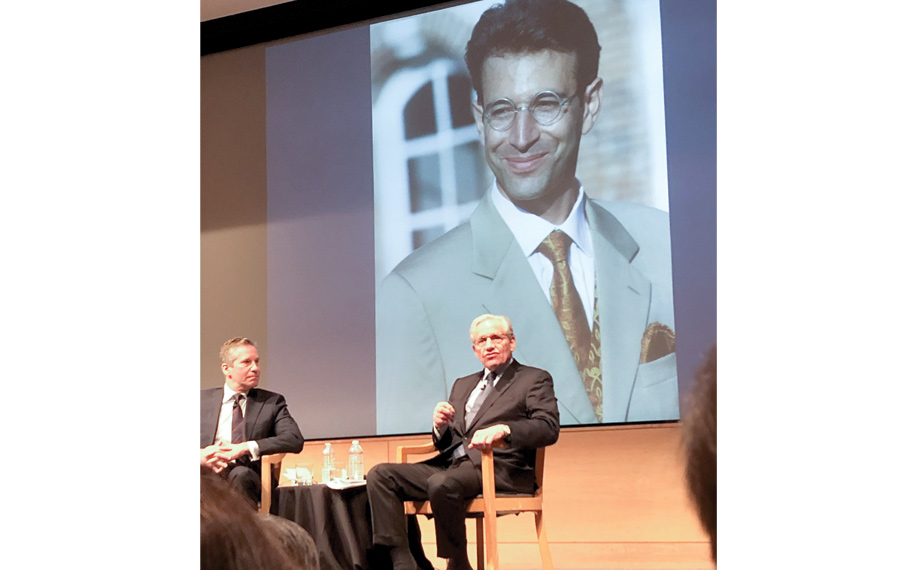
Pakistan Court Overturns Conviction in Daniel Pearl Murder Case

[Islamabad] An appeals court in Karachi, Pakistan, has overturned the murder conviction of the man sentenced to death for masterminding the kidnapping and beheading of US journalist Daniel Pearl in 2002.

Ahmed Omar Saeed Sheikh, a British-Pakistani national condemned to death in July 2002, was instead found guilty only of kidnapping. The charges against three alleged accomplices were also reversed.

One of Sheikh’s lawyers, Khwaja Naveed, told reporters that after having been imprisoned for 18 years, Sheikh could go free in a matter of days. The two justices from Sindh Province’s High Court said prosecutors had failed to successfully argue their case.

Pearl, a Mumbai-based reporter for the Wall Street Journal, had gone to Pakistan to write a story about armed groups following the 9/11 attacks on New York City and Washington, D.C. He disappeared in Karachi on Jan. 23, 2002, on the way to what he believed would be an interview, and was decapitated by his captors nine days later. The beheading was videotaped.

Justice Agha Muhammed Karim declared that “the prosecution had failed to prove the case against them” for murder. The appeals court ruled that Sheikh should serve seven years in prison for Pearl’s abduction. He has been on death row for 18 years.

Karachi police arrested Sheikh in February 2002. He was held along with the three others, Syed Salman Saqib, Fahad Naseem and Sheikh Aadil.

In June 2002, a counterterrorism court sentenced him to death by hanging. The others each received a 25-year prison sentence. The four filed appeals the following month.

The state also appealed, seeking to convert the 25-year sentences to the death penalty.

Sindh Prosecutor-General Fayaz Ali Shah told The Media Line: “Sheikh will remain in prison because his appeal against the death penalty is still pending at the Supreme Court of Pakistan. [The] provincial prosecution will appeal against the appeals court decision.”

However, Khawaja told the Media Line that Sheikh “has already served more than seven years in prison, so he would be freed” with the others.

“The police could not present concrete evidence during the trial against the accused,” he added. “The only witnesses were policemen.”

Pearl, the Wall Street Journal’s South Asian bureau chief, had been investigating a story about the alleged financing of al-Qaida via Pakistani militants. He was also trying to find links between Pakistani terror groups and Richard Reid, who had attempted to blow up a US airliner with a bomb built into his shoe.

The National Movement for the Restoration of Pakistani Sovereignty had claimed that it was responsible for abducting Pearl, but Pakistani security officials said the kidnappers were members of Lashkar e Jhangvi LeJ, a banned al-Qaida affiliate.

Daniel Bastard, responsible for Asia/Pacific affairs at Reporters Without Borders (RSF), condemned the court’s decision.

“The ruling is a shocking symbol of impunity for crimes of violence against journalists. This is [also] a shocking denial of justice for Daniel Pearl’s family, as well as for reporters in general,” he told The Media Line.

”Although RSF is fundamentally opposed to the death penalty, we deeply regret this morning’s verdict because it lacks coherence,” Bastard added. “While the judges confirm the guilt of Saeed Sheikh, their appeals sentence will likely allow him to go free, along with the three other accused.”

Michael Kugelman, the Asia Program deputy director and Senior Associate for South Asia at the Woodrow Wilson Center in Washington, said the Pearl case altered people’s views of the southwest Asian country.

“The horrific execution of Daniel Pearl, which happened fairly soon after the 9/11 attacks, had a major impact on US public perceptions of Pakistan,” he told The Media Line. ”Nearly 20 years later, it still looms large. It will be interesting to see if the US officially responds to this verdict.”

Scores of Pakistanis expressed concern over the court decision with the hashtag #danielpearl on Twitter.

Moed Pirzada, a leading Pakistani analyst, tweeted: “Very Disappointing Decision! Once again, based on technicalities, truth is defeated in our courts and evil set free; even abduction leading to a gruesome beheading deserved life without parole! Sad Day for Justice.”

Iman Zainab Mazari, Karachi-based lawyer and human-rights activist, said in her tweet: “As a Pakistani, I offer my sincerest apologies to Daniel Pearl’s family and friends. I can imagine their pain, and my heart breaks thinking of it.”

Pakistan Court Overturns Conviction in Daniel Pearl Murder Case Read More »

Funkadelic, Passover, Shabbat, COVID-19 and Me

What does it mean to be a slave? There is a redundancy of time and tasks; each day looks like the previous one and the next day is going to be the same as well. Isn’t the meaning of slavery a question we ask ourselves each Pesach at our Sedars? In order to celebrate the liberation from slavery, an understanding of the meaning of slavery is an essential component of the holiday.

In the pantheon of Jewish rituals, Shabbat has become the ultimate rebellion against slavery.  We acknowledge that in the Kiddush when we bless the wine in memory of both the creation and the Exodus from Egypt.  Instead of being controlled by time, I become its master.  I do not work at my chosen profession and spend the precious 25 hours with the people that I love, in prayer, in study, in contemplation and most importantly, in a community of others who are doing the same thing.

Shabbat consists of a series of rituals designed to make the day look and feel different. It is ended with a prayer that acknowledges its separateness from other days of the week.  Hamavdil bein kodesh lechol is blessing God who makes the distinction between the holy and the secular. And when Shabbat is over, we return to the daily grind.

And that is how my people have been celebrating both time and history for over 3,000 years. However a few months ago, a virus that originated with a bat which became zoonotic (a $64 word for transmission from animals to humans) and suddenly everything prior to that time meant something different.  Prior to March of 2020, whoever heard of social distancing, home quarantining or the myriad of other things we are having to do to avoid both getting and transmitting this deadly virus?

And with quarantining ourselves inside of our homes, each day feels the same as the previous one, a slavery of sorts. Granted this is not the physical slavery of Egypt, but it is not without its consequences, which include a redundancy of time, a similarity of each day to the one before it.

Without that marked difference between Shabbat and the other days of the week, the celebration of Shabbat these past few weeks have seemed listless and out of place. The holiness of Shabbat is acutely choreographed and so much of it is done within the context of community.  But that community has been taken away from each of us for our own safety and well being.  So when the task of making Shabbat holy can no longer be communal; it can only be personal and familial.

Is there still a method in the age of COVID-19 to connect with others as a means of feeling the transcendence of Shabbat? I am a non-Orthodox Jew so I do have the internet and electronic devices with which to connect to others in my community. But I am harping on an illusion and attempting to fool myself into somehow thinking this form of connection is anything other than an inadequate substitution for the real thing.  It may be the best form of Shabbat communal connection that we can have, but nevertheless it is a poor substitution.

Maybe my inability to find the connection that I seek comes down to a failure of my own imagination. George Clinton of Funkadelic may have had it right when he wrote, “Free your mind and your ass will follow.”  But the Rabbis who designed the rituals of Shabbat did so for a reason.  There are limitations to human imagination.  We are finite beings who need the tangible symbols with which to connect.  Otherwise everything is merely abstraction.

The Pesach story is the most visible demonstration of our need for non-abstractions.  We tell an actual story; we eat food symbolic of the story.  It is concrete.  We then personalize the story.  As the Haggadah says, it is incumbent upon us to personalize the Exodus. You must regard yourself as having been personally brought out of Egypt.  We do not live in an era of Jewish physical slavery. So personal liberation must take on a different tone, a spiritual liberation.  The symbols of the Seder are but one means of connecting.  Yes we may be connecting without loved ones present in small gatherings without the usual collection of extended family and friends.  But spiritual liberation is actually a mental state, which requires a freeing of the mind. And now more than ever we need to follow Funkdelic’s admonition that once we do so, everything else will follow!

Stay safe and hag sameach!!!


Doug Workman is a lawyer quarantining in Northridge.

Funkadelic, Passover, Shabbat, COVID-19 and Me Read More »

It’s In Israelis’ DNA to Battle the Coronavirus

Many years ago, some Israelis were among a group of backpackers abducted by terrorists in Asia. I forgot what country this occurred in, but I vividly remember watching TV at home when the initial report alleged that two of the backpackers had charged the terrorists and had been fighting with them. My son immediately said, “It must be the Israelis.” Indeed, few hours later, one of the Israelis was interviewed by the local TV stations. When asked how they had dared do such thing, he answered: “We wouldn’t be Israelis had we not tried.”

This can-do attitude is engrained in the Israeli DNA. We are used to fighting enemies on the battlefield, and always win even if we are taken by surprise, like, for instance, the Yom Kippur War. We chase terrorists who hide among civilians, targeting the suspects while trying to spare the innocent. We overcome economic crises like the one in 2008, emerging stronger than before. The one thing we can’t bear is standing idly by and letting events take their course without trying to shape them.

The coronavirus, however, seems to be an exception simply because this enemy is so elusive. Therefore, when it began to spread among us, we were confused: Should we paralyze our economy to overcome the coronavirus? Are we taking the right measures? Why does something that works in one country not work in another?

Then the Israeli can-do reflex came to life. Forget about the strange way Israeli Prime Minister Benjamin Netanyahu has been managing the crisis, not handing it over to the Homeland Command, which specifically had been created to deal with national crises (hint: he doesn’t want to share the credit with Naftali Bennett, Minister of Defense). And forget about the political mayhem, where after three election campaigns Israelis can’t form a decent government. It is the Yom Kippur War all over again: When the leadership failed, it was the officers and soldiers who saved the day.

So first of all, disregarding the uncertainties, Israelis asked themselves what they could do. In the emergency center at Sheba Medical Center, health officials were desperate to get information from other countries and analyze it: Why in Germany did few people die when the number of those infected is high? How did South Korea flatten the curve? Usually it takes days or weeks to get answers but not if Israel Defense Forces (IDF) clandestine Unit 8200 steps up, however. This elite unit of the IDF intelligence has the brightest people in Israel, who later become the entrepreneurs of Startup Nation. They provided the vital information in real time.

Explains Avishai Abrahami, a veteran of Unit 8200: “There’s nobody around to tell you how to do it … your superiors just tell you to go figure it out. That gives you the huge freedom to think differently. It’s you or nobody else.”

“The one thing we can’t bear is standing idly by and letting events take their course without trying to shape them.”

Then there was an acute shortage of ventilators and personal protective equipment. With the whole world desperately scrambling to get them, a black market blossomed. Israel then played its ace: If the Mossad could snatch Iran’s nuclear archives, surely it can deliver some medical equipment. There was a problem, however, because when the Mossad eventually brought those ventilators, we didn’t know what to do with the patients attached to them (humor, of course, is another way Israelis cope with this tsure).

Finally, there is a global race to find a vaccine for or a cure to the virus, and there might be good news coming soon from MIGAL-Galilee Research Institute based in Tel Hai, in northern Israel. A long time ago in Tel Hai, Joseph Trumpeldor, an early Zionist activist, was hit by an Arab bullet and, in his last breath, allegedly said, “Never mind, it is good to die for our country.” Researchers of MIGAL, on the other hand, believe that it is good to live for our country. In the past, they have developed a vaccine against IBV (infectious bronchitis virus), a disease affecting poultry, and are now working day and night to make the required genetic adjustments to adapt the vaccine to COVID-19.

And while the Lord said to Jeremiah: “Out of the north the evil shall break forth upon all the inhabitants of the land,” I hope that out of the north there will be a breakthrough in the search for a vaccine for or cure to the coronavirus, and if and when that happens, remember you first heard about it here.


Uri Dromi is the director general of the Jerusalem Press Club. From 1992-96, he was a spokesman for the Israeli government.

It’s In Israelis’ DNA to Battle the Coronavirus Read More »

As An Asian Israeli, The Coronavirus Has Awakened Me to Our Racism

On Feb. 16, a young Taiwanese woman posted on the popular Facebook group Secret Tel Aviv that she was riding her bicycle and a group of Israeli teenagers began to yell “Sinit” (Hebrew for Chinese) and “corona” at her. She called the police in tears. On March 15, a 28-year old Indian Yeshiva student was hospitalized after being beaten by two Israelis in Tiberias because they felt he “looked Chinese.”

A few weeks ago, as the hysteria amid the beginnings of the COVID-19 outbreak began, I turned around in the kitchen at work to find a colleague of mine coughing at me. I stared blankly, and he said, “You’re Asian. This is a little bit of a problem.” I literally had no words. I took my coffee and fled to my desk, speechless.  A fearful realization popped into my head: Two things have been spreading faster than the virus itself — misinformation and racism and xenophobia toward Asians  —and Israel is no exception.

Even before the pandemic, Israelis made inappropriate comments to me or asked me uncomfortable questions about my origins — from random people on the street asking if I want to clean their houses to cringworthy men in clubs telling me I’m “exotic.” This pandemic has only amplified these things.

I preface everything I’m about to say with the fact that I truly love Israel and the Jewish people. I am a staunch Zionist who has dedicated most of my career to working for Jewish nonprofits; encouraging young people to grow their relationships with Israel. I run an Instagram account that offers  a look into the daily life of Israelis and new immigrants, hoping the world might see that it’s not all wars and camels.

I get it. Asian Jews are far and few between, so if I want someone to speak up for us then I have to do it myself. So I am here to tell you, Israel has a real problem that runs deeper than any virus and needs to be eradicated.

“But how,” you ask? Israel is a country made up of diverse immigrants that fled ant-Semitism, persecution and some of the worst discrimination in the world. However, this is the first time in modern history that the Jewish people in Israel find themselves in a position of power. With this power comes great responsibility — the decision on how to treat minorities in our society. From my personal experience, Israel is missing the mark.

Two things have been spreading faster than the virus itself — misinformation and racism and xenophobia toward Asians  — and Israel is no exception.

Israelis simply do not understand and/or deny that something is racially motivated. They were never educated on why or how racism is bad. When the incident about the young Indian student was posted on Facebook it received the following comments: “My question is, who brought coronavirus in Israel? Get well bro,” and “This has nothing to do with race or color.”

Another common excuse I encounter is: “Amy, there is racism everywhere in the world.” Unfortunately, this is true. However, this is not an acceptable excuse. We should strive to do better. We often boast our purpose is to be a light among the nations, so let’s become that. Let’s acknowledge the racism and start improving. Here are two steps we can take right now:

1. When someone reports an incident of racism or discrimination, listen to them. Don’t say, “Oh, well people are just rude.” There is a difference between being rude and acting on racially charged pretenses. It can be hard to spot prejudice when you’ve never experienced it, so trust our minorities when they tell us it is happening.

2. Actively choose to eradicate racism. If you don’t understand why something is racist, ask. And then listen. If you witness something racist or xenophobic, speak up. We each have the potential to make a monumental change with our small, individual actions.

The coronavirus is devastating societies around the world. However, we have a real opportunity to translate it into something positive. While everyone is learning the importance of practicing proper hygiene, we can wash our hands of the racism in Israel.


Amy Albertson is a Californian-turned-Tel Avivian, and the new immigrant behind the Instagram account @theasianisraeli.

As An Asian Israeli, The Coronavirus Has Awakened Me to Our Racism Read More »

Swastikas Found on Maryland Synagogue

Swastikas and other slurs were found spray-painted on a Maryland synagogue on the morning of March 28.

The Washington Jewish Week reported that the vandalism occurred at Tikvat Israel Congregation in Rockville; the graffiti also featured the world “Hitler” misspelled as “Hilter.”

Surveillance video from the synagogue shows a male suspect appearing to commit the vandalism.

The graffiti was removed on March 29; the synagogue’s neighbors put a painting on the front door of the synagogue that read: “You R Loved.”

Tikvat Israel Rabbi Marc Israel told the Jewish Week, “It’s horrifying, the level of hate that exists.” He added that one of the silver linings of the coronavirus pandemic is that “very few of our members were able to see [the graffiti].”

The American Jewish Committee condemned the vandalism in a tweet.

“Anti-Semitism and hate are on the rise in the U.S.,” it wrote. “We cannot allow hate crimes to go unchecked and uncounted.”

The American Jewish Congress similarly tweeted, “We hope that this disgusting #antisemite is brought to justice soon.”

Swastikas Found on Maryland Synagogue Read More »

Adelson Says He Will Continue to Pay Employees During Shutdown and Urges Other Employers to Do So

Jewish philanthropist and GOP megadonor Sheldon Adelson wrote in an April 1 New York Post op-ed that he will continue to pay all of his employees while his casinos temporarily are shuttered and urged other employers to do the same.

Adelson began his op-ed noting that he was raised in a poor, immigrant household, so he understands the stress that millions of Americans are enduring at the moment as nonessential businesses are being shut down across the country to combat the spread of the coronavirus. He added that despite his family’s financial struggles while he was growing up, his father always set aside money for a charity box because he said, “there is always someone whose need is greater than ours.”

“There are certainly great stories of corporate America doing all it can to support employees’ needs during a time when so many of our fellow Americans have been asked to stand down from their work,” Adelson wrote. “But we employers, especially larger ones, can do more. We should do more.”

He praised President Donald Trump and Congress for the recent $2.2 trillion stimulus bill that provides financial relief for families and businesses adversely affected in the pandemic. However, Adelson noted that it might not be enough if the pandemic is prolonged.

Adelson also praised various Republican and Democrat governors, such Ohio Gov. Mike DeWine (R) and New York Gov. Andrew Cuomo (D) for their leadership in handling the crisis. He ended his op-ed on a note of optimism.

“I have seen the perseverance of this country over and over again,” Adelson wrote. “The common thread is that this nation and its people always come together in times of great need. There is no doubting this is one of those times, and the need is great.”

He added: “The coming weeks will be tough, and the months that follow will be unsteady. To my fellow business leaders, let us lead by example. I will gladly participate in an ongoing discussion with each of you on ways we can work together to protect this nation’s workforce.”

On March 30, Jewish Insider reported that Adelson is donating 2 million masks to hospitals in New York and Nevada; 250,000 of those masks will be part of the Trump administration’s initiative in providing aid to medical personnel.

Adelson Says He Will Continue to Pay Employees During Shutdown and Urges Other Employers to Do So Read More »

Anti-Semitism and Israel Advocacy Matters Even More During Coronavirus

There’s no doubt that anti-Semites and Israel detractors haven’t gone away simply because of the COVID-19 pandemic. Like the coronavirus, they, too, have mutated and changed their strategy. Therefore, so must we in the pro-Israel community, grasping the opportunity presented by this unprecedented and incredibly challenging period facing the entire world.

While many physical events, like the shameful “Israel Apartheid Week” on American college campuses, boycott, divestment and sanctions protests and the tri-annual United Nations Human Rights Council Israel-bashing session, have been canceled, our enemies, likewise confined to their computers, are resorting to spreading hate, misinformation and conspiracies online. This has created an “anti-Semitism on steroids” situation, which, if not addressed, only will continue to spread like a virus.

According to the Anti-Defamation League, “as the coronavirus continues to surge globally, antisemitic, xenophobic, and hateful messages and conspiracy theories are proliferating rapidly online.”

Spend even a cursory glance on the internet, and you cannot escape the deluge of conspiracy theories and vicious anti-Semitic hate material, from alleging Israel created the coronavirus to hook-nosed, greedy Jews profiting from its existence and Israel Defense Forces (IDF) intentionally infecting Palestinians with it.

This is, of course, notwithstanding Israel and the IDF are going out of their way to assist Palestinians in the combating this virus, including providing medical equipment and gear to the Palestinian Authority (PA), providing further aid, including testing kits, into Hamas-controlled Gaza and operating joint task-forces with the PA, as well as training their medical professionals. In a highly unusual step, even the U.N. Security Council praised Israel for this.

This influx of hate is coming from a toxic mix of far-right, far-left and Palestinian and Islamist sources.

Journalist Roshan Salih, from the Iran regime’s Press TV channel, even tweeted that “I’d rather take my chances with the virus than consume an Israeli vaccine.”

This influx of hate is coming from a toxic mix of far right, far left and Palestinian and Islamist sources.”

Adding fuel to this anti-Semitic fire has been a host of anti-Israel nongovernmental organizations seeking to shamelessly weaponize the coronavirus in their relentless assault on the Jewish state. This has included Blood Libel charges that Israel is somehow contributing to the spread of coronavirus to calling on Israel to lift the “blockade” of Gaza, as if COVID-19 has turned Hamas into the Salvation Army and not the brutal jihadist terror group it is.

Sarah Leah Whitson, the former head of the Middle East division at Human Rights Watch, even tweeted that Israel is only “missing a tablespoon of blood” in its purported oppression of Palestinians in the wake of the coronavirus and perhaps only now, will Jewish Israelis understand life under occupation. You don’t get anti-Semitic tropes any bigger than this.

What the global community is facing today is unprecedented, presenting unforeseen challenges and requiring dispensing with existing prejudices and grasping of new opportunities if humans are to defeat this pandemic.

So, what are some steps that those in the pro-Israel community can take during this time?

First, we need to be uncompromising in calling out, correcting and, where appropriate, responding to the hate and anti-Semitism proliferating online.

Secondly, we have an opportunity to shape the true narrative, including the immense steps Israel is taking in assisting and cooperating with the Palestinian Authority, and that how in this toughest of times, this could perhaps even serve as a model for future cooperation.

Thirdly, Israel, through its scientific and tech expertise, has much to share with the world. Our scientists, entrepreneurs and even special IDF units are leading the global effort in finding a vaccine for the coronavirus. Israel is also a world-recognized leader in disaster relief management, and Israel’s Foreign Ministry’s efforts to repatriate Israeli citizens, as well as assist other countries, is truly inspiring. It is imperative the world knows this.

Fourthly, although Israel has not been immune to the tragic loss of life from this pandemic, per capita, it has one of the lowest mortality rates. A study by Deep Value Knowledge company on March 31 ranked Israel as the safest country for dealing with the coronavirus, while Austrian Chancellor Sebastian Kurz credited Israeli Prime Minister Benjamin Netanyahu for alerting him (and European allies) to the seriousness of the virus and the need to take stronger action in response. The international community can learn a lot from Israel’s efforts to manage and fight this pandemic.

Lastly, we must utilize the entire array of digital diplomatic tools at our disposal to tell Israel’s story and how it is coping with this virus, to respond to the hatred and anti-Semitism mushrooming online, as well as to be pro-active in shaping our narrative.

While humans no doubt will find a vaccine against the coronavirus, it may be while longer until a cure is found for the world’s oldest hatred, anti-Semitism. Until then, we must remain vigilant and proactive.

Arsen Ostrovsky is an international human rights lawyer and pro-Israel activist, based in Tel Aviv. Follow him on Twitter: @Ostrov_A

Anti-Semitism and Israel Advocacy Matters Even More During Coronavirus Read More »

‘On the Map’ Free Online Screening and Q&A This Sunday

The documentary “On the Map” tells the story of the underdog Israeli basketball team’s triumphant victory at the European championship in 1977. Set against the backdrop of impactful events — including the Yom Kippur War, the Munich Olympics terror attack, the raid on Entebbe, the Cold War, and Prime Minister Yitzhak Rabin’s resignation — the film incorporates archival and rare game footage to tell the story of the triumph over the Soviets that put Macabbi Tel Aviv ‘on the map.’ It’s the perfect feel-good movie for the current uncertain times, and you can watch for free this weekend.

“On the Map” will stream on Sunday, Apr. 5 at 11 a.m. PST, followed by a live Q&A with filmmaker Dani Menkin and players Tal Brody and Aulcie Perry, hosted by executive producer Ori Eisen. Register here.

‘On the Map’ Free Online Screening and Q&A This Sunday Read More »

david suissa podcast curious times

Pandemic Times Episode 14: Courtney Mizel on Testing Positive for COVID-19

New David Suissa Podcast Every Morning at 11am.

What’s it like to catch the virus? How do you deal with friends and family? Courtney Mizel takes us through her journey.

How do we manage our lives during the Coronavirus crisis? How do we keep our sanity? How do we use this quarantine to bring out the best in ourselves? Tune in every day and share your stories with podcast@jewishjournal.com.

Pandemic Times Episode 14: Courtney Mizel on Testing Positive for COVID-19 Read More »