fbpx

April 2, 2020

7 No-Cost Decorating Tricks For Your Quarantined Home

Now that we’re all spending so much time inside during shelter in place orders, we might as well spruce up our homes a little bit to make them more cozy and comfortable. The good news is you don’t have to actually buy anything to do it. That’s a win-win — no need to venture out into a store or spend a dime. You’ll want to remember these decorating hacks even after the quarantine is lifted, because who doesn’t love saving money?

1. Collect free foliage
When you’re confined in your house, it’s so calming and reassuring to bring the outdoors in. Look in your backyard for branches, leaves, flowers and other natural elements that you can place in vases and bowls around the house. Which brings us to our next tip.

2. Repurpose bottles, cans and jars as vases
In my household, we use the Method brand of hand soap. The soap bottles have beautiful teardrop shapes, so I like to wash them out when I’m through with them and repurpose the bottles as vases. Wine and beer bottles, tin cans and glass jars all make great vases. If you wish, wrap them in ribbon, fabric or string to spice them up.

3. Move your accessories
You can freshen up your home’s décor scheme just by switching the accessories in different rooms. Move artwork from the living room into one of the bedrooms. Take some of the throw pillows from the bedroom into the living room. Those candles in the entryway would look so beautiful in the bathroom. Mix it up all you want and appreciate your accessories all over again.

4. Decorate with books
If you have a ton of books at home, stack some of the larger ones together to make an end table. I also like to create vignettes around the house with old books. If you don’t have vintage-looking books, wrap your current bestsellers in decorative paper, or even plain butcher paper, and they’ll become chic accessories.

5. Paint it
Do you have some cans of old house paint in storage? Use that paint to give new life to some old furniture. You can also slap some paint onto old picture frames and other tchotchkes that have been gathering dust.

6. Frame it
When you put anything into a frame, it becomes instant art. I have framed old glasses, report cards (they were really good), ticket stubs, children’s artwork, t-shirts, vintage magazine ads — you name. And don’t worry about buying a new frame. Just take something that’s already in a frame and switch it out.

7. Rearrange the Furniture
Here’s an idea that will give you some exercise as well. Treat yourself to a whole new furniture arrangement. Or start off with baby steps and move a chair here, a table there. Changing up where the furniture goes helps us look at things in a new way and shakes out the cobwebs in our psyches.

7 No-Cost Decorating Tricks For Your Quarantined Home Read More »

Spread Kindness With a Toilet Paper Bouquet

This week, I wanted to check on an elderly neighbor to see if she needed anything, so I left her this bouquet with a note on her front doorstep. I thought she’d get a kick out of how the “vase” is actually a roll of toilet paper, which these days seems to be more valuable than Baccarat crystal.

If you have extra toilet paper rolls that you can share, this would be a thoughtful gesture. You can either place fresh or artificial flowers in the hole in the middle. Either way, this floral arrangement is a lovely way to spread some kindness in the neighborhood.

What you’ll need:
Toilet paper roll
Tissue paper
Ribbon
Flowers
Zip lock bag or plastic wrap
Twist tie


1. Wrap a toilet paper roll with tissue paper.


2. Tie or tape a ribbon around the paper roll.


3. Cut flower stems short enough to fit inside the paper roll. Place the stems in a zip lock bag or wrap them in plastic so moisture does not get on the toilet paper. Insert the stems in the opening of the toilet paper tube.

Spread Kindness With a Toilet Paper Bouquet Read More »

Hamas Leader Threatens to ‘Stop the Breathing of 6 Million Israelis’ If Gaza Doesn’t Get Ventilators

Hamas leader Yahya Sinwar threatened to kill millions of Israelis if the Gaza Strip doesn’t receive ventilators to combat the coronavirus.

The Times of Israel reported Sinwar alleged the Israeli government is blocking medical aid from entering Gaza. “If ventilators are not brought into [Gaza], we’ll take them by force from Israel and stop the breathing of 6 million Israelis,” he said.

There are more than 9 million people in Israel; approximately 6.7 million of them are Jewish, according to Jewish Virtual Library (JVL).

Sinwar also said Hamas might be willing to engage in a prisoner swap with Israel, saying the terror group is hoping for Israel to release elderly “prisoners as a humanitarian gesture in light of the corona crisis,” according to Ynet News. TOI noted Hamas has held the bodies of Israeli soldiers Oron Shaul and Hadar Goldin, who Hamas kidnapped and killed in 2014.

Pro-Israel activist Arsen Ostrovsky tweeted, “Why doesn’t [Sinwar] just quarantine himself in one of those tunnels?”

Israel does have a blockade against Gaza; however, the Israeli government provides humanitarian aid in the form of food and medicine to Gaza, per JVL. The Jerusalem Post reported on March 21 that the Coordinator of Government Activities in the Territories (COGAT) delivered “hundreds of coronavirus testing kits, and 1,000 protective medical gear kits” to Gaza.

Hamas Leader Threatens to ‘Stop the Breathing of 6 Million Israelis’ If Gaza Doesn’t Get Ventilators Read More »

An Unwanted Symptom of the Coronavirus Crisis in France: Anti-Semitic Conspiracy Theories

(JTA) — Anti-Semitism has plagued French society for centuries, flaring up in times of crisis — especially during epidemics.

In the 14th century, for instance, Jews were massacred in France during the Black Death epidemic after they were blamed for spreading the disease by poisoning water wells. In the city of Strasbourg alone, 2,000 Jews were burnt alive by orders of the local council, according to the historian Robert Gottfried’s book “Black Death.”

That kind of disease-related conspiracy theory hasn’t widely manifested itself for centuries. Now, however, the coronavirus is reigniting that strain of anti-Semitism in France.

“It’s deeply saddening and it’s revolting, but the coronavirus pandemic is a reminder that Jews will be blamed whenever there’s an epidemic, be it today or 1347,” said Marc Knobel, a historian who since 2002 has been the head of studies at the CRIF umbrella group of French Jewish communities.

In recent weeks, a caricature of Agnes Buzyn, France’s previous health minister who was Jewish, pouring poison into a well — a depiction of one of the most prevalent theories that led to pogroms during the Black Death plague — has made the rounds on French social media. It’s been shared tens of thousands of times.

Another viral image superimposes Buzyn’s face on the “happy merchant” anti-Semitic caricature, which shows a grinning Jewish man rubbing his palms together.

Then there’s a widely shared video accusing Buzyn and her husband, Yves Levy, also Jewish, of withholding chloroquine — an anti-malarial drug being touted as a possible coronavirus antidote by some, including President Donald Trump, but whose effectivity against the coronavirus is unproven — from the French public for financial gain. It garnered 170,000 views on YouTube before being deleted.

Alain Soral, a Holocaust denier with multiple convictions for inciting hatred against Jews, said in a video he posted on YouTube that the virus is being used by “the luminary community, which we are forbidden to name” that “wants to cash in on the backs of the French to weaken French people by the sheer weight of the death toll.”

The statement, which echoes similar allegations made against Jews during the Middle Ages, was unusual for Soral, who likes to cloak his hate speech in academic language and pseudo-rational constructions that he delivers dispassionately.

But to Knobel, the historian, the video’s reach was even more surprising. Its 406,000 views made it the second-most popular video on Soral’s YouTube channel, Kontre Kulture, which he launched eight years ago.

Dieudonne M’bala M’bala, the anti-Semitic French comedian and a friend of Soral, has aired similar theories on his YouTube channel, which has hundreds of videos. His first post about the virus received 410,000 views — his highest number of clicks in more than six months.

Mainstream French media has taken notice of the anti-Semitic chatter around Buzyn, including the Voici news site and France Inter public radio, which said the pandemic was “triggering a wave of anti-Semitic rhetoric.”

In the United States and beyond, anti-Semites have seized on the coronavirus to spread their messages, the Anti-Defamation League said in a March 17 report on the phenomenon. But the trend has been most troubling in France, where Knobel says the authors have done well to fit anti-Semitism into the leading item on everyone’s agenda.

“The rhetoric comes from the same crowd of anti-Semites who trafficked in other kinds of anti-Semitic content before the corona crisis,” he said. “They just adapted their hate speech to fit the main topic of discussion to make it more effective.”

Anti-Semites have adopted the virus as a theme to push their message to a large, frightened and angry viewership. Knobel said that with everyone locked inside, the loyal viewers of people like Soral and Dieudonne inevitably will consume and disseminate more. He also said that the anti-Semitism in France is also showing “how fragile French society is, how polarized and confused.”

Even before the virus, polls suggested a growing resentment against the government of President Emmanuel Macron, a centrist who vowed to reform the French economy at the expense of its welfare provisions. In a survey from January, Macron’s approval rating was 25% — a drop of 16 points from 2018.

His popularity will likely not improve following the pandemic, which has killed 4,000 in France. On March 6, with nine dead, Macron went to the theater to demonstrate that normal life could go on. A week later, schools, bars and other non-essential businesses shut down in preparation for a total lockdown that was finally imposed on March 17.

A recent example of unrest in France shows how anti-Semitism can follow crisis quickly there. Demonstrations by the Yellow Vests — populist protesters pushing for economic reforms, so named for the reflective safety vests they wear — included signs and slogans describing Macron as a “whore of the Jews” and their “puppet.” At one protest last year, Yellow Vests mobbed the prominent French-Jewish philosopher Alain Finkielkraut, calling him a “dirty Zionist,” until police intervened to bring him to safety.

The bar for coronavirus anti-Semitism is getting lower by the day. For instance, Meyer Habib, a French-Jewish lawmaker, tweeted recently about the death from the virus of Maurice Bidermann, a Holocaust survivor, who he eulogized as a “humanist and Zionist.”

Bidermann’s family later said he had died of natural causes, but Habib’s tweet still triggered a slew of anti-Semitic vitriol, including by one user who wrote: “One less Israeli crook, but the list is still long.” Another said: “Shame he didn’t pay his taxes in France, maybe we would have had more beds for the ill.”

Bidermann, a fashion tycoon, had been convicted in 2003 for corporate malfeasance and spent two months in jail.

“There is apparently neither a cure nor a vaccine against the virus of anti-Semitic hatred,” Knobel said, “and it’s something we need to reflect on and deal with long after this virus is vanquished.”

An Unwanted Symptom of the Coronavirus Crisis in France: Anti-Semitic Conspiracy Theories Read More »

Coronavirus is Dismantling the Ultra-Orthodox Model

A map of the coronavirus cases in Israel indicates it’s spreading rapidly in the city of Bnei Brak, an ultra-Orthodox enclave in which, doctors believe, a very high proportion of the population is infected. Data indicate that the synagogue is the most common locus of ​​infection.

On March 26, Israel’s Minister of Health tested positive for the virus. It quickly became clear that the Charedi minister didn’t obey the instructions of his office. He was at a synagogue when the Ministry of Health urged Israelis to refrain from attending services. Every evening, Charedi TV correspondent Yair Sherki is planted on a darkened Jerusalem street to answer a simple question: Have they finally understood what’s at stake? The answer is yes. Finally, they did but it was too late. The pandemic has hit most ultra-Orthodox communities in Israel and the rest of the world hard, including a high rate of deaths among the Diaspora (Antwerp, Belgium; London; Strasbourg, France; Borough Park, N.Y.).

This is a nightmare coming true: an engine of propaganda that echoes the horrifying and well-rooted image in Western consciousness of the Jew as a disease transmitter. In New York and Tel Aviv, some business owners refuse to serve customers wearing certain attire. One must resent the ease with which an entire community is marked but still, one also must wonder about the the community’s role in this distinction.

This is a crisis in Charedi society — a crisis that is shaking the foundations of the entire Charedi society. This is a time when there is no external enemy, social trend or abusive regime harassing the community. The Charedi way of life is the enemy.

This is where the problem begins: The ultra-Orthodox world, in Israel and other countries, is a great success story, not necessarily in the eyes of sometimes critical observers but certainly in the eyes of those who measure it based on its own goals. What were those  goals? To erect walls of halachah and social seclusion to prevent assimilation and, indeed, these goals were met. To construct a vibrant world of Torah study and, indeed, such a goal was met and expanded. So much so, that my co-writer Camil Fuchs and I wrote in our latest book:

“The yeshiva world was rehabilitated and is now bigger than ever. Probably even bigger than it was 2,700 years ago during the reign of King Hezekiah, when according to Talmudic legend, ‘they searched … and did not find an ignoramus’ from the Dan region to Beersheba. Everyone was a Talmudic scholar. Of course, not everybody in the State of Israel today is a Talmudic scholar, but the country proved to be a convenient base for rapid demographic growth of the Haredi community, for relative economic security, and for the construction of a vast education system.”

Seventy years ago, with the destruction of ultra-Orthodox communities in Europe, some assumed that the end of ultra-Orthodox Judaism was near. However, it has, through stubbornness and sophistication, established a glorious world of communities. The birth rate is high, as is feeling of cohesion. Its seclusion may have angered other Jews but did the job. The model worked.

Now, it’s no longer working. Now this model for success is the enemy. The ultra-Orthodox community lives in relative poverty, within large families in densely populated areas. It’s a  good model because it enhances the sense of togetherness and separateness, but it’s terrible during a pandemic. The ultra-Orthodox are suspicious of the non-ultra-Orthodox establishment. They suspect, with good reason, the “others” wish to change them.

The epidemic forces the ultra-Orthodox to choose, at least for a while, between life and lifestyle.

So the Charedis don’t trust the media or the police — that is, the institutions that disseminate the information about the virus and those who try to enforce edicts (see graph for Charedis’ mistrust of the media and police). When the initial information concerning the need for closures reached the Charedi world, many of the leaders were thinking, “Here they go again, mocking us, marking us, trying to prevent us from studying Torah.” Some went as far as to mention the decrees of Antiochus, which prompted the Hasmonean revolt. First, the ultra-Orthodox make sure others  didn’t come to hurt them, and only then they might agree to listen. That is, after it is too late.

The Charedi coronavirus crisis has deep roots. This community is ideologicaly rigid and constantly concerned about setting boundaries. It has many laws and little flexibility. Thus, it is likely that their current crisis will be multilayered.

It will begin with their image. Luckily the election cycle in Israel is over, and there are no campaigns that would present Charedis as public enemies. But even without that, their image has meaning. It’s easier to go after a community that is perceived as posing a risk. It’s easier to incite against those who are perceived as harmful. The slow, hesitant and sometimes defiant response of ultra-Orthodox groups to government edicts will cost the Israeli taxpayer quite a bit. You can already hear what non-Orthodox people are saying: Charedis work at a low rate and pay taxes at a low rate, but will occupy beds in hospitals and use publicly funded respirators at a high rate. Such arguments sound biased but these are the facts.

The image of Charedis is not the most important variable of the current crisis. The ultra-Orthodox are used to getting odd looks and to having a negative image. But they’re not used to their customs being the enemy. Who is that enemy? The rabbi that irresponsibly dismissed the orders of state officials. The tzadik who insisted on having a minyan of 10 at the synagogue. The funny guy who belittled strange laws of distant government men in suits.

The enemy is the iconoclastic streak of a community that doesn’t bend. The enemy is the educational institution that insists on business as usual because education is the most important thing. The enemy is the large family. The enemy is the mitzvah to console a  mourner at a shivah. The enemy is the communal joy at a wedding. The enemy is the proximity of the young to the old. Aspects that make ultra-Orthodox society so appealing also make it dangerous for its own members.

Like all humans, they want to live. Unlike other humans, they’re willing to sacrifice a lot to maintain their lifestyle. The epidemic forces them to choose, at least for a while, between life and lifestyle. And it is a choice for which their instinctive response, historically speaking, is a stiff-neck devotion. As if devotion is the answer to all dramatic upheavals that the world throws at their direction.

Alas, a stiff-neck response to a deadly virus is ridiculous. The virus doesn’t care. Ultimately, the leaders of the ultra-Orthodox public realized that but it was much too late, after there was serious damage to the community. A preferred outcome would be for the community to recalibrate its priorities, reshape the structure of its leadership, and reconsider the model that brought it prosperity — until it had become the enemy.

Here is an example of such a recalibration: the internet. Using the internet requires the ultra-Orthodox to go beyond a model of seclusion. The internet is a network that is open to the world. It can be tamed in some ways, but taming it isn’t easy nor foolproof. Ultra-Orthodox Israelis’ use of the internet is on the rise. Not long ago, the share of Charedis connected to the web crossed the 50% mark. Of course, when the epidemic rages outside, the connection becomes urgent.

But more changes will be needed. For one, a recognition that the Jewish state is not the state of Antiochus, who persecuted Jews. That its decrees, even when they cancel Torah study, are not Antiochus’ decrees. That its decisions, even when synagogues are locked down, are not part of historical attempts to make Jews forgo their religion. The ultra-Orthodox public — those who comply with the regulations (a majority) and those who rebel against them (a vocal minority) — ought to find a subtler way of managing the Charedi model. They ought to find a new balance between a desire to prevent the establishment of the state from changing the ultra-Orthodox community, and the need of the community to rely on this very state, obey its leaders, and follow its instructions.


Thanks to my colleagues at the Jewish People Policy Institute, Shlomo Fisher and Dov Maimon, for their input. A version of this article was published in Hebrew by Maariv Daily.


Shmuel Rosner is senior political editor.

Coronavirus is Dismantling the Ultra-Orthodox Model Read More »

The Oy of Cooking – a poem for Torah Portion Tzav

And this is the law of the guilt offering.
It is a holy of holies.

Guilt is holy.
Such a part of the Jewish DNA
our Book has laws about it
fresh out of Egypt.

Guilt is slaughtered and burned.
There are particulars about guts
to pay attention to.

Guilt is baked in an oven.
The recipe, older than
our knocked down Temples.

Guilt is served in particular vessels.
It is owned by the chef.
Even our teachers and leaders,
even the wisest amongst us
have to eat to live.

Where they eat the guilt is holy.
It is the holiest of holies.
It is so holy, if anyone else touches it
they become holy by association.

Guilt is dashing to your door.
It is going up in smoke.
That is the point. It is going up –
away from you, an offering to
the Toppest of your Chefs.

This is the Oy of Cooking.
This is what always goes
in our mouths.


God Wrestler: a poem for every Torah Portion by Rick LupertLos Angeles poet Rick Lupert created the Poetry Super Highway (an online publication and resource for poets), and hosted the Cobalt Cafe weekly poetry reading for almost 21 years. He’s authored 23 collections of poetry, including “God Wrestler: A Poem for Every Torah Portion“, “I’m a Jew, Are You” (Jewish themed poems) and “Feeding Holy Cats” (Poetry written while a staff member on the first Birthright Israel trip), and most recently “Hunka Hunka Howdee!” (Poems written in Memphis, Nashville, and Louisville – Ain’t Got No Press, May 2019) and edited the anthologies “Ekphrastia Gone Wild”, “A Poet’s Haggadah”, and “The Night Goes on All Night.” He writes the daily web comic “Cat and Banana” with fellow Los Angeles poet Brendan Constantine. He’s widely published and reads his poetry wherever they let him.

The Oy of Cooking – a poem for Torah Portion Tzav Read More »

New York City Has Become A Strange, Social-Distance Ghost Town

Walking on Sunday afternoon in Central Park, we encountered a small village of white tents under construction in a space called the East Meadow around 99th Street, adjacent to Fifth Avenue across the street from the Mount Sinai Hospital complex. 

It is being assembled to treat the overflow patients from Mount Sinai. This “field hospital” contains more than a dozen tents and will house 68 emergency room beds and 10 intensive care unit beds. I was born in Mount Sinai Hospital 64 years ago. I did not like seeing it. Too real and too close. 

The Javits Center has become an emergency hospital with 1,200 beds supplied by the Army Corp of Engineers. It’s as if Hawkeye Pierce from “M.A.S.H.” were deployed right next door to Hudson Yards and The Highline. 

The U.S. Navy ship “Comfort” moored at Pier 90 on Monday, on the Hudson River at 50th Street. It holds 1,000 Navy medical people, 1,000 hospital beds, and a dozen operating rooms. The plan is for the Comfort to take patients who do not have the coronavirus, to allow other hospitals and medical facilities to focus on the pandemic. That plan might have to be reassessed. 

There are white tents and refrigerated trailers outfitted as mobile morgues now parked at Bellevue Hospital at the FDR Drive at 26th Street.

There are white tents and refrigerated trailers outfitted as mobile morgues now parked at Bellevue Hospital at the FDR Drive at 26th Street, near the medical examiner’s building. That’s a block away from the Asser Levy Recreation Center and swimming pool. The Asser Levy Center occupies the site of the public baths built in 1904-1906. The Roman revival bathhouse still stands. At the turn of the 20th century, the Lower East Side of Manhattan had only one bathtub for every 79 families. Not conducive to containing contagion. 

A deceptive surface calm belies the tension of living in Manhattan these days.

It is not just that restaurants, bars, churches, synagogues, museums, theaters, concert halls, most stores and other public places are closed. It is not just the uncharacteristic quiet. Not just the vastly reduced pedestrian and automobile traffic on all the streets and avenues and the East and West side drives. The sense of approaching danger and rising fear discommodes our thinking, reading, listening, communicating, Zoom meeting, planning. We keep trying to fuggedaboutit, but it won’t go away. 

The sense of approaching danger and rising fear discommodes our thinking, reading, listening, communicating, Zoom meeting, planning. We keep trying to fuggedaboutit, but it won’t go away. 

Free parking spaces on the streets are abundant: a multi-generational dream-come-true for New Yorkers. Alternate side of the street rules are suspended, so no need to abide by a Monday and Thursday or Tuesday and Friday cycle. 

Irony and sarcasm are harder to swallow and less effective than in olden days (last month). Belly laughs are in short supply. Cathartic laughter is scarce and cathartic release of any kind is difficult to achieve. Laughter through tears and nervous laughter remain plentiful. The sun comes out, but there’s more than just Spring in the air, and of course that’s the problem. 

Masks proliferate, but not in stores. For weeks we were admonished not to wear masks unless we were sick, but the scuttlebutt has shifted and now the talk is of universal masking. Crafty confined people are making their own. I searched vainly in pharmacies and one of the few hardware stores that remained open in my Upper West Side neighborhood, but medical and painters’ masks were sold out. 

A woman pushing a baby in a stroller protected by a transparent plastic windshield heard a pharmacy employee telling me through the glass front door he had opened just a crack that they were completely out of masks. Keeping her six feet of protective distance, she flashed a confidential look and told me, in conspiratorial tones, that there were masks for sale in a drug store 10 blocks south. 

I thanked her with genuine gratitude and started power walking in that direction. They did indeed have masks for sale, but not the coveted N95 masks that are all the rage. Just thin, single-use paper masks, individually wrapped. Normally these sell in packs of 50 for around $15. This drug store offered to sell one per customer for $10. I bought one.

Supermarkets, groceries, pharmacies and liquor stores remain open, (just the essentials) although in recent days they have begun lining people up on the sidewalks, six feet apart, and letting in only a limited number of people at a time. Many restaurants still make deliveries or allow you to come in and pick up take-out orders, but a growing number no longer allow patrons to enter at all. Instead, they insist that you text, call, or order online, and then pick up the bags they leave on the sidewalk with your name on them. 

Subways and buses are running, albeit on reduced schedules, but the news keeps delivering images of empty buses, subway cars and stations. Still, we see some hardy souls stepping gingerly in and out of the subway entrance on the corner next to our building. 

The newspapers are still delivered every morning, but not to your welcome mat, only to the lobby where you go the pick them up. The construction crew at the building across the street has continued to work each day, scaling the scaffolding, pointing and tucking brickwork, replacing a concrete belt course around the 20th floor, and the bronze-veneer railings and thick plexiglass panels on the upper floor balconies. The job is almost finished and they have begun to remove parts of the scaffolding. When they did not show up for work today we wondered when they would return. 

We walk the dog, and we see everyone else with their dogs out on the streets and in Central Park, but we only smile and wave now, keeping our social distance. 

New York City Has Become A Strange, Social-Distance Ghost Town Read More »

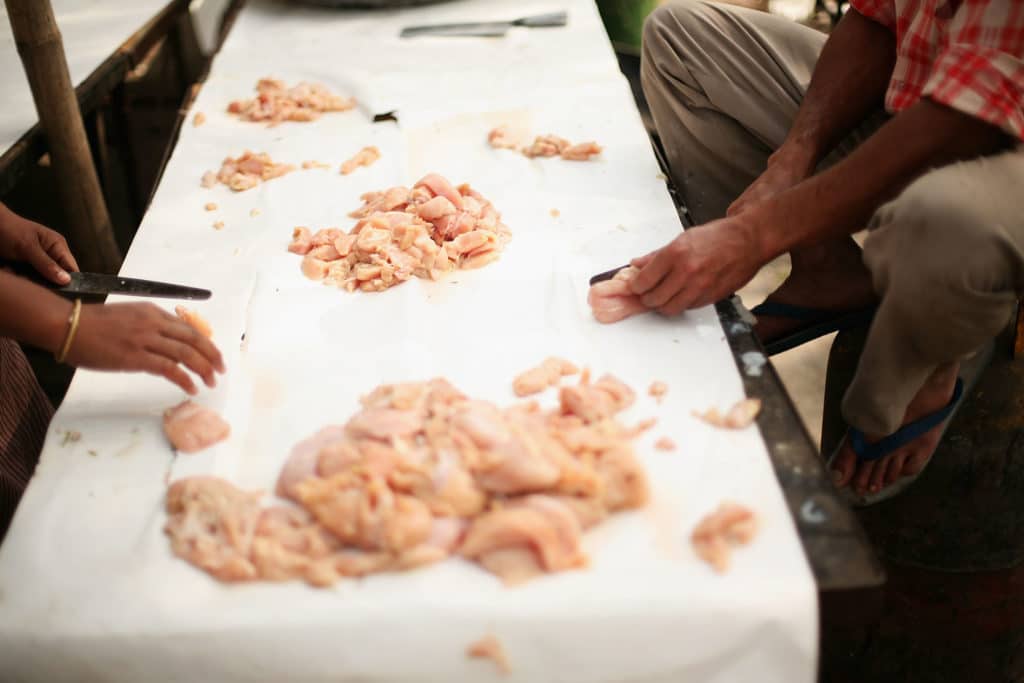
Empire Kosher Closes Chicken Processing Plant for 2 Weeks After Employees Test Positive for the Coronavirus

(JTA) — Empire Kosher closed its processing plant in Pennsylvania after two employees tested positive for the coronavirus.

But chickens are expected to be available for next week’s Passover seders, Rabbi Menachem Genack, CEO of the Orthodox Union’s Kosher Division, which supervises the Empire facility, told Crain’s New York on Thursday.

The Mifflintown plant, which has 550 employees, is scheduled to reopen on April 13, according to the report.

A spokeswoman for the Pennsylvania Department of Agriculture told Crain’s that the state did not order the closing.

The Lewistown Sentinel, citing an internal memo from Empire Kosher CEO Jeff Brown, reported that there would be “several complete sanitization procedures” performed on the facility.

The memo said that Empire has “implemented the recommended preventive measures as outlined by the World Health Organization, the CDC, the USDA, and local public health officials.”

It is not known in what area the employees who tested positive for the coronavirus worked.

Empire Kosher Closes Chicken Processing Plant for 2 Weeks After Employees Test Positive for the Coronavirus Read More »

Where is God During This Pandemic?

The Coronavirus has once more confronted us with the absence of God in modern times. This absence is often seen as the cause for much secularism. Since the days of the Renaissance man has become more and more skeptical of the occurrences of divine intervention. No longer, it is argued, are there enough indications for God’s interference in the national and private affairs of mankind. This viewpoint ultimately leads to the collapse of much of religious authority and in many ways undermined the role of religion in man’s life.

When the Israelites left Egypt, divine intervention was most visible. The ten plagues, the splitting of the Red Sea and the many other smaller and larger miracles gave full evidence for God’s intervention in man’s affairs. Consequently, our general reading of those years makes us believe that anyone living under such miraculous conditions would not have had any other option but to be a deeply religious person.

Rashi in his commentary on the Torah gives us, however, a totally different version of the events:

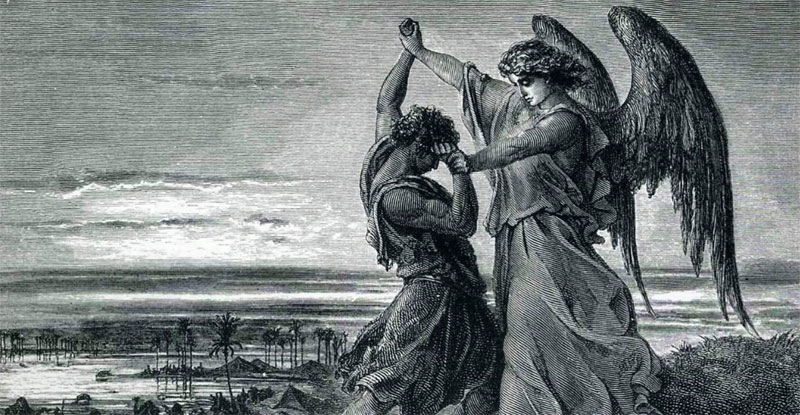
As a result of the sin of the spies in which they spoke evil about the land of Israel, the speech of God did no longer seclude itself with Moshe for 38 years. (Vayikra 1.1)

Whatever the deeper meaning of these mysterious words may be, it can’t be denied that this is a most remarkable and a far-reaching observation. What we are told is that most of the time in which the Israelites traveled through the desert, there was no special divine providence. God did not speak to Moshe or to the Israelites in His usual way and consequently, the Israelites had to deal with the question of God’s interference not much different from the way in which the modern human being does. Although the miraculous bread, manna, fell and other smaller miracles did take place, it becomes clear that these events did no longer have any real effect on the religious condition of the Israelites. Not for nothing did they say that this manna was lechem hakelokel, repulsive bread (Bamidbar 21.5). They saw these miracles as common events not much different than the way we view the laws of nature. (We are reminded of Rabbi Dessler’s famous observation that the laws of nature are nothing more but the frequency of miracles,[1] something which famous philosophers of science such as Karl Popper have fully endorsed from a secular point of view.[2]) Indeed on several occasions the Israelites asked whether God still lived among them.

It is perhaps this fact which makes Pesach so relevant for our own times: The realization that even at the time of the greatest of miracles, many years passed by without God making Himself known in any revealed form or way!

Sitting at the Seder table we often feel that we are reading a story that has little in common with our days and lives. We complain that God has become silent and that His spoken word is no longer available. How then can we believe in His existence and why should we listen to His words of many thousands of years ago? We are today confronted with a Deus Absconditus, an absent God, and no story about God’s open intervention in history is able to reach us any longer. God’s silence has made us deaf. So we complain.

And even when we admit that God did not speak with Moshe and the Israelites for 38 years, we still would make the powerful point that we have not heard from Him for more than two thousand years! So why asking us to deliberate on an event of thousands of years ago with which we have nearly nothing in common?

But with hindsight, we may have to radically change our view. We need to realize that the silence of these 38 years must have been much more frightening than all the Divine silence of our last two thousand years. While we are, to a great extent, able to take care of ourselves, and much more independent, this was not the case for our forefathers in the desert. They encountered the emptiness of desert land. There were no natural resources, food, water, or any other basic items without which even the most elementary forms of life are impossible. True, we are told that they miraculously had water and food, but once God stopped speaking with them in the middle of the desert and with the realization that this thundering silence of God went on day after day, accompanied by the frightening awareness that they had nothing to fall back on in case God would possibly also decide to stop providing them with water and food, this Godly silence must have been more dreadful than anything we can imagine. Being used to open miracles and then suddenly overnight finding oneself in an icy absence of any divine voice, right in the middle of a desert, must have been too much to bear. God’s “indifference”, no doubt, created a devastating traumatic experience without precedence.[3]

On the other side, the generation of our parents or grandparents experienced the Holocaust. This was far more calamitous than the forty years in the desert of our forefathers. So why not arguing that we are, after all, much worse off than those Israelites who had to undergo God’s absence in the desert? Would this not make the Exodus story completely irrelevant and meaningless to us?

However, it was our generation which, despite the absence of God in the Holocaust, clearly saw the return of the hand of God in the establishment of the State of Israel three years after the destruction of most of European Jewry. Without falling victim to the idea that all this is for sure the beginning of the messianic age, a highly dangerous idea, it is impossible to deny that God’s miraculous interference in the establishment of the Jewish State and the successes of its inhabitants which are nothing less but sui generis and touching on the impossible, remind us that despite the Divine silence in the Holocaust, God had re-entered history which makes the story of the Passover exodus very relevant. It was Ben Gurion who used to say that if one does not believe in miracles, one is not a realist.

When we realize that the story of the exodus was mainly a story of divine silence and that only occasionally a word of God entered the human condition, we also become conscious of the fact that the story which we read on the Seder night is most relevant. While the words of the Hagada relate the miracles, the “empty spaces” between the words tell us of the frightening divine silence of these very 38 years. And just as our forefathers must often have wondered what happened to God’s presence, in all these years, so do we. But just as they came through, so must we.

For reasons unknown to us, God disappears and suddenly emerges in this great drama called the history of mankind making the Jewish people the ultimate symbol of this strange spectacle.

The art is to hear God in His silence and to see His miracles in His paradoxical “hide and seek” with mankind. It is in the balance of these two facts that religious life takes place.

Where is God During This Pandemic? Read More »