A Brooklyn attorney has filed a lawsuit accusing New York Gov. Andrew Cuomo of violating his right to free speech and ability to observe his Jewish faith because of the state’s ban on large gatherings due to the coronavirus.
Lee Nigen also alleges that telling state residents to limit travel, Cuomo has violated his right to meet with clients, friends, family and “like-minded people,” the New York Post reported.
Cuomo signed an executive order requiring an indefinite ban on large gatherings on March 23. He has yet to impose a travel ban.
The suit filed Friday in Brooklyn federal court named Cuomo and the state government.
“Mr. Cuomo’s threat that his directives will be enforced by law enforcement cause Mr. Nigen to fear arrest if he attempts to travel for any other purpose other than getting medical attention or obtaining groceries, thus impermissibly chilling his exercise of his constitutional rights to travel,” the suit says, according to the Post.
Nigen has been strongly criticized on his Facebook page.
“Your rights stop when the purpose is to protect the greater good,” read one comment. “During a horrific time for the country, you feel the need to file a lawsuit? As a Jew, I’m ashamed you use our religion for this nonsense. And then you wonder why people hate us? Go ahead- ignore the warnings, spread the virus in your community and let’s see how many Jews are dead thereafter you schmuck.”
“To those who ill consider my dissent, I still wish you well, and treasure the right you have to express your opinion,” he wrote. “To the extent that fleeting flame has come upon me at this time of plague and panic, there is only one favor I ask of all: Be well and be free.”
Josef Neumann, 72, died on Sunday afternoon. Though he remained in a coma from the time of the attack to his death, he had begun to open his eyes in February, leading to calls to keep praying for a full recovery.
The assailant’s knife penetrated Neumann’s skull and cut into his brain. His right arm also was shattered. Four other people were injured in the Dec. 28, 2019 attack.
Neumann had seven children, “many grandchildren,” a great-grandchild, and brothers and sisters.
The alleged stabber, Grafton Thomas, 37, has pleaded not guilty to 10 federal hate crimes charges along with six counts of attempted murder and several assault and burglary counts in Rockland County court.
If it is determined that Neumann died of his injuries, Thomas could face the death penalty.
We are sad to inform you that Yosef Neumann who was stabbed during the Hanukah attack in Monsey late Dec 2019, passed away this evening.
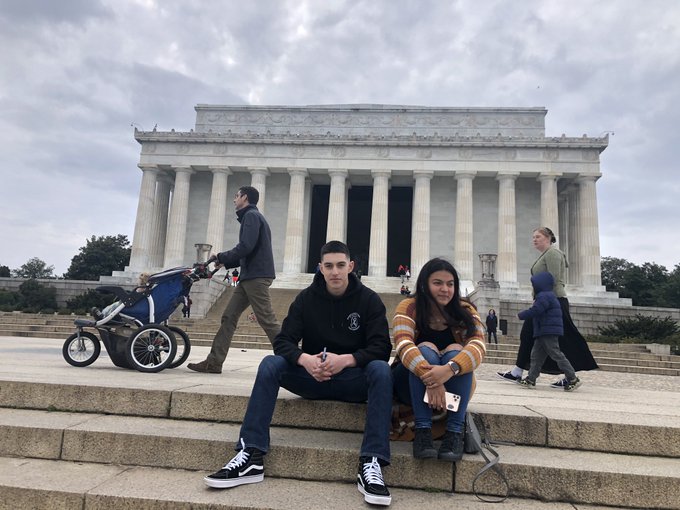
In the shadow of the Lincoln Memorial, a boisterous boy named Elliott darted away from his parents as they pushed their two younger sons in a double stroller. His mother yelled, “Elliott, be careful. Stop!” Elliott galloped away, and I watched with dread. Nearby, on the steps of Memorial, an 18-year-old U.S. military enlistee sat shoulder-to-shoulder beside a 19-year-old young woman he had just met, flirting. He’d be returning to his barracks. “I’ve got a pretty good immune system,” he said.
Research shows the deadly coronavirus can stay on surfaces from three hours to three days or longer, with a new Centers for Disease Control and Prevention report revealing the virus stayed on surfaces on the Diamond Princess cruise ship for up to 17 days. And, according to anew study, as many as 79 percent of coronavirus infections are caused by people with mild or no symptoms who do not know they carry the virus.
For days, President Donald Trump and Vice President Mike Pence have thanked Americans for abiding by their 15-day “recommendations” on social distancing. As #ReopenAmerica trended, Trump said he wanted church pews packed on Easter Sunday, before walking back that argument on March 29 and stating that social distancing practices will remain through April 30.
But even before this latest announcement, the reality on the ground revealed too many Americans were defying and continue to defy the White House’s “15 Days to Slow the Spread” because they are labeled as “recommendations.”
We cannot depend on public service announcements to save America. The U.S. must not reopen the country, but rather, #LockdownAmerica.
Like Elliott, not all people are highly attuned to danger. Last week, police in Lakewood, N.J., arrested two Orthodox Jewish men for hosting a wedding, in defiance of state social-distancing orders. Recent Spring Break reveler Brady Sluder apologized for his brash sense of “invincibility.”
In the neurobiology of threat assessment, people’s histories as well as our genetics affect our brains’ responses to a threatening event, according to clinical neuropsychologist Orli Peter. In Los Angeles, under statewide lockdown, she said there are two types of responses people can make in the face of an uncertain external threat: underreacting and overreacting. “In times of a serious threat, like the COVID-19 pandemic, the response that most likely guarantees your survival is overreacting,” she said.
There are two types of responses people can make in the face of an uncertain external threat: underreacting and overreacting.
For decades, trauma researchers have been studying the brain functions of people exposed to trauma or who have been in communities that endured mass violence or genocide, Peter said. “During safe times this sensitivity can result in an overreaction; but in times of threat, their sensitivity gives them a head start in actions that lead to survival,” she said.
From his post in Boston, Yaneer Bar-Yam, an MIT-trained physicist and founder of the New England Complex Systems Institute, has studied pandemics for 15 years. As the organizer of EndCoronavirus.org, he has been one of the loudest voices trying to educate policy makers and the public about the threat of COVID-19, penning an op-ed last week in USA Today advocating for a strict, five-week lockdown in the United States.
Bar-Yam also understands existential threats. Nazis killed his grandfather, and his father fled to safety in Israel, where his mother was born in Jerusalem. “We must save humanity,” he said.
In a March 24 policy paper, he co-wrote with Chen Shen, Bar-Yam stated five weeks would allow doctors time to manage two phases of new infections and one week to gain control of treatment and testing. He penned a letter to Trump, seeking the lockdown, and other business leaders, scientists and professionals, signed in, including myself.
Former options trader Nassim Taleb, a native of Lebanon, uses data to assess risk and has seen the cost of war. He argues an “overreaction” is the moral position to take in the face of this life-or-death threat. Yale sociologist and physician Nicholas Christakis presses for policies to stop social engagements to “flatten the curve” and slow the spread of the killer virus.
Italy has learned the hard way what happens when you don’t curtail the citizenry early on. Israel, Greece, India and the United Kingdom acted decisively, with federal lockdowns to protect a citizenry that may not practice hypervigilance.
As a former Wall Street Journal reporter, I defied U.S. State Department warnings, jetting to Pakistan after 9/11. My life was threatened when my colleague Daniel Pearl was kidnapped and murdered while visiting a home I had rented in Karachi. It sensitized my amygdala, the part of the brain network that defines how we respond to threats, and pierced my sense of invincibility. I chose to self-isolate after I learned I had walked the same hallway as someone who tested positive for COVID-19. I emerged to report in D.C. – at a super-safe distance.
Back at the Lincoln Memorial, young Elliott took a photo with his family, with President Lincoln behind them. Like Lincoln, Trump now has the opportunity – with the strong action of a national lockdown – to save our country and our economy in an hour of darkness. Our brain processing won’t allow all of us to take the correct action − and saving some of us just isn’t good enough.
Asra Q. Nomani is a former Wall Street Journal reporter. She launched the Citizens Task Force to help save lives and build community in the war against the coronavirus. She can be reached at asra@asranomani.com.
In the Song of Songs, an allegory of the love between God and Israel, King Solomon extols the fruit of the land — apples, figs, pomegranates, dates, grapes, walnuts, cinnamon and wine. And while there are many recipes for charoset, they all include some of the ripe, luscious fruits of Solomon’s verses.
Symbolic of the mortar our enslaved ancestors used in ancient Egypt, charoset comes in many forms, depending on the geographic region of origin. For Ashkenazi Jews, it’s apples and chopped walnuts, spiced with sweet red wine and cinnamon. The Afghani recipe calls almonds, walnuts, dark raisins, grated apple, sweet red wine and the unusual addition of a ripe banana! The Greek and Turkish tradition calls for apples, dates, almonds and wine, while the Italian Jews add chestnuts.
The Promised Land is described in the Bible as “overflowing with milk and honey.” The sages agree that the honey of the Bible is silan, a dark, delicious and decadent date syrup.
Before Pesach, Sharon’s mother boils boxes of dates, then squeezes the pulp through a muslin and boils it again. It’s a lot of work but delicious on the seder table with crushed walnuts. Silan is so delicious that you can buy it all year round in Israel and most kosher stores.
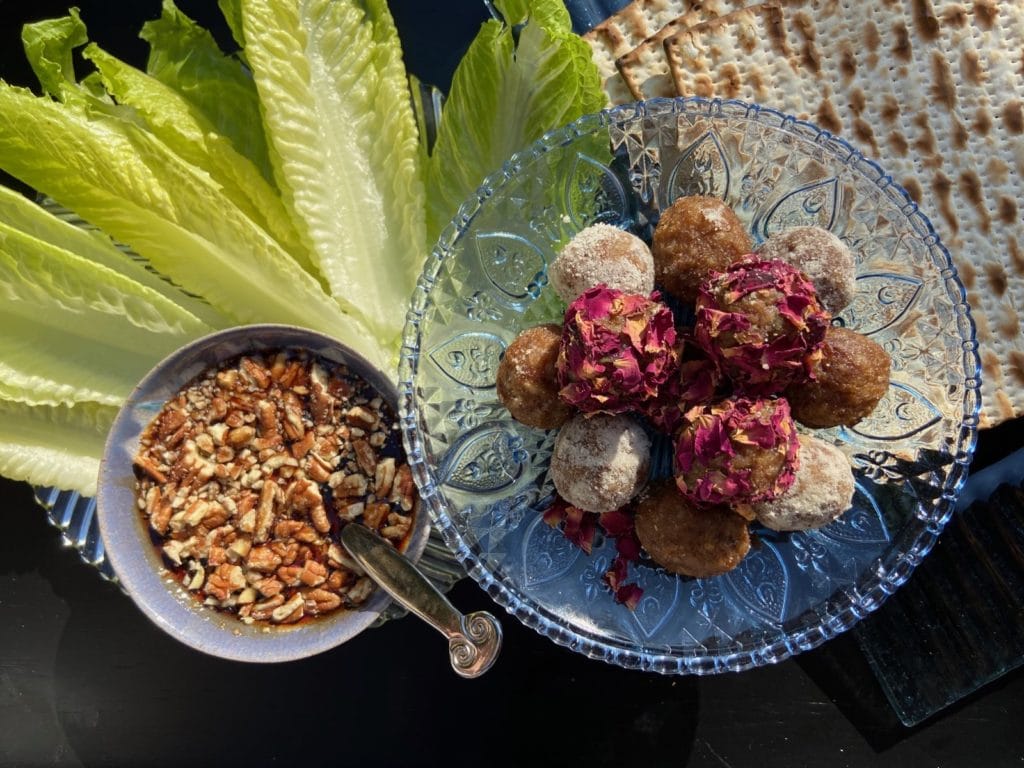
The Moroccan tradition is to form dates, raisins, walnuts and sweet wine into balls. Rachel has been making charoset with her mother since she can remember. This year, let your kids sink their hands into this fun and easy activity.
RACHEL’S MOROCCAN CHAROSET TRUFFLES 1 cup walnuts, roughly chopped
2 cups pitted dates
1 cup raisins, golden or dark
1 teaspoon cinnamon
1/4 teaspoon ground cloves
1/4 cup sweet wine
Finely ground almond flour and/or dried rose petals to roll charoset balls in (optional)
In food processor combine chopped walnuts, dates, raisins and spices until mixture begins to stick together and is finely chopped.
Add wine and mix.
Using small cookie scooper, make the balls the same size and place on parchment lined-tray. Wet hands with water and roll into perfect balls.
Refrigerate for 1 hour. Optional: roll truffles in almond flour or rose petals.
Can be stored in refrigerator in airtight container for 2 months.
Makes 3 dozen truffles.
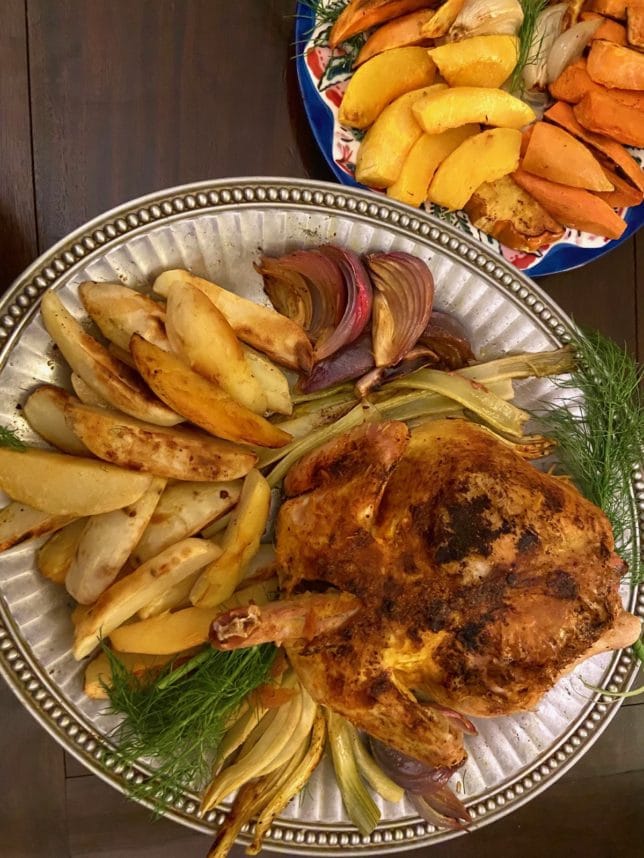
Chicken and Roasted Squash
SHARON’S PERFECT ROASTED CHICKEN 1 head fennel, cut into wedges
4 stalks celery
2 purple onions, cut into wedges
2 shallots, cut in half
1 roasting chicken
1 lemon, cut in half
8 cloves garlic
2 teaspoons kosher salt
2 teaspoons garlic powder
1/2 teaspoon turmeric
1/2 teaspoon paprika
5 medium potatoes, cut into wedges
1/2 cup safflower or avocado oil
Preheat oven to 425.
In center of large roasting pan, arrange fennel, celery, onions and shallots.
Wash chicken and pat dry.
Stuff lemon halves and garlic into chicken’s cavity.
Rub salt, garlic powder, turmeric and paprika all over chicken.
Place chicken breast side down and place potatoes around chicken. Drizzle chicken and potatoes with oil.
Roast for 45 minutes, then lower oven to 375 F for another hour until thigh temperature reaches 170.
Serves 4-6.
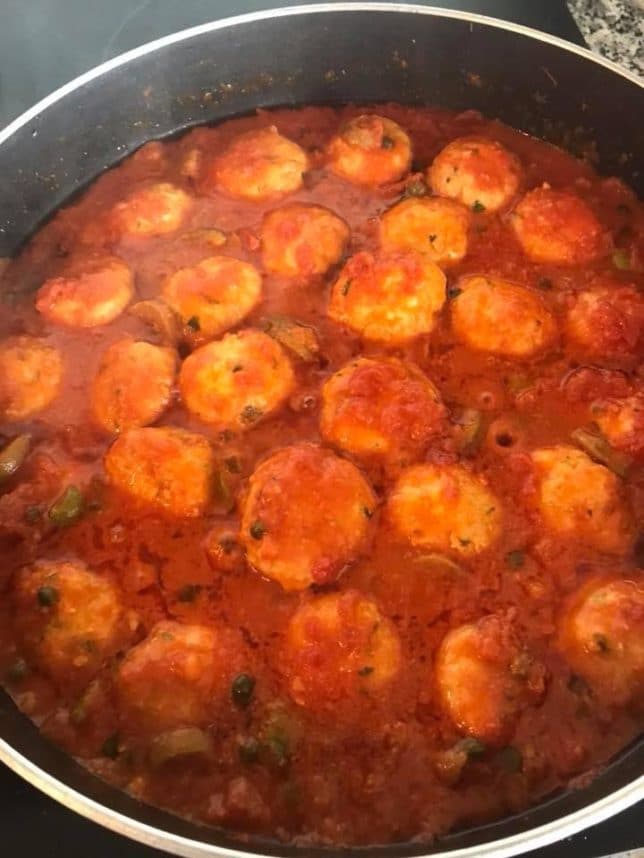
RACHEL’S MOROCCAN SPICY FISH BALLS 5 pounds whitefish
5 slices of lox (optional)
1 onion, cut in large chunks
6 cloves garlic, minced
3 eggs, lightly beaten
1/4 teaspoon mace
3 teaspoons salt
1 teaspoon white pepper
1/2 cup lemon juice
4-ounce can tomato sauce
1/2 cup matzo meal
1/2 cup fresh parsley, minced
Sauce 1/4 cup olive oil
1 tablespoon smoked paprika
1 teaspoon hot paprika
1 teaspoon cumin
4 garlic cloves, minced
2 28-ounce cans tomato puree
1 15-ounce can chopped tomatoes, or 6 fresh tomatoes, chopped
1 cup sliced green olives
1/4 cup capers
1 preserved lemon, minced, or zest of one lemon
Salt to taste
Grind the fish and lox in food processor, then place in large bowl.
Purée onion and garlic in food processor, then add to fish.
Add remaining ingredients and mix until well blended.
Form small balls (about the size of a walnut) and refrigerate.
Heat the olive oil in a large, deep pan and add all spices.
Stir well, then add tomato puree, chopped tomatoes and remaining ingredients.
Cover and simmer for 1 hour over low flame until sauce thickens.
Divide sauce into two large pots and place fish balls in a single layer in sauce.
Cover pots and simmer until fish balls are firm.
Add a little water if sauce becomes too thick.
Makes about 3 dozen balls.
SHARON’S ROASTED SQUASH MEDLEY 1 medium butternut squash
1 acorn squash
4 medium sweet potatoes
1 onion, cut into slices
1/2 cup oil
1 tablespoon honey
1 teaspoon garlic powder
1 teaspoon salt
1/2 teaspoon pepper
1/2 teaspoon cinnamon
Preheat oven to 400 F.
Cut squash and sweet potatoes into 1/2-inch strips and place on baking tray.
Add onions, oil, honey and spices.
Bake for 30 minutes or until fork tender.
Serves 6-8.
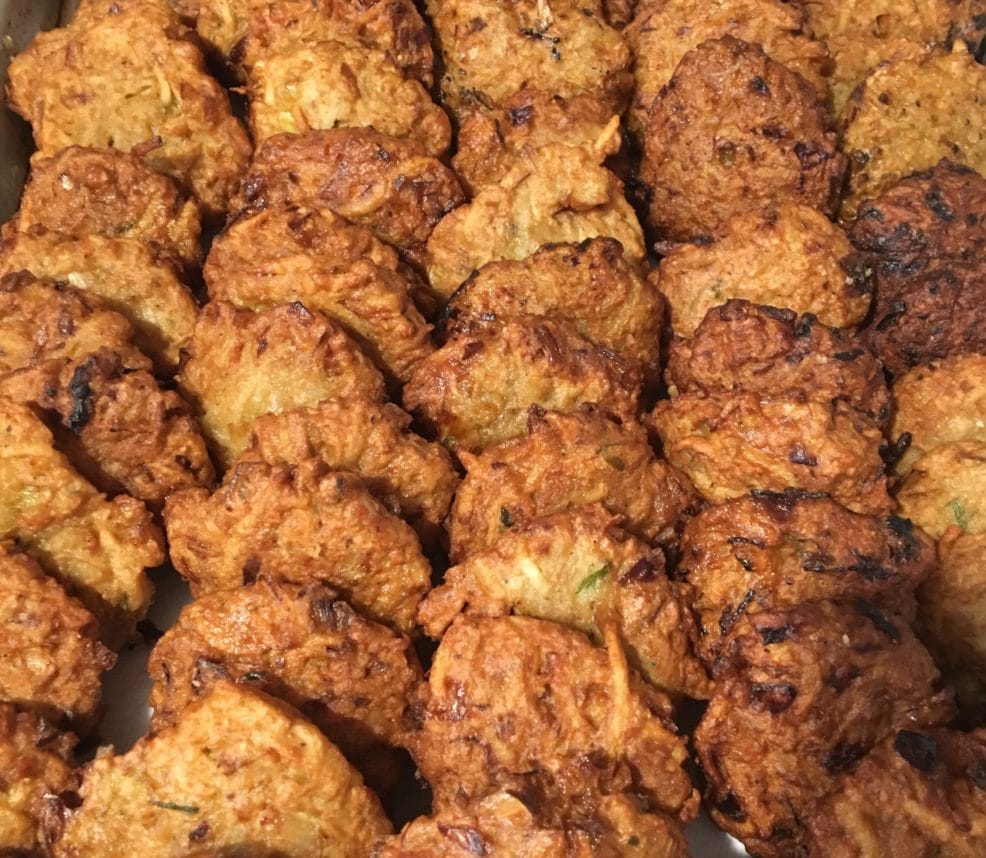
RACHEL’S LEEK AND POTATO PATTIES (KEFTES DE PRASSA) Adapted from The Sephardic Cooks’ “Come con Gana” cookbook from a Congregation Or VeShalom Sisterhood in Atlanta.
3 cups leeks, chopped
1 cup mashed potato
3 eggs
1 teaspoon salt
White pepper, to taste
1 tablespoon matzo meal or potato starch
Vegetable or peanut oil, for frying
Wash and clean leeks thoroughly.
Cook leeks in boiling salted water.
Drain and squeeze out all water, repeating this step several times. Chop leeks.
In large bowl, mix leeks with remaining ingredients.
Make small patties and pan fry in oil.
Makes about 40 patties.
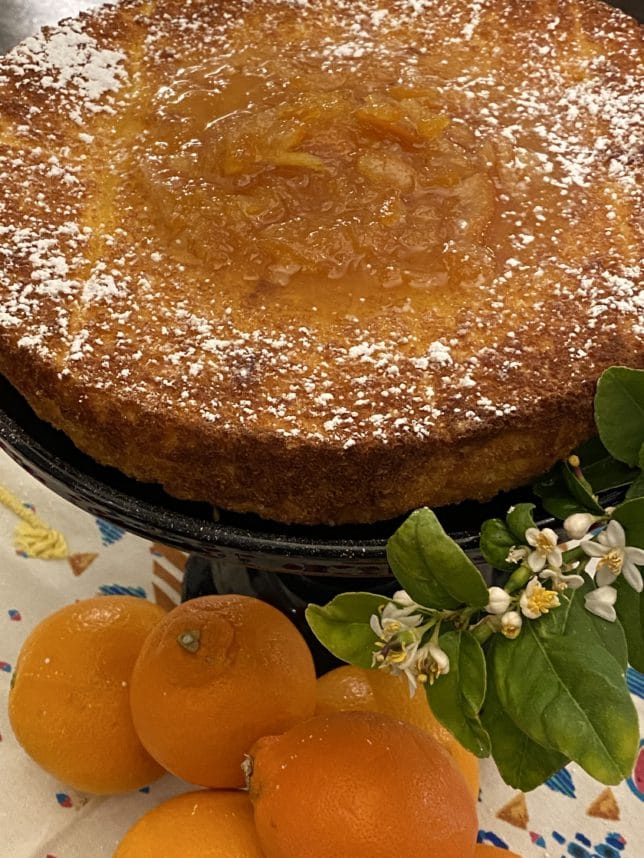
RACHEL’S ORANGE BLOSSOM CAKE 2 small oranges, washed
6 eggs, separated
1 1/4 cup sugar
1 1/4 cup ground almonds
2 teaspoons orange blossom water or almond extract
Preheat oven to 350 F.
Line nonstick springform cake pan with removable bottom with parchment paper.
Place unpeeled oranges in just enough water to cover them and boil for 1 1/2 hours or until they are very soft.
Let cool, then remove seeds and pith (white part of the orange center). Purée in a food processor.
In large bowl, combine egg yolks and sugar until creamy, then add ground almonds, cooled orange puree and orange blossom water (or almond extract).
In separate bowl, beat egg whites until stiff peaks form.
Slowly fold egg whites into the orange mixture, until combined.
Pour into prepared pan and bake for 1 hour. If cake is still wet, leave in the oven until center has set.
Cool completely before removing from pan. Decorate with candied orange slices, orange marmalade or powdered sugar and blossoms from your citrus tree.
Serves 8-10.
Rachel Emquies Sheff’s family roots are Spanish Moroccan. Sharon Gomperts’ family hails from Baghdad and El Azair in Iraq. Known as the Sephardic Spice Girls, they have collaborated on the Sephardic Educational Center’s projects, SEC Food Group and community cooking classes. Join them on Facebook at SEC FOOD.