fbpx

March 2, 2020

Bloomberg: A Candidate We Can Get Behind

My father always said I could ask him anything. But his ballot was a closely guarded secret. He avoided politics his entire life, seeing his mission as transcending such divides. Having survived the brutality of a populist dictatorship in Europe, he found refuge in the United States. He loved his adopted country. His eyes would tear up when the customs officers at JFK airport would stamp his passport and tell him: “Welcome home.”

I’m not writing this for my father.

My mother was also an immigrant from war-torn Europe. She marched for civil rights in the Jim Crow South and carried her NAACP card with pride. She sees how President Donald Trump’s administration demonizes South and Central American and Mexican immigrants, as well as Muslim refugees, for political gain. And she is dismayed that anti-Semitism has appeared on the left as well as the right, spreading its poison into progressive causes as important as the Women’s March. Three of its founders were forced to resign in disgrace when their tolerance for Jewish conspiracy theories was exposed. One of them is now an official surrogate for the Bernie Sanders campaign.

But I’m not writing this for my mother either. I’m writing it for my children.

As a parent, my nightmare is another school shooting. Our kids should not have to practice lockdown drills at school. Our leaders do nothing, or worse, stand in the way of gun safety reform.

My son is 14. He learned about climate change in elementary school and internalized it quickly. For years, his fear for our planet’s survival kept him up at night. He remembers the night Trump was elected president. He can’t forget what came next: slashed budgets for the Environmental Protection Agency, withdrawal from the Paris climate accord, the destruction of basic protections for clean air and water. Now when the topic comes up, my son often will leave the room. He’s no longer scared of what might happen. He’s scared of what’s already happening.

My daughter is 11. She knows bullies thrive on fear, and she knows that their power over people derives from the idea of “us” versus “them.” She has read what the president tweets about people he doesn’t like. Sometimes her brother shows her the hatred on Reddit toward political candidates who fall short of seeking revolution. Much of it is aimed at fellow Democrats by Sanders supporters.

Guns. Climate change. Bullying. The failure to meaningfully combat these challenges leaves my family, like many Americans, ready for change.

Who will we choose to drive this change?

Unfortunately, there is no such thing as a perfect candidate or a perfect record.

I’ve found a candidate who built a world-class business that created jobs for thousands, but was slow to eradicate the sexist culture of its time. He made the streets safer, but at the expense of human dignity.

Guns. Climate change. Bullying. The failure to meaningfully combat these challenges leaves my family, like many Americans, ready for change.

He has learned from these mistakes and apologized. But more than that, he took action. He has vigorously committed himself to championing equality in the workplace. In recent years, his company earned a perfect score in the Human Rights Campaign’s Corporate Equality Index. And in his last term as mayor of New York, he launched the Young Men’s Initiative to tackle the many challenges faced by African-American and Latino youth. It became the prototype for the My Brother’s Keeper program in former President Barack Obama’s  administration.

He is an activist, one with an unparalleled record in addressing climate change and gun safety. He partnered with the Sierra Club to retire 300 coal-fired plants and help transition us to clean energy. He created Everytown for Gun Safety, bringing together millions of supporters to end the cycle of bloodshed haunting American families. He has done more as a private citizen on these issues than any other candidate. Imagine what he would do as president.

Unlike the populist in the White House and the populist currently leading the Democratic primary polls, he refuses to stoke fear and anger. His advisers, unlike Trump’s, don’t defend separating parents from children. Unlike Bernie, he doesn’t find praise for Jeremy Corbyn, who has shattered England’s Labour Party with its rampant anti-Semitism. He stands against the demagoguery that incited tiki torch-bearing neo-Nazis who shouted, “Jews will not replace us” in 2017 in Charlottesville, Va., and the far-left extremists who burned American and Israeli flags outside the Democratic National Convention in 2016 in Philadelphia.

The candidate I plan to vote for recognizes that the true strength of America is in our determination to find common ground.

That candidate is Mike Bloomberg. I will vote for him in the New York primary.


Elisha Wiesel is the son of Marion and Elie Wiesel, a Holocaust survivor, author and Nobel laureate. He is a volunteer data scientist at Hawkfish, LLC, the digital agency for the Mike Bloomberg 2020 campaign. The opinions expressed are entirely his own. 

Bloomberg: A Candidate We Can Get Behind Read More »

30 Going on 13, I Think I’m Ready for A(nother) Bat Mitzvah

Let’s be honest, no one really thinks a 13 year old thinks too seriously about the religious commitment they’re making when they stand before the congregation and read from the Torah. More than likely they’re praying that they don’t mess up and embarrass themselves in front of the entire 7th grade class (or worse, their middle school crush). I distinctly remember almost the entirety of my bat-mitzvah even though it was well over 20 years ago. It was a special day to me and I’m not about to launch into a campaign to make any changes to the tradition…but I feel like now that I’m an actual adult I am ready to make an entirely more meaningful commitment to my Jewish identity.

It wasn’t until I experienced the joys of marriage and the trials of having children and losing a pregnancy that I had a real reckoning with my faith and my God. At 13 I (thankfully) hadn’t experienced much of anything outside of a sheltered Day School life. I didn’t wrestle with God so much as a I wrestled with my parents over their refusal to let me watch “Dawson’s Creek.” My bat-mitzvah was a major reminder that Judaism was an important component of my life and it served an essential purpose, but lately I find myself yearning to reaffirm my beliefs now that I’m actually an adult.

The trend I see is that many young Jewish kids are fairly affiliated with a Hebrew school and synagogue community and then later Hillel or Chabad in college and after that sort of ‘drop out’ of Jewish life. We settle into internships and jobs in new cities and navigate living away from the nest for the first time. Then there’s dating and maybe weddings and maybe kids and after all that there’s what I like to consider adulthood. That time in your life where you’re actually your own boss because you’re earning your own salary and possibly even the boss of a few little ones of your own.

This is where the next major crossroads of Jewish life starts – do you have a Jewish wedding, do you send your children to Jewish preschool, do you light candles on a Friday night and continue the traditions? And if you do, shouldn’t we maybe have some sort of celebration to welcome this reality? 

I feel like I’ve survived a lot these past years and my faith has had a trial by fire. In the end, thanks to many hours by many kind and caring rabbis (including but not limited to, Rabbi Stutman at 6th and I, Rabbi Weinblatt at Congregation B’nai Tzedek and Rabbi Hoffman at Valley Beth Shalom and the rabbis at Congregation B’nai Israel) as well as one pivotal reading of “When Bad Things Happen to Good People” by Harold Kushner, “The Sabbath” by Rabbi Heschel and “Jewish Meditation” by Rabbi Kaplan, I’ve chose to embrace the blessings Judaism has provided me and welcome it into my adult life, of my own volition and choosing. So…who wants to party? And can I pick my own theme this time around, mom?


Marion Haberman is a writer and content creator for her YouTube/MyJewishMommyLifechannel and Instagram @MyJewishMommyLifepage where she shares her experience living a meaning-FULL Jewish family life. Haberman is currently writing a book on Judaism and pregnancy titled “Expecting Jewish!” released Winter 2019. She is also a professional social media consultant and web and television writer for Discovery Channel, NOAA and NatGeo and has an MBA from Georgetown University.

30 Going on 13, I Think I’m Ready for A(nother) Bat Mitzvah Read More »

Pence Says at AIPAC, ‘Anti-Zionism Is Anti-Semitism’ Is Gov’t Policy

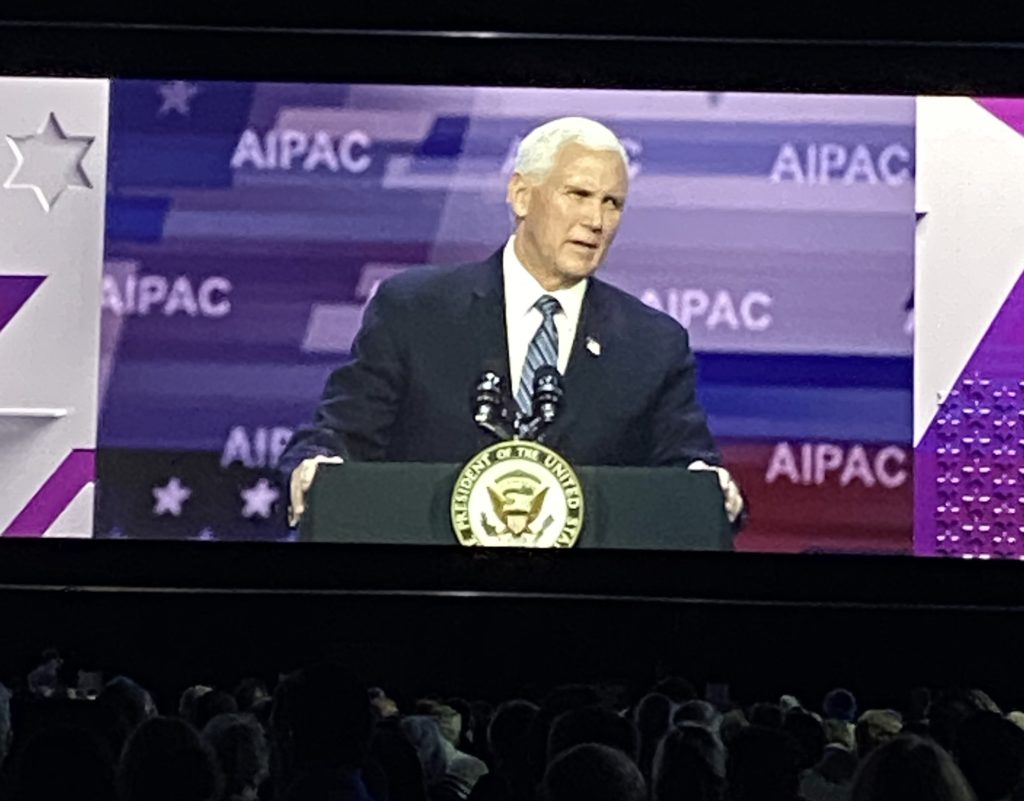
Vice President Mike Pence said during his March 2 speech at the American Israel Public Affairs Committee (AIPAC) policy conference in Washington, D.C., that the official policy of the Trump administration is that anti-Zionism is anti-Semitism.

Pence called anti-Semitism a unique and potent evil that is on the rise worldwide, including on college campuses and in Congress.

“We must root anti-Semitism out from every part of our society,” Pence said. “It’s not just a threat to Jewish Americans and Jews around the world, it’s a threat to us all.”

Pence touted President Donald Trump’s statement after the October 2018 shooting at the Tree of Life synagogue in Pittsburgh that “America would seek the destruction of those who seek the destruction of the Jews. Never before has an American president spoken with such clarity and resolve to the wider world [on anti-Semitism].”

The vice president also pointed out that Trump signed an executive order in December addressing anti-Semitism on college campuses.

“Our message to American universities and colleges is clear: if you want billions of dollars in taxpayer support, reject anti-Semitism and reject it now,” Pence said.

Earlier in his speech, Pence provided an update on the coronavirus, stating that 48 Americans have been infected with the disease and two have died. Because the figures are fluid, other news agencies have reported as many as 100 confirmed cases.

“Keep in your prayers all of those impacted by this disease,” Pence said.

He praised Trump for suspending travel to China and establishing a task force dedicated to combating coronavirus.

“President Donald Trump has no higher priority than the health and the safety of the American people,” Pence said.

Pence also called Trump’s Israel best friend, highlighting various policies including the moving the U.S. Embassy to Jerusalem, recognizing Israeli sovereignty in the Golan Heights — both controversial decisions denounced by his critics — and the administration’s “maximum pressure campaign” against Iran to stop supporting terror proxies in the Middle East.

“We truly hope for a better and more prosperous future for the people of Iran,” Pence said.

The vice president highlighted the U.S. killing Iranian Maj. Gen. Qassem Soleimani in a precision airstrike in Baghdad in January, and criticized Sen. Bernie Sanders (I-Vt.), the current Democratic presidential candidate, for describing Soleimani’s killing as “assassinating a government official. Soleimani was not some government official, he was a terrorist and President Trump was right in taking him down. That’s what leadership looks like.”

Pence warned that bipartisan support for Israel in the United States “is beginning to erode in one of America’s two major political parties,” pointing to Sanders’ recent criticisms of Israel and AIPAC.

“Those who side with Israel’s enemies must never be allowed to call themselves friends of Israel,” Pence said. “It is wrong to boycott and slander Israel, it is wrong to boycott and slander AIPAC.”

He concluded his speech on a note of optimism, saying: “I know the best days for Israel and the United States of America are still to come.”

The progressive feminist group Zioness criticized Pence’s speech in a statement.

“Today, the Vice President of the United States told us we must check our liberal and progressive values — our commitment to social, racial, economic and gender justice in America — at the door if we want to be ‘good’ Jews,” the statement read. “The implication in Pence’s comments was that the ‘good’ and ‘strong’ Jews — the Jews who are willing to fight antisemitism and its modern incarnation, anti-Zionism — must vote a certain way. This isn’t an echo, but a partisan mirror, of the suggestion in spaces in the left that divide ‘good’ Jews from ‘bad’ Jews based on their willingness to check their Jewish and/or Zionist identities at the door in order to fight for the rights of other marginalized communities.”

Pence Says at AIPAC, ‘Anti-Zionism Is Anti-Semitism’ Is Gov’t Policy Read More »

AIPAC Research Adviser, Palestinian Spar in Session Over Missed Palestinian Opportunities

American Israel Public Affairs Committee (AIPAC) senior research adviser Raphael Danziger and an attendee at the AIPAC Policy Conference identifying herself as a Palestinian briefly sparred during a Q&A period in a session about missed Palestinian opportunities to establish a state.

The Palestinian attendee told Danziger, who argued during the March 1 session in Washington, D.C., that the Palestinians have boxed themselves into a weak negotiating stance because of their refusal in prior decades to accept a deal, that his arguments made her “uncomfortable.” She argued that Israel’s continued occupation and building of settlements in the West Bank and siege of the Gaza Strip makes it hard for her to view Israel as a good-faith peace partner.

“I want to make sure my [Palestinian] state has real authority,” she said, arguing that past Israeli offers for a two-state solution came with a catch.

Danziger responded, “It’s a question of leadership, and the Palestinian leadership is failing its own people. Israel was blessed with strong leaders who were able to make compromises … but the Palestinians kept rejecting the compromises.”

The Palestinian attendee said she disagreed, and Danziger said he respected her differing opinion.

Leading up to that point, Danziger told the room of around 50 people that the Palestinians’ best opportunity for their own state came in the 1947 United Nations partition plan creating both a Jewish and an Arab state in what was the British-controlled Mandate Palestine territory. Instead, the Arab world declared war on Israel in 1948, and Israel’s boundaries in the aftermath of the war ended up being bigger than if the Arabs had accepted the partition plan.

“If you lose a war, there are consequences,” Danziger said.

The Palestinians had another opportunity with the 1978 Camp David Accords that established a peace treaty between Israel and Egypt, Danziger argued, noting that the agreements also would have established a Palestinian state in the West Bank. But the Palestinians rejected it because they weren’t involved in the talks, according to Danziger.

“The situation got much worse for [the Palestinians],” Danziger said, highlighting the fact that Israeli settlers in the West Bank have vastly increased since 1978.

Danziger also pointed out that the Palestinians could have had full autonomy over the West Bank had they accepted President Bill Clinton’s parameters for a peace plan or Israeli Prime Minister Ehud Barak’s similar offer in 2008, but each deal was rebuffed. 

Additionally, in 2005 the Israeli government forced Israeli settlers to withdraw from the Gaza Strip and left greenhouses for the Palestinians to use; Israel would have done the same with the West Bank had the Gaza withdrawal ended well, Danziger said.

“As soon as the Israelis left, the Palestinians looted the greenhouses; everything was destroyed. … Two years later, Hamas took over,” Danziger said, later adding: “[The Palestinians] really blew it.”

The reason why the Palestinians keep rejecting offers for a peace agreement is because they will never accept Israel’s right to exist as a Jewish state, according to Danziger.

“They want the whole [land],” he said. “From their perspective, the Jews have absolutely no right to have any part of Palestine … therefore, any notion of accepting a Jewish state regardless of the borders is out of the question for them.”

President Donald Trump’s peace plan, which annexes Israeli settlements in the West Bank and keeps Jerusalem as Israel’s capital, is the consequence of the Palestinians consistently saying no to peace offers, Danziger argued.

“It’s very hard to be optimistic that there will be compromise because of that continued rejection,” he said.

AIPAC Research Adviser, Palestinian Spar in Session Over Missed Palestinian Opportunities Read More »

At AIPAC, Bloomberg Pledges to Combat Anti-Semitism, Supports Two-State Solution

At the American Israel Public Affairs Committee (AIPAC) Policy conference in Washington, D.C., former New York City Mayor Michael Bloomberg pledged to combat anti-Semitism and work toward a two-state solution in the Israel-Palestinian conflict if he’s elected president.

The 2020 Democratic presidential candidate told the 18,000 attendees at the conference that he found the 4,000 college students in attendance inspiring, as they’re necessary to ensure pro-Israel voices are included in social justice spaces on college campuses.

“Your refusal to be intimidated reminds us of the courage and integrity we need in our political discourse,” Bloomberg said.

Bloomberg believes Judaism is more than just following rituals, but “about living our values.” He called Israel a “living miracle” and highlighted that in 2014, he flew to Israel during Operation Protective Edge, despite the Federal Aviation Administration’s (FAA) brief ban on flights headed to the Jewish state.

“Sometimes, gestures matter, and in my own little way, I wanted to show the world that terrorism will not keep us away from the Holy Land,” Bloomberg said.

He vowed to support Israel’s as president. “I will never impose conditions on military aid. no matter what government is in power,” Bloomberg said, pointing out how “Israel is on the front lines, countering American enemies in the region, sharing valuable intelligence for us.”

He also said he would leave the United States embassy in Jerusalem “because that’s where it belongs.”

The former mayor also expressed opposition to the boycott, divestment and sanctions (BDS) movement, saying BDS seeks to demonize Israel. However, Bloomberg stated his support for a two-state solution through direct negotiations between the Israelis and Palestinians. “Palestinians deserve dignity and opportunity as well,” Bloomberg said.

Bloomberg lauded bipartisan support for Israel in U.S. politics and criticized Sen. Bernie Sanders (I-Vt.) for accusing AIPAC of “providing a platform to bigots.”

“He’s dead wrong,” Bloomberg said, adding that “calling [AIPAC] a racist platform is an attempt to discredit those voices and weaken the U.S.-Israel relationship.”

He stressed the importance of maintaining bipartisan support for Israel in light of rising anti-Semitism in the country. “Jews have been beaten and harassed in the streets [in New York City],” Bloomberg said. “Attacks on Jews have taken place with horrifying regularity.”

Bloomberg noted there has been a rise in hate crimes across the country against all minority groups in the United States. “We need to stand up against all bigotry and hatred,” Bloomberg said, stating he was in favor of building a mosque in 2010 near the memorial of the 9/11 terror attacks.

Bloomberg posited that while the rise of anti-Semitism and other forms of hate can’t be attributed to any one person or political group, he suggested President Donald Trump has played a role in its rise. “Presidential leadership matters,” Bloomberg said. “It sets a tone.”

He added, “I will never stand idly by in the face of anti-Semitism.”

On the Iran nuclear deal, Bloomberg said he opposed its passage in 2015 because he didn’t think it adequately addressed Iran’s ballistic missile program or the regime’s support for terrorism. However, he criticized Trump for exiting the deal in 2018, arguing that doing so provided a green light for Iran to restart its nuclear program.

“As president, I will work to make the strongest deal possible,” Bloomberg said, pledging to “to end their nuclear program forever.”

At AIPAC, Bloomberg Pledges to Combat Anti-Semitism, Supports Two-State Solution Read More »

Roman Polanski Wins French Oscar amid #MeToo protests

(JTA) — Roman Polanski won the French equivalent of an Oscar as best director for his film about Alfred Dreyfus, leading to protests at the awards ceremony over his U.S. conviction three decades ago for raping a minor.

Adele Haenel, who was nominated for best actress in the Friday night awards Cesar ceremony, walked out of the auditorium shouting “shame” when Polanski’s award was announced. He also won for best adapted screenplay for “An Officer and a Spy,” about the wrongfully convicted Jewish French army officer Alfred Dreyfus.

Haenel last year accused the director of her first film, Christophe Ruggia, of sexually harassing her when she was 12.

“Honoring Polanski is spitting in the face of all victims,” Haenel said before the ceremony, according to reports. “It means raping women isn’t that bad.”

Meanwhile, protesters chanting “Lock up Polanski!” tried to enter the theater where the ceremony was taking place and were held back by  police firing tear gas, the French news agency AFP reported.

Polanski, 86, pleaded guilty to unlawful sex with a 13-year-old, but fled to Europe in 1978 rather than face a possible jail sentence. He has since lived outside of the United States and avoided extradition. Other women have accused him of rape or sexual abuse over the years.

Polanski has come under fire for drawing parallels between his legal ordeal and that of Dreyfus, who in 1894 was sentenced to life in prison for treason. He was later exonerated when evidence of the prosecution’s partially anti-Semitic motives was discovered.

Raised in Poland, Polanski survived Krakow’s Jewish ghetto as a child and, after launching his film career in Poland after the war, moved to the United States in 1968.

Roman Polanski Wins French Oscar amid #MeToo protests Read More »

Netanyahu won, Gantz lost: The (updated) shortest summary of Israel’s Election

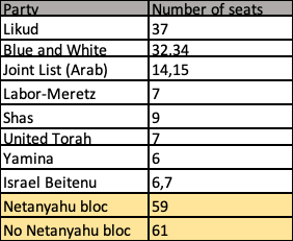
Based on the exit polls and partial results, here’s all you need to know about Israel’s political situation. As we get more accurate numbers, we will update the tables and our assessment of the likelihood of various final outcomes.


Numbers

The numbers presented here are based on exit polls by TV channels 12 and 13 that were updated late Monday night when real results started to get in. The official tally of the vote is expected late Tuesday.


Winners, losers

Winner: Netanyahu’s Likud is the largest party, and he might even get his dream narrow, loyal, right-religious coalition (to do that he will need deserters from other parties). Another option: A unity government.

Looser: Gantz and his party declined compared to previous elections. His options are limited. The outcome is not close enough for him to aim for a minority government or a fourth election.


Options for the future

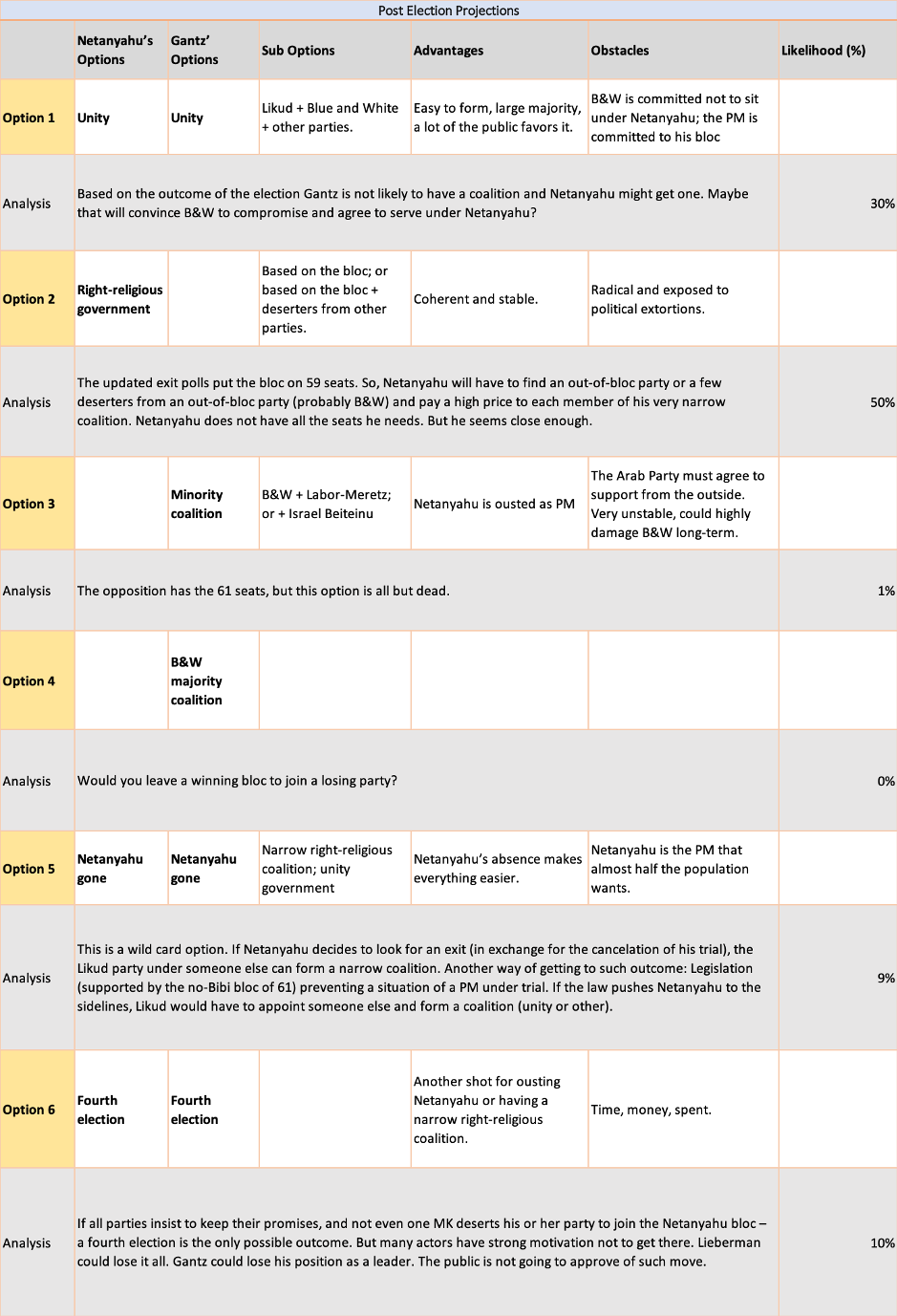
The column “likelihood” in the following table is based on my own assessment of the situation and not a result of any formal statistical process of looking at probabilities (I do not believe such process is possible at this time). We will also update this table when new numbers and facts get in.


Netanyahu won, Gantz lost: The (updated) shortest summary of Israel’s Election Read More »

apace 2020, Aaron bandler, jewish journal

AIPAC General Session Discusses Super Tuesday, General Election

A panel on the morning of March 2 discussed the upcoming Super Tuesday primary elections in the Democratic primary and the general election in November during the American Israel Public Affairs Committee (AIPAC) Policy Conference in Washington, D.C.

CNN analyst Bakari Sellers said Joe Biden’s win in the Feb. 29 South Carolina primary will “be a springboard” for the former vice president, predicting that Biden will do well on Super Tuesday in states like Alabama, Arkansas and Texas, and going forward it will be a two-person race between Biden and Sen. Bernie Sanders (I-Vt.).

“This race is going all the way to Milwaukee,” Sellers said, referencing the location of the Democratic National Convention in July.

Paul Begala, a former adviser to President Bill Clinton, said Biden is currently in “the driver’s seat” for the moderate lane in the Democrat Party, especially with former South Bend, Ind., Mayor Pete Buttigieg dropping out of the race on March 1.

“Saturday night, [Biden] gave Democrats a reason to fall in love with him,” Begala said, referencing Biden’s victory speech. He added that Biden provides Democrats with a good alternative to those who feel like the nation is in need of healing from Donald Trump’s presidency.

CNN commentator Alice Stewart echoed Sellers and Begala in that Biden’s first primary victory and Buttigieg leaving the race has caused a “major recalibration.” But she argued that it’s unclear how many of Buttigieg’s voters would go to Biden.

“You also have to keep in mind that Buttigieg has a very strong younger audience … [and] those may go to Elizabeth Warren,” Stewart said.

Their comments were made before the March 2 announcement by Minnesota Sen. Amy Klobuchar that she is dropping out of the race and endorsing Biden.

On the general election, Stewart argued that Trump has a good chance of winning re-election in November if Sanders is the Democratic Party nominee. She called Biden “a more viable candidate.”

Sellers was optimistic that Trump would lose in November.

“We had the two most unpopular candidates in the history of United States politics running against each other [in 2016],” Sellers said, referring to Trump and Hillary Clinton. “I don’t think we’re going to have that again.”

Begala was similarly optimistic, pointing to the Democrats’ taking control of the House of Representatives in 2018 as “the biggest landslide since Watergate.” He added that the Democrats won as a moderate party in 2018.

“[Trump] is highly vulnerable,” Begala said.

GOP political consultant Brad Todd countered that Trump has a good chance at re-election because the Democratic Party has lurched further left in recent years.

“We’re not talking about the Democratic Party of 2008,” Todd said. “That’s why Donald Trump has a great chance to win the Great Lake states.”

When discussing the alliance between the United States and Israel, Begala said he has wished that Sanders had decided to speak at the AIPAC conference.

“All Democrats should come here,” Begala said, saying that Sanders should have brought his argument to AIPAC. He also suggested that Sanders should visit Israel.

“They have a really good child literacy program in Israel,” Begala said, referencing Sanders’ recent remarks on “60 Minutes” regarding social programs launched in Cuba under the late dictator Fidel Castro. Begala, who suffered an appendicitis attack in Israel in 2015 and was treated at a Tel Aviv hospital, also pointed out that “Israeli socialized medicine saved my life and I think Bernie would love that.” 

Sellers, who is going to be on the Democratic Party’s platform committee, anticipated the party will pass a staunchly pro-Israel platform. He pointed to the $30 billion Memorandum of Understanding (MOU) that the Barack Obama administration signed with the Israeli government as example of the Democrats’ support for Israel.

Stewart argued that Israel could become a general election issue if Sanders is the nominee, drawing a contrast between Sanders accusing AIPAC of giving a platform to bigots and Trump’s decisions to move the U.S. embassy to Jerusalem, exiting the Iran nuclear and recognizing Israel’s sovereignty.

“If those are the options, [Israel] will be [a general election issue],” Stewart said.

On congressional races, Todd argued that Sanders would have a negative down-ballot effect on Democrats. Begala, on the other hand, suggested that Trump would be detrimental to Republican congressional candidates, saying that college-educated women “are running from Trump. … He frightens them for good reason.”

Begala added, “I think you’re going to see a lot of Republicans trying to unhinge themselves from Trump.”

Stewart disagreed, saying she thinks Trump will “galvanize Republicans.”

Sellers predicted the Democrats will take back the White House and remain in control of the House of Representatives in November, but will have trouble in the Senate races.

“I do think you’ll probably have a seat to flip but I don’t see too many bright spots for Democrats,” he said.

AIPAC General Session Discusses Super Tuesday, General Election Read More »

University of Maryland Student Arrested for Sending Anti-Semitic Text Messages to Fellow Student

(JTA) — A University of Maryland student was arrested for sending anti-Semitic text messages to a female student “because of her religious beliefs,” university police told local media.

The female student began receiving messages on her cellphone in December from a person she did not know while she studied in the library on the College Park campus, the local ABC affiliate WMAR Channel 2 News reported. She reported it on Dec. 12, 2019.

Muqarrab Ahmed Abdullah, 24, is charged with electronic communication harassment, telephone misuse and a race/religion crime. It is also classified as a hate crime, The Diamondback student newspaper reported. He was arrested on Thursday.

In an email sent to the campus community on Saturday, the university’s diversity and inclusion vice president, Georgina Dodge, and student affairs vice president, Patricia Perillo, called the incident “unacceptable,” according to the student newspaper.

“Hate has no place on our campus, and we thank UMPD for holding our community accountable,” they wrote. “[W]hen we have the ability to charge perpetrators, we will do so.”

University of Maryland Student Arrested for Sending Anti-Semitic Text Messages to Fellow Student Read More »