
fbpx

March 2, 2020

Notes From AIPAC: Weirdos, Elbow Bumps, Biden, Bernie, Bibi

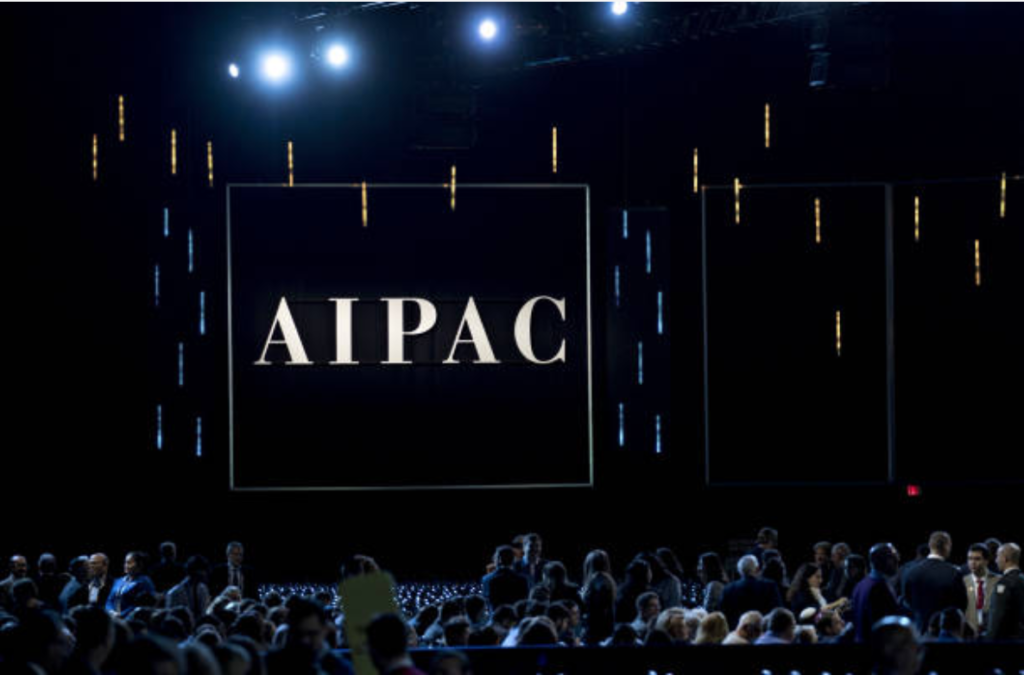
You have to expect sidewalk weirdos when you attend an AIPAC Policy Conference, usually of the anti-Israel variety.  This year, the weather being icy cold, I wasn’t too inclined to stop for any weirdos on my way to the Convention Center. But I did notice a middle-aged man holding up this sign: “God Hates Zionism.” When I slowed down long enough to ask him, “How do you know what God thinks?” he yelled back, “My father worked in the Pentagon!”

Okay.

Inside the conference were close to 20,000 Israel supporters, many of whom squinting to read name tags and exchanging business cards. This year, the crowd fell into three categories: Very nervous about the coronavirus, somewhat nervous and not at all nervous.

The very nervous group shied away from any physical contact, the somewhat nervous greeted people with elbow bumps, while the not-at-all-nervous were in full reckless handshake and hugging mode.  

The mingling of thousands of humans connected to countless causes is the most important thing you need to know about the annual AIPAC conference. The speeches from prominent speakers get most of the media attention, the breakout sessions cover interesting topics, but it’s the mingling, the schmoozing and the networking that is the real stuff of the conference.

It’s also kind of extraordinary that everyone you meet has a specific agenda, a cause, an idea, a movement, something they would like to advance, even if it is only to “meet new people.”

When the schmoozing has moved beyond causes to actual politics, three names have stood out: Biden, Bernie and Bibi. Biden for his resounding victory in the South Carolina primary that reset the Democratic race; Bernie for his unsavory boycotting of AIPAC and seeming takeover of the Democratic party, and Bibi for the possibility that he may pull off yet another miracle and win the Israeli election.

Timing is everything. Biden won the primary on Saturday, the Conference started on Sunday, Israeli elections are on Monday followed by Super Tuesday tomorrow, which may decide the immediate future of the Democratic party. That’s quite a tight bundle of news buzz for a conference that is all about the U.S.–Israel alliance.

A type of polite anxiety is always prevalent at AIPAC. That’s part of the ritual. We must worry about urgent stuff: Bernie looks terrible for Israel. Can Biden or Bloomberg save the day?  Who do we hate more—Bernie or Trump? Can we ever build true bipartisanship while Bibi is still in power? And so on. The stakes always feel enormous. That’s part of the AIPAC drama. 

After all, if the stakes didn’t feel so enormous, would it be worth braving the weirdos and the viruses?

Now if you’ll excuse me, I must join my panel on “Engaging the next generation of Sephardic leaders.”

Notes From AIPAC: Weirdos, Elbow Bumps, Biden, Bernie, Bibi Read More »

Derailing the Bernie Express: Bernie Versus the Un-Bernies

Over the last several months, the contest for the Democratic presidential nomination has been characterized as a clash between progressives and moderates, between the party establishment and outsiders, between measured caution and outright rebellion. But on the eve of Super Tuesday, the biggest day on the primary calendar, the race has crystalized even further: the campaign has now come down to a battle between Bernie Sanders… and the Un-Bernies.

As Sanders has established himself as the Democratic front-runner, a growing number of party regulars and a shrinking number of candidates have begun coming to terms with the challenge of derailing his insurgent candidacy. Joe Biden’s landslide victory in last Saturday’s South Carolina primary may not only have saved his campaign but provided him with a burst of momentum to emerge as the most likely obstacle in Sanders’ path. But Biden has stumbled frequently on the campaign trail, and he may lack the financial resources and campaign infrastructure to compete on a national playing field in the weeks ahead.

On the other hand, Michael Bloomberg has virtually unlimited resources and a state-of-the-art organization at his disposal. But his halting performances in the first two debates in which he participated, coupled with deep-seated resistance to his candidacy among many party activists, has led to worries about his viability as well.

But for Democrats who fear that Sanders might be too extreme a candidate to defeat Donald Trump in November, one of these two imperfect messengers represent their last and best hope to derail the Bernie Express as it picks up speed on its way to the party convention in Milwaukee this summer. Pete Buttigieg caused the hearts of party centrists to skip a beat after his unexpected showing in the Iowa caucuses early last month, while Amy Klobuchar gave them a glimmer of hope with her debate performance in New Hampshire a few days later. But Buttigieg withdrew from the race over the weekend, and Klobuchar seems likely to follow him to the sidelines later this week.

Some might wonder whether a more traditional Democrat like Colorado Senator Michael Bennet or Montana Governor Steve Bullock might have served as a workable Un-Bernie candidate. But both of them, as well as a handful of other moderates who entered and exited the race with little notice over the past several months, were unable to capture nearly enough public and media attention to mount plausible campaigns. So now Biden and Bloomberg regard each other warily, each concentrating their fire on Sanders (and Trump), while recognizing that the centrist lane in the nomination race is still not clear for them.

(Senator Elizabeth Warren still remain a candidate too, of course, and an exceptionally well-funded one at that. But until she demonstrates an ability to improve on her lackluster performance in the first four caucus and primary states, it’s unclear as to her potential impact on the race. As a self-declared “unity” candidate attempting to bridge the gap between the two wings of the party, it’s also difficult to discern which of the leading contenders is helped or hurt by her presence in the field.)

To be fair, there is still no undebatable evidence that says that Sanders cannot win a general election campaign. The candidate and his supporters cite numerous public opinion polls that show Sanders beating Trump in a head-to-head matchup. But growing numbers of party leaders and down-ticket candidates are openly worrying that Republican attacks on Sanders’ most ambitious policy proposals could lead to Trump’s re-election and significant GOP gains in Senate and House races.

The Democratic choice here is framed in an eternal political debate about the best strategy for winning a campaign – whether to emphasize persuading undecided voters to join your ranks or to instead concentrate on motivating your most loyal supporters to turn out in the largest numbers possible. Trump won in 2016 by utilizing the latter approach and has governed over the last three years in the same way, by devoting almost all his time and attention to exciting his political base. Sanders talks about accomplishing a similar feat from the left, predicting historic voter participation from young people and minority communities.

Democratic leaders old enough to remember the wipeouts suffered by George McGovern and Walter Mondale dread the type of campaign that Republicans will run against Sanders’ plans for single-payer health care, free college tuition and open borders. Younger activists and insurgents point to the less overwhelming defeats suffered by Hillary Clinton and John Kerry, among others, who ran closer to the political center. This type of argument will never be completely settled –in either party – due to both an extremely small sample size and an extremely large number of external variables.

But it will have to be resolved – if only temporarily — between now and the Democratic convention this summer. Sanders will almost certainly represent one side of the debate. Whether Biden or Bloomberg will take up the other side will be determined in the next few weeks.

Derailing the Bernie Express: Bernie Versus the Un-Bernies Read More »