Rabbi Fred Hyman, from Westville synagogue in New Haven, Connecticut, attended Maimonides School, Yeshivat Hakotel in Jerusalem, Brandeis University, and received semicha from RIETS/Yeshiva University. He recently completed an Ed.D in Education and Psychology at the American International College, Springfield, Mass.
In Vayigash, Joseph and his brothers finally reconcile, following a dramatic meeting.
Qassim Soleimani, leader of Iran’s Revolutionary Guards Quds Force, was killed in an airstrike at Baghdad International Airport.
Reuters reports that Soleimani was among those killed in an airstrike on their vehicles inside Baghdad International Airport, Jan. 3. Earlier in the morning, Iraq’s Security Media Cell announced that three katyusha rockets had targeted Baghdad Airport.
Iraqi state media reported that the deputy head of the Popular Mobilization Forces (PMF), Abu Mahdi al-Muhandis, was also killed in the attack.
“The American and Israeli enemy is responsible for killing the mujahideen Abu Mahdi al-Muhandis and Qassem Soleimani,” said Ahmed al-Assadi, a spokesman for Iraq’s Popular Mobilization Forces umbrella grouping of Iran-backed militias.
U.S. officials also told Reuters that strikes had been carried out against two targets linked to Iran in Baghdad.
According to the Jerusalem Post, police and health sources said that at least five people were killed and nine wounded.
Zubin Mehta and Mahler Los Angeles favorite Zubin Mehta, former music director of the Israel Philharmonic Orchestra, conducts Mahler’s Symphony No. 2, “Resurrection,” a musical classic widely regarded as overwhelmingly transcendent. Mehta is joined by the L.A. Philharmonic on three occasions this weekend at the Walt Disney Concert Hall. For lovers of symphonic melodies, is there a more pleasant way to open the New Year? 8 p.m. tonight and Saturday, 2 p.m. Sunday. $20-$240. Walt Disney Concert Hall, 111 S. Grand Ave., Los Angeles.
First Friday Shabbat For the first Shabbat of the new calendar year, Congregation Kol Ami is celebrating with a sushi meal. The evening with the LGBTQ community kicks off with Kabbalat Shabbat services at 6:30 p.m. First Friday dinner is at 7:30 p.m. $18 for dinner. Congregation Kol Ami, 1200 N. La Brea Ave., West Hollywood.
“The Song of Names”
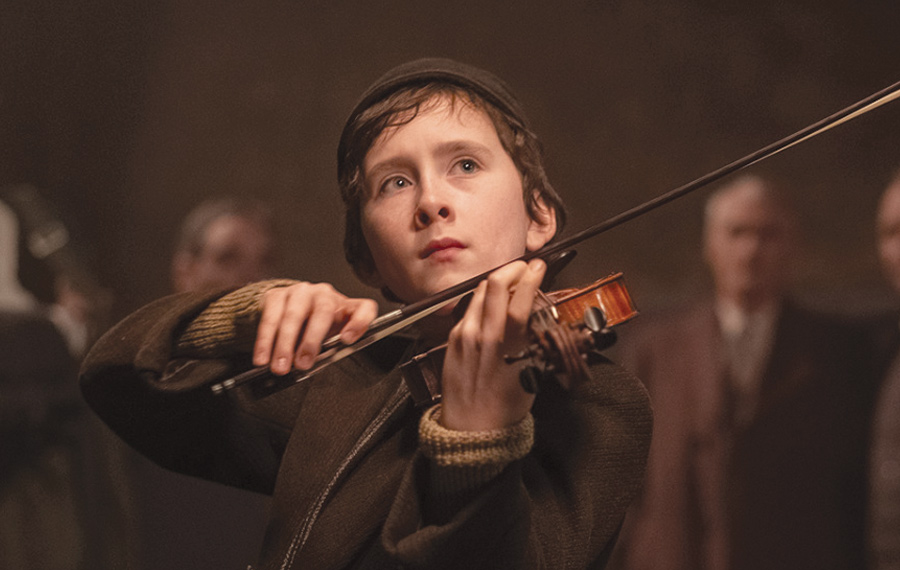
“The Song of Names” Holocaust-themed film “The Song of Names,” from the director of “The Red Violin,” opens today in three theatres. Tim Roth and Clive Owen star in Francois Girard’s historical drama about a man’s search for his best friend from childhood. Orphaned by the Holocaust, he later vanished and never was found. Laemmle Town Center 5, 17200 Ventura Blvd., Encino; Laemmle Playhouse 7, 673 E. Colorado Blvd., Pasadena. (310) 478-3836. laemmle.com. Regency South Coast Village, 1516 Sunflower Ave., Santa Ana. Buy tickets here or by clicking the link above.
SAT JAN 4
The Big Shabbat Three weeks after Nessah Synagogue was vandalized, the Iranian Jewish congregation in Beverly Hills strikes a welcoming note with “The Big Shabbat.” Organized for young professionals and young couples, the gathering offers a blend of learning, praying and celebrating followed by a hot and exquisite Kiddush. Rabbi Yitzchak Sakhai leads services. 9 a.m. Simcha Hall. Free. Donations appreciated. Nessah Synagogue, 142 S. Rexford Drive, Beverly Hills.
Ghostly Historic Sites Shmuel Gonzales, aka the Barrio Boychik, guides people through parts of old Los Angeles that cradle ghostly memories of a century ago. During this walking tour, “Ghostly and Ghastly,” Gonzales leads participants to haunted old sites across downtown. Among them are the grounds of the infamous Chinese Massacre of 1871 and the Pico House, a grand hotel built by California’s last Mexican governor. 5:45 p.m. check-in. 6 p.m. walking tour begins. Arrive early at the L.A. Plaza de Cultura y Artes, the La Tienda Bookshop, 501 N. Main St., Los Angeles. $25.
SUN JAN 5
Engel Chamber Concert Adat Ari El’s 26th annual Engel Chamber Music Concert features the quartetDavid Kaplan and Friends performing Mozart and Brahms. Joining pianist Kaplan are Vijay Gupta on violin, Jonathan Moerschel on viola and Eric Byers on cello. A reception with light refreshments follows the performance. 2 p.m. Admission is free. Reservations are requested. David Familian Chapel, Adat Ari El, 12020 Burbank Blvd., Valley Village.
TUE JAN 7
“Homelessness in 2020: An Overview and a Jewish Lens” In the past year, homelessness has become one of the most serious issues across Los Angeles. Rabbi Noah Zvi Farkas of Valley Beth Shalom, chair of the Los Angeles Homelessness Services Authority, explores the crisis through a Jewish lens. He recently led a two-year campaign to address homelessness in Los Angeles County and writes widely on social justice and millennials. The event is organized for University Women at American Jewish University. Noon-1:30 p.m. From $30. American Jewish University Familian Campus, 15600 Mulholland Drive, Los Angeles.
Rabbi David Wolpe Join Rabbi David Wolpe for his learning and lunch series, “Great Jewish Lives: Remarkable Jews from Ancient Times to Today.” The Sinai Temple leader delves into the lives of historical figures who have contributed to the world and have inspired contemporary Jews. Beginning with the Bible, he traces a variety of Jewish, spiritual ideas and movements throughout history. Noon-1:30 p.m.Free for Sinai members, $25 for general. Sinai Temple, 10400 Wilshire Blvd.
WED JAN 8
“The Jew in the Ashram” “The Jew in the Ashram,” actress-educator Amanda Miller’s solo show at the Whitefire Theatre, is a poignant and funny account of her experiences in an ashram in India years ago as she struggled with her mental health. Guided by an Indian guru, she reflects on Jewish summer camp and Judaism’s role in the lives of her late father and his Holocaust survivor mother whom he never knew, and she reconnects with her own cultural roots. At select moments, the audience is invited to move, chant and reflect on their own spiritual journeys. The performance is staged for one night only. 8-9 p.m. $20. The Whitefire Theatre, 13500 Ventura Blvd., Sherman Oaks.
“American Jews… In the Trump Era” In his book “Trouble in the Tribe: The American Jewish Conflict Over Israel,” UCLA Professor Dov Waxman argues that Israel has become a source of division in the American Jewish community. Tonight at UCLA, he expands on this as he discusses “American Jews, Israel and Anti-Semitism in the Trump Era.” The lecture is organized by the Rabbi Chaim Seidler-Feller Institute for Jewish Learning and Hillel at UCLA. 7-9 p.m. Free. Hillel at UCLA, 574 Hilgard Ave., Los Angeles. RSVP requested by clicking the link above.
“The Head vs. The Heart” The choice between emotions and the intellect has plagued civilization since the first morning in the Garden of Eden. Valley Beth Shalom (VBS) Rabbi Ed Feinstein weighs in when discussing, “The Head vs. the Heart: What Does God Want?” The evening is part of VBS’ Wednesday evening “College of Jewish Studies” series, which examines historic controversies. 7-9 p.m. Free. Valley Beth Shalom, 15739 Ventura Blvd., Encino.
Jewish Musical Satire Comedic folksinger, stand-up comedian and screenwriter David Misch looks at how Jewish musical satire shares with klezmer, Marc Chagall and Sholem Aleichem an awareness of, amusement at and sympathy for human fallibility. The multimedia presentation, “Jewish Musical Satire With David Misch,” draws on sounds old and new, from Rodgers & Hammerstein and Carole King to Randy Newman and Rachel Bloom’s “Crazy Ex-Girlfriend.” 7:30 p.m. $15. Sperber Jewish Community Library, American Jewish University, 15600 Mulholland Drive, Los Angeles.
THU JAN 9
“The World that We Knew” American Jewish University librarian Lisa Silverman leads a discussion about Alice Hoffman’s fantastical novel “The World That We Knew.” Set during World War II, the book is about a rare golem that aids in the salvation of a young girl who is sent to the home of a renowned rabbi, fleeing the Nazis. 2 p.m. $10. Sperber Jewish Community Library, American Jewish University, 15600 Mulholland Drive, Los Angeles.
Global Briefing on Anti-Semitism Peering into the past and assessing the present-day explosion of anti-Semitism, the kickoff event in this four-part series at Wilshire Boulevard Temple examines “Anti-Semitism on the Right: Christian Anti-Judaism, White Supremacy and Holocaust Denial/Distortion.” The remaining dates in this series are Feb. 27, March 5 and April 2. 7:30 p.m.Free. Wilshire Boulevard Temple Irmas Campus, 11661 W. Olympic Blvd., Los Angeles.
Have an event coming up? Send your information two weeks prior to the event to ryant@jewishjournal.com for consideration. For groups staging an event that requires an RSVP, please submit details about the event the week before the RSVP deadline.
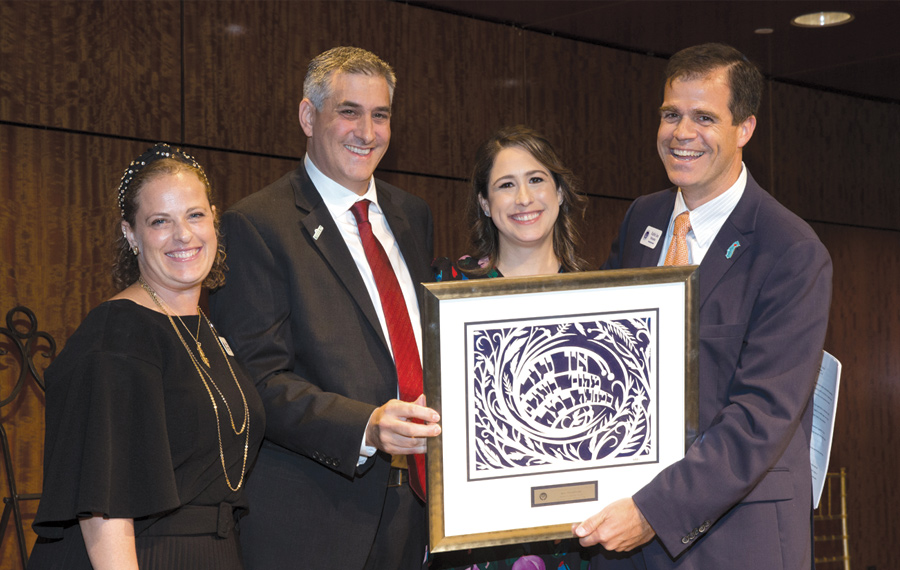
Camp Ramah honored Lesley and Jeff Wolman at its sold-out gala at Sinai Temple on Dec. 8.
The Wolmans are active in their synagogue, Sinai Temple, and also are involved with The Jewish Federation of Greater Los Angeles, the Ziegler School of Rabbinic Studies at American Jewish University, Foundation for Jewish Camp and several other local organizations.
Amy Mendelsohn was the recipient of Ramah’s Alumni Leadership Award. As director of the L.A. Jewish Teen Initiative at Federation, Mendelsohn works to enhance Jewish teen engagement in Los Angeles. She spent 15 summers at Camp Ramah as a camper, counselor, Rosh Edah (unit head) and program director.
The evening raised $720,000 to seed the Nechama Endowment for Staff Wellness, a passion of the honorees that is named in honor of Jeff Wolman’s late sister Nadia. The Nechama program underwrites initiatives to provide Ramah staff with guidance, teaching, peer support and mindfulness training, according to the Ramah website.
“People were very moved by the Nechama Staff Wellness Fund,” John Magoulas, director of development at Camp Ramah in California, said in an email.
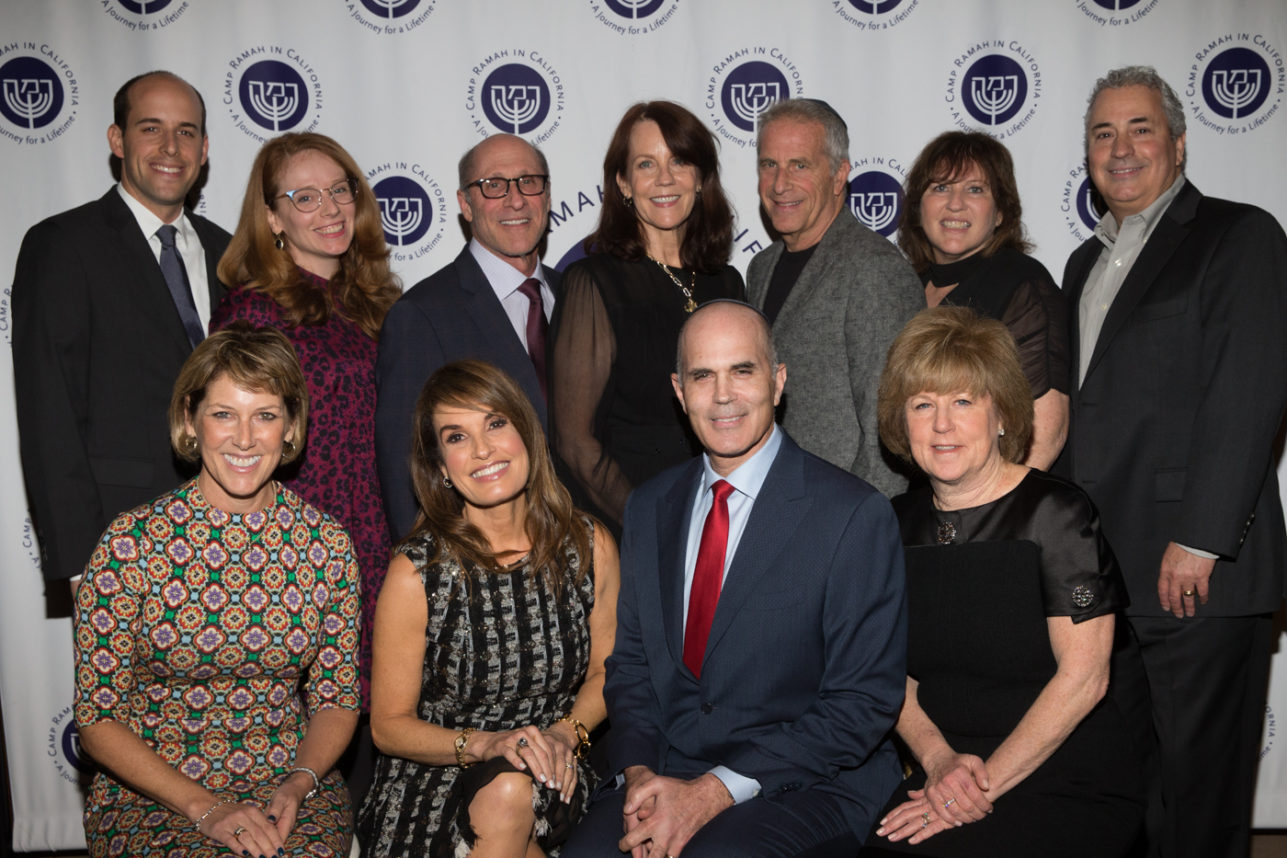
Camp Ramah gala attendees included (top row, from left) Austin Douglas, Rabbi Tova Leibovic-Douglas, Steven and Jill Namm, Marc Platt and Sandi and Avi Schlesinger and (bottom row, from left) Karmi Monsher, Lesley and Jeff Wolman and Julie Platt. Courtesy of Camp Ramah
The approximately 500 attendees at the gathering included Jeremy Fingerman, CEO of the Foundation for Jewish Camp, and Federation CEO Jay Sanderson.
Sinai Temple Senior Rabbi David Wolpe gave the invocation and Lesley Wolman’s brother, musician Eric Corne, provided entertainment.
Camp Ramah, which runs a summer camp as well as year-round programs, is affiliated with the Conservative movement.
Jewish Business Leaders David Jacobs, Larry Cohen and Joel Volk present a check to Survivor Mitzvah Project founder Zane Buzby (second from left). Photo by Richard Cassel
The Jewish Business Leaders Group (JBL2) has completed its inaugural year as an independent group and has selected three organizations to provide with financial support.
JBL2 meets monthly, bringing together business people to learn about the Jewish community, hear speakers on a range of Jewish and business topics, and support various philanthropic efforts.
In 2019, the group supported The Survivor Mitzvah Project, Chabad of the Conejo and Jews for Judaism. At a Dec. 6 event, JBL2 members David Jacobs, Larry Cohen and Joel Volk presented a check for $10,000 to Survivor Mitzvah Projectfounder Zane Buzby in support of her work in providing assistance to low-income Holocaust survivors in Eastern Europe.
JBL2 describes itself as a “professional networking association that brings together high-level executives from throughout the five valleys. Our mission is to pursue the unique combination of professional development with Jewish values and community service.”
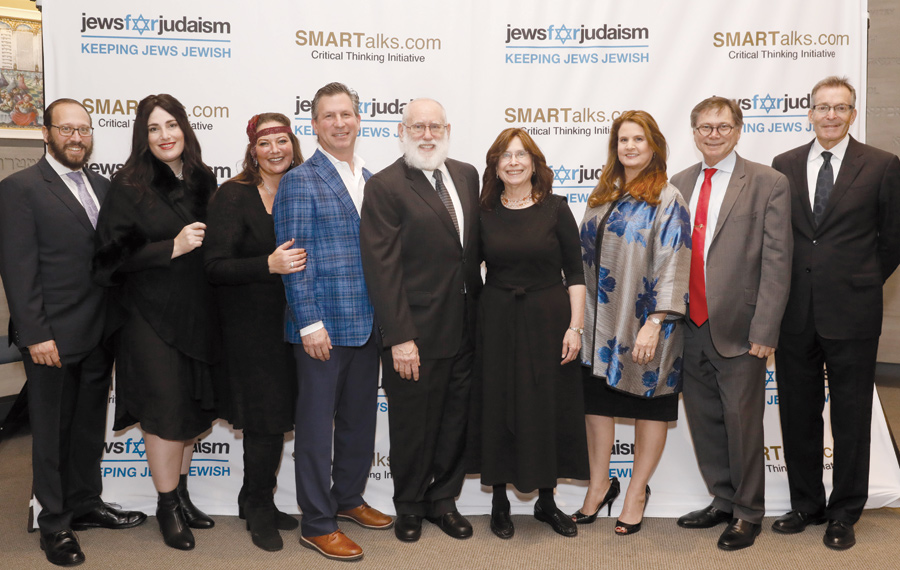
From left: Rabbi Zalman and Chanie Kravitz, Susan and Kevin Schlanger, Rabbi Bentzion and Devorah Kravitz, Joy and Michael Volk and Ron Altman attend Jews for Judaism’s 2019 gala. Photo courtesy of Jews for Judaism
The community turned out in large numbers for Jews for Judaism’s 2019 after-dinner gala, held on Dec. 11 at Young Israel of Century City and honoring Suzanne and Kevin Schlanger.
The event also honored Rabbi Zalman and Chanie Kravitz with the Young Leadership Award, and Joy and Michael Volk and Ron Altman with the Aleph Club Award.
At the event, which was billed as an evening of jazz, magic, mixology and awards, a young woman described how Jews for Judaism intervention counseling provided tools to her distraught mother that helped her return to Judaism after an extended involvement with another religion.
According to Bentzion Kravitz, founder and CEO of Jews for Judaism, the organization “touches the lives of hundreds of thousands of individuals through specialized counseling and education services, including a YouTube channel with 325 education videos that receives 3,000 hits a week.
“Jews for Judaism strengthens and preserves Jewish identity by responding to religious coercion, promoting critical thinking skills, and providing spiritual guidance and support,” Kravitz said in an email.
From left: StandWithUs (SWU) COO and CEO Jerry and Roz Rothstein, SWU “Festival of Lights” supporters Naty and Debbie Saidoff, SWU honoree Robert Lantos, keynote speaker Stephen Harper, Ellie and Bruce Lederman and SWU International President Esther Renzer. Photo by Jonah Light Photography
Pro-Israel education organization StandWithUs (SWU) held its annual “Festival of Lights” gala on Dec. 10 at the Beverly Hilton.
SWU board members Ellie and Bruce Lederman and Debbie and Naty Saidoff co-sponsored the event, which raised more than $4 million toward SWU’s annual $15 million budget, according to the organization. All proceeds benefit the SWU mission of Israel education and combating anti-Semitism.
Founded in 2001 by CEO Roz Rothstein, COO Jerry Rothstein and President Esther Renzer, SWU is committed to combating misinformation about Israel and promoting accurate information about the Jewish state through its social media and chapters across the United States, Israel, Canada, the United Kingdom and Brazil.
Michael Dickson, executive director of SWU-Israel, opened the event with
a moment of silence for the victims of the recent shooting at a kosher market in
New Jersey.
The evening’s keynote speaker, former Canadian Prime Minister Stephen Harper, denounced the boycott, divestment and sanctions (BDS) movement against Israel and told the crowd to be proud of their support for the Jewish homeland.
Honorees were Canadian film producer Robert Lantos, who received a lifetime achievement award for his career and commitment to supporting Israel; college seniors Shayna Lavi of UCLA and Stephanie Margolis of the University of Massachusetts Amherst, who were recognized with the “Star of David” awards for their pro-Israel leadership on their campuses; and Israeli reservist and SWU Israel Fellowship alumnus Arie Katz, who received the “Guardian of Israel” award.
Program participants included Consul General of Israel in Los Angeles Hillel Newman;comedian Elon Gold, who emceed the evening; Rabbi Cantor Alison Wissot, who sang the U.S. national anthem; and Alon Miller, who led the singing of the Israeli national anthem, “Hatikvah.”
Want to be in Movers & Shakers? Send us your highlights, events, honors and simchas.
Email ryant@jewishjournal.com.
There’s a rule that we can’t use the glow of the Hanukkah candles to read, light a room or keep warm. Is there a deeper meaning here or is it a kind of halachic riddle?
The sages say the sacred candlelight may not be used for any purpose but looking and reveling in the miracle they represent. I’m all for the notion of a mitzvah for its own sake. At the same time, “display and enjoy but don’t use” sounds like a call to publicize the miracle without politicizing it. A nice idea, but in these times, such instruction would appear wasteful and naive. We don’t observe our mitzvot in a vacuum — if we did, they wouldn’t mean as much.
Conceding in my last column that anti-Semitic incidents were the new normal, I made a case for Hanukkah’s heightened importance as both a unifier and source of relief for Diaspora Jews. We need to savor the lighter moments in these times, I wrote, “and if there’s a word for fun, it’s Hanukkah.” Devoid of context or judgment, the levity of the season could and did bring Jews of different backgrounds together. This was, in a sense, arguing for a Hanukkah that was publicized and not politicized.
I entered this Hanukkah season feeling unusually grateful. A close family member survived a medical near miss earlier in the month of Kislev — dayenu. The Maccabees’ heroic, miraculous defense of the right to assimilate on their own terms resonated with my experiences this year observing halachah in an apartment with non-Jewish roommates. Indeed, lighting the candles with roommates present felt like an awesome echo of the past, and a miracle in itself.
The news coming out of the Jewish community during this year’s Festival of Lights offered anything but relief. Instead, more tragedy: more hate speech sprayed on Jewish institutions and more random acts of violence against Jewish people. These will be followed by more questions about the compromises we will make to our values in the name of security. This Hanukkah contained one of the darkest weeks of a worryingly bleak 2019.
As the Jewish world tossed and turned, I went to more Hanukkah parties — every event on the late-December calendar but the Matzo Ball. It felt more important than ever to have fun. It was a surefire way to keep the forces of anti-Semitism from winning. Yes, deliberate candle watching was the way to go. The best way to use the Hanukkah candles was to not repurpose them. I felt pretty good about this stance. Very halachic.
The stabbings at the Rabbi Rottenberg shul in Monsey, N.Y., on the seventh night of Hanukkah did not shake my belief that we should leave the candles out of this. Rather, it was the sight of Jews of all religious and political backgrounds descending upon Grand Army Plaza in Brooklyn — not for a vigil, but to dance the final night of Hanukkah away with Crown Heights Chasids. Uniting under the largest menorah in Brooklyn defied every force seeking to divide us and to cleave us from our allies. Photos of the black, brown andMuslim groups who joined us at the park that night — not just sending tweets, but showing up — provide an unmistakable blueprint for an architecture of resistance, as well as a glowing reminder that we’re not alone. It goes without saying that we have to show up for them, too, and we can’t wait until something horrible happens to start.
In interpreting the beautiful moment of Prospect Park as a call to strengthen our bonds within and beyond our community, I may be politicizing the miracle of Hanukkah, not just publicizing it. I am refusing to let the precious candles of the final night burn down without using them to light the way forward.
Maybe it took me a full holiday of candle watching — eight days of bad news and eight nights of fun — to put a finger on the miracle those candles represent. Or maybe the miracle didn’t appear until the last day.
Louis Keene is a writer based in Los Angeles. He tweets at @thislouis.
One of the five victims from the Dec. 28 stabbing rampage in Monsey, N.Y., suffered serious bran damage and might not emerge from a coma.
The family of Josef Neumann, 72, released a statement on Dec. 31 through the Orthodox Jewish Public Affairs Council explaining that Neumann was stabbed several times in the head, neck and arm; the blade penetrated Neumann’s skull and damaged his brain.
“Our father’s status is so dire that no surgery has yet been performed on the right arm,” the family statement read, noting that the Neumann’s arm was “shattered.” The family added: “Doctors are not optimistic about his chances to regain consciousness, and even if our father does miraculously recover partially, doctors expect that he will have permanent damage to the brain; leaving him partially paralyzed and speech impaired for the rest of his life.”
The family also released a photo showing Neumann’s current state in the hospital.
STATEMENT BY THE FAMILY OF JOSEF NEUMANN with details about their beloved father following the #Monsey stabbing attack, and with a call to Jews around the world to share their experiences with anti-Semitism and adding the tag #MeJew.https://t.co/7B5p5qfNE4pic.twitter.com/nr4y3lTLwO
This is the visual state of Josef Neumann who has been stabbed at the Hanukkah celebration Saturday night in the Forshay area of #Monsey. (Press/media is authorized to publish/post this.) #MeJewpic.twitter.com/1e1acNG2O9
Neumann’s family also spoke about his condition in a Jan. 2 press conference, pleading with those watching to fight against anti-Semitism.
“We want our kids to go to school and feel safe, we want to go to our synagogues and feel safe, we want to go to groceries [stores] and malls and feel safe,” Nicky Kohen, Neumann’s daughter, said.
Kohen added that the family decided to release the photo of Neumann because they had received a vast number of inquiries asking if Neumann had woken up.
“When people ask, ‘Is he awake yet? Is he talking to you guys?’ and all I want to do is yell: ‘Do you understand the prognosis right now is that he really may not ever speak again or wake up or walk?’ ” an emotional Kohen said. “[The doctors] just don’t have hope. As a family, we do have hope, so we decided to release that photo after much thought so that people can realize how severe this attack was.”
Family of Jewish victim of antisemitic attack in upstate New York speaks out about condition of their father and they share a message to Americans. pic.twitter.com/FMTyjPqN8C
The suspect, 37-year-old Grafton Thomas, was arrested on Dec. 28 and faces multiple federal hate crime charges as well as charges of attempted murder. Thomas pled not guilty; his attorney said Thomas has a history of mental illness.
Federal prosecutors announced on Dec. 30 that they discovered journals belonging to Thomas that espoused anti-Semitic viewpoints, including “references to ‘Adolf Hitler’ and ‘Nazi culture’ on the same page as drawings of a Star of David and swastika,” according to the New York Daily News.
Broadway composer Jerry Herman, whose brassy, showstopping tunes for “Hello, Dolly!” “Mame” and “La Cage aux Folles” marked him as the heir to the Tin Pan Alley tradition of Irving Berlin, died Dec. 26 in Miami. He was 88.
Herman was born on July 10, 1931, in a hospital not far from New York’s theater district. He was the only child of Harry and Ruth Herman. His parents were teachers and amateur musicians who ran a summer camp in upstate New York. Herman was playing piano by the time he was 5, and wrote songs for the camp’s revues. But it wasn’t until he saw Ethel Merman in “Annie Get Your Gun” that he saw music as a career. “It was like a door opening; it really started everything moving in my life,” Herman told the Los Angeles Times in 1992.
He managed to get an audition with Frank Loesser, composer and lyricist of “Guys and Dolls,” who encouraged Herman to keep at it. Herman studied drama at the University of Miami and, after graduating in 1953, became a professional songwriter. His first Broadway musical, 1961’s “Milk and Honey,” about a group of American widows in Israel, was a hit, running for 543 performances and garnering Herman his first Tony nomination for original score. He would go on to win two Tonys, for “Hello, Dolly!” and “La Cage aux Folles.”
It also led to a call from producer David Merrick, who asked him to write samples for a musical based on Thornton Wilder’s “The Matchmaker.” Writing furiously over a weekend, Herman composed four songs — and got the job. The show was 1964’s “Hello, Dolly!” With 2,844 performances, it was, for a time, Broadway’s longest-running musical. Dolly Levi, the indomitable matchmaker, has been played by Merman, Carol Channing, Ginger Rogers, Martha Raye, Betty Grable, Phyllis Diller and, in 1968, Pearl Bailey, leading an all-black cast. The show’s title song was a No. 1 hit for Louis Armstrong and knocked the Beatles off the top of the charts. With the lyrics changed to “Hello, Lyndon,” it was the theme song for Lyndon Johnson’s 1964 presidential campaign.
Herman followed up “Dolly” with another hit, “Mame,” starring Angela Lansbury, which ran for 1,508 performances. The original cast recording won Herman a Grammy.
Herman hit a dry spell after “Mame.” “Dear World” (1969), “Mack & Mabel” (1974) and “The Grand Tour” (1979) were commercial flops. But in 1983, he had another hit with “La Cage.” Based on a French farce, with a book by Harvey Fierstein, the story of two gay lovers and drag queens was a breakthrough for Broadway, running for 1,761 performances. “I Am What I Am” became a gay pride anthem, and it is the only musical to win two Tonys for best revival, in 2004 and 2010.
It also was Herman’s last musical. He retired with his partner, Martin Finkelstein, who died of AIDS in 1989. Herman contracted AIDS in 1985 but was able to control the disease with experimental therapies. He moved to Miami with his husband, Terry Marler, who survives him. On Jan. 7, Broadway theaters will dim their lights in Herman’s memory.
For how will I go up to my father
if the boy is not with me?
Judah begs for his brother, the Prince of Egypt
to take him instead of their younger brother Benjamin.
I’m reminded of the time Bart Simpson
turned into a skeleton while he waited for
his father to pick him up from soccer practice.
I’m reminded of all the times my wife
asked me to pick our son up from school
and I would counter with pearls like What school does he go to again?
or what does our kid look like again?
or is it okay if I bring home a similar sized kid if it saves a little time?
I should have my own late-night show
they keep telling me while my wife
wavers between horror and laughter.
Of course if I were Judah, or Jacob
I would saw off my own arms and legs
to make sure my boy made it home safe.
We parents will find the strength to
lift cars over our heads if that’s what’s required.
We’ll sit in the dark. We’ll knit sweaters until
the sheep send us politely worded letters.
We’ll stay up ’til we hear the latch on the door
just for the comfort of knowing
we got them through another day.
Joseph weeps a weep all Egypt can hear.
The first family has come home.
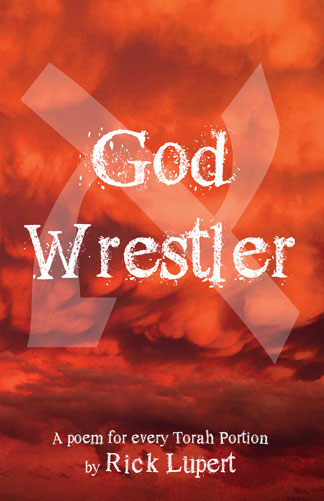
Los Angeles poet Rick Lupert created the Poetry Super Highway (an online publication and resource for poets), and hosted the Cobalt Cafe weekly poetry reading for almost 21 years. He’s authored 23 collections of poetry, including “God Wrestler: A Poem for Every Torah Portion“, “I’m a Jew, Are You” (Jewish themed poems) and “Feeding Holy Cats” (Poetry written while a staff member on the first Birthright Israel trip), and most recently “Hunka Hunka Howdee!” (Poems written in Memphis, Nashville, and Louisville – Ain’t Got No Press, May 2019) and edited the anthologies “Ekphrastia Gone Wild”, “A Poet’s Haggadah”, and “The Night Goes on All Night.” He writes the daily web comic “Cat and Banana” with fellow Los Angeles poet Brendan Constantine. He’s widely published and reads his poetry wherever they let him.
Another new year, another Pantone Color of the Year. Since 2000, the Pantone Color Institute has chosen one color to represent the zeitgeist of the times, and this selection influences fashion, home furnishings and consumer products.
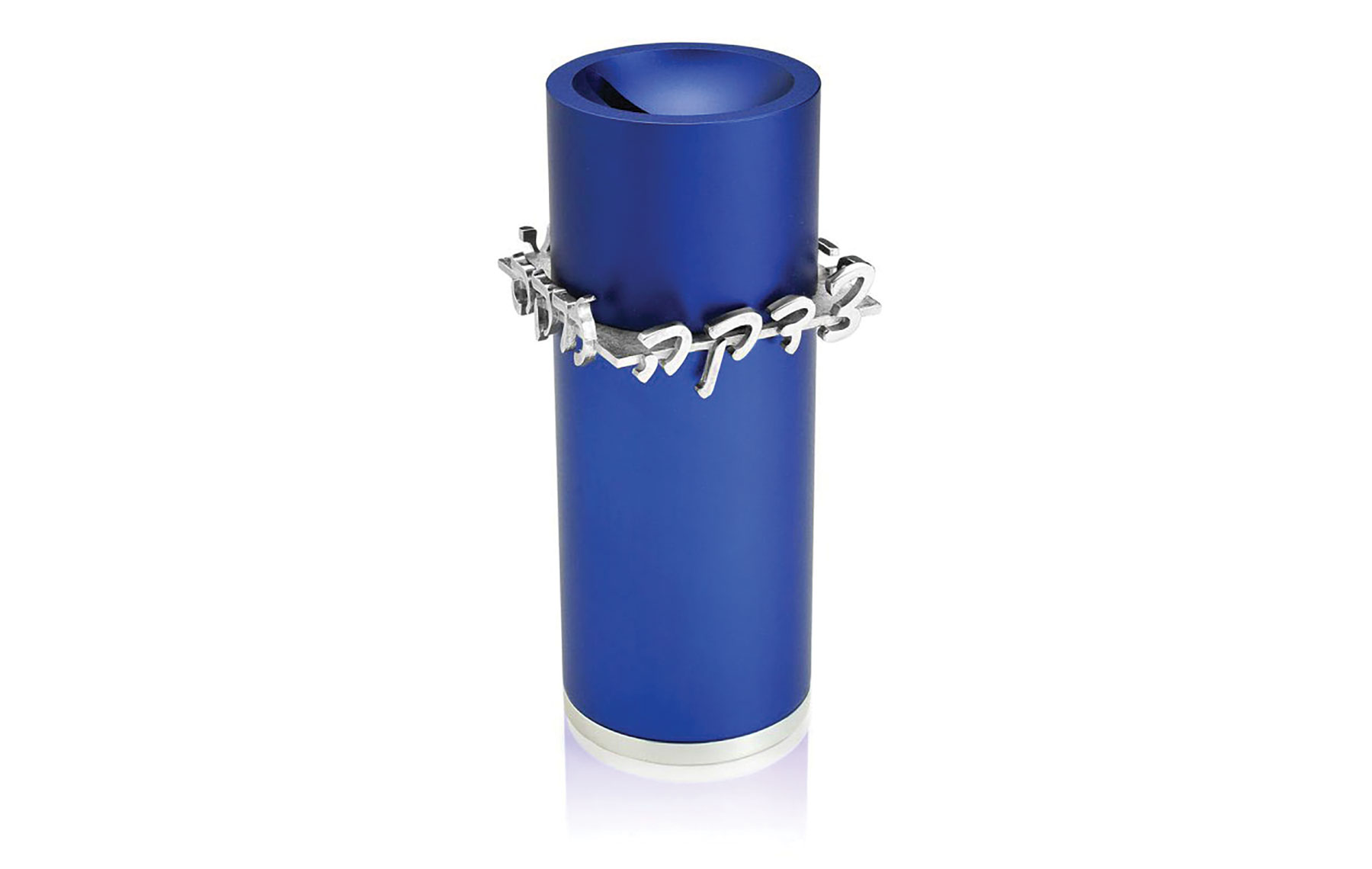
2020’s choice for Color of the Year is Classic Blue, and it’s one that is different from some of the flashier colors they’ve announced in the past such as Tangerine Tango or Ultra Violet. In its press release, Pantone explains that “Imprinted in our psyches as a restful color, Classic Blue brings a sense of peace and tranquility to the human spirit, offering refuge. Aiding concentration and bringing laser-like clarity, [it] re-centers our thoughts. A reflective blue tone, Classic Blue fosters resilience.”
Classic Blue may seem like a safe choice but by no means is it boring. In a time when so many homes are deluged with beige everything, this blue does add a punch of elegance. It also goes well with practically every other color.
If you want to be on trend and incorporate the Pantone Color of the Year into your space, here are some home accents that surely will be classics for years to come.
Jonathan Fong is the author of “Flowers That Wow” and “Parties That Wow,” and host of “Style With a Smile” on YouTube. You can see more of his do-it-yourself projects at jonathanfongstyle.com.
Adolf Eichmann was the first person to be tried in the State of Israel for Nazi war crimes. John Demjanjuk was the second and almost surely the last. Eichmann, of course, was found guilty in 1962 and hanged. Demjanjuk was convicted in 1988 and sentenced to the gallows, but his conviction was reversed by the Israeli Supreme Court in 1993 and he was sent back to the United States.
Teicholz is an award-winning author and journalist whose work has appeared in The New York Times Magazine, The New York Times, the Los Angeles Times and the Jewish Journal, among many other publications. Last August, I reviewed “9/12: The Epic Battle of Ground Zero Responders,” co-written by Teicholz and William Groner.
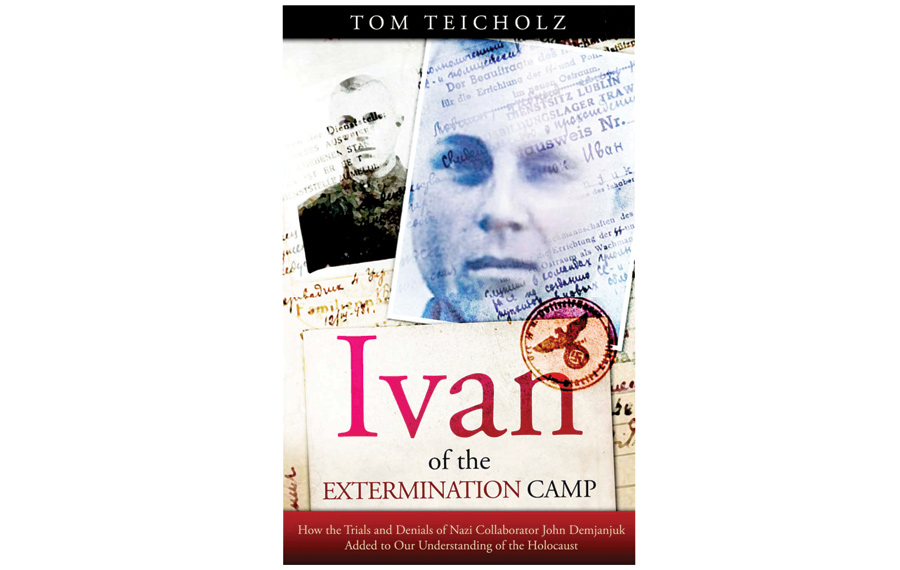
Teicholz covered the 1988 trial of Demjanjuk, and his account was published in 1990 as “The Trial of Ivan the Terrible.” Thanks to his expertise, as well as his remarkable gift as a storyteller, the producers of “The Devil Next Door” called on Teicholz to explain to viewers the exploits of Demjanjuk himself and the harrowing melodrama that constituted his prosecution in America, Israel and Germany. (Teicholz is, by the way, far and away the most astute and lucid of all the voices we hear in the documentary.) In “Ivan of the Extermination Camp,” Teicholz has returned to the Demjanjuk case, expanded and updated his research, and allowed us to glimpse yet another new and horrifying aspect of the Holocaust.
At the core of the story that is told in Teicholz’s latest book — which can be likened to a police procedural, an international thriller and a groundbreaking contribution to the scholarship of the Holocaust — is the deceptively simple question of whether a retired Cleveland autoworker named John Demjanjuk was or was not the Nazi executioner known by camp inmates at Treblinka as “Ivan the Terrible.”
Among the vast roster of torturers and murderers who were responsible for carrying out the Holocaust, the man called Ivan the Terrible distinguished himself by his sheer brutality and cruelty. Stationed at Treblinka, he used a weapon — “variously described as a knife, a sword or a bayonet,” as Teicholz reports — to prod his victims into the gas chamber, and when the spirit moved him, he would use it to slice off an ear or a breast. The moment before they were to be murdered, Ivan made sure they would suffer yet one more blow.
In “Ivan of the Extermination Camp,” Tom Teicholz has returned to the Demjanjuk case, expanded and updated his research, and allowed us to glimpse yet another new and horrifying aspect of the Holocaust.
Ivan the Terrible was a so-called “Trawniki man,” a term that was used to describe Ukrainian prisoners of war who were recruited by the Germans, trained at an SS camp called Trawniki and put to work in the concentration camps and death camps. So was Demjanjuk. Indeed, Teicholz calls Demjanjuk’s SS-issued identity card from Trawniki as “the Rosetta Stone, as concerned Demjanjuk’s history and what was to be gleaned from his Nazi service.”
Teicholz’s book deserves our praise for many reasons, but above all because he has added to our understanding of how Nazi Germany managed to kill Jews in the millions while, at the same time, fighting a two-front war. The more notorious Nazis, including Eichmann, never bloodied their own hands. But it was the Trawniki men, among others, who served as “the enthusiastic foot-soldiers in the murderous program to exterminate the Jewish race,” as Teicholz puts it.
Nowadays, we are confronted with the expertise of Russian intelligence agencies in campaigns of disinformation. Demjanjuk’s attorneys, too, argued during his trial that his Trawniki identity card was a KGB forgery. Then, too, Teicholz’s book comes at an especially fraught moment in the history of Ukraine, which is now consistently characterized as a heroic ally of the United States, and perhaps deservedly so. But “Ivan of the Extermination Camp” serves to remind us that the Ukraine, as it was known during the Soviet era, was also one of the killing grounds where Jews died during the Holocaust and a contributor of manpower for those who killed them.
After Demjanjuk’s conviction in Israel was reversed, he was deported from America a second time and later faced trial in Germany, where he was convicted of war crimes in 2011. He may not have been Ivan the Terrible, but the German court held him criminally liable for the deaths of 29,000 victims at Sobibor. But there was yet another appeal, and he died in bed at the age of 91 in 2012 while the appeal was still pending.
“In the end, after almost forty years of investigations and trials, Demjanjuk’s lies and evasions were reason for dedicated prosecutors, judges, researchers, historians, and experts of many kinds, in the United States, Israel, Germany, and even the former Soviet Union and Russia, to uncover vast new troves of information about the murderous actions of the Nazis and those in their service, such as Demjanjuk,” Teicholz concludes. “Regardless of politics, regardless of the government in power, regardless of the passage of time, these countries each showed themselves to be a nation of law.”
Whether or not John Demjanjuk was Ivan the Terrible himself, or just one of the many other Ukrainian collaborators who served Nazi Germany, does not ultimately matter. He was one of Hitler’s willing executioners, to borrow a phrase from the title of Daniel Goldhagen’s famous book, and yet, as Teicholz shows us in fascinating detail, Demjanjuk may have escaped the gallows but he did not escape justice.
Jonathan Kirsch, author and publishing attorney, is the book editor of the Jewish Journal.”