fbpx

December 6, 2019

Thoughts on Torah Portion VaYeitzei – From Darkness to Wisdom

From Darkness to Wisdom 2019: Thoughts on Torah Portion Vayeitzei  (adapted from 2018)

I can imagine Jacob bemoaning his fate, justifiably. Jacob was the one, the Bible tells us, who was the dweller in tents. The Midrash explains that this does not mean that he dwelt in tents at the campsite, but rather studied in the tents of “Shem and Eber”, the mythical founders of the wisdom academy that paralleled the lives of the ancestors. The rabbis of the talmudic era interpreted this to mean that he was the studious type, not a recluse, but certainly not a man of action.

Remember, he had learned from his mother (who, according to the talmudic rabbis, received her oracle in that same study house of Shem and Eber) that “the older will serve the younger” – taken to mean that the birthright from his father Isaac belongs to him, Jacob, not his fraternal twin, Esau. Mother Rebecca, the sister of Laban, devised a plan in last week’s Torah portion to trick Father Isaac to get the birthright away from Esau, to where it is supposed to be, with Jacob.

Jacob perhaps assumed that he would get the birthright and then go back to his studies. Perhaps he thought that once he assumed the mantle of leadership when his father died that he would then just delegate most of his duties. Life did not turn out that way. Instead of going back to his studies and delegating the work, he found that he had to hit the road to escape his brother’s murderous wrath. Back to the ancestral homeland in Paddam Aram he goes, to save his life – and find a wife.

In this week’s Torah portion, Jacob finds himself on the road, a bit like his ancestor Cain, a “na-ve-nad” – a wanderer, a man on the trail, in exile. Cain was exiled because he had murdered his brother, Abel. Perhaps the similarity was not lost on Jacob – in some symbolic way, he did kill his brother. The future that Esau imagined for himself was annihilated.

Jacob’s future, too. No more studying in tents. I think of Jacob on the road saying to himself, “I did not see this coming.”

I can imagine Jacob ruing this fate, the blessing of his father and the blessing of God notwithstanding. Instead of enjoying the blessings of the birthright, he will now have to struggle under the oppressive hand of that swindler, his uncle Laban. He falls in love, but does not get to marry his beloved Rachel – he is tricked into marrying Leah. He does finally get to marry Rachel, who some years later tragically died, birthing Benjamin as Jacob returned to Canaan.

Jacob’s life does not go as planned. He thought he was a dweller in tents. It did not turn out that way.

While on the road, Jacob has a dream of a ladder rooted in the earth, the top reaching to the heavens, angels ascending and descending. God promises to be with Jacob. God, it seems, had not appeared to him in his dreams all those years he studied in the study house of Shem and Eber. Only on the road, in exile, does God appear to him. Jacob’s miserable fate broke him and the light came in. He had planned for tents, but instead, while heading into exile, the ladder found him. He was forced to trade tents for a ladder to heaven. Maybe somebody’s life goes as planned, but I have not met that somebody yet.

What do we do when life does not go as planned?  We can ruminate on the oft-repeated maxim, “Life is what happens to us while we are making other plans” It is true – “life” cares very little about our plans. But now what?

What many people do when life happens not according to plan, at least initially, is complain, grieve poorly, deny, fight the truth, anger at someone (or God), and eventually depress. Many people become bitter and check out. If life is a battle (as Psalms 144:1 seems to imply), then it seems we have lost. Another adage comes to mind; when some doors close, others open. More accurately, when some doors close, we become aware of other doors, maybe obscured by our being fixated on the doors now locked.

As a counselor, I often time find myself guiding people through the “now what?” One thing seems to be required: we have to go deeper than the pain, deeper than the loss, deeper than the grief. The way through loss is depth. We live in a society that does not teach much about depth, nor about the life of virtue that helps us retain our dignity when we suffer. Much of what I see is a “culture of complaint.”  When things don’t go our way, we have to blame someone, typically insuring that life doesn’t go their way, either. We need to punish. We take our loss out on them. It is a zero sum game – loss is multiplied.

The need to blame, to punish, to complain is, for me, the indication of immaturity, a state of character that has little to do with chronological age. The complaining character has decided that they do not have the capacity for resilience, to hold the line. Blaming instead of growing, instead of making a plan, maybe even only one day at a time, as an answer to the “now what?” The despairing person might exhibit addictive behavior, medicating the pain instead of going deeper than the pain. Despair seems to say, “Anything but dignity and depth.”

“Life is what happens while we are making other plans.”  Eventually, it seems, you have to make a new plan or that unruly force we euphemistically call “life” will make a plan for us.  Understanding that life might intrude again as well, one must come out of the blaming, complaining, unproductive grief, despair, and loss into a life of depth and wisdom, perhaps even find occasional great bliss and joy. This is hard, sometimes bitterly hard work.

I wish I knew another way but I don’t.

 

Thoughts on Torah Portion VaYeitzei – From Darkness to Wisdom Read More »
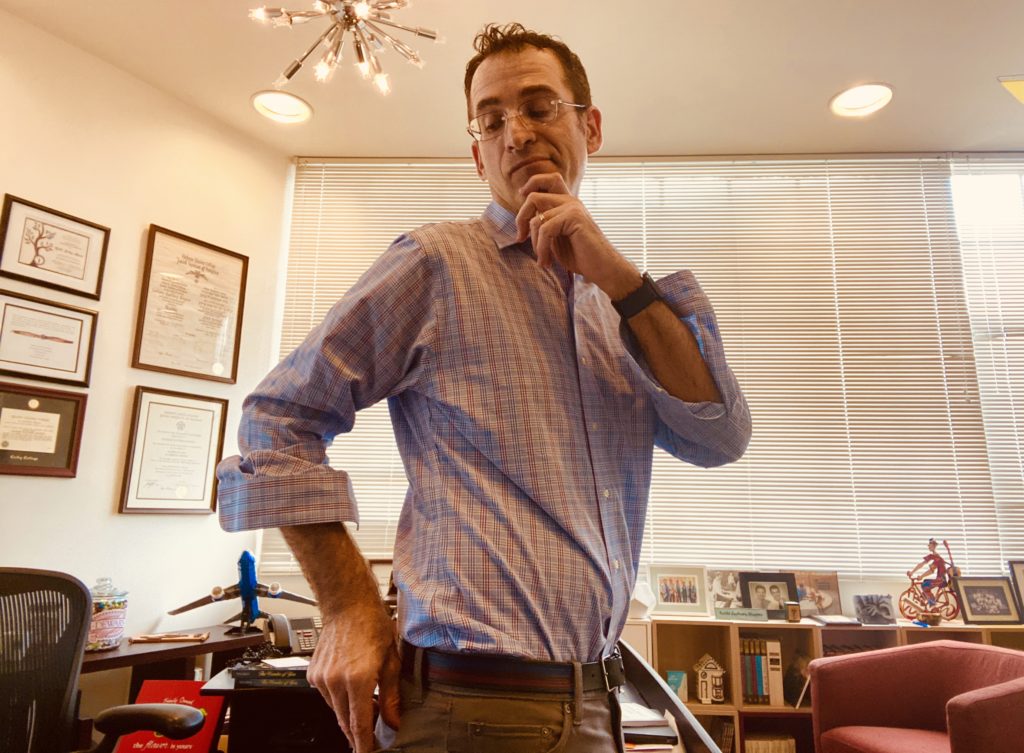
A Moment in Time: What’s in Your Back Pocket?

Dear all,
When I was studying to be a rabbi at the Hebrew Union College – Jewish Institute of Religion, one of my mentors guided me saying, “Always have a piece of Torah (religious text) in your back pocket. You never know when someone will call upon you to offer a teaching.”
To this day, I try always to be prepared with Torah. But there are additional treasures that are so important to have within arm’s reach.
Grandpa: Be strong and of good courage.
Dad: Anything is possible if you have the right tool.
My sister : Always look behind you 100 times when you back up (in your car)
My husband: Your job is not just to teach others. It is to reach others.
We all have adages, advice, wisdom, and tools that we keep in our back pockets. We reach for them daily. What’s in you back pocket? And in that moment in time when you reach for it, do you hear the voice of the person who gifted you this treasure?
With love and shalom,
Rabbi Zach Shapiro

A Moment in Time: What’s in Your Back Pocket? Read More »

The Bagel Report

The One with the Hallmark Movie, the American Pickle & the Inappropriate Ornament

Erin and Esther share Thanksgiving parade memories; talk new offerings from their favorite comedic ManJews; discuss American Pickle (sort of), the ‘Friends’ Holiday Armadillo and “Jewish” Hallmark movies; and potentially launch a new business. Plus, trying to imagine what kind of household would need an Auschwitz Christmas Ornament, and getting ready to receive a new season of ‘The Marvelous Mrs. Maisel.’

friends holiday armadillo
Credit: Friends

Follow Erin and Esther on social media! 

The One with the Hallmark Movie, the American Pickle & the Inappropriate Ornament Read More »

Ellie Cohanim Named Deputy Special Envoy to Combat Anti-Semitism

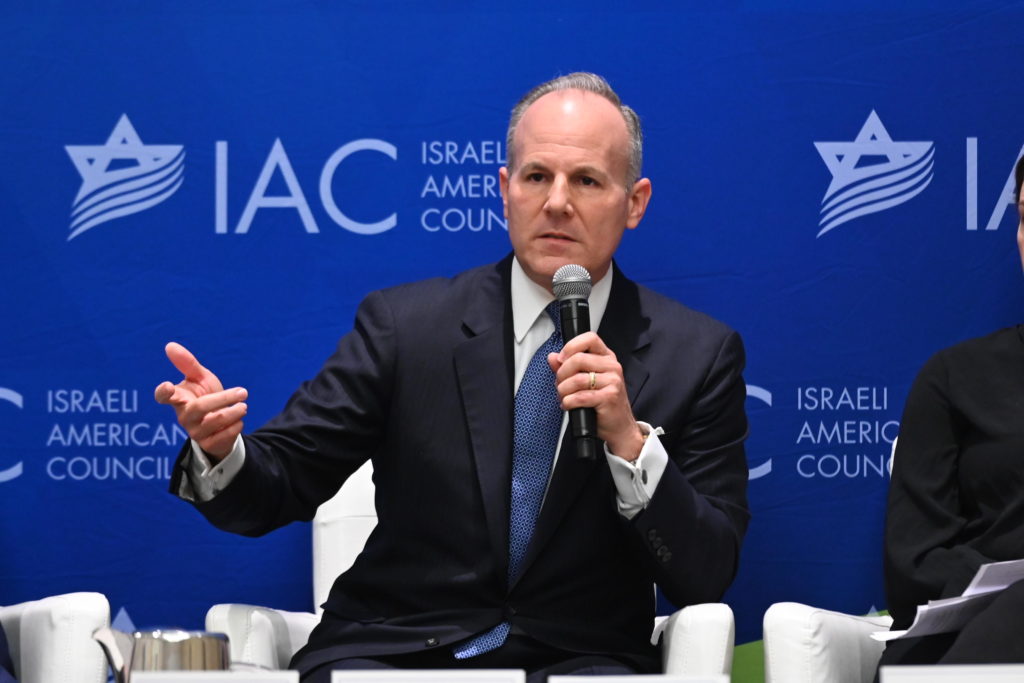
U.S. Special Envoy to Monitor and Combat Anti-Semitism Elan Carr announced on Dec. 6 that Ellie Cohanim has been tapped to serve as deputy special envoy to combat anti-Semitism.

Carr tweeted: “Ellie will be a strong asset in combatting anti-Semitism around the world. Congratulations Ellie! We’re thrilled to have you on board!”

Cohanim tweeted: “It is my honor & privilege to join @USEAntiSemitism under the leadership of SEAS Carr, to serve my great country, & to fight #Anti-Semitism.”

https://twitter.com/elliecohanim/status/1203009899971719168

According to her LinkedIn page, Cohanim’s family fled Iran in 1979 to escape rising anti-Semitism. Her background includes working as senior vice president and correspondent for Jewish Broadcasting Service (JBS) and development executive for the United Jewish Appeal-Federation of New York from 2004 to 2006. She also served on the boards of the American Jewish Committee’s New York region and the New York Jewish Community Relations Council.

Ellie Cohanim Named Deputy Special Envoy to Combat Anti-Semitism Read More »

Elan Carr, Israeli MK Spar Over How to Fight Anti-Semitism

United States Special Envoy to Monitor and Combat Anti-Semitism Elan Carr, and Israeli Meretz Party Chairman and Knesset Member Nitzan Horowitz shared differing views on how to combat anti-Semitism during a Dec. 6 panel at the 2019 Israel-American Council National Summit at the Diplomat Beach Resort hotel in Hollywood, Fla.

Speaking on a panel titled “How Can America Win the Fight Against Anti-Semitism,” Carr said there are three sources of anti-Semitism: the far-left demonizing and delegitimizing Israel; white supremacists and neo-Nazis on the far-right; and radical Islamists. All, he said, need to be addressed to adequately fight anti-Semitism.

“When you leave two-thirds of a tumor untreated or even one-third of a tumor untreated, the patient doesn’t do well,” he said.

Fighting anti-Semitism also involves combating its various manifestations, whether it’s vandalism or anti-Semitic propaganda being disseminated on internet chat rooms, Carr argued.“[Anti-Semitism] is a worldview. It’s an idea. It’s a deep and ancient human sickness.”

He added the best way to defeat to anti-Semitism is to provide education on philo-Semitism. He said there are a multitude of ways Jews have positively contributed to humanity worldwide, including that most Germans don’t know that the German language is rooted in Ashkenazi Jewish vernacular.

Additionally, most Americans don’t known that every May is Jewish-American Heritage Month, Carr said. “We now have for 20 years a presidentially declared month and we do nothing.”

Horowitz called anti-Semitism a global phenomenon and that partisan politics need to be put aside in order to combat it. “Sometimes it’s hard for some political people to acknowledge that anti-Semitism comes from a certain side,” he said, noting that anti-Semitic violence primarily comes from the right, pointing to the shootings at Pittsburgh’s Tree of Life synagogue in October 2018 and at the Chabad of Poway in April.

White supremacy, he said, is the more “immediate threat,” which prompted shouts of “No,” from the audience.

Carr said the sources and manifestations of anti-Semitism shouldn’t be ranked. “Jew-hatred is Jew-hatred,” he declared. “We don’t care what ideological clothing it wears. Once you rank it, even if you have reason and argument to rank it … you feed into the [extraordinarily] divisive times we’re in.”

Horowitz argued that while the targeting and singling out of Jewish and pro-Israel students on college campuses is a serious issue that needs to be fought “very severely … you cannot equalize and say that it’s exactly the same thing as a shooter getting into a synagogue.”

He also said anti-Semitism needs to be treated as another form of racism, calling it “the worst form of racism since Jews pay the heaviest price.” Anti-Semitism then can only be properly addressed through combating all forms of hatred, Horowitz argued.

Carr disagreed, stating that anti-Semitism needs to be handled separately because it’s unique “in terms of its relentlessness, its ubiquity and destructive power.”

Horowitz asked Carr what President Donald Trump’s administration is doing to combat anti-Semitism. Carr replied: “President Trump has made this a priority unlike any other previous administration.” He pointed to Trump inviting Holocaust survivors as well as a survivor of the Pittsburgh synagogue shooting to the 2019 State of the Union address.

He also highlighted the Department of Education designating Jews as an ethnicity, thereby protecting Jewish students on college campuses from discrimination under Title VI of the Civil Rights Act. Additionally, the Department of Homeland Security has made money available to Jewish institutions to use for security purposes, Carr said.

Carr also cited the Trump administration’s moving the U.S. embassy from Tel Aviv to Jerusalem, recognizing Israel’s sovereignty over the Golan Heights and preventing taxpayer dollars from going toward the Palestinian Authority’s “pay-to-slay” policy of funding terrorists.

“That is the sign of an administration that is determined to fight anti-Semitism,” he said.

Elan Carr, Israeli MK Spar Over How to Fight Anti-Semitism Read More »

American Rabbi Suspected of Running Baby Trafficking Network

(JTA) — Israeli police have arrested five people, including an American rabbi who heads a yeshiva, for allegedly running an international baby trafficking ring that targeted mentally disabled mothers.

The Nazareth Magistrate’s Court on Thursday identified the rabbi as Shmuel Puretz, 44, a businessman who divides his time between New York and Jerusalem, according to The Times of Israel. He and at least four other suspects were arrested in February, but details of the three-year investigation against them had been subject to a gag order until the court lifted parts of it on Thursday.

All the suspects have been released pending an indictment and trial.

Puretz, who denies the allegations, is accused of sending Israeli expectant mothers in need or suffering from a mental disability from within haredi Orthodox communities to the United States so they would give birth there. The babies would be given to childless foster parents who allegedly paid Puretz and others for the babies.

Many details about the affair, including how much money the handlers allegedly charged, are still subject to a gag order.

Yediot Aharanot reported in a 2017 expose about the affair that they charged a $100,000 to $150,000 “handling fee” per child.

One alleged accomplice is Rivkah Segal, a rabbi’s wife from Migdal Haemek, a city in northern Israel. She is suspected of abusing her legal guardianship over an expectant mother with mental health problems. The mother said that Segal had her flown to New York highly pregnant, deliver a boy in a Caesarian procedure and had him taken from her.

Segal denied the charges. But an Israeli court last week ruled she should pay that mother $144,000 in damages.

American Rabbi Suspected of Running Baby Trafficking Network Read More »

British Daily Drops Claim that West Bank Settlements Are ‘The Trouble With Jews Today’

(JTA) — The Independent daily in the United Kingdom revised an op-ed that called West Bank settlements “the trouble with Jews today.”

The change was made Thursday to an op-ed by the influential philosopher Slavoj Zizek published two days earlier titled “There is no conflict between the struggle against anti-Semitism and the struggle against Israeli occupation.”

It contained an apparent defense of Jeremy Corbyn, the leader of Britain’s Labour Party, from allegations of anti-Semitism.

The original language said that “the trouble with Jews today is that they are now trying to get roots in a place which was for thousands of years inhabited by other people.”

Following an outcry and allegations that the language used was anti-Semitic, The Independent replaced the phrase “the trouble with Jews today” with “the trouble with the settlement project today.”

The online article does not indicate that it had been revised.

In the op-ed, Zizek, whom the German Der Spiegel newspaper in 2015 described as “one of Europe’s boldest intellectuals and also a self-avowed leftist,” also condemned British Chief Rabbi Ephraim Mirvis’ warning last month about anti-Semitism in the Labour Party ahead of the Dec. 12 election as “ethically disgusting.”

Zizek also wrote: “I, of course, indisputably reject anti-Semitism in all its forms.”

The Independent was established in 1986 and has its digital editions are accessed more than 20 million time a month, according to the Newsworks website.

British Daily Drops Claim that West Bank Settlements Are ‘The Trouble With Jews Today’ Read More »

Episode 170: Are Israeli Ex-Soldiers Committing Treason?

Let’s say you’re a 16-year old Israeli teenager who likes computers and knows how to write some code. The day comes when you get a very important envelope in the mail (not email, but your actual mailbox) – this is called Tzav Shmone – “Draft Notice number 8”, and it’ll determine your fate for the next 5 to 20 years.

Now assuming your a 16 year old computer geek you know exactly where you wanna end up in the IDF – the 8200 unit, Shmoneh Mataim.

8200 is a secret-ish unit in the IDF’s intelligence division. It’s main purpose is to conduct telecommunication reconnaissance, aka sig-int or signal intelligence.

In recent years, 8200 has made a name for itself as the breeding ground for some of Israel’s leading entrepreneurs. A lot of people think of it as a ticket to success in life and indeed many of it’s alumni are snatched up by high tech companies and startups right out the gate.

But having been trained by the IDF in such confidential techniques, these veterans face a serious dilemma. Where do you draw the line between personal advancement and treasonous activity?

Today we’re joined for the second time by Dr. Ronen Bergman who recently published a series of articles in Yedioth Aharonot about veterans of the 8200 unit working for shady companies, sometimes even working for ones that are engaged in hostile activity against the State of Israel.

Dr. Ronen Bergman is a senior political and military analyst for Yedioth Aharonot and the New York Times. He’s the author of “Rise and Kill First: The Secret History of Israel’s Targeted Assassinations” and he’s been a guest lecturer at countless universities including Princeton, Yale, Oxford and Cambridge (where he received his PhD in history).

We are thrilled to be joined today by Dr. Ronen Bergman to talk about the 8200 unit and its graduates.

Dr. Ronen Bergman at the New York Time, and his book on Amazon

RSS Subscribe

Episode 170: Are Israeli Ex-Soldiers Committing Treason? Read More »

The Tell: Three of the Impeachment Witness Lawyers Were Jewish, and It Matters

WASHINGTON (JTA) – On Wednesday, the U.S. House of Representatives Judiciary Committee launched impeachment hearings just hours after the Intelligence Committee, chaired by Rep. Adam Schiff, D-Calif., concluded its own impeachment inquiry.

The 300-page Intelligence Committee report concludes that President Donald Trump “placed his own personal and political interests above the national interests of the United States” in asking Ukrainian President Volodymyr Zelensky to investigate former Vice President Joe Biden, calling it “the act of a president who viewed himself as unaccountable and determined to use his vast official powers to secure his reelection.”

It is now the Judiciary Committee’s task to decide whether to recommend articles of impeachment. And while the officials who appeared before Schiff’s committee were fact witnesses who described the events surrounding the Ukraine scandal, Judiciary Committee chair Rep. Jerry Nadler, D-N.Y., brought three witnesses — all constitutional scholars — that he hoped would outline a theory of impeachment.

All three witnesses are Jewish: Noah Feldman of Harvard, Pamela Karlan of Stanford and Michael Gerhardt of the University of North Carolina. So are Schiff and Nadler, and so was the Democrats’ counsel who directed the first 45 minutes of questioning, Norm Eisen.

Why does this matter?

Well, predictably, it mattered to anti-Semites.

Ann Coulter, the right-wing agitator, tweeted, “Too little ethnic diversity among the professors for me to take them seriously.” Considering her past flirtations with anti-Semitism, one could conclude that she wasn’t faulting the professors just for being white.

TruNews, the YouTube channel run by an anti-Semitic Florida pastor who has coined the term “Jew coup” to describe the impeachment process, took to Twitter to accuse  “Jewish socialist Jerry Nadler” and his “three Jewish witnesses” of “escalating the Jew coup.” TruNews also helpfully informed us that Jonathan Turley, a George Washington University scholar and witnesses called by the Republicans who testified that the evidence for impeachment simply does not add up, is a Roman Catholic.

Twitter removed the tweet. Anti-Defamation League CEO Jonathan Greenblatt screenshotted it for posterity, calling on social media platforms to take action against blatantly anti-Semitic posts.

Why not ignore the blatant anti-Semitism?

Because the fringes no longer have pariah status: TruNews has been accredited for White House news conferences. Trump has taken questions from them (about his plans for Israeli-Palestinian peace, of all things) and his son, Donald Jr., gave TruNews an impromptu interview earlier this year at a Michigan rally. (Trump Jr.’s spokeswoman told The Washington Post that he was not aware at the time of TruNews’ outlook.)

Those views have crept into the mainstream discourse.

While the hearings were underway, Breitbart News, the Trump-boosting news site, posted a story, “Norm Eisen, Democrat Impeachment Counsel, Linked to George Soros.” Breitbart reported that Soros’ Open Society Foundation had helped fund an ethics watchdog Eisen founded, Citizens for Responsibility and Ethics in Washington, to the tune of $1.35 million in 2017. (This is not a secret: It’s on the Open Society website.)

But the Breitbart story failed to explain the relevance. Eisen is not pretending to be nonpartisan or unaffiliated from a liberal outlook; there is no suggestion that Soros’ money is reaching the committee itself.

Soros, the liberal Jewish billionaire philanthropist, is incessantly attached to conspiracies. Fiona Hill, a former senior National Security Council staffer, noted last month how the baseless Soros conspiracy theories beset the Ukraine scandal and called them anti-Semitic.

Republicans on the panel attempted to depict the three scholars on the Democratic side as effete elitists, another classic trope.

“Democrats still don’t get it,” Minority Leader Kevin McCarthy said on Twitter. “They are pushing ahead with impeachment based on opinions from liberal law professors from coastal universities.”

McCarthy, from California, attended a “coastal university” (Cal State, Bakersfield), and Turley, the GOP’s scholar, teaches at one, George Washington — but never mind.

This creates Jewish fear

I got texts from leading Jewish Democrats during Wednesday’s hearings wondering, with not inconsiderable trepidation, whether the scholars were indeed Jewish.

The trepidation is a shame because considerations of how being Jewish shapes one’s outlook should be free of anxieties about what anti-Semites will make of it. And there are meaningful Jewish stories behind the decisions of these witnesses to become constitutional scholars:

“I grew up in Alabama, and I grew up Jewish in Alabama in the 1960s,” Gerhardt told C-Span last year, “and that was a time of great turbulence, and the time the civil rights movement was sort of unfolding, and it was all unfolding in front of me, and I paid attention to it, and that  — those events that arose in the ’60s and early ’70s really shaped my interest in civil rights, but also my interest in law.”

Karlan, delivering closing remarks in 2006 at the annual meeting of the liberal American Constitution Society, called herself one of the “snarky, bisexual, Jewish women who want the freedom to say what we think, read what we want and love who we do,” calling on listeners to “seize back the high ground on patriotism and on love of our country” from the rich, pampered, prodigal, sanctimonious, incurious, white, straight sons of the powerful.”

Feldman, who in 2015 launched Harvard’s Julis-Rabinowitz Program in Jewish and Israeli Law, also helped draft the Iraqi constitution; he is gripped by how and whether religious and civil law can coexist.

“Jewish law and Israeli law are distinct and different,” Feldman was quoted as saying by Tablet at the time of the launch of the Harvard program, “yet they also interact and make claims on each other.”

The Tell: Three of the Impeachment Witness Lawyers Were Jewish, and It Matters Read More »